Skip to content

Archive for

Week 309: One Step Back

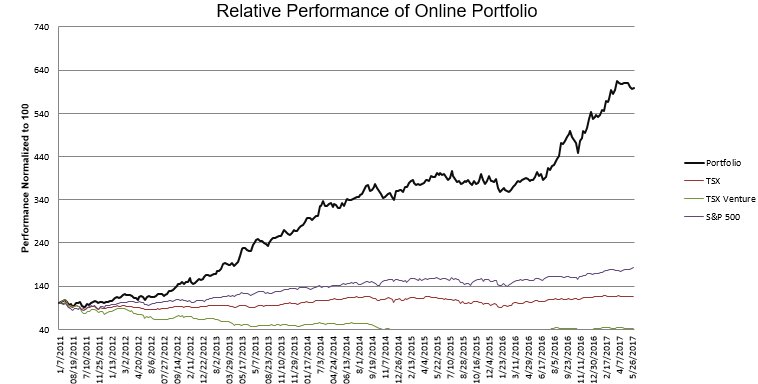
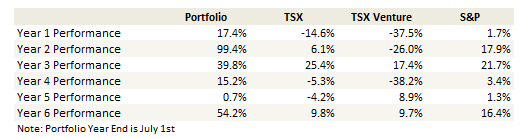
Portfolio Performance
 

Top 10 Holdings
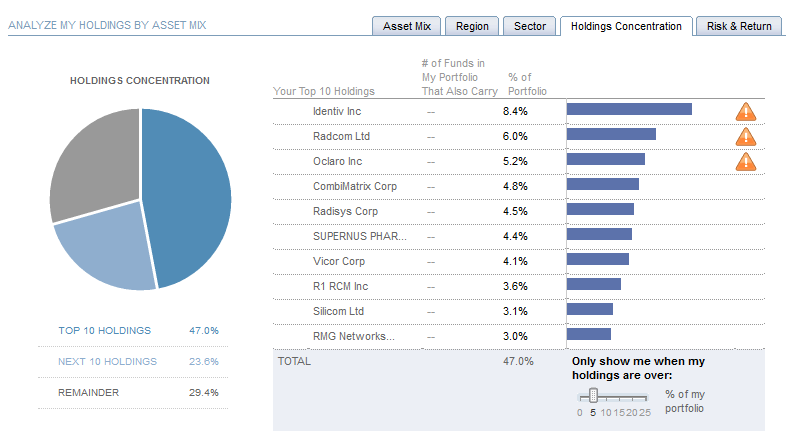
See the end of the post for my full portfolio breakdown and the last four weeks of trades

Thoughts and Review

April and May have been frustrating months.  My portfolio has been down about 2.5%, which isn’t terrible, but as the market has kept moving to new highs it has felt quite a bit worse.

Looking at the performance of my individual positions, I would attribute my under-performance to the following themes:

  1. Investments in sectors that are doing poorly
  2. Companies that have exciting potential but its still not showing up on the income statement
  3. Upside exhaustion

On the first point, I’ve had positions in oil and gas and biotech, and these sectors have been somewhere between lackluster and dismal.  Regarding oil, its been a tough time to own Journey Energy, Zargon Oil and Gas, and Vaalco Energy.  Each has performed about as poorly as every other oil and gas name.  I’m reluctant to cut these stocks loose though, I think each is cheap based on current prices and I’m not really in the camp that thinks we are heading back to $30 oil for any significant time.  And as I’ve said before, if we do, the Canadian dollar is going to collapse, which will more than “hedge” any oil exposure that I have.

My biotech positions have been similarly crummy.  Eiger Pharmaceuticals is the poster boy for this, having declined from $11 to under $7 in the last few months.  I’ve held off adding to Eiger up until last week, when I put in some bids in the high $6 range that got filled.  I am looking at a few other biotech names that I am looking to add on weakness.

Likewise, the performance of Novabay and Bovie Medical has been dismal.  I sold Bovie Medical after their first quarter results and a conference call that I just didn’t find inspiring.  Novabay, on the other hand, I feel more constructive about.  The stock is down to an enterprise value of a little over $25 million (or was as of the weekend when I originally wrote this).  The company is guiding to sales of $18 million for 2017, which is 50% growth over the $12 million in revenue for 2016.  It seems like the stock is being crushed off of a notice of deficiency from the New York Stock Exchange.  It’s a very low volume pull-back, which suggests it a couple of folks getting spooked out.  It doesn’t seem like a big deal to me?  I’m sure they will resolve it.

On the exciting potential but still not revenue bucket we have CUI Global, RMG Networks and Radisys.   Radisys hasn’t done terribly,  its about the same level it was in April (which is not really a positive thing to say), but RMG Networks and CUI Global have both been crushed.  RMG Networks needs to get some of these trials and engagements contributing to revenue and until they do I’m not going to be buying the stock.  I’m still wary of this name; it could pan out in a big way but it seems like there is a lot of hand waving about what’s to come that has been going on for a number of quarters now.  I’m waiting, but not as patiently as I once was.

I added a position too soon with CUI Global.  I bought the stock after some very weak results in the low-$4’s but that hasn’t proved to be even close to the bottom.  Fortunately I only bought a little, and have subsequently added at $3.70 and again at $3.40.

I have some conviction that CUI Global has the technology to generate significant revenues over time and that its just a matter of time before we see those materialize.  In particular, one day they are going to see the regulatory issue that their customer Snam Rete is having that is preventing installations get resolved, and when it does the stock is going to pop big-time.  I noticed there were some small insider buys at the $3.40 level so I’m not the only one who thinks this is a decent value here.

As for the third theme, I had great runs from Combimatrix and Identiv and they simply ran out of legs.  I continue to hold both, believing their momentum will resume after this breather.

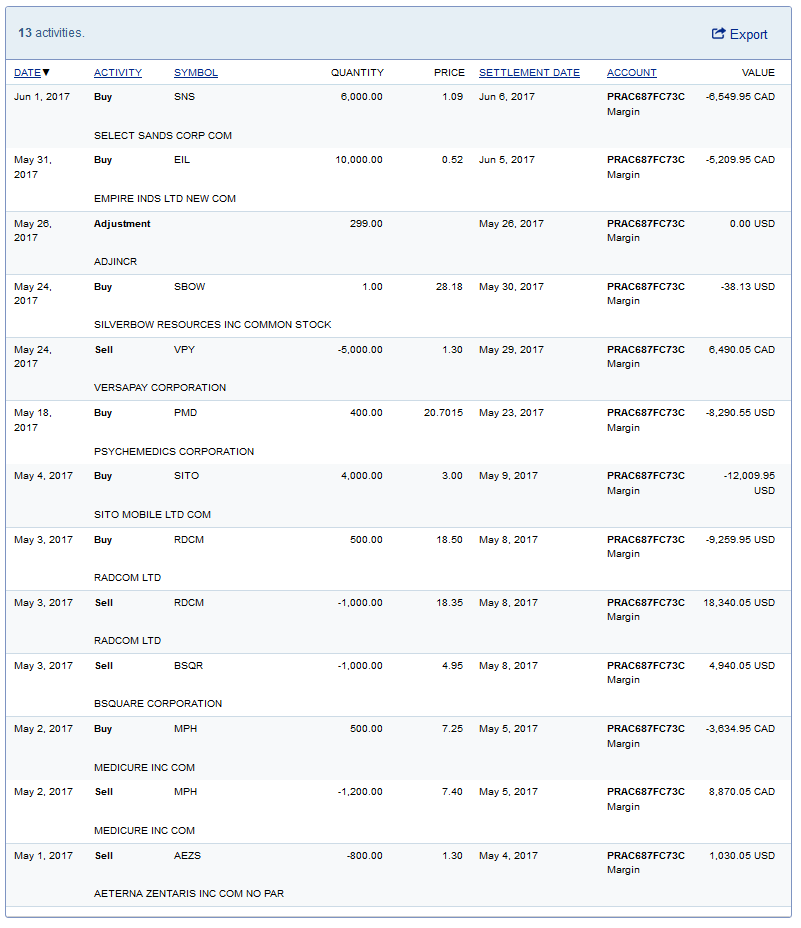
I took new positions in Sito Mobile and Psychemedics this month and have already written about both.  There are a couple of others that I will try to write about shortly.  I also reduced my position in Medicure, which I talked about here, and exited my positions in BSquare and Versapay.

Neither Versapay or BSquare have shown me that they can convert their leads into sales.  Versapay announced another quarter of decent growth on a year over year basis but still very low revenue on an absolute basis.  They are not cheap on a multiple of revenue.  BSquare isn’t gaining traction fast enough for my liking with its DataV product.  The company recorded no new bookings in the first quarter and their DataV backlog declined from $5.7 million to $3.2 million.  I’m actually a little surprised both stocks have held up as well as they have after what in my opinion were somewhat lethargic quarters.


Portfolio Composition

Click here for the last four weeks of trades.

Psychemedics: A reasonably Priced Gamble

I got the idea for Psychemedics from Mike Arnold, who mentioned the stock a couple of months ago.


I don’t think Mike owns the stock.  Mike believes in portfolio concentration.  Diversifying to 2 or more companies would be seen as a dilutive exercise to him. 😉

I, on the other hand, can’t have enough stocks in my portfolio.  I think this one is worth a buy.  Here is the deal.

Psychemedics provides alcohol and drug testing via hair samples.  They have a patented technology that digests the hair and then releases any residual drug trapped in it.   They then use a proprietary enzyme immunoassay on the liquid mixture to evaluate the presence and level of drug residual in the sample.  Its based on knowledge that blood will carry chemicals, including some that are markers of drug or alcohol use, to the hair follicles, where they become trapped in the protein mixture.

Using hair to test for drugs is a somewhat new, at least in terms of being an accepted alternative to urinalysis.  But it does have advantages.

First, its not nearly as easy to trick the process.  With urinalysis, you can replace the sample or tamper with the sample using chemicals.

Second, urinalysis is only testing for drug and alcohol use in the recent history, usually 3-5 days, hair sampling is testing for a far longer period.  Most tests that Psychemedics performs are looking back 90 days.  The chemicals are deposited in the hair soon after ingestion, so theoretically you can look back as far as the hair has grown for.

Because its harder to game the system air testing typically gives more positives than urinalysis.  In their 10-K Psychemedics notes that when compared to urinalysis “in side-by-side evaluations, 5 to 10 times as many drug abusers were accurately identified by the Company’s proprietary methods.”

The downside is that hair testing can’t be used for to test for-cause, like in the case of a drunk driver.  Drug ingestion does not appear in the hair above the scalp for 5-7 days after use.  Hair testing is also priced “somewhat higher” than urinalysis (from the company, I don’t have specific numbers).  And there are some concerns that hair can become contaminated from the environment or that different hair colors are more susceptible to accumulating chemicals, but I didn’t get the feeling that these were wide spread concerns.

Hair sampling appears to be gaining acceptance.  The Psychemedics process is used for testing by 10% of Fortune 500 companies.  And in 2016 Brazil mandated a hair testing hurdle for professional drivers.

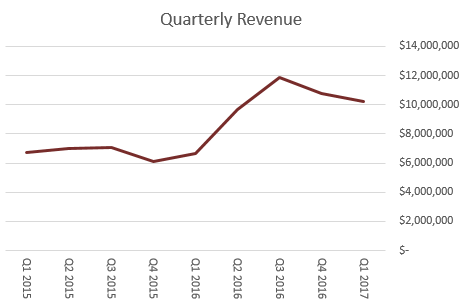
The Brazil requirements created a step change in the results of the company.  Prior to the legislation the company operated at roughly a $7 million revenue rate per quarter.  Since the testing has been mandated, that level has stepped up to $10 million.  You can see how that step change occurred in the second quarter of last year:

Brazil also has room to grow further.  In September 2018 a second phase of the Brazilian law will be enacted that will reduce the number of years between testing from 5 to 2.5.

Note that there were some problems in Brazil earlier this year when their Brazilian distributor, Psychemedics Brazil, lost a court case for uncompetitive practices.  A SeekingAlpha short piece came out shortly after to drum up some fear about the event.  The company clarified that the Brazilian distributor was not owned by Psychemedics and that they expected no interruption in Brazilian revenues as a result.  I read through the court document and thought it probably wouldn’t have much of an effect on their results.

The second potential growth area is the United States.  This is where it really gets interesting.  In the United States the federal government hasn’t recognized hair as a reliable sample for federally regulated employees and programs.  However, there was a bill passed in 2015 that changed that, as it would allow for hair testing of Federal employees as well as for workers needing to meet Federal requirements.

While the bill past some months ago, its implementation is being held up by Health and Human Services (HHS), which has so far yet to issue standards on the tests.  In March the American Truckers Association (ATA) called on the HHS to hurry up and give some guidance.

ATA spearheaded efforts to allow carriers to use hair testing as an alternate test method to traditional urinalysis in the most recent highway bill, but to date HHS has yet to issue the necessary standards to allow those tests to go forward. This week, the HHS agency responsible for developing those standards, the Substance Abuse and Mental Health Services Administration, holds its Drug Testing Advisory Board meetings to consider hair testing, putting HHS well behind its congressionally mandated deadline.

“Many trucking companies are using urinalysis to meet federal requirements, while also paying the additional cost to conduct hair testing,” Spear said in his letter. “We are frustrated that the previous administration failed to meet the statutory deadline and believe your leadership will finally see a resolution to this long-standing and important safety rule.”

The opposition to hair testing seems to come from the Democrats, while the Republicans are in favor of it.  I have no idea what the reasons behind the divide are but I bet they have more to do with constituencies and political support than the value of hair testing.  Neverthless, with a Republican controlled everything right now, I would think the odds are that it is resolved in Psychemedics favor.

I have to admit I haven’t found any source to quantify the size of the opportunity if the HHS issues guidelines and the bill takes effect.  My assumption is that it’s material.

The nice thing about Psychemedics is that you have this growth optionality that really doesn’t seem to be baked into the price.

The market capitalization of the stock is $122 million.  The company has roughly the same amount of cash as debt, with neither being substantial.  Free cash flow for the past 12 months was $11.5 million.  EBITDA was a little over $15 million.  So the stock trades at about 11x free cash flow and 8x EBITDA.

Its not amazingly cheap but also its not particularly expensive.  I like the idea on the basis that we see further revenue growth from Brazil and maybe an announcement in the United States that takes things to another level.  It’s worth a bit more than a starter position for me.