Skip to content

Posts from the ‘Radisys (RSYS)’ Category

Week 258: In Search of the Next Big Thing

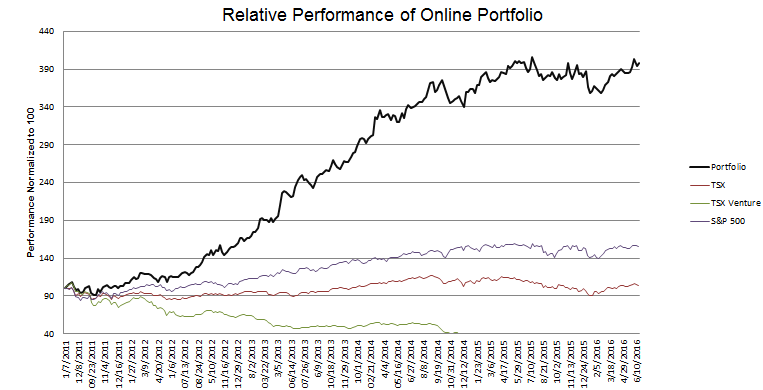
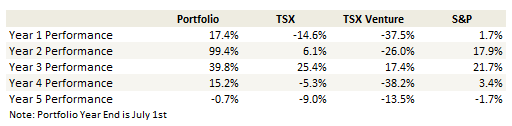
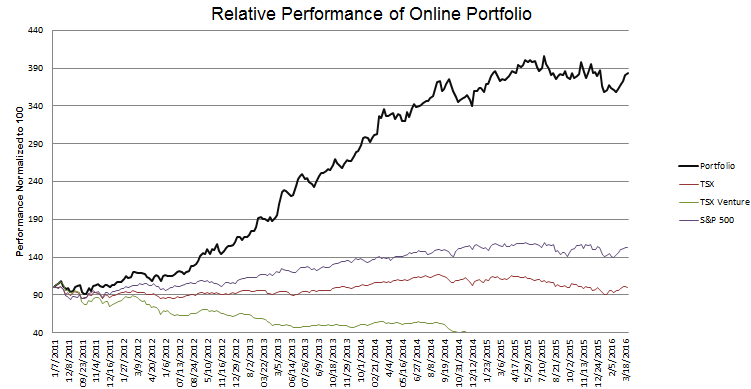
Portfolio Performance
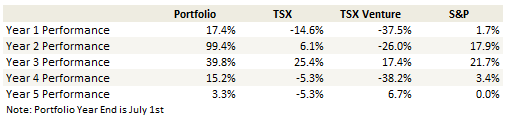
week-258-yoyperformance

week-258-Performance

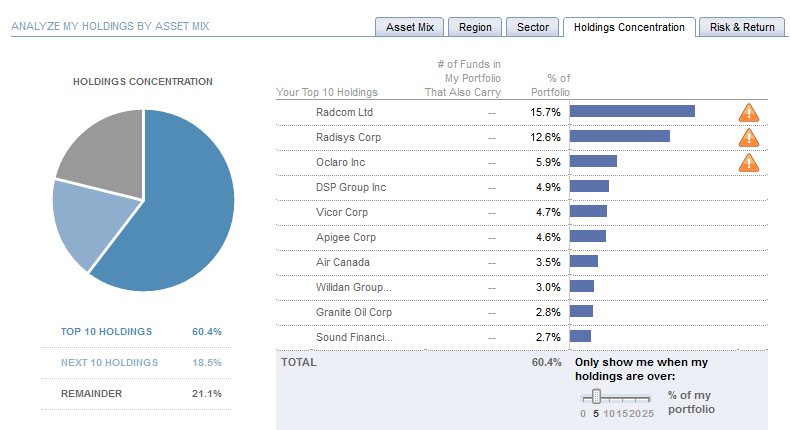
Top 10 Holdings

 week-258-holding-concentration

See the end of the post for my full portfolio breakdown and the last four weeks of trades

Thoughts and Review

I’m wrapping up the fifth year of the blog and portfolio I track here.  Unfortunately it was my worst year since inception.  With about a week to go I’ve eked out a miserly 3% gain.

In my last few posts I touched on what I think I’ve been doing wrong.  My observation is that I am spending too much time looking for value and not enough time looking for growth and finding major trends underway.

To put that in context, let’s look back at the last number of years for a minute.

I did well in 2009 and 2010 as I bought stocks that benefited from the infrastructure build-out in China, in particular a number commodity producers, mostly copper/nickel (FNX, Hudbay, Quadra) and met coal (Western Canadian Coal and Grande Cache Coal).

In 2011 I extended that thesis into pulp stocks, with wins from Mercer International and Tembec.  In 2011 I also made a few bets on gold stocks that paid off.

In 2012 I stuck with gold and began to see opportunities in small community banks that were recovering but where the market had yet to acknowledge this.  I also saw a slowly recovering housing market, and made successful bets on mortgage servicing stocks like Nationstar, which was a recent IPO, originators like Impac Mortgage, and hated mortgage insurers like MGIC and Radian.

In 2013 I continued the theme of a recovering housing market, with my mortgage insurer bets continuing to pay off, added more underappreciated community banks, and bet on a number of oil and gas opportunities that were taking advantage of the new fracking revolution.  I also correctly discerned that the market would take a more favorable attitude to debt, and so I made some of my biggest gains with stocks with debt, particularly YRC Worldwide, which rose from $6 to $36.

In 2014 my biggest gains were thanks to the ethanol stocks, in particular to Pacific Ethanol, which rose from $4 to $24.  I also did quite well playing the cyclical turn in airline stocks, particularly Air Canada and Aercap.

And how about 2015?  What led to my less than remarkable results?

For one I think that I spent too much time following tanker stocks.  While these stocks were cheap, they couldn’t and can’t shake their cyclical stigma.  Looking at the ships being delivered later this year and into 2017, maybe that is for good reason.

I focused too much on companies that were only marginally undervalued or where there was no real catalyst at hand to improve valuation.  In particular, I wasted far too much time on REITs, both simple single asset REITs like Independence Realty and Sotherly Hotels, and more complicated multi-asset REITs like Ellington Financial, Northstar Realty and even New Residential.  I remember Brent Barber commenting to me at one point to be careful with REITs in the environment we were  entering into, and I should have heeded that call.

I also spent too much time trying to justify the airlines.  As a whole the group is captive to their own history of pitiful returns.  One day multiple expansion may come, but holding too many of these stocks in anticipation of that day is not a good use of capital.

And finally, and more generally, I didn’t have a big theme or trend that worked for me.  There was no China infrastructure, pulp stocks, mortgage servicing, community bank or ethanol idea that I could ride.

For the upcoming portfolio year (beginning July 1st) I am going to focus on finding trends and growth.  The one I have latched onto so far is the move of telecom service providers to software defined networks and network function virtualization, and more generally, the continued move by businesses to locate resources to the cloud.

So far I have made the bet with Radcom, Radisys Vicor, Oclaro and Apigee.  Each of these is bearing or at least starting to bear fruit.  Unfortunately I also came extremely close to taking a position in Gigamon, a company I really like, but instead waited for it to slips into the mid $20’s. It never did and now its $37+.

While I made a couple of endeavors into bio-tech stocks last year and for the most part got taken to the cleaners on those, I’m not giving up on this sector yet.  I have been prepared to lose a few dollars under the agency of education and I am slowing learning more. I have a few more words about TG Therapeutics below.

Overall I really like the stocks that I own right now.  While the risk of what I own remains high as always, I also haven’t felt like I have had so many potential multi-baggers in some time.

I’ve been talking about some of the above mentioned names in the past few posts.  Below I am going to highlight a few others: a new position in RMG Networks, a position revisited in TG Therapeutics and some more information about Radisys.   Lastly I’ll review Intermap, which is more of a crap-shoot than the other names I own, but if the cards align it most certainly is a multibagger.

As for stocks I haven’t talked about in a while but will have to review in a later post, Swift Energy is treading water in the grey market and the warrants I received post bankruptcy don’t even trade, but I remain optimistic that when the stock gets to a big board it will go significantly higher.   While I remain wary of the Iconix debt load a few astute moves by management and the stock will trade at a more reasonable free cash flow level.  And Accretive Health, a very small position that trades on the pink sheets, is struggling through its transition but will soon begin to on-board patients via its long term agreement to manage services for Ascension, the largest non-profit health system in the United States.

It was a tough year but I feel good about the future.  Hopefully its a year that I have learned a little from, and that will set me up for a better one to come.

RMG Networks

RMG Networks provides what is called “digital signage” solutions.  They provide the hardware, content, content management system, and maintenance of the product.  The easiest way to understand “digital signage” is to see a couple of examples:

whatisdigitalsignageThis is a small company with 37 million shares outstanding and about a $37 million market capitalization at the current share price.  Yet even though the company is tiny, they do business with 70% of the Fortune 500 companies.

I came across the idea from a hedge fund letter I read by Dane Capital.  At first I wasn’t very excited about the idea; it seemed like a turnaround story with a struggling business, something I have been trying to stay away from.  It was really this quote from Robert Michelson, CEO, that led me to persist in my investigation:

I joined the company and was incentivized by two things. One, was on the company’s position in a really interesting growth industry, and two, my ability to make a lot of money and not salary bonus, but through equity. And you know, for me — I guess everyone wants to make a lot of money but I want to be able to make millions and millions of dollars. And you know I certainly go back and do the math and say, “you know, to get where I want to get to and it’s not just me — obviously, I’m doing this for the stockholders — this company needs to be significantly larger.” And I didn’t come to a company that was grow at like you 5% or 10% per year. You know, if you take a look at public companies, they get higher multiples when their growth is 20% plus.

The other thing that made it interesting to me is its size.  I already mentioned that RMG Networks has a miniscule market capitalization.  The company generated about $40 million of revenue in the trailing twelve months.  That means that relatively small amounts of new business are going to have an out sized impact on growth.  I will outline the growth strategy below.

The turnaround story at RMG began in 2014 when Michelson was brought in.  He proceeded to cut what was a fledgling international expansion, reduce the sales staff and bring back R&D spending to a more sustainable level.  We’re just on the cusp of seeing the fruits of that turnaround.

While the graphic I posted above shows five distinct end verticals the company has only made significant penetration into the contact center market.

This, in part, is where the opportunity lies.  Michelson is trying to address new markets.  His focus is the supply chain vertical and internal communications.

RMG’s supply chain solution provides real time data to distribution centers and warehouses.   Think about big screens in warehouses providing information about shipments, and performance metrics of teams.  The company currently sees a $10 million pipeline and has been seeing progress with leads with 40 prospects.   In the last few months they moved ahead with pilot programs with five of those leads.  RMG is targeting $5 billion companies with 80+ distribution centers and they expect to generate $1 million of revenue from each pilot if closed.

As for internal communications, RMG has a solution that delivers the existing content and management system but directly to employee desktop computers, mobile devices or to small screens around the office.

Internal communications is a $2 billion market.  The company has had advanced discussions with large customers to roll out their solution across their enterprise.

Maintenance revenue has been a headwind over the past two years, falling from over $4 million per quarter in 2014 to $3.4 million in the last quarter, but should stabilize going forward.  There have been two factors reducing maintenance revenue.  First has been the election to end-of-life older equipment that has componentry no longer supported by manufacturers.   Second, the new products being introduced can have a list price 40-50% less than their predecessors that were purchased 8 years ago and because the company charges maintenance as a percentage of sales, this has led to a reduction in maintenance revenue.  Both factors should begin to abate going forward.

Since Michelson started with the company a focus on sales productivity has led to an improvement in lead generation and new pilots.  Sales productivity was up 50% year over year in the first quarter as measured by sales orders per sales representative.  Michelson describes management as having “a relentless pursuit on costs” which is validated by the decline in general and administrative costs from the $5 million level in early 2014 when Michelsen took over to around the $3 million level and a decline in overall operating costs from $11 million per quarter to $5.6 million per quarter.

With the focus on the new verticals and improve productivity of the sale force new opportunities in pipeline are up over 40%.  And here is where we start to see an inkling that the strategic shift is bearing fruit.  In the sales pipeline, Michelsen said that the number of deals $100,000 or greater has increased by 50% in the last year while the number of $1 million deals have tripled.

My hope is that these early signs of sales improvements lead to an uptick in revenues in short order.

The stock is reasonably priced given the potential upside and it will only take a few good sized contracts to move the needle substantially.  I can see this one becoming a bigger position over time if they continue to execute along the current path.

Wading Cautiously back into a Biotech – TG Therapeutics

Here are a couple of thoughts on Biotechs that have begun to crystallize for me. I just finished reading a book called “Cracking the Code” and have started reading another called “The Billion Dollar Molecule”.  Please let me know if you have any recommendations for other good books or articles to help me with the sector.

While I am still a newbie in the bio-tech world, I am starting to understand a few things about the business.   I would distill the most important of my thoughts into the following three points:

  1. Approval/non-approval of any drug and the subsequent market for it is under SIGNIFICANT room for interpretation. Apart from a few obvious blockbusters that get snapped up by the large pharmas well in advance, there is a lot of uncertainty about what will work and what won’t and if it does work what kind of sales it will generate
  2. There is a big difference between the value of a company in Phase II or II trial that will eventually have to ramp up its own sales and marketing of the drug versus what that drug would be worth rolled into a larger entity that already has the salesforce, marketing engine and infrastructure in place.
  3. Biotechs in Phase 1-3 are event driven, open to interpretation, and their share price is as dependent on the capital markets as it is on the state of their particular research.  In this respect they have a lot of similarities to gold exploration companies.

With those points said, and being fully aware of what remains to be limited knowledge in this sector, as I wrote about last month I did purchase, or re-purchase, a biotech position this month.  I have been buying shares in TG Therapeutics.

The story at TG Therapeutics is the same one I wrote about a few months ago.  But that thesis has moved forward in some ways.

TG Therapeutics has two drugs that are in late stage trials for B-cell cancers.  The first, TG-1101, is what is called a CD20 monoclonal antibody.  To dissect what that means, an antibody is a protein designed to attack a pathogen, monoclonal means it is an antibody that latches on to one particular cell type, and in the case of TG-1101, the cell that is latched onto is a B cell, the latching achieved by way of a protein called CD20, which is expressed on the surface of B-cells. Once TG-1101 grabs onto the CD20 receptor it works eventually to destroy the cell.

The second drug that is in the pipeline is called TG1202, which is a PI3K-delta inhibitor.  An inhibitor blocks a particular pathway (a pathway is a series of action by which a cell changes or creates something), in this case the pathway is called the 3-kinase pathway.  The 3-kinase pathway is one of the most activated pathways in human cancers.  So the theory is that if it can be blocked, cancer development will be stunted.

TG-1101 is in Phase 3 trial in combination with an already approved drug called Ibrutinib, which goes by the trade name Imbruvica, and is owned by Abbvie.  Ibrutinib inhibits another receptor on the B-cell called Bruton’s tyrosine kinase.  Abbvie bought Imbruvica for $21 billion in 2014.   Ibruvica has been approved and has shown strong sales; it generated $1.3 billion in sales in 2015 and estimates are that sales could peak at as much as $12 billion.   TG-1101 is expected to improve both the efficacy and safety profile of Ibrutinib when used in combination and so far the results are bearing that out.

A second Phase 3 trial has TG-1101 and TGR-1202 working together.  TGR-1202 is also in a stand-alone trial.  In the stand-alone trial efficacy rates of TGR-1202 are tracking at slightly better than Ibrutinib monotherapy.  In combination, efficacy is even better.

One of the concerns that I believe has hit the stock is because of results that have recently been released for two other PI3Kdelta drugs in development.  Duvelisib (owned by Infinity Pharmaceuticals) and Zydelig (owned by Gilead), have run into issues with efficacy. The market could be looking at this that the read through to TGTX drug is that it is a PI3K inhibitor so in same class as these drugs and so maybe concerns spill over

Everything I have read suggests that Duvelisib and Zydelig had very similar structures whereas TGR-1202 does not.  More importantly, so far TGR-1202 is showing a good toxicity profile (meaning manageable side effects).  So I think we could see the current read through go in opposite direction as the data is digested.

This Barrons article quotes Wedbush as saying that the Zydelig problems have a negative read through for Duvelisib:

Zydelig safety issues raise red flags for duvelisib program. Given their structural similarities and similar mechanism of action, we believe the new Zydelig-related safety concerns provide a negative read-through for Infinity Pharmaceuticals’ ( INFI ) duvelisib program. Zydelig and duvelisib are both inhibitors of PI3K, a family of enzymes that regulate a variety of cell signaling processes, with Zydelig inhibiting just the delta isoform while duvelisib inhibits both the delta and gamma isoforms. A comparison across clinical studies suggests that duvelisib has a poorer safety profile compared to idelalisib, which we attribute to the potentially immune-weakening effect of PI3K-gamma inhibition.

Zydelig, before the recent issues, was approved and brought in $130 million in sales last year.  I saw estimates that Zydelig could reach peak sales of $1.2 billion by 2020.  If TGR-1202 can continue to show a better safety profile, presumably it should be able to take

The differentiation of TGR-1202 the other PI3Kdelta drugs was addressed by TG Therapeutics in a recent press release:

The integrated analysis, which includes 165 patients treated with TGR-1202 alone or in combination with TG-1101, demonstrates that the toxicities observed with other PI3K delta inhibitors such as liver toxicity, colitis, pneumonitis and infection are rare with TGR-1202 with discontinuations due to TGR-1202 related AEs occurring in less than 8% of patients.  We see this as particularly compelling given the recent setbacks for idelalisib with the closure of a series of randomized studies due to safety concerns.  The data presented today provides strong evidence to support the hypothesis that the adverse events seen with idelalisib are not necessarily a class effect.”

TG Therapeutics has about 55 million shares outstanding.  At the current price the market capitalization is about $380 million.  They have $85 million of cash on the balance sheet which should be good for a couple years of cash burn.

Success in the TG-1101 trial will give them a complimentary drug to the widely used Ibrutinib that can be prescribed alongside it.  Success in the combination trial will give the company a “platform” of two drugs from which others can be layered in order to attack the cancer from multiple angles and deliver the knock-out punch.  There are a couple of drugs addressing other mechanisms of attack of B-cells in earlier stages in the pipeline.  And there are investigations ongoing into whether TG-1101 can be used in the treatment of Multiple Sclerosis.

Radisys – Comments on the B Riley Conference

For some reason I get a lot of emails about Radcom and absolutely none about Radisys. I don’t know why? I would be hard pressed to call Radcom the better investment of the two. Maybe there is more upside to Radcom, particularly if they can evolve their product into something that could be used in a larger market (ie. Data center or security) but in terms of product and sales performance, not to mention stock performance, Radisys is the clear winner so far.

Radisys presented a very bullish call at the B Riley conference.  It isn’t coincidence that the stock moved up from $4.20 to $5 in the subsequent days.

To recap the story, Radisys is growing off of three products. FlowEngine, MediaEngine and DCEngine.

FlowEngine is a software defined network (SDN) friendly load balancer; basically a packet forwarding box. It already has a Tier 1 customer (Verizon) that uses it to triage packets in their network. FlowEngine had no revenues in 2014, had $5 million in 2015 and is expected to double revenue in 2016.

At the B Riley conference Radisys CEO Brian Bronson said it’s a $100 million business in the long term.  Towards the end of the Q&A Bronson pointed out a specific deal in India where they were competing against incumbent equipment manufacturers that were delivering similar functionality in a more traditional appliance for $750,000, while FlowEngine could provide the same for $250,000.

MediaEngine manages and manipulates media, is used in the conference space (I believe Mitel is a customer) as well as in VoLTE and transcoding. It’s the biggest revenue driver of the software and systems segment, had about $50 million in revenue last year, and while further growth is expected, it will not be the driver of growth going forward.

DCEngine is a rack solution for telecom datacenters.  As they upgrade service providers are migrating equipment to a data center environment, replacing the central office that they operate in today. The DCEngine rack is half as expensive as the competition. Bronson outlined that their advantage with DCEngine is that they are not the incumbent equipment provider, which stands to lose revenue and margins by replacing their fully populated custom solution with a rack populated with 3rd party equipment.

Because most of the rack is populated by third-party equipment, DCEngine is a low margin business, pulling in 15-20% gross margins though it does deliver 10% operating income. More importantly it will begin to pull through FlowEngine sales beginning in the second half of this year, as there will be as many as two FlowEngine appliances installed per rack, depending on the application.  Bronson suggested that at some point it could pull through MediaEngine sales as well but that is the first I have heard of that so I don’t know what sort of volumes we are talking here. Finally, selling the rack makes Radisys the natural player for profesional services (ie. installation, integration and maintenance) which on a gross margin basis are only about 20-30% but most of that drops to bottom line.

I gave my model for Radisys in the last update. What I have learned in the last month only strengthens my belief that I am likely going to be conservative on my revenue growth forecast.

Intermap Gambling

I had a friend go to the Intermap AGM, and some questions he subsequently asked about the company got me to review my research on the name.

I’ll review the details again but first the conclusion.  Same as what I concluded originally, this is a coin flip with a large potential upside if things pan out, and an absolute zero if they don’t.   I still feel the odds are favorable given the reward but only for a small “option” position type that I have reconciled to losing in its entirety.

Let’s review.  The story is that of an Spatial Data Integration contract, or SDI.  An SDI encompasses data acquisition, which in Intermap’s case entails crisscrossing a jet  over the country collecting IFSAR data, and data integration, which includes bringing the mapping data into Intermap’s Orion platform, integrating it with existing data (both geospatial, think LIDAR, and other layer information that can be tied to a GIS location), and building queries to automate searches and perform analytics on the data.

The SDI that Intermap has won is with the Congo.  Intermap is not dealing directly with the Congo. They are dealing with a prime contractor, of which the rumor is a company called AirMap.  The purpose of a prime contractor is to provide the local contact and regional expertise, and to arrange project financing.

The project financing is what everyone is holding their breath on.  You do project financing on a big contract like this SDI to help address the mismatch between project costs and funding timeline by the government.  It basically is put in place to insure that Intermap gets paid on time and has the cash flow to keep executing on the deal.

The project financing was supposed to be completed within 90 days of some date in February.  This would have put the deadline at the end of June at the latest.  On the first quarter conference call management implied that there could be an extension, but that the expectation was, by way of the prime contractor, that the financing would close by the end of the quarter.   Management said that financing discussions had moved away from financial details and were now focused on operational details, which presumably is to say things are progressing.

Intermap has 120 million shares fully diluted, so about a $20 million market capitalization.  They have $21 million of debt, mostly payable to a company called Vertex One.  The relationship with Vertex One is another wrinkle.  Here is Vertex One’s position in Intemap:

  • They owned 19.8mm shares in June 2015 (from here) and have subsequently reduced by 4.1mm (from this Sedar Filing)
  • 7 million warrants at 7.5c (from Gomes and from Vertex One filing)
  • They have a 17.5% overriding royalty on revenue
  • Hold $21 million of debt as already mentioned

The question is, given the distributed position, what is in Vertex One’s best interests?  I remain of the position that as long as the SDI is in play, Vertex One interests are best held by keeping their hand.  The equity upside is at least $1, the royalty will skim off the top, and they will collect on the debt through cash flow repayments.

But if the SDI is lost the relationship with Vertex likely means game over for Intermap in their current form.  Interest payments will overwhelm cash flow generated from data sales and InsitePro.

Its worth noting that InsitePro is a product sold to the insurance industry to help them identify insurance risks such as flood plains.  While InsitePro is an interesting little product, and management has noted that the addressable market is upwards of $500 million with a similar competitor product from CoreLogic currently running at $50 million annual sales, the company is really all in on the SDI and it is the success or failure of it that will determine Intermap’s fate.

So Intermap is a binary bet worth holding a small slice of if you don’t mind taking a significant risk.  I’m ok with it, I still think it makes more sense at this point that the deal closes then doesn’t.  But I won’t be shocked if I am wrong.

Extendicare’s Slide

In retrospect Extendicare was probably fully valued when it crossed above $9 into that $9.50 range. But I like the long-term trends in the business which always makes me reluctant to sell a stock like this. With the stock back down to below the $8 level it looks like I am in for another cycle. While I didn’t add any in the tracking portfolio, I did add to the stock in my RRSP.

I can’t be sure what has precipitated the sell off. It could be that the activist is reducing or exiting. The first quarter results were a little light, they are struggling with the Home Health business that they are integrating and margins are coming up a bit short.

I believe they are correct to expand into the home health space. Government is going to try to keep people in their homes as long as possible because its cheaper.  While the publicly funded side of the business is always going to be constrained by funding, it does give the company a base from which to build a private business, which they are starting to do.

I think of my wife’s parents, who take care of her mom’s parent in their home in Ontario. They get a nurse every day for an hour that is publicly funded but even with that help its becoming too much.  One option is to start paying a nurse to stay longer, or come a second time later in the day, out of pocket.  Its those kind of needs that Extendicare can serve.

What I learned about listening to Oil Bears

Its pretty interesting to look back at what has been said about the oil market on twitter over the past 6 months. From January to March there was a decidedly negative bent on oil market tweets. Many of these tweets were made by users with a large follower base, which presumed a degree of authority to their comments. I actually made a list of these tweets at the time, because I really wondered whether the market was as dramatically out of balance as was being suggested.

I’m not going to call out names, but it just reiterates that twitter has to be taken with a grain of salt.

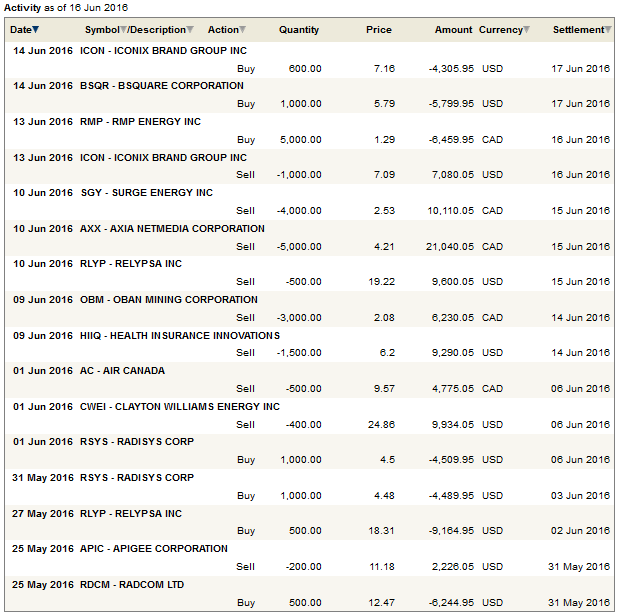
I mostly sold out of my position in Clayton Williams Energy and Surge Energy.  I hold a few shares in one account but am out of these stocks in the practice portfolio.  I’ve replaced the position with another name that feels a bit safer with oil at these levels, an old favorite of mine called RMP Energy.  I continue to hold Granite Oil.

What I sold

I sold out of Health Insurance Innovations after the announcement of the proposed ruling by the Health and Human Services department to limit short term medical plans to three months and not allow renewals.   This is their whole business model, and if it goes I don’t know what happens to the company.  I also noticed that I have been seeing complaints about the company’s call centers aggressive sales tactics pop up, which is worrisome.

I also sold out of Oban Mining, which has been another gold stock winner for me, more than doubling since the beginning of the year.  I just don’t want to overstay my welcome here.

Also note that I did take a position in BSquare, which I will write up in the next post.

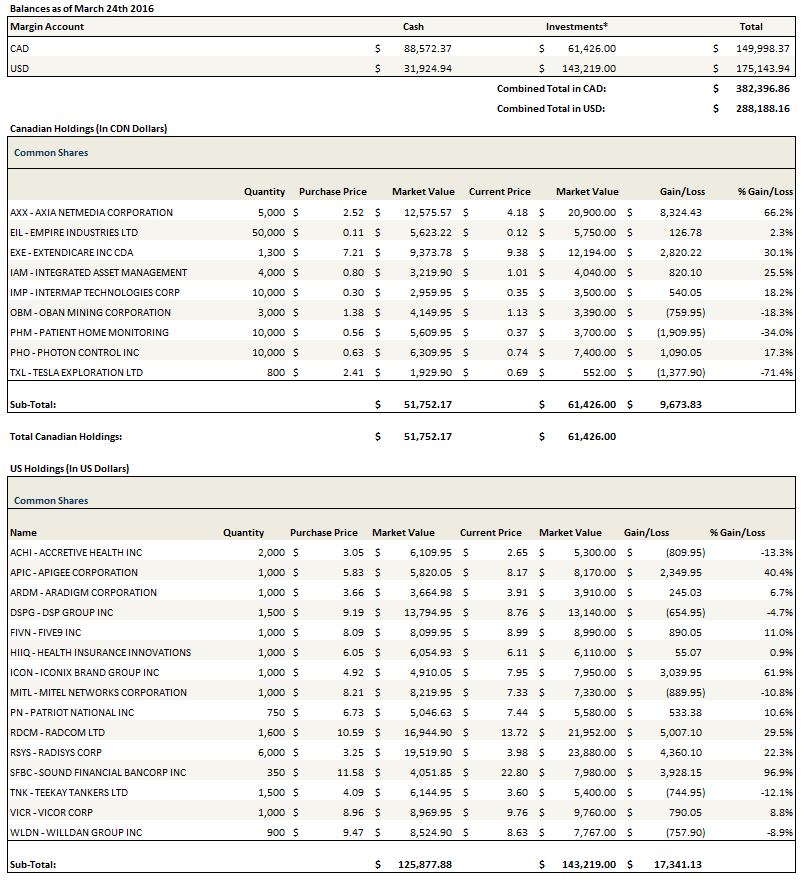
Portfolio Composition

Click here for the last four weeks of trades.
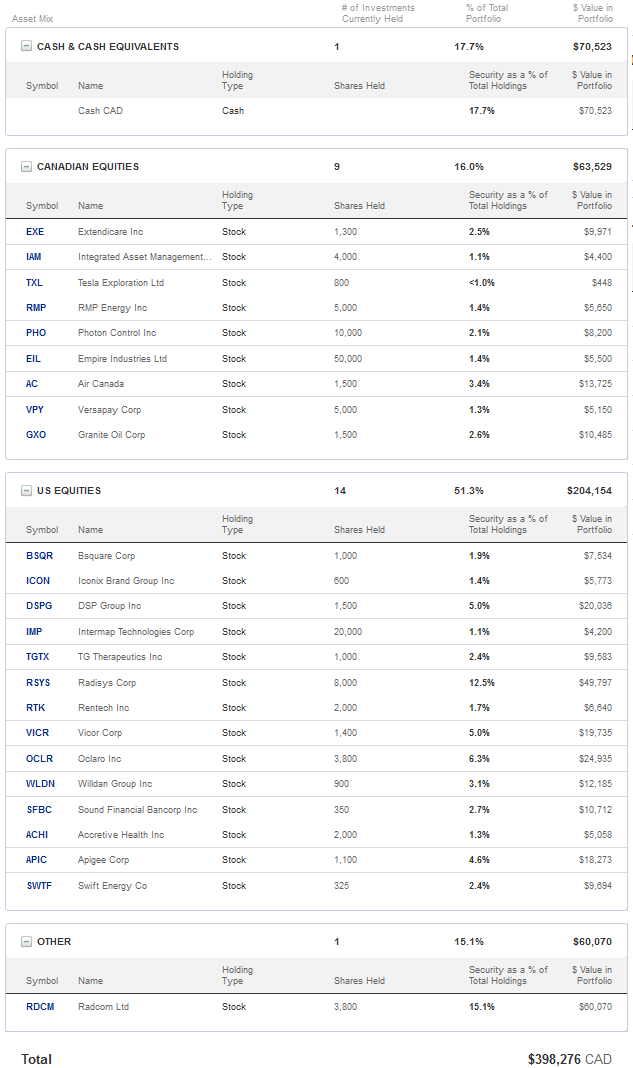
week-258

Week 254: Just a Bunch of Company Updates

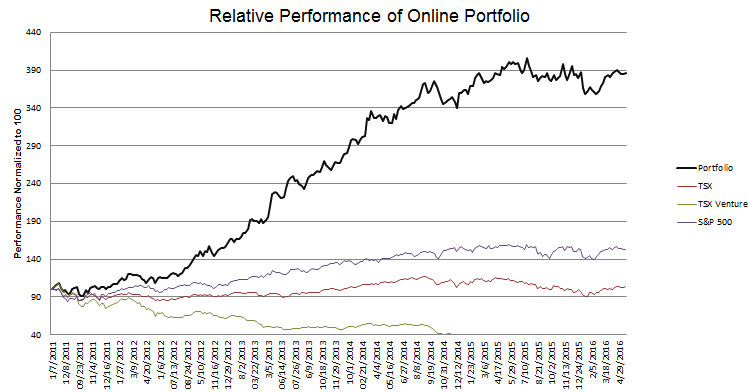
Portfolio Performance

week-254-yoyperformance

week-254-Performance

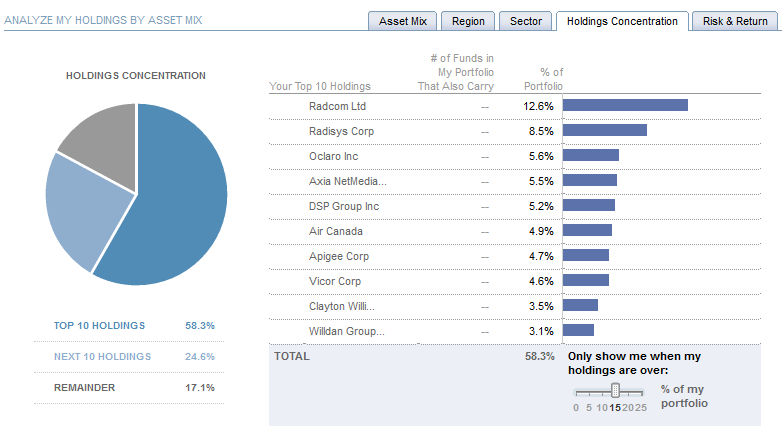
Top 10 Holdings

week-254-holding-concentration

See the end of the post for my full portfolio breakdown and the last four weeks of trades

Thoughts and Review

First some house keeping.  RBC’s has added new tools to make it easier to show performance for practice accounts.  I’ve maintained my portfolio manually through an excel spreadsheet for the last couple of years because RBC screws up the purchase values on their portfolio holding page and the gain/loss on individual stocks are, at times, ridiculous (my average cost is sometimes negative).

Recreating the results, even after building a visual basic routine to update the month of trades, was quite cumbersome, so I welcome these new tools.   At the beginning of the post I showed a list of my top ten holdings and below are all my positions, both are from the new tools.

The only information that is lost in this new format are the position by position gains and losses. While this is unfortunate, its so much less work compared to the process I had to go through before that this is how its going to be.

With that said…

I didn’t purchase any new stock in the last month so this is going to be a bit of a boring update.  I’ve be dedicated the space below to a discussion of a few of my larger and/or more interesting positions.

With April/May being an earnings period, there is a lot of information to consume.  I had mostly good news from the companies in my portfolio. I’ve tried to stick to names with solid operating momentum, staying away from those that might be turning it around but where good news has yet to trickle out.  And that has served me well.

As I have remarked before, my portfolio has been sitting in a holding pattern for the better part of a year.  While I am still waiting on a break out from the range, I feel better about the stocks I own than I have for a while.  Not all of them will pan out of course, but a few will, and hopefully 1 or 2 will be the multi-baggers that I depend on for out-performance.

Radcom

There is a lot to write about Radcom.

Radcom’s first quarter results were fine.  The company had revenue of $6.5 million and generated non-GAAP income of 15 cents per share. Perhaps the only negative about the quarter came out in a subsequent filing, that over $5 million came from their Tier 1 client, AT&T.

For the first time the company provided revenue guidance for the full year, a range of $28-$29.5 million.  They said that they were very confident in their ability to achieve this guidance as 80% of it was already secured with contracts.  In a later filing they said that 50% of their revenue in 2016 would come from North America.

Putting that together, Radcom is saying that they will generate about $14-$15 million from AT&T, and another $14 million from their existing non-NFV deployment.

Overall this is all as expected to slightly positive.   But the quarterly results and guidance don’t begin to tell the whole story here.  In fact what is most telling about guidance is what is left out; it does not include any contribution from additional Tier 1 service providers.

The company is actively pursuing additional Tier 1 customers for their virtual probe solution (MaveriQ).  They said they are in discussions with carriers from North America, Western Europe and APAC.  I’ve heard that the number of Tier 1’s is in the range of a handful.

It was reiterated on the conference call that MaveriQ is well ahead of its peers. Competitors either haven’t rolled out an NFV product, or if they have they don’t have real world implementation on it, and it is still tied to hardware.

We have competitors in the market but to our best understanding and everything that I am hearing from the CSPs and say they enrolled out an NFV product, some are saying that they have – they don’t have real world implementation on it. Some seem to be still in the hardware area and you cannot monitor an NFV network with the equipment, that’s why we believe they were the first mover and we were widening the gap with our competition.

This is inline of what I have gathered from one of the leaders in physical probes, Netscout, who recently said that their first virtual device would not be released until May.  I listened to Netscout’s webinar dedicated to NFV where they talked about their virtual probe technology and I was not impressed.  It felt like the event was put together to prove that they were in the game.

I note that Mark Gomes wrote the following on Friday, which corroborates with scuttle I had picked up from a different source:

In fact, word is spreading that RDCM’s product (MaveriQ) scored a perfect 100/100 in its lab trials, while the nearest competitor could only manage a 70/100. In other words, RDCM’s technology lead is wide, making them the de facto leader for NFV Service Assurance.

Amdocs provided some color around the cost advantage of virtual probes in this interview.  Justin Paul, head of OSS marketing at Amdocs, said the following:

The fixed video network model uses virtual probes instead of physical probes. This is because traditional, physical probes can’t probe a virtual network and the cost of a virtual probe is significantly lower than a physical one. We’re working with Radcom to implement a vProbe solution with a North American CSP and we’re seeing from the work we’ve done there that physical probe is 20-25% less costly than a physical probe. In addition, you can throw up a ring of probes around a specific area to address a specific peak in demand and redeploy those licences elsewhere when the peak has passed. They’re cheaper to buy and they offer greater flexibility and agility to operators because of that redeployment capability.

Since the results of the first quarter Radcom announced a share offering.  What has followed is an ensuing sell-off in the shares ha culminated Friday when the pricing of the shares came in at a disappointing $11.

Maybe I am too sanguine but I am not worried about the sell-off and while the dilution is unfortunate it is not overly material compared to the eventual upside.

Whether Radcom did a poor job selling their story, were poor negotiators, or just deemed the institutional backing and analyst coverage as being worth the cost of dilution at a somewhat low-ball price is unclear to me.

In the same article I quote above Gomes commented about over-subscription.  I have heard similar comments from another source.  The price action on Friday where the stock traded enormous volume and did not dip below the offer price suggests significant demand even as some shareholders throw in their cards in frustration after what could be perceived as a poor deal.

So the evidence is that the offer price is not a function of lack of interest and not a reflection on investor enthusiasm for their business prospects or for the strength of their MaveriQ solution.  And that was the real negative here; does $11 reflect poorly on Radcom’s business?  If it does not, and is a function of their willingness to concede in order to improve their balance sheet and get institutional support then really its not very negative at all.

I added to my position in the days leading up to the pricing.  That’s unfortunate.  I could have gotten those shares lower on Friday. But I do not see any reason to back track on those purchases.

I sat on a 1-2% position with Radcom for a couple years, all along thinking that this was an interesting little company with a promising technology that was worth keeping close tabs on in case they were able to step into the big time.  That is exactly what they’ve done with AT&T and are on the cusp of doing with other Tier 1’s.  I would be want not to do exactly what I anticipated doing in the event of such a progression.   And in the long-run I don’t think I will care too much that I bought the stock a day or two too soon.

Radisys

The first quarter results marked another step along the trajectory towards transforming Radisys’s business. The company continues to add to its suite products and services designed to facilitate the migration of service providers towards virtualizing their networks.

The company hit the high end of their guidance and then raised their guidance for the rest of the year.  They raised revenue to the range of $195-$215 million from $180-$200 million previously.  They left earnings per share guidance with the range of 22-28 cents on the expectation that additional costs would be incurred to support the expected revenue ramp.

he guidance raise was in large part due to the new DCEngine product.

DCEngine is a rack frame pre-installed with open-architecture software and white box hardware.  Its designed to be an alternative to the “locked in architecture” sold by the incumbent providers, and is consistent with the move to virtualize network functions (as opposed to tying them to hardware) so that upgrades, additional capacity and new functionality can be installed via software installs rather than hardware swaps.

DCEngine had its first order from Verizon, a $19 million order, at the end of the fourth quarter and this order was fulfilled in Q1.  On the first quarter call the company said the order from this service provider was expanded to $50 million, with the rest of the order expected to occur in the second quarter.

While this a large order for a company Radisys size, what is most interesting is that Brian Bronson, the CEO, referred to it as a “rounding error” in comparison to what Verizon needs to build out.

DCEngine is a low margin product, somewhere south of 20% gross margins.  But volumes could be significant, and management said that once the product gains traction that DCEngine orders “should be in the hundreds of millions.”

In addition, there is ancillary revenue to be gained from DCEngine sales.  Right now Radisys populates each rack with two white box switches.  In the second half of 2016 the company’s FlowEngine product will be upgraded and allow Radisys to replace those switches with it.  FlowEngine is a 60%+ gross margin product.

Second, the move from central office to data center is complicated and often requires support services from Radisys.  Providing the rack positions Radisys as the natural support resource, which on the call the company said can add another 10 points of operating income.

The company painted a positive picture of growth going forward.

They said that in addition to the Verizon order they were in discussions with a dozen service providers for DCEngine and expect to have 4 to 6 in trials by the end of the year.

With MediaEngine Radisys continues to ship product to their Asian servicer provider customer and said they are  “increasingly confident in our ability to secure further orders.”

They also see strong orders for FlowEngine in the first half from their Tier 1 carrier and while that might taper off somewhat in the second half they are still expecting revenues for FlowEngine to double year over year and there is the opportunity that more orders will materialize in the second half.

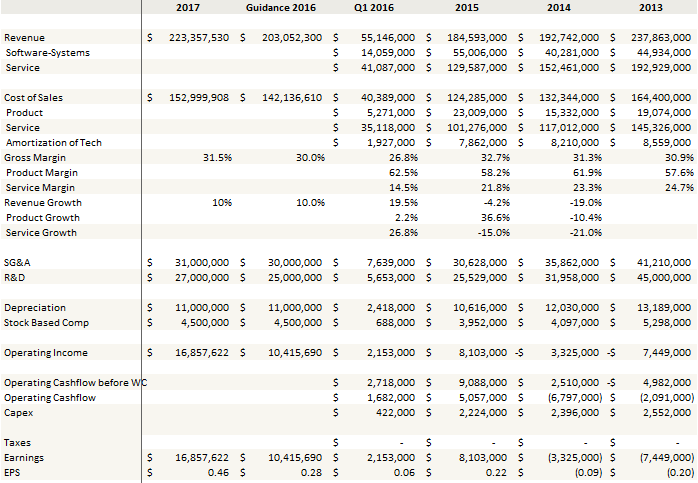
There are a lot of evolving parts with Radisys which make it difficult to pinpoint a forecast.  If I assume that revenue can grow 10% in 2017 on top of midpoint of guidance growth in 2016, that gross margins stay constant and SG&A and R&D costs increase modestly, I easily get to an EPS above 40c in 2017.  This seems like pretty conservative projections and yet it should easily support a stock price that is 50% higher.

guidanceWhat is interesting is how sensitive the numbers are to incremental revenue growth.  15% revenue growth produces and EPS above 50c while 20% revenue growth in about 60c.

What this makes clear is that there is real upside if the product suite begins to gain traction and realizes some of the expectations management alluded to one the conference call.  The speed of the move up above $4 makes it difficult to pinpoint exactly where one should add to their position, but I feel like somewhere in the low $4’s, high $3’s will look like a good price in the long run.

Medicure

I was pleased with the first quarter results announced by Medicure.  Sales were down to $6 million from $9.5 million in the fourth quarter.  Earnings per share were 5c again down from the fourth quarter.  None of this was unexpected after the run-up in earnings in Q4 due to Integrillin shortages.

Earnings as reported by the company are also being depressed by higher intangible amortization due to Medicure reversing some of the write-down of intangibles related to Aggrastat in the fourth quarter of last year.  These intangibles show up in the cost of goods sold (which is why margins were down to 86% in the quarter) and most drug companies exclude them from their adjusted earnings.  Without the intangible earnings would have been 8c per share.

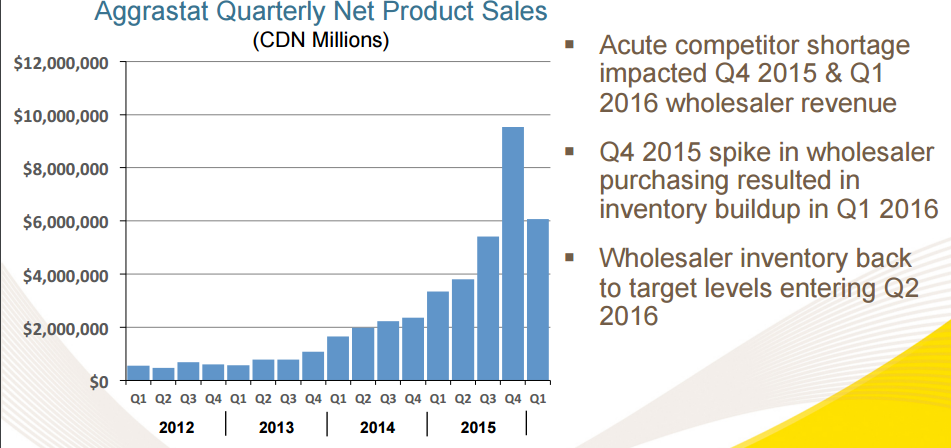
As the slide below, from their first quarter presentation, demonstrates, first quarter sales of Aggrastat were down sequentially as wholesalers that had stocked in the fourth quarter due to shortages of Integrillin purchased less but still up from the third quarter.

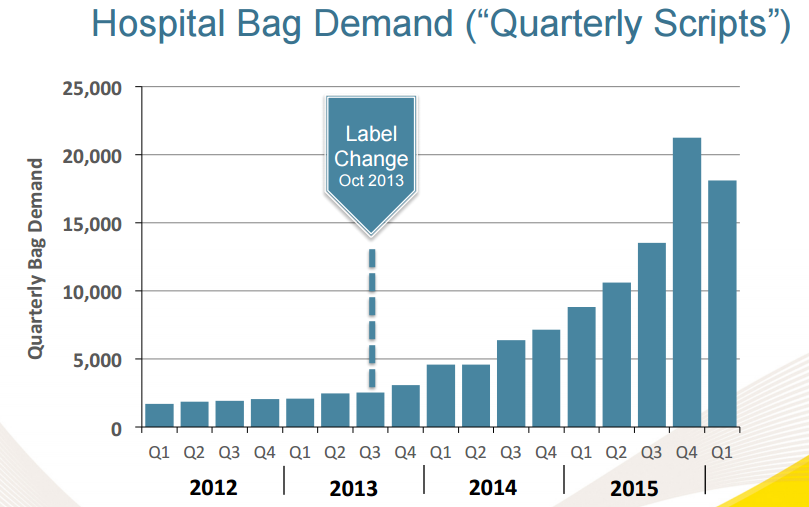
q1salesThe company also provided data for hospital bag demand, which was down again from the fourth quarter but to a lessor extent than sales, and up significantly from Q3.

q1bagdemandInterestingly, the company gave a couple data points to help investors normalize their sales data.  They said that first quarter sales understated demand by “a couple million dollars” because of the destocking.  They also said that they are currently shipping 1,700 bags per week, which works out to 20,000 per quarter and means that bag demand has continued to ramp subsequent to the first quarter.

The day before earnings Medicure announced that they are in the process of filing for bolus vial format approval – this will make it easier for hospitals to use Aggrastat. Some hospitals struggle with delivering high dose bolus via intravenous pump instead of syringe. The company provided the following clarification on the conference call:

Although the current bag format can be used to deliver the HDB as well as the maintenance infusion, some physicians and hospital catheterization labs prefer to administer the initial bolus dose with a smaller volume of drug product.  Moreover, the availability of a ready-to-use bolus vial will provide greater operational similarities and efficiencies for hospitals transitioning to AGGRASTAT.

Finally, although there is nothing concrete yet, the company reiterated its interest in purchasing Apicore, the generic supplier that they own 5% of, have a purchase option on the remaining interest, and are in partnership with for the production of a as of yet unnamed generic later this year.

There were a couple of questions in my last post about Medicure.  In particular what generic Integrillin meant to Aggrastat and second, whether Aggrastat itself would have a generic equivalent soon.

The second question came up because when you look at the patents that Aggrastat has, some of them run out as soon as 2016.  While its still not totally clear to me everything I have read suggests that when a drug is approved for a new indication it extends the exclusivity of the drug.   Medicure was granted patent until 2023 on the high dose bolus.

I still haven’t found the smoking gun that addresses this type of situation specifically but I did find a number of resources that indicate that generics will not be allowed until the high-bolus patent expires. This link to the FDA describes the periods of exclusivity for various NDAs. This slide show describes how a new drug is patented and how the exclusivity period is determined.  This q&a describes how a patent is extended with a label change for a new indication and how that will keep a generic off the market. In the book “Cracking the Code” authors Jim Mellon and Al Chalabi write:

Quite often, drug companies therefore try and extend patent life by tweaking the molecular structure of their drugs, changing the dosages or combining their drugs with other therapies to try and create a novel but similar product that allows the patent life to be extended.

Also worth noting is that Medicure does not refer to generic tirofiban (the drugs name) competition as a risk factor in their AIF.

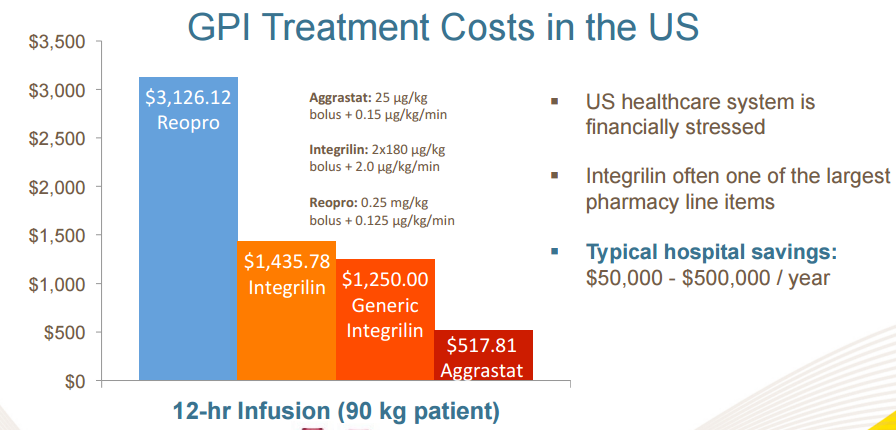
As for the generic competition from Integrillin, it is real and occurring but Medicure allyed concerns by updating their price competition slide to include the cost of the generic.

pricecomp

Aggrastat remains the cheapest of the bunch.

I have added to my position around the $5 range and even caught a couple purchases in the $4’s.  Unless I am wrong about the direct generic competition being years away I think the stock is too cheap and should trade up to a high single digit number on the current level of Aggrastat sales alone.  If there is a positive event with Apicore, the new generic introduction, or additional sales from new indications for Aggrastat, then all the better.

Air Canada

I continue to believe that Air Canada is misunderstood.  Maybe some day I will be proven right.

The stock trades at a significant discount to all of its peers.  The justification behind the discount amounts to:

  1. Air Canada has a lower operating margin
  2. Air Canada has a comparatively higher debt load
  3. Air Canada’s strategy of capacity additions is bound to end in tears

I get that (1) and (2) validate a somewhat lower multiple than a debt free, high margin peer.  But the current discount is too much.  As for the third justification, I think it fails to recognize what Air Canada is trying to accomplish.

Air Canada is adding capacity, but it is not to serve a slow Canadian economy. Capacity is being added to international flights in what they see as under-utilized Canadian/international hubs in Toronto, Montreal and Vancouver.  The strategy is to pin-point international demand where the location of the hub and cost structure puts them at an advantage against the competition.

Air Canada is also taking advantage of what is actually a lower cost structure on some routes (due to Canadian dollar based expenses and new airplanes with better efficiency) to claw back trans-border traffic that they lost to US carriers during the dark period of their bankruptcy and near-bankruptcy.

Finally Air Canada has added new planes and routes that increase their flexibility to redistribute the fleet during slowdowns like the one that we have seen in Alberta.  It didn’t seem to get a lot of focus in the first quarter follow-up but the Alberta slowdown barely blemished their results.

I think its instructive that with few exceptions when Air Canada comes up on BNN’s Market Call, the pat responses is:

  1. The Airline industry is always terrible
  2. Air Canada has gone through bankruptcy before
  3. It can’t be different this time

What is unfortunate is that there is no quick fix to this perception.  The past couple of years of mostly excellent results are proof that it is going to take time, maybe a full cycle, before portfolio managers become comfortable with the idea that Air Canada has positioned themselves to withstand economic weakness and grow the business in good times. Perhaps when oil prices recover and we see the Canadian economy turn up investors will start to conclude that hey, that was the downturn, and look, Air Canada is still standing.  I’m willing to wait that out as long as the company continues to perform.

Health Insurance Innovations

Health Insurance Innovations turned in a very good first quarter but they haven’t gotten a lot of credit for it.  Revenue was up 88% to $42.5 million. EBITDA grew from a negligible amount in the first quarter of 2015 to $4.2 million in 2016.   Policies in force grew from 195,100 to 258,000 sequentially while submitted applications grew from 153,300 to 192,200.  They saw growth from all their sales channels but in particular Agilehealthinsurance.com, their online sales channel, doubled from 11,000 policies submitted in the fourth quarter to 23,000 policies submitted in the first quarter.  Both revenue and EPS guidance were increased for the year.

I’m not sure why the stock hasn’t responded better.  There is a large short interest, which I don’t really understand, so maybe those players have been doubling down on their bet.  The mid point of EPS guidance is 40c, so the stock trades at 15x this years earnings which does not seem expensive given the growth they are beginning to experience.  I suspect that comments on the conference call are partially responsible for the muted response.  They said their baseline assumption is that growth will level out at Agile until the next open enrollment:

we’re taking a view that says a lot of people bought it during open enrollment that’s why we’re still strong and things are going to level off until the fourth quarter when open enrollment comes in.

Hopefully, we’re wrong and we have dramatic sales in between these open enrollment periods, but frankly given the dynamism of this market, we’re not sure and so we’ve done our best to forecast sales at Agile and the rest of the company over the next six months and that take place in our guidance.

I think this might be conservative.  The story seems to be getting better.  At the current price the growth trajectory that has began to emerge over the last couple of quarters is not priced in. While something has held the stock down since the release of the first quarter results, I doubt that can continue with the release of another strong quarter.

Shorter thoughts on a few other names

Granite Oil

Granite Oil had their credit line reduced from $80 million to $60 million.  While I expected some reduction, this was a bit larger than I had anticipated given that the company has such modest debt levels compared to its peers.  Fortunately the company only has $40 million drawn so the reduction is not really an impediment.

Intermap

Intermap still hasn’t received initial payment to allow it to start its SDI contract in the Congo.  I never expected this to be easy and I acknowledge that the stock is a flyer so I have it sized accordingly.   The bottom line is that the risk reward remains attractive if you treat the position like an option that could expire worthless (or close to it anyways) but also could be a ten bagger.  I note that Mark Gomes, who I quoted above, is involved in Intermap as well and has written a number of good posts on the name.

Rentech

Rentech had a not unexpectedly terrible quarter.  In the fourth quarter the company was pretty clear that the ramp at Atikokan and Wawa wasn’t going smoothly, needed more equipment, that they were still tweaking operation plan, and that they were not even sure Wawa would reach original capacity.  In the first quarter they appeared to get Atikokan on-track which leaves Wawa.  Here is what they said about Wawa on the conference call:

Our production shortcomings appear to be the product of limited experience operating the plant at higher levels of throughput and sustained operations as a result of our past conveyor problems. We are now experiencing the operational and production issues that we should have witnessed last year, but for the conveyor problems.

Even with these recent challenges, we’re still learning how to respond to or prevent these causes of production disruption that are typical of ramp-up of new pellet mills, such as sparks, jams, plugging, dust, moisture content, silica content, truck dump outages, hammer mill clogging, et cetera.

On top of that they experienced weather related weakness at NEWP.  The warm winter in the North East reduced demand for wood pellets.

I have only taken a small position in the stock and I don’t plan to add more until we see positive momentum from the Canadian operations.  But I look at these plants like a mine, which I have quite a bit of experience investing in, and the two things I have learned about starting a new mine is that A. it never goes smoothly and B. the initial start-up problems are typically figured out after some time.  So I think Rentech will get their hands around this, and I want to be ready when they do.

Mitel

I sold out of Mitel, at least for now.  The acquisition/merger with Polycom takes the company further down the path of being a hardware provider for enterprise telecom solutions, which is not really why I found the stock interesting.  The justification around the deal is mostly about cost reductions and synergies, not growth, which again is not inline with my original thesis.  And the combined entity still has to compete against Cisco which is significantly larger and has been taking market share from Polycom.  Until I get a better understanding of where Mitel is going from here, I thought it best to exit my position.

TG Therapeutics

I bought back into TG Therapeutics at $7 last week.  There hasn’t been any negative data to justify the fall in the stock of late.  My original investment thesis still stands, just at a price now that is about 2/3 of what it was at the time.  Really, if anything we are getting closer to the conclusion of their Phase II and Phase II studies.

By the way, if anyone can recommend any good books for understanding biotechnology please send me an email liverless@hotmail.ca.  Thanks!

Portfolio Composition

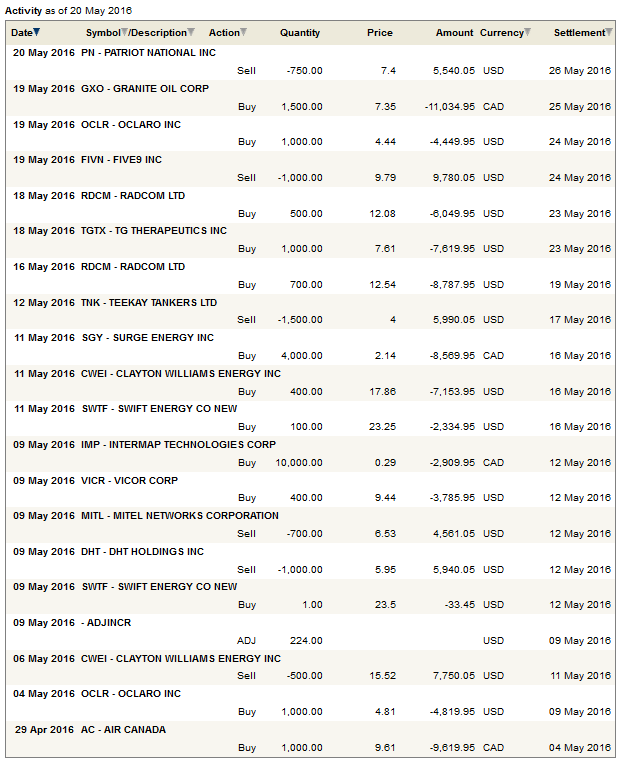
Click here for the last four weeks of trades.  Note that the 224 share AdjIncr transaction is because when Swift pink sheet equity converted to new equity I lost my shares in the practice account and so I had to restore those manually.

week-254

Week 246: Hidden in Plain Sight

Portfolio Performance

week-246-yoyperformance

week-246-Performance

See the end of the post for the current make up of my portfolio and the last four weeks of trades

Thoughts and Review

The market was up and so not surprisingly I had much better performance in the last month.  Even so, I performed better than I might have expected given just how much uninvested cash I have sitting around.

It just goes to show how much of a drag the losers have been.  I’ve had my share of winners in the last year, but my performance has been flat because I also had a bunch of crappy losers.

It would be one thing if I couldn’t distinguish between the winners and losers ahead of time.  But when I look back at what has cost me over the last year, it has been pretty predictable; stocks where I am stretching for a trade, stocks where the value wasn’t clear, or stocks where my primary motivation was their attractive yield.

I’m going to make a concerted effort to prefer cash to those positions going forward.

In the last month I haven’t been actively looking at stocks.  I’ve been surprised by how quickly the market has bounced back and I remain skeptical that it can continue.  So with the exception of a couple of opportunities that I will describe below, I am will remain holding a high cash position until I see a reason to believe the market will sustain a move higher.

Takeovers!

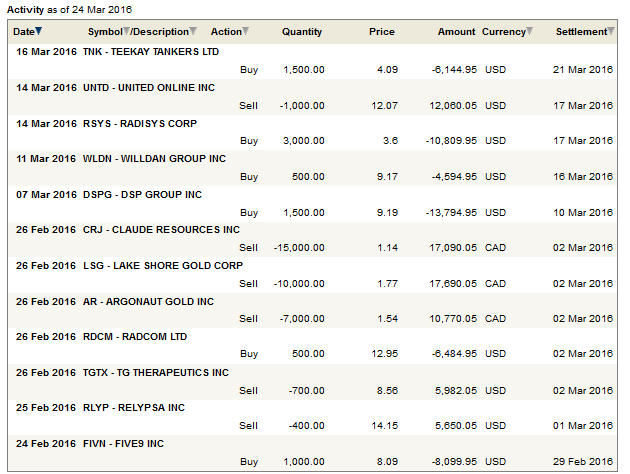
I went a long time without a takeover and then in the matter of 6 weeks I got 3 of them.  First, both of my gold stock picks, Lake Shore Gold and Claude Resources, were taken over.  I bought Lake Shore at $1.12 and, after the takeover offer from Tahoe Resources to exchange each share of Lake Shore for 0.1467 shares of Tahoe, the stock now trades at a little under $2.  I bought Claude at 76c. Silver Standard Resources made an offer of 0.185 shares for every share of Claude.  At the time of the offer this amounted to $1.65.  I’ve sold some of each position and so have reduced stakes in both.  They have been solid performers and I am not unhappy.

A few days after the Claude Resources news my long held fiber-to-the-home play, Axia NetMedia, got scooped up by a private equity firm, Partners Group.   While I was happy to see a quick takeover of both of my gold stock positions, I was more divided by the news from Axia.

The problem is that the opportunity at Axia is much greater than the $4.25 takeover offer.  The company has a massive build out on its horizon in both France and Alberta.  Its becoming clear that fiber-to-the-home is not just a “higher speed-nice-to-have” but a necessary conduit to access all forms of media.  Axia’s cash flow stream once this build-out is complete will far exceed the price paid by Partners Group.

The problem is getting from here to there.  As Axia outlined on their last conference call, the capital necessary to realize the growth is a stumbling block for a $200 million Canadian company.  Axia warned on their last call that they were evaluating alternatives; that they would try to raise capital and if not consider offers by a larger entity with greater access to capital.  Partners Equity is a $50 billion investment management firm.  The only reason that a firm that large bothers with a takeover this small (Axia was a $200 million market capitalization before the offer and under $300 million at $4.25) is because they see significant upside.

Radisys, Radcom, Willden, and what the Market Misses

I’ve made a number of mistakes over the last couple of months but one thing I have done right is add to my positions in Radcom and Radisys in the face of market weakness.

Radisys has had a big move in the last month, moving as high as $4 from $2.50 in January.  I have added to my position on the way up.

The Radisys move over the last couple of weeks has been instructive.  Consider that during the fourth quarter conference call the company announced a large contract from a Tier I customer (from this transcript):

And finally, and maybe most important in this release is, we secured orders totaling approximately $19 million, the majority of which is contained in deferred revenue at year-end for our new data center product targeted at telecom and cable operators which we expect to launch more broadly in the coming months.

The stock moved a little but nothing that couldn’t be explained by what were decent quarterly results.

About three weeks later Radisys officially announced the product, DCEngine, with this press release, along with the name, details and comments from the Tier 1 customer, Verizon.

“As Verizon introduces open, flexible technology that paves the way for central office transformation, we look to companies like Radisys to assist us in that journey,” said Damascene Joachimpillai, architect, cloud hardware, network and security, Verizon Labs. “Network modernization will rely on solutions such as DCEngine that meet service provider needs with open source hardware and software technologies.”

The stock has moved straight up since this press release.

I think this demonstrates how poorly small cap companies like Radisys are followed and how slow the market can be to react to positive developments.  While I find it easy to second guess myself when what I construe as good news in announced and the stock doesn’t move, it is worth reminding myself that this isn’t always an indicator of importance.

With that in mind consider the following situations, Radcom and Willdan Group, two stocks I have had in my portfolio for some time, and Vicor and DSP Group, two new positions that I have added.  I believe all four of these situations represent similar “hidden in plain sight” opportunities.

Radcom

First, Radcom.  Radcom announced in early January that they had signed a contract with a Tier I customer for their next generation service assurance solution MaverIQ.  There wasn’t a lot of details provided, only that the initial phase of the contract would be completed mostly in 2016, and was worth about $18 million.

On their fourth quarter conference call in mid February the company gave more color.  They said the contract for NFV deployment was much bigger than the $18 million announced.  I’m pretty sure its with AT&T.

While they declined from giving guidance (historically the company has given virtually no guidance in the past so this was no surprise) they were willing to say that they expected their cash level to increase to $20 million from current $9 million by end of the first half of 2016, and that the increase in cash would be due to new revenue and not deferred payments.

They also gave an indication of just how big the deal with AT&T might be (my bold):

We just said that we received an $18 million initial deal out of a bigger deal. There is – it’s a large transformation, so it’s not – I think when you’re envisioning it, so I’m going to try to help you model it, right. So when you’re envisioning it, envision something between 2.5 to three year evolution for the very significant portion of the transformation, okay. It doesn’t mean that everything stops after three years, but envision that over the course of those three years, that number $18 million that we’ve disclosed is just an initial number out of something bigger, that’s bigger than that. And I can’t disclose the accurate numbers here. There is things that it depends on. There is – it’s more complicated just throwing other number out there, but it’s much bigger than $18 million, okay.

In addition they made it clear that they are ahead of the competition, witnessed by their comments about Netscout on the call.   They are in the process of trials  with other Tier 1 customers and believe that the next-gen service assurance market will be a “winner takes most” market where they can take the most.

Radcom is a $130 million market cap company.    They just said they can generate $10 million of free cash in the first half of 2016, that the contract they have announced is actually much larger than the announced number, and that they have a product that is significantly better than the competition.

If Radcom can win a couple more contracts in the next year the stock should trade significantly higher than it is now.  it probably gets bought out at some point.   In the mean time I think its quite a good growth story.  The market is really not paying a lot of attention to the “color” provided on the conference calls, and instead is focused on the rather puny revenue that the company generated in 2015 ($18.6 million) and the rather lofty valuation for the stock if you use that backward looking measure.

Willdan Group

Update: I got a response from Willdan IR and they say the revenue is not new revenue and is included in guidance.  I am still of the mind that this is an expansion of scope though and I am happily holding the position I added that I describe below.

Second example.  On their fourth quarter conference call, which I thought was quite positive in terms of the outlook provided for 2016, Willdan stated the following about their ongoing contract with Con-Ed:

We have the extension for 2016 at a value of approximately $33 million. We’re prepared to go beyond this baseline and expect to. The good news is that we continue to perform well for Con Ed and as a result we are in discussions to expand our scope of activity in the second half of 2016 to include more programs targeting customer segments, for example, more of Brooklyn, Queens and larger projects, 100 kW to 300 kW in our SPDI program, the type of programs that will include in the larger retail stores and warehouses and more real estate.

Note that the transcript is incorrectly referring to the SPDI program, which should read SBDI (small business direct install program).

Flash forward to Thursday. In a press release Willdan said the following:

Willdan Group, Inc. (“Willdan”)(WLDN) announced that it has been awarded a one-year, $32.8 million modification from Con Edison to an existing Small Business Direct Install (SBDI) contract.  Under the modification, which extends through the end of 2016, Willdan will be delivering approximately 86 million kilowatt-hours in electric energy savings to Con Edison’s small business customers throughout the entire Con Edison service territory. This includes the Bronx, Brooklyn, Queens, Manhattan, Staten Island and Westchester County, New York. Willdan described this forthcoming modification in its recent fourth quarter earnings conference call.

Based on the language used it seems pretty clear to me that the $32.8 million is in addition to the $33 million baseline contract.  They talked in the fourth quarter conference call about scope expansion with respect to the SPDI and this is scope expansion to the SPDI.

If I’m right, then the market hasn’t caught onto this yet.  Full year guidance is $170-$185 million and so $33 million is significant.

It’s possible I am wrong.  Maybe Willdan is just re-releasing old news.  I would be surprised though.  I have followed the company for some time and their management does not strike me as the sort to throw out a press release with a big number that is a rehash of an already disclosed contract.  It just doesn’t strike me as something they would do.

I think its equally possible that this was the Thursday before a long weekend, that there are maybe one or two analysts following the company, and so no one that was around to check the news cared enough to notice it.  Yet.

For what its worth I added to my Willdan position significantly.  What the heck; I’m buying the stock at the same price I was buying it at a few weeks ago before this announcement anyways.    What’s the downside?

DSP Group

I have been watching DSP Group for a couple of years and have owned it once in the past.  The previous time I owned it the story was primarily one of valuation.  The stock was trading at $7 and the cash and investments on the balance sheet accounted for nearly $6 of that.   But there wasn’t a clear story behind the business itself and so I sold the stock after it went a few dollars higher.

In the two years since the story around the company’s business has been evolving for the better.  The legacy business that they have, and for which I had a lack of excitement in my first endeavor, is the design and manufacturing of chipsets used in the cordless telephones.  It’s profitable and brings in decent free cash, but it’s an industry in decline to the tune of 10-12% annually in recent years.

This business has fallen off the cliff even more in the last couple of quarters.  Slower demand and an inventory build has led to 20% plus year over year declines.   These declines are expected to moderate back to trend in the second half of the year.  However the bad numbers drag down the overall revenue numbers for the company and are hiding some pretty decent growth businesses.

DSP Group has been investing in a number of new technologies that are starting to bear fruit.  Lets step through them briefly:

  1. HDClear – they have developed a new technology that will improve voice quality on next generation phones. On the fourth quarter call the company announced that they had a couple of wins and one of the wins was with a Tier I device supplier.  Turns out that is Samsung, where it has been designed into the S7.  They expect $2 million to $3 million in the first quarter and guided to lower double digit or high single digit revenue for the year.  When I look at some of the numbers I wonder whether it could be higher: according to this article from Reuters (here), DSPG should get 70c-$1 for each HDClear chip sold.  The Samsung S6 sold over 50 million units last year.
  2. VoIP – their VoIP business unit had $22 million in revenue in 2015. They have guided for 50% growth in 2016.
  3. IoT – Eight OEM’s and three service providers have launched products based on DSPG’s ULE technology. They have a ULE chipset that can be used in home automation, security, remote healthcare or energy management products.  They generated $3.8 million of revenue in 2015 and they think that can get to $5 million in 2016.
  4. Home Gateway – Home Gateway generated $14 million in 2015. It is expected to take a step back in the first quarter of 2016 with around $2.5 million of revenue, but this is going to climb as the year progresses and some new product launches, in particular a North American telecom provider.
  5. SparkPA – DSP Group announced a new product, a power amplifier to be used in the high end access point market. They don’t expect any revenues from this business in 2016 but it will ramp in 2017 and they consider the market they are tapping to be over $100 million

The company gave quite a bit of color about the revenue expectations for each of these businesses in 2016 on their fourth quarter conference call.  If you add up the expected 2016 revenue from the new businesses alone you get around $57 million.  These businesses grew at 35% in 2015 and the company said that in aggregate they expect higher growth in 2016.

When I think about a company with an $80 million enterprise value and $57 million of high growth revenue products, it doesn’t make a lot of sense to me.  I understand that overall the company’s revenue is not growing because of the out sized contribution of cordless declines.   But this business is profitable and therefore not a drag on the company, in fact it even helps fund the growth.

I think the stock should trade at least at 2x the revenue of its burgeoning new product lines.  This would be a 50% upside in the stock.  If the growth continues I would expect it to be even higher.

Vicor

I got the idea for Vicor from a friend who emails me regularly and goes by the moniker Soldout.  He gave me a second idea some time ago, called Accretive Health, that I didn’t initially buy and has done really poorly for the last half a year but that I added recently and will talk about another time.

As for Vicor, the company has a market capitalization that is a little under $400 million, $60 million of cash on its balance sheet and no debt.  The company sells power converters.   They offer an array of AC-DC and DC-DC converters that are used in telecom base stations, computers, medical equipment, defense application, and other industries.

Vicor has a history of high-end products and so-so results.  Their technological edge goes back to the 80’s, as they were the original inventor of the DC-DC brick converter, a device that allows the power converter to sit on the circuit board, which in turn allowed a single DC voltage to be distributed throughout the system and converted as required to lower voltages.  However they haven’t made a significant profit since 2010, and even then it was only 80c per share.

The story going forward is simple.  The company says that with recent design wins and product launches, in particular wins for new data centers that will utilize the VR13 standard (more on that in a second), as well as high performance computing, automotive and defense, they can grow revenue 3-5x in the next couple of years.  That estimate comes directly from management (from the third quarter call).

I think it’s fair to say that the array of products that have been introduced and the products which are about to be introduced, for which the development cycle has ended and we’re very close to new product introductions, that in the aggregate these products are more than capable of supporting the 3-by-5 revenue growth goal that we had set for ourselves, and with respect to which we suffered delays.

The increases in revenue in 2016 will coincide with the move to the VR13 class of processors made by Intel (known as the Skylake family of processors) and that are used in a number of high end computing applications.  These processors require power conversion levels that are easily addressed by Vicor’s high efficiency products.  Vicor has already had a number of design wins to be included in VR13 system designs.  The move to a VR13 based architecture has been slower than expected though, and the company has pushed back the revenue ramp from originally beginning in early 2016 to now occurring in the second half of the year.  The company describes the VR13 opporunity below:

VR13 is a class one processor, it’s a class of processors, and it’s processors that in many respects represent the significance that [inaudible] performance relative to the earlier class, which is VR12.5. Now this can be potentially look confusing because, as you follow Intel’s introductions with respect to the many different flavors of these devices, some of them play in a space where now we do not play, and other ones are targeted in particular to higher-end datacenter, more intensive — computing intensive applications. And those are the ones that are relevant to our revenue opportunity.

Vicor has significantly more design wins for the VR13 product line than they did for VR12.5 (again from the third quarter conference call):

To the extent our footprint with factorized power solutions across applications and customers will increase going from VR12.5 to VR13, this product transition is a mixed bag as it may cause near term softening in demand but should result in substantially greater total revenue as VR13 applications begin to ramp.  On a related note, we have started to see significant design wins for our new chip modules as point of load, board mount devices and in chassis mount VIA packages, which validates our expectations of market reception of these products.

Vicor’s technology differentiates them from competitors.  For example they have introduced a factorized power 48V architecture that includes components that can step down voltage directly from 48V to 5,3 and 1V without an intermediate 12V stage.  I believe they were the first company to come up with this solution and I have only seen one other advertising the capability.  Stepping down directly from 48V has higher efficiency and takes up less board space than existing architectures.  On the third quarter conference call the company said the following:

In my recent visits to customers in the U.S. and Europe, I confirmed spreading a rising level of interest in our factorized power 48-volt architecture and are now frontend solutions for automotive, datacenters, high-performance computing, and defense [ph] electronics applications among others.

The 48V products are particularly interesting to data center and server applications where power losses due to the intermediate step-down to 12V are undesirable.  Google, for one has championed a 48V server solution with a new 48V rack standard.  Vicor released a press release describing Google’s initiative:

Patrizio Vinciarelli, President and CEO of Vicor, commented: “By developing its 48V server infrastructure, Google pioneered green data centers. And by promoting an open 48V rack standard, Google is now enabling a reduction in the global cloud electricity footprint.”

The company has been building out their capacity and their existing cost structure can support the anticipated rise in revenue.

So we have significant design wins. We have been working furiously to establish automated manufacturing capacity. There’s been good progress to that end. You know, there’s equipment coming in, factory flaws, have been prepped for it, and we’re going to have a turn now in the very near future in anticipation of volume ramp in Q1 of next year.

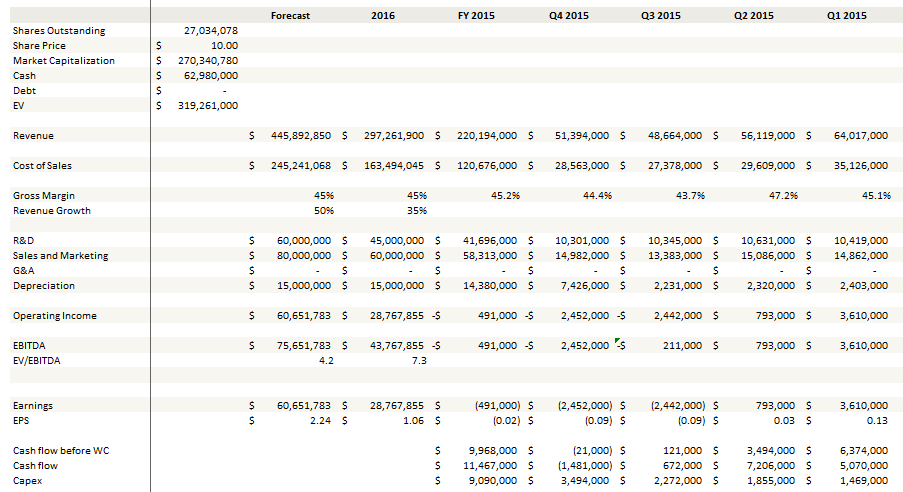
If you step through how the numbers would play out and assume that revenues double at some point, a modest increase in SG&A and no improvement in gross margins as revenues ramp, you can see the leverage to earnings that quickly develops. Note that the company has significant net operating losses that will shelter them from tax:

forecast

Keep in mind that I’m not trying to exactly predict how earnings will ramp.  This is not intended to have the accuracy of a forecast.  Its intended to demonstrate the magnitude of the earnings leverage if the company can make good on their expectations.

I have a position in Vicor and expect the stock to move significantly higher if they can realize their revenue expectations.

Tanker Stocks

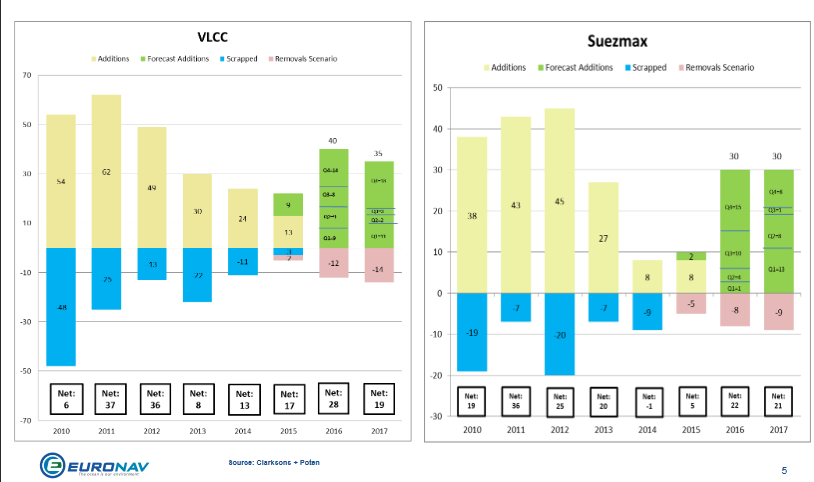
After watching the tanker stocks dramatically under-perform for the last two months I decided to take a closer look.  I concluded that you can attribute the negativity entirely to the order book for Suezmax and VLCC’s over the next couple of years.  The slide below is taken from the Euronav September 2015 presentation.

orderbook

Note that since that time the gross additions for Suezmax have fallen by 3 in 2016 and risen by 15 in 2017, while gross additions have risen by 5 in 2016 and 5 in 2017 for VLCCs.

The rule of thumb on VLCC demand is that every 500,000bbl/d of demand requires about 15 ships.  The new ships being added covers somewhere between 1Mbbl/d to 1.5Mbbl/d of additional demand.  This seems to be inline with 2016 demand expectations, which I believe are around 1.2Mbbl/d according to the EIA.

Some of the new build activity was likely a rush to procure ships before the introduction costly NOx Tier III compliance requirements which adds an additional $2 million to $3 million to the price of newbuildings (source here)

Adding it all up, this seems like a balanced market to me.  But the stock prices of the tanker equities are trading like a dry bulk type oversupply was about to occur.   I think the extremely low prices we are seeing in these stocks will be corrected at some point during the year, if for no reason other than the typical rate spikes that we see periodically.

I have taken a basket approach and bought positions in Teekay Tankers, DHT Holdings and Ardmore Shipping. Of all these names I think I like Ardmore Shipping the best because the order book for product tankers, where Ardmore has all of its fleet, is the least concerning but also think that in the $3 range Teekay Tankers seems particularly overdone.

These should be viewed as trades.  A move to $5 in Teekay, somewhere in the $11s for Euronav, $6.50 for DHT or $10 for Ardmore and I will cut them loose.  All of these price targets are well below where the stocks traded at the beginning of the year.  I just don’t think conditions have changed that dramatically to warrant the change in stock price.

Portfolio Composition

Click here for the last five weeks of trades.

week-246