Skip to content

Posts from the ‘Regional Banks’ Category

Community Bankers Trust: Gives a Little Bit of Green in the Sea of Red

In a week where most stocks I own (and most stocks period) went down, there were a few bright spots in my portfolio.  Almost all of those bright spots were regional banks.  The best of the bunch, by far, was Community Bankers Trust (BTC).  Community bankers trust reported its second quarter earnings last week.   Evidence of a nascent turnaround in their operations are likely responsible for the interest in the stock.

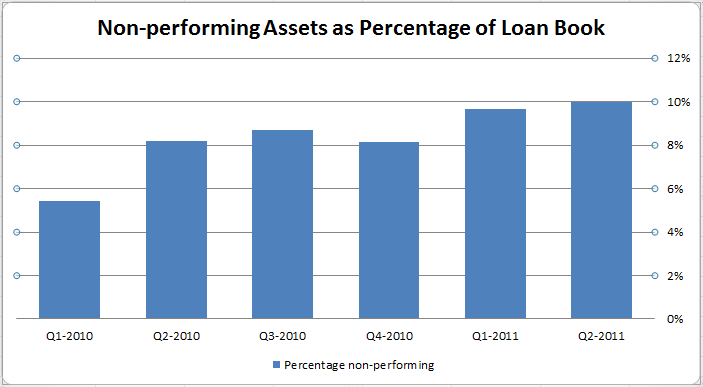
I only have a small position in BTC because, to be honest, they are a bit of a flyer.  Unlike my other bank holdings (ONFC, HFBL, and recently XBKS) has some nonperforming loan issues.
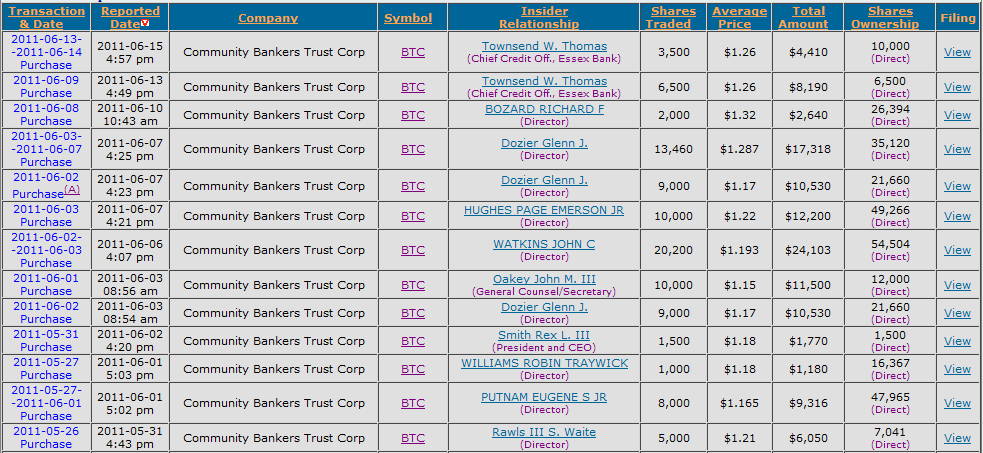
Still there are some signs that the bank is turning things around.  First of all, there has been a lot of insider buying going on in the last couple of months.
Second, delinquent loans have been coming down, as have charge-offs.  On the Q2 conference call management talked of definitively turning the corner on their nonperforming loan issues.  They also suggested that new loan growth would begin to kick in soon.
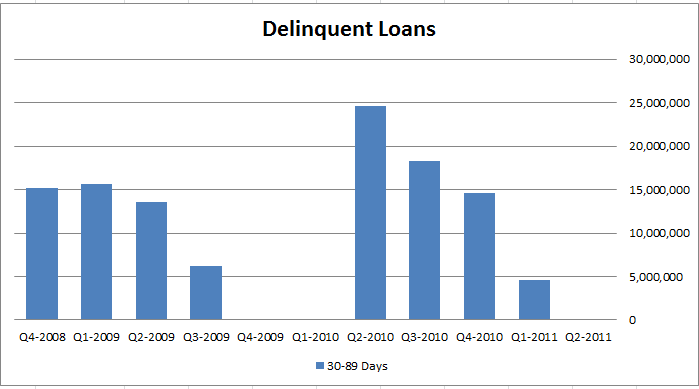
(note that the 30-89 day number for Q2 won’t come out until the 10-Q is filed.  This is an important number and something to watch for when the 10-Q comes out).
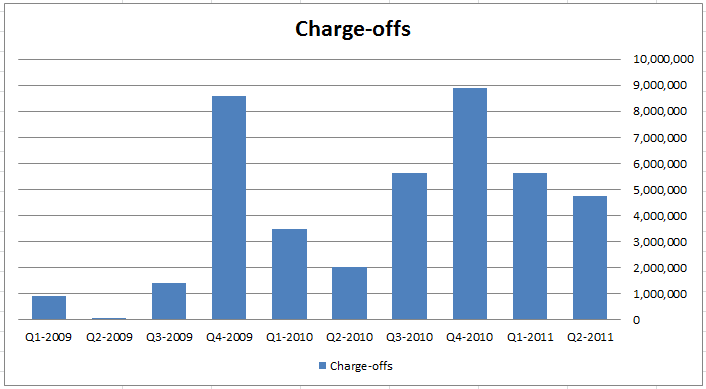
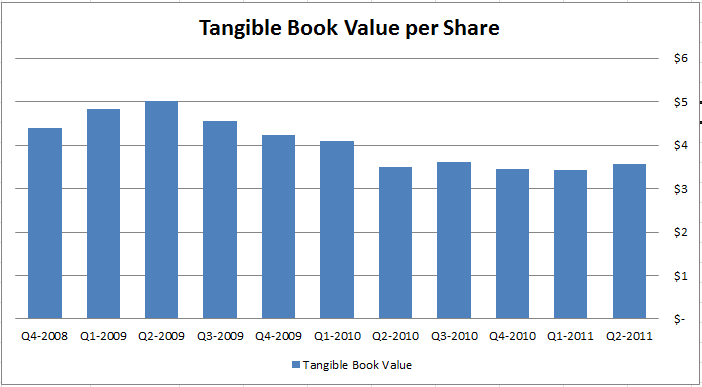
Finally, the company is trading at a severe discount to book value.  Tangible Book value is $3.57, meaning that the stock is trading at about 39% of tangible book.  Moreover, unlike some banks, tangible book hasn’t proven to be a continuously shrinking metric.  Book value has remained relatively constant for over a year now.
BTC is one to keep an eye on.  If there is continued progress on their non-performing loans, and charge-offs continue to fall, I think this is the sort of stock that could easily triple from here.  I will watching closely for their 10-Q.  Confirmation that loans past due fell further in Q2 would likely lead me to buy more.
Oneida Financial – Local MHC Continues to Make Good

I got introduced to the idea of buying regional banks stocks about 6 months ago.  Two separate catalysts piqued my interest in the idea:

  1. Last summer I read the David Einhorn book, “You Can Fool Some of the People All of the Time”.  In that book, which is about a fraudulent business development company called Allied Capital, Einhorn spends a chapter outlining his investment philosophies.  One of the ideas he puts forth is investing in mutual holding companies.   Seth Klaman has been another proponent of investing in MHC’s.
  2. Tim Melvin’s trade of the decade.  Melvin, a fairly well known value investor, believes that the small regional bank stocks have been beaten up well beyond what is justified and that their recovery represents the trade of the decade.

After spending a few months getting to understand the banking industry, and scouring the net for cheap MHC’s trading below or at book value, I stuck money into a couple of them, with one of those being Oneida Financial.  Now, in the 5 or so months that I’ve owned it the stock has done absolutely nothing.  You might want to take that as neither a good or bad thing in this market.  Oneida has bounced back and forth between 8.40 and $8.80, but does not seem in any hurry to break out in either direction.

I have already written an extensive write-up on Oneida’s regional banking business and why I picked Oneida as one way to play this trade of the decade.  I’m not going to go further into the details of my reasons here.  I’m just going to focus on their second quarter results.

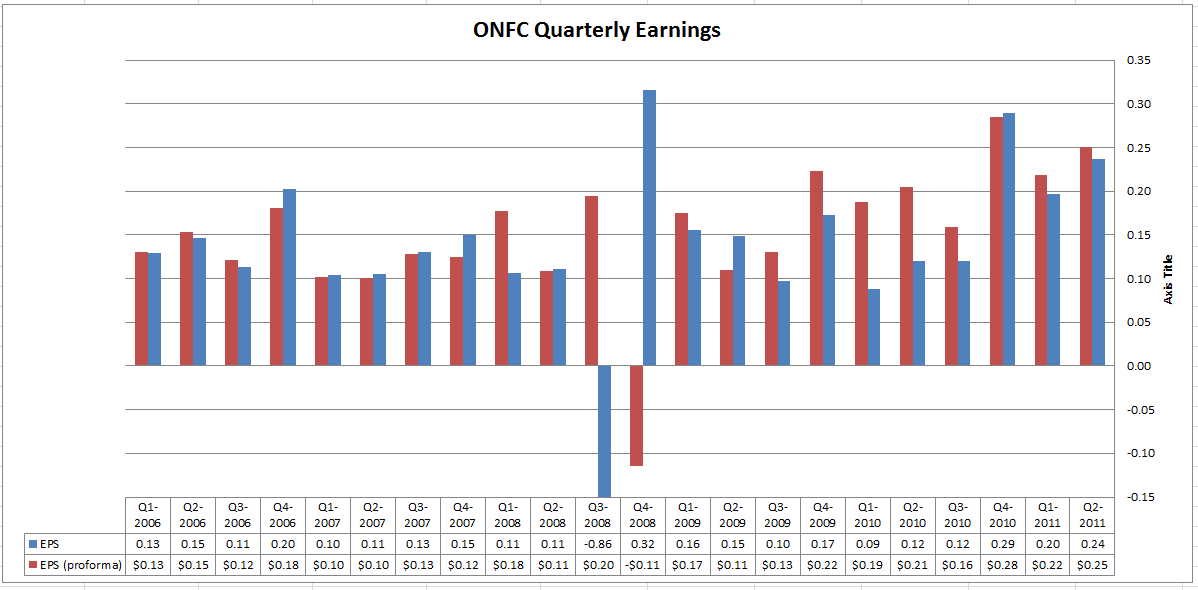
Another strong quarter for earnings.  Oneida earned 24 cents for the quarter.  Stripping out loan loss provisions they earned 25 cents.  Over the past 4 quarters their earnings have been 84 cents basic and 91 cents after stripping out loan losses.  Below is a chart of their earnings over the last 5 years.  There has been a steady upward march over the past two years.

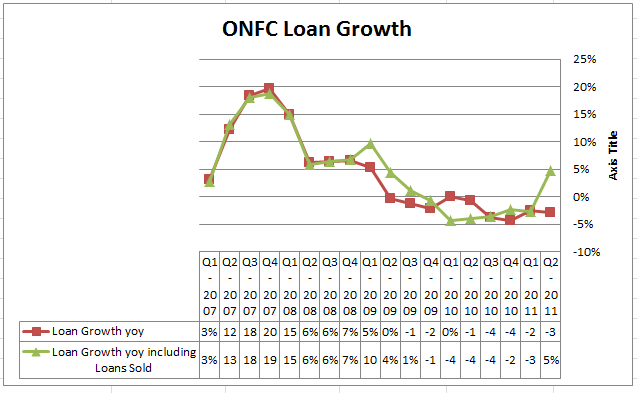
I bought Oneida in part because I thought they were cheap based on earnings power.  They should easily be able to earn a $1 next year, meaning they are trading at less than 9x earnings on a forward basis.  What I have been waiting for is for Oneida to begin to grow their loan book again.  Its been shrinking (albeit at a small rate) since the 2008 debacle.  This looks like it might be starting to change.

Oneida’s loan growth is a bit tricky because they sell of much of the fixed rate loans they generate.  So to get a true picture of their loan generation, you have to add back the fixed rate loans that are being sold off.  Below is a chart of loan growth at Oneida showing both growth before and after accounting for the fixed rate loans sold.  Up until this last quarter loan growth has been negative since Q2 2009.  That changed this quarter with the uptick.

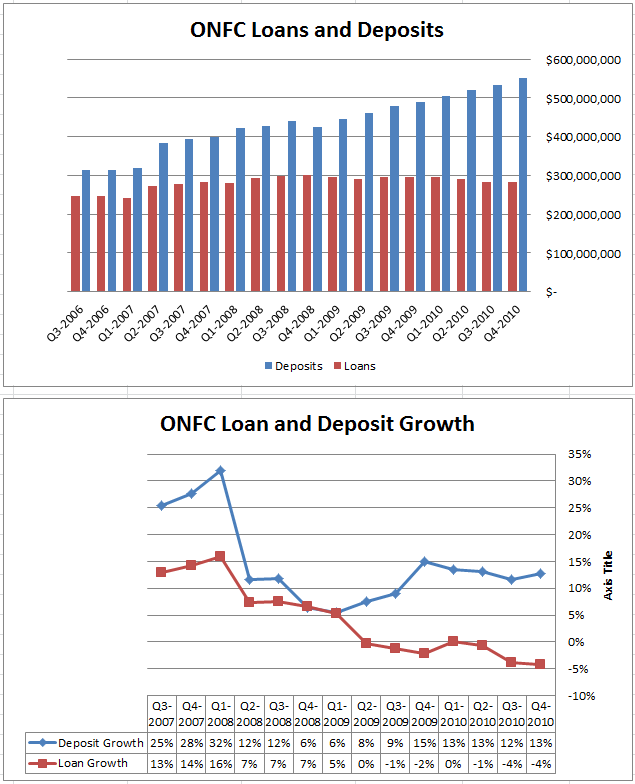
Deposit growth declined somewhat in Q2 from the last few quarters.  Nothing to worry about yet though.


The company continues to sell below book value and tangible book value.  More importantly, book value continues to grow at a smart pace.

Oritani Financial Posts a Solid Quarter

Three banks I follow, Oritani Financial, Oneida Financial and Eagle Bancorp or Montana reported earnings in the last couple days.  I want to look at each, and I will start here with Oritani.

I don’t own Oritani but it is a reasonably priced and well run regional that I follow closely.  Their CEO, Kevin Lynch, has an extremely low tolerance for non-performing loans, which is why non-performing assets are down to 0.50%.

With earnings of 0.52/share the bank is trading at  26x earnings, which isn’t particularly cheap on that metric.

Book value of the stock is $11.45, meaning the bank is trading at 1.13x book.  But not reflected in book is around $50M, or $1/share, in REO (real estate owned).  Now this isn’t foreclosed real estate owned, but instead its JV real estate that the company bought in the past for the purposes of capital appreciation.

The company is showing extremely strong loan and deposit growth.  The loan growth is particularly impressive because so few companies are growing their loan book right now.

Oritani pays a 3% dividend.
The company last presented at the Stifel Nicolaus conference late last year.  Its worth listening to.