Skip to content

Posts from the ‘Rurban Financial Corp (RBNF)’ Category

A look at the Rurban Financial Annual Report

Rurban Financial is quickly becoming my favorite regional banking investment.

Under the retail name of State Bank and Trust Company, Rurban operates 20 branches in Northwest Ohio, servicing the mostly rural communities of Allen, Defiance, Fulton, Lucas, Paulding, Wood and Williams.

I’ve already discussed Rurban in a small amount of detail here.

The company is generating an improving return on equity, improving earnings, and has a reasonably low amount of non-performing assets.

I just finished reading through the Rurban Financial Annual Report that arrived in my mail box a few days ago.  There were a few highlights that I thought were worth noting.

The Ohio Economy

In the CEO Letter to Shareholders, Mark Klein pointed to improvement in the Northwest Ohio economy.  He noted that the downturn in the Midwest economy occured later than in other parts of the country and so the recovery has been likewise delayed, but that signs of recovery are appearing.

Klein also pointed out that Ohio has risen to number one in job creation in the Midwest, and is up to ninth nationwide from 48th a year ago.

As part of a section of the Annual Report titled “Commitments to our Communities” Rurban profiled two farm lending relationships that they have cultivated, as well a tractor parts dealer.  Rurban’s primary clientele is rural Ohio residents and business.  I feel quite confident that grain prices will remain at profitable levels and that opportunities to service these folks will only continue to grow.

The loan book

In 2011 loans outstanding grew by a small amount, from $428M to $443M.  Unfortunately agricultural loans decreased from $40.8M to $38.4M but I would expectt this to pick up in the next year as another year of strong grain prices is under the belts of farmers.

I was pleased to see that the company has no land loans and no contruction loans.

Non-performing assets make up a fairly small 1.77% of total assets.  This is down from 2.87% at the end of 2010.

Increasing exposure to mortgage banking and mortgage servicing

Mortgage banking activity is seen as “exceptionally strong”. One of the attributes of Rurban that I like is that they hold onto the servicing rights of the mortgages they originate.  While these mortgage servicing rights (MSR’s) are not being valued very highly by the market, I expect that to change.

I was surprised to learn that Rurban will not revalue the MSR’s upward if (when) rates begin to rise or defaults begin to fall and, as a result, the valuation model used to put a value to the MSR begins to show increasing value.  As part of Note 1 to the financial statements the company wrote that “the valuation allowance is adjusted to reflect changes in the measurement of impairment after the initial measurement of impairment… Fair value in excess of the carrying amount of servicing assets for that stratum is not recognized.”

Rurban took a beat down because of the valuation adjustment that they had to make to the MSRs that they hold.  The valuation adjustment for the full year 2011 was $1,119,000.  That works out to 0.22 per share of before tax earnings.  Rurban reports the MSR adjumstent within its “core earnings” calculation, so it does not get ignored as is the case for some of the other mortgage servicers like PHH.  I’m not sure why they don’t “ex” it out of core earnings.  Its a somewhat bogus accounting requirement in my opinion.  If an asset can be adjusted up or down 25% in a single year is than you have to question the valuation period.

There has certainly been a move by the company to increase its MSR portfolio.  Below is a graph of the unpaid balance held by Rurban over the past 5 quarters.

Core earnings are increasing and not reflected in the stock price

If you ignore the effect of the valuation adjustment that Rurban has had to take on its MSR portfolio, and you look strictly at the company’s recurring core earnings, you quickly realize that the company’s stock price is not pricing in the full extent of its earnings generation or its earnings growth.
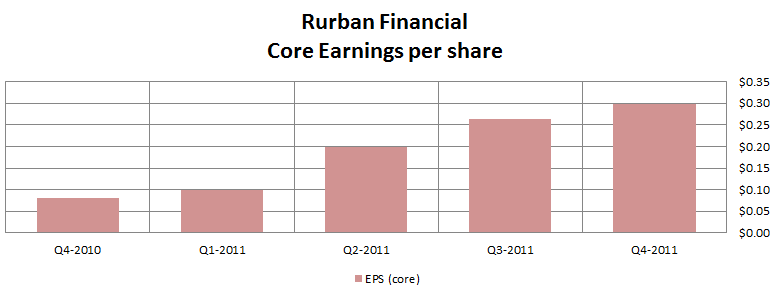
To come up with core earnings I have taken GAAP earnings and made the following adjustments:

  • OREO impairments
  • Goodwill impairments
  • Provisions for loan losses
  • Gains on securities
  • MSR valuation adjustments

Earnings have been improving both because of loan and mortgage business growth as well as because of prudent management of costs.  Looking at the income statement I was struck by the degree of cost cutting that the company has done in the past 3 years.  Looking at salaries and employee benefits, they were reduced from $21M in 2009 to $18M in 2010 and to $14M in 2011.   Similarly, professional fees fell from almost $3M to less than $2M.  Even postage and delivery expenses fell, from $2.1M to $1.1M.

Going forward in 2012, Rurban is going to focus on growth in revenues.  I expect loan totals to increase along with originations.  I expect further increases to mortgage banking activity.  Both of these should drive further improvements in earnings.

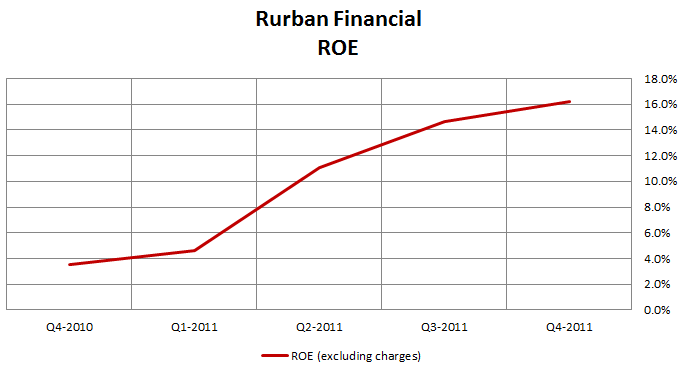
Improving return on equity

In the chart below I am looking at core earnings return on equity, which ignores one time charges and MSR valuation adjustments.
Why doesn’t the market care?

It seems kind of crazy to me that a bank with a solid loan book, decent growth and with earnings that look set to top $1/share in 2012 can be trading at less than $4.  But I guess that is why the regional banking sector remains the trade of the decade.

Listening to the financial news for the last couple of weeks, I am starting to hear some positive comments made about the large money centre banks.  I think this is the first step in the healing process of investor sentiment towards the banking industry.  It may take some time yet, but at some point solid regional and community banks like Rurban are going to benefit from that change in sentiment.

Rurban trades at 4x core earnings and at about 60% of a tangible book value that is valuing their MSR portfolio at an extremely low level.  That just doesn’t seem sustainable to me.  As the cycle turns I would expect to see the company trade at a premium to book value and at a double digit earnings multiple. Both would suggest a share price over $10 per share.


Letter 31: Bank earnings and more bank earnings, lightening up on gold stocks (again) and a soon to come Canaco Magambazi resource

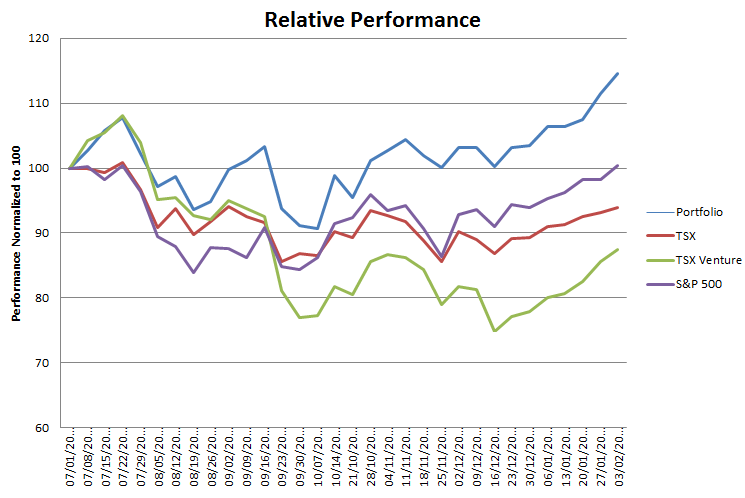
Portfolio Performance:

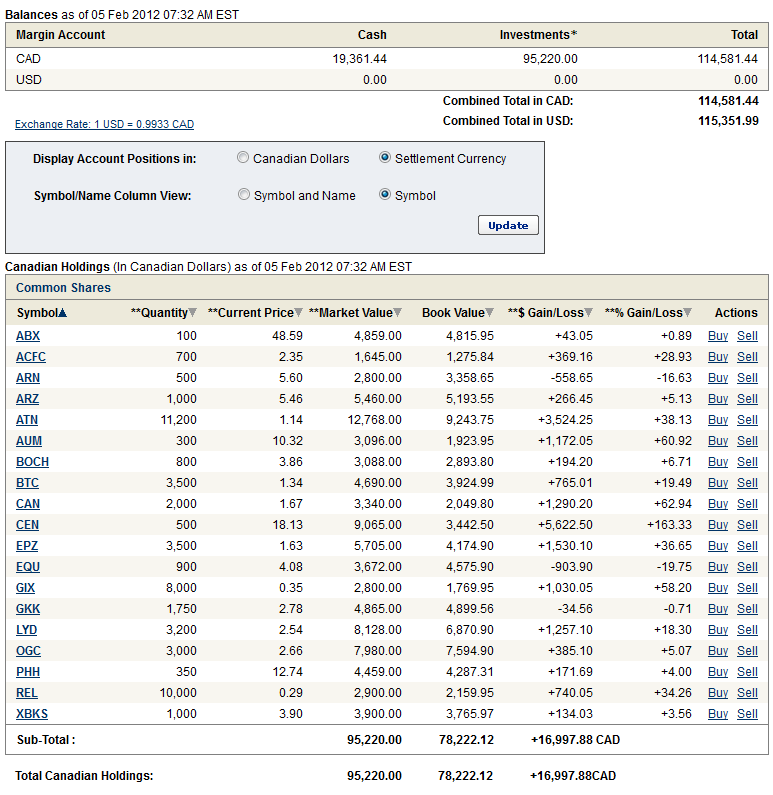
Portfolio Composition:

Waiting on Magambazi…

I have been working most of the week on an evaluation of Canaco’s Magambazi deposit in Tanzania. I was hoping to be finished the work by today but its carrying on and I don’t have a lot of time to finish it today (what with the superbowl and all) so this will be a rather short update, but with a longer, hopefully rigorous analysis of the Magambazi deposit will follow shortly tomorrow or the next day.

Outperformance of the US

Now that is something that I haven’t said in a few years.

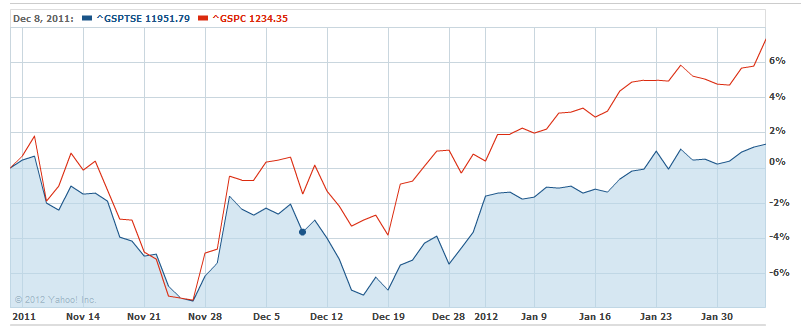
While it was another good week for the S&P and a decent week for my portfolio it was not a great week for the TSX.  Again.  This is becoming a pattern.  Its striking how badly the TSX is underperforming so far this year.  The S&P is up almost 6%, the TSX is up hardly at all.

I have tried to increase my positions in the US-sensitive stocks I own to take advantage of this American out-performance with a particular emphasis on leverage to the mortgage industry.  Most recently, in the last week I added to my positions in Community Bankers Trust, PHH Corporation and I introduced a new position in Rurban Financial Corp.

Rurban Financial Corp

Rurban was  recommended in a comment (by Robert) to my post last week.  I did a quick look at the company, which released 4th quarter earnings on Monday, and they do indeed look cheap.  And while I haven’t had a chance to take a close look at their prospects, I’d liked what I saw on the surface, so I bought a small starter position.

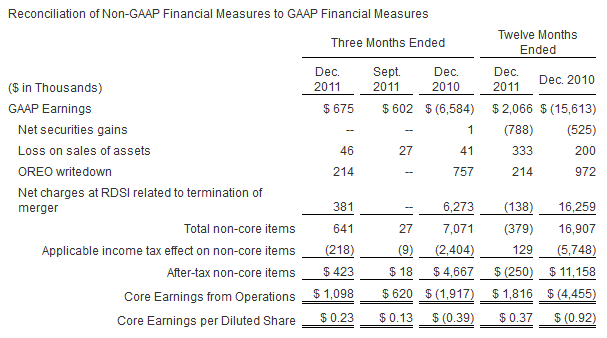
The company produced earnings ex a one time merger charge and ex OREO losses of 23 cents per share in the 4th quarter.

Now I admit I have not dug into Rurban to the point that I need to (this Canaco resource estimate has been all consuming of my spare time).  I plan to do that in the next week.  I’d like to put together a comparison of Rurban and Community Bankers Trust and perhaps Bank of Commerce Holdings (both of which I will touch on below) side by side to better evaluate Robert’s legitimate skepticism in BTC.

Community Bankers Trust 4th Quarter Earnings

And speak of the devil, they released 4th quarter earnings on Tuesday.  I thought the numbers looked pretty good. The quarter was summed up by the following statement from CEO Rex L. Smith III:

“Our goals for 2011 were to make major improvements in our problem assets and to rebuild the fundamentals of the core bank, and I am pleased to report that we accomplished our goals. Both nonaccrual loans and net charge-offs saw continual and substantial declines throughout the year. At year-end our ratio of nonperforming assets to loans and other real estate was at its lowest level since the first quarter of 2010. Additionally, the fourth quarter showed a strong increase in new loan production in our targeted growth areas. All of this occurred while we lowered noninterest expense for the year by 21%.

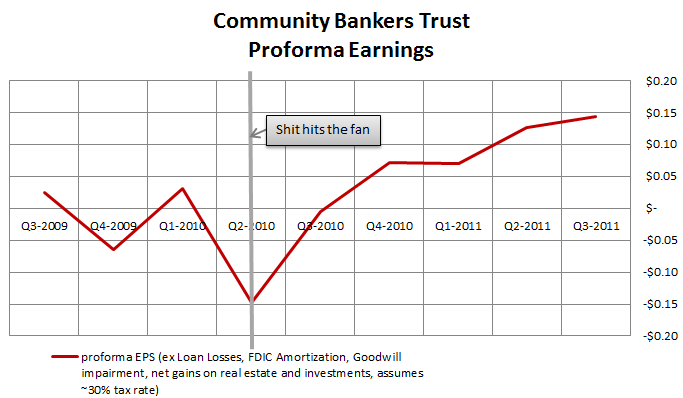
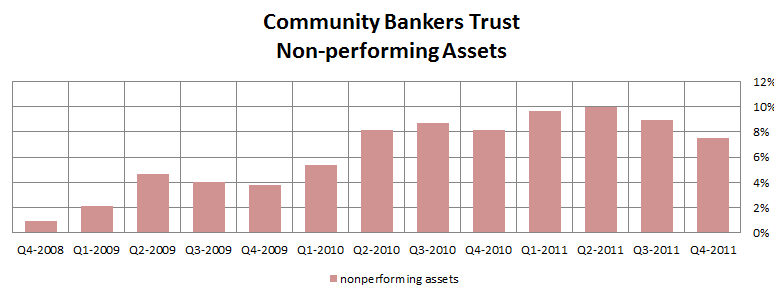
Let’s step through some of the key metrics and update the graphs I showed last week with the 4th quarter numbers.

Pro-forma earnings (that is earnings before the FDIC amortization and before any one time hits to investments and real estate owned) were strong in the fourth quarter, coming in at 14 cents per share.  Again I think the bank has a lot of earnings power going forward once (if) it is able to bury its past misdeeds.

Equally important, nonperforming loans were down again in Q4.

The only negative I saw for the quarter was something I have seen a lot of with the banks reporting fourth quarter results thus far.  Net interest margin is on its way down.

Banks are struggling with the headwind of low interest rates.  Basically,  purchasing non-risky securities (ie. Treasuries and government backed MBS) means accepting extremely low returns.  As older securities mature and roll off the books they are being replaced by low yielding new securities.  Of course this is exactly what Bernanke is looking for to try to get the banks lending again.  That seems to be working in the case of BTC, as loans originated was up in Q4.

Bank of Commerce Holdings 4th Quarter Earnings

I wrote a short piece ofter my purchase of Bank of Commerce Holdings about two months ago.  Since that time the stock has risen about 15%, so its been an okay purchase but nothing exceptional.

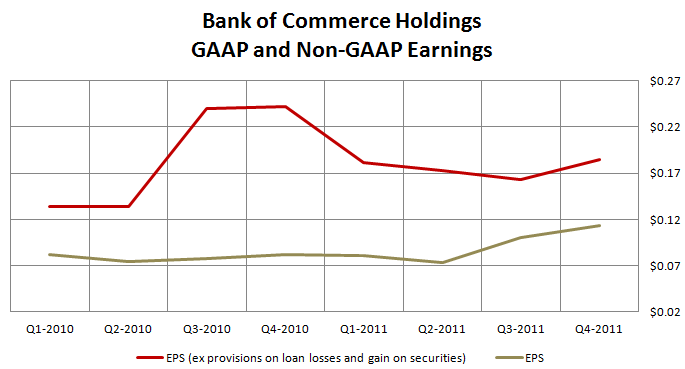
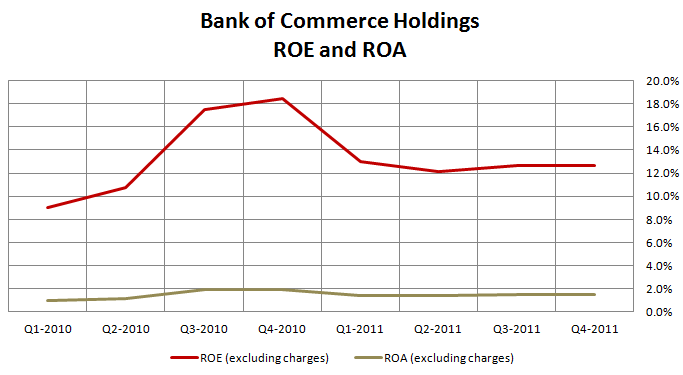
I have yet to really evaluate the stock in the kind of depth I need to.  I hope to get to that in the next week.  In the mean time I have been compiling the basic statistics to do that evaluation.  The company came out with another data point on Tuesday when they released their 4th quarter earnings.  I would call it a mixed bag.  On the bright side the company showed another strong earnings per share number when you ex-out the one time hits, and ROE and ROA also showed strength on a proforma basis.

Note that my estimates of ROE and ROA exclude provisions from loan losses, losses on real estate owned and one time investment gains so they are somewhat higher than the posted numbers in the news release.

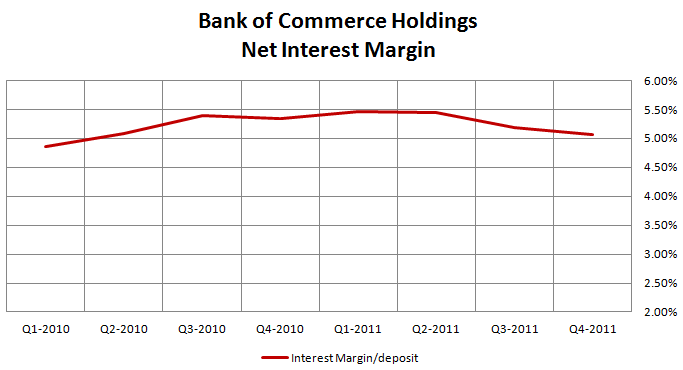
On the negative side the company struggled in much the same way as Community Bankers, posting a lower Net Interest Margin quarter over quarter.

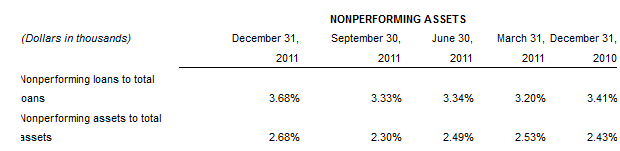
Perhaps more worrying is that nonperforming loans are rising.

I’m not sure about Bank of Commerce Holdings.  I don’t have a large position in the stock.  I don’t love where the bank is based (around Sacramento California) and I don’t like how non-performing loans are rising at all. As CalculatedRisk pointed out recently, there aren’t any signs of things improving in Sacramento yet.

The percent of distressed sales in Sacramento was unchanged in November compared to October. In November 2011, 64.1% of all resales (single family homes and condos) were distressed sales. This was down slightly from 66.1% in November 2010.

I’m going to evaluate it closely and turf it if I don’t see a strong story being written that will lead the company back to the $6+ level.

I need to understand gold better

Early in the week the gold stocks and the bullion looked to be breaking out together and there was a hope (at least in my mind) that it was for real.  Then the Friday employment number came out and presumably frightened everyone about the prospects of inflation and the gold price dropped 1.8%.  Some of the gold stocks got hit much harder.  I’m not willing to find out if this is a blip or another true correction; I reduced my trading positions in Aurizon, Canaco, and OceanaGold (though as you will note at the end of the post with respect to my weekly practice account trades, I mistakenly bought rather than sold OGC.  This is something I will have to rectify on Monday).

What I need to do to gain some lasting confidence in my gold stock position is gain a better understanding of the supply/demand dynamic right now.  I’m flailing a bit here and I’m fully aware of it.  But there are a number of headwinds happening here that I don’t want to ignore:

  1. The lack of Indian demand brought on by the strong rupee
  2. An improving US economy will mean higher interest rates eventually
  3. The ETF has become such a big part of demand and I wonder how much of those holders are “weak hands”

The problem is that while I believe in gold in the long term, I also know that a lot can happen in the interim.  Rick Rule was pointing out a few months ago how in the 70’s and early 80’s, when gold rallied from $35 to over $800, it also had a number of corrections, including one of over 50%.

My lack of clarity in understanding just what is driving gold at the moment (and whether in the short term, particularly given that the seasonality effect is about to turn against the metal, it remains sustainable or not) is leading me to these short term in’s and out’s with OceanaGold and to a lessor extent Aurizon.  Gaining back some clarity, and with it hopefully some more certainty in my decisions, is another endeavour I hope to accomplish in the next week.

Speaking more company specifically, Atna remains the strangest bird of the bunch in the gold stock sphere.  It consistently outperforms (even goes up) on days when other gold stocks are going down and then does nothing (or goes down) when all the other gold stocks are up.  I don’t understand the stock for a second, though I am happy that the trend in the stock is, to borrow the phrase from Dennis Gartman, from the lower left to the upper right.

My soon to be complete Canaco Magambazi Estimate

In a next day or so I will be posting my interpretation of the resource estimate at Mogambazi.  I basically have went through the deposit, cross-section by cross-section, and evaluated the resource using a rough block model.  I thought it would be a fun project, and it has been, but its also been a lot of work.  My tools consistent of Visio, Excel and the screen capture tool snip-it, and my main resource to educate myself has been google, so its been a bit of a process.  Still, I’ve learned a lot and have become developed a better understanding of what Magambazi is (both the good and the bad) which I think will allow me to act prudently on it in the future.

So stay tuned for that.

Weekly Trades