Skip to content

Posts from the ‘Sotherly Hotels (SOHO)’ Category

Week 210: All about the 5-baggers

Portfolio Performance
week-210-yoyperformance

week-210-Performance

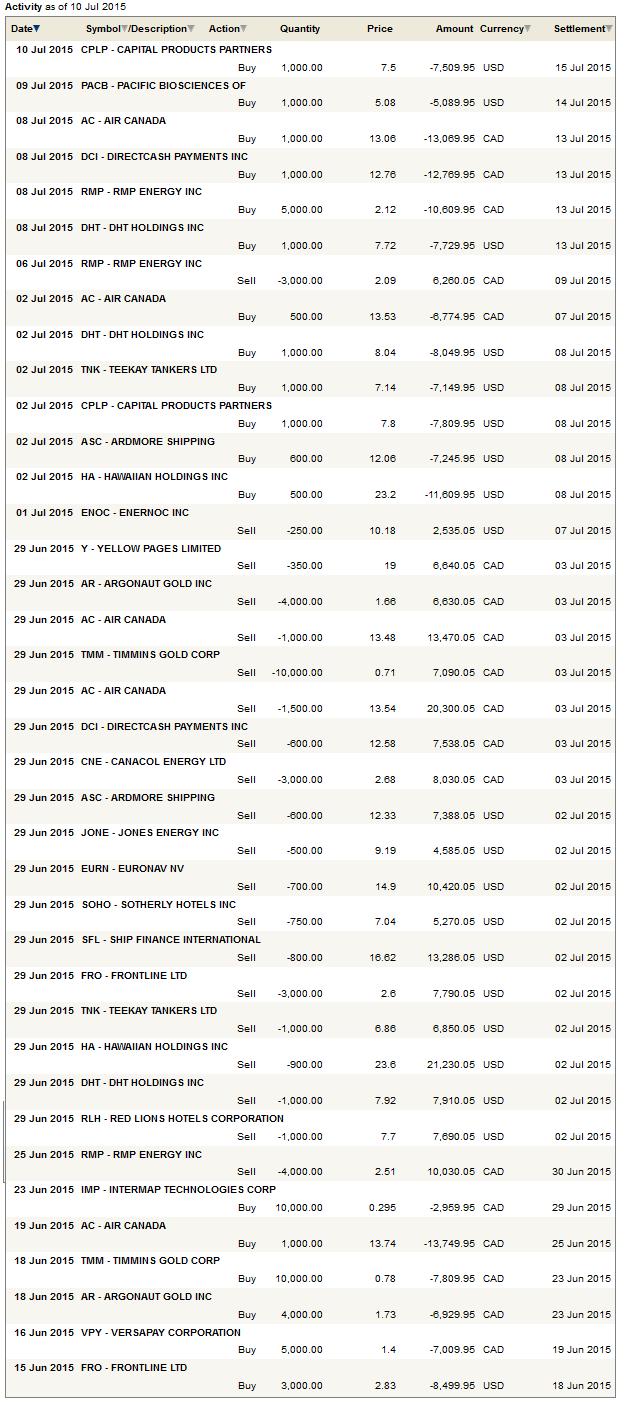
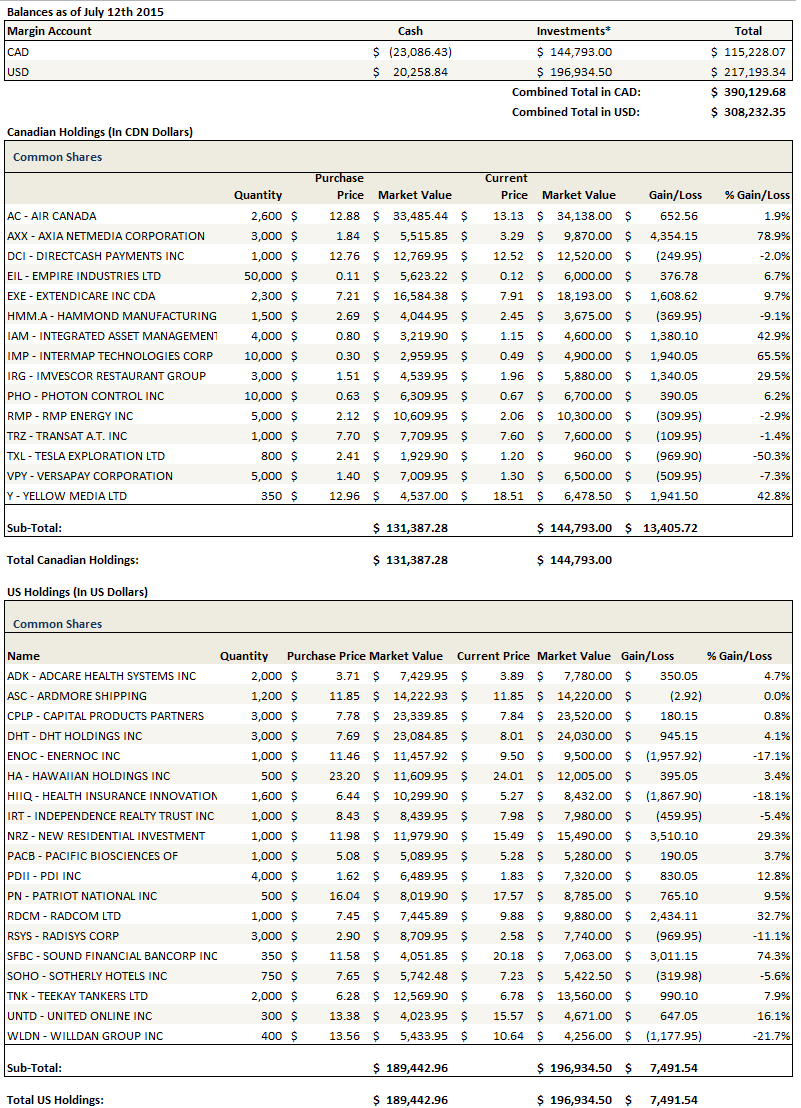
See the end of the post for the current make up of my portfolio and the last four weeks of trades

Monthly Review and Thoughts

A few weeks ago I was talking to someone who works at a large fund.   He was telling me about a retail clothing chain that their fund was interested in.  To help evaluate the opportunity, they commissioned a research firm to canvas and scout locations across the country.

That is amazing intel.  It is also wholly impossible for me to replicate.

I generally have a pretty good idea about a business before I buy into it.  I do a lot of work up front, far more than the highlights that go into these posts.  But I’m always left with elements that are uncertain.   For an individual investor with access to limited information and with limited time, certainty about one’s beliefs is more hubris than reality.

In the face of such disadvantages, my strategy is to take smallish positions and add to them if they begin to work out inline with my expectations.  If they don’t, I cut them.

By keeping my positions small until they start working and cutting my losses before they get big I guard against the big hit to my portfolio.  On the winning side of the ledger I generally end up with a similar number of winners that cancel out the losers.  But I also end up with 2 or 3 big winners that lead to out-performance.

It’s the 5-baggers that make the engine go.

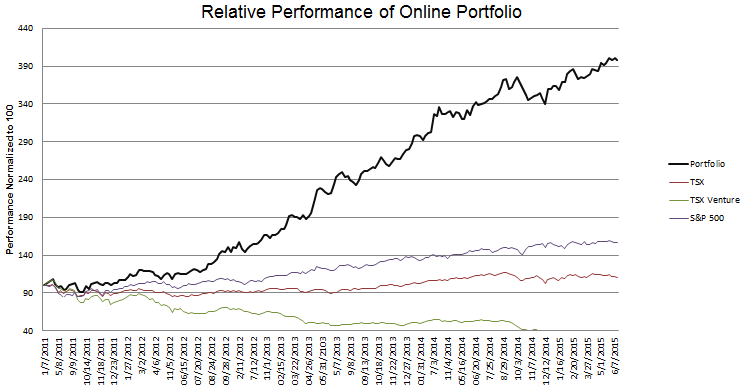
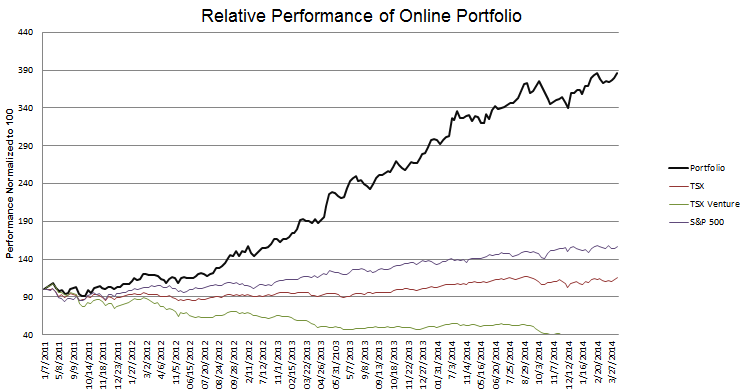
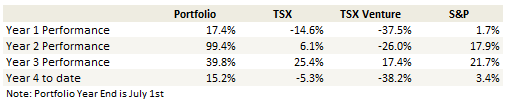
Another portfolio year has passed (I started writing this blog on July 1st 2011) and you can see from the results that the last year was not as good as the previous few.  I still did better than the market, but I didn’t do that great.

In part the under-performance was caused by not sticking to my rules.  I have already rehashed my failures with Bellatrix and other oil names in past posts so I won’t go into that again here.

But I also attribute it to my lack of “5-baggers”.  I haven’t had a big winner in the last 52 weeks.  I’ve had a lot of good picks (Air Canada, Axia NetMedia, PNI Digital, Extendicare, Radcom, Rex American, the second go around with Pacific Ethanol and so on) but only one true double and nothing that tripled or quadrupled.

Realizing how important multi-baggers are I’m sending myself back to the drawing board.  I’m not sure why I’ve failed to discover the big movers over the last year.  But I suspect that it is at least partially due to ignorance of the sectors that have had the momentum.

Up until recently I never owned a bio-tech.  I’ve stayed away from technology in all but a few exceptions.  I’ve only been in healthcare on a couple of occasions (one of those being Northstar Healthcare, subsequently Nobilis Health Corp, which I rather amazingly sold last October, at no gain or loss, literally days before it began a climb from $1.20 to over $10 in thee next six months).  Yet these sectors are where the big winners have been.

My attitude towards these and other outperforming sectors is going to change.  I have invested in a couple of bio-techs and in technology (shorts mind you, as I will explain later) and in the last couple of months.  More new ideas will follow.

What I Sold

Usually I discuss my new positions next.  While I have a couple of these, they are not significantly sized and my actions have been more weighted to the sell side of the ledger, so it seems appropriate to discuss what I sold first.

As I tweeted on a couple of occasions I have been skittish about the market over the past month and a half.  I sold out of some positions and reduced others when Greece went on tilt and announced a referendum two weeks ago.

Since that time as my worries have subsided I have bought some of those positions back. It doesn’t look like an immediate contagion is upon us, which was my main concern.  Still I’m keeping a healthy amount of cash (20%) and where I can I am short a number of stocks.

In what turned out to be an unexpected consequence of my recent research expansion, over the past month I spent a lot of research hours looking at short opportunities. Trying to take more of an interest in tech, I read through reports describing the state of business and dynamics at play in everything from telecom infrastructure to smartphone.  As I did I felt most of the near term opportunity was on the short side, and so I took positions there.

My tech shorts have been based on three-fold expectations: PC sales are declining faster than consensus, smart phone sales will grow slower than consensus, and rumors that the big data build out by cloud providers has been overdone will prove to be true and future spending will be scaled back.  Without going into the individual names, I’ve stuck mostly with the big players and mostly with semi-conductor providers, which seem to be the most susceptible to spending downturns.

I think however that this play has almost run its course.  I have been taking off some positions heading into earnings (for example I was short Micron going into their June quarter but took it off the day after earnings were announced), and plan to exit my remaining positions as earnings are released.  I don’t like to hold short positions too long.

While I have yet to take any short positions in healthcare, I get the feeling that the recent merger mania may be leading to valuations that prove difficult to justify once the feeding frenzy subsides.  I note that a top pick of Jerome Haas, who I have followed and found to be a solid thinker, was a short on Valeant Pharmaceuticals.

In my online portfolio, in which I cannot short, I sold out of my gold mining shares, my oil stock shares, some of my tanker shares (Euronav and Frontline), a hotel play (Red Lion), reduced my airline exposure in both Air Canada and Hawaiian Holdings as well as my Yellow Pages and Enernoc positions.

I also sold out of DirectCash Payments, though I subsequently added the position back later (at about the same price).  I really want to hold this one through earnings because its been beaten down so far and I still have doubts as to whether the first quarter is the secular harbinger that the market seems to think it is.  In the turned out to be an unexpected consequence of my recent research expansion

Similarly, while I sold out of RMP Energy, I bought it back (at a lower price) because I want to see their quarter before giving up on the stock.  Like DirectCash Payments, I question whether results will be as dire as the market suggests. In the same segment of his BNN appearance Haas also made DirectCash Payments another top pick.

I only added to a couple of positions in the last month.  Patriot National continues to execute on their roll-up strategy, buying up smaller insurers at accretive multiples.  The stock is up 40% from my original purchase (though in the online portfolio I forgot to add it when I originally mentioned it so its up somewhat less there) and I decide to add to the position since its working out.

Second, I added to my position in Capital Product Partners on what I believe is unwarranted selling on Greece.  The company is incorporated in the Marshall Islands, does not pay Greek taxes but does have offices in Greece, which is at the heart of the sell-off.  A scan of the company’s annual filings shows that their exposure to Greece is potentially some deposits in Greek banks and the risk that one or more of their subsidiaries could face higher taxes.  I don’t think that correlates to the 20% plus sell-off in the share price.

I also added two new positions to my portfolio.

Intermap

I have followed Intermap for years.  Its a company that my Dad owned. While it always held out the promise of a significant revenue ramp Intermap could never quite figure out how to monetize their world class geo-spatial data.

Then, a couple of weeks ago, the company signed a large contract with unnamed government for the implementation of a National Spatial Data infrastructure program.

For years Intermap was primarily a mapping services provider.  They owned 3 Lear jets equipped with radar technology that scanned and mapped large swaths of terrain.  They would land contracts to map out a country or region and be paid for providing that data.

The company always kept the rights to their mapping data and, over time, Intermap compiled a database of geospatial data for a large part of the earth.   This spatial database became a product called NextMAP.   The database can be accessed through commercially available GIS software like ArcGIS or web browser apps developed by the company. Customers can license either parts of or the entire NextMAP database for their use.

The latest version of the database, called NextMAP World 30, is “a commercial 3D terrain offering that provides seamless, void free coverage, with a 30meter ground sampling distance, across the entire 150 million km2 of the earth’s surface.”

Intermap has always had a leading technology.  But they have struggled with coming up with profitable ways of marketing that technology.   Over the last three years the company has been working on applications that can be layered over their basic mapping data.  They have a program for analyzing the risk of fires and floods (InSite Pro), a program for managing hazardous liquid pipeline risk (InSite Pro for Pipelines) and a program for assessing outdoor advertising locations (AdPro).

None of these niche solutions have resulted in significant revenue to the company.

The carrot has always been that they land a large government contract for the full implementation of a geo-spatial solution for the country.  Most investors have given up on this ever happening, but then it did.

The announced contract is for $125 million over two years, during which time Intermap will implement the infrastructure solution.  This will be followed by an ongoing maintenance contract valued at $50 million over 18 years.

When I saw the number on the contract I knew immediately that the stock would jump significantly.  Including warrants and options Intermap has 127 million shares outstanding.  So at the closing price the night before the deal was announced the market capitalization was around $10 million.  When it opened around 25 cents I figured the upside was only about half priced in, so I jumped aboard.

The implementaton of a full geo-spatial solution as per the contract will involve the implementation of the company’s Orion platform, which includes the company’s NextMAP data integrated with other relevant third party data and with applications for accessing and analyzing the data.   The platform will be used to help with decision making with infrastructure planning, weather related risks, agriculture, excavation, and national security.  Because this is basically a new business for the company, its difficult to peg margins or profitability.  So I’m not going to try.

Nevertheless, just based on the rough assessment of what $125 million in revenue would mean, at this point, with the current stock price of 50 cents the contract is probably mostly priced into the stock.  I maybe should have sold on the run-up to 60 cents, but I decided not to.

The company has suggested in the past that they have a number of RFPs in the works and some of those they have already won but cannot announce until funding is secured.  The upside in the shares is of course a second contract. That could happen next week or next year.  Its impossible to predict.

The other consideration, and something I have always wondered about, is why some large company doesn’t pick up Intermap for what would amount to peanuts, securing what is truly a world class data set and a platform that would seem to be more valuable in the hands of a large company with the resources to sell large projects to governments.  Somebody like an IHS comes to mind.

Pacific Biosciences

This investment idea is a little out of my normal area of expertise and consistent with my desire to expand my investing horizons.   Its an idea I came up with after reading  this Seeking Alpha article which I think does a good job explaining the trend we are trying to jump on.

PACB has 74 million shares outstanding, so at $5.20 (where I bought it) the market capitalization is $385mm.   The company has $79 million of  cash and investments and $14 million in debt.

They are in the business of gene sequencing.  Pacific Biosciences sells gene sequencing machines and related consumables for running tests to map an individuals gene in hopes of detecting a mutation that will diagnose the future susceptibility to disease.  The machine of course is a one-time sale but the consumables are a recurring revenue stream so the business has a bit of a razor-blade type revenue model to it.

The big player in the gene sequencing arena is a company called Illumina.  This is a $30 billion market cap company that did nearly $2 billion in revenue last year.  They dwarf Pacific Biosciences, which did around $60 million of revenue last year.

In fact I read that Pacific Biosciences has only sold around 150 machines.  One interesting thing from their presentation is that for each of the machines Pacific Biosciences sells, they generate about $120,000 of consumable sales a year.   Thus the opportunity for significantly higher recurring revenues is there if they can sell a few more machines.

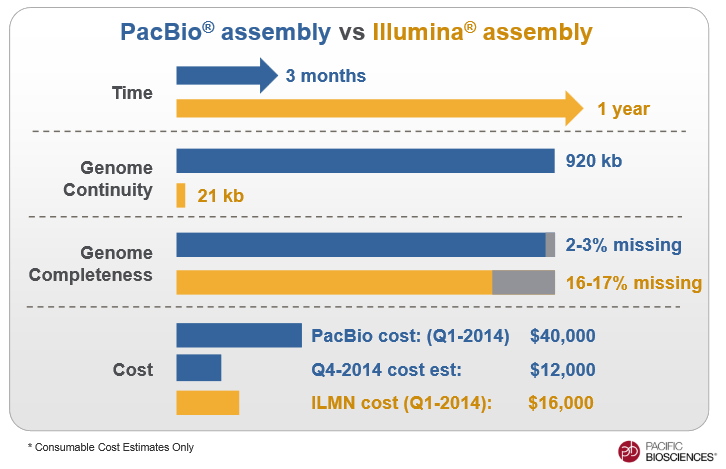
What seems to set Pacific Biosciences apart from Illumina is that their technology produces much longer gene sequencing strings which results in far lower error rates.  Below is a comparison between the two.
comparisonilluminaOne thing I am not sure of is where Pacific Biosciences sits compared to some of their non-public competition.  I was reading through some of the comments on a site called Stock Gumshoe that suggested that some private competition may have as good or better sequencing technology.

Pacific Biosciences also has an agreement whereby Roche will market their product for the diagnostics market in 2013.  In May Pacific Biosciences met the second milestone of that agreement.  The only thing that is a little disconcerting about this agreement is that Pacific Biosciences did not announce how much revenue they would be giving up once (and if) the product is commercialized.

My bottom line is that there are enough interesting things going on for me to speculate in the stock.  The key word being speculate.  There is a chance of wider adoption, there is a chance of an expansion of their relationship with Roche, there is maybe even an outside chance of a takeover.  And its an industry that is clearly growing, is in investor favor, and the stock was at a 52-week low when I bought it.

But I will flatly state that I would not take my comments about Pacific Biosciences too seriously.  My knowledge of this industry remains weak (though its improving as I read more).  They could be, or maybe even have been, surpassed by competition and I would not be the first to know.  So we’ll see how this goes and chalk up any loss to the cost of education.

Portfolio Composition

Click here for the last four weeks of trades.
week-210

Week 197: “Make your money while you can”

Portfolio Performance

week-197-yoyperformance

week-197-Performance

See the end of the post for the current make up of my portfolio and the last four weeks of trades

Monthly Review and Thoughts

On Thursday, while I was surfing around the web over lunch hour trying to figure out what I wanted to write about this month, I stumbled on a YouTube clip of Neil Young being interviewed on Charlie Rose. He describes what he thinks of Bob Dylan’s song writing (the quote in the title of this post is attributable to the Dylan song Rambling, Gambling Willie).  Young observes the source of inspiration that leads to a great song.

The argument about whether investing is an art, a science, or just a mundane business is one that depends as much on who is making the argument as it does on an objective reduction of its reality.  Investing has elements of all three and it’s essence is whatever one associates with best.  I stand firmly in the camp that it is an art, and I think that for the kind of shooting star sort of performance I try to achieve it is that hard to put your finger on source of inspiration that leads to out-performance.

Maybe I am being too bold to analogize the making of a great song and the development of a great investment idea but as I stand back from both I do note some common characteristics. Both tend to be built on their historical predecessors, both stand in deference to the structure they abide in and, when done correctly, both live within the bounds of their genre’s common sense.  At the same time each has to extend outside of that imposed limit just enough to see what is not easily seen, but not so far as to drop off the cliff of abstraction or dogma.

Most importantly though is that both are built upon a sensibility, one that is hard to put your finger on but nevertheless is there.  Being more of a word guy, I can describe this best with lyrics; when you hear something that is right, you just know it, even though you might not know why.  You can try to break it down to the linguistic structures, cultural context and the feelings it invokes, but I don’t think you will ever quite get to understanding.  The right phrase in the right spot is right because it just clearly is, and if you happen to be possessed by the inspiration that Neil Young describes you will discern that and act accordingly.

The sensibility on which an investing idea is based is no less complicated, no less abstract, and I would argue no less difficult to reduce down to its essence.  But if you are in the groove, you just know that a good idea is good before you even know why.

Two Interesting BNN Segments… the first on the market

I listen to a lot of BNN clips.  I will have them on in the background as I’m doing research.  Most of it is not helpful and I’ve become deft at tuning out the noise.  But every so often I hit upon a gem.  I came across a couple of those in the last month, with the first being this segment on market performance.

I can’t figure out how to embed a BNN video for the life of me so here is the link to the segment.

The theme is the performance of small cap stocks, and in it Jonathan Golub describes his thoughts on the small cap sector.  The really interesting part is in the last minute, where Golub notes that in the average year that the economy is not in a recession you will see 16-18% gains in the stock market.  But when we hit a recession you “lose all your chips” and the average loss is 35%.

A couple of points here.  First, this exemplifies something I have been saying, that one has to get while the getting is good but be ready to get out when it ends.  There is no hiding when the tide goes out.

Second, this is relevant to what we are seeing right now.  All of the gnashing of teeth over valuations and the lack of a correction forgets that the stock market rarely makes a sustained move down when the economy is expanding.  But once the economy begins to contract the moves down are exaggerated when compared to the amplitude change in growth.

In the mean time there are always ways to justify valuation. Right now the most common one is that with interest rates low, inflation expectations non-existent, so ergo a future dollar is worth more than it has been in the past.  Therefore, paying a higher multiple for that future dollar of earnings is justified.  This logic, which like all justifications contains both germs of truth and seeds of failure, can be used to rationalize stock prices to these levels and probably a lot further.

… and the second on oil

Over the last couple of months I have picked away at position in oil stocks on weakness and at this point have accumulated positions of a decent size in RMP Energy (RMP), Rock Energy (RE), Canaco (CNE), Jones Energy (JONE) and most recently DeeThree Energy (DTX).

There are still plenty of analysts and much of the twitter universe posturing for a further decline in oil and with it a commensurate drop in the oil stocks.  I don’t know about oil, it may fall if the storage concerns are real, or it may not, but I do think that barring some further shock (ie. a demand shock brought on by a recession) we have seen the lows in the stocks.

It doesn’t make sense to me that oil stocks (at least the one’s I own) will fall to new lows even if the price of oil does drop further.  I understand there are leveraged companies that can ill afford further whittling of their cash flow and for those names sure I can see further declines.  But for well capitalized companies, I just don’t buy the idea that further panic will engulf them and send them down further.

To think that is to embrace the idea that an oil stock price should be based on the current price of oil.  That’s crazy.  Nothing in the stock market is priced off of current prices.  If it was, shipping stocks would be trading at 3-4x what they are, Pacific Ethanol would have gotten to $50 for crashing all the way back down to $5, I could go on.  Oil stocks, like everything else, go up and down based on the expectation of future business.

Turning again to a BNN clip, Eric Nuttall was on Market Call last week and he had some interesting observations about the oil market.

The four important data points that Nuttall provides are:

  1. US company capital expenditures are expected to be down 40-50% in 2015.
  2. Production has already seen monthly declines in Eagleford and Bakken
  3. The natural decline in the US is 2mbbl/d per year
  4. Weatherford was recently quoted of  saying that international capital expenditures have fallen by 20-25% and that as a result they expect production ex-US and ex-Canada will fall by 1.5mmbbl/d in 2016

I think there is a growing understanding that prices are too low to support stable production levels worldwide and that we will soon (in the next 9 months) see the impact of this as supply turns down.  Without getting into too many details, I have seen enough declines of Eagleford and Bakken wells to know that these fields are not eternal springs of flowing oil.  We are already seeing the first signs of declines in these fields.  And the natural gas analogy is flawed; there is no such thing as associated oil, so there will be no analogy to the associated gas (and of course the Marcellus) that led to the strong production from natural gas even as rig counts fell.

What I find ironic is that many of the same names who derided oil companies for not producing free cash at $100 are somehow confident that production will remain high at $50.  It seems like a rather bizarre confluence of opinion to me.

But most investors are beginning to realize that well financed oil companies will soon be making significantly more cash flow than what is implied by plugging in the current spot.  So I don’t think we see new lows in names like those I own, or if we do it is going to be an operational catalyst (see RMP Energy for an unfortunate example), not a general malaise.

Portfolio changes

I did not make a lot of portfolio changes over the last month.  The few things I did do was to add two more shipping companies to my basket of tanker stocks, and a cheap little hotel REIT trading well under net asset value.  I will discuss each below:

Ardmore Shipping

As I watch my tanker trade finally start to pay off, in the last month I added three new tanker stocks, Euronav (EURN), Tsakos Energy (TNP) and Ardmore Shipping (ASC).   There was a good Seeking Alpha article on Tsakos, which is available here, and I’m still stepping through my research into Euronav, so I will focus my discussion here on Ardmore.

Both Ardmore and Tsakos allowed me to dip my toes into the product tanker market.  Up until now I have focused my purchases on crude tanker companies.  However, with oil prices low demand for oil products (gasoline, heating oil, jet fuel and the various chemical product inputs) should be strong.  While Tsakos Energy has a diversified fleet with 30 crude tankers and 29 product tankers, Ardmore is a pure play on the product tanker market with a fleet consisting of only MR tankers.

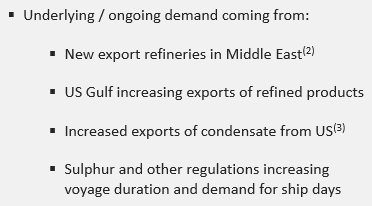
In addition to the demand story, Ardmore listed the following reasons to expect strengthening demand in the product tanker market.

demanddynamic

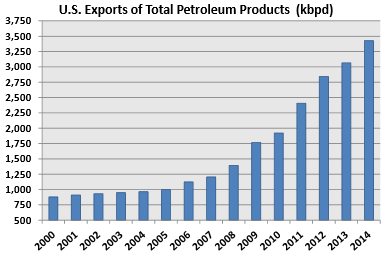
The following chart is from the Capital Product Partners corporate presentation, and it illustrates the extent to which point 2 from above is asserting itself:

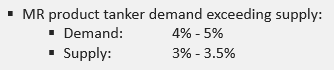
USexportsOn the supply side, Ardmore sees demand outstripping supply in the medium term:

supplydynamic

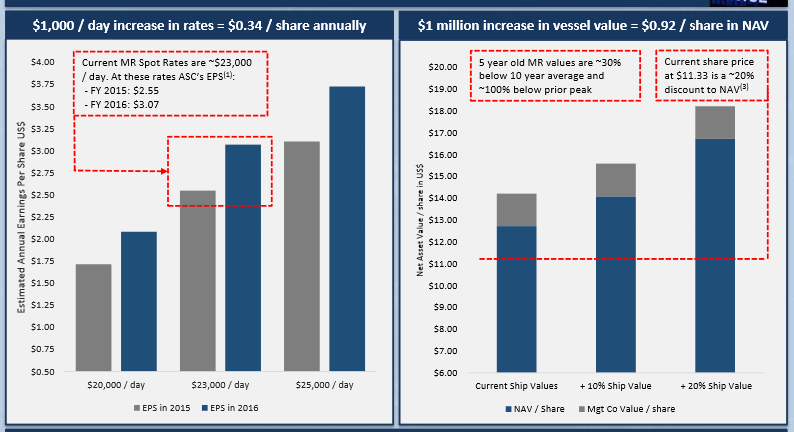
So the supply/demand situation is favorable.  But what really drew me to Ardmore is their valuation.  The company provided the following charts on Page 7 of their January presentation.

earningspotential

Right now MR spot rates are above $23,000 per day.  From the above slide, the company is saying they expect to earn at least $2.55 per share with rates at current level, and the stock trades at a little more than $10.

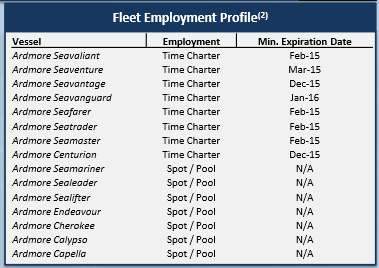
Ardmore owns and operates exclusively MR2 tankers (mid-range tankers).  They have a fleet of 24 tankers including 10 new builds that will delivered throughout this year.  The fleets average age is only 4 years.  Their operating fleet is almost entirely on spot or short term charter.

fleetWhile Ardmore looks cheap on an earnings basis they are also reasonable on a net asset value basis.  According to their January presentation Ardmore is priced at a 20% discount to net asset value.

I still like the crude tanker story more than the product tanker story, and indeed my bet on tankers is severly skewed to the crude tanker side (I know, DHT, TNK, EURN, FRO, and NAT on the curde side).  Nevertheless I do think there is upside in both and that Ardmore is a solid way to play the product tanker side.

Capital Product Partners

While Capital Products Partners was one of the first tanker stocks I bought, but I haven’t written much about them and so, since I’m talking about the product tanker market in this post, I wanted to give them a bit of space here.

Capital Product Partners differs from the other tanker plays that I own in that it is not a direct play on the spot market.  Every vessel that the company owns is chartered out for the long term, with some of those charters lasting upwards of 10 years.  Capital Product Partners also differs from the other positions in that it is a dividend play.   The company distributes virtually all of its available cash flow in dividends and markets itself to dividend investors.

Yet even though the company has very little exposure to the spot rate, I still look at this as a play on nearterm tanker market fundamentals.  The idea here is that as rates prove themselves durable, investors will become more comfortable with the dividend sustainability of the company and perhaps anticipate increases to the dividend.  The shift in sentiment should lead to capital appreciation, which when combined with the 10% dividend that the company pays will need to a nice overall return.

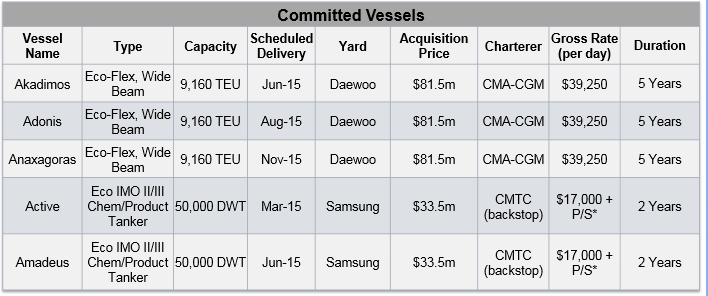
Capital Product Partners is primarily levered to the product market.  In all they have 18 product tankers, 4 suezmax tankers, 7 containers and 1 capesize dry bulk vessel all with period employment.  Their fleet is fairly young with an average age of 6.5 years (their MR fleet is on average 8.3 years old). In addition they have 3 container vessels and 2 MR tankers being delivered in 2015, all of which will be on long term contract:

newvessels

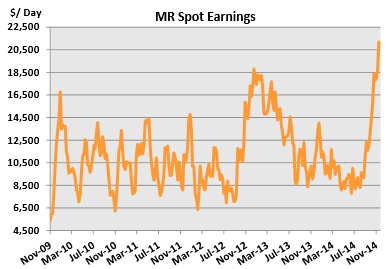
In their corporate presentation, the company provides a chart giving some historical perspective to current MR rates.  As you can see, MR spot rates are higher now than they have been in some time, and since the chart was published, rates have gone higher still and are now in the $25,000 per day range:

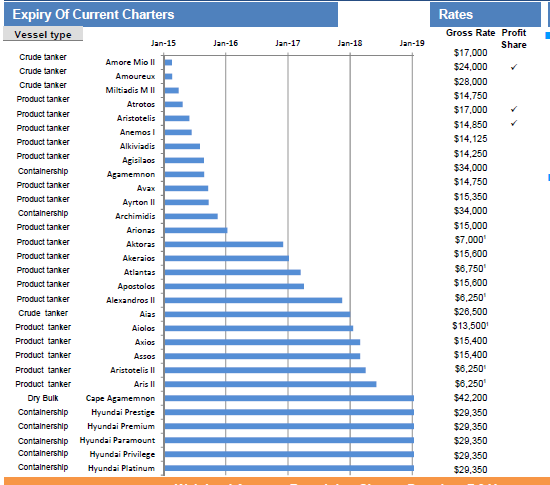
MRspotBelow is a table illustrating the expiry of charters for Capital Product Partners.  Notice how the expiry of most of the product tankers occurs in 2015, which should result in rate hikes to the majority of the renewals, whereas the containerships and the dry bulk vessel, for which the market is currently in excess and rates very soft, are chartered for years in advance.

charters

I have some questions about the long-term sustainability of the dividend, but I don’t think I will be sticking around long enough in the stock to warrant too much consternation over them.  They’ve been paying a dividend for a while, so from that perspective things look good,  but I still am uneasy over the long term in the same way that I am around many of these capital intensive businesses: Asset purchases are lumpy and large and so free cash generation follows suit which makes it really difficult to discern exactly what the average free cash is over the long term.

For example cash flow from operations over the last 3 years has been $125mm, $129mm and $85mm respectively.  Vessel acquisition and advances less proceeds has been: $30mm, $331mm and -$20mm (in this year dispositions exceeded acquisitions and thus resulting in negative overall expenditures). Clearly the company’s free cash has whipped wildly over this time.   Taking the three year period fas a whole, free cash (before dividend) has been essentially nil at -$2 million.

Now some might look at this as a red flag and something to be avoided, but I think it fits quite well into the thesis (which is short enough in duration to not worry too much about the long-term sustainability).  No doubt investors are assigning the 10% dividend in part because they are evaluating the same free cash flow numbers I am and questioning the sustainability of that dividend.  If however charter rates do show themselves to stay high for the short-term (lets say the next 12 months), this concern will be alleviated and backward looking free cash flow models will be thought to be inadequately pricing in what will come to be viewed (by some at least) as a secular change in rates.

Whether the rate change will be truly secular is up for debate; I really have no idea what rates will be in 2 years let alone the 10 or 20 years relevant for modeling Capital Product Partners sustainability and I think that anyone who does better have called the downturn in the oil price 2 years in advance to have credibility in that prediction.

What I do know is that when the price of a commodity changes, even if turns out to be for a short time, there consensus perception of that commodity shifts at the margins, and that shift in perception can make very large differences in the valuations of those equities priced off of the commodity.  Such is the nature of the world we live in and rather than gnashing one’s teeth at the uncertainty, better to take advantage of it and make a few bucks on the euphoria.

Sotherly Hotels

I have been on the look-out for some safer investments.  As much as I enjoy speculating in tankers and airlines and oils, these remain short-term plays.  I doubt I will have investment in more than one or two of these stocks in a years time.

I came across Sotherly from a SeekingAlpha article available here.  Its written by Philip Mause, whom I have been following for a while and of whom I have gotten a number of solid income oriented investment ideas from.

The income angle of Sotherly is modest, the company pays about a 3.5% dividend, but they have a exemplary habit of increasing that dividend on a quarterly basis. I’m also pretty sure they could pay out a significantly higher dividend if they chose to. The dividend amounts to about 25% of AFFO, and they expect AFFO to grow from $1.09 per share in 2014 to $1.21 in 2015.

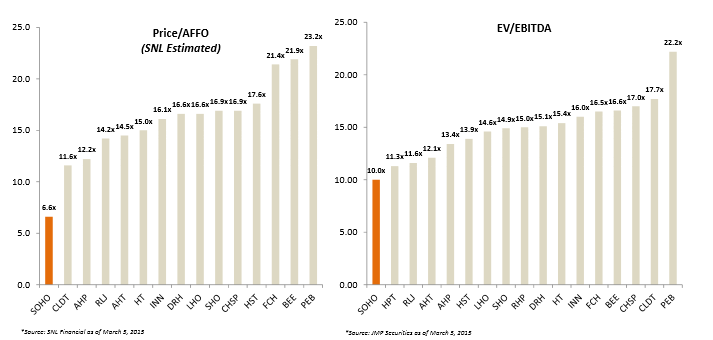
The stock trades at a significant discount to other hotel operators as the chart below illustrates.

comparison

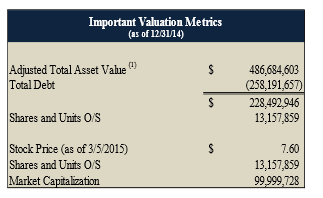
I think that the reason the stock trades at such a discount is its size; with 10.5 million shares outstanding and another 2.55 million units, at $7.74 the market cap of Sotherly’s is only about $101 million.  Volume is typically light and so its too small and too illiquid for most institutions.  But the smallish dividend likely limits its attractiveness to the retail contingent.  It is in this no-mans land that there is the opportunity.

The company’s stable of hotels is situated across the south east United States:

hotels

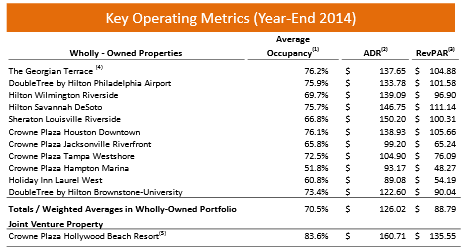
In total these hotels have a total of 3,009 rooms.  Looking at this on a standard EV/room basis, rooms are priced at $112,662 per room, which isn’t particularly cheap.  However this is mitigated by fact that these are mostly high-end hotels – ADR and RevPAR are quite high:

hotels2

On an EV/EBITDA the stock trades at 11.7x and on FFO basis they trade at 5.7x.  The company guided AFFO for 2015 of $1.24 per share and on the conference call when confronted with some discrepancy in the high and low estimates for their AFFO guidance they were forced to admit that they were being conservative on the high end.  Again turning the the company presentation, they put the “inherent value of assets” at over $17 per share:

NAV

On the last conference call management was adament that they would not issue equity at these prices and that they would need to see at least $10 before reconsidering that position.  While they have some exposure to Texas, thus far occupancy does not seem too impacted by oil and many of their larger corporate customers are not oil related.  I’m not sure what else to write about this one.  Its a solid hotel operator trading at a discount to peers for not a very good reason.  As long as the economy  remains sound I think the stock slowly walks up to the double digits over the rest of the year.

Impac Mortgage

I’ve gotten a bunch of questions in emails about Impac Mortgage.  So yes, I have bought back Impac, I took a tiny position around $9 and added to it at $11.  But its a small position and I haven’t talked about it on the blog or on twitter. The reason?  I really don’t know how this plays out, so my thesis is pretty weak.

The company is doing some interesting things.  They have a deal with Macqaurie for the purchase of their non-QM originations and they bought out a fairly large online origination business called CashCall.  So they are doing something, and the share price is reacting.  Still, I find it hard to quantify what it all means for the fair value of the stock. So I really dont know what I’m buying.

If you look at the recent financials and they aren’t great, so the bet I’m making here is kind of a bet that Impac is going to use these pieces and become a big non-compliant originator but while that qualitatively seems like a sound thesis, I don’t really know what numbers they will be able to churn out. To put it another way I probably wouldn’t have bought the stock if I didn’t have a history of it and some comfort that Tomkinson seems pretty experienced and can put something together.  So I own the stock but probably won’t talk about it any more unless something happens to clarify the situation.

What I sold

Midway Gold

My Midway Gold sale wasn’t quite as bad as it looks.  I forgot to sell my holdings in the practice portfolio account and  by the time I realized this the stock had tanked to under 30 cents.  So my sale looks particularly ill timed.

Nevertheless I sold Midway at a loss after the company announced delays with Pan, a potential cash shortfall and some early problems with grade.  The company realized news in its March update that one of the water wells malfunctioned so it has taken them longer to fill up the tailings pond and that Pan would not see the first gold pour until the end of the month, delayed from early March estimates.  Worryingly the company had drawn $47.5 million of its $53 million lending facility and was under negotiations with its lenders to fund working capital requirements.  To make matters worse early results showed some grade discrepancies with their model as grades were coming in lower.

Of all the news, it was the grade discrepancies that led me to sell.  If it hadn’t been for that I would have chalked it up to early days mining hiccups that they would eventually struggle through.  But until the grade issue is resolved you just don’t know what you are getting.  So I had to sell.

Nationstar Mortgage

As I wrote in my comment section last month, I didn’t talk about Nationstar because the stock was a trade that I didn’t expect to hold very long.  As it turned out, I held it hardly any time at all, selling the stock in the day following the posting of my last post.  Nationstar was down below $26 when I bought it and I sold it at around $30, so I made a little profit on the transaction.

I bought the stock because I thought there were some tailwinds here in Q1: the company said on their fourth quarter conference call that so far in first quarter originations were strong.  They also expected amortization to be lower in the first quarter, which will boost earnings.  Nationstar also has a reasonable non-HARP business so they don’t face quite the pressure Walter Asset Management does at that winds down and that, combined with the evolving travails at Ocwen, might bring marginal dollars into the stock from investors looking for the one remaining non-bank servicer without significant regulatory risk (or at least so it appears).   Nevertheless I figured the move from $26 to $30 was probably too far too fast so I took my quick profit.  I have been thinking about buying back in for another run now that is again languishing in the mid-$20’s.

Final Thoughts

I waited three months for it but the tanker trade is upon us.

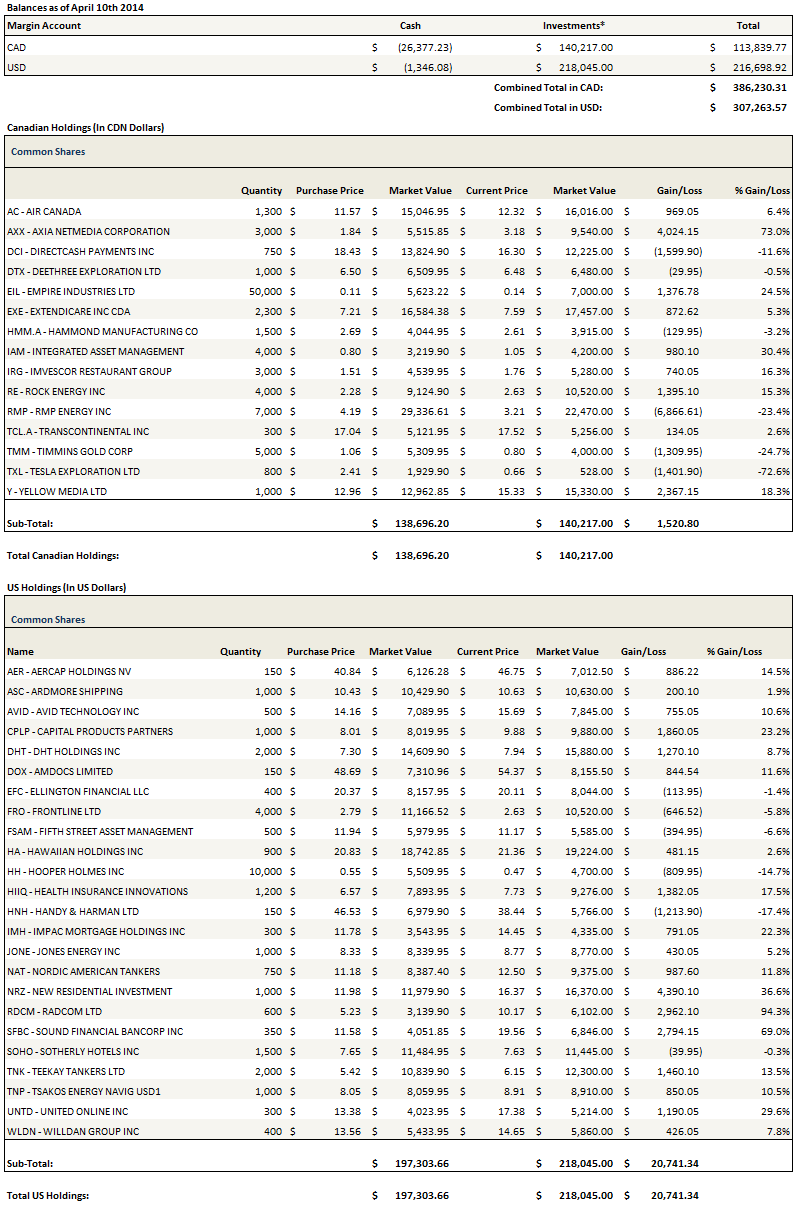
Portfolio Composition

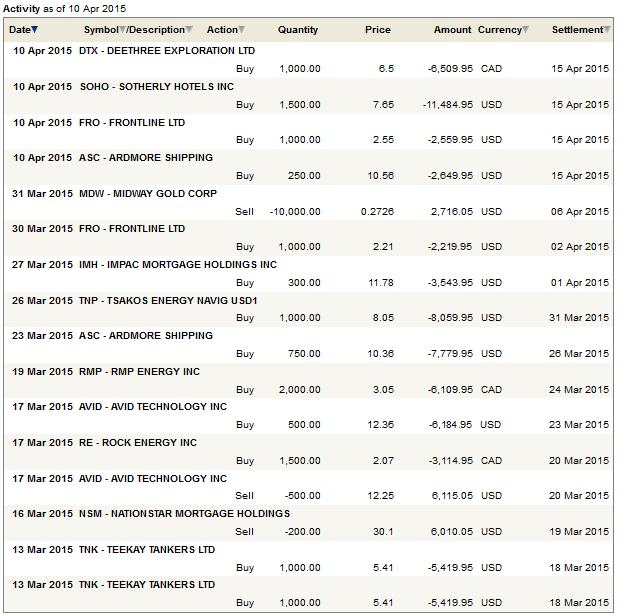
Click here for the last four weeks of trades.

week-197