Skip to content

Posts tagged ‘alamos gold’

Aurizon Mines: Maybe growth is finally on the horizon of Aurizon

Sorry about the title.  That was a terrible rhyme.

I didn’t set off with the intent of writing a long post on Aurizon Mines this morning.  I have other research projects to spend my time on that hold more near term potential.  In particular, I have regional banks to evaluate, mortgage lenders to learn about, and mortgage lending podcasts to listen to and transcribe.

Nevertheless I must have a masochistic side because I am always more fascinated by the times I am wrong and the things that I don’t understand than with what is working and making sense.  And nothing has been wrong or made as little sense to me as the downward spiral of Aurizon Mines.

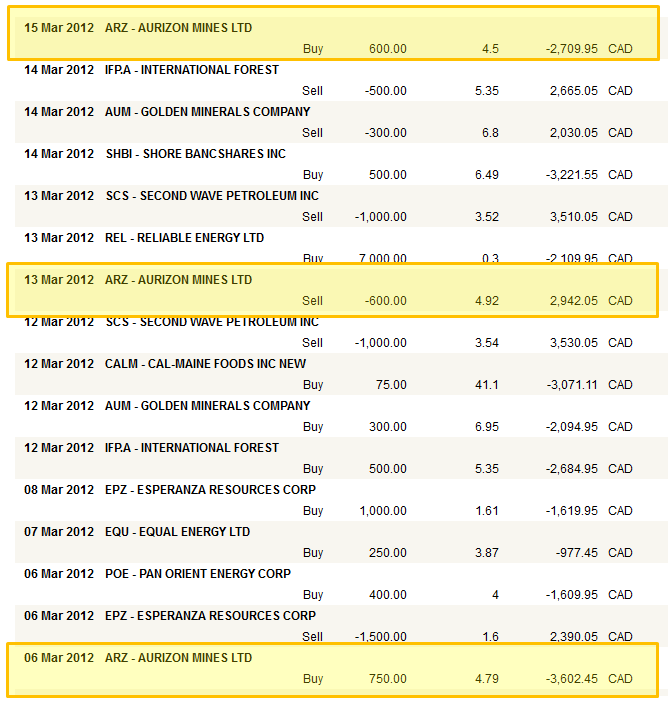
Over the past 6 months I have (somewhat unintentionally) been swing trading Aurizon Mines.  I hold a core position but around that position I buy more at or just under $5 and I sell what I buy at around $5.75 or $6.  It worked well a couple of times last year, however this year not so much.   The stock stalled out a few weeks ago at $5.50, it didn’t stay there long, and I ended up jumping out of some of my non-core position in the $5.30 range.  After that I sat as a bagholder with the rest, watching the stock tumble below $5.

In the last couple weeks I have been in and out some more, buying at $4.80, getting out at $4.9 before buying back on Thursday at $4.50.  The frequency of my indecision is telling. I clearly don’t know what to think about the stock.
To be honest, I didn’t think Aurizon would get this low.  The company holds $1.31 in cash and would be considered to be one of the lower cost gold producers. It has consistently met targets.  Its not a management disaster like so many gold miners.  These are solid operators.

The Alamos Gold Comparison

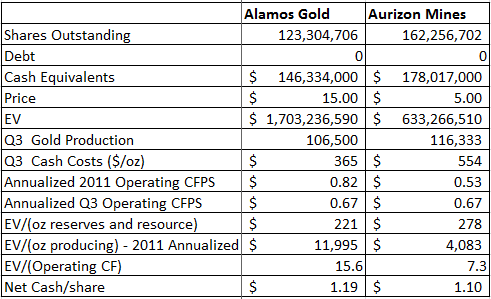
I did a comparison a few months ago between Alamos Gold and Aurizon Mines to demonstrate the disconnect.  I think it is instructive to dig up and refresh that analysis now that the Q4 numbers are out:
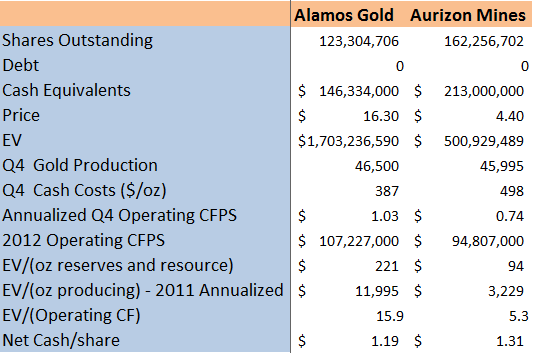
Instead of focusing on the valuation discrepancy and how the market has it wrong, I want to focus instead on why the market is willing to value Alamos at 2x to 3x the value they are willing to assign to Aurizon.

I think its all about growth and costs.

In the Alamos Q4 report, the company forecast that they would increase production from 153,000 ounces to over 200,000 ounces in 2012.  They also predicted that costs would come in about the same as they did in 2011.

In 2012, the Mulatos Mine is forecast to produce its one millionth ounce of gold. Ongoing exploration success has resulted in a track record of mined reserves being replaced. In 2012, the Company expects production to increase to between 200,000 and 220,000 ounces at a cash operating cost of $365 to $390 per ounce of gold sold ($450 to $475 per ounce of gold sold inclusive of the 5% royalty, assuming a $1,700 gold price). The Company expects that gold produced from the gravity mill, which will process high-grade ore from Escondida, will add a minimum of 67,000 ounces of production in 2012 at a grade of 13.4 g/t Au. Based on bulk sample testing conducted in 2007, the Company believes that there is the potential for higher production from the gravity mill as a result of realizing positive grade reconciliation to the reserve grade.

The high-grade gravity mill has been constructed and is currently undergoing commissioning and is expected to be operational with high-grade production by the end of the first quarter of 2012. The current life of the Escondida zone is approximately three years and exploration efforts in Mexico in 2012 will continue to focus on sourcing additional high-grade mill feed. Metallurgical testing completed in 2011 on higher grade ore from San Carlos demonstrated that it is amenable to gravity processing, potentially doubling the amount of available mill feed. Further optimization and metallurgical studies are underway in order to increase the amount of high grade ore that can be processed through the gravity plant.

On the other hand a look at Aurizon’s Q4 report shows the following outlook:

It is estimated that Casa Berardi will produce approximately 155,000 – 160,000 ounces of gold in 2012 at an average grade of 7.5 grams of gold per tonne. Average daily ore throughput is estimated at 2,000 tonnes per day, similar to 2011. Mine sequencing in 2012 will result in ore grades that are expected to be approximately 6% lower than those achieved in 2011. Approximately 42% of production will come from Zone 113, 41% from the Lower Inter Zone, and the residual 17% from smaller zones and development material.

Assuming a Canadian/U.S. dollar exchange rate at parity, total cash costs per ounce for the year are anticipated to approximate US$600 per ounce in 2012. Onsite mining, milling and administration costs are expected to average $134 per tonne, up approximately 6% from 2011 costs as a result of higher stope preparation costs and smaller stopes.

Flat production.  Higher costs.

$600 costs are not high by most gold mining standards.  With those sort of costs Aurizon would still sit in the top quartile of low cost producers.  I think that in this case Aurizon is guilty by association.  There have been SO MANY gold miners that have began to predict higher costs only to see those costs spiral much higher than was originally anticipated. The market is on guard.

The Sinking Growth Ship

As for the growth, the problem is that the company’s flagship growth project is not inspiring confidence.   I stepped through the news timeline at Joanna in a previous post.  Since Aurizon has made it a habit of updating the street with quarterly reminders of just how shitty the Joanna PEA is going to be, let’s do the same thing here.  Below is the time line of events:

May 12th 2008

Aurizon first commissioned a pre-feasibility study on Joanna.

November 11, 2009

Aurizon finally received that pre-feasibility study and proceed to a full feasibility study.

September 14th 2010

Aurizon notifies shareholders that the original recovery process assumed (called the Albion process) would show lower recoveries and higher costs than first anticipated. Additional metallurgical test work would be done and the study delayed until mid 2011.

August 11, 2011

Aurizon delays the feasibility study for Joanna again, saying: “the projected capital and operating costs appear to be significantly higher than previously anticipated. The increased scope of the project, as a result of the expanded mineral resource base, has increased capital costs, including those associated with an autoclave process. The costs of ore and waste stockpiles, tailings and of materials and equipment have also all been trending higher, along with the gold price.”

January 11, 2012

Another update giving an ETA: Feasibility study work on the Hosco deposit will continue in 2012 with completion of the study anticipated by mid-year. The feasibility study will incorporate a reserve update based on the increased mineral resource estimate announced on June 13, 2011, together with results of metallurgical pilot tests, a geotechnical study, updated capital and operating cost estimates, and other relevant studies.

As I wrote at the time:

Its been almost 4 years since the original pre-feasibility study on Joanna was complete! At this rate they should be mining by 2100.

The time line can now be updated with the latest installment from the Q4 report and the following comment:

While some studies are still in progress, based on its review of information currently available the Company believes that the feasibility study is sufficiently advanced to conclude that the projected capital and unit operating costs will be significantly higher than estimated in the December 2009 Pre-Feasibility Study, due in part to the change in the scope of the project, the expanded mineral resource base, the selection of an autoclave process and a decision to process the ore on site.

I think this is about the 3rd time the company has warned investors not to get their hopes up about Joanna.  Keep in mind that the original numbers for Joanna weren’t exactly thrifty (if I rememver right they were $200M + capital and $700 costs).

If I was going to translate this news-release-speak into plain english it would sound something like this:

It is surprising even us with how shitty this project is turning out to be

But that’s just my interpretation.  I could be wrong.

Takeover talk!

I have found 3 articles (here, here, and here) discussing a post-earnings release interview (or maybe it was on the conference call, I haven’t had a chance to listen yet) done by George Paspalas, the company’s CEO, where he said that the company has been approached by potential suitors and that the company is also looking for companyies they could takeover.

With respect to the potential for an acquisition, Paspalas said the following:

To receive the company’s interest, a target would have to be producing around 120 000 oz/y, and at similar profit margins to Aurizon’s flagship Casa Berardi mine in Quebec.  “We’ve looked hard, I can tell you that,” Paspalas said, speaking in a telephone interview from the firm’s Vancouver headquarters.   “There are a lot of companies out there…that are at a point where they have a pretty good project, but they don’t have any cash – and the shareholders are saying ‘enough’s enough’ in terms of dilution,” commented Paspalas.  “We have five or six opportunities in our grade one category,” he said, adding that one of these could close in the near-term if there weren’t any pitfalls in the technical due diligence or price negotiations process.

He went on to say that they are shifting their focus from looking at acquiring a producing mine to instead acquiring a near-term project.

The one report also said that Aurizon “has itself received informal approaches regarding potential mergers.”

Cautiously Optimistic

I think this is quite good news.  The problem with Aurizon, as I have tried to lay out above, is that the market wants growth and the market isn’t buying Joanna as the vehicle for that growth.  It’s too bad they will have to pay up a good chunk of their cash hoard to acquire a project but the argument could easily be made that the cash is being ignored by the market right now anyways.  If you remember Argonaut Gold, their adventure to double digit share prices began when the company took over Pediment Gold and with that acquisition bought themselves a stable of near term production projects.  A similar acquisition by Aurizon would be a positive.  It would allow the brokerages to start prjecting realistic growth  into the future, and from those higher production numbers they can begin to tag a higher multiple onto the stock.  Then everyone gets excited about the prospects and we all jump on the bandwagon and a couple of fund managers get on BNN and hype the stock and pretty soon you have Argonaut Gold all over again, going from $3 to $10 in a little over a year.

Its a plausible scenario.   If the takeover happens and it looks like its the right takeeover, I will no longer swing trade the stock and instead will begin to hold it for the longer term.  But without the takeover I am just not willing to put too many of my eggs in the Joanna feasibility basket, which is sounding more and more to me like it has a big hole in it.
Letter 24: Risk and Reward, Atna Analysis, More Community Banks

Last week I wrote that I did not understand why  the market was reacting as favourably as it was to the European proposals that came out of the Dec 9th summit.

A tweak here, a tweak there and pretty soon you have… well not a whole lot to be honest.

In a way I felt vindicated  by the market collapse that occurred in the early part of this week.  In another way I felt sick to my stomach, because though I have been creating an evermore conservative weighting to my portfolio, when the shit hits you still feel it.

Kyle Bass was on CNBC this week giving some more detail on his doomsday-like expectations:

The observation that deposits are leaving Greek banks at an annualized rate of almost 50% is somewhat frightening.  Clearly this crisis is going to come to a head soon.

John Mauldin publishes a great conversation between Charles Gave and Anatole Kaletsky.   It is quite provoking, and its hard to walk away after reading it without feeling the impending doom that awaits the Eurozone.  Kaletsky and Gave both make the quite reasonable point that perhaps Germany would prefer a break-up of the Eurozone.  If you watch what Germany is doing, and ignore the platitudes they are saying, you might question their motives.  Kaletsky points out that of the necessary measures to fix the Eurozone, Germany seems to be steadfastly opposed to both Eurobonds and to ECB intervention.  Absent those  measures, what hope does the Eurozone have?  Perhaps that is the plan all along.

Gold Stocks – I should went all out

Gold stocks got CREAMED this week.  I had been lightening up on my gold stocks the week before in anticipation that something might be about to hit.  I didn’t like the way gold was going, I didn’t like the fact that the WSJ was penning articles describing a dearth of Indian demand, and I didn’t like that Draghi talked tough during the EU summit, suggesting that money printing was still some time off.

Nevertheless being that I was not fully out of gold stocks, I got smacked about pretty good over the course of the week.   Atna, Aurizon, and with Lydian all performed quite miserably.

What’s Wrong with Aurizon?

Aurizon is a surprise to me.  I expected the stock to hold up better than it has been.  I might have expected its performance to be closer to that of Alamos.  Both are low cost producers.  Both are single mine operations.  Yet the valuation difference between the two is somewhat staggering.

I can only guess that there is a strong seller of Aurizon out there that wants to be out of the stock by year end.  I can only hope that the new year will bring some sanity to the stock.

While reviewing Aurizon, I began to wonder how much having a AMEX listing hurts the stock.  Anecdotally it appeared to me  that the Canadian stocks with AMEX listings are much more volatile then those without.  I decided to take a closer look.

I grabbed price data since August 1st for 9 stocks, 5 with AMEX listings and 4 without.  From the web I grabbed a visual basic function that calculates volatility based on the following Black-Scholes formula.

For purposes of Black-Scholes calculations, volatility is the standard deviation of the periodic percent change in prices, divided by the square root of time.  Volatility is emphatically NOT the same as “beta”, which measures the correlation of a security’s price movements with those of the overall market.  Neither is volatility simply a measure of the standard deviation of a security’s closing prices over time.

Here is the volatility of each security:

Is there a correlation?  Perhaps, though its not as clear a one as I had suspected.   The distinction is most clear between Aurizon, Alamos and Argonaut Gold.  There is no reason, in my opinion, that Aurizon is so much volatile than these other two stocks.  But apart from that, volatility seems similar between stocks on the two indexes.

I bought back some of the shares of Aurizon at $5.07 that I had sold at over $6 a few weeks ago.

The NPV of Atna

Another stock to get clobbered this week was Atna Resources.  I mentioned a couple weeks ago that I had finished an analyses of the company and would post shortly.  I never did that post, until now.

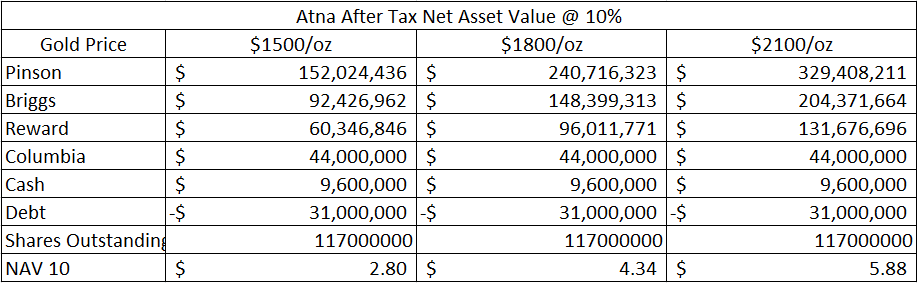
Below is the after tax NPV10 that I calculated for Atna at various gold prices.

I based my model on the following assumptions:

Briggs:

  • A 11year mine life, at 40,000 t/d
  • Total produced ounces of 476,000 oz over LOM
  • 0.017 oz/t resource over the mine life, strip ratio of 4 and with 80% recoveries
  • Resulting in gold production of  39,700 oz per year
  • Mining costs of $1.30/t mined, milling costs of $4/t milled and G&A costs of $1.7/t mined
  • Cash costs of $898/oz over LOM

Pinson:

  • A 15 year mine life, beginning at 350t/d and ramping to 750t/d by year 4.
  • Total produced ounces of 940,000 oz over LOM
  • 0.4 oz/t resource over the mine life, diluted by 30% with 90% recoveries, resulting in gold production beginning at 50,000 oz and ramping to 75,000 oz.
  • Mining costs of $110/t, milling costs of $50/t and G&A costs of $11/t
  • Cash costs of $687/oz over LOM

Reward:

  • A 8 year mine life, at 24,000 t/d
  • Total produced ounces of 292,000 oz over LOM
  • 0.026 oz/t resource over the mine life, strip ratio of 4 and with 80% recoveries
  • Resulting in gold production of  36,400 oz per year
  • Mining costs of $1.30/t mined, milling costs of $4/t milled and G&A costs of $1.14/t mined
  • Cash costs of $560/oz over LOM

Columbia and Cecil:

  • To the current resource of each I assigned a simple asset value per ounce of $40/oz measured and indicated and $20/oz inferred on the total resource of both properties

Atna is, in my opinion, is one of the best gold stock investments out there.  As demonstrated above, the stock is trading at about 1/3 of its NPV 10 at $1500 gold.  If I wanted to get more aggressive in my evaluation, I would note that many companies are moving to value feasibility on NPV5.  On an NPV 5 basis Atna is worth $3.86 per share at $1500/oz gold.  That number jumps to almost $8 per share at $2100/oz gold.  Clearly there is upside once the momentum begins to build.

I added to my position in Atna on Friday at 78 cents.

Taking Advantage of the Collapse

In addition to Atna and Aurizon, I also added new positions in a few juniors.  Call it the beginnings of a basket; I added a couple of non-producing juniors with deposits to my portfolio this week:

Geologix was recommended by Rick Rule as a takeover candidate on BNN about a year ago.  Since that time the stock has fallen significantly.  The company has a very low grade copper-gold deposit called Tepal in Mexico.  The PEA that was published on Tepal a few months ago put the NPV5 of the project at $412M based on $1000/oz gold and 2.75/lb copper.  Geologix has $14M of cash on hand.  With 145M shares outstanding, the market capitalization of the company was $28M at my entry price of 20 cents.  That puts half the market cap in cash and the other half in a project with an NPV that is nearly 10x the value of the company.  Something has to give here.

Esperanza Resources is another old Rick Rule recommendation.  Rule doesn’t talk much about specific stocks anymore, but there is some evidence that he is still interested in the company.  http://www.investmentu.com/2011/September/why-gold-mining-stocks-will-skyrocket.html .  The company certainly fits the bill of the sort of stock Rule likes.  Esperanza has 1Moz of gold in Mexico.   It’s a heap leach project so it should be able to be brought on production without a massive capital requirement (about $100M).  Like Geologix, the company has almost half its market cap ($100M) in cash on hand ($50M).

I plan to add more to both of these stocks in the coming weeks.

Regional Banks: A  Position in Community Bankers Trust

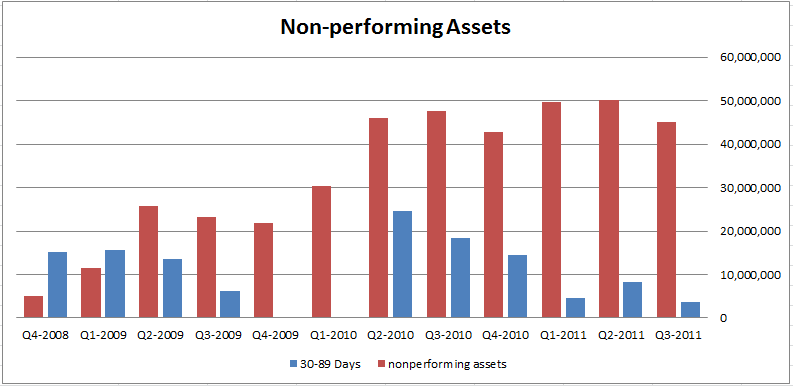
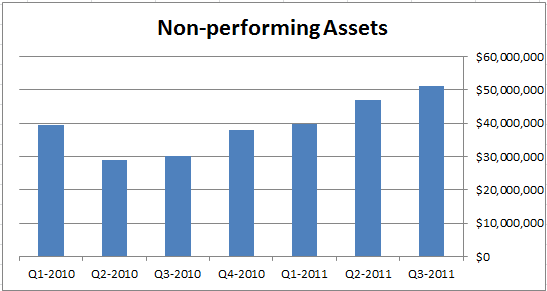
Community Bankers Trust (BTC) hit my bid when it sold off back down to a dollar this week.  BTC is trading at 27% of tangible book value.  This is, of course, partially because of the large number of non-performing loans on their books.  Non-performing loans make up 8.9% of total loans in the Q3 quarter.  This was down from 10.1% in Q2.  In fact, there are some encouraging signs that the worst of the loan losses are behind us.  The company has shown 3 quarters of lower loan amounts 30-89 days past due.  This trend is beginning to show up in the total non-performing loans, which decreased for the first time in a year in Q3.

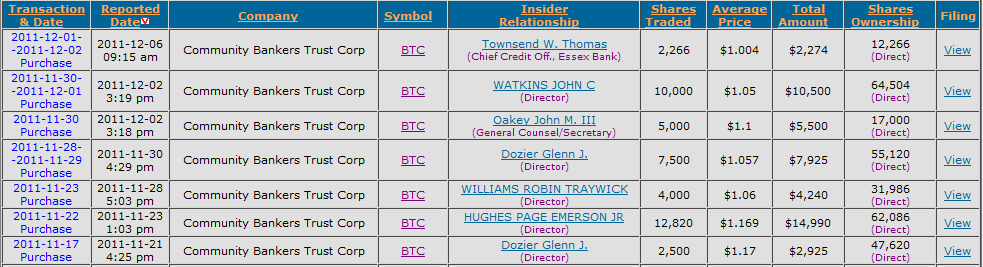
Moreover, as I have pointed out previously, insiders continue to buy the stock.  Third quarter purchases by insiders were a little less than $50,000.

And Another Regional Bank Position in Atlantic Coast Financial

To be perfectly honest, I might have made a mistake here.  I’ve only put a very tiny amount of capital at risk, but even that may have been too much.   Atlantic Coast Financial (ACFC) is a lottery ticket.  I bought the stock at $1.70 on Friday.  There is just as much chance that it will go to zero as there is that it will double.

ACFC is a former Mutual Holding company that did their second step bank in February.  The second step added cash to the balance sheet and resulted in a bank trading well below book value.  ACFC trades at a rather crazy 10% of tangible book.  Clearly there is more to the story.

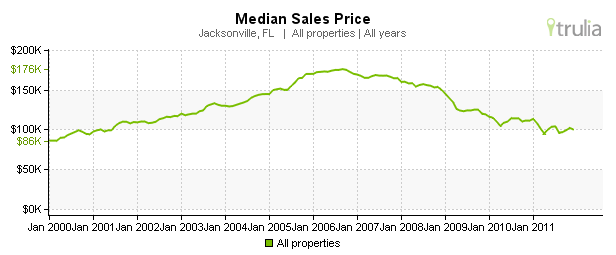
The more to the story is that the bank is centered in Jacksonville Florida.  They primarily make residential real estate loans.  Real estate in Jacksonville has not done particularly well over the last few years (though it appears to be bottoming).

The falling real estate prices have led to skyrocketing non-performing loans.  Those non-performing loans have not shown any sign of peaking yet (thus the possible mistake on my part).

The questions are, how many of these nonperforming loans will eventually be written down, and will there be value left in the equity once the non-performing loans are written down.

What drove me to take a small position in the stock was in part that an improving economy, and stabilizing home prices in Jacksonville, may mitigate further deterioration of the bank assets.  As well, the bank is generating decent earnings before provisions.  Ignoring provisions in Q3, the bank earned $1.16 per share.  In Q2 that number was $0.55.

What is going on at ACFC is something akin to a tug-of-war, whereby on the one hand loan losses strip away value every quarter, while on the other earnings power of the performing loans adds value back.  The share price is so low that it doesn’t take much a a shift in the dynamic between these two forces to change the value equation substantially.  Its easy to see how a stabilization in non-performing loans could quickly allow the earnings power to win the race and shareholder value to go up substantially.

The other factor in my decision to buy was the recent announcement that the company was looking into strategic alternatives.

On November 28, 2011, Atlantic Coast Financial Corporation issued a press release announcing that its Board of Directors has engaged Stifel, Nicolaus & Company, Incorporated to assist the Company in exploring strategic alternatives to enhance stockholder value

Part of the reason that the company is looking for options is that they are not in compliacne with the Individual Minimum Capital Requirement (IMCR) agreed to by the Bank with the Office of Thrift Supervision on May 13, 2011.  Under the IMCR, ACFC agreed to achieve Tier 1 leverage ratio of 7.0% as of September 30, 2011. Tier I capital at the bank is 6.22% right now.

It is a far from perfect scene.  Nevertheless, an improving US economy and stabilizing housing prices could give me a decent return on the stock.  The book value of $19 is unrealistic, a return to $3 is not.

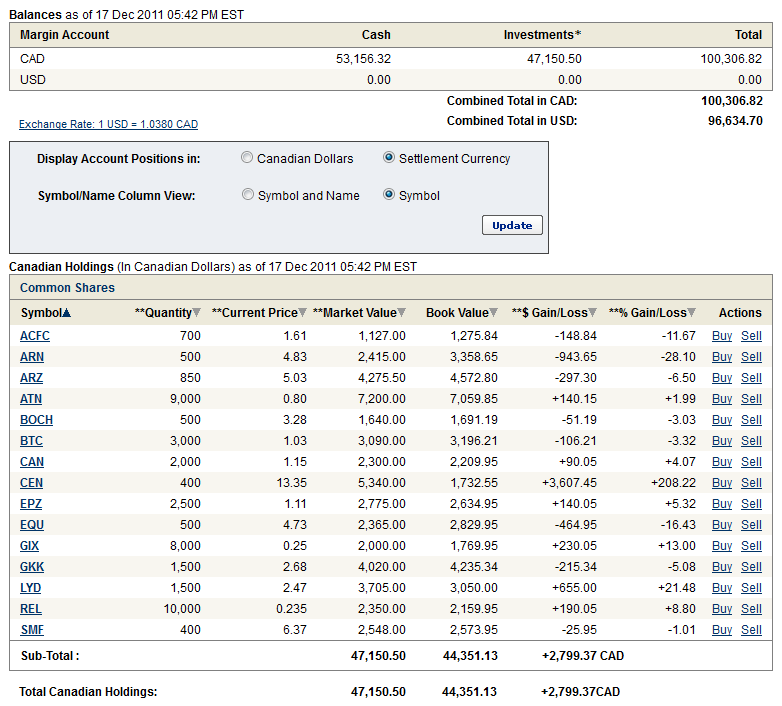
Portfolio Composition