Letter 26: A Move in ACFC, the end of tax loss selling for gold stocks, Mispricing of Aurizon Mines, and All the Devils are Here
All the Devils are Here (though most have probably moved to Europe)
Over the winter break I read the book All the Devils are Here, by Bethany Mclean and Joe Nocera. The book essentially traces out all the strands that culminated in the panic of September 2008. The book identified the following factors:
- A reliance on ideology instead of analysis. In particular this applies to the Federal Reserve and Alan Greenspan, whose ideological “market is always right” view permeated the decisions of the Fed and to some extent those of the other regulatory bodies. But more generally, ideology, specifically free market ideology, seemed to permeate through all the political and financial institutions to the point that it replaced a sober look at reality. Similarly, for many traders and investment bankers, an ideological reliance on “the model” often led to an ignorance of the potential risks of an outlier scenario
- The absence of regulation. For a variety of reasons (the power of the lobby groups, the political infighting between the regulatory bodies, the ideological free market view of the participants and the myopic focus on regulators on Fannie and Freddie) an attempt to regulate the subprime industry was hardly even contemplated until it was too late.
- The development of securitization. The most important consequence of the innovations to pool mortgages, to tranche pools, and then to create pools of pools (CDO’s) was that the lender and the borrower became further and further divorced by more degrees of separation. The securitization process created so many layers of intermediaries between the party who actually ended up with the loan on their books and the party that took the money that risks were easily lost in the translation.
- The rubber stamped AAA status provided by the ratings agencies. Some books focus on how the rating agencies didn’t understand what they were rating. Mclean and Nocera point out that the revenue structure of the agencies was doomed to be corrupted. A system where the raters are paid by the producers of the securities they rate might be considered to be an insane one. The result was that the agencies were played off against one another by the investment banks; market share went to the most relaxed rating. Add to this the fact that the agencies, particularly Moody’s, became focused on profits at the expense of their inherent conflict of interest, and you had a situation ripe for abuse.
- Greed. Politicians more concerned with their own campaign donations than with promoting sustainable public policy. Company executives intent strictly on their own promotion and profit. Mortgage originators with essentially no moral compass at all. The system was (and is) corrupt.
- A lack of understanding. The same characters at play as with greed. So few people saw the disaster coming. Sure some did, there were a few regulators and a few hedge funds that saw how unsustainable the leverage being piled on in the mortgage sector was. But the vast majority didn’t have a clue. Even the supposed smart money didn’t really get smart until 2006-2007.
It is this last point, the lack of understanding, that I think is most relevant to what we face today. It really surprised me how little the people in influential and powerful positions understood the concepts that they were making decisions with regard to. Even Hank Paulson, who is actually portrayed in quite a positive light, was completely blind to the corruption and leverage being amassed in the mortgage market.
This naturally begs the question of Europe: how many of the politicians and bureaucrats in the EU really understand the situation they are trying to navigate? Do they really know the risks inherent in the decisions that they are making? Do they even really understand the banking sector they are trying to protect?
The last 6 months for me has been an education in how the modern banking system works. I have been trying to read all that I can, all the boring, technical aspects. And I don’t think for a minute think that I’ve wrapped my head around it. There are so many moving and interdependent parts. It’s also not a very tangible subject. It simply isn’t something that is easily understood.
Thus I think it’s a legitimate question as to whether the bureaucrats of Europe have the understanding required to navigate the minefield of sovereign defaults and banking bankruptcies. As Lehman showed, it only takes one mistake to create a loss of confidence that spirals uncontrollably.
How can you take on risk with this in mind?
The end of (tax loss) selling?
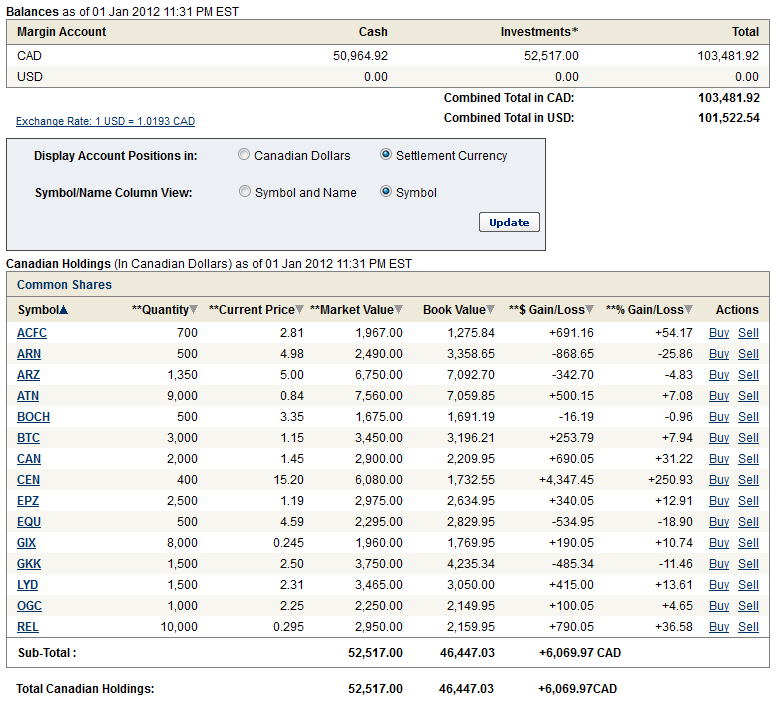
The week after tax-loss selling is always an interesting one. It provides the first glimpse into whether a security has been facing unrelenting selling because of investors simply wishing to take their losses (and their tax breaks) and move on, or whether something more nefarious is at play. Along the lines of the former, this week provided a rather marked jump in a number of the regional bank stocks that I have initiated a position in. Most conspicuous of these moves was that of Atlantic Coast Financial.
A Take-over Imminent for ACFC?
ACFC had a rather astounding 50%+ move this week. I really have no idea what precipitated the move. To take it with a grain of salt, the volume for the stock this week was less than spectacular, though the same could be said for almost the entire move down.
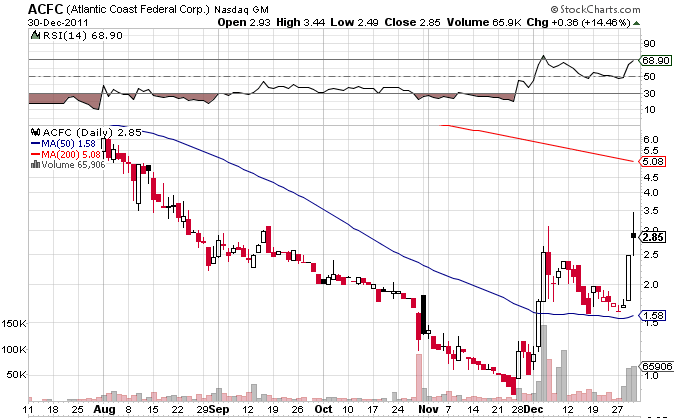
As I pointed out last week the stock is a bit of a flyer; the bank is a mortgage lender in one of the most crippled mortgage markets (Florida), they have bad loans coming out their wazoo, and a stock that has fallen from $10 to $1 in less than a year generally does not do so on speculative panic alone. Nevertheless, part of the story is the book value, which even with 3 years of bad loan write-downs lies at a rather surreal $19 per share (versus a share price of $1.70 when I bought it).
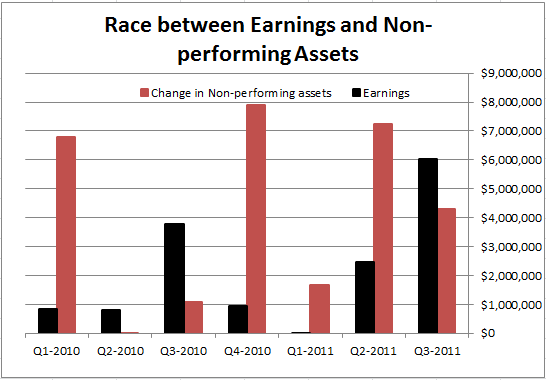
The other part of the story is simply the realization that what is going on with this bank (and many of these little community banks that got caught up in making bad loans at the wrong time) is a race between the write-downs of their past transgressions and the earnings of their current performing loan book. With ACFC it is not at all clear to me that the bad loans will win out; in fact I tried to make the case last week that with a little luck (and an improving economy) the performing book may very soon be able to out-earn the losses on a consistent basis. If this happens, the shares are clearly worth more than 10% of book value. Even if it just becomes a possibility, a shrewd competitor may be tempted to take a plunge. I constructed the chart below to try to see where ACFC is in that process. The chart compares earnings before provisions (black) to the quarter over quarter change in non-performing loans (red). Its basically a look at whether the company is out-earning the loans going bad each quarter. The 3rd quarter was the first in four that the black won out.
Community Bankers Trust: Another Regional Bank with a Move of its Own
While ACFC was the best of the lot of regionals, there were others that showed signs of life. Community Bankers Trust surged on Friday. The stock remains at about 1/3 of book value. If it were not for Europe and the ever-impending doom there, I would add more. As well, Oneida Financial continues to push higher. Unlike ACFC, BOCH and BTC, Oneida is a terribly boring bank trading at about book that is probably going to do nothing but increase in price by 10% a year and pay a 5% dividend until one day it gets bought out. At some point I might get bored with with relatively low return, but in this environment, I am happy to take a reward with so little risk.
Will Gold Stocks Rise now that Tax-loss Selling is over?
As for the golds, Esperanza, Canaco and Geologix all are showing classic signs of a let-up in tax loss selling. All are well above where I bought them. Aurizon, on the other hand, continues to be sold rather indiscriminately. Yes, I realize that the price of gold is getting clobbered on a regular basis. I can appreciate that investors may be questioning the wisdom of holding gold as a hedge to anything given the fact that it seems to dramatically underperform on risk-off days.
Still, I scratch my head at Aurizon. Here is a low cost gold producer that is comparatively less correlated to the price of gold than most of its competitors. For one, if you are low cost you are by definition high margin. Thus, a $30 move in the price of gold is of much less impact to a producer with $1000/oz margin (like Aurizon), than say a producer with a $500/oz margin. Yet Aurizon regularly trades down MORE than your average gold producer on the down days.
Going Short Argonaut Gold and long Aurizon Mines
So confounded have I been that in order to hedge my risk with Aurizon I have decided to take a short position in a fellow gold producer, Argonaut Gold. To be sure, there is nothing wrong with Argonaut Gold. I wrote the company up rather glowingly a couple months ago. However that was at $5, and now AR trades at $7, while in the same time Aurizon has fallen to less than $5. Below is a comparison of the key metrics of both companies.
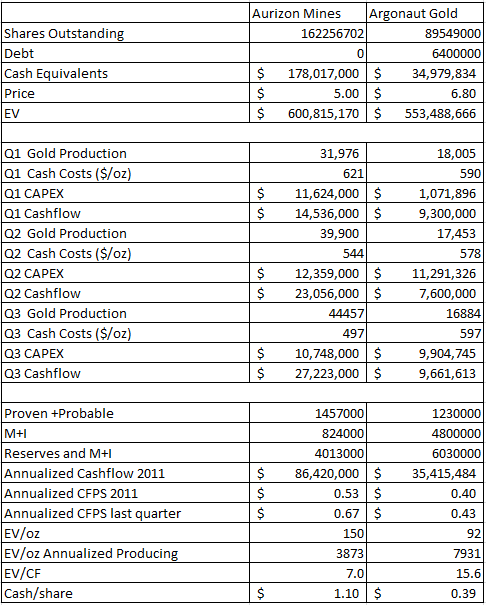
So to briefly summarize the above, Aurizon produces more than twice as much gold, it produces over double the cash flow, and to top it off, Aurizon’s 3rd quarter was stronger than Argonaut’s. Argonaut potentially has a better pipeline of projects, but this is more than nullified by the fact that Aurizon trades at almost half the price on a per producing ounce basis, produces those ounces at $50-$100 cheaper, and has over $1 in cash on its balance sheet while Argonaut has a mere 30 cents. It simply doesn’t make sense.
While I remain bullish the price of gold, I also remain wary that I am not very right in this bullishness at the moment, and so it seems like the prudent thing to do to short what seems relatively over valued and buy what seems relatively undervalued. Anyways, that is what I did.
I also bought back OceanaGold for another run. Its getting to be repetitive, but it has been a consistant source of profits. Buy OceanaGold below $2.20 and sell it above $2.70. I must have done this 3 times already in the last 9 months.
Portfolio


 Reminiscences of a Stockblogger