Atna’s New Pinson Resource
Atna released an updated resource on Pinson on Monday. Over the next 3 days the stock fell about 15%.
The release of the Pinson resource produced one of those bizarre situations you happen on in the market from time to time whereby you had a company valued at a price that wasn’t really reflecting anything near the value of the assets in the first place, but on the other hand the value of the assets has disappointed on the downside so clearly the company must be worth less today than it was the day before the news was released.
So the stock goes down and the assets are even less reflected in the price of the stock. C’est la vie.
Was it that bad?
Lets look at the details. I don’t think numbers are that bad. The underground number is still robust, and the open pit number is intriguing.
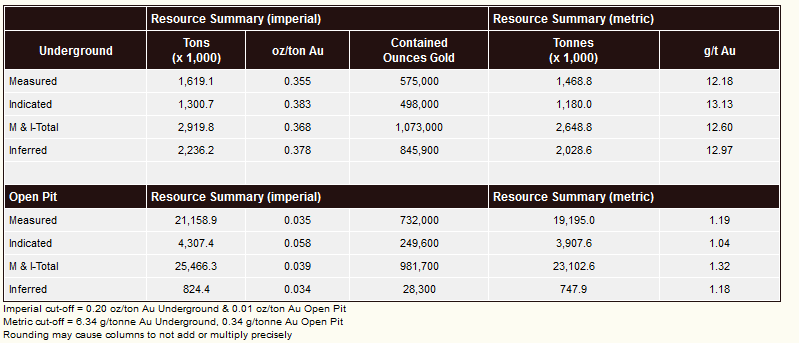
The reasons for the sell-off is that compared to the previous resource on Pinson (done ages ago in 2007), the numbers were a little disappointing. Two ways they were disappointing.
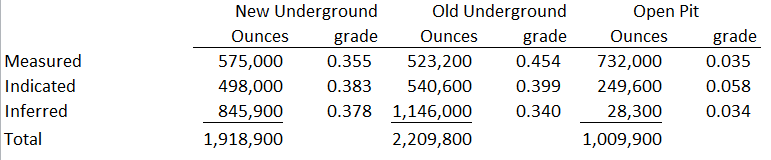
The first disappointment
The underground ounces went down.
Now the lost underground ounces are compensated by the gained open pit ounces. Kind of. I mean the open pit is a whole other animal. It needs its own permitting, it needs big yellow trucks, and while the grade is decent (a little over 1 g/t), its not the kind of knock your socks off grade that the underground is. In fact, I think the open pit was maybe what Barrick was looking to make Pinson attractive to the larger miner. Just to recap the history with Barrick, and perhaps shed some light on the open pit, here is a short timeline of those events, as presented by sequential Atna MD&A and press releases.
The history of Atna’s official comments about Pinson
Press Release August 8th 2008: Initial results of PMC resource optimization studies indicate the potential for an open pit concept that could combine the underground resource with un-mined resources remaining in and around four of the historic Pinson mine pits, into a large pit concept… Simultaneous work is being conducted on optimizing underground mine design and economic trade-off studies on the benefits of mining the high grade resource zone by underground methods or proceeding with the project using a large scale open pit concept.
Q2 2008 MD&A: However some of the remaining MAG pit material is believed to be refractory and may require autoclave or roasting preoxidation to be amenable to conventional cyanidation.
Q2 2009 MDA: PMC recently concluded the expenditure of US$30 million at Pinson to earn its 70 percent equity position. The results of that work are being evaluated to determine the feasibility of development and a future plan for the project. The property has been placed on care and maintenance while the technical study is completed and until a decision is made concerning the future of Pinson. Dewatering of the underground facilities will continue during this decision period to protect the partners’ investment and facilitate re-start, if warranted.
Q3 2009 MDA: Drilling reported by Barrick included a significant number of infill drill holes within the Ogee, the CX-West, the Range Front (and hanging wall splays), and Mag Pit mineral zones. This new information, along with the existing drilling data developed by Atna and prior operators, has been included in PMC’s evaluation of the project’s potential. On the basis of this evaluation, PMC has determined that the open pit potential is not viable. The joint venture is discussing alternatives for the project. The joint venture has agreed to a property budget that allows for continued dewatering of the underground workings while the technical evaluation is being completed.
Q4 2009 MD&A: The joint venture is discussing alternatives for the project. These alternatives include the development of high grade gold resources at the property by underground methods. Atna is in discussions to potentially acquire Barrick’s interest in the project and Barrick may be considering this offer, but they may also solicit other offers or they may continue to hold their interest. Atna holds a preemptive right to match any third party offer should Barrick decide to sell their interest. The joint venture has agreed to a property budget that allows for continued dewatering of the underground workings until a final development or divestiture decision has been reached.
Q1 2010 MD&A: In general, the drilling program did not extend any of the known resources significantly. Drilling was suspended in December of 2008. In 2008, underground exploration drifting was re-started with 2,010 feet, of drift excavation completed. The underground excavation contract was terminated in January of 2009. Over 4,000 feet of underground drift and workings have been completed at the site… PMC has completed an in-house review of the project for both underground and open pit mining potential. They are currently reviewing their strategic options in regards to the project, which may include sale of their interest.
Q3 2010 MD&A: PMC has completed an in-house, unpublished review of the Pinson project for both underground and open pit mining potential, but did not develop a project that was immediately attractive to Barrick for development. Atna believes that the underground development potential at Pinson is attractive. As a result, the MVA partners are engaged in an active dialogue concerning the future direction of this project.
It sounds to me like Barrick lost interest in the project when it looked like the open pit was a no go. Now of course, the open pit was a no go when gold prices were under $1000 per ounce and Barrick was probably using $700-$900 per ounce as its target price for development.
Of course the Pinson open pit is undoubtably viable at these gold prices. And Atna is anticipating bringing it into the mix. So its good news that the resource is robust. It just doesn’t necessarily compensate for the loss in underground ounces… or in grade.
The second disappointment
And that is the second disappointment. The grade was lower. What is not completely clear to me fromthe press release is whether the grade was lower because the more recent drilling just outlined lower grades, or because the new grade estimates are taking into account more realistic dilution of grade now that the company has a firmer grasp of the mining methods that will be used. I have just emailed the company about this (I should have thought of it sooner). Atna vaguely alluded that this might be the case in the press release:
The Block model was divided into five statistically related zones to accommodate statistical search parameters appropriate for individual mineral styles.
But its hard to say what that sentence is saying. I will update if I get one from the company.
Taking a look at Atna’s most recent presentation, the company has changed its costs at Pinson from (I think) the $700 to $750 per oz range to a wider $700 to $850 per oz range. That increase in the upper end range is probably reflective of the lower grade, either because of a decrease in the ore grade itself, or an expectation of a higher dilution of that ore through the mining techniques expected to be employed.
When I did my estimates I assumed what I thought was a restrictive dilution of 30%. To refresh, the parameters I used in my analysis were:
- A 15 year mine life, beginning at 350t/d and ramping to 750t/d by year 4.
- Total produced ounces of 940,000 oz over LOM
- 0.4 oz/t resource over the mine life, diluted by 30% with 90% recoveries, resulting in gold production beginning at 50,000 oz and ramping to 75,000 oz.
- Mining costs of $110/t, milling costs of $50/t and G&A costs of $11/t
- Cash costs of $687/oz over LOM
I went back over that analysis and looked at the sensitivity to dilution. Turns out that Pinson is quite sensitive to that dilutive factor. You would need to see about 45% dilution at my original grade of 0.4 oz/t to get up to $850 per ounce costs (these are the $2100 per oz gold price estimates. I used the high end number so that I could see just how big the differences in dilution could amount to in terms of NPV):
 You could run the same sort of sensitivity with grade and you’d get about the same thing. Dilution and grade are really two sides of the same coin; the outcome of the two combined is the actual grade of the rock being mined and processed.
Its all academic
So you can run the numbers and get an idea of the sensitivity to grade and dilution and of how the change in reserves affects the present value. That’s nice. But in the end what’s it come to?
Sometimes you have to step back and look at what you got instead of focusing on the details. Pinson is probably worth at least double Atna’s current enterprise value (about $125M). You add onto that the value of Briggs, of Reward, and of Columbia, and they are probably worth at least the enterprise value themselves. Put that together and it seems rather stupid to be talking pennies about whether Pinson has gone up or down 10-15%.
Bottomline: Atna remains the best opportunity in the gold space over the next year, in my opinion.


 Reminiscences of a Stockblogger