Skip to content

Archive for

Time to Get Out?

So I’ve been doing some reading (lots of reading) and ‘ve come to the conclusion that this situation in Europe is most likely going to end in a disaster…

I’m going to start this post with Europe, and I’m going to end it with my portfolio.  From the macro to micro, so we begin:

First of all, lets separate the immediate problem from the almost immediate problem.

The immediate problem is the concern that there is stress in the European banking system and that this stress is going to intensify and some bank is going to blow up.

This was brought to the forefront in this WSJ article on Thursday: Fed Eyes European Banks. The markets tanked on Thursday and were stressed on Friday because of this article.  The basic problem that can occur is this.

Foreign banks that lack extensive U.S. branch networks have a handful of ways to bankroll U.S. operations. They can borrow dollars from money-market funds, central banks or other commercial banks. Or they can swap their home currencies, such as euros, for dollars in the foreign-exchange market. The problem is, most of those options can vanish in a crisis.

If you are a little bank in Shreveport Louisiana you rely on deposits for liquidity.  Unless your depositers decide to pull out all their money you don’t have to worry about having enough money to fund your operations.  If you are a big bank that has foreign operations but no branches in that country to take deposits, you rely on debt markets for liquidity.  When debt markets get worried, there is no more liquidity.  Then you are screwed.

When you are a too big to fail bank and have no deposits and the debt market gets worried, then we are all screwed.

The actual or perceived stresses have led to further actual stresses (perception is reality in the finanical markets no matter what the EU Officials will have you believe):

The cost of protecting European financial debt surged to an all-time high today. The Markit iTraxx Financial Index of credit-default swaps linked to senior debt of 25 banks and insurers increased as much as 12 basis points to 243, a record based on closing prices, according to JPMorgan.

So the important question is, how immediate are these funding stresses and are they about to go parabolic.  From a Bloomberg article on Friday:

“Our funding stress indicators continue to flash amber,” Citigroup Inc. analysts led by Kinner Lakhani said in a note to clients today. “Most indicators weakened yesterday, but remain below the highest levels of last week.”

Another Bloomberg article quotes Dominic Konstam, the New York-based head of interest-rate research at Deutsche Bank AG:

“Banks are still funded, they’re well funded,” Konstam said during a Bloomberg Television interview on “Surveillance Midday” with Tom Keene. “I think the investors are more worried about funding than the banks themselves are.”

FT Alphaville, who I believe broke the story on the ECB funding being tapped, points out that the amount that it has been tapped for is not a lot (thus far):

$500m is not massive it’s still bigger than the $50m dribs and drabs that were allotted the last time the ECB swap was in use, around February. We think that use was about a bank taking a few precautions rather than needing the money.

It doesn’t sound like funding problems are going parabolic.  Yet.

I wouldn’t expect them to really.  I mean nothing has blown up yet.  Right now we are just at the point where the specter of something blowing up is coming closer.

Which leads us to the almost immediate problem.

This problem was put succiently by JP Morgan in a recent report.

The JP Morgan report excerpt, titled The Maginot Lines, outlines the options that Europe has to deal with their sovereign debt problems.   This has been posted in a few places but I read about it on Zero Hedge.

If you read through the list it does not provide a lot of hope.  Expand the EFSF to a trillion euros or more?  Get the EU to agree on Eurobonds?  Get the IMF to backstop everything?

How is this going to end well?

Moreoever, JP Morgan drops the reality hammer with the following statement.

What we do know is that these steps are unlikely until there is some kind of market riot, which means asset prices may be much lower by the time they happen.

Lets bring this back home.  What am I going to do with my investments on Monday, on Tuesday, and for the rest of the week?

To summarize the above points, the immediate problem of bank insolvency is probably not going to escalate in the immediate future.  The almost immediate problem of national insolvency is likely to escalate in the next few weeks.  So there is some time (hopefully) but not too much.

After perusing my portfolio, I’ve drawn the following conclusions:

  1. Gramercy Capital has to go
  2. All oil stocks need to be trimmed
  3. Oneida Financial needs to be cut in half
  4. Leader Energy Service needs to be cut by as much as I can cut it without affecting price.
  5. Gold stocks need to be evaluated based on performance.  If they continue their breakout: hold.  If not: trim.

I’m going to start to do this on monday.  I hope that I am right that I have at least a few days to finish these changes and that Monday is not a watershed event.
They Know Nothing!

In the summer of 2007 Cramer came out and gave one of his most famous clips.  His They Know Nothing clip.

The Europeans appear to know nothing as well.

I get concerned with this kind of talk.

Van Rompuy said unwarranted panic sparked the selloff of Italian and Spanish bonds that led the European Central Bank to intervene earlier this month….“Markets aren’t always right,” Van Rompuy said. He cited purchases of the Swiss franc, which jumped 14 percent in value this year, as an example of investors overreacting to European debt concerns and the U.S. credit downgrade by Standard & Poor’s.

Its like they think they can show the market who is boss.  Right, and markets can continue with unwarranted selloffs and not being right all the way until they have dragged the european banking system into insolvency and taken the world into another recession.

But nope, this is a time to be ideological, stand by your principles and ignore the reality of what is actually happening.  Consequences be damned.

What does “right” mean?  You’d think that europeans, given their history, might have a better grip on the existential nature of that question then they are exhibiting.

Torn

This is a very difficult time to invest in stocks.

I am torn. I want to stay invested in companies that I believe will grow their business in a normal, even slow growth, environment.  And I want to get out of all stocks because I have no faith that the situation in Europe will return to a normal environment any time soon.

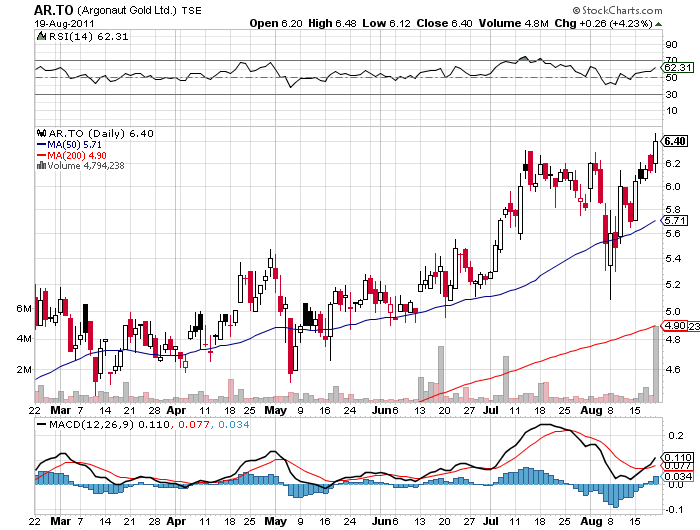
On the bright side, the gold stocks that I own broke out yesterday.  Jaguar Mining was up 6%.  Argonaut gold was up 4%.  Lydian International was up 4%.  Even OceanaGold was up 4%, and at one point was up more than 10%.  When I saw Jaguar Mining up first thing in the morning I added to my positions in Argonaut and OceanaGold.  I reasoned that if Jaguar is on the move, then something must be up.

The chart of Argonaut Gold looks particularly good.

Jaguar Mining is potentially on the verge of breaking out.

The positive move in gold stocks yesterday more than offset the losses I had in my non-gold holdings.  Coastal Energy and Arcan Resources were both down  a couple percent.  Gramercy Capital and Equal Energy were down less than a percent.  Leader Energy Services is looking more and more like a terrible mistake, and was down more than 5%.  My small position in Community Banker Trust took a drubbing, down 10%, though I don’t know why?

I changed the composition of my short positions yesterday. I exited my short in St. Joe and in Migao, and I added shorts to a number of banks.  I shorted Citigroup, HSBC, and UBS.

As for the gold stocks, I had a friend remark yesterday that he was finally seeing his gold stocks act as a hedge of his positions.  My reply was:

I hope you are knocking on wood, crossing your fingers, stepping between the cracks, holding a rabbits foot and wearing your clothes inside out when you say that.

Gold stocks have had so many false breakouts and so many months of disappointment that its hard not to be skeptical.

Having said that, I think that there are a few legitimate reasons here for gold stocks to move higher.

First, you have to always remember that the best environment for gold stocks is a low growth economy.  Gold stocks do best when the price of gold is doing well, but the prices of the basic inputs for gold mining (oil, metals, labour) are not doing well.

You saw this last year.  Gold stocks did great from August to October, when the economy was still perceived to be sluggish and a double dip was still on the table.  Once oil and other costs began to take off, gold stocks faltered.  The market rightly perceived that costs would rise for gold miners.  They did.  The market is smarter than you think.

So now, as growth expectations are ratcheted down and as oil prices come down, expected margins for gold producers are  expanding.  The market is probably anticipating this.

The second cause could be the expectation that Bernanke will react next week at Jackson Hole.  The following is an excerpt of a Goldman Sachs report released yesterday.  Goldman discusses what Bernanke might propose at Jackson Hole.

The Fed has three main easing tools: 1) communication; 2) asset purchases; and 3) cutting the interest rate on excess reserves. At the August meeting, it exercised option #1 by making a conditional commitment to keep the funds rate low until mid-2013. Option #3 is often mentioned but in our view is unlikely for several reasons. That leaves only option #2, asset purchases.

We believe Bernanke’s Jackson Hole speech will include a detailed discussion of the potential for more easing through large-scale asset purchases. A variety of indicators suggest many investors already expect more QE. For instance, a recent CNBC survey shows that more than $300bn of purchases may already be priced in. The sharp decline in forward real rates is also partly related to QE expectations, in our view (Exhibit 2).5 Based on our conversations with clients, we believe investors would be very surprised if the speech did not include a discussion of asset purchases.

We see two main reasons why Fed officials may prefer to change the composition of the balance sheet as a first step. First, as we showed in Monday’s US Daily, if used aggressively this could have a sizable impact. For example, if the Fed were to sell its Treasury securities that mature over the next two years and buy securities in the 10- to 30-year part of the curve—apportioning them based on amounts available in the market—it could take a similar amount of duration risk onto its balance sheet as in QE2 (around $350bn in 10-year equivalent terms, or 80-90% of QE2). The policy could be scaled up further by weighting purchases toward even longer maturities, or by changing the mix of the mortgage portfolio.

Second, policies that keep the size of the balance sheet (and excess reserves) unchanged may be less controversial among politicians and the broader public. A detailed discussion of possible changes in balance sheet composition seems a likely component of the Jackson Hole speech.

Bernanke may of course also discuss conventional QE. Arguments in favor of this approach include a less complicated exit strategy—if securities mature faster, the Fed may not need to sell actively—and potentially a larger impact on confidence and expectations. We do not think Bernanke will signal anything more unconventional, such as a higher inflation target, price level targeting, or a long-term interest rate target.6 However, these ideas may turn up in the FOMC minutes published on August 30. 

While listing the easing options looks probable, Bernanke is very unlikely to pre-commit to taking action next week. This is a monetary policy decision, and any announcement would come at an FOMC meeting. In addition, core inflation continues to accelerate, and Fed officials seem to have a rosier outlook than our forecast or the consensus. While we expect additional QE and the odds are rising at the margin, it is not yet a done deal.

So what GS is expecting is not the same type of QE that occured last time.  They expect a rearrangment of the Federal Reserve balance sheet to longer dated securities.  True QE means an expansion of the Fed balance sheet, so what is expected to be proposed is not true QE.  So its not directly supportive of higher gold prices.  What these sort of policies would be supportive of is lower long dated rates.  In other words lower interest rates for a longer time.

I remember reading Mish Shedlock a number of years ago.  He was (still is?) of the mind that gold prices at the time were in for a rough ride because interest rates were headed up and the real rate of return on treasuries were going to get more positive.  His basic reasoning was that if you can get a real return from a safe interest bearing asset you will move out of gold into that asset.  Conversely, if the real rate of return is close to zero (or negative!) you will tend to prefer gold.

At the margin demand for gold is determined from the real rate of return on other (perceived) safe haven assets.

What the Fed would be doing is effectively lowering interest rates across the curve.

That should be supportive of gold and good for gold stocks.

Tough Choices

I ran across another couple of good background pieces (here and here) on Europe.   I think these stories help put in perspective the difficult problem that europe faces.

I do not see how Europe faces up to this without being pushed into it.  And they being pushed into it right now.  The question for an investor is how much more pain it will take before Europe resorts to one or both of two possible solutions:

  1. The ECB assumes lender of last resort indefinitely
  2. A eurobond is floated

How much more pain?  I am afraid it may be a lot.  The more unappealing the alternatives, the more pain it takes to cajole someone into taking them.  I’ve lightened up on most everything.  I am considering lightening up now on my core positions (which thus far I have held steadily) of Arcan and Coastal if the market bounces back this morning.  Nothing to do with the companies.  I just don’t like where the world, and in particular Europe, looks to be headed.

Meanwhile, the source of my neverending frustration continues.  Gold goes to the moon and gold stocks do nothing.  For a while yesterday it looked like this might be ending.  I saw Jaguar, Argonaut and even OceanaGold up in the morning when the rest of the market was down.  This went on most of the day but ended in the last half hour.

Oh well.  The companies are printing money at these gold prices.  The 3rd quarter results will be tremendous.  And it will make it all that much easier for the three above mentioned names to fund their growth plans.