Skip to content

Archive for

The US Economy: Is the data bad?

I put a lot of emphasis on the Weekly Leading Index published by the Economic Cycle Research Institute.  The index is a leading indicator of US economic growth.  The index and its smoothed annualized growth rate have both turned up recently.
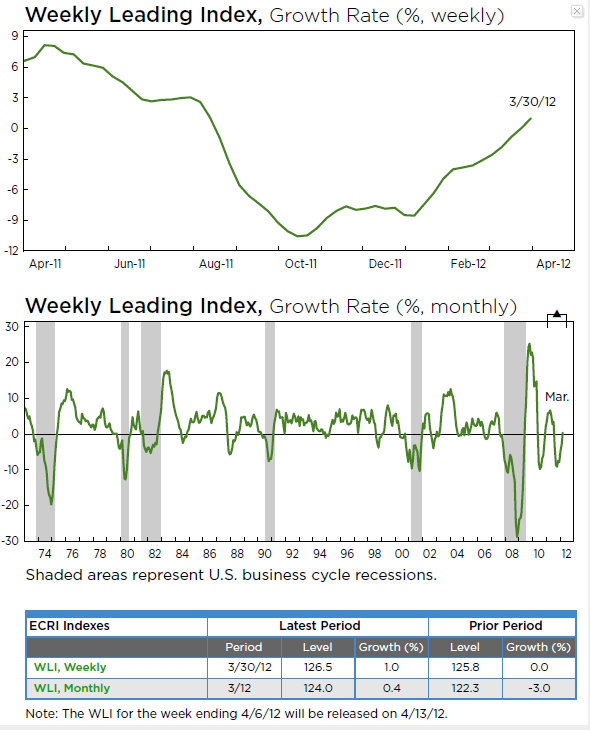
Presumably this suggests an improving economy.   Yet the ECRI has been sticking to a prediction that the US economy is going to fall back into a recession.

Why?

I was reading through the ECRI’s publically available articles trying to find out why when I ran into this article.  It describes a problem that has developed with the seasonal adjustment algorithms.  It seems that the economic collapse that followed Lehman Brothers in 2008-2009 has led to a skew in the adjustment that is being made.  Many of the seasonal adjustment algorithms are interpreting the downturn that occurred in Q4 2008 – Q1 2009 as a seasonal event that should be adjusted for.

Most data, both public and private, are seasonally adjusted. But the nature of the Great Recession seems to have had an unexpected impact on the statistical seasonal adjustment algorithms that are hard-wired to detect when the seasonal patterns evolve and change over the years. This is normally a good thing, but when the economy fell off a cliff in Q4/2008 and Q1/2009, it was partly interpreted by these procedures as a lasting change in seasonal patterns. So, according to these programs, data from Q4 and Q1 would be expected thereafter to be relatively weak, and therefore automatically adjusted upwards. Our due diligence on this subject indicates a widespread problem, resulting in many recent economic headlines being skewed to the upside.

The article was written in mid-March but as recent as last week the ECRI remained behind its conclusions and their conviction that the pick-up in growth is illusory.  This SeekingAlpha article quoted Lakshman Achuthan (who is the chief economist and spokesman for the ECRI) recentlyas saying that year over year (yoy) growth, which would not be distorted by the 2008-2009 numbers, is not improving.

Please note that PCI growth yoy is still -2.2% and even q-o-q is -4.9%… With yoy growth in all the coincident indicators (GDP, industrial production, personal income and sales) all staying in cyclical downturns, and yoy payroll job growth, which had been the only holdout, now rolling over — as we had predicted a few weeks ago — it’s pretty clear that for now U.S. economic growth is worsening, not improving.

The rub is that the data we have been looking at from January through March may be overly optimistic.  It is being overly adjusted to the high side.  Now that we are into April, that is about to end.

The data isn’t great

Indeed we are seeing something like that in the recent numbers.  The monthly jobs report was a big disappointment.  The jobless claims number that came out last week spiked to 380,000.

Home sales, which to me would be the true sign of a pick-up in the economy, remain depressed.

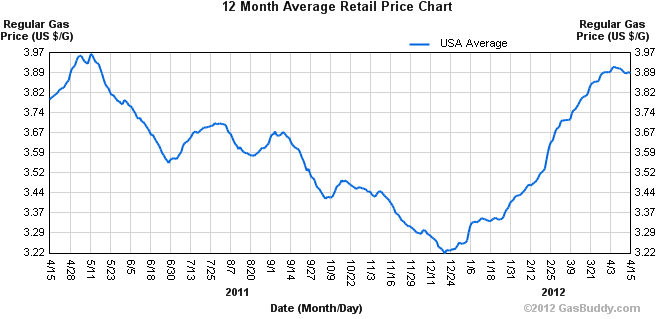
Add to this the fact that gasoline prices are about the only thing that have recovered to pre-recession highs.
What does it mean?

The situation feels to me like another false start.  To use the phrase coined by John Maudlin, we are in for more muddling through.  Low growth rates, low interest rates; maybe the ECRI will prove to be right and we will dip into another recession.

As for my portfolio, I am of the mind that I am mostly in stocks that should perform well in this environment.

Given the bleak outlook, gold and gold stocks should do well.  Of course gold stocks have done anything but well lately.  I have to remind myself of the volatility of these stocks, how they can bounce up and down like a yo-yo and turn on a dime.  I think that as it becomes more clear that the skies remain grey and the horizon dark, the gold stocks should recover.  I am certain that the reason we have not seen a breakdown in the price of gold itself is because there is smart money out there that sees the same picture I am drawing.

The mortgage servicers, Newcastle, Nationstar, and PHH, should hold their own in this environment. Servicing revenues are not dependent on an uptick in home sales to the same extent as other housing related businesses.  Interest rates remain at such low levels that these companies continue to accumulate incredible assets (in the form of new servicing rights) that will outperform in years to come.

The regional banks are a bit of a tougher choice.  However when I look at many of the regionals, they remain below their price level before the European shock in the summer.  The US economy may not be getting that much better, but it is slowly healing, and to see these stocks at lower levels is, in my opinion, a disconnect.
Week 41: A bit of a shellacking

Portfolio Performance

Portfolio Composition

Trades

Update

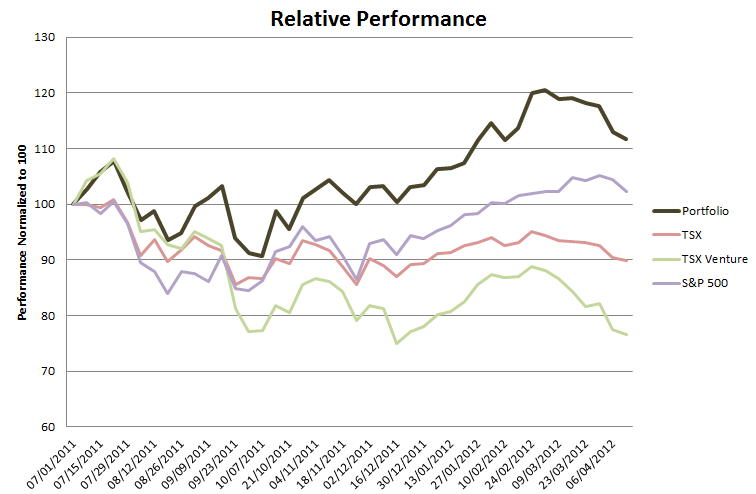
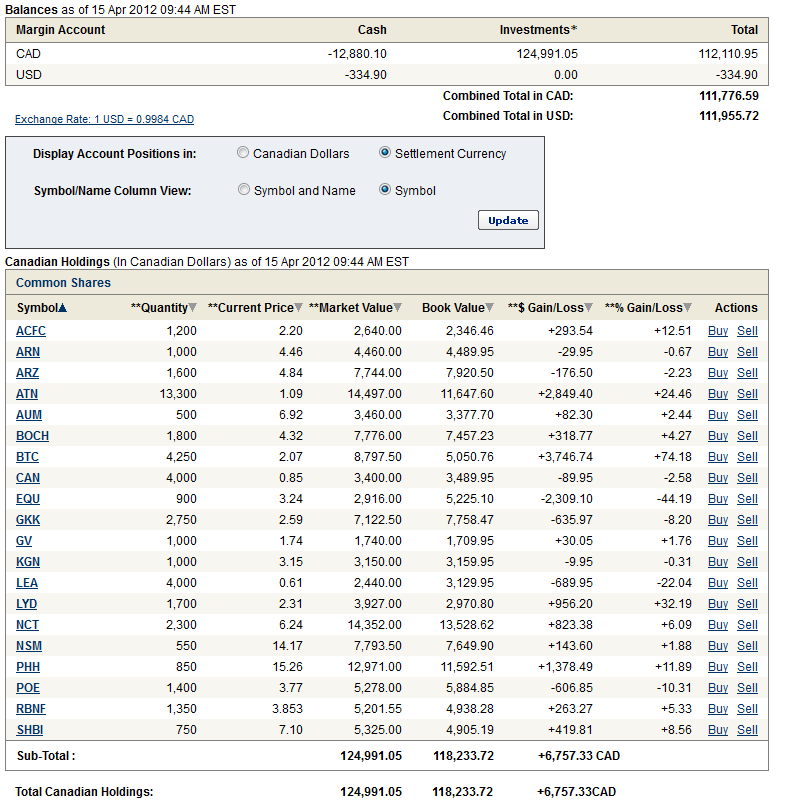
My practice portfolio has been taking a bit of a shellacking over the past number of weeks.  I am down about 10% since the end of February when my portfolio (along with the rest of the market) peaked.

Why I’m doing poorly

When I looked at what has caused the downturn in the practice portfolio I found I could blame most of the loss on 3 things:

  1. $1600 loss from Aurizon Mines.  I never thought Aurizon would stay below $5 for as long as it has with gold prices still over $1600.  Its bizarre but the same can be said for most gold stocks right now.
  2. $2500 loss from Coastal Energy.  Coastal peaked at around $21 per share and I sold Coastal for an average price of around $15.50.  After having sold half at $17 I made a $1,000 mistake when I bought it back at $16 only to sell at $14.50.
  3. $4900 loss from Atna Resources. I’m not sure what to say about this one.  It was not fairly valued at $1.50 so I was not willing to sell.  Now I have to sit through this correction to see if my thesis plays out as I expect

My emphasis on the mortgage servicers and the regional banks has thus far proven correct, and these companies are up slightly in the last month and a half.  Unfortunately their gains have been dwarfed by the above losses.

Keegan Resources: Trading almost at cash

Looking ahead I don’t plan to sell any of the gold stocks I own at what I would call ridiculously cheap prices.  In fact I did the opposite on Friday; I bought a position in a new gold stock, Keegan Resources.  I got Keegan off of a article on Mineweb that listed a number of gold explorers trading at market capitalizations that had fallen to levels where they were mostly covered by the company’s cash balance.  Keegan has a cash balance that makes up about 87% of its market cap.  I am of the mind that such a large cash position takes a good deal of the risk out of the stock.  I will write up Keegan shortly.

Less of what isn’t working with Equal

I did sell some Equal Energy this week.  I sold because A. the stock continues to go down even after the announcement of a Mississippian joint venture, which proves that like it or not I have been wrong in my thesis, and B. I am becoming nervous about the falling price of NGL’s and Equal, while being equally weighted between liquids and natural gas, is heavily weighted to NGLs in its liquids.

Back into Arcan

I bought back into Arcan Resources this week.  The stock has come well off of its highs, down from $6 to $4.50.  At this price, and given the company’s recent production estimate of 6,000 boe/d, it is trading at a reasonable $80K per flowing barrel.  The company also announced a boomer well on their southern Virginia Hill lands:

Arcan drilled and completed the Virginia Hills 13-32-64-13W5 (“13-32”) Beaverhill Lake horizontal well, with excellent results. The 13-32 well was drilled to a total depth of 4505 meters and flowed at a rate of 1773 barrels of oil equivalent per day (“BOE/D”) averaged over the first seven days and 1226 BOE/D averaged over its initial 21-day production period, with maximum day rates of 1900 BOE/D (92 percent light oil), flowing dry oil up 4.5″ casing.

Margin

I also wanted to note that a discrepancy has occurred between my practice account and the actual account that I try to track with it.   I’m on a lot more margin in the practice account.   I’m not positive when this happened, but I don’t look that closely at the practice account balances and I so it wasn’t until this week when the margin in my practice account hit double digits that I noticed that things were out of whack.  If my practice account were to reflect the same percentage as my actual account the margin would be around $2,500.  I think that what happened is that I am not strict about making sure the ratio of shares that I add in the practice account matches that of the actual account and I tend to round up, so over time I have been taking on more shares of each stock than I should.  Anyways I’m not sure what I am going to do about this because if I were to reduce each of the stocks that I have overweighted I would have to take a commission hit of $10 per trade because that is the standard commission charged in the practice account.  I think I will just try to slowly reduce the discrepancy over time until I get the account back into alignment with reality.

Looking at the business of Cal-Maine Foods

I’m going to have to spend some time over the next few weeks evaluating stocks that I don’t own in my portfolio covered by this blog.  These are companies of a few portfolios that I am taking on the responsibility of managing.  Many of these companies I am not terribly familiar with, and so I am going to have to learn what they do and whether they are businesses worth holding onto.

One of the larger positions that I am inheriting is Cal-Maine Foods. In this post I am going to focus on Cal-Maine’s business.  In a subsequent post I will look at the effect of the European legislation that is causing egg prices to increase substantially in Europe, and try to draw a conclusion on whether I will hold onto or sell the stock.

What they do

Cal-Maine was founded in 1957 in Jackson Mississippi.  The company came on to the national scene when they bought out Ralston Purina in 1972.  Since that time they have completed 16 more acquisitions of other egg producers.

Cal-Maine is the largest egg producer in the United States.  They sell shell eggs in 29 states, primarily in the southwestern, southeastern, mid-western and mid-Atlantic regions of the United States.

Cal-Maine distinguishes between eggs.  They sell regular eggs, and they sell specialty eggs.  A specialty shell egg is one of either a nutritionally enhanced, cage free and organic egg.  In fiscal 2011, specialty shell eggs represented approximately 25% of our shell egg dollar sales, as compared to to 21% in 2010 and 19% for fiscal 2009.  Retail prices for specialty eggs are less cyclical than non-specialty shell egg prices and are generally higher due to consumer willingness to pay for the increased benefits from those products.

Is the company growing?

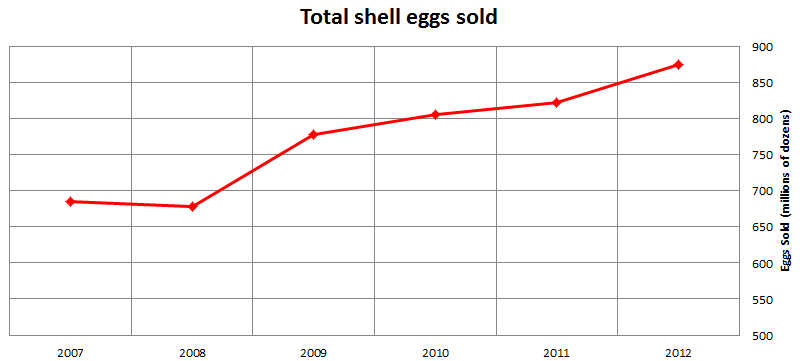
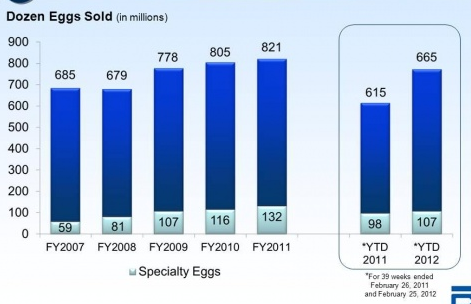
Cal-Maine says that the shell egg business grows about 1% a year.  So this isn’t exactly Facebook.  In the last fiscal year (ended May 30th 2011) Cal-maine sold 820,000 dozen eggs.  Egg sales have been growing consistently over the past few years at a rate that is higher than the industry growth rate, though this growth rate has been still only been in the low to mid single digits.

Below is the growth in eggs sold since 2007.  The 2012 number has been pro-rated to 12 months and I wasn’t sure how much to adjust for seasonality so I might be a bit on the high side here.

Costs and Margins

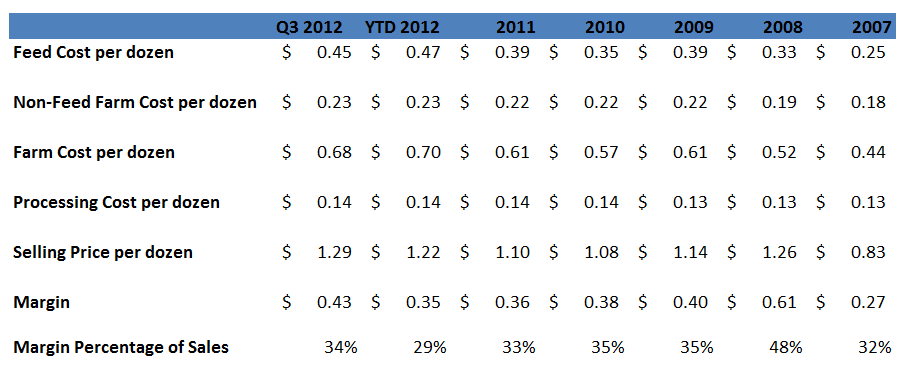
The cost of producing a dozen eggs have been increasing for Cal-maine.  The main input cost is the cost of feeding the chicken.  Feed for chickens are corn and soybean meal and so the costs of these inputs are directly related to the cost of corn and the cost of soybeans.  Both commodities tend to fluctuate quite a bit, and because of the growth of demand for corn from the developing world, as well as the ethanol subsidies, feed costs have been on what seems to be a secular uptrend over the past few years.

This is what feed costs look like over the past 5 years.

Cal-Maine doesn’t take any forward pricing positions to hedge feed cost.  So you can basically look at the price of corn, and to a lesser extent the price of soybeans, and that is what the costs are going to be for that quarter.

Apart from the feed cost, other costs associated with producing eggs consist of the cost of operations, labour, electricity, the usual.  There are also processing and packaging costs.  The total costs of doing business, and the margins, are illustrated in the table below for the past 5 years as well as thus far in 2012:

Again, its clear that the cost pressures are primarily on the feed side.  Processing costs and non-feed farm costs have risen slightly over the past 5 years, but not enough to warrant any concern.

Earnings, ROE, and ROA

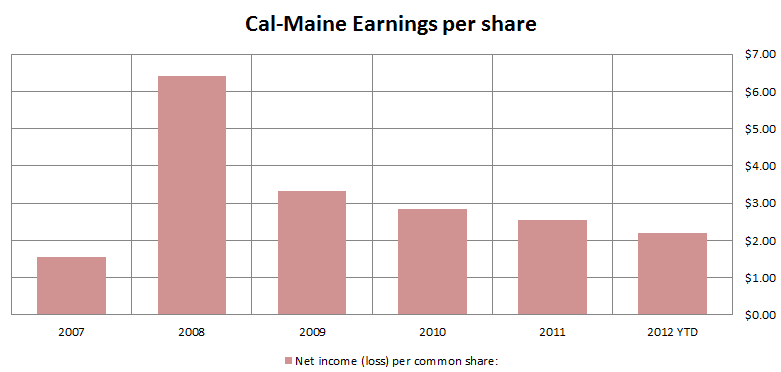
Earnings fluctuate pretty significantly depending on feed costs and egg prices:

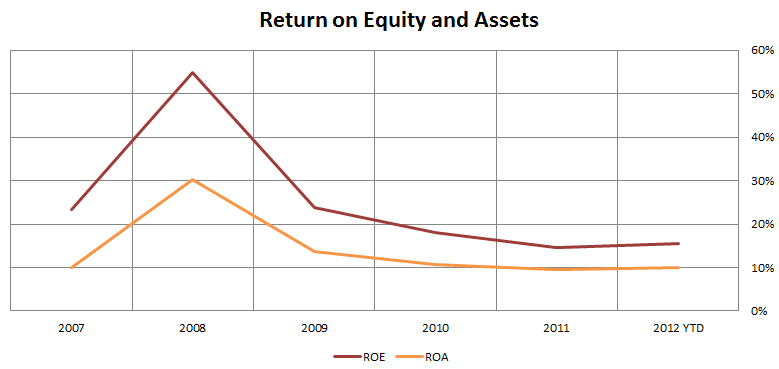
But even with the cyclicality, its not a bad business.  Profitability has been consistent, even through the recession.  Return on Equity has consistently been above 15%.  Return on Assets has consistently been above 10%.

Two ways to grow the business

Cal-Maine highlights a 4 pronged growth strategy but I am going to focus on the two of those prongs that I think are most promising.

  1. Acquisitions
  2. Specialty Egg Business

Acquisitions

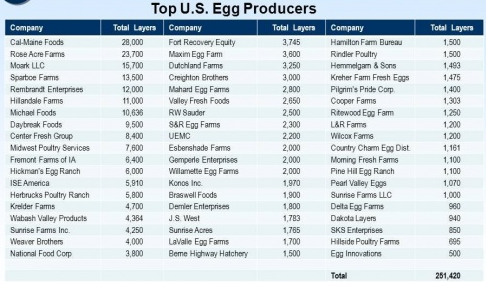
Pretty much all the competitors to Cal-Maine are family owned businesses.  At the JP Morgan conference the CEO, Fred Adams, pointed out that there is always generational turnover in these businesses and that turnover represents opportunities for acquisition.  What that means in english is that the younger generation isn’t always interested in running a boring egg business and without anyone to take over when the parents are ready to retire, Cal-Maine can buy them out.

I stole the chart below from the Cal-Maine presentation at the conference.  As you can see, none of the companies below are publically traded and most of them are family owned.

Obviously the advantage that Cal-Maine has is that it can take over these companies and quickly integrate them into their much larger operation.  Presumably there are cost efficiencies to be had.

In response to a question about acquisitions this is what Cal-Maine’s CFO Tim Dawson said about the company’s appraisal process:

When we talk about industry valuations we want to talk about the model we use.  We aren’t able to predict egg prices.   When you talk about an EBITDA model at the end of the day you are really basing that off of egg prices.  And we admit that we can’t predict egg prices.  So what we do is we send in a team of internal appraisers, and we do a depreciated replacement cost appraisal of the assets.   And then make an adjustment based on how good or bad the market that they service might be.

So basically an acquisition is going to be done based on the equipment, machinery and labour value of the operation.   Basically, how much would it cost to build this operation from scratch?   By looking at the acquisition target this way, they don’t have to make cash flow predictions that would of course be tied to egg prices.

The CEO, Fred Adams had this to add:

If someone wants to sell their business we are usually the first one they call because we have a good track record.  And if someone wants to sell their business its really just putting a value on the land, buildings and on the equipment.  Everything else is dollar for dollar whether it is receivables or inventories.  We’ve been very successful in the past, we’ve missed one or two but we’ve been told we were probably over-paying.

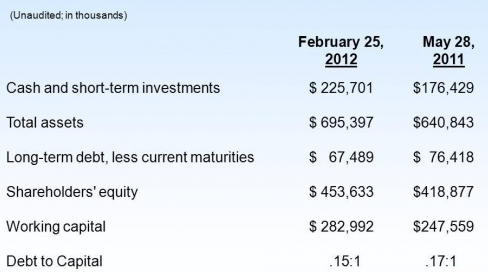
The company is well positioned to take on more assets at the moment.  They have an extremely clean balance sheet and net cash per share of $158M (about $6 per share).

You will also note that shareholder equity is $453M.  Total shares outstanding are a little under 24 million.  That puts the book value of the company at $18.88.  The company has consistently been growing book value at $40M to $50M a year for the past 5 years.

Specialty Eggs

Specialty eggs represent the second growth potential for the company.  Cal-Maine produces specialty eggs through the Egg-Land’s Bestä, 4-Grain, and Farmhouse eggs brand names.  Retail prices for specialty eggs are less volatile than prices for regular shell eggs.  They get a higher, more stable price for specialty eggs.  What is not clear from the 10-K and from the presentations I have listened to is whether the specialty egg business is actually a higher margin business.  Given the company’s desire to expand further into the business I would assume it is, but I can’t find informaiton anywhere that states the margins of the specialty business versus the regular shell egg business.

The company is growing the Specialty egg business at a brisk rate.  In 2011 it grew at a 14% clip and so far in 2012 its growing at a 9% clip.

Europe and the egg crisis

The third potential growth opportunity for Cal-Maine comes in the way of an unexpected egg shortage that is occuring in Europe, brought on by changes to legislation that have resulted in the loss of a large chunk of the egg producing chickens.    This is the topic that I am going to focus on in my next post.

What to make of the valuation

On a first glance at Cal-Maine, here is what I see.  I see a company that is running a decent business, a business that is profitable and bringing in cash, and they are reasonably priced.  At $36 they are trading at 12.5x last years earnings and 10.9x the average earnings over the past 5 years.  This excludes the $6.60 of net cash that they have on their balance sheet.

I think though that the key to the stock in the near term is whether the situation in Europe is going to spill over into the United States.   Right now I’m not sure of that, so I am going back to my hole to do some more research and figure out whether Europe can have a positive impact on a company for a change.

Leader Energy Services: Earnings should be out shortly

In the last month I sold off most of my oil related positions. Reliable Energy was bought out.  I sold Second Wave, sold Arcan Resources, and just this week sold Coastal Energy.

I haven’t sold Leader Energy Services.  The reason is partially because the stock hasn’t budged since I bought it.  With fourth quarter results coming out today, I am hoping for an uptick in the stock from strong earnings, but am worried about a disappointment.

The company closed a share offering at 70 cents.  It was the share offering that precipitated me to get back into the stock.

Leader Energy Services Ltd. (“Leader” or the “Company”) is pleased to announce that it has completed its previously announced bought deal short form prospectus offering (the “Offering”) entered into with AltaCorp Capital Inc. (the “Underwriter”). Pursuant to the Offering, Leader issued an aggregate of 9,790,000 common shares of the Company (“Common Shares”) at an issue price of $0.70 per Common Share, including 1,218,000 Common Shares pursuant to the partial exercise of the over-allotment option by the Underwriter, for aggregate gross proceeds of $6,853,000.

The company then used $6.1M of the proceeds to pay down debt.  In a subsequent press release the company said that after the pay down, the debt facility will be $8.9 million. The debt reduction will save Leader approximately $730,000 in cash interest per year.

I think the heavy debt load has been partially responsible for the cap on the share price.  Getting the debt down to $8.9M makes that debt load more manageable.  I would expect that they will bring down the debt even further as the year progresses.

The share offering increases the share count to 28,040,000 shares outstanding.  That puts the current market capitalization at $19.6M and the current enterprise value at $28.5M.

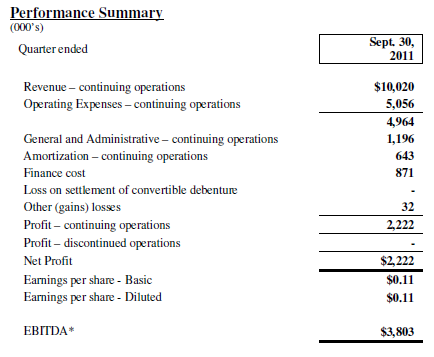
The company generated $2.2M of earnings (11 cents per share) in Q3 off of $10M of revenue.

The company guided Q4 revenue at over $11M back at the beginning of January.

Leader Energy Services Ltd. (“Leader” or the “Company”) today announced that it expects revenue for the fourth quarter ending December 31, 2011 to exceed $11.0 million, an increase of approximately 25% over the comparable quarter last year and approximately 10% higher than the third quarter of 2011.

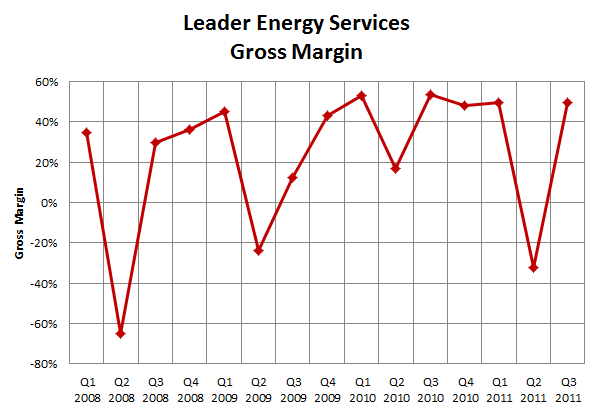
Leader has consistently shown that they can achieve gross margins of around 50% for the 3 quarters that aren’t spring break-up (in Q2 every year the ground gets very wet in Alberta and Saskatchewan and so oil and gas drilling activity comes to a halt.  This causes Leader’s earnings to have a somewhat seasonal aspect to them, with a yearly dip in Q2).

From the company’s revenue guidance and the expectation of 50% gross margin it is easy to predict earnings of around $2.7M for the fourth quarter.  Using the new fully diluted share number this is about 10 cents per share.  This doesn’t include the 750K, or 2.5 cents per share, of savings the company will derive from reduced interest costs every year due to the debt pay down.

If I extrapolate earnings for a full year, the company has, on average, lost $2.6M during Q2 because of the spring break-up.  If you assume $2.5M of earnings for the other 3 quarters and add back the $750K of interest savings you get full year earnings of around $5.65M or 20 cents a share.

The company said that they plan capital expenditures for the full year of $4.5M  If I look at the cash flow that the company would generate, adding back amortization expense of $2.4M, the company should be able to generate about $8M in cash flow, or enough to pay down debt by another $3.5M.

So there you have it.  That’s why I remain a holder of the shares of Leader Energy Services.  It seems like the company is going in the right direction by paying down debt and at the current price I am getting the shares at the same price as the offering.  If my expectation that the company can generate $8M of cash flow this year, then they have a debt to cash flow ratio of just a little over 1 and that will come down further as more cash is used to pay down more debt.  Couple that with the fact that they are trading at under 4x what I expect them to earn for the year, and with no slowdown to oil drilling activity in sight, and I conclude that the stock looks cheap.  Its an illiquid stock, so I don’t want to own too much of it, but the valuation makes it compelling to own a piece.