Skip to content

Archive for

Fourth Quarter Update: Ichor Holdings beats and beats

I have a lengthy update on Oclaro that I finished a couple of days ago and was planning to post this weekend but it will have to wait a few more days because I wanted to write a few short posts about what was a busy day on Friday.  After going a few days without any significant earnings updates, I was blitzed on Thursday night with 3 sets of year end results: from Radisys, Ichor and Hortonworks.

Two of these companies, Ichor and Hortonworks, produced unquestionably solid reports.  The third, Radisys, was considered a disappointment by analysts.  Of the three names, I added to my position in one, and it wasn’t the one with positive results.

I’ll start with the beats in this post by talking about Ichor.

Ichor Holdings

I wrote up the reasons for taking a position in Ichor about a month ago.

This was the first quarter that Ichor reported as a public company.   The report was very good, and the guidance for the first quarter was excellent, but all of this was expected.  Ichor pre-announced both in early January.

The most interesting new tidbit came from the conference call, where in response to a question asking ‘what if things get even better?’, management described their recent capacity additions.  They said that they had recently added or were adding enough capacity to support $200 million of quarterly revenue.  This is quite a large number.  Consider that with the “big beat” in the fourth quarter the company had $131 million of revenue, and that they are guiding to $150 million in the first quarter.  Only a year ago Ichor was generating a little over $60 million a quarter.

As strong as business has been, this has to be considered an indication that management sees it getting even stronger.

Given the growth (over 104% year over year and 24% sequentially in the fourth quarter), the concern of many, myself included , is that at some point this turns.  These capacity adds, which presumably are being done now because of some visibility of what is to come, allay those concerns in the near term.

The company supplies its gas and liquid delivery systems to two major customers, Lam Research and Applied Materials.  These two customers make up 90% of its revenue.  Both of these companies have projected a slower second half.  But even that level, which was described as a 55/45 H1/H2 breakdown on the call, is significantly higher revenue than Ichor was generating a year ago.

The company trades at a reasonable multiple considering the growth that is occurring.  If you annualized the fourth quarter results, the stock price is at 7x EBITDA.  The multiple shrinks to even less than that as revenue ramps higher in the first quarter.

Yet I struggled to add to my position on Friday even as the response to the report was somewhat muted.  I worry about being blindsided when the turn comes, as I feel like I have very little insight into the catalysts that will precipitate it.

It could happen in second quarter or in two years, I just don’t know.  The company suggests it may be more prolonged than many expect, as the drivers, which are 3-D NAND and multi-layer designs, are becoming ever more prevalent, and in the gas delivery business they have room to take market share from smaller competitors.  They are putting their money on that by investing in more capacity today.  But I wonder if Ichor is so far down the food chain that when the inflection comes they will be one of the last to know.

Thus I suspect that Ichor is destined to remain a 3-4% position for me, which I hope through appreciation eventually becomes a 5-6% position, but which I find unlikely I will be inclined to accumulate further and make it a portfolio changing score.
Community Bank Earnings: SFBC, SBFG, PKBK


Owning community bank stocks is boring.  Even on earnings day they often trade less than 1,000 shares.  The shares move up and down on so little volume that you never really believe the moves are real.  They seem like dead money, but then a year passes and you check out your account and you own a bunch of stocks up 20% and you can’t figure out how that happened.

So get ready for a boring but quite possibly profitable update.

I’ve had a number of the community banks I own report fourth quarter results.  All of the results were good so far.  I’m going to go through 3 of them here.

SB Financial (SBFG)

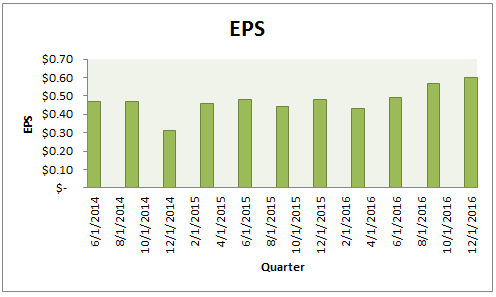
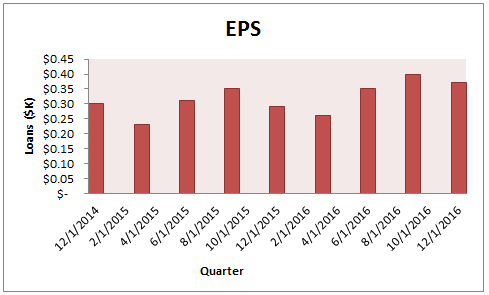
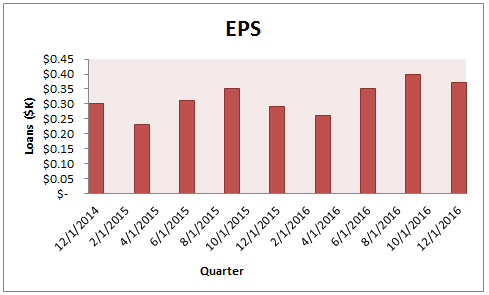
SB Financial was the first to report, a couple weeks ago.  The company made 37 cents EPS in the fourth quarter and $1.37 for the year.  The stock has traded up since the report, but even at $17.50 the PE multiple remains low at 12.5x 2016 earnings.

sbfg_eps

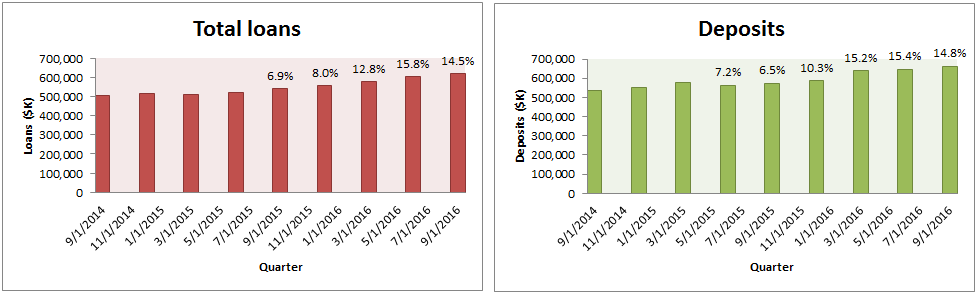
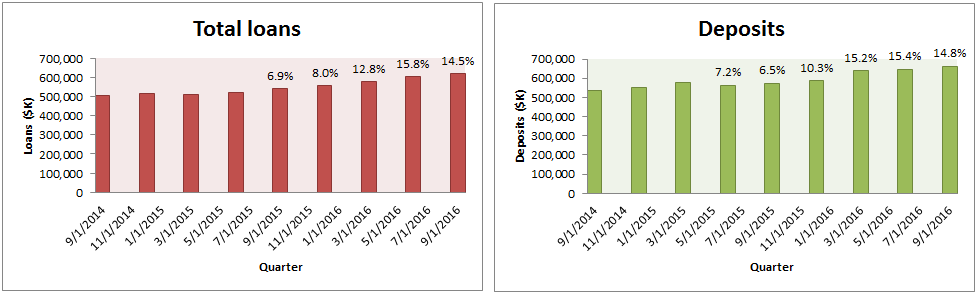
One of my criteria for buying a bank was loan growth and deposit growth.  These are the two pillars that will lea to eventual earnings growth (as long as the bank is well run and can leverage their expenses).  Loan growth at SB Financial continued in the fourth quarter, up another $15 million or 14% year over year. Deposit growth was up $20 million or 15% year over year.

sbfg_loansanddeposits

My one complaint was that earnings were somewhat low “quality” compared to the past few quarters.  Fee income was a little lower ($1.5 million versus $1.6 million in the second quarter), while the company got a big gain from the mark to market of its mortgage servicing right portfolio.   I’ve talked about mortgage servicing rights in the past. The mark to market adjustments from servicing rights can be large as they are very sensitive to changes in interest rates.  But this doesn’t really reflect health of the underlying banking business and if anything it portends to lower originations.

Nevertheless return on equity (ROE) was 10.72% and return on assets was 1.14% which are solid numbers.  Non-performing assets remain a small percentage (0.65%) of total assets.  I am happy with the results.

Sound Financial (SFBC)

Sound Financial put together a similarly good quarter.  Loan growth was 8.4% year over year.  Yield on loans reached 5.19%, which is a 10 basis point bump in the last year.  Deposit growth was 6.3% year over year.  Non-interest bearing deposits, which are the best because they are essentially free, rose to 13.6% of total deposits from 11.5% of deposits the previous year.

sbfg_loansanddeposits

Deposits should continue to increase in the first quarter after the pending purchase of deposits from Sunwest bank in October:

Sunwest Bank of Irvine, California to acquire approximately $17.7 million of deposits for a core deposit premium of 3.35% and its University Place, Washington branch located at 4922 Bridgeport Way West.  The cost of funds from this branch is an attractive 17 basis points and the cash received is expected to be used to pay down FHLB borrowings.

Earnings per share were 63 cents in the fourth quarter and $2.16 for the year.  On a trailing basis the stock trades at 13.4x earnings.


sfbc_eps

Like SB Financial, Sound Financial suffered from lower fee income which declined from $647,000 to $586,000. I’m not sure the cause of these declines and whether there is general pressure on the industry.  It is something to keep an eye on.  Also like SB Financial, they took a gain on mortgage servicing rights, though the servicing portfolio is much smaller so it was to a much smaller degree.

Book value rose 80c in the quarter and is now $24.  Return on assets crept up to almost 1%, at 0.97% up from 0.89% at the end of last year.  Return on equity was at 9.4%.

Non-performing assets are up a little, to $4.5 million from $2.9 million a year ago, but this is still a tiny 0.77% of assets so nothing to worry about.  Again, solid performance and it remains a cheap stock.

Parke Bancorp (PKBK)

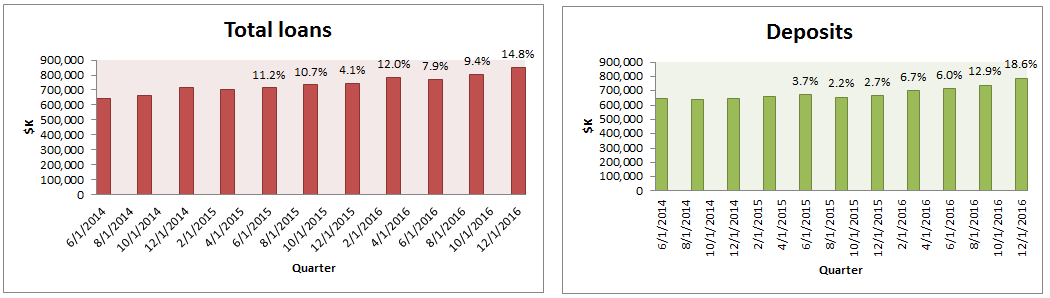
This is going to feel repetitive.  Parke Bancorp had a good quarter as well.  They saw year over year loan growth (15%) and deposit growth (18.6%).

pkbk_loansanddeposits

Diluted earnings per share for the quarter were 38c.  For the year, earnings per share were inflated because in the second quarter the company sold its small business admin loan business for a $9 million gain.  Excluding that sale I estimate diluted earnings for the year would have been about $1.50.  That trades the stock at 13x earnings.  Below is diluted earnings ignoring the sales of the SBA business.

pkbk_eps

Earnings likely would have continued to grow in the third and fourth quarter had the company not chosen to monetize their SBC business.  I’m not sure why the bank sold it?  In the second quarter press release they referred to it as a “unique opportunity”.  It’s possible they just got a great offer, which the profit (over $1/share) suggests.  They still plan to offer SBA loans through their bank, but it probably won’t be at the same scale.  There were no SBA loans sold in the third quarter and no the fourth quarter press release there was no mention of SBA loans sold.

Parke Bancorp has somewhat higher non-performing assets than the other banks I own, at $21.7 million or 2.4% of total assets.  Over half of that amount is real estate owned.  In the fourth quarter press release the bank mentioned one property in New Jersey that has been written down from $12 million to a little over $3 million.  The trend on non-performing assets is in the right direction though, they stood at $30 million a year ago.

The bank has opened two branches in the last year, which is helping deposit and loan growth.  The first is in Collingswood New Jersey and the second is in Chinatown Pennsylvania.   These banks are still ramping and should help fuel growth in 2017.

Combimatrix: Just too cheap

I stumbled on Combimatrix shortly after taking a position in Nuvectra.  The companies have similarities.  Both are very small biotechs trying to gain momentum on sales.  Both have showed recent growth.  And both have a large part of their market capitalization tied up in cash.

But Combimatrix is cheaper.  To be honest, I don’t quite understand why Combimatrix is as cheap as it is.  It’s possible that there is an element to the story I a missing.  When I bought the stock, in the low $3’s, the market capitalization was a little over $8 million.  It’s closer to $10 million now.  The company has over $4 million in cash and very little debt.

While there are many biotechs around that boast high cash percentages (Verastem, for example, remains with a cash level well over 2x their market capitalization) these companies aren’t generating any revenue.  Combimatrix has a revenue generating business, and the business is growing.

Combimatrix provides reproductive diagnostics testing.  They offer three types of tests: microarray, karyotyping and fluorescent in situ hybridisation (FISH).  I believe these are the only three commonly used testing methods for such diagnostics.

Of the three, Combimatrix’s primary focus is on microarray testing.   It makes up about 70% of their testing volumes.  Microarray is (I think) the newest test method (based on what I’ve read, though there is some indications that FISH being applied to some reproductive diagnostics is new).  It seems that microarray tests have the advantage over karyotyping and FISH in that they provide more information about potential problems (from this article):

chromosomal microarray, detected more irregularities that could result in genetic diseases — such as missing or repeated sections of genetic code — than did karyotyping, which is the current standard method of prenatal testing.

But it is also a more expensive test.  Which has led to problems getting insurance coverage:

The tests can cost $1,500 to $3,000 in addition to the cost for the amniocentesis or C.V.S. procedure. Karyotyping can cost $250 to $1,500. Insurance does not always pay for microarray testing since it is not considered the standard of care for prenatal testing.

Looking back I believe that this is where some of Combimatrix’s problems have come from.  Insurers have been slow to adopt microarray tests into their coverage.  The company hasn’t ramped revenue they way they had anticipated.  There have been cash issues, and capital raises.  But this seems to be changing.  In August Combimatrix put out a press release with the following comment:

“There are now at least 20 health insurance providers this year that have revised their medical policies to include coverage for recurrent pregnancy loss testing,” said Mark McDonough, President and Chief Executive Officer of CombiMatrix.

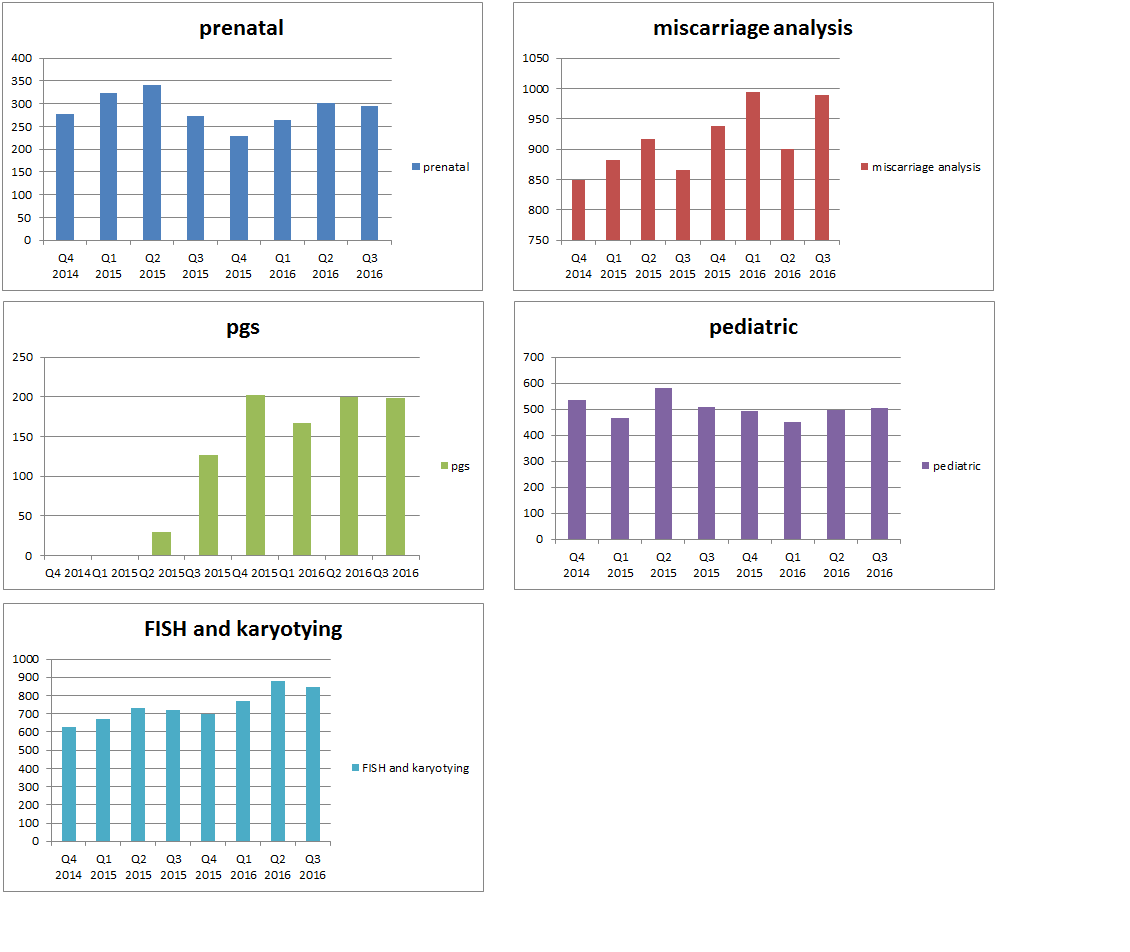
Below are charts showing volume growth for the 5 segments that Combimatrix reports.  Growth is lumpy, but overall there has been a trend towards increasing tests.  They also seem to have pricing leverage, as similar charts showing revenue by product line (not shown) trend more clearly left to right.

volumes

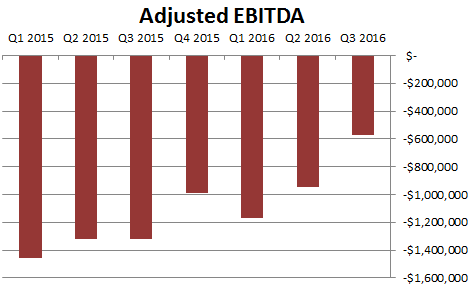
Management has reiterated on a few occasions (most recently in the third quarter conference call) that they will be cash flow breakeven by the end of next year.  This seems reasonable as adjusted EBITDA has been trending towards that level for 2 years now.

adjusted_ebitda

So it’s a cheap stock with a business that is pointed in the right direction.   The only reason I can think of for the stock being so cheap is the risk of further dilution.  As they approach the breakeven mark this concern diminishes and hopefully the stock price responds.  At least that is my expectation.  We will see.