Skip to content

Posts from the ‘Agnico Eagle’ Category

Comparing Gold Producers

Every quarter I spend an evening or two going through the reports of the 15 or so gold stocks that I follow and updating a spreadsheet that I use to track their progress and compare them against each other.

I do not use the spreadsheet in the way a strict value investor might.  I do not search out and buy the cheapest gold stock of the bunch on a cash flow metric or per ounce metric.  I do look for value, but I also look for growth.  The stock market tends  to treat gold producers in much the same way they treat any other business: stocks with superior growth potential get bid up to higher valuations.  On the other side of the coin, you can sit on what appears to be an undervalued producer for a long time if that producer has a poor pipeline of projects or has no prospects to produce near term incremental ounces.

I did exactly that recently with Aurizon Mines.  I was attracted to the value, it was cheap compared to its peers, it had a lot of cash on its balance sheet and no debt, and they have a well run and profitable operation at Casa Berardi.  Yet Aurizon does not have a strong growth pipelne.  Its closest to completion project is an open pit prospect called Joanna which, while it could one day produce a lot of gold, has been stuck in the feasibility stage for more than a few years and has the worry of requiring a large capital outlay out front.  When you add that to a number of fairly early stage exploration projects the result is a company without the near term potential to grow ounces significantly.  I sat on Aurizon for almost 6 months based on its value story and the stock went nowhere.

At the other end of the spectrum is a company like Argonaut Gold.  I owned Argonaut Gold for a while last fall but sold out way too soon.  I sold because I saw the stock was priced dearly compared to many of its peers.  However I failed to adequately account for the growth opportunities.  It was a silly oversight;  I had originally bought the stock because of the low capital cost heap leach projects that they could bring to market quickly.  Somehow though I forgot about this, got caught up in the valuation and that led me to sell too early.  The stock has since doubled to $10 before pulling back in the recent carnage that has brought all gold stocks to their knees.

When I was looking for gold producing companies a couple of weeks ago I was on the lookout for the next Argonaut Gold.  Unfortunately I have not been able to find them (if you have some ideas, please drop me a note).  In my opinion the closest comparison to Argonaut in terms of near term low capital cost growth potential is Atna Resources.  Atna has a legitimate chance of increasing their gold production from 40,000 to over 150,000 ounces in the next couple of years.  What makes Atna an imperfect comparison is that most of its projects hover around the cash cost level of $900 per oz, which is on the high side of the cash cost scale, whereas Argonaut has been able to achieve the double whammy of low cash cost low capital cost growth.

A second producer that I have bought (back) recently is OceanaGold.  I have had good luck with buying OceanaGold when the market hates them and selling when the market starts to show some love.  This time around I may hold on for a bit longer.  OceanaGold has typically been one of the cheapest gold stocks on cash flow metrics.  This is because, in part, they have struggled with costs and production at their existing mines. However, their soon to be producing mine in the Philippines (Didipio) will bring about some growth to the company, and perhaps more importantly, it will reduce the corporate cash flow numbers substantially.

One thing that got me interested in OceanaGold again was my research of Agnico-Eagle (which by the way is the third producer I own right now).  While Agnico-Eagle has had some difficulties with the closure of their GOldex mine, they remain one of the best growth stories in the industry and I believe the market will come around to forgetting about Goldex and recognizing this once again.  Agnico-Eagle owns 5 operating mines.  Of those five, one mine, Meadowbank, produces about 1/3 of the production.  At the corporate level, Agnico-Eagle has reasonably low cash costs.  They were $594 per oz in the first quarter.  However Meadowbank, the largest mine, has cash costs over $1000 per oz. On its own its a marginal mine that produces a large number of ounces.  Together with the other low cost assets that Agnico has, it receives a much higher valuation than it would on its own.

I liken this situation to the one at OceanaGold.  At OceanaGold, the corporate level cash costs should come down fairly substantially with the introduction of gold production from Didipio.  Didipio will produce a lot of copper in addition to its gold, and this will make the cash costs of the project appear to be quite low.  The cash costs of OceanaGold will not get down to the level of a company like Agnico-Eagle (the high cost mines at Oceana will continue to make up too much of the production) but I do not see it as unreasonable to think they will drop into the high $700 range.  My bet on OceanaGold is that when production begins at Didipio, analysts will begin to revalue the company on the basis of a mid-cost producer rather than a high cost one, and that should provide for some upside in the stock.

I updated the spreadsheet below over the weekend.  I did not update it during this week with stock prices for each stock tabled.  The prices are as of Friday’s close.  There has been so much movement in many of these gold names in the last couple days that the prices are already somewhat outdated.

My hope with gold and gold stocks is that this move is for real.  What I think we need to have for this move to be real is action out of Europe that brings gold back into the system.  I wrote this weekend about how, in general, the turmoil in Europe should cause weakness in paper currencies and lead to strength in gold.  On Sunday Donald Coxe was interviewed on King World News and decribed a scenario whereby gold would be used along with a value added tax as colateral for euro-bonds on ther periphery.  While I am a bit fuzzy on what  the details of such a bond might be, I believe that conceptually this is the sort of event that has the potential to create a great rally.  On the other hand my enthusiasm is tempered that if nothing is done in Europe, and if the Federal Reserve does indeed decide that QE is not working (I don’t think its nearly as clear as others do that the Fed will mindlessly embark on further quantitive easing.  The Fed is, after all, a data centric institution, and if it appears that the benefits of QE are not what was anticipated, and I believe that has been the case, they may decide that a third installment is not beneficial).

Below is my spreadsheet comparison.
On the trials and tribulations of owning gold stocks

About a month ago I wrote the following in an email to a friend:

I probably seem crazy to be chasing gold stocks in and out like I have.  I’ve been wrong over and over.  But I’m not losing much money doing it because I keep selling before it gets out of hand and I know from experience that when they move up they will move so fast and you have to be ready for it.  What we saw in January was nothing, in the past I have had stocks triple in a month when they move.  They can move so fast in such a short time its crazy.

At the time I was getting mucho frustrated and more than a little despondent about the reaction of the gold shares.   Gold stocks were being sold indiscriminantly.  Even though the price of gold was holding up rather well, the stocks of the companies that produced gold were being trashed.  For those companies that only explore for gold, the thrashing was even worse.

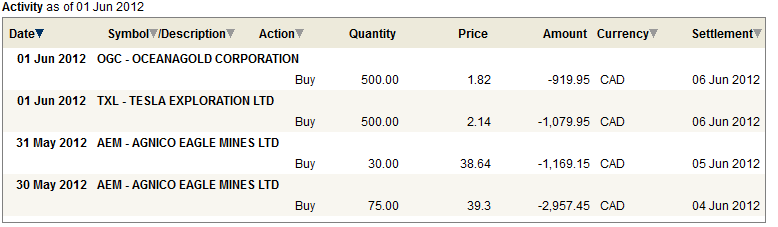
I follow a few rules for investing.  One of those rules is to never add to a losing position.  Another rule is to scale out of stocks that are not doing what I think they should do.  A third is to mind the intraday reversals.  The consequence of following these rules with the gold stocks is that I have bought in and been bounced out of these companies a few times over the last couple of months.  I have owned Aurizon Mines, Lydian International, Golden Minerals, Barrick Gold, Newmont Mining. I now own OceanaGold and Agnico Eagle in addition to a large position in Atna Resources and Gold Standard Ventures and (sigh) Canaco that I have held throughout.

While my furstration has left me tempted to walk away from gold completely, the reasons I didn’t give up was three-fold.

First, I just can’t get past the conclusion that the underlying condition of the world right now should be favourable to owning gold and gold stocks.  World economies are weak and weakening, and along with it so are the inputs to gold mining.  Interest rates are near zero, which means that alternative paper investments (bonds) do not have their usual yield advantage over gold.  Central bankers have shown a bias towards printing money to avoid lengthy recessions and prevent a destabilizing banking crisis.  Debt in the developed world is still high historically.

In this environment the perception of gold should be favorable, and its perceived value in units of paper currency should increase.  The truth is that the price of gold is based on perception.  I think that is why you have such wild fluctuations in both gold and gold stocks.  Its because gold has no value apart from the value that man has historically perceived in it.  And its difficult to nail that down.  I am starting to get tired of the term, but to say that gold is the existential commodity is really not very far off.

Second, the gold stocks are cheap.  They are trading at multiples that I didn’t think gold stocks would ever see.  Newmont and Barrick have been down as low as 8x earnings.

As well, with economies slowing, I think we are finally going to see the benefit to gold mining from lower energy,  labour and capital costs.  It has become so common for a gold company to report escalating operating costs, or increase the estimate of capital costs to build a new mine, that it is now almost expected by the market.  But these costs do not rise in a vacuum.  They rise because energy, copper, steel and labor prices have been rising.  As economies around the world slow, this effect is reversing.  We should begin to see that effect in the second quarter numbers, where cash costs beging to show decline.

The third reason that I didn’t give up on gold stocks is because I know that when they turn, they turn hard.  I have been on the outside looking in before when this turned happened.  I have learned that it is extremely difficult to buy a stock when it has risen a significant amount in a short period of time.  In the same manner that gold stocks have fallen day after day for months, with seemingly no support, they can also do the opposite, and rise very quickly and dramatically in a short period of time.  The only way I have found to take advantage of this, given my own constitution, is to be in before the rise begins

In my update last weekend I noted that I had bought a position in OceanaGold and in Newmont.  This week I added to OceanaGold and initiated a new position in Agnico Eagle:

I finally had timing on my side with these purchases.  Yesterday gold and gold stocks took off after the dismal employment report.  I was pleased that in my review of the carnage after the market closed, that because of the outperformance of the gold stocks, I was actually up a reasonable amount in my portfolio.  This despite the fact that Newcastle and PHH got clocked pretty hard, and the oil stocks I own, Mart, Equal and Pan Orient succumbed to the pressure of falling oil prices and oil stock malaise.

Is what happened yesterday the sort of rise I have been waiting for?  While it feels like it to me, its impossible to say.  What I do know is that the underlying conditions in Europe have been supportive of a rising gold price for some time now.    To say that gold must fall with Europe (presumably because of margin calls) can only be taken so far.  There are only so many margin calls that can be made before no one is on margin any more.

I have listened to twice and would highly recommend this interview given by Donald Coxe on the James Pulplava Financial Sense news hour. He said the following:

With the great gold mines they have 20 or 30 or 40 years of reserves and you are getting it for free.  Gold prices voer the longer term are bound to go up.  You don’t have to pay via a call option to own gold in the future, you are getting it for free with these great gold companies.  This is an amazing investment opportunity.  All you have to say is, it won’t be an amazing investment opportunity if no governments are running deficits, if the money supply growth is not above 3.5%, in which case you should not own gold.  If that is what you believe is likely then you should not own gold.  On the other hand if you believe that is about as likely as an invasion of spaceships from some remote part of the milky way, which is my view, then you should be owning gold.  And the best way to do that is by owning the gold mines.

Before today the concern about gold, I think, was that the American economy was on the cusp of a robust recovery and quite truthfully, if the US can grow sustainably, it can solve a lot of its problems.  What the job report yesterday suggested was that the recovery is not robust.  It needs to be understood that there is the possibility that the US just continues to muddle.  The job report today does not mean that the US is collapsing, as the stock market and bond market seemed to suggest it was.

The bottom line, I think is that gold is an asset negatively correlated asset to paper currencies, and as paper currencies lose their perceived value, gold must benefit.  Gold miners remain a very cheap way to take advantage of this idea.