Skip to content

Posts from the ‘Atna Resources (ATN)’ Category

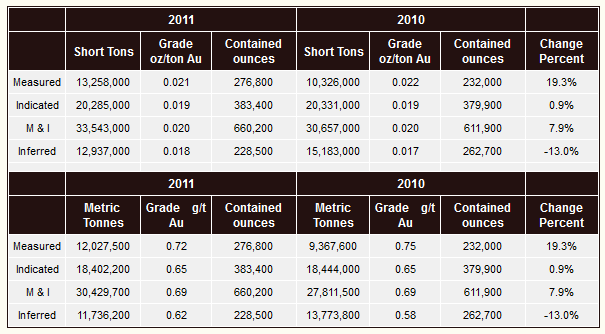
Atna’s New Pinson Resource

Atna released an updated resource on Pinson on Monday.  Over the next 3 days the stock fell about 15%.

The release of the Pinson resource produced one of those bizarre situations you happen on in the market from time to time whereby you had a company valued at a price that wasn’t really reflecting anything near the value of the assets in the first place, but on the other hand the value of the assets has disappointed on the downside so clearly the company must be worth less today than it was the day before the news was released.

So the stock goes down and the assets are even less reflected in the price of the stock.  C’est la vie.

Was it that bad?

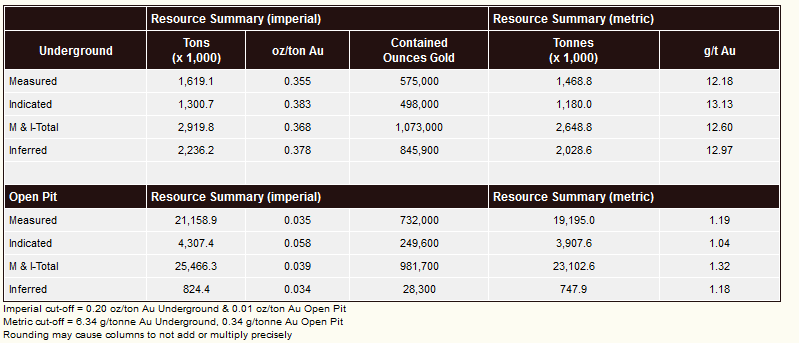
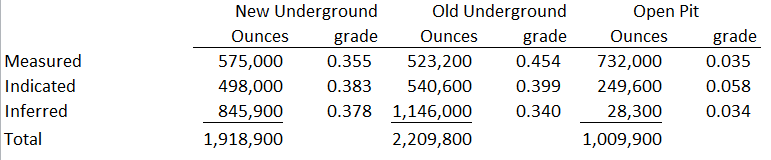
Lets look at the details.  I don’t think numbers are that bad.  The underground number is still robust, and the open pit number is intriguing.

The reasons for the sell-off is that compared to the previous resource on Pinson (done ages ago in 2007), the numbers were a little disappointing.   Two ways they were disappointing.

The first disappointment

The underground ounces went down.

Now the lost underground ounces are compensated by the gained open pit ounces.  Kind of.  I mean the open pit is a whole other animal.  It needs its own permitting, it needs big yellow trucks, and while the grade is decent (a little over 1 g/t), its not the kind of knock your socks off grade that the underground is.  In fact, I think the open pit was maybe what Barrick was looking to make Pinson attractive to the larger miner.  Just to recap the history with Barrick, and perhaps shed some light on the open pit, here is a short timeline of those events, as presented by sequential Atna MD&A and press releases.

The history of Atna’s official comments about Pinson

Press Release August 8th 2008:  Initial results of PMC resource optimization studies indicate the potential for an open pit concept that could combine the underground resource with un-mined resources remaining in and around four of the historic Pinson mine pits, into a large pit concept… Simultaneous work is being conducted on optimizing underground mine design and economic trade-off studies on the benefits of mining the high grade resource zone by underground methods or proceeding with the project using a large scale open pit concept.

Q2 2008 MD&A:  However some of the remaining MAG pit material is believed to be refractory and may require autoclave or roasting preoxidation to be amenable to conventional cyanidation.

Q2 2009 MDA: PMC recently concluded the expenditure of US$30 million at Pinson to earn its 70 percent equity position. The results of that work are being evaluated to determine the feasibility of development and a future plan for the project. The property has been placed on care and maintenance while the technical study is completed and until a decision is made concerning the future of Pinson. Dewatering of the underground facilities will continue during this decision period to protect the partners’ investment and facilitate re-start, if warranted.

Q3 2009 MDA: Drilling reported by Barrick included a significant number of infill drill holes within the Ogee, the CX-West, the Range Front (and hanging wall splays), and Mag Pit mineral zones. This new information, along with the existing drilling data developed by Atna and prior operators, has been included in PMC’s evaluation of the project’s potential. On the basis of this evaluation, PMC has determined that the open pit potential is not viable. The joint venture is discussing alternatives for the project.   The joint venture has agreed to a property budget that allows for continued dewatering of the underground workings while the technical evaluation is being completed.

Q4 2009 MD&A:  The joint venture is discussing alternatives for the project. These alternatives include the development of high grade gold resources at the property by underground methods. Atna is in discussions to potentially acquire Barrick’s interest in the project and Barrick may be considering this offer, but they may also solicit other offers or they may continue to hold their interest. Atna holds a preemptive right to match any third party offer should Barrick decide to sell their interest. The joint venture has agreed to a property budget that allows for continued dewatering of the underground workings until a final development or divestiture decision has been reached.

Q1 2010 MD&A: In general, the drilling program did not extend any of the known resources significantly. Drilling was suspended in December of 2008. In 2008, underground exploration drifting was re-started with 2,010 feet, of drift excavation completed. The underground excavation contract was terminated in January of 2009. Over 4,000 feet of underground drift and workings have been completed at the site… PMC has completed an in-house review of the project for both underground and open pit mining potential. They are currently reviewing their strategic options in regards to the project, which may include sale of their interest.

Q3 2010 MD&A: PMC has completed an in-house, unpublished review of the Pinson project for both underground and open pit mining potential, but did not develop a project that was immediately attractive to Barrick for development. Atna believes that the underground development potential at Pinson is attractive. As a result, the MVA partners are engaged in an active dialogue concerning the future direction of this project.

It sounds to me like Barrick lost interest in the project when it looked like the open pit was a no go.  Now of course, the open pit was a no go when gold prices were under $1000 per ounce and Barrick was probably using $700-$900 per ounce as its target price for development.

Of course the Pinson open pit is undoubtably viable at these gold prices.  And Atna is anticipating bringing it into the mix.  So its good news that the resource is robust.  It just doesn’t necessarily compensate for the loss in underground ounces… or in grade.

The second disappointment

And that is the second disappointment.  The grade was lower.  What is not completely clear to me fromthe press release is whether the grade was lower because the more recent drilling just outlined lower grades, or because the new grade estimates are taking into account more realistic dilution of grade now that the company has a firmer grasp of the mining methods that will be used.  I have just emailed the company about this (I should have thought of it sooner). Atna vaguely alluded that this might be the case in the press release:

The Block model was divided into five statistically related zones to accommodate statistical search parameters appropriate for individual mineral styles.

But its hard to say what that sentence is saying.  I will update if I get one from the company.

Taking a look at Atna’s most recent presentation, the company has changed its costs at Pinson from (I think) the $700 to $750 per oz range to a wider $700 to $850 per oz range.    That increase in the upper end range is probably reflective of the lower grade, either because of a decrease in the ore grade itself, or an expectation of a higher dilution of that ore through the mining techniques expected to be employed.

When I did my estimates I assumed what I thought was a restrictive dilution of 30%. To refresh, the parameters I used in my analysis were:

  • A 15 year mine life, beginning at 350t/d and ramping to 750t/d by year 4.
  • Total produced ounces of 940,000 oz over LOM
  • 0.4 oz/t resource over the mine life, diluted by 30% with 90% recoveries, resulting in gold production beginning at 50,000 oz and ramping to 75,000 oz.
  • Mining costs of $110/t, milling costs of $50/t and G&A costs of $11/t
  • Cash costs of $687/oz over LOM

I went back over that analysis and looked at the sensitivity to dilution.  Turns out that Pinson is quite sensitive to that dilutive factor.  You would need to see about 45% dilution at my original grade of 0.4 oz/t to get up to $850 per ounce costs (these are the $2100 per oz gold price estimates.  I used the high end number so that I could see just how big the differences in dilution could amount to in terms of NPV):

You could run the same sort of sensitivity with grade and you’d get about the same thing.  Dilution and grade are really two sides of the same coin; the outcome of the two combined is the actual grade of the rock being mined and processed.

Its all academic

So you can run the numbers and get an idea of the sensitivity to grade and dilution and of how the change in reserves affects the present value.  That’s nice.  But in the end what’s it come to?

Sometimes you have to step back and look at what you got instead of focusing on the details.  Pinson is probably worth at least double Atna’s current enterprise value (about $125M).  You add onto that the value of Briggs, of Reward, and of Columbia, and they are probably worth at least the enterprise value themselves.  Put that together and it seems rather stupid to be talking pennies about whether Pinson has gone up or down 10-15%.

Bottomline: Atna remains the best opportunity in the gold space over the next year, in my opinion.

Week 30: Cognitive Dissonance, Canaco updates, Canadian house prices and the story of Community Bankers Trust

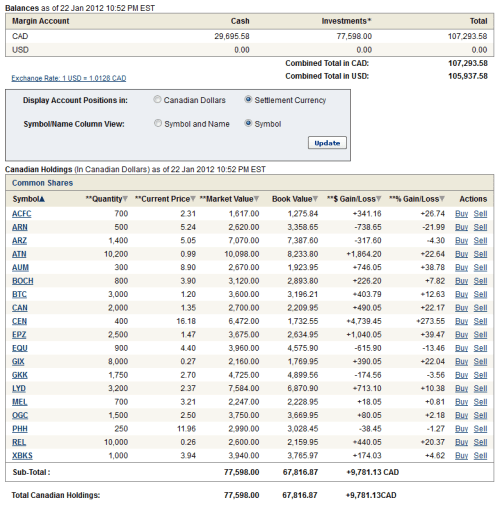
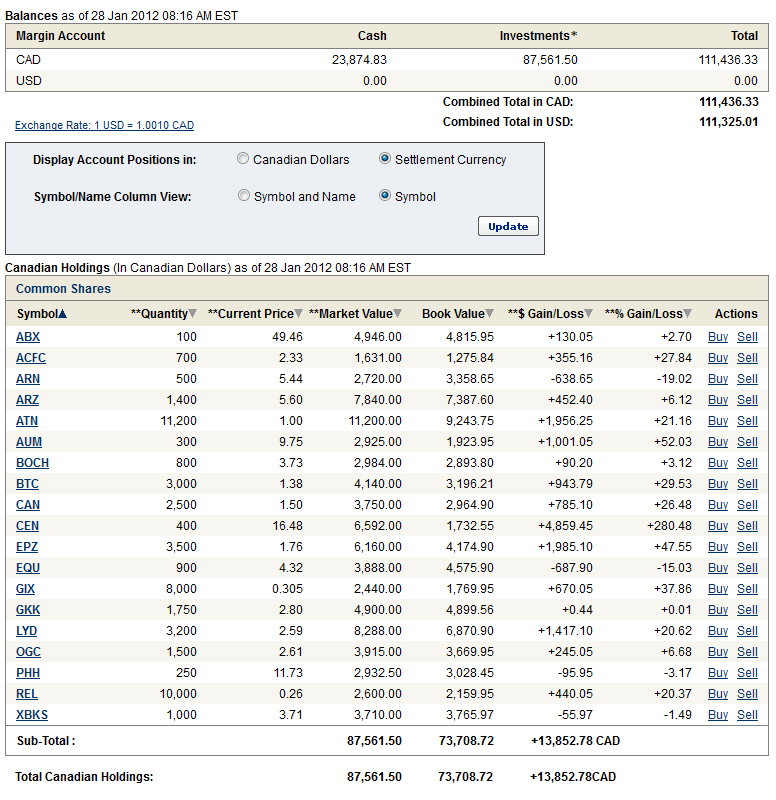
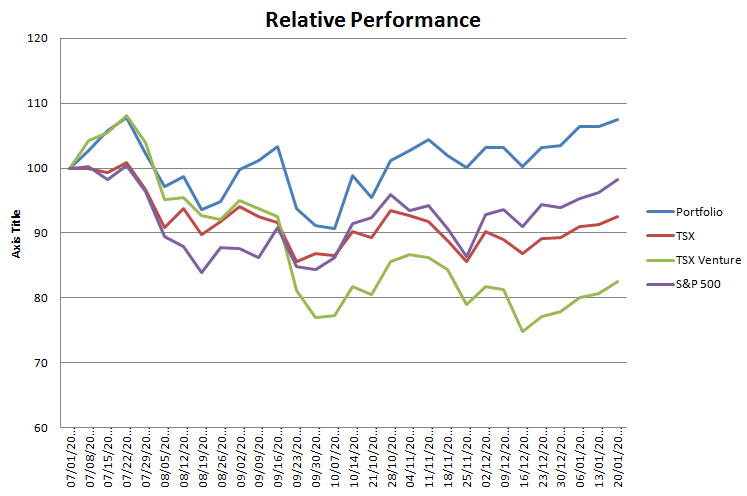
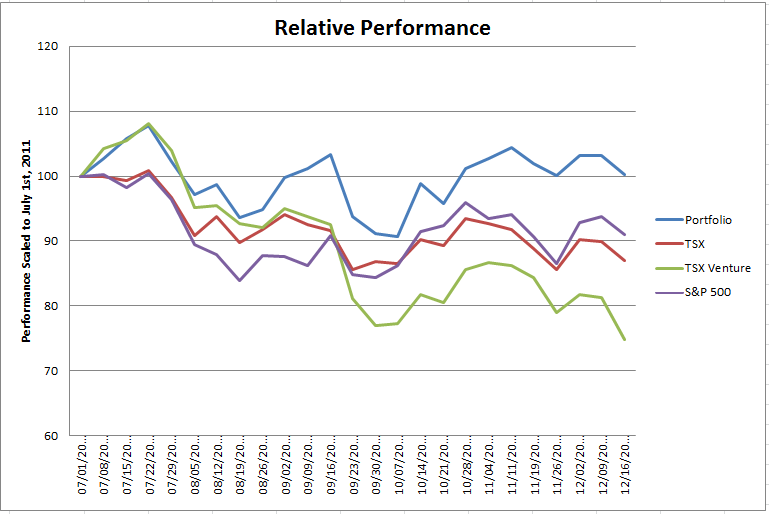
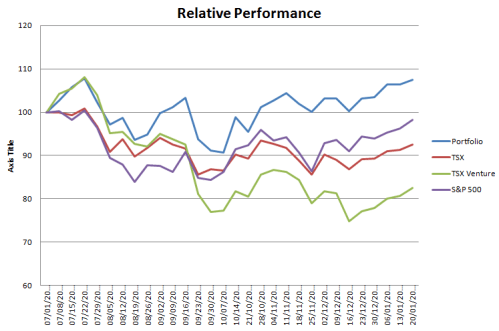
Portfolio Performance
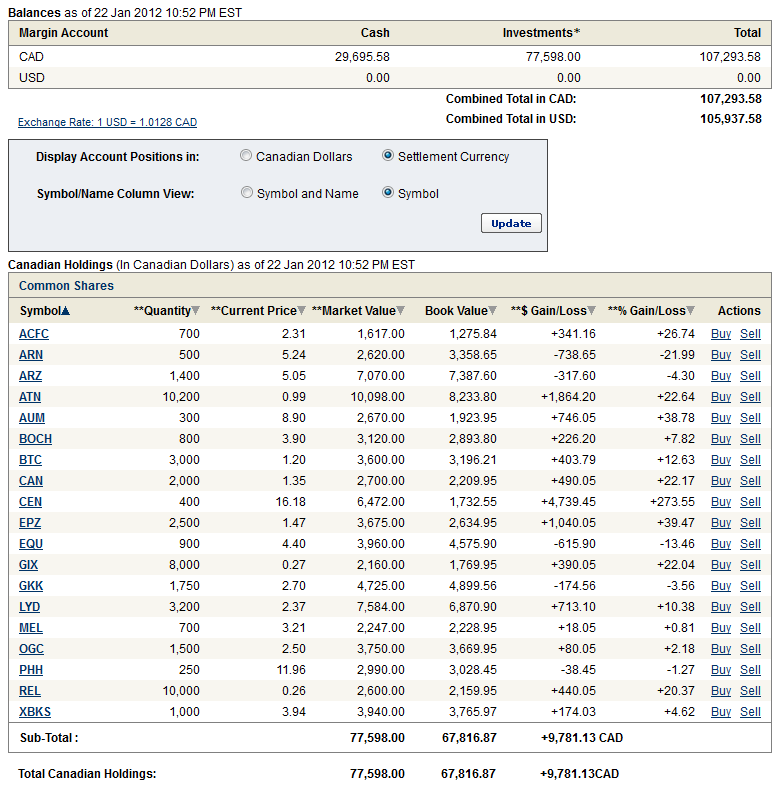
Portfolio Composition

Trying to not be dogmatic

A few years ago I read a book called Mistakes were Made.  The book described our ability as human beings to remain convinced that we are right to the point where we ignore all evidence to the contrary.

Our predisposition to fabricate reasons why we are right and ignore reasons why we are wrong is based on a concept called cognitive dissonance.  As the book defines it:

Cognitive dissonance is a state of tension that occurs whenever a person holds two cognitions (ideas, attitudes, beliefs, opinions) that are psychologically inconsistent… Dissonance produces mental discomfort ranging from minor pangs to deep anguish; people don’t rest easy until they find ways to reduce it.

All symptoms I am all too well acquainted with.

Along the same lines, I came across an interesting piece on FT this week.  The following quote can be attributed to SocGen’s Dylan Grice:

But all is not lost. The bias towards thinking we’re more correct than we are isn’t driven by an inability to fully assimilate undesirable information but an unwillingness to do so. Therefore, the first step in removing the bias is to adopt procedures that foster a more honest acceptance of logical conclusions. Logic has no emotional content per se. There is no such thing as good or bad information; information is only true or false.

But because of our hardwiring, we only want certain information to be true. In particular, we want the information that confirms our prior beliefs and validates our belief systems to be true — about ourselves, about others, about the world. Thus, debiasing ourselves must involve an honest assessment of what we want: do we want to be right about everything, or do we want to know what’s true?

Let’s bring this back to what this blog is about: investing.  In my piece last week I stepped through the basic premises on which I am currently invested.  The tenants I stated were the conclusion of a somewhat anguished and certainly restless mental reevaluation that I had been running through over the prior few weeks.

As the market moved against me I  started to look at why I might be wrong.  In my spare time I tried to “assimilate the undesirable information” and paint the most contrary picture I could.

I especially went through the exercise with gold and with my rather significant precious metal stock positions (Aurizon Mines, Atna Resources, OceanaGold, Canaco Resources, Geologix, Esperenza Resources, Lydian International and Golden Minerals).  Gold is always easy to question (what does gold really do anyways?).  I attempted to soberly evaluate both the prospects of the metal  and the companys.  I looked for reasons to basically cut them loose.

I hemmed and hawed a lot, and at times began to convince myself that I was indeed wrong.   But in the end I was led back to the basic points of valuation and underlying conditions, which seemed to me to remain firmly in gold’s favor.

This is how I make decisions.  At times it undoubtably appears that I am flip-flopping.  I am sure that my weekly writings must have an aire of contradiction when read one after another.  A reader might wonder how it is that my point of view can go from one extreme to another in the matter of weeks (see Argonaut Gold).  Or at times even flip 180 degrees only to flip back a few weeks later (see Argonaut Gold).

In truth, this is the only process I know of that allows me to really question whether I am right.  If I can push myself to the edge, almost convince myself of the diametrically opposed point of view, and still in the end come back to my original conclusions, then well, that’s really getting somewhere.   At times I push myself so far that I actually begin to believe it myself (ah yes, see Argonaut Gold), but that is just a occasionally necessary casualty.  Far more often I leave the exercise with more clarity, and with that clarity comes the likelihood that I will act properly when the situation arises.

In the end I came away from my “anguished” analysis of gold more confident in my positions than I was when I started.  And this week, on Wednesday, when the Fed news hit the wire that interest rates would be low for time eternity, that gave me the clarity to act.

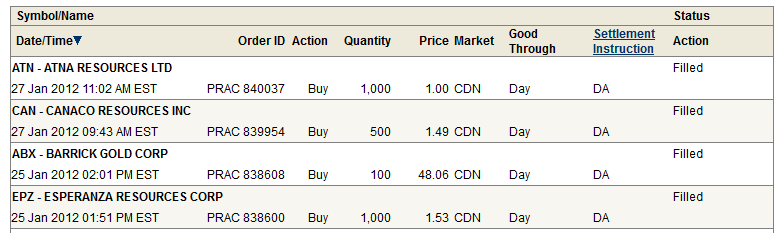
The moment I read the news I bought a position in Barrick Gold, and I added to my positions in Esperanza Resources and Golden Minerals (though I neglected to make the AUM trade in my practice account).  The next day I added to OceanaGold, and thta was followed by additions to Atna and Canaco the day after that.

In my practice account:

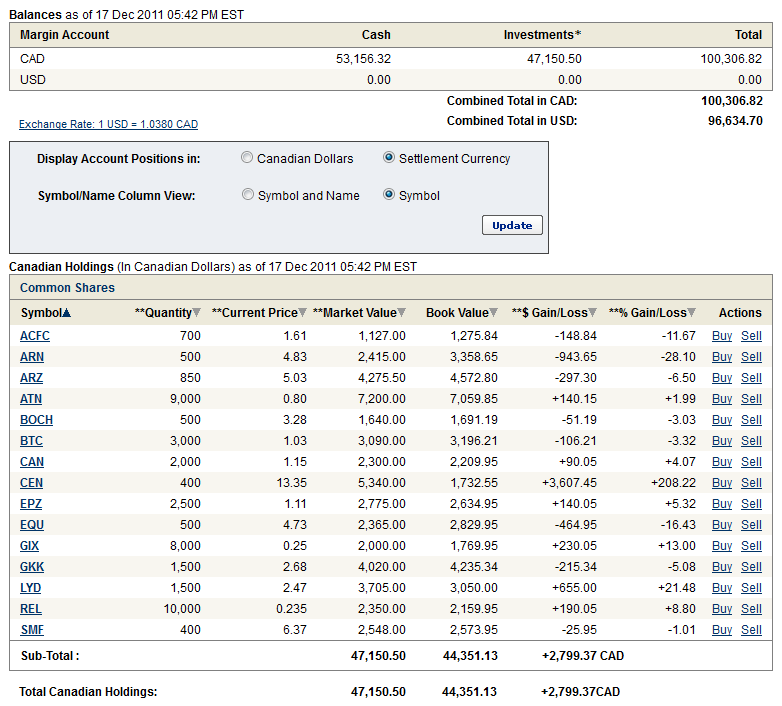
And in my actual account:

You do the work so that you have the confidence to act.  You put in the time learning and working through why so that when an opportunity makes its brief appearance, when Bernanke comes out and says “yeah we aren’t going to raise rates for a long time” you can recognize it for what it is and say “all right, I’m in” and you know what you have to do.

Had I not been stepping through the thesis of why gold and gold stocks remain a solid investment, I likely would not have had the conviction to buy into the rally.  At worst, I would have sold into the rally, because if you really don’t know why you are investing in something you tend to take the first blip after a long period of blah as a “finally I can get out” moment.  As it is, with the Fed putting interest rates on hold for another couple years, and with their actions maybe even foreshadowing a true QE event in Europe, I feel quite confident that I am positioned well for that fall out.

Speaking of Canaco Resources…

I bought Canaco Resources at the end of the year at about $1.10 as part of my “tax loss buying binge”.  A couple of things happened with Canaco this week.

First, the stock went up.

Second, the company updated us on its activities in Tanzania:

  • Expect a resource estimate by the end of March
  • Expect a preliminary economic assessment by the end of the third quarter
  • Expect further metallurgical testing results at some point

Third, Canaccord Capital came up with an updated price target, and more importantly helped give us a glimpse at what to expect from the upcoming resource estimate (hat tip to howestreetbull who posted this on Investors Hub).

  • Canaco has approved a US$35-40 million 2012 exploration budget, and is currently drilling 10,000 metres per month at Handeni with nine diamond drill rigs and one RC rig.
  •  Six of the drill rigs are focused on delineating the Magambazi resource in preparation for the initial resources estimate. Two diamond drill rigs are focused on the Kuta and the Magambazi North Extension targets. The remaining diamond drill rig is operating on the Majiri target, where previous surface sampling and RC drilling indicate a gold anomaly. The RC drill rig iscurrently operating on the Bahati target to test preliminary regional targets.
  • We are expecting an initial resource and metallurgical test results in Q1/12, and a PEA in Q3/12. We are expecting an initial resource of 2.3 million ounces of gold at a grade of 3+ g/t gold. Previous metallurgical testing indicates recoveries of 90+% using a conventional CIL process.

Valuation: with US$110 million in cash, we believe the company is in a strong position to continue to derisk and advance the Handeni project. Our peak gold price estimate of NAVPS (10%, US$1,750/oz) remains unchanged at $7.50. We continue to value Canaco based on a 0.65x multiple to our peakgold price estimate of NAVPS.

At the current price of $1.50 Canaco trades at a market capitalization of $300M.  Subtracting the current cash balance of $115M, the enterprise value of the company is a little less than $200M.  If the deposit does indeed contain 2.3M oz of gold, the valuation being given for those ounces is about $80 per.

This is a 3 g/t open pittable deposit that looks to be 90% recoverable with a straightforward metallurgical process sheet.  In my opinion (and apparently Canaccord’s as well) those ounces should be worth more than $60/oz.

To throw out a comparison point from a recent PEA, Prodigy Gold had a PEA done for its Magino gold property last March.  The PEA assumed a CIL recovery process, a 9 year mine life, producing gold from an open pit at a grade of 1.2g/t for 9 years to give a total mine of life production of 1,585,000 oz of gold.  The after tax NPV5 of the project was estimated at $259M at $1000/oz gold.   That works out to a value of $160/oz.

Albeit there may be better comparisons out there, but this one surely suggests that Canaco is undervalued.  Canaco’s Magambazi project is much higher grade than Prodigy’s (3g/t versus 1g/t).  The location is Africa, versus Canada for Prodigy, which probably suggests a bit of a discount against Canaco but not enough to make me change my opinion.  And while the Magambazi strip is as yest unknown,  the Magambazi deposit appears to be around a hill top, which should lead to a reasonable number (the strip for Prodigy’s Magino is 3.3).

Finally, the last bit of news was that Brent Cook came out with the following plug about Canaco:

“The funds were just jumping in on this thing – and they all bailed out as well – the stock got down to $1.20. During this time period they’ve been drilling and drilling and drilling, and the results continue to show me that they’ve got what I think is going to be a legitimate, decent size, decent grade, open-pittable deposit in Tanzania,” Cook says. “So we’re buying this stock at $1.30 with $115 million in the bank, and a $41-million exploration program. That, to me, seems like a good buy.”

Yup.

When the gold price broke out on Wednesday, Canaco was the first stock I added to.

and speaking of gold…

I came across this interesting piece of information regarding the appetite of the Chinese for gold.   This may be old news to some but I think it is still worth reporting.

The People’s Bank of China  research director Zhang Jianhua was cited as saying Monday in the central bank publication Financial News that gold purchases should be ramped up when prices drop, although he gave no indication of what proportion of the nation’s $3.2 trillion forex reserve should be allocated to investments in gold.

Apparently, Jianhua called gold the only safe haven left and said that:

“the Chinese government needs to further optimize China’s foreign exchange asset portfolio and seek relatively low entry points to buy gold assets…no asset is safe now.  The only choice to hedge risks is to hold hard currency – gold”.

High House Prices

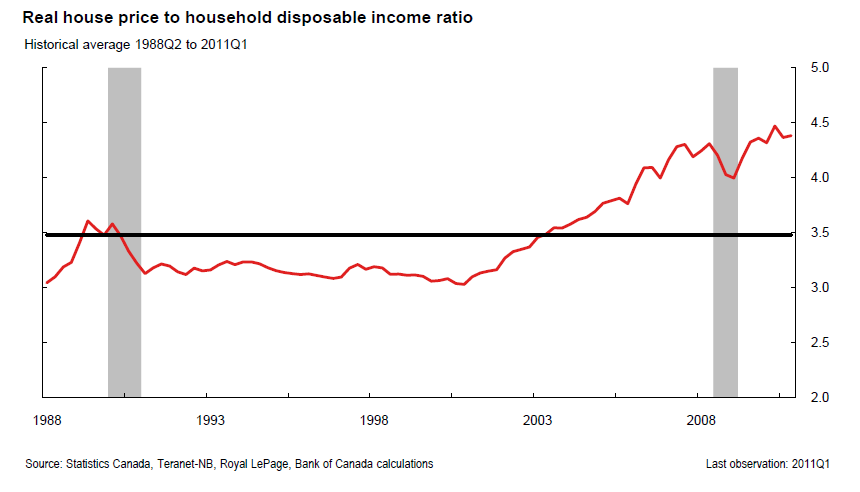
I’ve been doing some research on house prices in Canada and in particular in my city, Calgary.  I plan to do a separate post on my findings shortly, but for the moment I just want to throw up a couple teaser graphs that gave me pause for thought.

The chart is taken from a speech given by Mark Carney to a Vancouver audience last June.  The methodology used is the ratio of the nationwide median home price to the median household disposable income. A ratio of greater than 3 has traditionally been seen as unaffordable.

It makes you think.

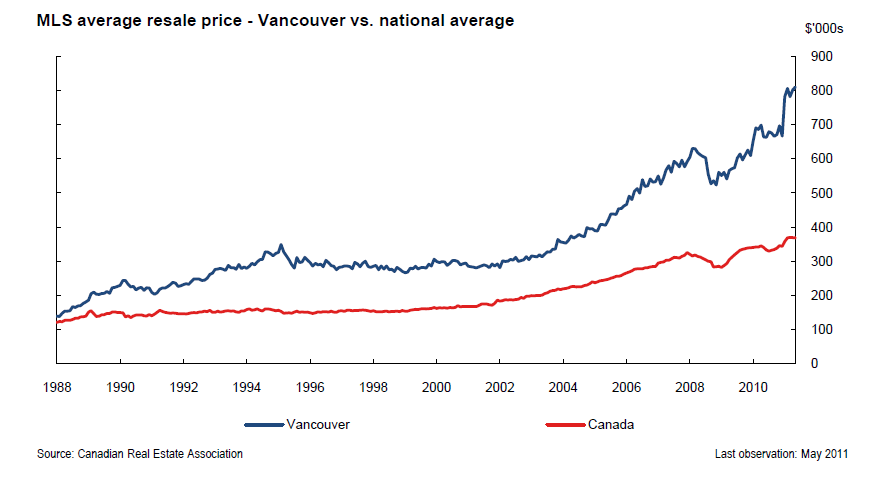
One other chart from the same report.  Below is the average house price in Vancouver:

Its either a heck of a bull market or a bubble.  To say it another way, I don’t know about house prices, but when a stock goes parabolic you typically know how it is going to end.

Anyways, more on this later.

Community Bankers Trust

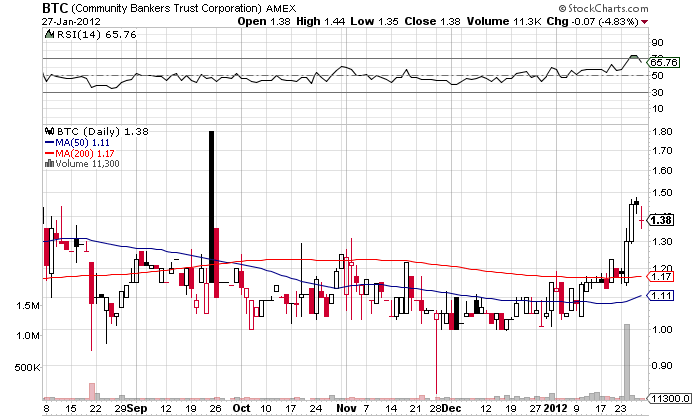
It was a good week for Community Bankers Trust (BTC).

Earnings will come out for the company on Tuesday.  Hopefully the company will put together another profitable quarter.

The BTC story

I bought BTC as a turnaround story.  Community Bankers Trust is a bank that has been trying to reincarnate itself after the first incarnation came close to an early death. My observation is that they have been successfully navigating this resurrection, and with the recent turn in profitability (and a helpful turn in the economy) the bank is on its way to realizing its earnings potential.

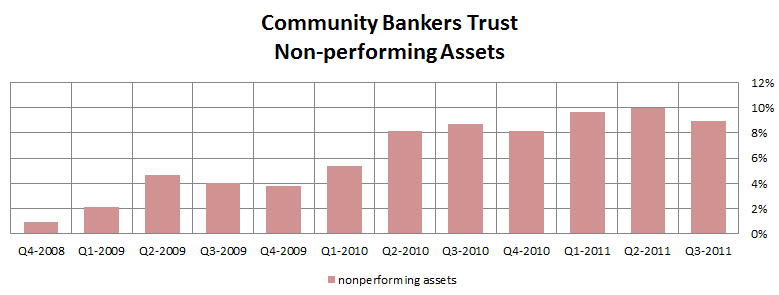
The bank was hit hard by the recession in 2009.  The company saw nonperforming loans skyrocket from 2% of total loans in the first quarter of 2009 to 10% of total loans in the second quarter of 2011.  Yet there have been signs that the efforts the company has been making to turn itself around are working, culminating with a profitable quarter in Q3.

Let’s hope they can keep that momentum.

How did they get to here?

The original strategy of the bank was, as far as I can tell at least, to simply buy other banks and get bigger.  Witness, the name of the original company was called Community Bankers Acquisition Corporation  (CBAC), so they weren’t exactly being subtle.  Along with the acquisition strategy, the bank seemed to have a “worry about the profitability later” strategy, which may have worked ok when the economy was growing but that fell flat when the economy didn’t in 2008.

As best as I can discern the acquisition effort was spearheaded by Gary Simanson. He headed up the original company CBAC, and then moved into a position of Strategic Vice President, a position I don’t think I’ve ever heard of with any other company. According to this article, Simanson was responsible for subsequent acquisitions.

In truth, the timing was what killed the acquisition strategy.  To quickly step through the timeline, in May 2008 the company began its journey by acquiring two local Virginia banks, TransCommunity Financial Corporation, , and BOE Financial Services of Virginia, Inc.  In November the bank moved ahead and acquired The Community Bank, which was a little bank in Georgia.  Finally in January 2009 they acquired Suburban Federal Savings Bank, Crofton, Maryland.

So you had 4 bank acquisitions in less than a year happening at the time of a 100 year financial tsunami.  How do you think things turned out?

Change in Direction

By 2010 Simanson had left the company and the direction of the company was changed to the more pragmatic “we need to get profitable before we go belly up” strategy.

This was described pretty bluntly in the 2010 second quarter report. CEO Gary Longest said at the time:

Our strategy has shifted from that of an aggressive acquisition platform, to one that meets the banking needs of the communities we serve, while providing sustainable returns to our stockholders. To this end, we are taking the necessary steps to return immediately to profitability. We are actively analyzing our market base to assess the contributions of all branches to our franchise value and will take the appropriate actions in the third quarter of this year. Additionally, we will make aggressive expense reductions, and will look to restructure and strengthen the balance sheet. We are confident that the analysis of these potential critical paths and the resulting execution of these initiatives will lead us back to profitability quickly.” “Our goal is an immediate return to consistent quarterly profits. To accomplish this, we have no alternative as a Company but to make clear and intelligent decisions in the next 60 days, no matter how difficult, to accomplish that goal as soon as possible. That is our full focus.”

 In a somewhat odd twist to which I’m sure there is a good story, Longest himself was gone only a couple months later. Nevertheless the interim CEO and soon to be permanent CEO Rex L. Smith took up the reins and has carried out the strategy quite well given the circumstances.

 Where are they now?

I already mentioned that the company had its first profitable quarter in a long time last quarter.  I don’t believe this was a one time fluke.  It looks to me like its the culmination of a number of initiatives put forward by the bank that have been geared towards making the bank more profitable.

The company has made an effort to lower the cost of its deposit base.  Time deposits, which are expensive high interest bearing deposits, have decreased from 73% to 67% of total deposits since the end of 2009.  As well, the cost of the time deposits has come down from 2.9% in 2009 to 1.6% in the third quarter.

The effect has been a steadily rising net interest margin (NIM) since the strategic direction change in 2010.

(note that this graph is a simplified version of NIM calculated as a percentage of all assets rather than the more common formulation of interest bearing assets)

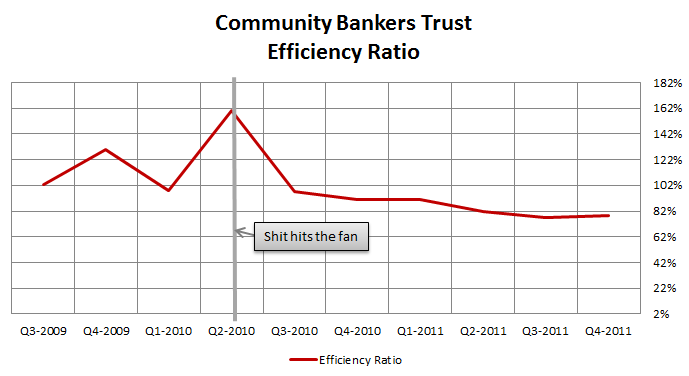
The company also undertook efforts to reduce expenses.  The most common way of illustrating the day to day expenses of a bank is through something called the Efficiency ratio.  The Efficiency ratio is simply the ratio of the total non-interest expenses at the bank (so the salaries, building costs, lawyer fees, pretty much everything except the actual cost of borrowing money) to the  net interest margin (so the amount of interest made minus the amount of interest paid).  The reason that you look at the Efficiency ratio is because it ex’s out growth, since growth should occur for both NIM and expenses in concert with one another.

The Effiency ratio of BTC has been falling consistently.

What’s it worth?

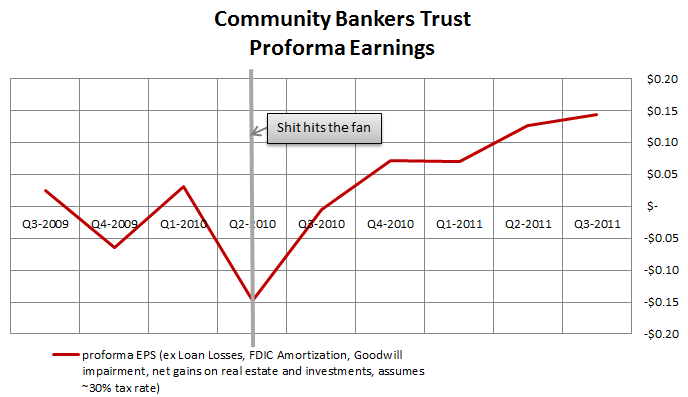
To get an idea of what the bank might be worth if it continues to pull itself together, I put together a proforma earnings estimate.  I stripped out all the provision for loan losses, the FDIC intangibles (from their earlier acquisitions) that the bank is required to amortize, as well as losses on real estate and gains of the sale of securities.  So basically I looked at the banking skeleton that is BTC.  Here is what I found:

What this clearly demonstrates is that if get rid of all the scabs, there is quite a profitable little enterprise here.

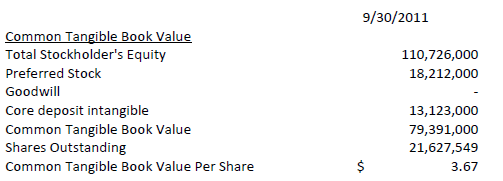
Meanwhile, the bank sports a tangible book value that is much greater than the current share price ($1.40 after last weeks run up):

What is left to be done?

The story that still needs to play itself out is the healing process.  The really big negative for the bank is that it still has an extremely elevated portfolio of non-performing loans.  There are signs that this is abating, and in truth part of the bet here is the same one that you make on any regional bank: the US economy is turning the corner, the Fed is not going to allow it to fall into another recession, and so the worst of the loan defaults are behind us.

But just to get an idea of the risk here, typically you wouldn’t want a bank to have non-performing loans in excess of a couple of percent.  Many of the best banks I’ve looked at have nonperforming loans of well less than 1%.  BTC, onthe other hand…

There are tentative signs that the peak has passed, but it will take a few quarters before we know for sure that further write-downs are not coming.

Earnings on Tuesday will give us a lot of insight into the direction of the trends.  I’ll be looking closely at nonperforming assets and the 30-89 day deliquents (which are an early warning of the soon-to-be not performing.  I also will be hoping to see some decent earnings.

Week 29: Conviction and Humility, Investigating PHH, Don’t forget about Atna, Buying Midway

Portfolio Performance

Portfolio Composition:

On Conviction and Humility

I find that investing in stocks is a constant antithesis/synthesis (to use a couple of terms from philosphy) between conviction and humility.  Never is this more evident than when things aren’t going your way.

While the market has been up the last couple of weeks, and my portfolio has been up somewhat as well, it is not doing as well as I would like, not as good as the market even, and that makes me want to reevaluate.

Part of me wants to just get out and start all over again.  Right now there are things of  which I am wrong.   Wrong about some of the gold stocks I own (while Atna continues to do well, Aurizon is not doing well, Lydian is not doing well, and a couple of my more recent purchases, Esperenza and Canaco, have stalled out).  Wrong about some of the oils I own (I probably should have sold out of Reliable Energy at 30 cents)  that aren’t doing much of anything.  Certainly wrong about my big bad bailout bank short bet, which went quite far south last week.

The other part of me, pushing just as strongly, wants to stay the course and, more exactly, to ignore what the market might be telling me because the market is wrong and I am right and in time I will be vindicated.

It goes without saying that this last attraction is a dangerous one.  Surely we all have listened to the expert that held his conviction against all evidence to the point where his credibility was lost forever.

The truth between these two extremes lies, of course, somewhere in the middle.  The difficulty is figuring out exactly where that is.

The basic long term investment theses on which I am currently holding stocks (and shorts) are as follows:

  1. Europe is on an inevitable course to dissolution, with a collapse in Japan not far behind
  2. Gold is the only asset that is no one’s liability and it will gain respect as a store of value as these events unfold
  3. The US, while troubled, is muddling through, and the US housing market has likely had, as Kyle Bass has put it, the pig go through the python
  4. Oil is harder to find and harder to get out of the ground then most people appreciate, and its price will prove sticky to the upside
  5. The hz-multifrac is a revolutionary technology and so you want to own oil companies that can take advantage of that technology

I think its helpful to review these basic points on occasion, particularly when things are not going my way.  If I can still stand by these tenants then the rest is just a matter of evaluating if the individual stocks themselves are decent businesses (or perhaps more importantly good stories) in their own right.

And, having thought about it over the weeked, I wouldn’t stand away from any of the above.

Two weeks of a market moving up with many of my stocks doing nothing can seem like an eternity.  Sitting with as much cash as I currently have (though I have reduced that cash level somewhat, mostly in response to specific opportunities and a recogntion that the deterioration of Europe no longer seems imminent) while the market rises, can be tough to bare.  But I can’t just abandon what makes sense because of a few tough weeks.  If the facts change, certainly I have to change with them.  No doubt about that.  But when the main fact that has changed is that the market is not going down any more, I think it is wise to respect that fact (no sense doubling down and some sense in lightening up with what doesn’t work) but not so wise to change course entirely.  Better to move as a big ship might, slowly inching it way towards a new course, ever on the lookout for signs on the horizon that might make the destination more clear.

Wading into the Mortgage Market

On Tuesday this week a 13-G was issued that Hayman Investments (the hedge fund run by Kyle Bass) had purchased over 7% (4,448,751 shares) of PHH Corp.  I got a google alert  on the news almost immediately.  It still wasn’t soon enough.  The stock was up 10% within minutes and closed up 12% on the day.

I sat down on Tuesday night with the intent of understanding what Bass what was up to.

I don’t think this is just Bass buying a cheap company (which they are) and hoping for the best.  I think there is more to this story, as I will explain below.  But first, lets talk a bit about where I think we are in the housing cycle.

First of all, I am no blind optimist here.  I don’t think for a second that housing is about to make a robust 180 with rising prices and robust new builds.  That’s not happening for a long time yet.

But that does not mean that all housing company’s should be left in the trash bin.  No I think that those that rely more on volume then price may find themselves doing better this year, and may be ripe for a move.

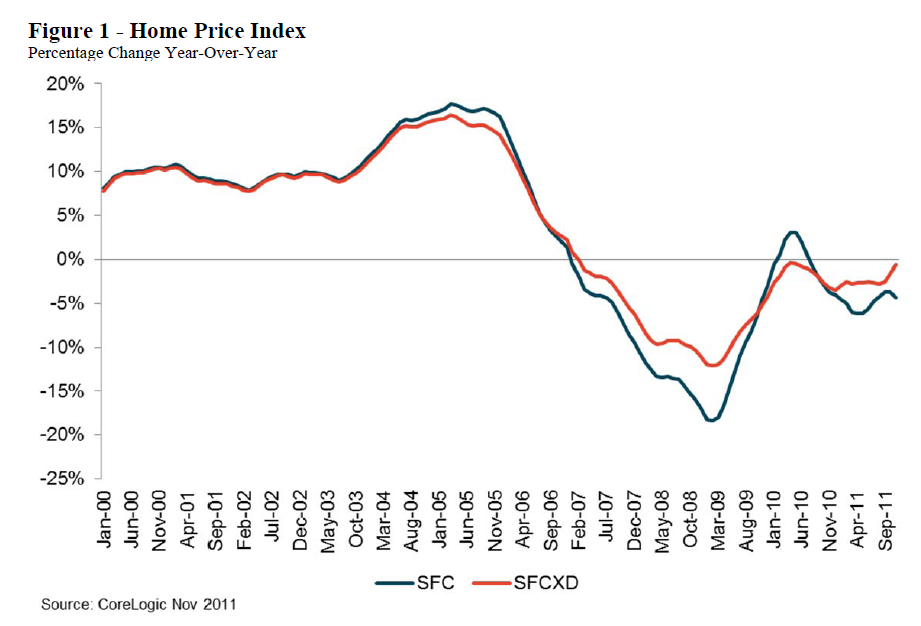
Why?  Because I think prices have fallen enough in many markets.   Most of the damage in terms of declines appears to have been done.  There was a great graph provided by Core Logic a couple weeks ago that showed prices both including and excluding foreclosures.

Illuminating!  If you ignore foreclosures, prices nationwide are on the verge of going positive.  If you look at the regional data, prices are actually up in many locales.  And while some areas are still bogged down in foreclosures, many have worked through the worst of it.  Those are going to be the areas where we start to see a turn.

So it makes sense to look for companies that stand to gain from these first signs of stabilization.

And with that, onto PHH…

PHH is in the business of mortgage origination. They are in the business of mortgage servicing rights.  Tthey are also in the business of commercial vehicle fleet management but I don’t think that’s the story here so I’m not going to dwell on that.  Lets talk for a minute about the two former businesses.

Mortgage Origination

Mortgage origination basically consists of finding a person that needs a loan to buy a home, showing that person a list of mortgage options of how they could finance that loan, qualifying the borrower for loan guarantees such as those from the GSE’s, and then processing the loan through (doing all the paperwork) and passing it through to the eventual lender institution (usually to Fannie, Freddie or a bank that will either keep it on their books or sell it to another investor).  PHH takes a cut in the process, or an origination fee, that is typically between 1/2% and 1%.  In the third quarter the company said that their “pricing margin also expanded by more than 47 basis points as compared to the second quarter.”

Mortgage Servicing

Mortgage servicing happens after the loan is made. The servicer is responsible for calculating how much the borrower owes and collecting that amount.  If a loan is not being paid then the servicer takes on additional responsibilities such negotiating a workout upon default, looking after the foreclosed property and such.

PHH refers to these businesses as a natural hedge of each other.  Why?  Because they are inversely correlated with respect to interest rates.

Let’s say interest rates fall.  What happens?  People with mortgages at higher rates refinance those mortgages.  That’s great for the origination business.  They are writing up refi’s and taking in the fees.

Not so great for the servicing business. Those refi’s mean that the mortgages that PHH has the rights to service no longer exist.  Now ideally PHH originates the refi and thus takes on the servicing rights for that refi so the old mortgage servicing right (MSR) is replaced with a new one.  But there’s no guarantee of that.

Rates go up and the opposite situation occurs.  Origination suffers, no one is refinancing at the higher rates, but that also means the MSR’s are not being lost either.

As it is, PHH has proven to be pretty good at holding on to more MSR’s then it loses.  Forthe 9 months ending in the 3rd quarter the company had a replenishment rate on MSR’s of 167%.

Ok, back to Bass.  There are a number of things happening in the mortgage business right now from which PHH stands to benefit.  Let’s go through them one by one starting with Harp II.

HARP II

Harp stands for the Home Affordability Refinance Program.  Harp II is the name that has been coined for the new version of HARP.  It supersedes the original Harp.  Harp I was a total failure.

The HARP program has helped far fewer borrowers than its proponents estimated — roughly 894,000 borrowers since Aug. 31, 2011. — and many less than the estimated 11 million U.S. homeowners who owe more than their homes are worth.

Why was it a total failure?  A few reasons:

1. Put back risk: Basically when a bank participated in the original program they were worried that they would get stuck with the original mortgage.  I think what happens here is that to rewrite the original loan to new terms, the loan is going to be scrutinized.  The banks and other underwriters know that the quality of many of those original documents are sketchy at best and they would rather not have to pull out the skeletons.

2. LTV Limits: This is probablythe biggest problem.  The original HARP program dealt with current loans with LTV’s of 80-105.  That was expanded to 125 in 2009, but that still wasn’t enough.  I was surprised by that until I read this:

This should have a big impact in certain parts of Nevada, Arizona, and Florida where many borrowers owe more than 125% of the value of their homes. In Nevada, for example, two thirds of all loans backed by Fannie Mae are underwater, and half of all loans are above the 125% loan-to-value cut-off.

3. Appraisal costs: the borrower had to have an appraisal done to qualify for the original program.  That appraisal could cost $400.  Borrowers were reluctant to take this cost on when there was no guarantee they would be accepted by the program

HARP II aims to correct these mistakes.  The LTV limit is gone.  Appraisals are no longer required.  And banks are protected against the put backs.Says Brian Ye, analyst at J.P Morgan Chase & Co:

“We are of the opinion that there are enough changes to the program that bank servicers could really change their behavior, and this could be one of the first times that the administration has under-promised and over-delivered,”

The two tiers of HARP II

There is one particular element of the new program that helps out PHH is that servicers get a head start over third party originators.   I confess I don’t know just what of impact this is going to have, but it is interesting and potentially significant, so I think its worth mentioning.  Servicers like PHH have been writing borrowers up for the program since the beginning of the year.   A third party originator cannot submit any documents to Fannie or Freddie until March.   This was done to entice the banks into the program, but the corrollary is that a company like PHH can capture business up front without the competition.

There is more interesting information on the new HARP program here.

What’s it going to mean?

This is, of course, the big question. The program is aimed to attract two million borrowers by the end of 2013.  This would be a little more than twice what the original program attracted.

However if the program works, and if JP Morgan turns out to be right and the administration “under-promised”, there is certainly a lot of room for upside.  According to CoreLogic:

10.9 million, or 22.5 percent, of all residential properties with a mortgage were in negative equity at the end of the second quarter of 2011.  Eight million borrowers with negative equity, or nearly 75 percent of all underwater borrowers, have above market rates. The disparity is even greater for those with severe negative equity. More than 40 percent of borrowers with 125 percent or higher loan-to-value (LTV) ratios have mortgages with rates at 6 percent or above, compared to only 17 percent for borrowers with positive equity.

Apart from the obvious fact that these numbers show just how staggeringly bad housing has become, if you prefer to see the glass half full those numbers also suggest that there are a lot of borrowers out that could benefit from a program like this.

I was listening to this week’s Lykken on Lending and they were talking about Harp II.  Lykken said that listeners (brokers and third party originators) needed to gear up for the “mother of all refinancing booms”.  In another segment a couple of weeks earlier Lykken and his guests spoke quite excitedly about the impact of no LTV limits. The one guest talked about how common it is to have to turn away borrowers because they are too far under on their home.  HARP II should help with that.

BOA and correspondent lending – another tailwind

So first of all, what is a correspondent lender?

Consider a broker who develops significant business volume, has earned the confidence of wholesale lenders who will authorize him to approve their loans, and has accumulated some capital. He can now obtain a credit line from a bank that can be drawn against to fund loans, repaying the loans when they are sold to wholesale lenders. Under the law, the broker has morphed into a “lender” – the type called a “correspondent lender”.

This has been a business the big banks have taken a large piece of.   Until now.  In August BoA reported that they were exiting correspondent lending.

This isn’t small potatoes.  It accounted for”47 percent of Bank of America’s mortgage originations, or $27.4 billion, in the first quarter of 2011, the Wall Street Journal said citing Inside Mortgage Finance.”

There are rumors others are leaving the business.  Its a low margin, highly competitive business but it could become less so with some of the big players moving on.

In comparison, for PHH total mortgage closing volumes for 2011 so far were $36.3 billion of which approximately 70% were retail and 30% were wholesale/correspondent.  Here is what management said on the Q3 conference call:

Yes I’m going let – yes the answer to the question is yes, we think there are better opportunities but once again we’re really pretty opportunistic in that channel. So we pay close attention to margins in that channel. As you know it’s probably the most cost competitive channel, it is the most cost competitive channel that we operate in and we’ve seen some really strange behavior in that market in terms of where margins are being priced. Some of our competitors are in the market, when they are in the market they’re very aggressive in terms of their pricing and then they back off and they’re out of market and that’s why we stay really opportunistic in that market. Luke, do you want to add anything?

The company made a total of $95M off of mortgage production, meaning off of fees for new originations of that $36.3B of loans they processed.  The company doesn’t break down the margins between the retail and the wholesale/correspondent.    Total revenue from the segment was $264M, which suggests that the fees on average are around 0.7% of total loan value.

Tailwind 3: Signing up new partners

The last tailwind for PHH is that they are having success signing up some big partners for their origination business.  From the Q3 CC:

We also made significant progress in growing our nationwide sourcing footprint over the past two quarters signing five new private label accounts. The new relationships include Barclays which we mentioned on last quarter’s call and today we’re pleased to announce that we’ve added Ameriprise and Morgan Stanley Private Bank along with two other financial institutions all as new PLS partners.

They also lost one significant client in Charles Schwab but over all the company expects to gain significant production:

We expect the five new PLS accounts in the aggregate based on their 2011 production and taking into account ramp up time and anticipated launch schedules to produce about 7 billion in closing volume in 2012, about double what we predicted for Schwab.

Twisting in the (tail)Wind

The Donald Coxe conference call this week was very good, and it produced one particularly enlightening graph.
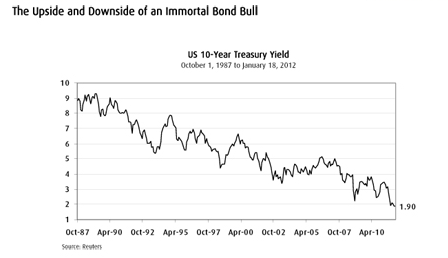
Long term rates, both treasury and mortgage, are at all time lows.  When the Fed embarked on operation twist, it was with the intent of bringing down the long end of the curve, and by doing so, propping up and ideally pushing ahead, the housing market.

I would say this was a success.

When you add to the fact of HARP II that interest rates are at all time lows and really, given the decline in house prices in many markets, are basically creating the conditions where you would be crazy not to buy a house, you just have to think that this is going to help origination activity in 2012.  I think the point that is sometimes forgotten is that the downard spiral of housing is really caused by the foreclosure mess.  Its the lynchpin.  If you could create the conditions to stem that flow, I think the situation would right itself a lot faster than is appreciated.

When core earnings matter

A lot of the time when a company is reporting some sort of non-GAAP earnings, its in order to hide something.  A good example of this is Salesforce.com.  They report non-GAAP earnings that exclude certain costs (particularly stock options) that they would rather ignore.

PHH reports a core earnings number every quarter but for a very good reason.  Core earnings is a far better representation of the company’s profitability than is the GAAP number.

The problem with the GAAP number is that it is obscured by changes in the mark to market value of the MSR portfolio. PHH has to write up and down their mortgage servicing rights with changes in interest rates and to a lessor degree credit quality.  When rates go down they have to write down the value of the rights and when rates go up they have to write up the rights.

The fluctuations on the income statement caused by these mark to market moves are huge.  Up to $400M in some quarters.  If you look at quarterly GAAP earnings over the past couple years they look like a scatter chart.

The reality of the MSR’s is that as long as the company is replenishing the existing pool with more rights from new originations then its losing to payoffs of its existing pool, its all good.  As I already noted, PHH is doing that.

The core earnings number takes out that effect. And if you look at that core earnings number you see a pretty cheap looking company.

All that, and discount to book…

The last point I would like to make about PHH is the discount relative to book value.   You can get the shares at a pretty substantial discount, even after the post-Bass run up:
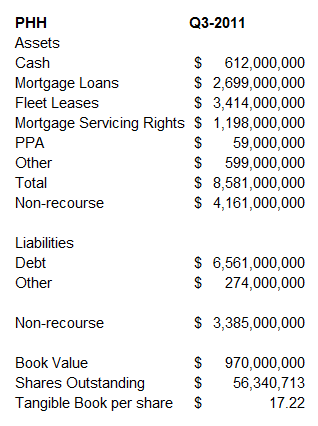
What’s even more interesting is that this discount exists even after the valuation of the MSR portfolio has been clobbered by falling interest rates.  It is not impossible to imagine a scenario where the MSR’s add book worth $500M plus, or another $10 per share.

So what does Bass see?

To sum it up, with PHH you are getting a cheap company that has earned decent money of late and that should benefit from the tailwinds of HARP II, weary competitors and a rebounding housing market.

The negative with PHH is the debt they have coming due, and whether they will have the cash to pay it off.  That debt is an issue I believe is worthy of a post in itself, and I will try to get around to that next week.

Europe is still a problem

…it just doesn’t seem like it right now.

I have a few other things I was hoping to talk about this week but I’m running out of time and this letter is getting quite long already.  But I do want to talk a bit about some of the reading I have done on Europe the past week.

It seems what with the stock market rising every day that Europe is old news now.  Yet I think that to ignore the risk of Europe right now, to go all in, is still at best a gamble.  It may turn out, you could do it and cash out big in 6 months.  But to say you knew it would turn out that way would be kidding yourself.  We could just as easily wake up tomorrow in crisis mode again as in the happy-happy-risk mode that we’ve been in the last couple weeks.

Europe  hasn’t gone away.

The S&P downgrade of a number of European countries been widely reported already so I’m not going to dwell on it, but I do want to point out that the language used.  In particular:

We also believe that the agreement is predicated on only a partial recognition of the source of the crisis: that the current financial turmoil stems primarily from fiscal profligacy at the periphery of the eurozone. In our view, however, the financial problems facing the eurozone are as much a consequence of rising external imbalances and divergences in competitiveness between the EMU’s core and the so-called “periphery”.

This strikes at the basic point that I have made in past posts.  Austerity measures are not going to fix the problem with Europe because the problem is not a one time spending binge that just has to be paid off.  The problem is much deeper, relates to inherent inequities in the productive abilities of the economies, and is quite possibly not solvable without a break up.

As John Maudlin said in his piece “End of Europe”:

For most of the past two years, European leaders have tried to deal with the problems as though they were short-term liquidity problems: “If we just find the money to buy some more Greek bonds, then Greece can figure out how to solve its problems and then pay us back. Given enough time, the problem can get solved.”

They have now arrived at the understanding that it this not a short-term problem. Rather, it’s a solvency problem of the various governments, which of course creates a solvency problem for their banks. They are now addressing the problem of solvency and providing capital until such time as certain countries can get their budgets under control and the bond market sees fit to provide the capital they need.

But they are completely ignoring the third and largest problem, and that is massive trade imbalances. Germany exports products to the peripheral European countries, which run trade deficits. As I have shown in several letters, a country cannot reduce private-sector leverage, reduce public-sector leverage and deficits (balance its budget), and run a trade deficit all at the same time. That is simple, unavoidable math, based on 400 years of accounting understanding. Ultimately, there must be a trade surplus if leverage and debt are to be reduced.

There is a great model that Maudlin creates in the post that summarizes the situation of Greece, Portugal et al to a tee.  I would recommend reading the piece in its entirety.  One last point from the piece:

Prior to the euro, the imbalances would be handled by currency exchange rates. The value of the drachma would go down relative to the value of the deutschmark. Things would balance over time. Now, all of the eurozone countries are effectively on a gold standard, with the euro standing in for gold this time. Britain, the US, and Japan print their own currencies. Their currencies can rise or fall over long periods of time, based on national accounts and the desires of foreigners to buy goods or invest in their countries.

He is retreading the old Jane Jacobs idea that I brought up a couple weeks ago:

What Europe has embarked on with the Euro is the exact opposite of what is needed.  Currency regimes need to evolve to produce better feedback, not worse.  The Euro currency feedback mechanism is skewed by the strength of the German economy (actually more exactly the economy of its one or two prime export replacing cities, Berlin and Frankfurt).  Peripheral countries like Italy, Greece, Spain and Portugal are doomed to receive faulty feedback rather than the natural “export subsidy” that would occur if those countries had (lower value) currencies of their own.

To think that all is well is to mistake the calm eye of the storm for the end of it.

Meanwhile, I’ll end my Europe talk with this: There seems to be a growing recognition that Greece needs to exit the Euro.  The chief executive of Germany’s natural gas firm Linde’s chief executive Wolfgang Reitzle was quoted as saying the following in Reuters:

“In the medium term Greece needs to exit. And the writedowns on Greek debt will not be between 50 to 70 percent, but in the end will be written down by 100 percent,” Reitzle said.

Asking Germans to pay more than 50 percent taxes to help fund other euro zone countries will erode the will of the German electorate to support rescue measures, Reitzle said.

Although this scenario is not desirable, he felt that German industry would survive working in a new currency.

Atna’s jump in reserves (and share price)

I haven’t spent as much time as I should writing about Atna.  I tend to ignore the stocks that I am right about.  This is perhaps not the best way to self-promote, but since I’m not really in that ballgame anyways, who cares.  I learn more from my mistakes.

But don’t take that for disinterest.  I watch Atna like a hawk every day. As I pointed out a month ago, I think that if Pinson works out the stock is worth somewhere between $3 and $6.  I know that there is some skepticism around Pinson, that there may be rock stability issues, but I’m of the mind that the current stock price is more than pricing in that risk.

It feels to me like a stock being accumulated before a break-out.  Perhaps we got a taste of things to come this week when the stock popped over $1 and up to as high as $1.05.

On the news front, Atna released an updated resource at Briggs on Thursday.
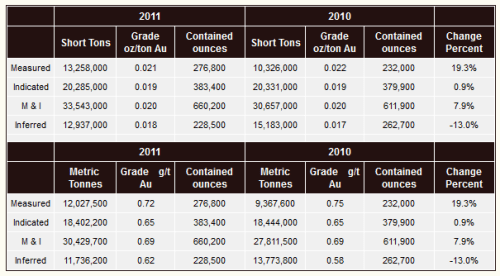
There is not too much to get too excited about, though it is nice to see that they managed to move about 50,000oz to measured and indicated, basically replacing production.  Overall they showed a slight increase of about 14,000 oz all in.  At the current production rate (45,000 oz), Briggs is good for another 10 years. That alone is probably good for the current share price.

Buying Midway Energy (Again)

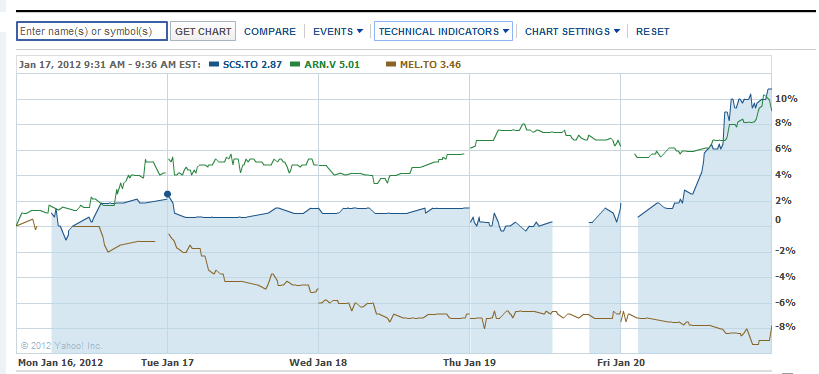
The other move I made this week was to reinitiate a position in Midway Energy.  I decided to pull the trigger here because the other Swan Hill players showed signs of moving up towards the end of the week.

I already own positions in Second Wave and Arcan (though the Second Wave position didn’t get taken in the practice account due to an unfortunate glitch in the order fill).  I did not own Midway and it had not moved higher and it seems a reasonable presumption that it will follow suit eventually.
Letter 24: Risk and Reward, Atna Analysis, More Community Banks

Last week I wrote that I did not understand why  the market was reacting as favourably as it was to the European proposals that came out of the Dec 9th summit.

A tweak here, a tweak there and pretty soon you have… well not a whole lot to be honest.

In a way I felt vindicated  by the market collapse that occurred in the early part of this week.  In another way I felt sick to my stomach, because though I have been creating an evermore conservative weighting to my portfolio, when the shit hits you still feel it.

Kyle Bass was on CNBC this week giving some more detail on his doomsday-like expectations:

The observation that deposits are leaving Greek banks at an annualized rate of almost 50% is somewhat frightening.  Clearly this crisis is going to come to a head soon.

John Mauldin publishes a great conversation between Charles Gave and Anatole Kaletsky.   It is quite provoking, and its hard to walk away after reading it without feeling the impending doom that awaits the Eurozone.  Kaletsky and Gave both make the quite reasonable point that perhaps Germany would prefer a break-up of the Eurozone.  If you watch what Germany is doing, and ignore the platitudes they are saying, you might question their motives.  Kaletsky points out that of the necessary measures to fix the Eurozone, Germany seems to be steadfastly opposed to both Eurobonds and to ECB intervention.  Absent those  measures, what hope does the Eurozone have?  Perhaps that is the plan all along.

Gold Stocks – I should went all out

Gold stocks got CREAMED this week.  I had been lightening up on my gold stocks the week before in anticipation that something might be about to hit.  I didn’t like the way gold was going, I didn’t like the fact that the WSJ was penning articles describing a dearth of Indian demand, and I didn’t like that Draghi talked tough during the EU summit, suggesting that money printing was still some time off.

Nevertheless being that I was not fully out of gold stocks, I got smacked about pretty good over the course of the week.   Atna, Aurizon, and with Lydian all performed quite miserably.

What’s Wrong with Aurizon?

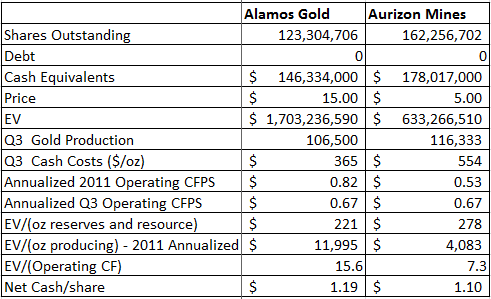
Aurizon is a surprise to me.  I expected the stock to hold up better than it has been.  I might have expected its performance to be closer to that of Alamos.  Both are low cost producers.  Both are single mine operations.  Yet the valuation difference between the two is somewhat staggering.

I can only guess that there is a strong seller of Aurizon out there that wants to be out of the stock by year end.  I can only hope that the new year will bring some sanity to the stock.

While reviewing Aurizon, I began to wonder how much having a AMEX listing hurts the stock.  Anecdotally it appeared to me  that the Canadian stocks with AMEX listings are much more volatile then those without.  I decided to take a closer look.

I grabbed price data since August 1st for 9 stocks, 5 with AMEX listings and 4 without.  From the web I grabbed a visual basic function that calculates volatility based on the following Black-Scholes formula.

For purposes of Black-Scholes calculations, volatility is the standard deviation of the periodic percent change in prices, divided by the square root of time.  Volatility is emphatically NOT the same as “beta”, which measures the correlation of a security’s price movements with those of the overall market.  Neither is volatility simply a measure of the standard deviation of a security’s closing prices over time.

Here is the volatility of each security:

Is there a correlation?  Perhaps, though its not as clear a one as I had suspected.   The distinction is most clear between Aurizon, Alamos and Argonaut Gold.  There is no reason, in my opinion, that Aurizon is so much volatile than these other two stocks.  But apart from that, volatility seems similar between stocks on the two indexes.

I bought back some of the shares of Aurizon at $5.07 that I had sold at over $6 a few weeks ago.

The NPV of Atna

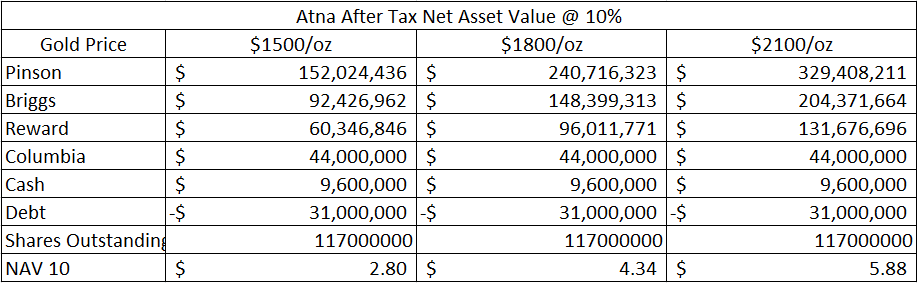
Another stock to get clobbered this week was Atna Resources.  I mentioned a couple weeks ago that I had finished an analyses of the company and would post shortly.  I never did that post, until now.

Below is the after tax NPV10 that I calculated for Atna at various gold prices.

I based my model on the following assumptions:

Briggs:

  • A 11year mine life, at 40,000 t/d
  • Total produced ounces of 476,000 oz over LOM
  • 0.017 oz/t resource over the mine life, strip ratio of 4 and with 80% recoveries
  • Resulting in gold production of  39,700 oz per year
  • Mining costs of $1.30/t mined, milling costs of $4/t milled and G&A costs of $1.7/t mined
  • Cash costs of $898/oz over LOM

Pinson:

  • A 15 year mine life, beginning at 350t/d and ramping to 750t/d by year 4.
  • Total produced ounces of 940,000 oz over LOM
  • 0.4 oz/t resource over the mine life, diluted by 30% with 90% recoveries, resulting in gold production beginning at 50,000 oz and ramping to 75,000 oz.
  • Mining costs of $110/t, milling costs of $50/t and G&A costs of $11/t
  • Cash costs of $687/oz over LOM

Reward:

  • A 8 year mine life, at 24,000 t/d
  • Total produced ounces of 292,000 oz over LOM
  • 0.026 oz/t resource over the mine life, strip ratio of 4 and with 80% recoveries
  • Resulting in gold production of  36,400 oz per year
  • Mining costs of $1.30/t mined, milling costs of $4/t milled and G&A costs of $1.14/t mined
  • Cash costs of $560/oz over LOM

Columbia and Cecil:

  • To the current resource of each I assigned a simple asset value per ounce of $40/oz measured and indicated and $20/oz inferred on the total resource of both properties

Atna is, in my opinion, is one of the best gold stock investments out there.  As demonstrated above, the stock is trading at about 1/3 of its NPV 10 at $1500 gold.  If I wanted to get more aggressive in my evaluation, I would note that many companies are moving to value feasibility on NPV5.  On an NPV 5 basis Atna is worth $3.86 per share at $1500/oz gold.  That number jumps to almost $8 per share at $2100/oz gold.  Clearly there is upside once the momentum begins to build.

I added to my position in Atna on Friday at 78 cents.

Taking Advantage of the Collapse

In addition to Atna and Aurizon, I also added new positions in a few juniors.  Call it the beginnings of a basket; I added a couple of non-producing juniors with deposits to my portfolio this week:

Geologix was recommended by Rick Rule as a takeover candidate on BNN about a year ago.  Since that time the stock has fallen significantly.  The company has a very low grade copper-gold deposit called Tepal in Mexico.  The PEA that was published on Tepal a few months ago put the NPV5 of the project at $412M based on $1000/oz gold and 2.75/lb copper.  Geologix has $14M of cash on hand.  With 145M shares outstanding, the market capitalization of the company was $28M at my entry price of 20 cents.  That puts half the market cap in cash and the other half in a project with an NPV that is nearly 10x the value of the company.  Something has to give here.

Esperanza Resources is another old Rick Rule recommendation.  Rule doesn’t talk much about specific stocks anymore, but there is some evidence that he is still interested in the company.  http://www.investmentu.com/2011/September/why-gold-mining-stocks-will-skyrocket.html .  The company certainly fits the bill of the sort of stock Rule likes.  Esperanza has 1Moz of gold in Mexico.   It’s a heap leach project so it should be able to be brought on production without a massive capital requirement (about $100M).  Like Geologix, the company has almost half its market cap ($100M) in cash on hand ($50M).

I plan to add more to both of these stocks in the coming weeks.

Regional Banks: A  Position in Community Bankers Trust

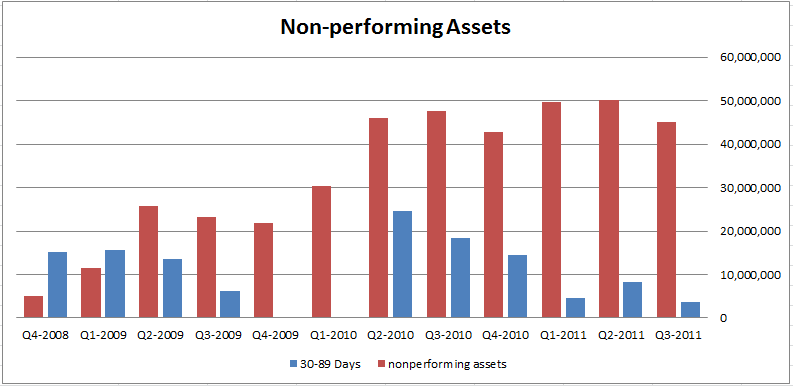
Community Bankers Trust (BTC) hit my bid when it sold off back down to a dollar this week.  BTC is trading at 27% of tangible book value.  This is, of course, partially because of the large number of non-performing loans on their books.  Non-performing loans make up 8.9% of total loans in the Q3 quarter.  This was down from 10.1% in Q2.  In fact, there are some encouraging signs that the worst of the loan losses are behind us.  The company has shown 3 quarters of lower loan amounts 30-89 days past due.  This trend is beginning to show up in the total non-performing loans, which decreased for the first time in a year in Q3.

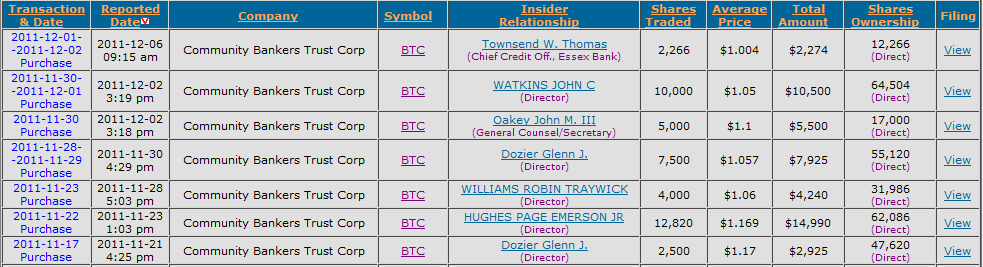
Moreover, as I have pointed out previously, insiders continue to buy the stock.  Third quarter purchases by insiders were a little less than $50,000.

And Another Regional Bank Position in Atlantic Coast Financial

To be perfectly honest, I might have made a mistake here.  I’ve only put a very tiny amount of capital at risk, but even that may have been too much.   Atlantic Coast Financial (ACFC) is a lottery ticket.  I bought the stock at $1.70 on Friday.  There is just as much chance that it will go to zero as there is that it will double.

ACFC is a former Mutual Holding company that did their second step bank in February.  The second step added cash to the balance sheet and resulted in a bank trading well below book value.  ACFC trades at a rather crazy 10% of tangible book.  Clearly there is more to the story.

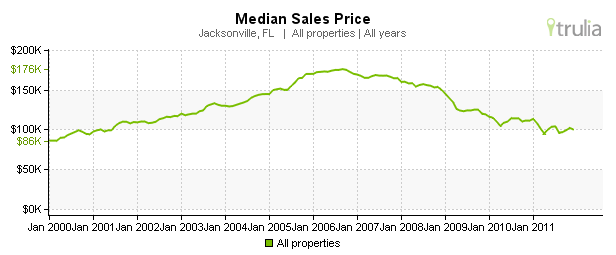
The more to the story is that the bank is centered in Jacksonville Florida.  They primarily make residential real estate loans.  Real estate in Jacksonville has not done particularly well over the last few years (though it appears to be bottoming).

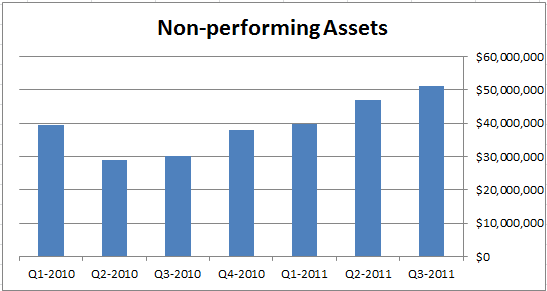
The falling real estate prices have led to skyrocketing non-performing loans.  Those non-performing loans have not shown any sign of peaking yet (thus the possible mistake on my part).

The questions are, how many of these nonperforming loans will eventually be written down, and will there be value left in the equity once the non-performing loans are written down.

What drove me to take a small position in the stock was in part that an improving economy, and stabilizing home prices in Jacksonville, may mitigate further deterioration of the bank assets.  As well, the bank is generating decent earnings before provisions.  Ignoring provisions in Q3, the bank earned $1.16 per share.  In Q2 that number was $0.55.

What is going on at ACFC is something akin to a tug-of-war, whereby on the one hand loan losses strip away value every quarter, while on the other earnings power of the performing loans adds value back.  The share price is so low that it doesn’t take much a a shift in the dynamic between these two forces to change the value equation substantially.  Its easy to see how a stabilization in non-performing loans could quickly allow the earnings power to win the race and shareholder value to go up substantially.

The other factor in my decision to buy was the recent announcement that the company was looking into strategic alternatives.

On November 28, 2011, Atlantic Coast Financial Corporation issued a press release announcing that its Board of Directors has engaged Stifel, Nicolaus & Company, Incorporated to assist the Company in exploring strategic alternatives to enhance stockholder value

Part of the reason that the company is looking for options is that they are not in compliacne with the Individual Minimum Capital Requirement (IMCR) agreed to by the Bank with the Office of Thrift Supervision on May 13, 2011.  Under the IMCR, ACFC agreed to achieve Tier 1 leverage ratio of 7.0% as of September 30, 2011. Tier I capital at the bank is 6.22% right now.

It is a far from perfect scene.  Nevertheless, an improving US economy and stabilizing housing prices could give me a decent return on the stock.  The book value of $19 is unrealistic, a return to $3 is not.

Portfolio Composition