Skip to content

Posts from the ‘Canaco Resources (CAN)’ Category

Canaco’s Magambazi Deposit

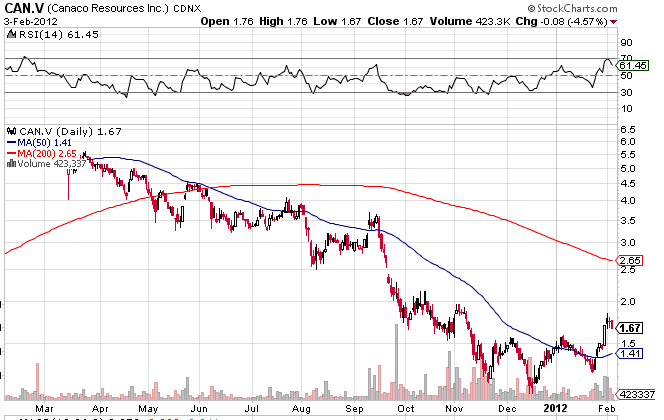
Last week I decided that I would abandon all other research and devot my spare time to evaluating Canaco’s Mogambazi deposit.   I have been thinking more about Canaco recently because the stock has fallen from such heights that even now, after the recent 50%+ move, the stock is less than a third of its highs.
I noted last week that Canaccord Capital has said that they expected the soon to be released NI 43-101 report to show 2.3 Moz at around 3 g/t.

I thought it would be an interesting project to come up with my own estimate.  So that’s what I did.  As you will read, I had some difficulties, was left with a big question mark, but learned a lot along the way that will help me evaluate Canaco and Magambazi going forward.

But first a bit about Canaco

While Canaco has fallen rather dramatically over the last year, the still stock commands a rather large enterprise value for an company exploration company.

Even after subtracting the current cash on hand of $115M, the stock still sports a valuation of $200M.  For $200M you need to be getting a lot of gold to make the upside worthwhile.

The gold is at Magambazi

Canaco is a one trick pony and that one trick is Magambazi.  Magambazi is in the eastern part of Tanzania.
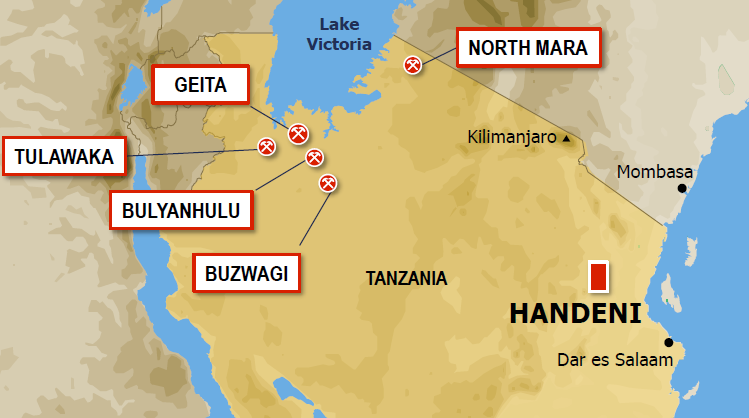
There has been a lot of gold found in Tanzania but it is all in the northwest.  There has been almost no historical exploration in the eastern part of Tanzania.  That is because the geological intrepretation was that the Sukumaland Corridor, which is the belt that holds all of the gold on Tanzania, extended only to the western part of the country.  In 2007 this changed, and academic research began to reinterpret the geology as extending much further to the east.  It was around this time that Canaco stake claims around Handeni, and soon after that they returned their “discovery hole” at Magambazi of 53m of 4.32 g/t.

The deposit

The Magambazi deposit consists of a number of zones, or what the company calls lodes, that run any where from a few hundred metres to a kilometre along strike.

The most prominent of the lodes is the Main lode.  The Main lode hosts the original discovery and also a number of other impressive intercepts with rather eye-popping numbers.
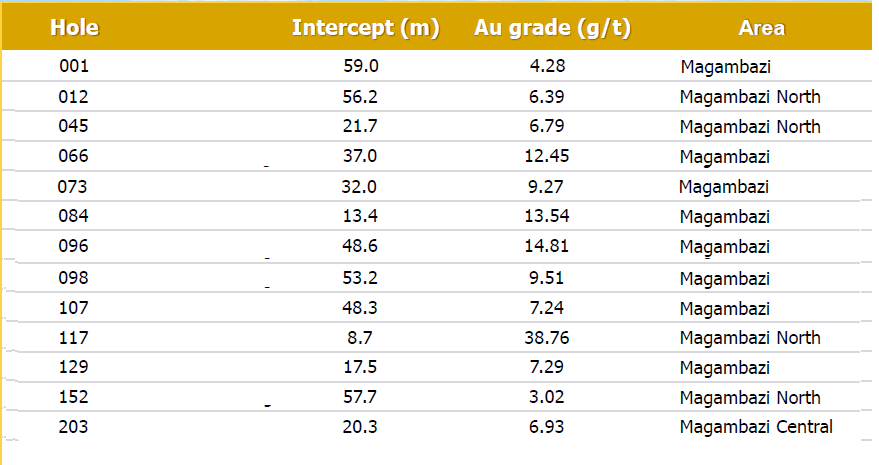
When you look at these drill intercepts your first reaction is that there must be a massive amount of gold here. Numbers like 48 metres of almost 15 g/t are extremely high numbers.  The problem that I have found in the course of my evaluation, and perhaps this is why the stock has done so poorly over last year, is that the gold is erratic.  More often than not, that long high grade intercept will be right next to a much shorter or much lower grade intercept, suggesting a quick pinch off, or even to a barren hole entirely, suggesting a fault line that ended the mineralization.

The numerous faults present in and around the deposit make any evaluation complicated.  They create sudden start and stops to the mineralization that are difficult to pin-point exactly without dense drilling.  I have to wonder how this will affect the Ni 43-101 that is going to come out in a few months?  Will the evaluator be forced to make conservative assumptions with respect to where mineralization begins and ends?

The deposit also has a number of very quickly narrowing finger like strands.  These also make it difficult to evaluate without a lot of drill holes. Take for example the following section from the company’s presentation.  In particular, focus on hole 265.  Here is one of those fairly monster like holes, grading a little over 3 g/t over 56m.  But notice hole 6, only a few meters away.  The mineralization goes from robust to not even reported in the presentation very quickly.
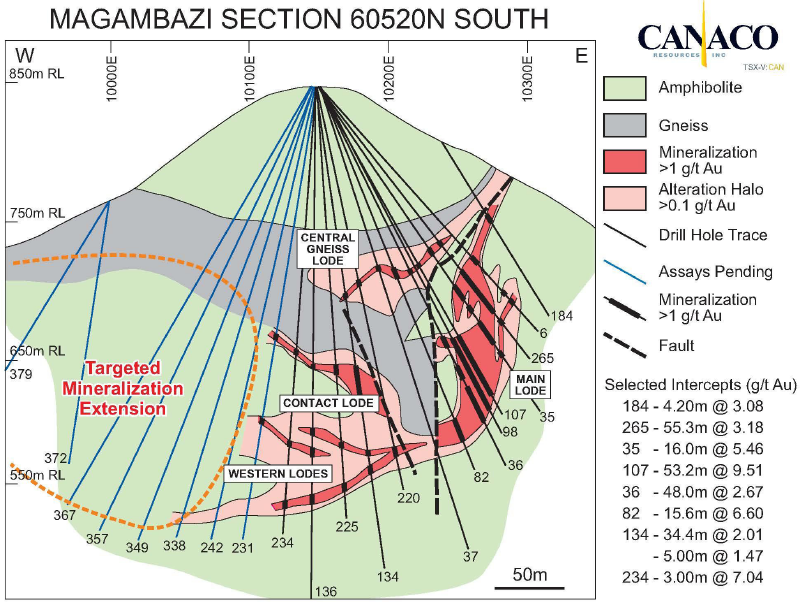
Another example of the same sort of quick pinch out can be seen from hole 134. Taken alone, at 34m of 2g/t, you would think that it has discovered another lode comparable to the main lode.  But 225 quickly demonstrates that the lode pinches out quick to the east, and 220 shows that the lode ends abruptly due to a fault to the west.  The overall ounces present in such a lode are not as impressive as the single intercept would suggest.

The point here is that you simply can’t take a bunch of drill intercepts and extrapolate the robustness of the deposit.  You probably shouldn’t do that in general and you definitely can’t do that with Magambazi.  You really have to look at it in detail and make out what the actual orientation is.  So that is what I did.

The Power of Corebox

Corebox.net is a website that hosts a powerful and rather surprisingly free tool to help you evaluate mineral deposits.  The tool holds a database of drill results for more than 100 different deposits.  It displays those drill results in 3-d form, making it really quite simple to look at each cross section individually and evaluate continuity, overburden, etc.
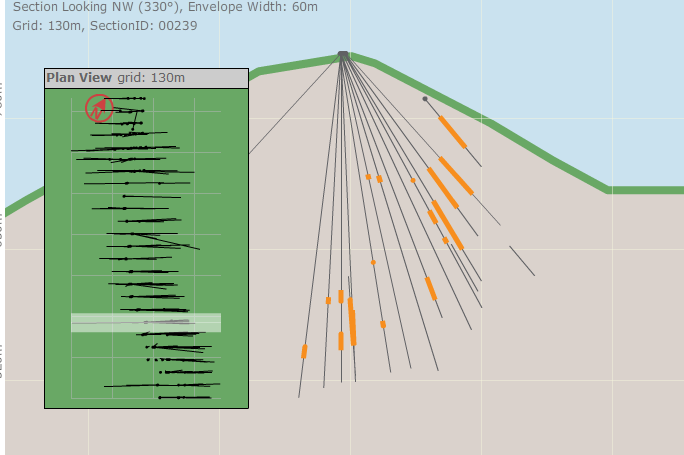
The Magambazi project is on Corebox.  This greatly simplified my work.  Its a very empowering (dangerous?) tool because it lets you attempt evaluate a deposit to a degree that you would otherwise only be able to guess at.  I have tried to do this sort of work before on other projects where I didn’t have Corebox.  There isn’t a great way to graphically display the angles correctly, so in the past I ended up using a crude approach whereby I summed up lengths and multiplied by what the total width of the end holes were.  This isn’t very accurate.  Corebox eliminates the need for such simplifying assumptions.  It also gives you the great advantage of being able to visualize where the deposit is with respect to topography.

My Process

Evaluating a deposit is time consuming, getting the information is a struggle, but overall it is not a complicated process.  Basically I had to go through the following steps.

  1. Determine a volume of the deposit.  You do this by simply figuring out the length x width x height of the ore bearing gold
  2. Use the volume to determine a mass of the deposit.  Mass is simply volume multiplied by density (or specific gravity)
  3. Make an estimate of the average grade of the deposit and multiply that by the mass to determine the amount of gold in-situ
  4. Convert the grade from grams to ounces and you are done

Step 1: Determining the Volume

This is the step where corebox really helps out.  Canaco has drilled the Magambazi deposit at 40m spacing.  The birds-eye view of this drilling is shown below.

With corebox you can look at each of these cross sections and try to deliniate the deposit.

How did I do that?

First I used the Microsoft program Snipit to snip the screen shot of the section.  So I got something like this:
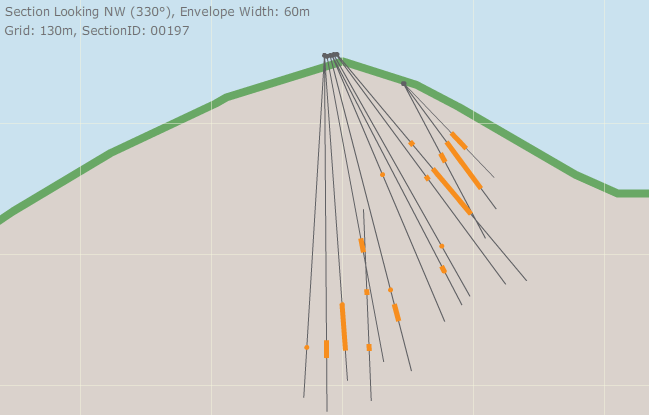
Next I had to find a program that would allow me to draw the deposit in free form around the drill holes but (and here is the tricky part) then tell me what the area of the resultant irregular polygon was.  This proved to be difficult to find.  The first program I used was a app on the web called SketchandCalc.  It worked fine, you can import the image, you draw your shape and it calculates the area and as long as you have a reference block on your image of known area you can scale that block to determine the actual area of your shape.  With a section like the above one, the reference block is the 130m x 130m grid block so you just sketch deposit, record the area and scale appropriately.

I probably would have stuck with SketchandCalc but I ran into some problems with my results not being quite what I expected (more on this later).  This led me to question the validity of the area being calculated by the program.  I went out searching for a second program to use as verificiation.  As it is, it turned out to be rather fortuitous because one thing SketchandCalc doesn’t let you do is save the sketches so you have no record of your work.  After much searching (there is truly a dearth of programs available on the web for calculating area) and many failed attempted to determine the area using Powerpoint (you can’t do it), I figured out that another Microsoft program, Visio, works extremely well for the task.  By the way, it turned out that there was nothing wrong with the calculations by SketchandCalc, my Visio results matched up well to my original SketchandCalc work.

My Visio sections

Its really easy to draw and get the area of a section in Visio.  You just have to do the following:

  1. Import the screen capture of the cross section into Visio
  2. Draw out the shape of the deposit to align with the intercepts
  3. Under the tools add-ons there is a Visio Extra that allows you to calculate the area and perimeter of an irregular polygon.  Use this to get the area of the shape and of the reference block

What you end up with (for example with section 200 that I showed above) is something like this:
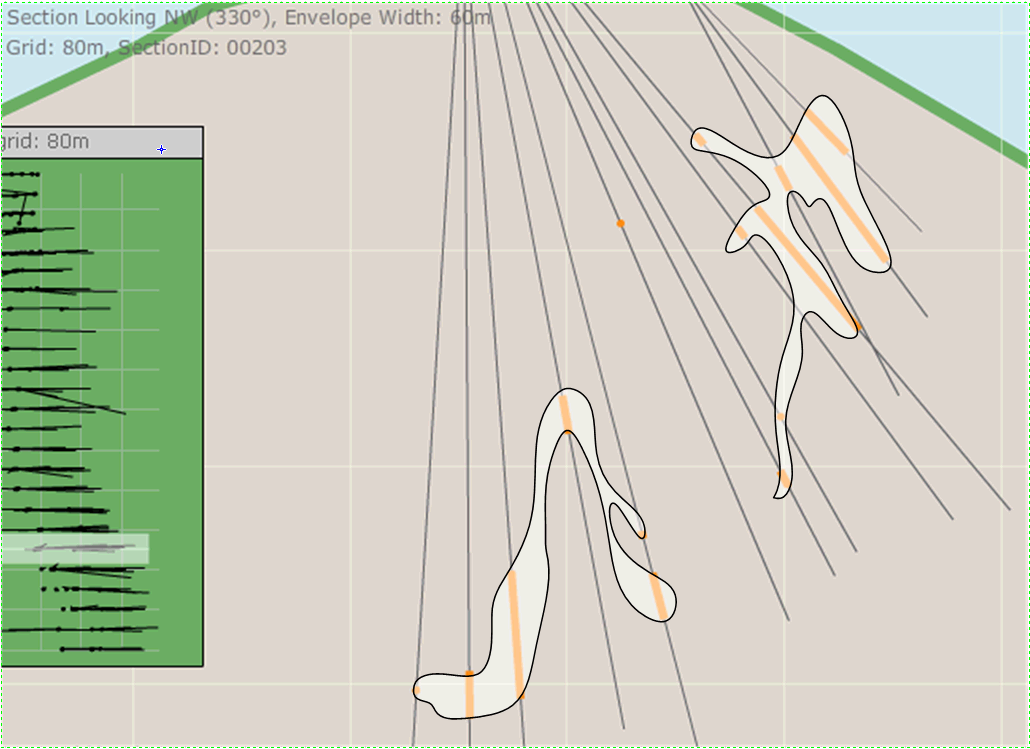
What a Orogenic deposit should look like

So clearly there is some interpretation going on here.  And I am not a geologist so you do have to take my personal interpretation of the deposit with a grain of salt.  With that said, before drawing out a bunch of squiggly envelopes I did do some research into the type of deposit at Magambazi to get a better idea of how one might expect the gold to be disseminated.

Of particular help was a fellow named D.I Groves.  Groves is referenced numerous times in the 43-101 and I think it is fair to call him an expert on deposits of the Magambazi type.  Magambazi is a Orogenic gold deposit.  An orogenic gold deposit is a type of mesothermal deposit, which means a deposit that was created by the influx of water from deep in the earth’s crust that has been heated and risen through cracks and fissures, taking some gold along with it.  Where this water find “traps”, meaning non-porous barriers that prevent it from rising further, it stops, and over time the water dissipates leaving behind the minerals it carries.

It used to be (and maybe still is in some circles) that all mesothermal deposits were called mesothermal deposits, but Groves wrote a few papers on the subject arguing that these deposits should be further categorized based on a bunch of technical geological attributes that aren’t really that important to what I am trying to accomplish.  One such deposit type was named an Orogenic deposit, and the term must have stuck because in the NI 43-101 filed on Sedar by Canaco, the deposit is referred to as being of the orogenic variety.

Most importantly to what I am trying to accomplish is that Groves provided some descriptions and a few useful pictures about the specific nature of an orogenic deposit, how it evolves and thus how one might expect the gold to be deposited.  One such picture is shown below.
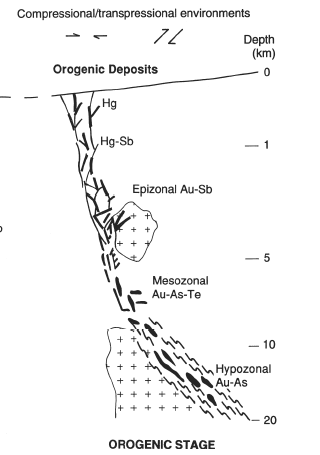
What you would expect to see at Magambazi is a number of thick, organ like veins with small branches jutting up from the deeper sources.  This is exactly what you get in Canaco’s own interpretation as illustrated in a couple of the cross-sections they make available in their February presentation.   At Magambazi there is the added complexity of vertical faults along strike throughout the deposit, resulting in sudden terminations and offsetting of the mineralization.
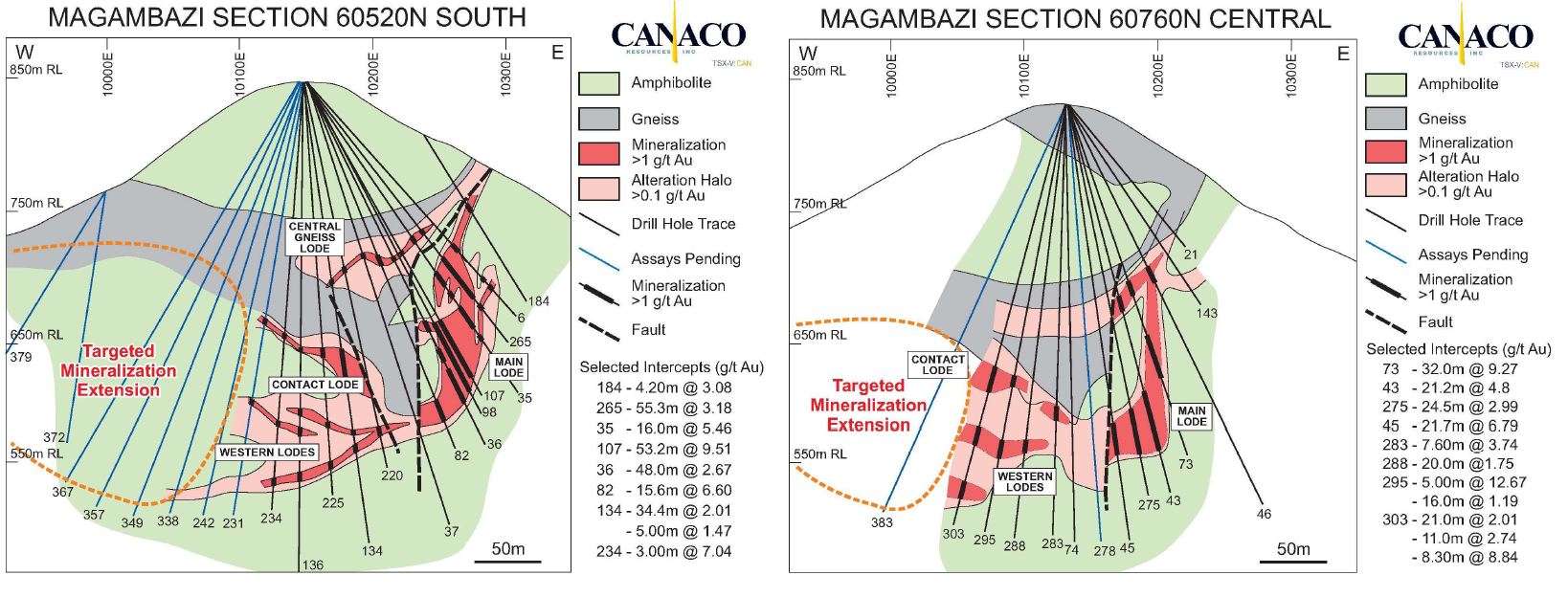
For reference, the interpretation I used for these same two sections are below:

With Section 280 (on the left in both pictures) you can see a few spots where corebox wasn’t perfect; where the complete drill result wasn’t shown in the cross section.  I was careful about this, and whereever there was a discontinuity where it didn’t seem there should be one I checked the actual drill results against what corebox was showing to make sure corebox didn’t miss one of the shorter or lower grade intercepts (in a few cases it did).

Overall though it did a nice job.

There were 25 sections in the deposit spaced 40m apart.  I basically spent my lunch hours last week drawing funny looking shapes in Visio (and/or SketchandCalc) for each one of these sections.  I have a link to my visio sections here.

Because I am not trying to be excessively detailed, to compute a volume I made the simplifying assumption that each cross section was valid for a 20m strike in each direction, meaning that each cross section represented 40m of the deposit.  Volume was therefore calculated by multiplying each cross section by 40m.

Organizing the intercepts and getting an average grade

The other tedious task was taking the long list of drill intercepts and determining which cross section each belonged to.  Canaco provides a list of all the drill intercepts here.  Basically I took the PDF file and turn it into an excel file (something that turned out to be more complicated then it should have been), and then went to each of thecross sections, found all the intercepts that lay within that cross section and grouped those intercepts together.

Now if I had been doing the analysis with the detail of an actual report I probably would have broken up each cross sectional volume up into smaller blocks, determine the average grade in each block and then determined that amount of gold in each block discretely.  But that is too much work.  Instead I made the simplifying assumption that the average grade in each cross section is constant throughout the section.  I determined the average grade per section by summing up the length weighted grade of each intercept and then dividing by the total length.

I have a spreadsheet that I have tried to make available here with the data.

I calculated the overall average grade for the deposit as a whole as being 3.66 g/t.

Figuring out the density

As it turns out, determining the density is was BY FAR the hardest part of the process.

The density that we are interested in is the density of the rock that immediately hosts the gold mineralization.   The density is typically defined in terms of specific gravity, which is the ratio of the density of rock to the density of water.  I have exhaustively researched what to use as thespecific gravity (also sometimes referred to as bulk density) and to be honest, I’m just not sure.  This is a real sticking point and what it means is that I can’t report my results as a single estimate.  Instead I’lll have to give a range of ounces depending on the specific gravity assumed and we’ll just have to see how it turns out when the actual resource comes out.

My initial assumption was that the density was simply the density of quartz, or maybe a little bit more.  Quartz has a density of 2.6.  According to the initial NI 43-101 put out by Canaco (Page 8):

In situ gold is spatially associated with quartz vein zones within silica and garnet altered amphibolite gneiss. Mineralization is commonly associated with arsenopyrite (possibly also loellingite), pyrrhotite and graphite. Visible gold is commonly present in drillcore.

And then later on, talking specifically about the Magambazi zone (Page 9):

Gold is spatially related to quartz veins within silica and garnet altered amphibolite.

So its quartz.  Plug in 2.6 and its end of story right?

Wrong.  Or at least I think so.  The problem is that if I use 2.6 as my density I don’t get anywhere near as many ounces as I should.  A specific gravity of 2.6 gives me a little over 1,000,000 oz of gold.

This is where the real work began.  As I mentioned early, the first thing I thought was that there must be something wrong with my cross-sections.  Enter visio and a rigorous re-evaluation of each intercept (sometimes 3 times!).  Eventually I was satisfied that my original cross-sectional estimates were fine, and that this wasn’t the problem.  Next I thought I might be using the wrong spacing.  Was it 80m (my number was about 1/2 of what I would have expected).  But no, its not, the spacing is 40m.  I also checked all my units (intercepts are recorded in metric, gold is reported in grams per metric tonne, specific gravity is in tonnes/m3) so no that’s not it either.

The only parameter I am left with uncertainty about is the specific gravity.

My theory is that the gold is hosted in a quartz that has a lot of heavier pyrite (basically iron sulphide) in it.  Maybe its even all pyrite.  There is some evidence that leads me to this.

First of all from the NI 43-101:

Page 42: Mineralization is characterized as vein‐related structurally‐controlled orogenic gold associated with pyrrhotite, arsenopyrite, and locally graphite

Page 100: Mineralized zones at Magambazi and Magambazi North are distinctively mineralized with pyrrhotite and arsenopyrite, with graphite and chalcopyrite present locally. Additionally, graphite appears present in significant quantities related to major fault structures.

And second of all, from the original discovery press release:

The 293 metre drill hole (MGZD 001) has intersected a broad, intense alteration zone and sulphide mineralization (pyrrhotite, arsenopyrite, pyrite and chalcopyrite) with trace amounts of visible gold in eight separate metre intervals

Pyrrhotite, arsenopyrite and pyrite all have much higher specific gravities then quartz.
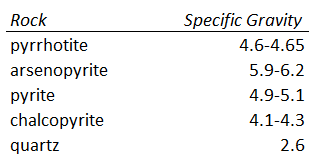
Therefore if the rock has a significant amount of pyrite in it, the specific gravity would be higher, which would help to raise the ounces to an amount more consistent with the Canaccord estimate.   I scoured the net looking at the NI 43-101 of other projects that appeared to have the gold hosted in pyrite.  Unfortunately I wasn’t able to find a single instance where the vein was not dominated by quartz and thus where the specific gravity was significantly higher than 2.6.

Finally I emailed the company and asked them if they would tell me what sort of specific gravity to expect.  Unfortunately they wouldn’t give me a number but they did say:

We don’t have an exact number yet for the specific gravity of the rock but it’s hard silicified material, so likely a higher density than your average mineralized system.

Exactly how much higher remains an open question.

Summing up the resource

I’ve already mentioned the spreadsheet that I built to sum up the resource.  Basically all I did was take the volume for each individual section and convert that volume into a mass using the specific gravity of the rock (in this case 3 scenarios with a range of specific gravity’s between 3 and 5).  Once I had the mass, I multiplied that mass by average grade of gold in that section (as determined by by weighted averaging) and then converted that gold from grams to ounces.

What I ended up was the following:
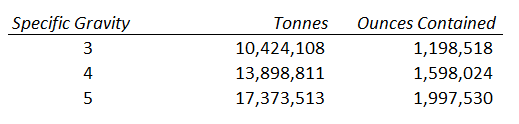
All 3 of these estimates are lower than I would have expected.  To be honest, I’m not sure what to make of that.  I don’t know how much I trust my own work given the uncertainty with specific gravity and obviously the low-tech tools I am using.  But before I draw any conclusions about the results, I want to talk for a second about some of the potential sources of error.

Sources of error

Even my high specific gravity estimate is on the low side of the estimate provided by Canaccord (they estimated 2.2Moz).  I suspect the actual specific gravity is closer to 4, which would mean that my estimate is really quite a bit on the low side.  I am of the opinion that Canaccord probably knows more than I do, so I am pretty sure there is something being under-estimated by mine.  With that in mind there are a few other potential sources of error in the calculationsthat could be responsible for the discrepancy.

First, as I mentioned already, there is a lot of interpretation involved here, and perhaps with Visio I was making the connections between drill holes too narrow or too short.   I do admit that I was consciously erring on the side of conservativeness when I drew out each section, though I didn’t think that doing so would have such an effect.  I played around with this a bit to see how sensitive the resource is to changing the cross sections.  Its actually not that much, not unless you start getting really creative and adding mineralization where there clearly isn’t any.  If you are just tweaking the known areas to make them a bit bigger, you might be able to add 200,000 oz but you would have trouble adding more.  My conclusion is that this can’t be the only issue.

A second potential source of error is that the high grade intercepts are surrounded by a low grade halo of gold.  Canaco didn’t report the low grade numbers in their press releases or in the 43-101 so its really difficult to get a handle on their significance.  The 43-101 did have this to say about the low grade:

What is apparent from sectional review is that significant gold is present outside of acknowledged ‘main zones’ of mineralization, or key intercepts as documented, and the mineralization system is in areas, seemingly pervasive. While separate internal gold intercepts exist that would be considered high‐grade in terms of underground mining assessment, the overall type of mineralization can be difficult to quantify, and requires assessment as a potential pitable target.

If you look at the cross sections Canaco provides you get an idea of how significant the low grade is.  The halo is the light red areas.
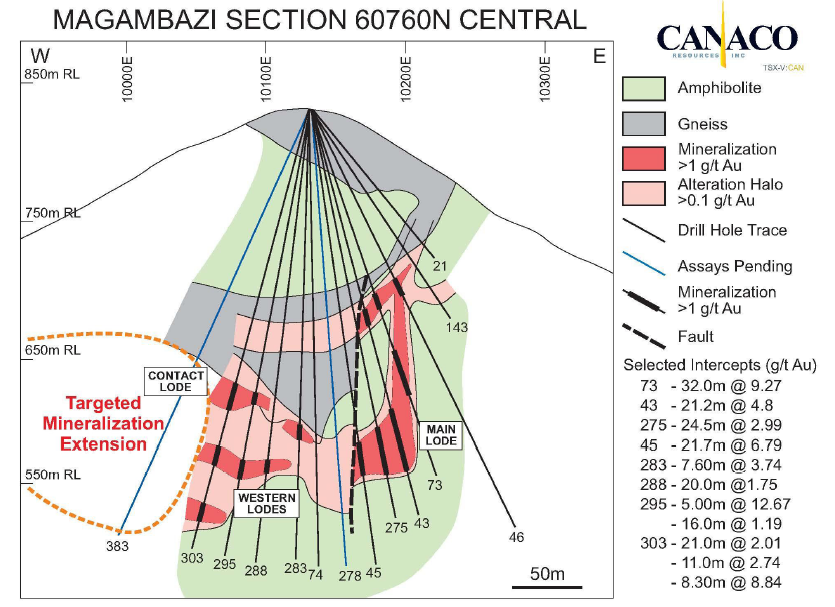
Based on what the 43-101 says, I think the halo likely has a grade of aroud 0.3g/t.  Perhaps if you add this up over the entire strike of the deposit you might get another 500,000 oz, which would put you more inline with what Canaccord is estimating.

A third source of potential error is that corebox isn’t scaling correctly.  I tried to verify this by taking a number of intercepts and measuring the depth of the intercept versus the length, and seeing whether the ratio was correct.  In all the cases that I tested it matched up.  But that does not preclude the possibility that some of the cross-sections I used to estimate area had error.

What other conclusions can you draw?

Aside from the resource number, I can draw some other qualitative conclusions about the Magambazi deposit.

1. This is not evenly disseminated gold.

The point here is that with an open pit project it is going to be difficult to maintain a consistent mill feed.  The project dips from north to south, with the north being the closest to surface.  Unfortunately the north has the lowest grades and the shortest intercepts.  If you look at the deposit section by section, the northern most third of the deposit has on average 16,000 oz of gold per 40m width.  This compares to 49,000 oz per 40m in the central part of the deposit and 70,000 oz per 40m in the southern part.  Its not a uniform deposit and the deepest part of the deposit is the most economical.

2. The strip ratio is going to be pretty high

I didn’t calculate the strip ratio but it is clear from looking at the cross sections such as the one’s I have highlighted above that much of the gold is deep and vertically oriented, which is going to mean that you have to move a lot of waste to get to it.  The ore at the northern end of the deposit is near the surface, but towards the central and especially southern portions that deposit deepens significantyl. To give just a couple of examples, taken from the company’s own cross sections:

You can see just how much waste lies above the gold.

3. The widths and grades of mineralization vary significantly

Perhaps one of the reasons that I struggled to match my estimate to Canaccord was because the mineralization changes so suddenly.  While stepping through the deposit I found again and again the situation where a long, high grade intercept was offset by a shorter or much lower grade intercept.  This has a consquence for the eventual mining operation of course but it also has a consequence for the upcoming Ni 43-101.  There is certainly some wiggle room for the evaluators to mark up or down the resource depending on the interpretation they use.  It’s not necessarily a good or bad so much as a risk.

What am I going to do?

At the end of the day I do this sort of analysis and it really comes down to a decision of whether I am still going  to hold the stock or whether I am going to sell it.  At the price level that Canaco is currently at I am inclined to hold.  I would be reluctant to buy much more though.

As Steve T pointed out in one of his comments the other day, you really are holding a stock like Canaco for the potential that they can grow the deposit beyond its current size.  At its current market capitalization I would say that the company is probably fairly valued for the resource it currently has, but there is certainly upside potential as the resource expands.  Management gave a good presentation on the potential of the land package around Magambazi at the Denver gold conference this year.  There are plenty other anomolies around Magambazi that are left to be explored, these anomalies are virtually untested historically, and because of the high levels of pyrite associated with the gold they are easy to detect through surveys.  I wouldn’t be surprised to see more success from Canaco as they expand the envelope that they explore.  So I will continue to hold my position on that speculation.
Letter 31: Bank earnings and more bank earnings, lightening up on gold stocks (again) and a soon to come Canaco Magambazi resource

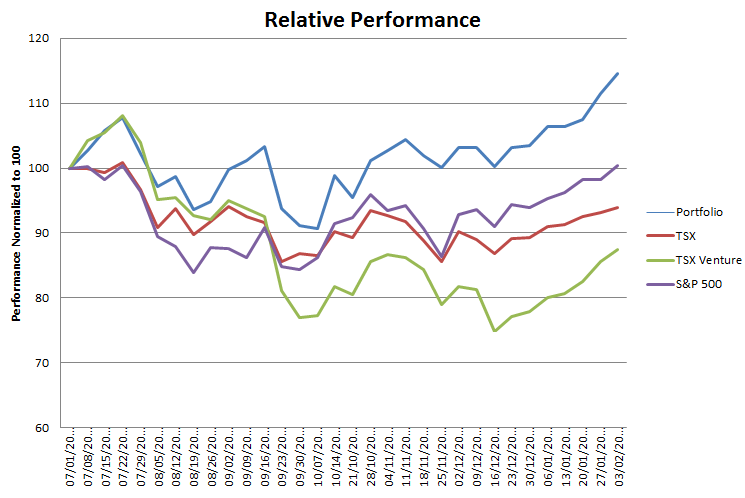
Portfolio Performance:

Portfolio Composition:

Waiting on Magambazi…

I have been working most of the week on an evaluation of Canaco’s Magambazi deposit in Tanzania. I was hoping to be finished the work by today but its carrying on and I don’t have a lot of time to finish it today (what with the superbowl and all) so this will be a rather short update, but with a longer, hopefully rigorous analysis of the Magambazi deposit will follow shortly tomorrow or the next day.

Outperformance of the US

Now that is something that I haven’t said in a few years.

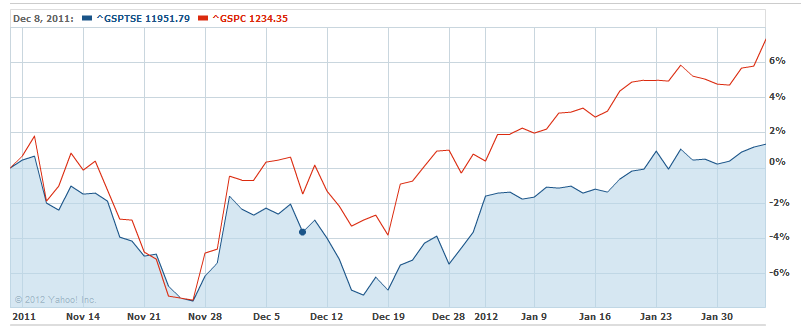
While it was another good week for the S&P and a decent week for my portfolio it was not a great week for the TSX.  Again.  This is becoming a pattern.  Its striking how badly the TSX is underperforming so far this year.  The S&P is up almost 6%, the TSX is up hardly at all.

I have tried to increase my positions in the US-sensitive stocks I own to take advantage of this American out-performance with a particular emphasis on leverage to the mortgage industry.  Most recently, in the last week I added to my positions in Community Bankers Trust, PHH Corporation and I introduced a new position in Rurban Financial Corp.

Rurban Financial Corp

Rurban was  recommended in a comment (by Robert) to my post last week.  I did a quick look at the company, which released 4th quarter earnings on Monday, and they do indeed look cheap.  And while I haven’t had a chance to take a close look at their prospects, I’d liked what I saw on the surface, so I bought a small starter position.

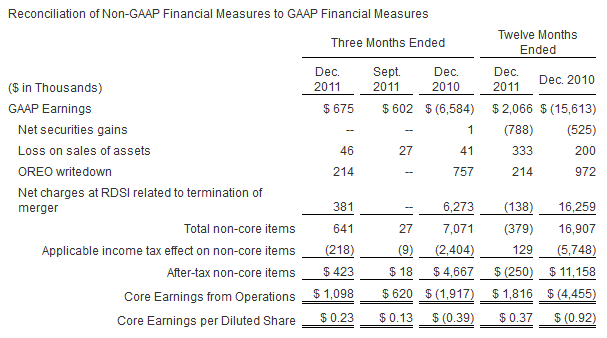
The company produced earnings ex a one time merger charge and ex OREO losses of 23 cents per share in the 4th quarter.

Now I admit I have not dug into Rurban to the point that I need to (this Canaco resource estimate has been all consuming of my spare time).  I plan to do that in the next week.  I’d like to put together a comparison of Rurban and Community Bankers Trust and perhaps Bank of Commerce Holdings (both of which I will touch on below) side by side to better evaluate Robert’s legitimate skepticism in BTC.

Community Bankers Trust 4th Quarter Earnings

And speak of the devil, they released 4th quarter earnings on Tuesday.  I thought the numbers looked pretty good. The quarter was summed up by the following statement from CEO Rex L. Smith III:

“Our goals for 2011 were to make major improvements in our problem assets and to rebuild the fundamentals of the core bank, and I am pleased to report that we accomplished our goals. Both nonaccrual loans and net charge-offs saw continual and substantial declines throughout the year. At year-end our ratio of nonperforming assets to loans and other real estate was at its lowest level since the first quarter of 2010. Additionally, the fourth quarter showed a strong increase in new loan production in our targeted growth areas. All of this occurred while we lowered noninterest expense for the year by 21%.

Let’s step through some of the key metrics and update the graphs I showed last week with the 4th quarter numbers.

Pro-forma earnings (that is earnings before the FDIC amortization and before any one time hits to investments and real estate owned) were strong in the fourth quarter, coming in at 14 cents per share.  Again I think the bank has a lot of earnings power going forward once (if) it is able to bury its past misdeeds.

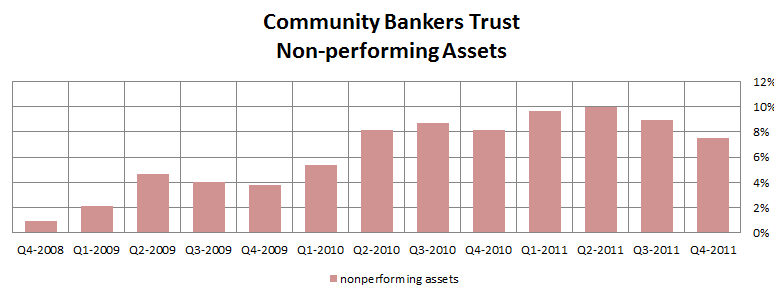
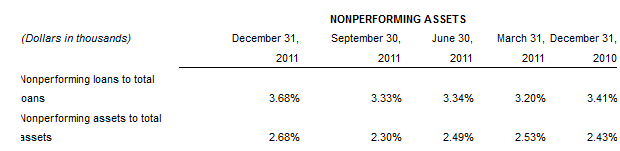
Equally important, nonperforming loans were down again in Q4.

The only negative I saw for the quarter was something I have seen a lot of with the banks reporting fourth quarter results thus far.  Net interest margin is on its way down.

Banks are struggling with the headwind of low interest rates.  Basically,  purchasing non-risky securities (ie. Treasuries and government backed MBS) means accepting extremely low returns.  As older securities mature and roll off the books they are being replaced by low yielding new securities.  Of course this is exactly what Bernanke is looking for to try to get the banks lending again.  That seems to be working in the case of BTC, as loans originated was up in Q4.

Bank of Commerce Holdings 4th Quarter Earnings

I wrote a short piece ofter my purchase of Bank of Commerce Holdings about two months ago.  Since that time the stock has risen about 15%, so its been an okay purchase but nothing exceptional.

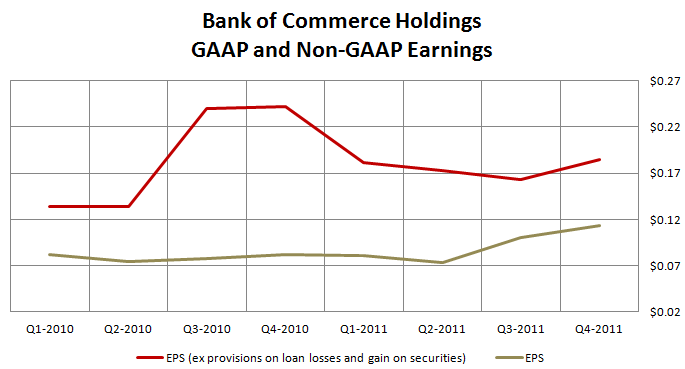
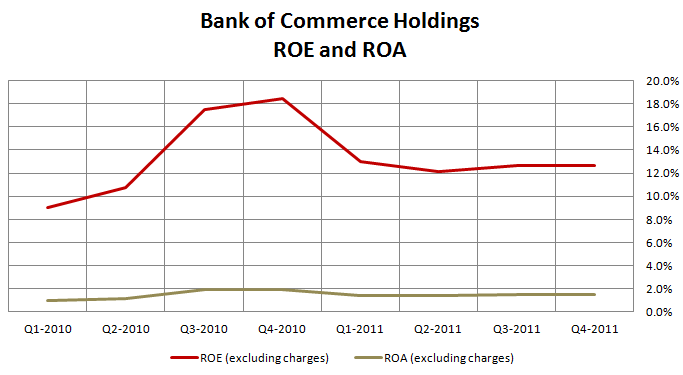
I have yet to really evaluate the stock in the kind of depth I need to.  I hope to get to that in the next week.  In the mean time I have been compiling the basic statistics to do that evaluation.  The company came out with another data point on Tuesday when they released their 4th quarter earnings.  I would call it a mixed bag.  On the bright side the company showed another strong earnings per share number when you ex-out the one time hits, and ROE and ROA also showed strength on a proforma basis.

Note that my estimates of ROE and ROA exclude provisions from loan losses, losses on real estate owned and one time investment gains so they are somewhat higher than the posted numbers in the news release.

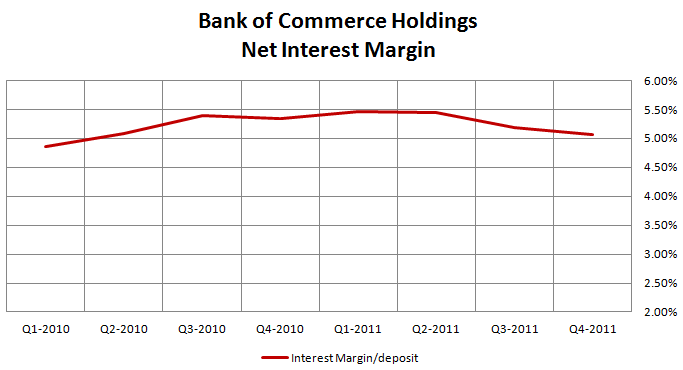
On the negative side the company struggled in much the same way as Community Bankers, posting a lower Net Interest Margin quarter over quarter.

Perhaps more worrying is that nonperforming loans are rising.

I’m not sure about Bank of Commerce Holdings.  I don’t have a large position in the stock.  I don’t love where the bank is based (around Sacramento California) and I don’t like how non-performing loans are rising at all. As CalculatedRisk pointed out recently, there aren’t any signs of things improving in Sacramento yet.

The percent of distressed sales in Sacramento was unchanged in November compared to October. In November 2011, 64.1% of all resales (single family homes and condos) were distressed sales. This was down slightly from 66.1% in November 2010.

I’m going to evaluate it closely and turf it if I don’t see a strong story being written that will lead the company back to the $6+ level.

I need to understand gold better

Early in the week the gold stocks and the bullion looked to be breaking out together and there was a hope (at least in my mind) that it was for real.  Then the Friday employment number came out and presumably frightened everyone about the prospects of inflation and the gold price dropped 1.8%.  Some of the gold stocks got hit much harder.  I’m not willing to find out if this is a blip or another true correction; I reduced my trading positions in Aurizon, Canaco, and OceanaGold (though as you will note at the end of the post with respect to my weekly practice account trades, I mistakenly bought rather than sold OGC.  This is something I will have to rectify on Monday).

What I need to do to gain some lasting confidence in my gold stock position is gain a better understanding of the supply/demand dynamic right now.  I’m flailing a bit here and I’m fully aware of it.  But there are a number of headwinds happening here that I don’t want to ignore:

  1. The lack of Indian demand brought on by the strong rupee
  2. An improving US economy will mean higher interest rates eventually
  3. The ETF has become such a big part of demand and I wonder how much of those holders are “weak hands”

The problem is that while I believe in gold in the long term, I also know that a lot can happen in the interim.  Rick Rule was pointing out a few months ago how in the 70’s and early 80’s, when gold rallied from $35 to over $800, it also had a number of corrections, including one of over 50%.

My lack of clarity in understanding just what is driving gold at the moment (and whether in the short term, particularly given that the seasonality effect is about to turn against the metal, it remains sustainable or not) is leading me to these short term in’s and out’s with OceanaGold and to a lessor extent Aurizon.  Gaining back some clarity, and with it hopefully some more certainty in my decisions, is another endeavour I hope to accomplish in the next week.

Speaking more company specifically, Atna remains the strangest bird of the bunch in the gold stock sphere.  It consistently outperforms (even goes up) on days when other gold stocks are going down and then does nothing (or goes down) when all the other gold stocks are up.  I don’t understand the stock for a second, though I am happy that the trend in the stock is, to borrow the phrase from Dennis Gartman, from the lower left to the upper right.

My soon to be complete Canaco Magambazi Estimate

In a next day or so I will be posting my interpretation of the resource estimate at Mogambazi.  I basically have went through the deposit, cross-section by cross-section, and evaluated the resource using a rough block model.  I thought it would be a fun project, and it has been, but its also been a lot of work.  My tools consistent of Visio, Excel and the screen capture tool snip-it, and my main resource to educate myself has been google, so its been a bit of a process.  Still, I’ve learned a lot and have become developed a better understanding of what Magambazi is (both the good and the bad) which I think will allow me to act prudently on it in the future.

So stay tuned for that.

Weekly Trades

Week 30: Cognitive Dissonance, Canaco updates, Canadian house prices and the story of Community Bankers Trust

Portfolio Performance

Portfolio Composition

Trying to not be dogmatic

A few years ago I read a book called Mistakes were Made.  The book described our ability as human beings to remain convinced that we are right to the point where we ignore all evidence to the contrary.

Our predisposition to fabricate reasons why we are right and ignore reasons why we are wrong is based on a concept called cognitive dissonance.  As the book defines it:

Cognitive dissonance is a state of tension that occurs whenever a person holds two cognitions (ideas, attitudes, beliefs, opinions) that are psychologically inconsistent… Dissonance produces mental discomfort ranging from minor pangs to deep anguish; people don’t rest easy until they find ways to reduce it.

All symptoms I am all too well acquainted with.

Along the same lines, I came across an interesting piece on FT this week.  The following quote can be attributed to SocGen’s Dylan Grice:

But all is not lost. The bias towards thinking we’re more correct than we are isn’t driven by an inability to fully assimilate undesirable information but an unwillingness to do so. Therefore, the first step in removing the bias is to adopt procedures that foster a more honest acceptance of logical conclusions. Logic has no emotional content per se. There is no such thing as good or bad information; information is only true or false.

But because of our hardwiring, we only want certain information to be true. In particular, we want the information that confirms our prior beliefs and validates our belief systems to be true — about ourselves, about others, about the world. Thus, debiasing ourselves must involve an honest assessment of what we want: do we want to be right about everything, or do we want to know what’s true?

Let’s bring this back to what this blog is about: investing.  In my piece last week I stepped through the basic premises on which I am currently invested.  The tenants I stated were the conclusion of a somewhat anguished and certainly restless mental reevaluation that I had been running through over the prior few weeks.

As the market moved against me I  started to look at why I might be wrong.  In my spare time I tried to “assimilate the undesirable information” and paint the most contrary picture I could.

I especially went through the exercise with gold and with my rather significant precious metal stock positions (Aurizon Mines, Atna Resources, OceanaGold, Canaco Resources, Geologix, Esperenza Resources, Lydian International and Golden Minerals).  Gold is always easy to question (what does gold really do anyways?).  I attempted to soberly evaluate both the prospects of the metal  and the companys.  I looked for reasons to basically cut them loose.

I hemmed and hawed a lot, and at times began to convince myself that I was indeed wrong.   But in the end I was led back to the basic points of valuation and underlying conditions, which seemed to me to remain firmly in gold’s favor.

This is how I make decisions.  At times it undoubtably appears that I am flip-flopping.  I am sure that my weekly writings must have an aire of contradiction when read one after another.  A reader might wonder how it is that my point of view can go from one extreme to another in the matter of weeks (see Argonaut Gold).  Or at times even flip 180 degrees only to flip back a few weeks later (see Argonaut Gold).

In truth, this is the only process I know of that allows me to really question whether I am right.  If I can push myself to the edge, almost convince myself of the diametrically opposed point of view, and still in the end come back to my original conclusions, then well, that’s really getting somewhere.   At times I push myself so far that I actually begin to believe it myself (ah yes, see Argonaut Gold), but that is just a occasionally necessary casualty.  Far more often I leave the exercise with more clarity, and with that clarity comes the likelihood that I will act properly when the situation arises.

In the end I came away from my “anguished” analysis of gold more confident in my positions than I was when I started.  And this week, on Wednesday, when the Fed news hit the wire that interest rates would be low for time eternity, that gave me the clarity to act.

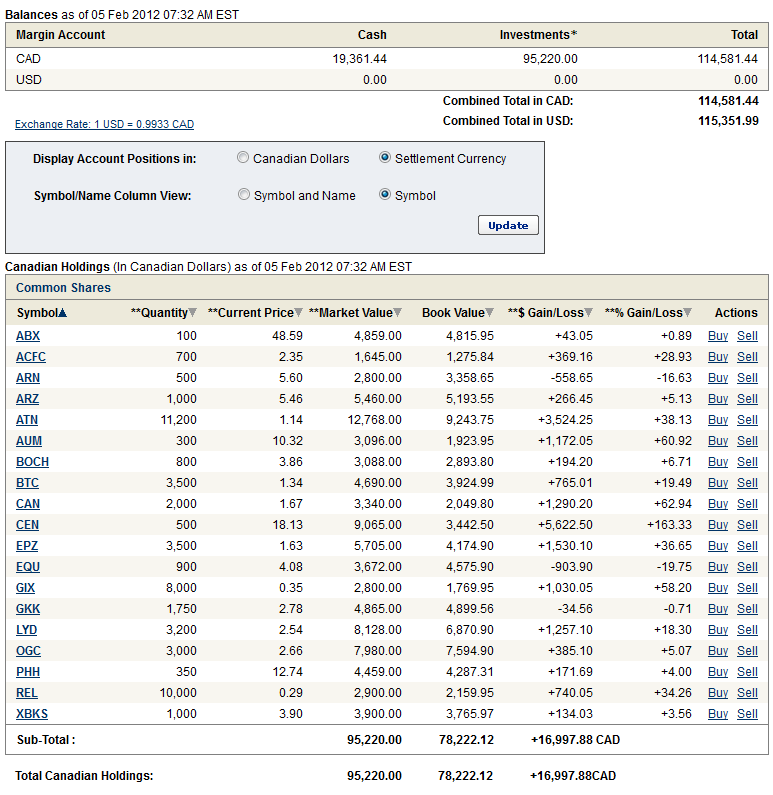
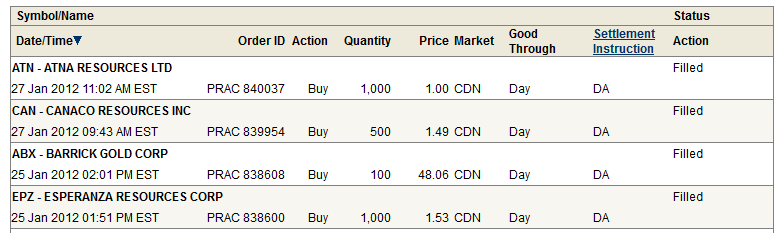
The moment I read the news I bought a position in Barrick Gold, and I added to my positions in Esperanza Resources and Golden Minerals (though I neglected to make the AUM trade in my practice account).  The next day I added to OceanaGold, and thta was followed by additions to Atna and Canaco the day after that.

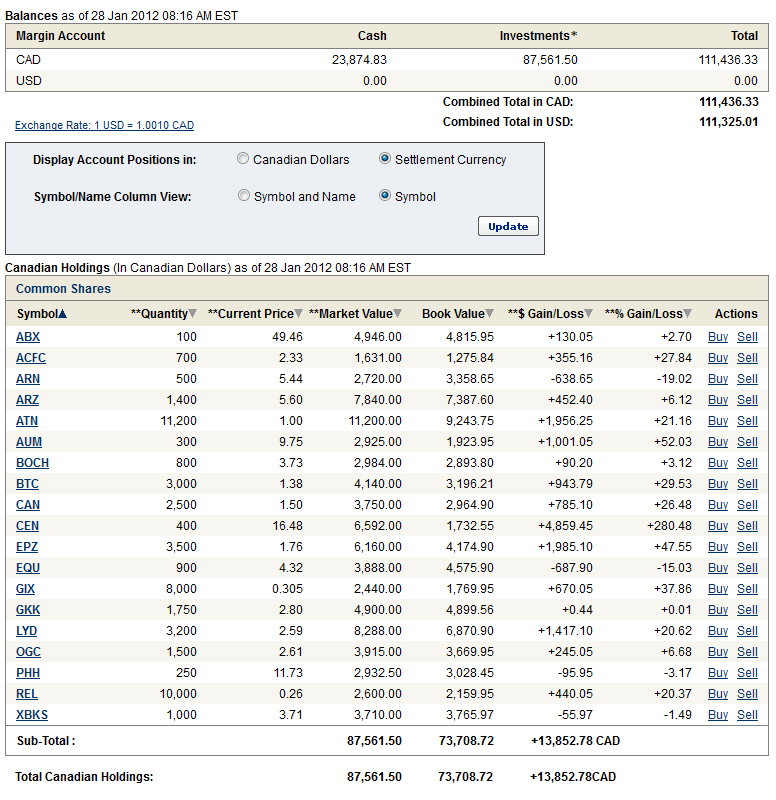
In my practice account:

And in my actual account:

You do the work so that you have the confidence to act.  You put in the time learning and working through why so that when an opportunity makes its brief appearance, when Bernanke comes out and says “yeah we aren’t going to raise rates for a long time” you can recognize it for what it is and say “all right, I’m in” and you know what you have to do.

Had I not been stepping through the thesis of why gold and gold stocks remain a solid investment, I likely would not have had the conviction to buy into the rally.  At worst, I would have sold into the rally, because if you really don’t know why you are investing in something you tend to take the first blip after a long period of blah as a “finally I can get out” moment.  As it is, with the Fed putting interest rates on hold for another couple years, and with their actions maybe even foreshadowing a true QE event in Europe, I feel quite confident that I am positioned well for that fall out.

Speaking of Canaco Resources…

I bought Canaco Resources at the end of the year at about $1.10 as part of my “tax loss buying binge”.  A couple of things happened with Canaco this week.

First, the stock went up.

Second, the company updated us on its activities in Tanzania:

  • Expect a resource estimate by the end of March
  • Expect a preliminary economic assessment by the end of the third quarter
  • Expect further metallurgical testing results at some point

Third, Canaccord Capital came up with an updated price target, and more importantly helped give us a glimpse at what to expect from the upcoming resource estimate (hat tip to howestreetbull who posted this on Investors Hub).

  • Canaco has approved a US$35-40 million 2012 exploration budget, and is currently drilling 10,000 metres per month at Handeni with nine diamond drill rigs and one RC rig.
  •  Six of the drill rigs are focused on delineating the Magambazi resource in preparation for the initial resources estimate. Two diamond drill rigs are focused on the Kuta and the Magambazi North Extension targets. The remaining diamond drill rig is operating on the Majiri target, where previous surface sampling and RC drilling indicate a gold anomaly. The RC drill rig iscurrently operating on the Bahati target to test preliminary regional targets.
  • We are expecting an initial resource and metallurgical test results in Q1/12, and a PEA in Q3/12. We are expecting an initial resource of 2.3 million ounces of gold at a grade of 3+ g/t gold. Previous metallurgical testing indicates recoveries of 90+% using a conventional CIL process.

Valuation: with US$110 million in cash, we believe the company is in a strong position to continue to derisk and advance the Handeni project. Our peak gold price estimate of NAVPS (10%, US$1,750/oz) remains unchanged at $7.50. We continue to value Canaco based on a 0.65x multiple to our peakgold price estimate of NAVPS.

At the current price of $1.50 Canaco trades at a market capitalization of $300M.  Subtracting the current cash balance of $115M, the enterprise value of the company is a little less than $200M.  If the deposit does indeed contain 2.3M oz of gold, the valuation being given for those ounces is about $80 per.

This is a 3 g/t open pittable deposit that looks to be 90% recoverable with a straightforward metallurgical process sheet.  In my opinion (and apparently Canaccord’s as well) those ounces should be worth more than $60/oz.

To throw out a comparison point from a recent PEA, Prodigy Gold had a PEA done for its Magino gold property last March.  The PEA assumed a CIL recovery process, a 9 year mine life, producing gold from an open pit at a grade of 1.2g/t for 9 years to give a total mine of life production of 1,585,000 oz of gold.  The after tax NPV5 of the project was estimated at $259M at $1000/oz gold.   That works out to a value of $160/oz.

Albeit there may be better comparisons out there, but this one surely suggests that Canaco is undervalued.  Canaco’s Magambazi project is much higher grade than Prodigy’s (3g/t versus 1g/t).  The location is Africa, versus Canada for Prodigy, which probably suggests a bit of a discount against Canaco but not enough to make me change my opinion.  And while the Magambazi strip is as yest unknown,  the Magambazi deposit appears to be around a hill top, which should lead to a reasonable number (the strip for Prodigy’s Magino is 3.3).

Finally, the last bit of news was that Brent Cook came out with the following plug about Canaco:

“The funds were just jumping in on this thing – and they all bailed out as well – the stock got down to $1.20. During this time period they’ve been drilling and drilling and drilling, and the results continue to show me that they’ve got what I think is going to be a legitimate, decent size, decent grade, open-pittable deposit in Tanzania,” Cook says. “So we’re buying this stock at $1.30 with $115 million in the bank, and a $41-million exploration program. That, to me, seems like a good buy.”

Yup.

When the gold price broke out on Wednesday, Canaco was the first stock I added to.

and speaking of gold…

I came across this interesting piece of information regarding the appetite of the Chinese for gold.   This may be old news to some but I think it is still worth reporting.

The People’s Bank of China  research director Zhang Jianhua was cited as saying Monday in the central bank publication Financial News that gold purchases should be ramped up when prices drop, although he gave no indication of what proportion of the nation’s $3.2 trillion forex reserve should be allocated to investments in gold.

Apparently, Jianhua called gold the only safe haven left and said that:

“the Chinese government needs to further optimize China’s foreign exchange asset portfolio and seek relatively low entry points to buy gold assets…no asset is safe now.  The only choice to hedge risks is to hold hard currency – gold”.

High House Prices

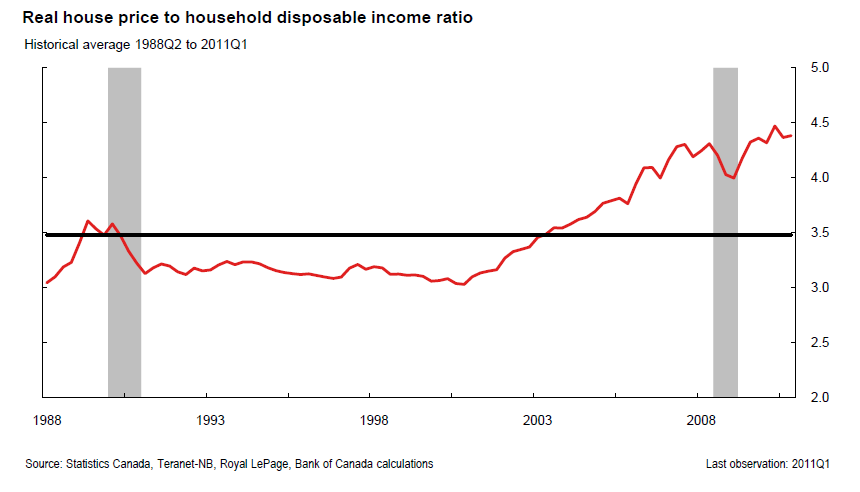
I’ve been doing some research on house prices in Canada and in particular in my city, Calgary.  I plan to do a separate post on my findings shortly, but for the moment I just want to throw up a couple teaser graphs that gave me pause for thought.

The chart is taken from a speech given by Mark Carney to a Vancouver audience last June.  The methodology used is the ratio of the nationwide median home price to the median household disposable income. A ratio of greater than 3 has traditionally been seen as unaffordable.

It makes you think.

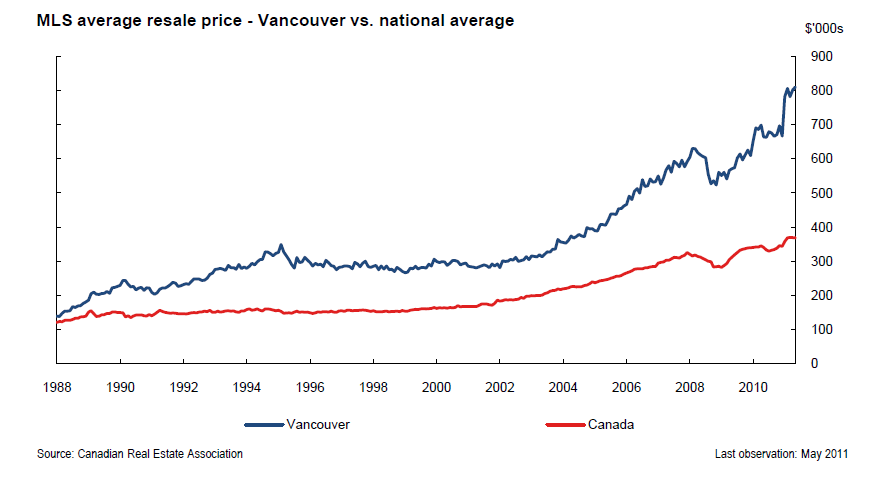
One other chart from the same report.  Below is the average house price in Vancouver:

Its either a heck of a bull market or a bubble.  To say it another way, I don’t know about house prices, but when a stock goes parabolic you typically know how it is going to end.

Anyways, more on this later.

Community Bankers Trust

It was a good week for Community Bankers Trust (BTC).

Earnings will come out for the company on Tuesday.  Hopefully the company will put together another profitable quarter.

The BTC story

I bought BTC as a turnaround story.  Community Bankers Trust is a bank that has been trying to reincarnate itself after the first incarnation came close to an early death. My observation is that they have been successfully navigating this resurrection, and with the recent turn in profitability (and a helpful turn in the economy) the bank is on its way to realizing its earnings potential.

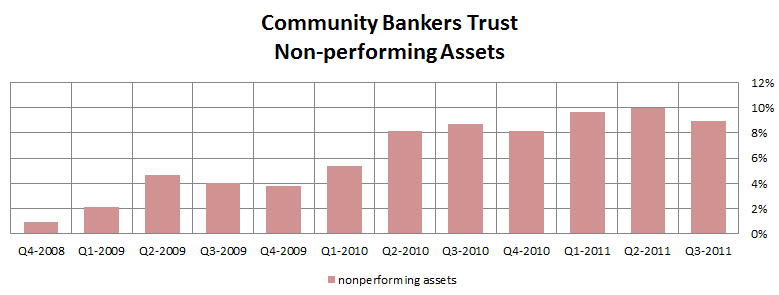
The bank was hit hard by the recession in 2009.  The company saw nonperforming loans skyrocket from 2% of total loans in the first quarter of 2009 to 10% of total loans in the second quarter of 2011.  Yet there have been signs that the efforts the company has been making to turn itself around are working, culminating with a profitable quarter in Q3.

Let’s hope they can keep that momentum.

How did they get to here?

The original strategy of the bank was, as far as I can tell at least, to simply buy other banks and get bigger.  Witness, the name of the original company was called Community Bankers Acquisition Corporation  (CBAC), so they weren’t exactly being subtle.  Along with the acquisition strategy, the bank seemed to have a “worry about the profitability later” strategy, which may have worked ok when the economy was growing but that fell flat when the economy didn’t in 2008.

As best as I can discern the acquisition effort was spearheaded by Gary Simanson. He headed up the original company CBAC, and then moved into a position of Strategic Vice President, a position I don’t think I’ve ever heard of with any other company. According to this article, Simanson was responsible for subsequent acquisitions.

In truth, the timing was what killed the acquisition strategy.  To quickly step through the timeline, in May 2008 the company began its journey by acquiring two local Virginia banks, TransCommunity Financial Corporation, , and BOE Financial Services of Virginia, Inc.  In November the bank moved ahead and acquired The Community Bank, which was a little bank in Georgia.  Finally in January 2009 they acquired Suburban Federal Savings Bank, Crofton, Maryland.

So you had 4 bank acquisitions in less than a year happening at the time of a 100 year financial tsunami.  How do you think things turned out?

Change in Direction

By 2010 Simanson had left the company and the direction of the company was changed to the more pragmatic “we need to get profitable before we go belly up” strategy.

This was described pretty bluntly in the 2010 second quarter report. CEO Gary Longest said at the time:

Our strategy has shifted from that of an aggressive acquisition platform, to one that meets the banking needs of the communities we serve, while providing sustainable returns to our stockholders. To this end, we are taking the necessary steps to return immediately to profitability. We are actively analyzing our market base to assess the contributions of all branches to our franchise value and will take the appropriate actions in the third quarter of this year. Additionally, we will make aggressive expense reductions, and will look to restructure and strengthen the balance sheet. We are confident that the analysis of these potential critical paths and the resulting execution of these initiatives will lead us back to profitability quickly.” “Our goal is an immediate return to consistent quarterly profits. To accomplish this, we have no alternative as a Company but to make clear and intelligent decisions in the next 60 days, no matter how difficult, to accomplish that goal as soon as possible. That is our full focus.”

 In a somewhat odd twist to which I’m sure there is a good story, Longest himself was gone only a couple months later. Nevertheless the interim CEO and soon to be permanent CEO Rex L. Smith took up the reins and has carried out the strategy quite well given the circumstances.

 Where are they now?

I already mentioned that the company had its first profitable quarter in a long time last quarter.  I don’t believe this was a one time fluke.  It looks to me like its the culmination of a number of initiatives put forward by the bank that have been geared towards making the bank more profitable.

The company has made an effort to lower the cost of its deposit base.  Time deposits, which are expensive high interest bearing deposits, have decreased from 73% to 67% of total deposits since the end of 2009.  As well, the cost of the time deposits has come down from 2.9% in 2009 to 1.6% in the third quarter.

The effect has been a steadily rising net interest margin (NIM) since the strategic direction change in 2010.

(note that this graph is a simplified version of NIM calculated as a percentage of all assets rather than the more common formulation of interest bearing assets)

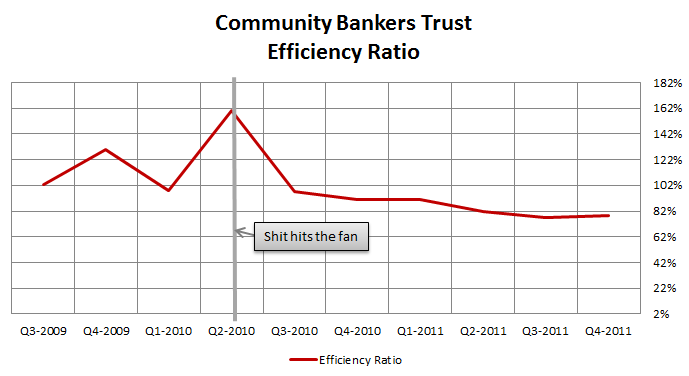
The company also undertook efforts to reduce expenses.  The most common way of illustrating the day to day expenses of a bank is through something called the Efficiency ratio.  The Efficiency ratio is simply the ratio of the total non-interest expenses at the bank (so the salaries, building costs, lawyer fees, pretty much everything except the actual cost of borrowing money) to the  net interest margin (so the amount of interest made minus the amount of interest paid).  The reason that you look at the Efficiency ratio is because it ex’s out growth, since growth should occur for both NIM and expenses in concert with one another.

The Effiency ratio of BTC has been falling consistently.

What’s it worth?

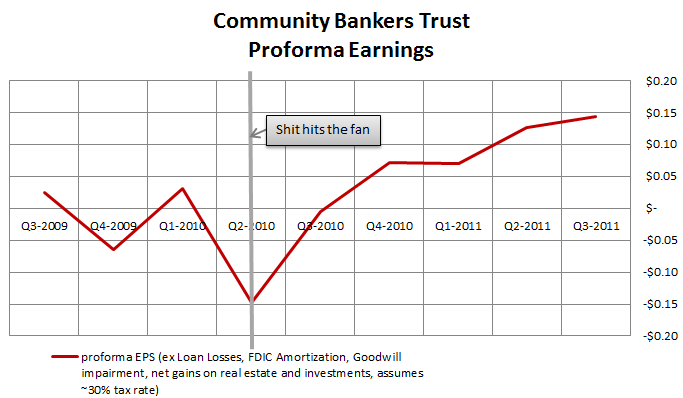
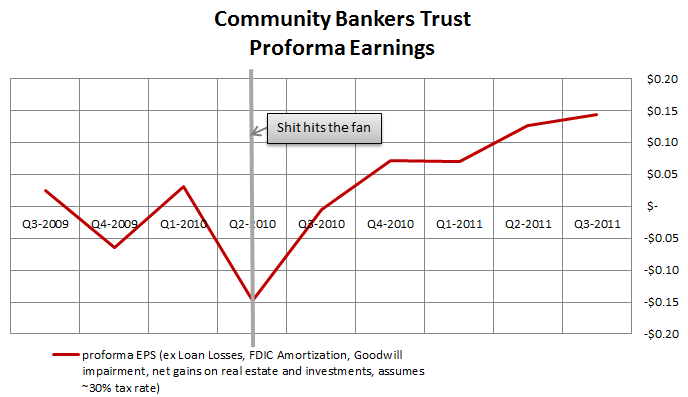
To get an idea of what the bank might be worth if it continues to pull itself together, I put together a proforma earnings estimate.  I stripped out all the provision for loan losses, the FDIC intangibles (from their earlier acquisitions) that the bank is required to amortize, as well as losses on real estate and gains of the sale of securities.  So basically I looked at the banking skeleton that is BTC.  Here is what I found:

What this clearly demonstrates is that if get rid of all the scabs, there is quite a profitable little enterprise here.

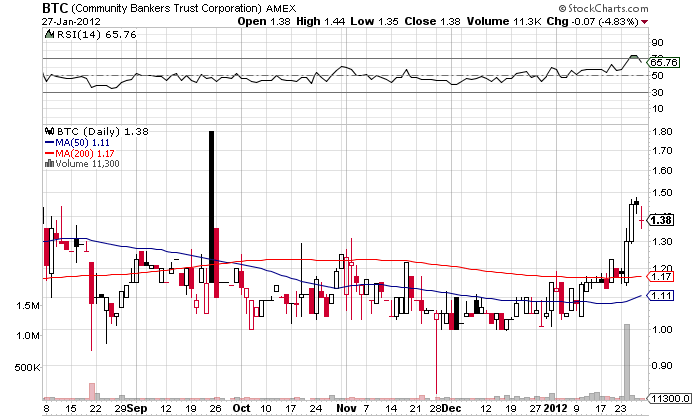
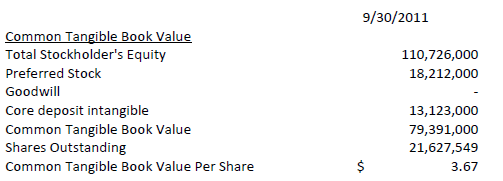
Meanwhile, the bank sports a tangible book value that is much greater than the current share price ($1.40 after last weeks run up):

What is left to be done?

The story that still needs to play itself out is the healing process.  The really big negative for the bank is that it still has an extremely elevated portfolio of non-performing loans.  There are signs that this is abating, and in truth part of the bet here is the same one that you make on any regional bank: the US economy is turning the corner, the Fed is not going to allow it to fall into another recession, and so the worst of the loan defaults are behind us.

But just to get an idea of the risk here, typically you wouldn’t want a bank to have non-performing loans in excess of a couple of percent.  Many of the best banks I’ve looked at have nonperforming loans of well less than 1%.  BTC, onthe other hand…

There are tentative signs that the peak has passed, but it will take a few quarters before we know for sure that further write-downs are not coming.

Earnings on Tuesday will give us a lot of insight into the direction of the trends.  I’ll be looking closely at nonperforming assets and the 30-89 day deliquents (which are an early warning of the soon-to-be not performing.  I also will be hoping to see some decent earnings.