Skip to content

Posts from the ‘Combimatrix (CMBX)’ Category

Week 324: Underlying Conditions

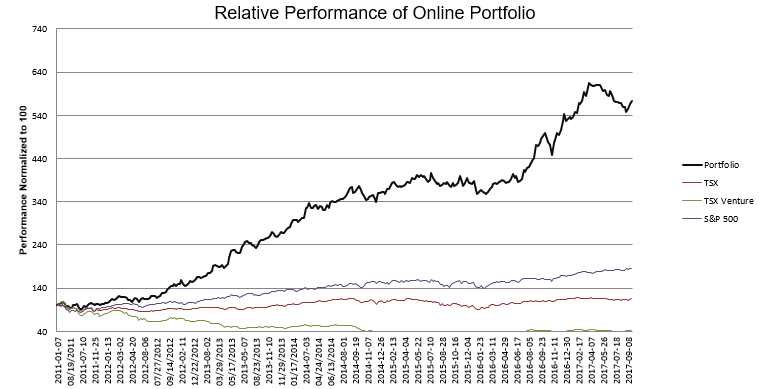
Portfolio Performance

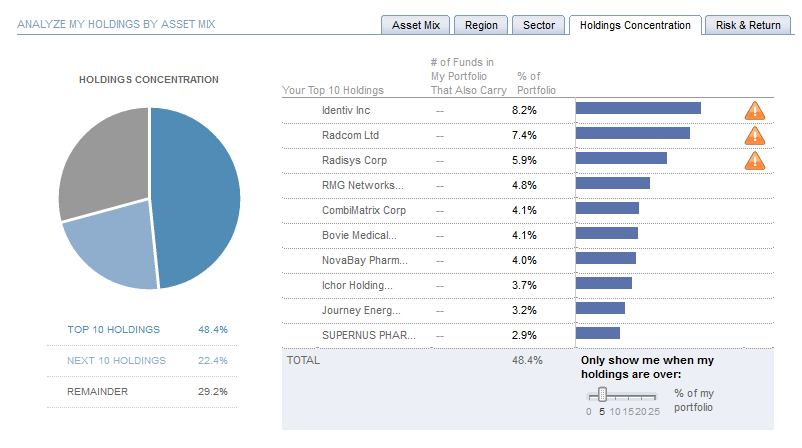
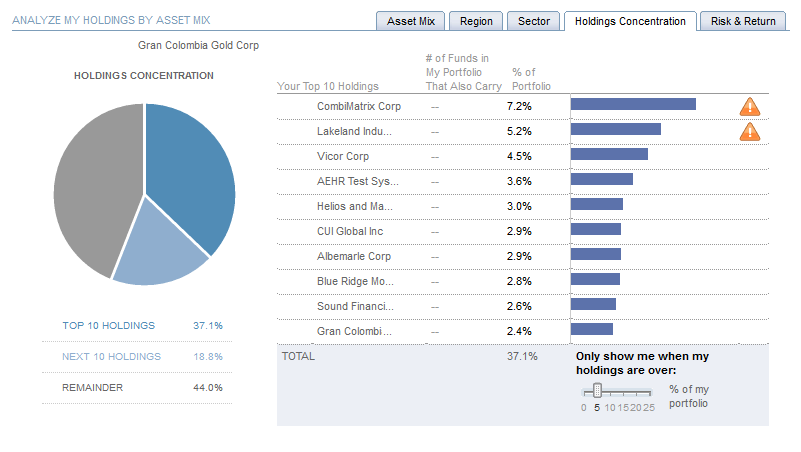
Top 10 Holdings
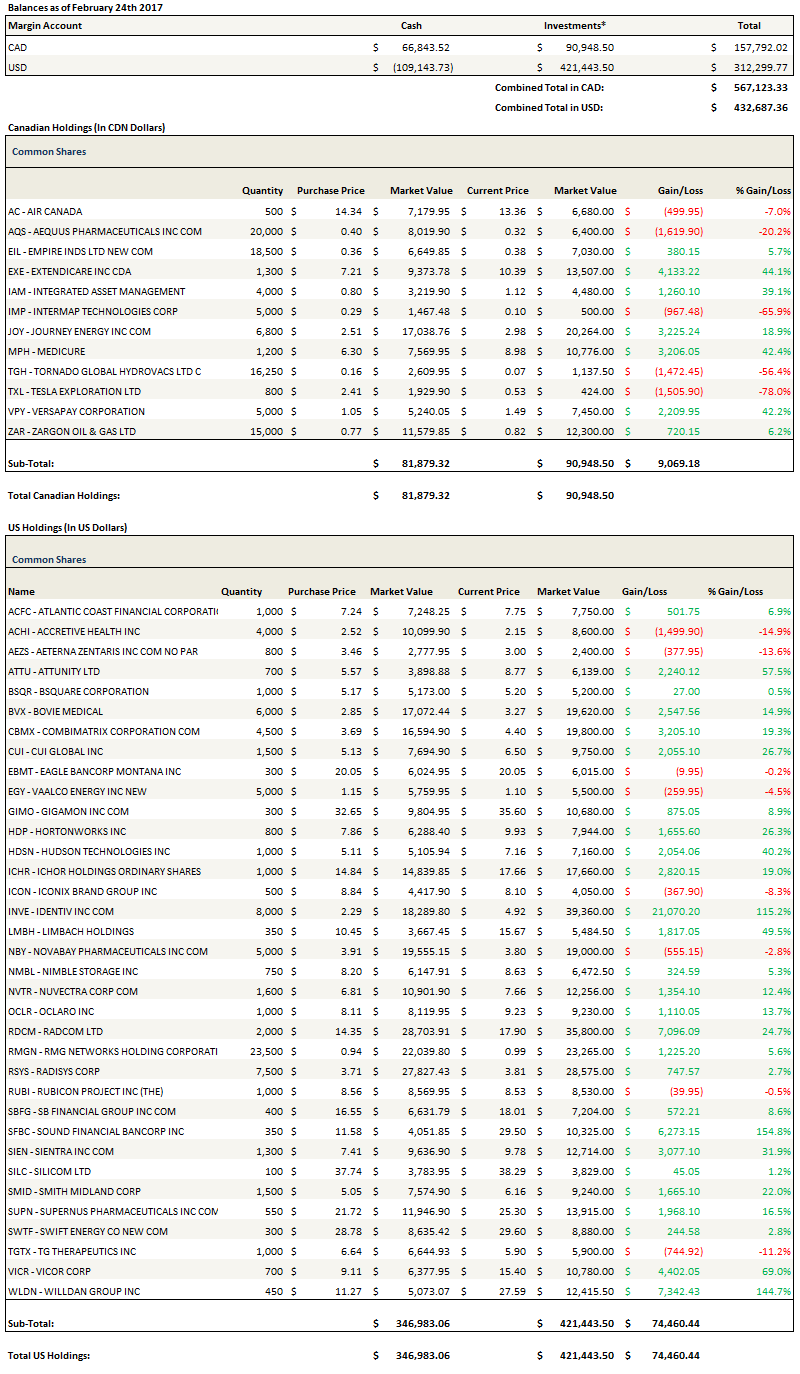
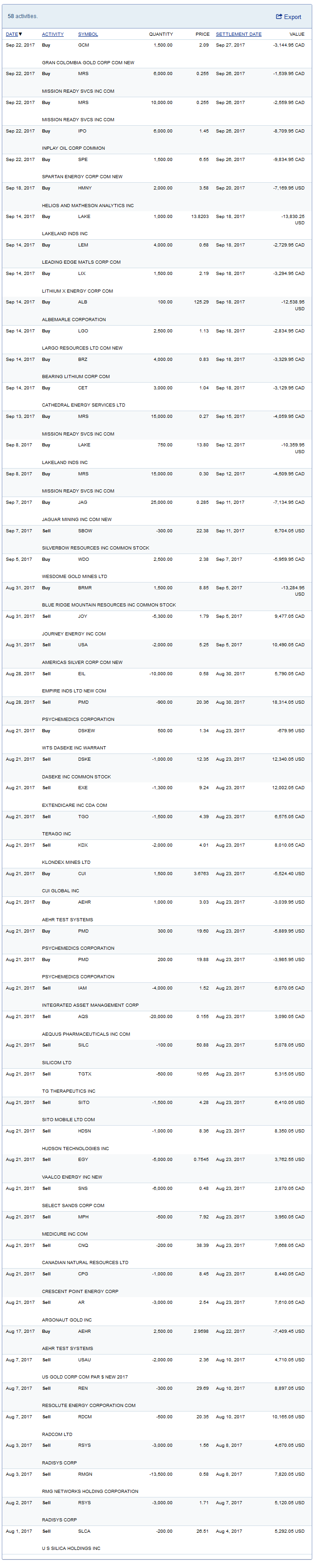
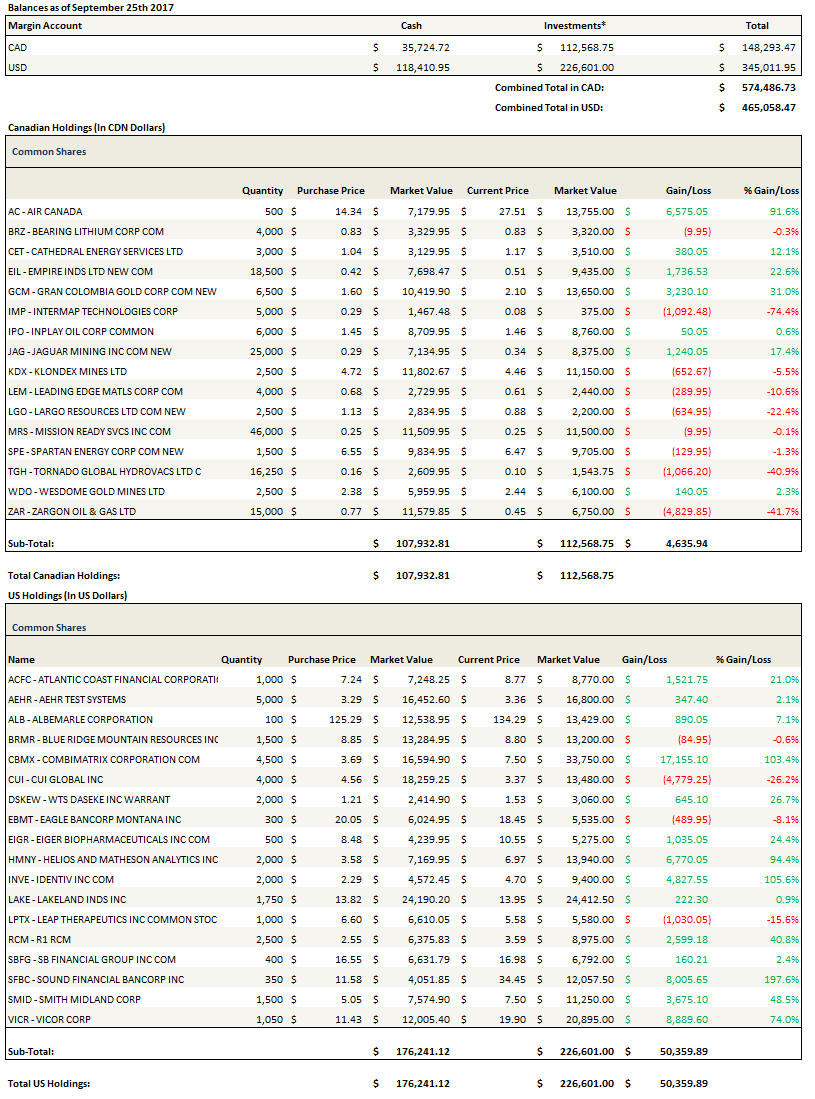
See the end of the post for my full portfolio breakdown and the last four weeks of trades

Thoughts and Review

The late spring and early summer months were a trying time for my investments.

I haven’t written up my portfolio in a while.  Part of that was due to the summer, being away and not having the time to do my usual work.  But I also went through a 3 month period, from mid-May to mid-August, where I lost money and struggled with why. That dampened my spirits for putting pen to paper.

Losing money is hard enough, but it is harder when you have been generally right in your decisions.   I try, like the namesake of this blog, to analyze underlying conditions and let that determine my general bent on sectors and the market.  Where there is a bull market I like to be very long those stocks, and when there is a bear market I like to pull back significantly, retreat into cash, and go short where I can.

Throughout the spring and summer I found myself in a general bull market in US stocks, one that had made me a lot of money throughout the winter.  I was, quite rightly, very long US stocks.  The market kept going up, albeit in fits and starts.  But I began to lose money.  Now I didn’t lose money quickly.  In retrospect that may have been a better route as at least I would have been forced to discover my error.  But instead my losses slowly accumulated over the months of May and June.

What’s more, I did not see noticeably poor performance from any of the stocks I owned.  Sure my names weren’t breaking out to new highs, but my core positions at the time, the likes of Radcom, Silicom, Sientra, Combimatrix, Identiv and Vicor were not by any means breaking down (I leave out Radisys as it is a separate discussion).

It wasn’t until my portfolio was down about 6%, in the middle of June, that I woke up to the fact that something was wrong.  I scoured my list of stocks but found nothing worrisome with the names I held.  I knew that the Canadian dollar had been rising so that must have been having some effect but I had never really quantified my currency exposure.  I had always thought of currency as an afterthought, something that balances itself out in the end.

As I crunched through the numbers on my currency losses, I realized that while in the very long run my theory that currency balances itself out might be correct, in the short run a currency can make or break you.  The Canadian dollar was in the midst of unwinding 2 years of gains in two months.  Measuring my losses from the portfolio top in mid-May, I was 6% down, of which 5% came from currency.

It is here that I made my first big mistake. I was armed with the information I needed to act decisively.  I knew my problem: stocks were in a bull market, but clearly the US dollar was not, and I was, rather unwittingly, very long the US dollar.

So what did I do?  Something that, in retrospect, was absurd.  I made only a token effort towards the problem, taking only the excess US dollar cash in my portfolio and putting it into a Canadian currency ETF.  This effort, while directionally correct,  impacted about 15% of my US dollar holdings and thus did nothing to alleviate the problem.  I followed this up with an even more inexplicable move, even to me looking back on it now.  I put on index shorts to hedge my long positions.

Here I was with losses proving that I was wrong.  I had determined the source of those losses.  And what did I do?  I did something that was likely only to exacerbate them.

It really goes to show how wrong one’s logic can be when you are trying to cling to what you had. The reality, I think, is I didn’t want to do what was right.  What was right was to sell my US stocks.  Not because my US stocks were going down. They were not.  Not because the theses behind these positions was not sound.  They were.  But because I was losing money on those US stocks.

Unfortunately I could not wrap my head around this.  All I saw were good stocks with strong catalysts.  How could I sell my positions?  It’s a bull market!

I spent most of June compounding my problem with band-aid solutions that only dug me in deeper. I fell back on oil stocks as a Canadian dollar hedge.  This had saved me the last few times; in the past the Canadian dollar had risen because oil had risen, so I had gone long oil stocks and my losses on currency were more than compensated with my gains on E&Ps.  I was saved a lesson and left none the wiser to how impactful currency could be.

But this time around the currency was not rising because of oil.  My appraisal that I should be long oil stocks was based on the flawed logic that what works in the past must work again regardless of conditions.  That is rarely the case.  In June and July I bought and lost money on companies like Resolute Energy, US Silica and Select Sands, all the time continuing to hold onto US dollars and lose on them.

I also went long gold stocks on the similar thesis that if the US dollar is weak then one should be long gold.  In this case I was at least partially correct.  That is the right thing to do given conditions. But my conviction was misplaced. Rather than being long gold stocks because I thought gold stocks would go up, I was long gold stocks to hedge my US dollar positions.  You cannot think clearly about a position when you are in it for the wrong reasons even if a right reason to be in it exists.  Thus it was that in late July I actually sold a number of my gold stock positions. It was only a couple weeks later, finally being of a clear head (for reasons I will get to) that I bought them all back, for the right reasons this time, but unfortunately at somewhat higher prices.

As I say it was at the beginning of August that I finally was struck by what I must do.  I’m not sure what led me to the conclusion but I think an element of deep disgust played a part.  I had just seen my biggest position, Combimatrix, get taken over for a significant premium. My portfolio took a big jump, which took down my losses from my mid-May peak from -10% (over 8% due to currency!) to -7.5%.  But then in the ensuing days I saw those gains begin to disappear.  Part of this happened because Radisys laid an egg in their quarterly results, but part of it was just a continuation of more of the same.  Currency losses, losses on index short hedges, some losses on my remaining oil stocks, and the ups and downs of the rest of my portfolio.

I simply could not handle the thought of my portfolio going back to where it was before Combimatrix had been acquired. I was sick of losing money on currency.  And I was reminded by the notion that you never see conditions clearly when you are staked too far to one side.  So I sold.

When I say I sold, I really mean I sold.  I took my retirement account to 90% cash.  I took my investment account to 75% cash.  There were only a couple of positions I left untouched.  And I took the dollars I received back to Canadian dollars.

I continued to struggle through much of August, but those struggles took on a new bent.  I was no longer dealing with portfolio fluctuations of 1%.  The amounts were measured at a mere fraction of that.   This breathing room afforded me by not losing money began to allow me to look elsewhere for ideas.

I don’t know if there is an old saying that ‘you can’t start making money until you stop losing it’, but if there isn’t there should be. When you are losing money, the first thing you need to do is to stop losing it.  Only then can you take a step back and appraise the situation with some objectivity.  Only then can you recover the mental energy, which until that time you had been expending justifying losses and coping with frustration, and put it towards the productive endeavor of finding a new idea.

In August, as my portfolio fluctuated only to a small degree but still with a slight downward slant, I mentally recuperated. And slowly new ideas started to come to me.  It became clear that I was right about gold, and in particular about very cheap gold stocks like Grand Colombia and Jaguar Mining, so I went long these names and others.  I realized that being short the US market was a fools errand, and closed out each and every one of those positions.  I saw that maybe this is the start of another commodities bull run, and began to look for metals and mining stocks that I could take advantage of.  I found stocks like Aehr Test Systems and Lakeland Industries, and took the time to renew my conviction in existing names like Air Canada, Vicor, Empire Industries and CUI Global.

Since September it has started to come together.  I saw the China news on electric vehicles and piled into related names.  Not all have been winners; while I have won so far with Albemarle, Volvo, Bearing Lithium and Almonty Industries, I have been flat on Leading Edge Materials and lost on my (recently sold) Lithium X and Largo Resources positions.  Overall the basket has led to gains.  I’ve also been investigating some other ways of benefiting from the EV shift.  It looks like rare earth elements and graphite might be two of the best ways to play the idea, and I have added to my position in Leading Edge Materials (which has a hidden asset by way of a REE deposit at the level of feasibility study) to this end.  Likewise nickel, which is not often talked about with electric vehicles and has been pummeled by high stock piles, has much to gain from electric vehicles and could see a resurgence over the next couple of years.  I’m looking closely at Sherritt for nickel exposure and took a small position there so far.

I saw that oil fundamentals were improving and got back into a few oil names, albeit only tentatively at first.  Such is the case that once you are burned on a trade, as I was when I incorrectly got into oil stocks in June and July for the wrong reasons, you are hesitant to return even when the right reasons present themselves.  Thus it has taken me a while, but over the last couple of weeks I have added positions in Canadian service companies Cathedral Energy and Essential Energy, and E&Ps Gear Energy, InPlay Oil and even a small position in my old favorite Bellatrix.  A company called Yangarra Resources has had success in a new lower zone of the Cardium, and I see InPlay and Bellatrix as potential beneficiaries.  These newer names go along with Blue Ridge Mountain Resources, Silverbow, and Zargon, all of which I held through the first half slump in oil.

I even saw the Canadian dollar putting in the top, and converted back some currency to US dollars a couple of weeks ago.

Most importantly, got back to my bread and butter.  Finding under the radar fliers with big risk but even bigger reward.  I have always said it is the 5-bagger that makes my returns.  If I don’t get them, then I am an average investor at best.

I found Mission Ready Services, which hasn’t worked yet but I think is worth waiting for.  I found some other Canadian names that I think have real upside if things play out right (in addition to the above mentioned metals an oil names, I added a position in Imaflex). Most profitably, I was introduced to Helios and Matheson after reading an article from Mark Gomes.

I don’t completely understand the reason why, but good things do not come to you when you are mired in a mess of doing things that are wrong.  It is only when you stop doing what is wrong that other options, some of which may be right, will begin to present themselves.

I also don’t know which of what I am doing now will turn out to be right, and what will turn out to be wrong.  I will monitor all my positions closely and try to keep a tighter leash than I have been.  What I do know is that I will not continue to be wrong in the same way I was through the months of May to August.  And that is a big step in the right direction right there.

Portfolio Composition

Click here for the last eight (!!) weeks of trades.  Note that in the process of writing this update I realized I do not have a position in Gear Energy or Essential Energy in the practice portfolio.  I have owned Gear for over a month and Essential for a few weeks.  This happens from time to time.  I miss adding a stock I talk about and own in my real portfolio.  I added them Monday but they are not reflected below.

Note as well that I can’t convert currency in the practice account.  I know I could use FXC but in the past I haven’t, I have just let the currency effects have their way with the practice portfolio. Thus you won’t see the currency conversions that I talked about making in my actual portfolio.  I may change this strategy the next time the Canadian dollar looks bottomy but as I am inclined to be long US dollars at this point, I’m leaving my allocations where they are for now.
Week 294: It doesn’t matter how you get there

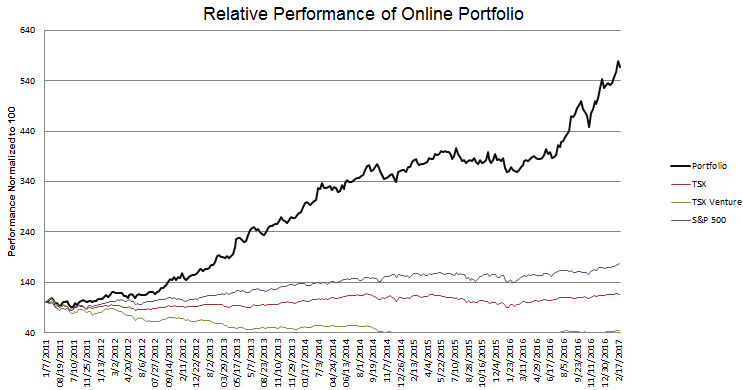
Portfolio Performance

week-294-yoyperformance

week-294-performance


Top 10 Holdings

week-294-holding-concentration

See the end of the post for my full portfolio breakdown and the last four weeks of trades

Thoughts and Review

It’s a seminal moment for the blog!  For the first time in what seems like forever my largest position is something other than Radcom.  Thanks to more than doubling in price in the last four months (and even after pulling back from $6 to $5), Identiv now holds that honor.

At the beginning of November I wrote the following about Identiv:

I tweeted a couple of times this morning that I don’t think this stock makes sense at a $20 million market cap… The company has a $55 million trailing twelve month revenue run rate, they are showing growth, they are EBITDA positive now and it’s not an insignificant amount of EBITDA.  That feels like it should warrant at least 1x sales.

We are already at a $55 million market capitalization but with momentum at the company’s back I haven’t sold a share.

A second position, RMG Networks, has also ran up the ladder, and now sits as my fourth largest position at a little less than 5%.

I wrote this about RMG Networks when I first took the position in late June:

With the focus on the new verticals and improve productivity of the sale force new opportunities in pipeline are up over 40%.  And here is where we start to see an inkling that the strategic shift is bearing fruit.  In the sales pipeline, Michelsen said that the number of deals $100,000 or greater has increased by 50% in the last year while the number of $1 million deals have tripled…My hope is that these early signs of sales improvements lead to an uptick in revenues in short order.

We are starting to see that pipeline bear fruit.  The entire move has come in the last two weeks.  The stock has moved from 70 cents to a dollar on news that they had secured contracts in the healthcare vertical and converted one of their previously announced trials into revenue in the supply chain vertical.

Finally, a third company, Combimatrix, which I wrote about earlier this week, is beginning to run and take a more significant position in my portfolio after releasing solid fourth quarter results.

So that’s all great, but the reason I mention these three examples is because they illustrate how bad I am at predicting how things will play out.   In the second half of last year had you asked me what my portfolio would move on I would have replied it will rise and fall on the fortunes of Radcom and Radisys.

Flash forward a few months and my portfolio has moved significantly higher and Radcom and Radisys have done nothing.  Radisys has actually went backwards to the tune of 20%.  Whodathunkit.

This is why I carry so many positions.   A. I’m a terrible timer.  The events that I think are imminent take months or years to play out, while the events that I think are distant have a habit of manifesting much faster.

Second, my favorite ideas are often not my best one’s.  I have no idea why this is.  If I did I would change my favorite ideas.  But it’s uncanny.  I’ll sit on a thesis like Radisys, work it into the ground to understand it in depth, and then along will come a Health Insurance Innovations, which I will buy on a bare thesis (in this case that the Affordable Health Act will be repealed and this is going to be good for HIIQ) and when the dust settles I’ll have more gains from the latter than the former.  Its kinda crazy.

I guess as long as you are moving in the right direction it doesn’t really matter how you get there.

Portfolio Changes – Adding Silicom

I added a couple of new positions this month.  The Rubicon Project and Silicom.

Silicom got hit after releasing what I thought was a pretty good fourth quarter.  The company traded down to $35 from $39 pre-earnings.  I’ll try to get a more detailed write up out on Silicom at some point, but the basic points are:

  • This is a $250 million market capitalization company with $36 million of cash and no debt
  • It’s trading at a little over 2x revenue and just guided 15% growth in the first quarter and double digit growth for the year
  • Their past seven year compounded annual growth rate is 26% and growth was 21% in 2016.

Silicom designs a wide range (over 300 SKUs) of networking, cybersecurity, telecom and storage products. These are generally board level and appliance level hardware solutions.

They expect their security vertical will grow double digits, their cloud vertical will “grow significantly” and that a contribution from SDWAN will kick-in in 2017 and is expected to become a “major growth area”.  They said that over the intermediate term they see a larger opportunity in their pipeline than they have have in the past.

Already the stock has rebounded on news of a significant contract for encryption cards that will ramp in 2017 and reach $8 million in sales in 2018.

I’ll talk more about Rubicon Project in an upcoming post.

Apart from these new positions I did a bit of tweaking of my positions, adding a little to Nuvectra and Combimatrix, reducing my position in Bsquare and selling out of DSP Group.  I also have added to my Vicor position in the last couple of days (subsequent to the update end so not reflected in this update).

Taking advantage of Bovie Medical Weakness

I also added significantly to my position in Bovie Medical.  The stock sold off on news that their pilot project with Hologics for selling the J-Plasma device would not be extended.    As I tweeted at the time, I didn’t think this was as big of news as the market did.

To expand on my reasoning, Hologics has a particular business model they follow for their instrumentation and disposable business, of which J-Plasma would have been a part (from 10-Q):

we provide our instrumentation (for example, the ThinPrep Processor, ThinPrep Imaging System, Panther and Tigris) and certain other hardware to customers without requiring them to purchase the equipment or enter into a lease. Instead, we recover the cost of providing the instrumentation and equipment in the amount we charge for our diagnostic tests and assays and other disposables.

So they go “full razor blade”.  Bovie on the other hand, generates significant sales from generators.   The average selling price (ASP) for a generator is much higher than hand piece so Bovie generates a significant slice of their revenue from it.  From the 2015 fourth quarter conference call :

I guess when you think about it, the generator ASP is north of $20,000, the hand piece ASP is $375

So the models aren’t aligned.

Second, Hologic’s Gyn Surgical business segment (consisting of the NovaSure Endometrial Ablation System and our MyoSure Hysteroscopic Tissue Removal System) is a $400 million business so J-Plasma is microscopic for them.  They may not have been inclined to bend their model for Bovie.

Also worth noting is that Hologics wasn’t even mentioned in the Bovie 10-Q whereas the agreement with Arteriocyte that was mentioned favorably.

Finally the language used on the third quarter conference call around Hologics wasn’t exactly definitive:

Well, as you know, the sales channel partnership with Hologic,right now,is in a pilot phase.  So we wouldn’t be in a position, if we were to disclose the economic relationship, until that’s a permanent agreement.  So the pilot portion of our partnership will go until the end of February.  So you could look at some period after that before we can announce a permanent relationship and we’ll decide at that point in time if we’re going to elaborate on the economics of the relationship.

The agreement with Hologics hadn’t generated material revenue so there is no hit to the bottom line.  And in a separate press release (which oddly was released on the same day as the Hologics information but didn’t get on their website for a couple days after), Bovie reiterated guidance for 2017, including “accelerated growth for J-Plasma”.

I think the stock sold off in the following couple of days because its small, illiquid and under followed, not because this agreement was meaningful to the company.  So I bought.

Portfolio Composition

Click here for the last four weeks of trades.

week-294

Combimatrix Fourth Quarter Update: I don’t think the market has this one right

When you are speculating in small cap stocks that have only 3rd or 4th tier analyst coverage (if that), it’s always an adventure when an earnings report comes out.

The market reaction is not always immediate, nor is the first one always correct.  Short term considerations; a heavy short interest, a big holder who wants to use the volume to reduce an overweight position, or a long or short pump by a pennystock newsletter, can overwhelm the otherwise expected response.

Unlike large market capitalization companies that generally are well understood and where the news is quickly reflected in the stock price, the sort of tiny micro-caps I play in have responses to news that can be erratic for days or weeks after a news event.

In the face of noisy feedback, you just have to trust in your work.

I first wrote about Combimatrix a little under a month ago.  The company performs a number of diagnostic tests centered around reproductive health.  Combimatrix has been around a long time and only recently has started to gain traction on insurance coverage with their tests, which in turn has begun to translate into earnings.  The reported results last Tuesday.

My thesis centers around the company’s claim that they will be cash flow positive by the fourth quarter of this year. I just don’t think the stock is anywhere near pricing in that possibility.

Combimatrix has a history of burning through cash.  The stock trades at a level that says nothing has changed.  Even after the recent run-up (when I first looked at Combimatrix it was a $3 stock versus the current price over $4) the stock trades at 0.5x revenue.  If they achieve their goal of becoming cash flow positive they should trade at multiples of that.

The fourth quarter results moved them closer to the goal.  Revenues were up 32% year over year and 10% sequentially.  EBITDA continued its upward march toward the black.  They are on track to exceed guidance and be cash flow positive even earlier.

ebitdaq4

The stock’s immediate after hours response was what I expected.  It quickly ran above $5 and my expectation was we would soon see $6.

But that wasn’t to be, at least not yet.  After opening a little under $5 the next morning it was pressured the rest of the day and only closed up about 5%.  There was more pressure on Friday, it actually got below its pre-earnings close for a short time, but fought its way back to flat by the end of the day.

I don’t know what has held the stock back for the last two days but I don’t think I’m wrong about where its going.  Maybe there are shorts making a last ditch attempt to push it down, maybe there is a big holder who has already made the decision to reduce their position into strength and doesn’t care about the results.  I don’t know.

The bottom line is the results are good, the company continues to increase revenues, show increases in test volumes for their core tests, and show excellent cost control (G&A, Sales and Marketing and R&D costs are all at levels at or below what they were at the beginning of 2015).

I added to my position.  I had already been adding prior to earnings but I added some more.  It’s getting to be a big position, especially considering the entire company is only worth about $7 million net of cash.  I’m okay with that.  I think this is a disconnect in an under-followed, mostly hated, perennially disappointing micro-cap and few are willing to give them the benefit of the doubt.  So I will.

Combimatrix: Just too cheap

I stumbled on Combimatrix shortly after taking a position in Nuvectra.  The companies have similarities.  Both are very small biotechs trying to gain momentum on sales.  Both have showed recent growth.  And both have a large part of their market capitalization tied up in cash.

But Combimatrix is cheaper.  To be honest, I don’t quite understand why Combimatrix is as cheap as it is.  It’s possible that there is an element to the story I a missing.  When I bought the stock, in the low $3’s, the market capitalization was a little over $8 million.  It’s closer to $10 million now.  The company has over $4 million in cash and very little debt.

While there are many biotechs around that boast high cash percentages (Verastem, for example, remains with a cash level well over 2x their market capitalization) these companies aren’t generating any revenue.  Combimatrix has a revenue generating business, and the business is growing.

Combimatrix provides reproductive diagnostics testing.  They offer three types of tests: microarray, karyotyping and fluorescent in situ hybridisation (FISH).  I believe these are the only three commonly used testing methods for such diagnostics.

Of the three, Combimatrix’s primary focus is on microarray testing.   It makes up about 70% of their testing volumes.  Microarray is (I think) the newest test method (based on what I’ve read, though there is some indications that FISH being applied to some reproductive diagnostics is new).  It seems that microarray tests have the advantage over karyotyping and FISH in that they provide more information about potential problems (from this article):

chromosomal microarray, detected more irregularities that could result in genetic diseases — such as missing or repeated sections of genetic code — than did karyotyping, which is the current standard method of prenatal testing.

But it is also a more expensive test.  Which has led to problems getting insurance coverage:

The tests can cost $1,500 to $3,000 in addition to the cost for the amniocentesis or C.V.S. procedure. Karyotyping can cost $250 to $1,500. Insurance does not always pay for microarray testing since it is not considered the standard of care for prenatal testing.

Looking back I believe that this is where some of Combimatrix’s problems have come from.  Insurers have been slow to adopt microarray tests into their coverage.  The company hasn’t ramped revenue they way they had anticipated.  There have been cash issues, and capital raises.  But this seems to be changing.  In August Combimatrix put out a press release with the following comment:

“There are now at least 20 health insurance providers this year that have revised their medical policies to include coverage for recurrent pregnancy loss testing,” said Mark McDonough, President and Chief Executive Officer of CombiMatrix.

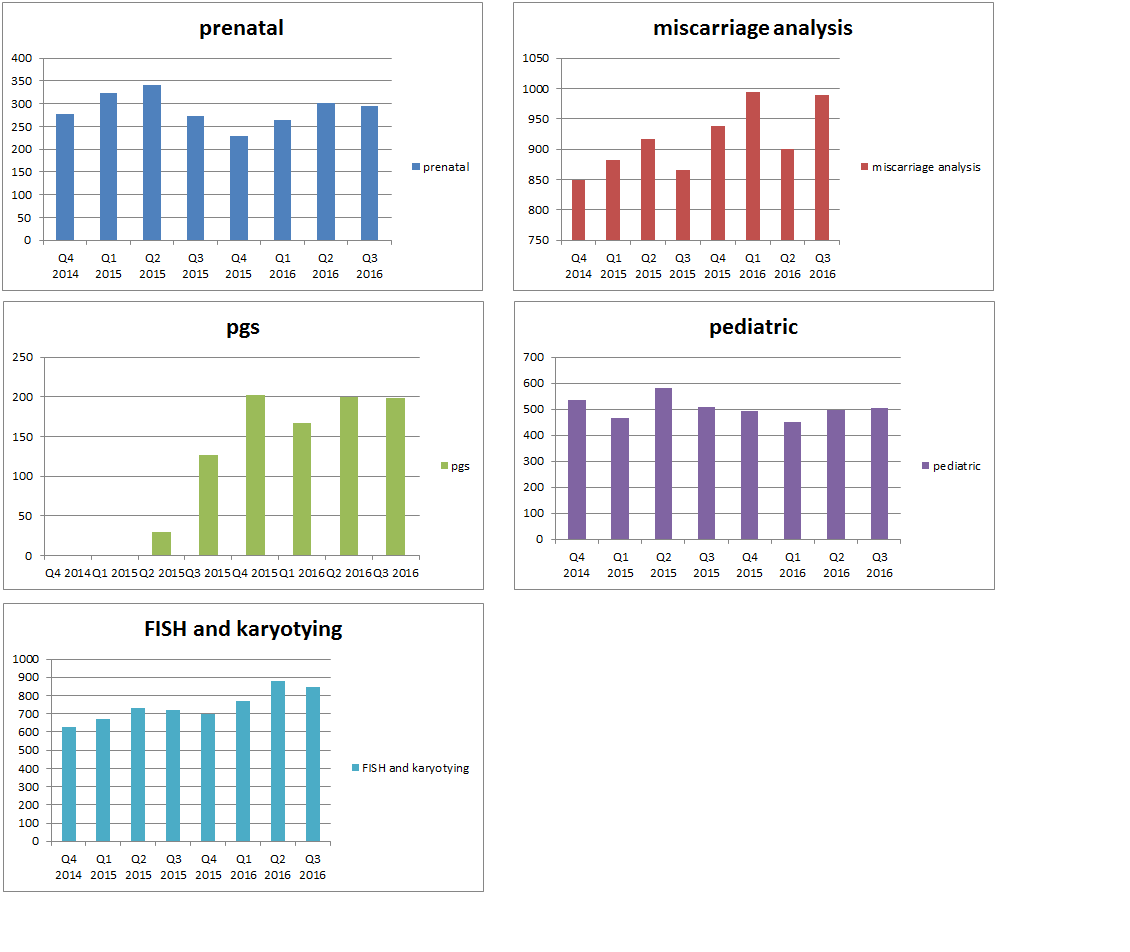
Below are charts showing volume growth for the 5 segments that Combimatrix reports.  Growth is lumpy, but overall there has been a trend towards increasing tests.  They also seem to have pricing leverage, as similar charts showing revenue by product line (not shown) trend more clearly left to right.

volumes

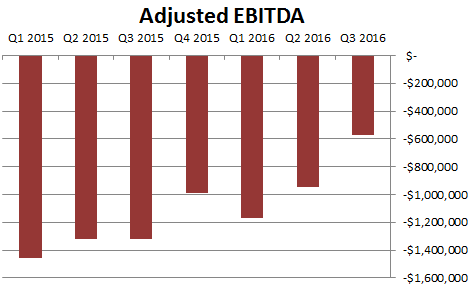
Management has reiterated on a few occasions (most recently in the third quarter conference call) that they will be cash flow breakeven by the end of next year.  This seems reasonable as adjusted EBITDA has been trending towards that level for 2 years now.

adjusted_ebitda

So it’s a cheap stock with a business that is pointed in the right direction.   The only reason I can think of for the stock being so cheap is the risk of further dilution.  As they approach the breakeven mark this concern diminishes and hopefully the stock price responds.  At least that is my expectation.  We will see.