Skip to content

Posts from the ‘Eiger Pharmaceuticals (EIGR)’ Category

Eiger Pharmaceuticals: Good Data but the stock hasn’t followed

I bought Eiger Pharmaceuticals back in February at $11.  As the chart below shows, its been a painful slide since then.
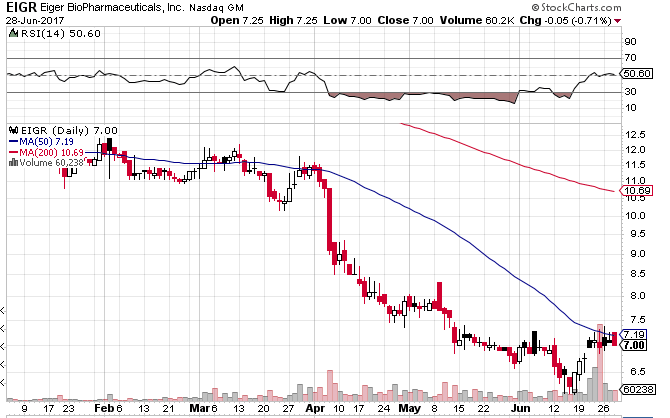
It is one ugly looking chart.  However Eiger is not alone.  Among the biotech stocks I follow there were a number that fell into a similar malaise in March or April.   While the IBB (the biotech index) has held up and recently rallied hard, the smaller biotechs that are not part of the index have not done as well.  However I’m seeing signs of this sentiment changing, which hopefully bodes better for the future.

Eiger’s Post-Bariatric Hypoglycemia Data

While the stock has declined, I remain of the opinion that the data Eiger has presented has been pretty good.  I already discussed their Phase 2 result on lonafarnib in this April blog post.  Last week they released more Phase 2 results for another drug called Exendin 9-39.  Again I thought the results were positive.

Exendin 9-39 is targeting patients with post-bariatric hypoglycemia.  This is a condition that occurs in some people that have undergone bariatric surgery, which is a surgery performed for weight loss.  Some post-op patients become hypoglycemic after eating.  That means their glucose level drops too low.  Depending how severe this is it can cause all sorts of terrible outcomes, with the worst being unconsciousness and seizures.

Exendin 9-39 decreases insulin secretion.  It is expected therefore that introducing Exendin 9-39 will dampen the instances of hypoglycemia in patients at risk.  In December Eiger presented initial Phase 2 results, which looked at a single-dose subcutaneous (SC) injection.  Those results showed that Exendin 9-39 produced the desired effect.

The results released in June were an extension of the December results (I also have a copy of the poster and will send it to anyone who emails me for it).  The new data looked at two variations of the first set of results: a multiple ascending dose of the SC injection, and a multiple ascending dose of a liquid formulation of Exendin 9-39.   The charts below show 3 hour glucose levels following a meal of the SC injection (left) and liquid formulation (right). These levels are compared to a baseline patient group that received nothing.
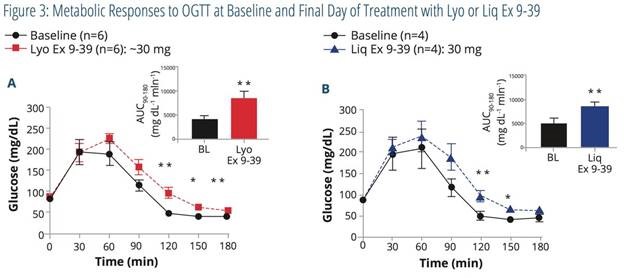
In the 60, 90 and 120 minute intervals, the patients on Exendin 9-39 had significantly better glucose levels, which is what you want to see.

After the stock reacted poorly to the data it was postulated by Daniel Ward on twitter that maybe the market didn’t like the 150-180 minute data.  You can see how during this time period the baseline and Exendin arms converged to similar glucose levels.  But I point out that in an earlier key opinion leaders (KOL) presentation by Eiger, the following chart (slide 28 from this presentation) shows the glucose responses of 3 patient groups: symptomatic post-bariatric hypoglycemia patients (so those that get hypoglycemic), asymptomatic post-bariatric hypoglycemia patients (those that don’t get hypoglycemic), and control persons (I believe these are just regular people that have not had a surgery).  You can see that in the 150-180 minute data of the two post-bariatric patient cohorts, neither of which are on Exendin 9-39 or any other drug, the glucose levels converge in a similar fashion to what was seen in the Exendin 9-39 results.
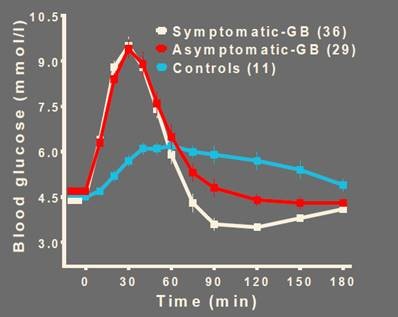
I believe there is one other important inference that can be drawn from the above chart.  Again, focusing on the red and white groups of patients who have undergone  post-bariatric surgery, I can’t help but notice that the difference between a symptomatic and asymptomatic patient is really not that big.

I have to wonder how much of the market response was due to this.  Folks looked at the delta in the response between the Exendin 9-39 and control group and were unimpressed with the visual difference between the two groups. What the above chart is telling you is that the expectation should not be so high.  The difference between a symptomatic and asymptomatic post-bariatric patient is simply not that big.  That Exendin 9-39 is producing results that appear close (maybe better?) to that of a healthy post-bariatric patient is quite positive in my opinion.

Summing it up

The stock is cheap but it’s admittedly its not the perfect set-up.  At $7 the market capitalization is about $60 million.  Eiger had $48 million of cash on their balance sheet at the end of the first quarter and $15 million of credit line debt.  They have another $10 million more they can borrow under the credit line.  Eiger burned through $11 million in the first quarter and $12 million in the fourth quarter.  Before that their cash burn was in the mid-single digit millions.  So bottom line they are going to have to raise cash here at some point, probably before year end.

I originally reduced my position in Eiger as it seemed to be in free fall.  However after thinking about the results and drawing the conclusions above, I decided to add that stock back.  This isn’t the sort of position that I am going to double down on or anything, but I think the price is succumbing to a weak market for micro-cap biotechs and lack of liquidity in the shares (it only takes a couple thousand shares to send the stock up or down 5%), not poor data, and I hate to get shaken out for that reason.  The company has a bunch more data coming out before year end, though most of it will likely be in the fourth quarter.  I will wait until those readouts and then reassess.
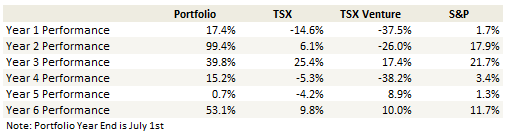


Week 298: Keep on Truckin

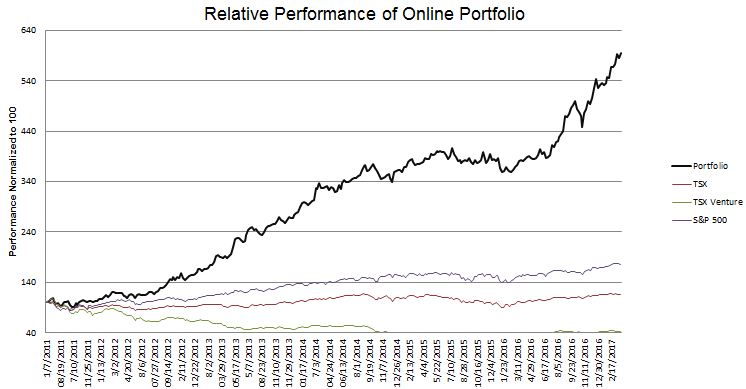
Portfolio Performance


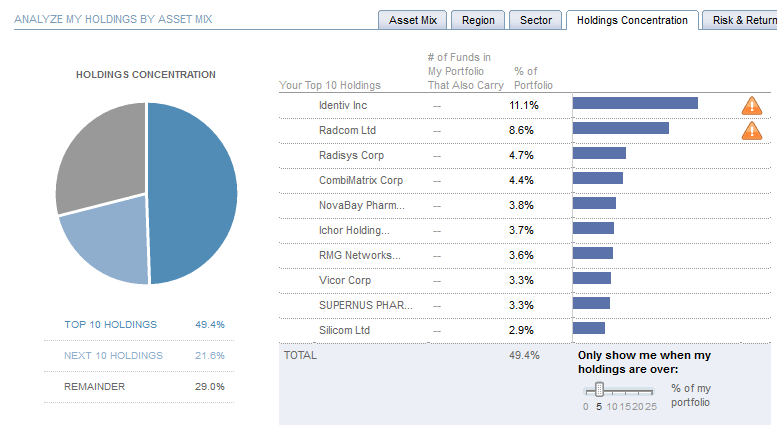
Top 10 Holdings

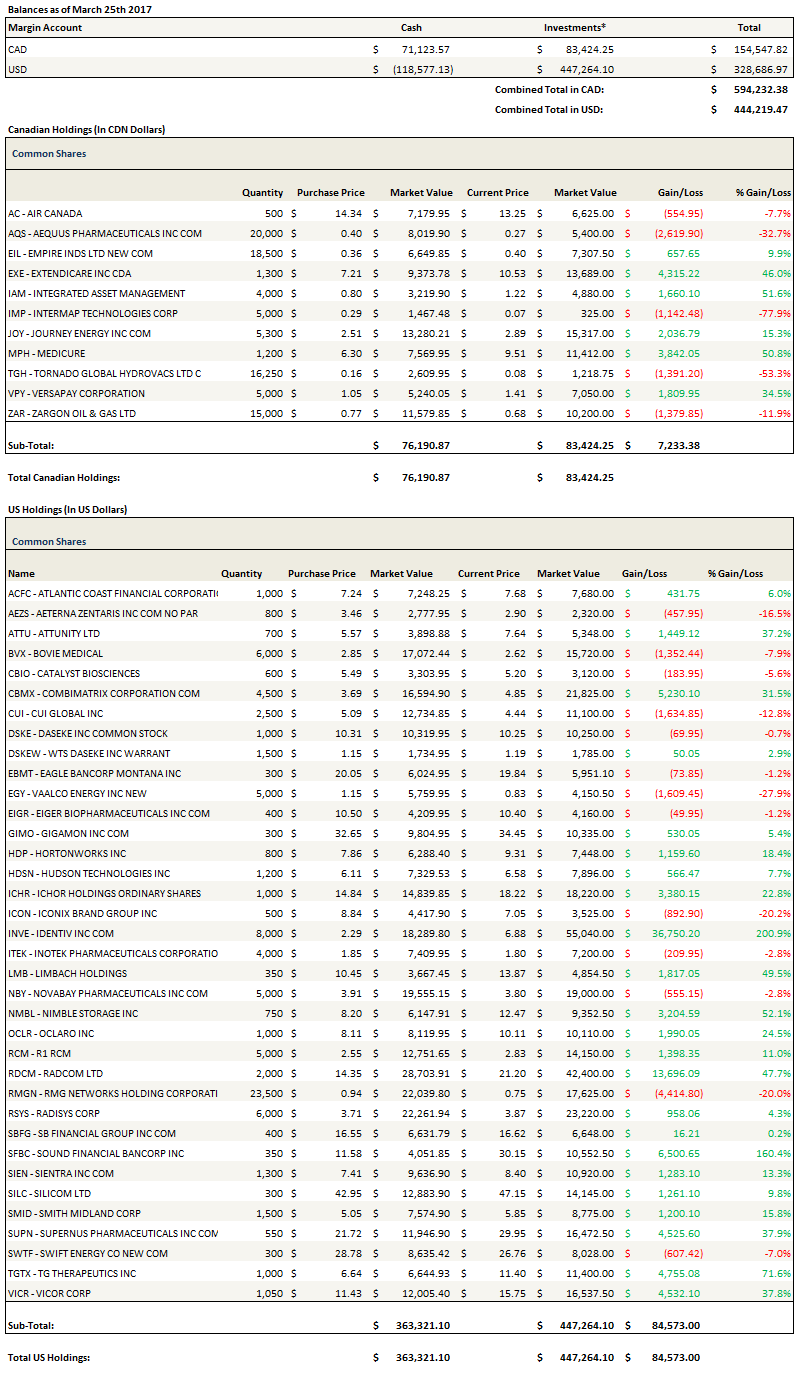
See the end of the post for my full portfolio breakdown and the last four weeks of trades

Thoughts and Review

No great insights this month.  My portfolio continues its upward climb even as the market stalls.  I continue to be buoyed by my large position in Identiv and more recently my large position in Radcom.  Combimatrix is consolidating in the $4’s but it looks healthy and I am hopeful it will break out on another leg up soon.  Silicom has helped a lot and I will talk more about that shortly, as has Supernus.  I still have a bunch of stories that I think are on the cusp and waiting for that final catalyst, Radisys, Vicor, and maybe even CUI Global, which I wrote about a little earlier this week.  Overall, no complaints.

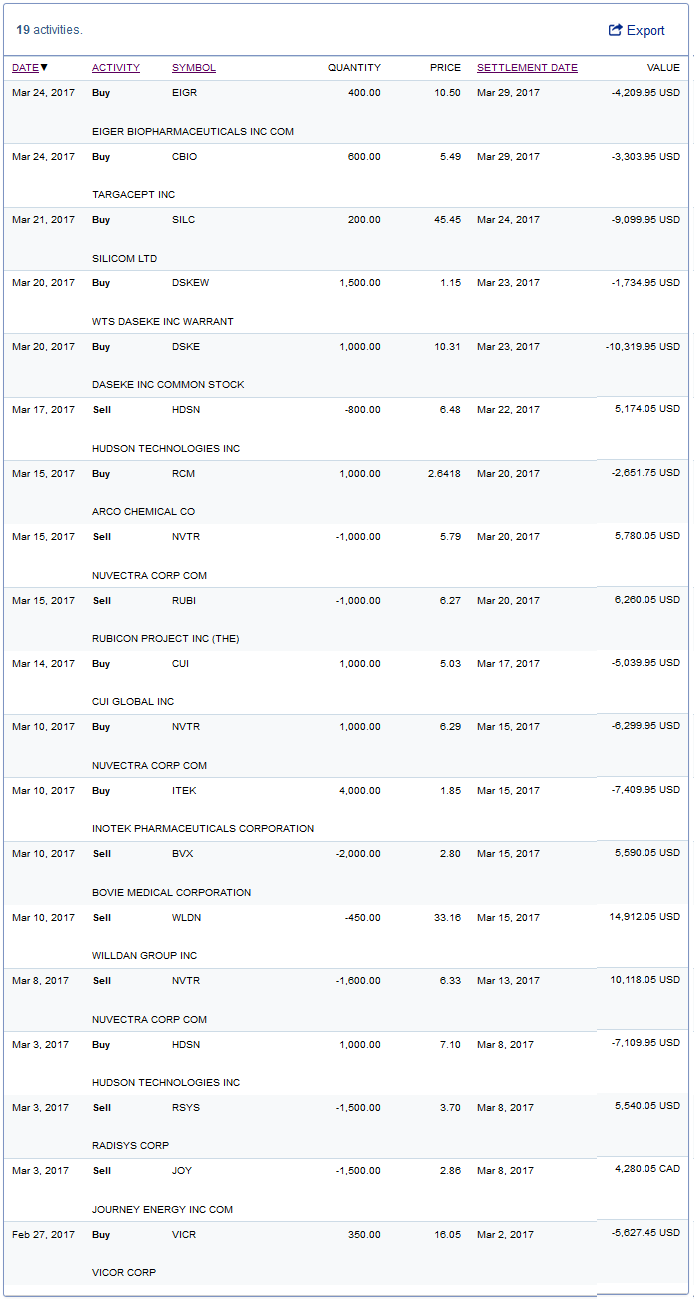
New Position: Daseke Inc.

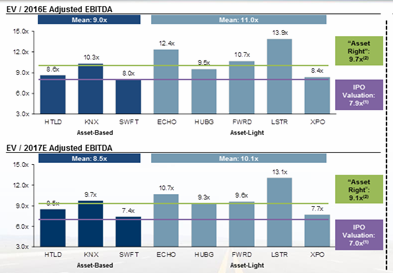
I added a new position in Daseke after reading this write-up by Dane Capital.  The story seems pretty straightforward.  Daseke is born of a special purpose acquisition company (SPAC) that acquired the previously private company, its trading cheaply relative to its peer group (see chart below from their presentation) and is in an industry that should see a tailwind as economic activity, infrastructure spending and oil and gas capex pick up.  There is not point repeating what Dane Capital already wrote so I recommend going to the article for the details.

I added both warrants and shares.  I’m not really sure whether the warrants are fundamentally overvalued or undervalued compared to the shares, I just thought they represented a good upside given that the stock is probably around two times EBITDA lower than it should be and that if it traded up to an appropriate level it would get to the high teens, which would be a triple for the warrants.

What I added to

I added to four companies over the past month.  In each case I was persuaded by an upbeat outlook about the future that was given by management on the calls.  I’ve already written my thoughts on Vicor.  Likewise I wrote up CUI Global just the other day.

I also added to Accretive Health, which has changed its name to R1 RCM.  I last talked about R1 RCM here.  Not much has changed, they are making progress on-boarding Ascension and finally moved their stock over to the NASDAQ.  I figured the NASDAQ listing would be a bit of a catalyst, so I added the day prior to that.

Finally I added to Silicom on this news.  This is just a huge contract for the company with an $17 million initial purchase order and $30 million expected annual run rate.  I read somewhere that the customer is likely with Gigamon.

I do intend to write-up Silicom, I just keep getting tied up with other stories, and I wanted to spend time understanding their whole product suite before putting any post up.  The good news is that as I have dug more, I have become even more comfortable with the company.

What I sold

On the sell side of the ledger, I already wrote about my sales of Nuvectra and Rubicon Project, and my reduced position in Bovie Medical.

In addition to these names I also sold the last of Willdan Group.  Willdan has been a great name for me.  I added the stock in the single digits, around $8, and am selling the last of my shares in the low-$30’s.  The business is still humming, and the company seems to have shifted to an acquisition strategy that so far is fueling further growth.  Yet at this price I just feel like the upside is priced in, with the stock trading at 25x the upper end of their 2017 guidance (which is $1.20 diluted EPS).

A couple late Biotech Buys

I also bought starter positions in a couple of mid-stage biotechs at the end of last week: Eiger Pharmaceuticals and Inotek Pharmaceuticals.  I got both of these names from Daniel Ward, who comes up with a lot of good ideas.  I’ll try to write up some details on both companies in the near future, but you can get a pretty good overview of the investment thesis if you listen to their recent conference presentation (Eiger at the BIO CEO and Investor conference and Inotek at the Cowen Healthcare conference).

The Catalyst Biosciences Catastrophe

Finally there is Catalyst Biosciences.  This is so painful.  So on Friday I put in a market order for Catalyst in the practice portfolio.  I always use market orders with the practice portfolio because it doesn’t always work to put in limit orders.  With limit orders sometimes you get filled, sometimes you don’t, even if the stock moves below your limit.  But because I didn’t like the bid/ask spread on Catalyst (it was something like 5.20/5.45 at the time, so really big), and because the stock bounces around a lot, in my actual account I put in a limit order at 5.10.  I liked the stock because it was at a big discount to cash, but it didn’t seem like there was any reason to chase it.

It was with great pain that I watched the open this morning.  Catalyst opened in the $9’s and proceeded to move to as high as $18.  I made a killing in my practice portfolio (its not reflected in the update because this update is for the four weeks ended last friday) but I made nada in my actual account.

I hate, hate, hate limit orders.  I rarely use them and this is a big reason why.  If you want to buy a stock, buy it.  If you want to sell it, sell it.  All the pennies I may save putting in limit orders over the next year will not amount to what I should have made on Catalyst today.  It makes me a little ill to think about it.

Portfolio Composition

Click here for the last four weeks of trades.