Skip to content

Posts from the ‘Frontline (FRO)’ Category

Week 210: All about the 5-baggers

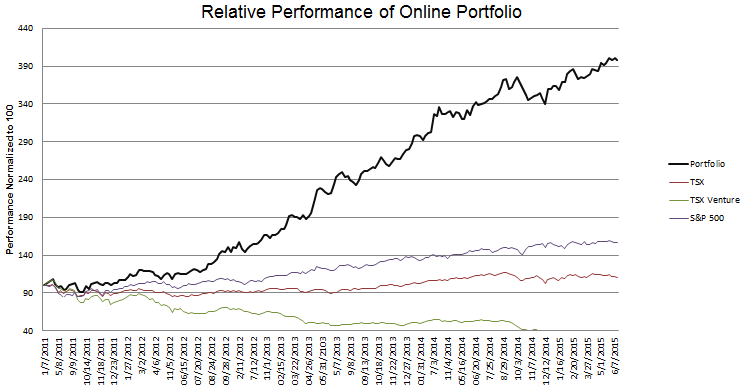
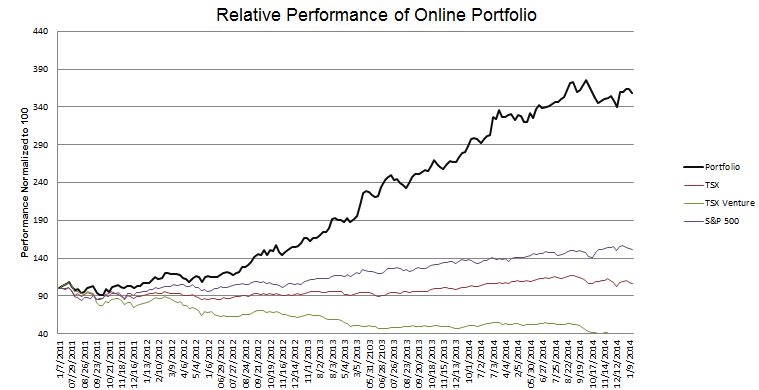
Portfolio Performance
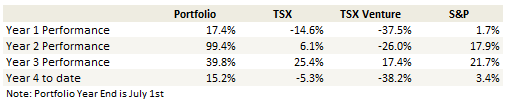
week-210-yoyperformance

week-210-Performance

See the end of the post for the current make up of my portfolio and the last four weeks of trades

Monthly Review and Thoughts

A few weeks ago I was talking to someone who works at a large fund.   He was telling me about a retail clothing chain that their fund was interested in.  To help evaluate the opportunity, they commissioned a research firm to canvas and scout locations across the country.

That is amazing intel.  It is also wholly impossible for me to replicate.

I generally have a pretty good idea about a business before I buy into it.  I do a lot of work up front, far more than the highlights that go into these posts.  But I’m always left with elements that are uncertain.   For an individual investor with access to limited information and with limited time, certainty about one’s beliefs is more hubris than reality.

In the face of such disadvantages, my strategy is to take smallish positions and add to them if they begin to work out inline with my expectations.  If they don’t, I cut them.

By keeping my positions small until they start working and cutting my losses before they get big I guard against the big hit to my portfolio.  On the winning side of the ledger I generally end up with a similar number of winners that cancel out the losers.  But I also end up with 2 or 3 big winners that lead to out-performance.

It’s the 5-baggers that make the engine go.

Another portfolio year has passed (I started writing this blog on July 1st 2011) and you can see from the results that the last year was not as good as the previous few.  I still did better than the market, but I didn’t do that great.

In part the under-performance was caused by not sticking to my rules.  I have already rehashed my failures with Bellatrix and other oil names in past posts so I won’t go into that again here.

But I also attribute it to my lack of “5-baggers”.  I haven’t had a big winner in the last 52 weeks.  I’ve had a lot of good picks (Air Canada, Axia NetMedia, PNI Digital, Extendicare, Radcom, Rex American, the second go around with Pacific Ethanol and so on) but only one true double and nothing that tripled or quadrupled.

Realizing how important multi-baggers are I’m sending myself back to the drawing board.  I’m not sure why I’ve failed to discover the big movers over the last year.  But I suspect that it is at least partially due to ignorance of the sectors that have had the momentum.

Up until recently I never owned a bio-tech.  I’ve stayed away from technology in all but a few exceptions.  I’ve only been in healthcare on a couple of occasions (one of those being Northstar Healthcare, subsequently Nobilis Health Corp, which I rather amazingly sold last October, at no gain or loss, literally days before it began a climb from $1.20 to over $10 in thee next six months).  Yet these sectors are where the big winners have been.

My attitude towards these and other outperforming sectors is going to change.  I have invested in a couple of bio-techs and in technology (shorts mind you, as I will explain later) and in the last couple of months.  More new ideas will follow.

What I Sold

Usually I discuss my new positions next.  While I have a couple of these, they are not significantly sized and my actions have been more weighted to the sell side of the ledger, so it seems appropriate to discuss what I sold first.

As I tweeted on a couple of occasions I have been skittish about the market over the past month and a half.  I sold out of some positions and reduced others when Greece went on tilt and announced a referendum two weeks ago.

Since that time as my worries have subsided I have bought some of those positions back. It doesn’t look like an immediate contagion is upon us, which was my main concern.  Still I’m keeping a healthy amount of cash (20%) and where I can I am short a number of stocks.

In what turned out to be an unexpected consequence of my recent research expansion, over the past month I spent a lot of research hours looking at short opportunities. Trying to take more of an interest in tech, I read through reports describing the state of business and dynamics at play in everything from telecom infrastructure to smartphone.  As I did I felt most of the near term opportunity was on the short side, and so I took positions there.

My tech shorts have been based on three-fold expectations: PC sales are declining faster than consensus, smart phone sales will grow slower than consensus, and rumors that the big data build out by cloud providers has been overdone will prove to be true and future spending will be scaled back.  Without going into the individual names, I’ve stuck mostly with the big players and mostly with semi-conductor providers, which seem to be the most susceptible to spending downturns.

I think however that this play has almost run its course.  I have been taking off some positions heading into earnings (for example I was short Micron going into their June quarter but took it off the day after earnings were announced), and plan to exit my remaining positions as earnings are released.  I don’t like to hold short positions too long.

While I have yet to take any short positions in healthcare, I get the feeling that the recent merger mania may be leading to valuations that prove difficult to justify once the feeding frenzy subsides.  I note that a top pick of Jerome Haas, who I have followed and found to be a solid thinker, was a short on Valeant Pharmaceuticals.

In my online portfolio, in which I cannot short, I sold out of my gold mining shares, my oil stock shares, some of my tanker shares (Euronav and Frontline), a hotel play (Red Lion), reduced my airline exposure in both Air Canada and Hawaiian Holdings as well as my Yellow Pages and Enernoc positions.

I also sold out of DirectCash Payments, though I subsequently added the position back later (at about the same price).  I really want to hold this one through earnings because its been beaten down so far and I still have doubts as to whether the first quarter is the secular harbinger that the market seems to think it is.  In the turned out to be an unexpected consequence of my recent research expansion

Similarly, while I sold out of RMP Energy, I bought it back (at a lower price) because I want to see their quarter before giving up on the stock.  Like DirectCash Payments, I question whether results will be as dire as the market suggests. In the same segment of his BNN appearance Haas also made DirectCash Payments another top pick.

I only added to a couple of positions in the last month.  Patriot National continues to execute on their roll-up strategy, buying up smaller insurers at accretive multiples.  The stock is up 40% from my original purchase (though in the online portfolio I forgot to add it when I originally mentioned it so its up somewhat less there) and I decide to add to the position since its working out.

Second, I added to my position in Capital Product Partners on what I believe is unwarranted selling on Greece.  The company is incorporated in the Marshall Islands, does not pay Greek taxes but does have offices in Greece, which is at the heart of the sell-off.  A scan of the company’s annual filings shows that their exposure to Greece is potentially some deposits in Greek banks and the risk that one or more of their subsidiaries could face higher taxes.  I don’t think that correlates to the 20% plus sell-off in the share price.

I also added two new positions to my portfolio.

Intermap

I have followed Intermap for years.  Its a company that my Dad owned. While it always held out the promise of a significant revenue ramp Intermap could never quite figure out how to monetize their world class geo-spatial data.

Then, a couple of weeks ago, the company signed a large contract with unnamed government for the implementation of a National Spatial Data infrastructure program.

For years Intermap was primarily a mapping services provider.  They owned 3 Lear jets equipped with radar technology that scanned and mapped large swaths of terrain.  They would land contracts to map out a country or region and be paid for providing that data.

The company always kept the rights to their mapping data and, over time, Intermap compiled a database of geospatial data for a large part of the earth.   This spatial database became a product called NextMAP.   The database can be accessed through commercially available GIS software like ArcGIS or web browser apps developed by the company. Customers can license either parts of or the entire NextMAP database for their use.

The latest version of the database, called NextMAP World 30, is “a commercial 3D terrain offering that provides seamless, void free coverage, with a 30meter ground sampling distance, across the entire 150 million km2 of the earth’s surface.”

Intermap has always had a leading technology.  But they have struggled with coming up with profitable ways of marketing that technology.   Over the last three years the company has been working on applications that can be layered over their basic mapping data.  They have a program for analyzing the risk of fires and floods (InSite Pro), a program for managing hazardous liquid pipeline risk (InSite Pro for Pipelines) and a program for assessing outdoor advertising locations (AdPro).

None of these niche solutions have resulted in significant revenue to the company.

The carrot has always been that they land a large government contract for the full implementation of a geo-spatial solution for the country.  Most investors have given up on this ever happening, but then it did.

The announced contract is for $125 million over two years, during which time Intermap will implement the infrastructure solution.  This will be followed by an ongoing maintenance contract valued at $50 million over 18 years.

When I saw the number on the contract I knew immediately that the stock would jump significantly.  Including warrants and options Intermap has 127 million shares outstanding.  So at the closing price the night before the deal was announced the market capitalization was around $10 million.  When it opened around 25 cents I figured the upside was only about half priced in, so I jumped aboard.

The implementaton of a full geo-spatial solution as per the contract will involve the implementation of the company’s Orion platform, which includes the company’s NextMAP data integrated with other relevant third party data and with applications for accessing and analyzing the data.   The platform will be used to help with decision making with infrastructure planning, weather related risks, agriculture, excavation, and national security.  Because this is basically a new business for the company, its difficult to peg margins or profitability.  So I’m not going to try.

Nevertheless, just based on the rough assessment of what $125 million in revenue would mean, at this point, with the current stock price of 50 cents the contract is probably mostly priced into the stock.  I maybe should have sold on the run-up to 60 cents, but I decided not to.

The company has suggested in the past that they have a number of RFPs in the works and some of those they have already won but cannot announce until funding is secured.  The upside in the shares is of course a second contract. That could happen next week or next year.  Its impossible to predict.

The other consideration, and something I have always wondered about, is why some large company doesn’t pick up Intermap for what would amount to peanuts, securing what is truly a world class data set and a platform that would seem to be more valuable in the hands of a large company with the resources to sell large projects to governments.  Somebody like an IHS comes to mind.

Pacific Biosciences

This investment idea is a little out of my normal area of expertise and consistent with my desire to expand my investing horizons.   Its an idea I came up with after reading  this Seeking Alpha article which I think does a good job explaining the trend we are trying to jump on.

PACB has 74 million shares outstanding, so at $5.20 (where I bought it) the market capitalization is $385mm.   The company has $79 million of  cash and investments and $14 million in debt.

They are in the business of gene sequencing.  Pacific Biosciences sells gene sequencing machines and related consumables for running tests to map an individuals gene in hopes of detecting a mutation that will diagnose the future susceptibility to disease.  The machine of course is a one-time sale but the consumables are a recurring revenue stream so the business has a bit of a razor-blade type revenue model to it.

The big player in the gene sequencing arena is a company called Illumina.  This is a $30 billion market cap company that did nearly $2 billion in revenue last year.  They dwarf Pacific Biosciences, which did around $60 million of revenue last year.

In fact I read that Pacific Biosciences has only sold around 150 machines.  One interesting thing from their presentation is that for each of the machines Pacific Biosciences sells, they generate about $120,000 of consumable sales a year.   Thus the opportunity for significantly higher recurring revenues is there if they can sell a few more machines.

What seems to set Pacific Biosciences apart from Illumina is that their technology produces much longer gene sequencing strings which results in far lower error rates.  Below is a comparison between the two.
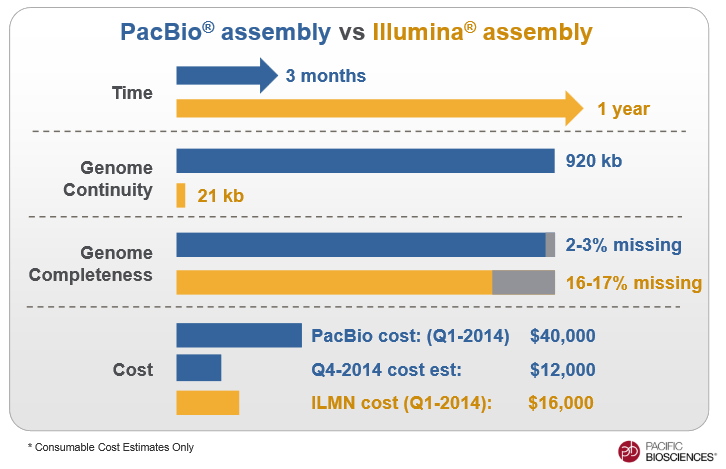
comparisonilluminaOne thing I am not sure of is where Pacific Biosciences sits compared to some of their non-public competition.  I was reading through some of the comments on a site called Stock Gumshoe that suggested that some private competition may have as good or better sequencing technology.

Pacific Biosciences also has an agreement whereby Roche will market their product for the diagnostics market in 2013.  In May Pacific Biosciences met the second milestone of that agreement.  The only thing that is a little disconcerting about this agreement is that Pacific Biosciences did not announce how much revenue they would be giving up once (and if) the product is commercialized.

My bottom line is that there are enough interesting things going on for me to speculate in the stock.  The key word being speculate.  There is a chance of wider adoption, there is a chance of an expansion of their relationship with Roche, there is maybe even an outside chance of a takeover.  And its an industry that is clearly growing, is in investor favor, and the stock was at a 52-week low when I bought it.

But I will flatly state that I would not take my comments about Pacific Biosciences too seriously.  My knowledge of this industry remains weak (though its improving as I read more).  They could be, or maybe even have been, surpassed by competition and I would not be the first to know.  So we’ll see how this goes and chalk up any loss to the cost of education.

Portfolio Composition

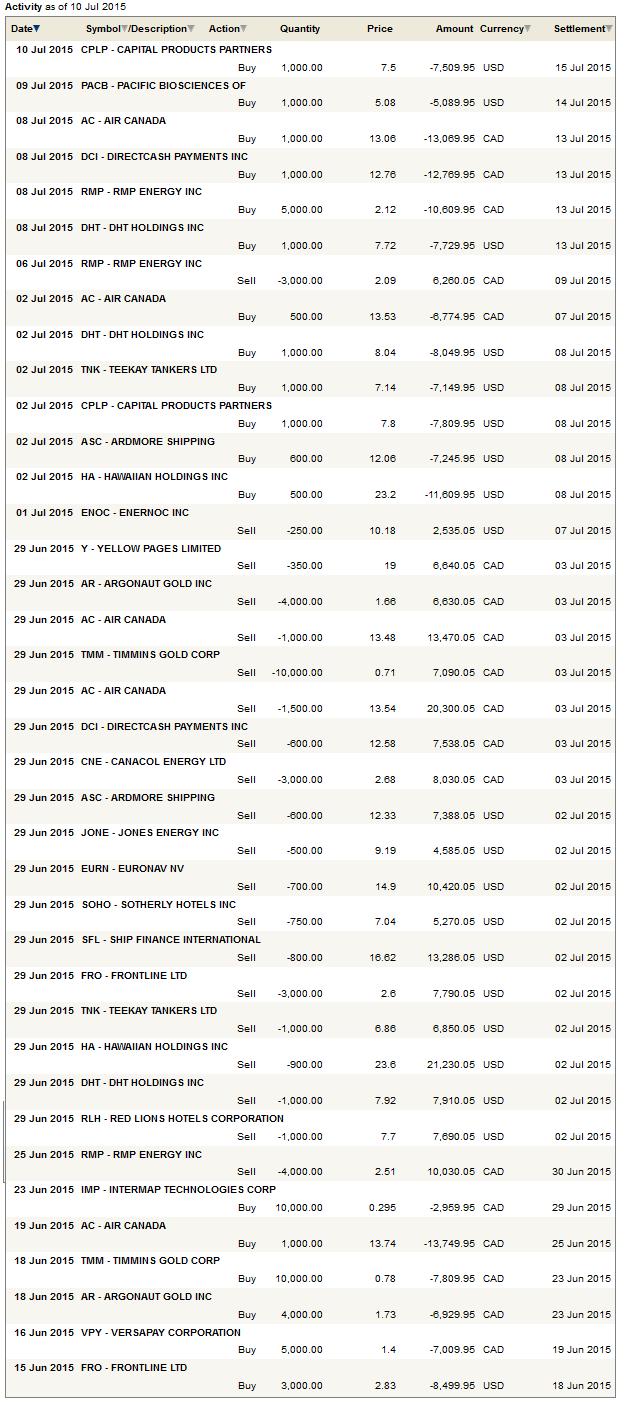
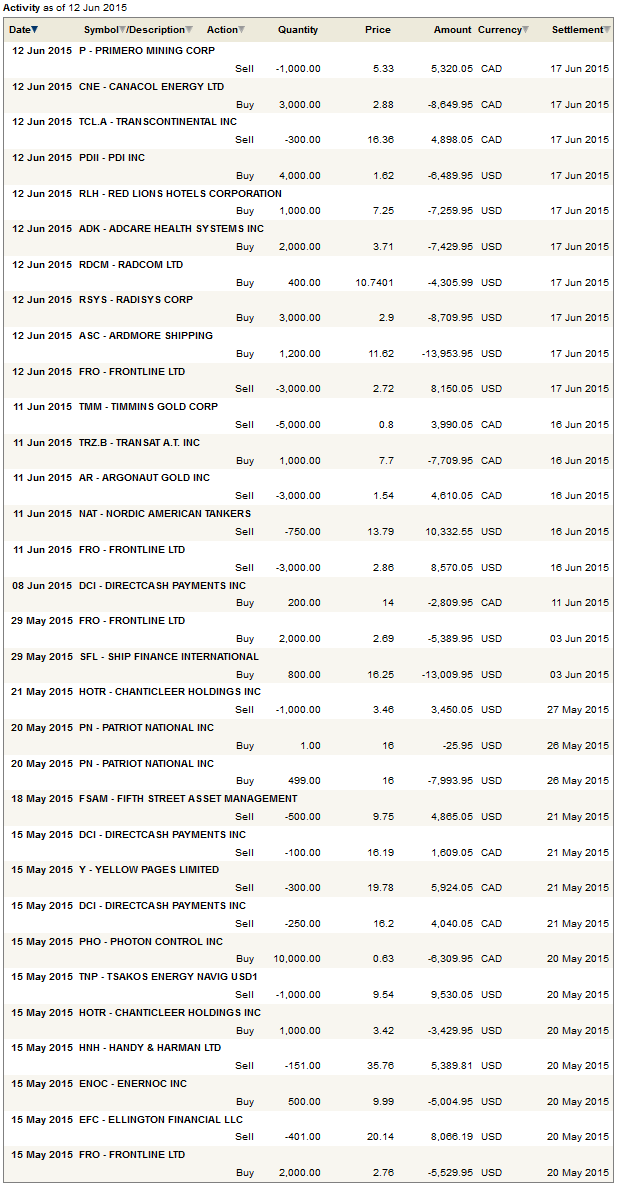
Click here for the last four weeks of trades.
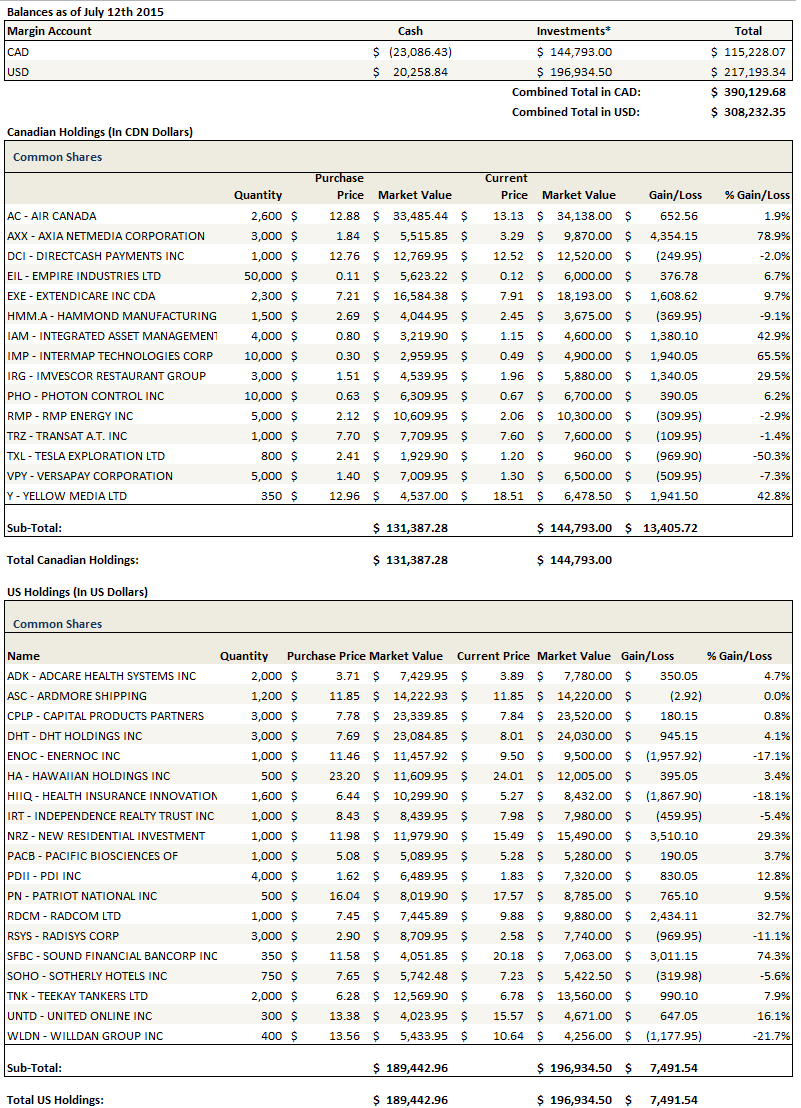
week-210

Week 206: The Thin, Steep Line

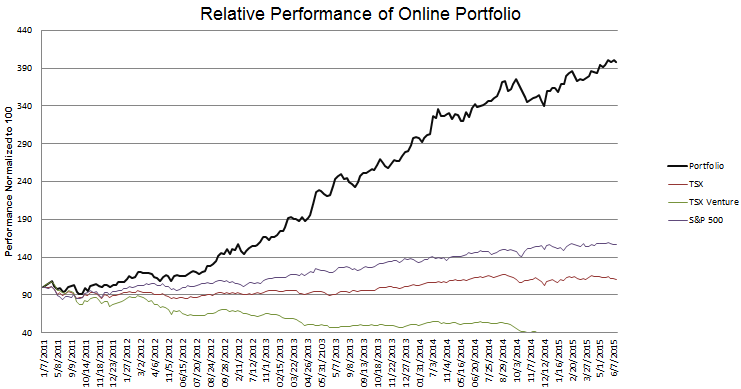
Portfolio Performance

week-206-yoyperformance

week-206-Performance

See the end of the post for the current make up of my portfolio and the last four weeks of trades

Monthly Review and Thoughts

I’ve been listening to interviews with traders.   I found two interesting podcasts, one called Chat with Traders and another called 52 Traders.  I go through an episode a day on my bike ride into work.

The interviews are generally at odds with my own investing style.  These guys don’t pay attention to fundamentals and they are short-term in nature (mostly day trading).  Nevertheless I have found the interviews insightful.

One concept that comes up a lot is “edge”.  An edge is essentially the advantage that allows you to beat the market more than it beats you.  For many of these traders understanding their edge; a system, a pattern, a money management technique; has been a major step toward consistent success.

So what’s my edge?

I have been pretty good about beating the market for the last 10 years.  I don’t know if you can chalk it all up to luck.  Though there is much I do wrong, there must be something I’m doing right.

I’m not going to dissect the details of what specifically I do “right”.   I’ll leave that to a future post.  I bet that if you read the last 3 years of writing you’d get a pretty good idea.

I want to talk more generally.  I’m going to hypothesize about what I believe to be some general characteristics of my edge.

First, I doubt you could boil my edge down to a single thing.  I think its more likely there are a number of small things I do right that together add up to decent out-performance.

If true, this means that I have to be careful about cutting corners.  Not being sure exactly what aspect of my process leads to out-performance means that leaving out any one piece could be critical.

I also don’t think that these tiny edges act together linearly in an independent fashion.  Let’s say I have 6 things that I do that contribute to the overall edge I have.  I highly doubt that if I do 5 of these 6 I will get 83.3% of the returns.  It will likely be significantly less.  Maybe even I don’t outperform at all.  The sum of my edge is greater than the parts.

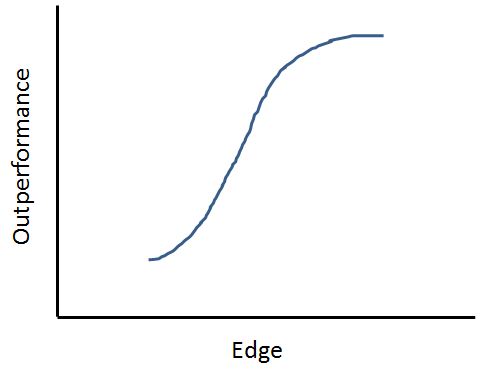
Finally, I think that the slope of out-performance to edge is likely quite steep.  In other words, if I am off my game, my performance deteriorates quickly.

As the chart below illustrates, the degradation of performance due to small changes in edge is closer to vertical than to horizontal.  Think of the right side of the curve in the chart below as being the execution of maximum edge.  In other words you are doing everything right.  As you do more and more wrong; less due diligence, cutting corners on a spreadsheet, not following a stop rule, adding to a losing position, etc; you slide to the left of the curve and with your dwindling edge comes dwindling performance.

edge

The point I am trying to illustrate is that small deviations from what make me successful will likely result in outsized drops in performance.  If I don’t do everything right: do the mounds of research up front, follow my buying patterns, follow my stops, correctly discern when I should not listen to my stops, etc; I will see my edge decline and my out-performance will drop significantly when it does.

It’s a bit like I’m balanced above the ground on a pole, and the slightest wrong move, one way or the other, and I’ll fall off back down to earth.  This is quite analogous to how each day on the market feels to me.

Continuing on with updates of some of the stocks I own

Hawaiian Holdings

Hawaiian got hammered along with the rest of the airline sector over the past couple of weeks.  The hammering was precipitated by A. raised capacity guidance from Southwest Airlines, B. comments from the American Airlines CEO that they would defend their market share against competitors pushing forward with capacity increases and C. reduced passenger revenue (PRASM) guidance from Delta Airlines.

There is a good article on SeekingAlpha discussing the severity of these factors here.

What is frustrating about the above developments is that they should only be peripherally correlated to Hawaiian Holdings.  Hawaiian runs 3 basic routes:

  1. Inter-Island
  2. Island-Mainland
  3. Island-Asia

None of these really have much to do with mainland capacity.

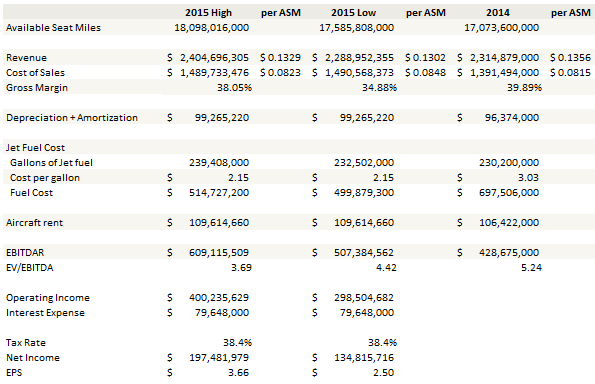
I think Hawaiian is cheap in the low $20’s.  A move above $25 and I look to lighten up as I did earlier this month.  Below is my 2015 earnings estimate based on the company’s high and low guidance.  All of the inputs come directly from guidance with the exception of RASM, which I estimated as -2% year over year on the high side and -4% year over year on the low side.

guidancetoeps

When I look at analyst estimates they trend to the low end of guidance. The average analyst estimate (per Yahoo! Finance), is $2.79.  The high estimate is $3.05.  If the company hits the high end of their own guidance they are going to blow away these numbers.

I’m hoping that a combination of earnings beats and what has so far proved elusive multiple expansion for the airlines combine to send the stock price up closer to $30, which would be a nice gain from current levels.

DC Payments

I’ve spent a lot of time debating what to do with my position in DirectCash Payments.  After a lot of thought but still without consensus (of my own mind), I added slightly to my position at $14.

The stock has dropped from about the $16 after reporting weaker results in the first quarter.  The market is concerned about poorer revenue and gross margin decline.

I am somewhat sympathetic to the spirit of these concerns.  DCI is in the ATM business.  They buy an ATM, sign an agreement with the owner of a space to place that ATM into a space for a fixed period, and then depending on the agreement they either split the profits with the owner or lease the space for a fee.  Clearly, this is not a growing sector.  You would expect pressure on revenues and margins as society moves towards the use of less cash.

However I think the market is making a mistake to think that the first quarter results are evidence that this transition is accelerating.  There were a lot of one-time items and events that impacted the first quarter.  The company lost revenue from its CashStore ATMs, which has been going through bankruptcy proceedings.  They lost 120 ATMs as Target exited Canada.  In Australia, the recent implementation of cash-and-pay technology (something that has been in Canada for a while) led to steeper than usual declines (though not out of line with the declines experienced when the technology was introduced in Canada).  Finally year over year comparisons were impacted by a one-time GST gain in 2014.  On the expense side, they saw one-time accounting expenses due to the Australia acquisition as well as expenses related to the upgrade of the Australia fleet.

So I’m not convinced this is a secular decline story just yet.  The second quarter is going to benefit from an additional 340 BMO ATM’s in Canada and 120 ATMs being installed at Morrisons in the UK.  Some of the one-time expenses are going to roll off.  Increased surcharges are being implemented in both Canada and Australia.  And finally, beginning in the second half we will see some of the intangible amortization related to acquisitions begin to run off, which will result in a better income statement.  So we’ll see.

New Positions

PDI Inc

I like to find companies with one of the following attributes:

  1. A market capitalization that is a fraction of their annual revenue
  2. A small but growing segment that is being obscured by a larger mature business

I really like it when a company has both of these attributes, which PDI Inc has.

PDI’s mature legacy business is a outsourcing sales force for the pharmaceutical industry.   This is a 20% gross margins business that has seen some headwinds in the last year.  These headwinds are responsible for the poor stock performance.

The growing business is molecular diagnostic tests.  PDI entered molecular diagnostics via a couple of acquisitions, Redpath and some assets from Asuragen. They now offer diagnostic tests for malignancy of pancreatic cysts (PancraGen), and of thyroid nodules (ThyGenX and ThyraMir).

marketopp

The molecular diagnostic test segment generated very little revenue in 2014. They have been ramping up the business through acquisitions since the summer of 2014.  Below is a timeline, taken from the investor presentation, of their progress so far.

timeline

The company points to a recent report from Visiongain estimating that the molecular diagnostics market is around $6 billion and that it is growing at a 15% CAGR.

In the first quarter of 2015 revenue from molecular diagnostics was a little over $2 million.   Guidance for the segment is $13-$14 million, which suggests that they think they can grow the segment by nearly 100%.   Keep in mind that the company has a captive, experienced sales force at their disposal to help them reach that goal.

The company has significant net operating loss carryforwards of over $240 million so there will be no taxes paid for quite some time.

As part of the acquisition deals they also granted significant contingent considerations.  In addition to two milestone payments of $5 million, they pay a net revenue royalty of of 6.5% on annual net sales above $12.0 million of PancraGen, 10% on net sales up to $30 million of PathFinderTG and 20% on net sales above $30 million of PathFinderTG.

While I like the direction and I like the leverage to gross margin improvement, I caution that even with growth from the molecular diagnostic segment profitability remains somewhat distant. If they meet their guidance for 2015 they will still have an operating loss for the year.

However the bet is that if they show some success the market will reward them for the potential of their acquisition strategy, rolling up new treatments and integrating them into their sales platform.  Its not hard to see that strategy being worth significantly more than the current $25 million market capitalization.

Versapay

Versapay is another tiny market capitalization company ($29 million).  They have a newly launched SAAS offering that could scale quire quickly.

In the past Versapay’s product offerings have revolved around point of sale solutions: point of sale terminals (basically the little hand helds that you use at every shop), payment gateways for online purchases, app’s for mobile payments, and virtual terminals.

Margins on the legacy business are north of 60% but it is not a high growth business; it grew at around 5% in 2014 and showed flat revenues in the first quarter of 2015.  The business generated $2.1 million of EBITDA in 2014, so at the current market capitalization Versapay is probably slightly expensive if valued on this business alone.

Recently though Versapay expanded their offering to include a B2B e-commerce platform called ARC, or Accounts Receivable Cloud.  ARC is aimed at small to medium sized business and provides an accounts receivable process for business to business transactions.  Below is a slide from the company presentation that gives a high level overview of ARC’s functionality.

howarcworks

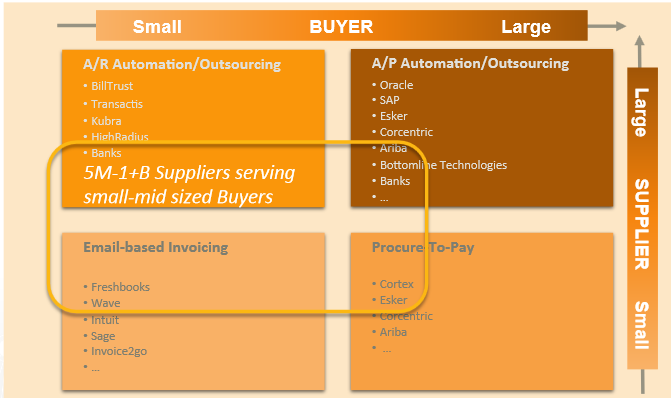
The company says existing offerings on the market either focus on accounts payable (so on the buyer), are geared towards large enterprises, or are accounts receivable applications for business to consumer transactions.  ARC fills a niche that is largely unaddressed.  The slide below depicts ARC’s target market:

arcmarket

The company says that its biggest competition are excel spreadsheets and inertia, for which, coming from a small business whose accounts receivable management consisted of a large excel spreadsheet with many tabs that had been maintained in the same way for years and emails sent out by salespeople with PDF invoices, I can sympathize with.

So I think there is a market here if Versapay can prove that their software is more efficient and can create more timely payments than the alternative.

What I really like about this idea is that if it does begin to take off the nature of the application could cause it to snowball quickly.  When a supplier uses ARC for invoicing, all of their customers are introduced to the platform via their bill paying portal.  If the portal is perceived as suitably impressive, these customers become natural targets for Versapay.

ARC also has synergies with Versapay’s existing point of sale solutions.  Both can leverage the same payment backbone for processing transactions.

synergiesWhile the platform is in its infancy (basically at a pilot/early adopter level), the early results show what could be in store.  As of the May conference call, Versapay had 16 suppliers signed up, 8 who are live, but already there are 14,800 buyers invited and 2,450 buyers who had signed up and registered.  This was up by 1,000 buyers in past 20 days.

The numbers of the buyers who are somewhat incidentally being introduced to the system is impressive.  It illustrates the need for quality before a full roll out.  Just as it is extremely beneficial to Versapay if these buyers have a positive experience, it will be a disaster if they don’t.

So far the early response is positive.  Two of the eight early adopters, Metroland and Teachers Life, went so far as to give positive testimonials at the Versapay investor day.  Versapay also announced on their first quarter call that they had signed up a large commercial real estate firm subsequent to the quarter.

There is enough potential here for me to take a position.  But I have to be careful.  I’ve talked before about companies whose product is a bit of a black box, where I can’t really be sure whether its going to be a hit or miss and so I have to judge it based on the evidence but show humility if things go south.   Radcom is a name I own that fits in this category.  Radisys is another, as is Enernoc.  The idea makes sense, the sector makes sense, but there is a bit of a leap as to whether the solution will be the best fit for the niche being marketed.  I just can’t be sure.

I am being careful about position sizing and will be on the look out for any adverse developments, comments or even just poor price action that may imply things aren’t going rosily.  This risk is justified by the reward; while the downside is that I get out at $1 after some poor results, the upside is likely multiples of the current price.

These are exactly the kind of bets I’m looking for, even if they all can’t pay off.

Transat AT

When I sold Transat AT at the beginning of the year it was always with the intention that I would get back in.  As I wrote in the comment section of my February post (after it was pointed out to me that I had neglected to mention my sale):

I sold the stock because I think the weak CDN dollar is going to make Q1 and Q2 difficult. They also hedge fuel so in the very short term they are going to be hit by the dollar over the winter but not going to gain from fuel to the same extent yet. The winter routes also have a lot of added capacity from Air Canada and such so that is making it more competitive.

I still really like Transat though in the medium term. I think once we get Q1 released I will look to adding it back, because the summer is going to be stronger, they will begin to benefit from fuel more, and presumably the dollar will stabilize… I’m just stepping aside until the uncertainty has passed.

With the release of second quarter results last week the uncertainty has passed.  And really, the results weren’t too bad.  Because Transat runs a very seasonal business, it is useful to compare quarterly results from year to year.  Below are second quarter results for Transat over the last 7 years.

Q2compThe company guided that its summer quarters (Q3 and Q4) would be similar to 2014.  That means that for the year they are going to have earnings that are pretty close to last year.  Income adjusted for one time items and for changes in fair value of fuel hedges was $1.16 per share last year.  The company has mounds of cash on the balance sheet and will also begin to benefit more from lower oil prices in the second half.  I believe that things are setting up for another run at double digits here.

Ship Finance

I added a position in Ship Finance after they announced an amended agreement with Frontline along with their first quarter results.  The new agreement gives Frontline lower time charter rates ($20,000 for VLCC and $15,000 for Suezmax instead of $25,500 and $17,500 respectively) and higher management expenses (Ship Finance will pay $9,000 per day instead of the previous $6,500 per day) in return for a larger profit share (50% rather than 25%) and 55 million in Frontline stock.

I bought Ship Finance on the day of the deal because the stock wasn’t moving significantly (it was a little under $16) and I thought the deal was accretive by at least a couple of dollars.  At the time I also bought July 17.50 options for 10c as I liked the short-term outlook.

Even though I don’t expect to hold Ship Finance for the long run, I did do a background check on the company before buying the stock.  In addition to the Frontline charters, Ship Finance has 17 containership charters, 14 dry bulk charters, and 10 offshore unit charters (consisting of 2 jack-ups, 2 deep water vessels and 6 offshore supply vessels).

The supply/demand dynamic of these 3 other industries is not great but Ship Finance has very long term charters locked up in most cases.  With the exception of 7 Handysize dry bulkers, everything is locked up until at least 2018 and most of the charters extend into the next decade.  I don’t see anything particularly concerning about these other lines of business that would interfere with my thesis, which revolves around Frontline.

As I have been thinking more about the deal this weekend, I think I was wrong with my original conclusion that the deal was very one-sided for Ship Finance.  Ship Finance is giving up a lot of guaranteed income for the speculative upside of much higher rates.   I still think its a good deal for Ship Finance, but its also not a bad deal for Frontline.  While I sold my Frontline position on Friday, I am very tempted to buy it back.

The dynamics of the new deal will lead to lower guaranteed cash payments for Ship Finance.  They receive $5,500 less for the charter and pays $2,500 more to Frontline for operating the ships.  This $8,000 is offset by the 25% increase in profit share and the 55 million shares they receive.

Under the old agreement at a low charter rate of $30,000 for VLCC’s Ship Finance would have gotten about $25,500 for the charter and paid back $6,500 of operating expense for Frontline management.  They would have received 25% of the profit of $4,500 per day (I realize the profit calculation may be more complex than this but I’m ballparking here) that the ships made.  So the total profit per ship per day would have been about $20,000.

Under the new agreement Ship Finance gets a charter rate of $20,000 per day, pays Frontline $9,000 in operating expense and Ship Finance receives 50% of the profit, which is now $10,000 per day.  Total profit per ship is $16,000.

If you work through that math at higher rates, earnings accretion of the new deal doesn’t begin until somewhere around a $45,000 per day charter rate.  Above that level every $10,000 per day increase in charter rates adds $0.16 per share to Ship Finance’s annualized earnings.

That means that at current VLCC rates in the mid-60’s, the accretion is around 30c.  Pricing the deal at a 10x multiple would mean Ship Finance is worth about $3 more than it was before the deal.  None of this includes potential upside from the 55 million Frontline shares they received.

Even though the deal isn’t quite as one-sided as I originally thought, I am inclined to hold onto my Ship Finance shares for another month or two and hopefully get $18+ for them.  I came close to selling my shares at $17.50, which turned out to be unfortunate given the down draft in the stock over the last two days.   Having sold my Frontline shares on Friday (something that I am looking at this weekend as a mistake)  I’m inclined to hold onto my Ship Finance shares a little bit longer to see if they take part in a move up from Frontline that the chart is suggesting may occur and fully reflect the impact of the new agreement.

Closed Positions

Gold Stocks

I had a couple of gold stock positions (Timmins Gold, Argonaut Gold and Primero Gold) that just haven’t done well.  The price of gold seems to be languishing below $1,200 and I’m not sure what the catalyst will be that will move it higher in the near term.  Both Timmins and Argonaut hit my 20% stop loss and I couldn’t think of a good reason to hold onto either of them.

TC Transcontinental

Transcontinental is one of those stories that would fit into the bucket of “cheap stock with a little bit of earnings momentum so let’s see if something goes right here”.  I buy these sorts of names all the time and sometimes they work out and sometimes they don’t.  What I have learned is that if they don’t seem to be working out its best to dump them before they become “clearly not working out”.

Transcontinental is in a declining industry (printing flyers, packaging materials, newspapers, magazines and books) that will continue to produce a headwind that the stock will have to overcome.  While I didn’t think the second quarter results were that bad, probably not justifying the 10+% drop in the stock the last couple of days, I also didn’t see a lot in them to give me confidence the price will bounce right back.  So I sold.

I wrote about my purchase of Transcontinental TC here.

Fifth Street Asset Management

One strategy that I’ve employed in the past but gotten away from recently is the “sell now ask questions later” strategy.  If a stock begins to sell off heavily I am better off getting out of it now and figuring out the right thing to do later rather than staying in it, dealing with the sell-off and taking a potentially larger loss in the future.

I think this is a common bias of investors.  We believe that because we hold a stock we have to keep holding it until we are certain we should sell it.  But this is false.  There is nothing necessary about what we should do predicated on whether the stock is or isn’t already in our portfolio.  If I do not hold a stock and news comes out that makes me uncertain about whether I would purchase that stock I certainly wouldn’t go out and purchase the stock.  Why should that logic not work just because I already hold the stock?

So when Fifth Street came out with a crappy first quarter I sold it at the open.  On my list of things to do is to revisit Fifth Street in more detail and look at whether my assumptions about assets under management growth outside of the BDC’s was unrealistic or just a little delayed.  Until I have time to do that though, I would rather be out of the stock than in.

I wrote about my purchase of Fifth Street here.

Portfolio Clean-up

As I have discussed in the past, the portfolio I follow in this blog is based on a practice account that is available through one of the Canadian banks.  While I do my best to track my actual portfolio transactions, from time to time I do forget to buy or sell positions to coincide them.  Therefore I periodically have to clean-up the online portfolio to better reflect the actual securities I hold.

I haven’t done a clean-up in a while and so when I finally on Friday I noticed I was missing a number of positions that should be included.  Thus I added Canacol Energy, Red Lion Hotels, Adcare Health Systems, Radisys, and Ardmore Shipping.  Fortunately with the exception of Radisys and Red Lion none of the other positions had moved significantly from my actual purchase level.  I bought Radisys at a little over $2 and Red Lion at around $6.25 so I did miss out on some gains there.  But in the grand scheme of things the differences are minimal and now the tracking portfolio for this blog is much more closely aligned with my actual positions.

Portfolio Composition

Click here for the last five weeks of trades.

week-206

Week 185 Just your run-of-the-mill Portfolio Update

Portfolio Performance

week-185-yoyperformance

week-185-Performance

See the end of the post for the current make up of my portfolio and the last four weeks of trades

I don’t have any general comments to make so I am going to get right into my portfolio updates for the last month.

The Tanker trade

The biggest moves in my portfolio have tended to take place in the first couple months of the year .  In 2013 it was YRC Worldwide.  In 2014 it was Pacific Ethanol.  I’m hoping that this year its the tanker stocks.

Of course the tanker stocks have already had significant moves.  I have been adding positions at prices that are much higher than they were a couple of months ago.  But to use Pacific Ethanol as an analogy, the move from $2 to $4 was only the first act.  I’m not sure if these stocks will put on the show that Pacific Ethanol did, but I am hopeful there is  a second act in the cards. Read more