Skip to content

Posts from the ‘Gold Stocks’ Category

Yesterday’s David Tepper Moment

David Tepper is a very successful hedge fund manager who, in the fall of 2010, went on CNBC and explained, with a simplicity that the market loves, why you had to own stocks.

“Either the economy is going to get better by itself in the next three months…What assets are going to do well? Stocks are going to do well, bonds won’t do so well, gold won’t do as well,” he said. “Or the economy is not going to pick up in the next three months and the Fed is going to come in with QE.

“Then what’s going to do well? Everything, in the near term (though) not bonds…So let’s see what I got—I got two different situations: One, the economy gets better by itself, stocks are better, bonds are worse, gold is probably worse. The other situation is the fed comes in with money.”

I am coining the phrase “David Tepper moment” to refer to a time when what appears to be the obvious thing to do is the right thing to do.  A moment when the correct action is “just that simple”.

I believe that yesterday was a David Tepper moment for gold stocks.

Read more

The OceanaGold Gamble

I first bought OceanaGold at $1.80 at the end of May.  I originally bought it strictly as a trade.

The price subsequently moved up and I added to the position twice, first at $1.98, and later at $2.14.  You’ve heard me say it before – do more of what’s working and less of what doesn’t.

Well sometimes that backfires.   When gold got pummeled in mid-June, my position in OceanaGold got hammered back below $2.   It happened so quickly that I did not have time to react, and I ended up losing all of my profits and a little more on top of that.

Such is the difficulty of owning a trading stock with a secular thesis.

From that time until this week OceanaGold didn’t do much of anything.  It sat in the 1.80’s, would briefly rise into the 1.90’s but never for more than a few days.  I held, not wanting to sell near the low without justification and not having the time to do the work I needed to do to get that conviction.   But over the weekend (last weekend), I stepped through their recent reports and presentations, made a few runs at their numbers, and I decided I might just stick this one out.

Two reasons to stick it out

OceanaGold had a terrible first quarter.  Costs were up and above $1000 per ounce.  Production was down over 20%.  The mines that it is currently operating in New Zealand have been struggling with costs pressures for some time now.  But the first quarter was particularly bad.

Part of the bet I was making when I bought OceanaGold at $1.80 was that the first quarter was an aberration.  And, having stepped through that first quarter in some detail now, while I don’t expect costs to drop back to pre-2011 levels, I do find it plausible they they fall back into the low $900’s an ounce.  Similarly, production could easily return to 60,000 ounces plus per quarter.  The progress made in its second quarter earnings release on Thursday suggests this just may be in the process of playing out (note that I wrote most of this post before the Q2 earnings were released so I won’t be talking in detail about them).

The other part of the bet on OceanaGold is the expectation that the company will be reevaluated for the better once the Didipio project begins to produce substantial ounces.  Because of the by-product credits from copper production, Didipio will produce gold at negative cash costs for the first couple of years.

Let”s step through this two-pronged thesis in more detail.

Production Costs should come down

Productions costs on a per ounce basis were bad in the first quarter and they have been rising for some time now.

When you look closely at the rise in production costs over the last number of quarters you can attribute the rise to essentially 3 factors:

  1. Rise of the New Zealand Dollar
  2. Fewer Ounces produced
  3. Changes in the amount of the total costs that can be amortized as pre-stripping

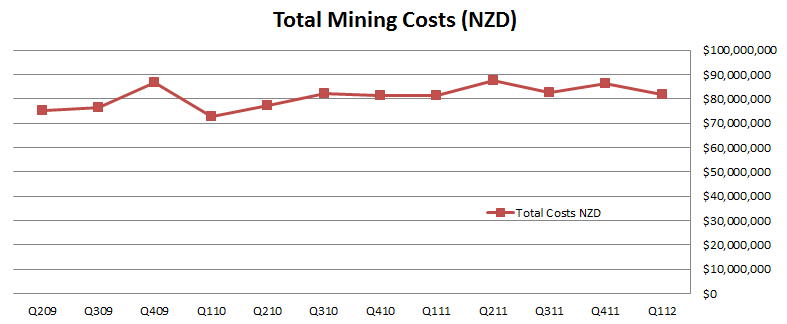
I was quite astonished by just how much of the company’s costs increases could be attributed to these 3 factors.  In fact all of it.  If you look at the total operating costs in New Zealand dollars over the last few years, including costs that were amortized as pre-stripping, they are remarkably flat.

Note that I did this work before the Q2 earnings release so it is not included in the chart.

What the chart illustrates is that this a story of a company dealing with cost pressures due to their local currency appreciating and the natural evolution of the mine plan with changing grades and changing strip ratio.

Looking ahead, I don’t expect much further appreciation of the New Zealand dollar.  With a global slowdown at hand, it seems reasonable to expect the NZD to weaken against the US dollar.  The fewer ounces produced has been a function of various issues that occurred in Q1.  There were issues at the Macraes open pit, at Fraser underground and at Reefton.  The good news is that it appears the company made progress on all fronts in Q2 (production in Q2 was 55,000 ounces versus a little over 50,000 ounces in Q1) and expects production back to normal (which would be around 60,000 ounces per quarter) by Q3.  As the above chart of total costs  indicates, costs per ounce are primarily a function of ounces produced.  A return to 60,000 ounces per quarter would show a drop in costs to about $900 per ounce.

Didipio

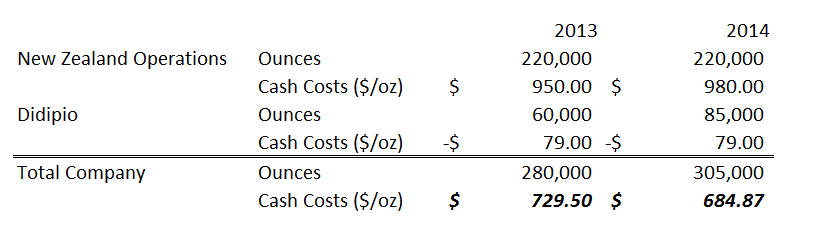
The other part of the bet on OceanaGold is the expectation that the company will be re-evaluated once the Didipio project begins to produce ounces. Because of the by-product credits from copper production, Didipio will produce gold at negative cash costs for the first few years and over the life of the mine cash costs will be substantially lower than the existing New Zealand operations.  This is going to dramatically bring down corporate cash costs.  I expect that analysts will be more inclined to give OceanaGold an average mid-tier multiple once their cash costs settle in-line with other mid-tier producers.

In the table below I have estimated the impact of Didipio on corporate cash costs in 2013 and 2014.

By way of analogy, consider Agnico Eagle.  In the first quarter (again I wrote most of this post before second quarter numbers were out) Agnico recorded cash costs of $594/oz.  Agnico’s largest mine in terms of gold production for the quarter was Meadowbank, which produced 79,000 ounces for the quarter.   Meadowbank produced those ounces at costs of $1,020 per ounce.  Taken alone, Meadowbank would be a high cost producer and receive a low multiple.  But Agnico offsets the high costs at Meadowbank with costs of $278/oz at Pinos Altos and $216/oz at LaRonde.

Looking at the latest BMO report on Agnico Eagle, I note that the company gets a cash flow multiple of 10x.  This compares to OceanaGold at 4x cash flow excluding Didipio and 2x cash flow including it.

Clearly, there is room for an upside re-evaluation.

Gold Price

The last factor that is going to determine the future direction of the share price is the price of gold.  I have some thoughts there, but I am not going to go into them in detail here.  Suffice it to say that this is the piece of the puzzle that I am least confident about.  Its unfortunate that I am so uncertain about whether gold will continue to rise or whether it will stall out and potentially fall.  Because given the other factors at hand, OceanaGold would seem to be a good place to build a large position at today’s prices.


Mr. Hyde Buys Barkville Gold Mines

I am two investors rolled up into a single portfolio.

On the one hand there is the meticulous researcher, searching out value that has been overlooked by the market.  This fellow is the investor that does most of the writing here, drawing logical conclusions from stepped out deductions and well thought out inferences.  We might call him Jekyll the Investor.

But there is another fellow that haunts these pages from time to time and who comes from a somewhat different place.  He likes to jump into more speculative positions, sometimes with no more reading then a news release, a quick scan of the company’s presentation and a few back of the napkin calculations.  While he still does more work than most do on the stocks he chooses, it is not with the same care as his counterpart.  Time is of the essence to him. He is especially attracted to gold and oil stocks that hold the opportunity of a big score, and you saw his work with the purchase of Gold Standard Ventures a couple of months ago or with the purchase of Mart Resources a couple of weeks ago (while he perhaps isn’t so thorough, he is still often quite lucrative).  We could call him Hyde the speculator.

Now to be fair, Hyde is not some sort of willy nilly gambler.  He has honed his craft with over 10 years of studying the business of getting commodities out of the ground.  The reason that he can take such quick action is because he has made enough moves, both good and bad, to develop an intuition about it.

Hyde begins to watch Barkerville Gold

I’ve had my eye on Barkerville Gold Mines (CA: BGM) for a month now.  It wasn’t a close eye, and I wasn’t really interested in buying stock in the company so much as I was curious about what they would do next.

I owned Barkerville 2 years ago for a brief one month stint when gold prices were going up and the best thing to buy was the cheapest junior with a story and a property.  I wrote about my purchase of the stock here, and then about my sale soon after here. I think I summed up my reason for being so quick to be in and then out quite well with this comment:

My experience is that you can make some money on juniors by projecting out cash flows based on a successful mine and then waiting for other people to make those same calculations.  But you are better off selling out before you test out the theory of whether those cash flows are realized.  

Mining is hard, and its pretty easy to screw up a mine and there seems to be just as many disasters as there are successes.  So unless you are willing to play this ‘greater fool’ game with your finger on the trigger, you’re probably better off in the long run with the big producer.

This is something I am trying to remember with these gold juniors we have been talking about lately.  The numbers we and the analysts are throwing about are legitimate for a trade, but don’t start believing them.

I added the bold and I think it is a sentence that shouldn’t be forgotten.  Even with mining stocks where I have the honest intention of holding through the duration of development (ala Atna), it is important to remember that numbers are just that, numbers, if things appear to be going wrong, it is always better to sell first and ask questions later.

Since that brief run I haven’t followed Barkerville very closely.  I took a quick look again about 6 months ago but was turned off by what looked like the high costs of maintaining a mill that couldn’t be delivered enough ore.   They seemed forever doomed to struggle with the high costs that come from a mill running at partial capacity.   Their eventual savior was another deposit that was unfortunately a number of miles away and that had some long-lead time permitting to be done before it could be brought to production.

I started following Barkerville again after beginning to lurk on a junior mining message board over on Silicon Investor called Microcap Kitchen Canadian Stocks.  What drew me to the board was that one of the posters, diddlysquatz, was listing companies that were trading at a price below or equal to their net cash position, and I’m always a sucker for cash on hand.

The folks on that board have been pointing to Barkerville for some time, and they have done an excellent job of picking out the run before it happened.  I saw the stock going up but I didn’t know why so I didn’t make any plunge myself.  But I was intrigued when I saw that Barkerville Gold was halted for trading Thursday morning.  I wondered if there might be some sort of merger, or maybe a drill hole, and the more cynical  part of me wondered if a diluted offering was in the works.

Well today at lunch I saw the stock trading up some 50% and it was pretty clear this wasn’t a dilutive offering.  I did a quick scan for news and almost didn’t believe what I saw.

The indicated resources, between the elevations 3,550 feet and 4,550 feet above sea level (town elevation 4,000 feet), estimated by Geoex for the Gold Quartz open pit model on Cow Mountain are 69,039,000 tons with an average grade of 0.154 ounces gold per ton (5.28 grams/T) and 10,626,100 ounces of contained gold as summarised in the following table.

In fact, I didn’t believe what I saw.  I wrote the following on twitter:

$BGM:CA Barkville resource at 10Moz? Is this for real? If it is the stock is suddenly very cheap

And while Jekyll has difficulty swallowing the thought of buying JC Penney up 2% on an up day, Hyde does not even consider that Barkerville Gold is up some 50% in the last hour when evaluating his potential purchase of the stock.  So I jumped in, albeit with a small position.

Honestly however, I’m still skeptical.  It just seems too good.  10Moz at over 5g/t of open-pittable indicated resource?  I put indicated in italics because this isn’t an inferred resource estimate.  Indicated ounces generally have some substance (I would ignore the geologic potential that the company provided, if anything it makes me wonder what they are doing here, building a resource or promoting a stock).   And at what looks like a strip ratio of a little over 1?  It seems extremely low for a pit that will contain 5 g/t gold.  I keep thinking I must be missing something, because even with the stock up some 50% on the day, it does not appear to be up nearly enough.

I took a quick look at the company that performed the resource estimate, Geoex Limited, and they aren’t some sort of one hit wonder.  They have produced estimates for Rubicon and San Gold in the past.

This is purely a speculation that there is not something here I am missing, and that the basic points of resource size, grade and strip are all legitimate estimates.  There’s no report available on Sedar yet, so I really can’t evaluate this on anything more than the numbers from the news release, which are the basic figures and not much more.  We’ll have to see what the stock does on Tuesday when it opens; if I am not missing anything, we should see it move higher.  If it doesn’t than I am probably best to assume someone knows something and that I would be better off leaving the speculation for someone else.

Nevertheless, Hyde felt it was worth a couple of bucks to speculate that the resource is indeed without a hitch.  If it is, then this stock is going much higher.
Comparing Gold Producers

Every quarter I spend an evening or two going through the reports of the 15 or so gold stocks that I follow and updating a spreadsheet that I use to track their progress and compare them against each other.

I do not use the spreadsheet in the way a strict value investor might.  I do not search out and buy the cheapest gold stock of the bunch on a cash flow metric or per ounce metric.  I do look for value, but I also look for growth.  The stock market tends  to treat gold producers in much the same way they treat any other business: stocks with superior growth potential get bid up to higher valuations.  On the other side of the coin, you can sit on what appears to be an undervalued producer for a long time if that producer has a poor pipeline of projects or has no prospects to produce near term incremental ounces.

I did exactly that recently with Aurizon Mines.  I was attracted to the value, it was cheap compared to its peers, it had a lot of cash on its balance sheet and no debt, and they have a well run and profitable operation at Casa Berardi.  Yet Aurizon does not have a strong growth pipelne.  Its closest to completion project is an open pit prospect called Joanna which, while it could one day produce a lot of gold, has been stuck in the feasibility stage for more than a few years and has the worry of requiring a large capital outlay out front.  When you add that to a number of fairly early stage exploration projects the result is a company without the near term potential to grow ounces significantly.  I sat on Aurizon for almost 6 months based on its value story and the stock went nowhere.

At the other end of the spectrum is a company like Argonaut Gold.  I owned Argonaut Gold for a while last fall but sold out way too soon.  I sold because I saw the stock was priced dearly compared to many of its peers.  However I failed to adequately account for the growth opportunities.  It was a silly oversight;  I had originally bought the stock because of the low capital cost heap leach projects that they could bring to market quickly.  Somehow though I forgot about this, got caught up in the valuation and that led me to sell too early.  The stock has since doubled to $10 before pulling back in the recent carnage that has brought all gold stocks to their knees.

When I was looking for gold producing companies a couple of weeks ago I was on the lookout for the next Argonaut Gold.  Unfortunately I have not been able to find them (if you have some ideas, please drop me a note).  In my opinion the closest comparison to Argonaut in terms of near term low capital cost growth potential is Atna Resources.  Atna has a legitimate chance of increasing their gold production from 40,000 to over 150,000 ounces in the next couple of years.  What makes Atna an imperfect comparison is that most of its projects hover around the cash cost level of $900 per oz, which is on the high side of the cash cost scale, whereas Argonaut has been able to achieve the double whammy of low cash cost low capital cost growth.

A second producer that I have bought (back) recently is OceanaGold.  I have had good luck with buying OceanaGold when the market hates them and selling when the market starts to show some love.  This time around I may hold on for a bit longer.  OceanaGold has typically been one of the cheapest gold stocks on cash flow metrics.  This is because, in part, they have struggled with costs and production at their existing mines. However, their soon to be producing mine in the Philippines (Didipio) will bring about some growth to the company, and perhaps more importantly, it will reduce the corporate cash flow numbers substantially.

One thing that got me interested in OceanaGold again was my research of Agnico-Eagle (which by the way is the third producer I own right now).  While Agnico-Eagle has had some difficulties with the closure of their GOldex mine, they remain one of the best growth stories in the industry and I believe the market will come around to forgetting about Goldex and recognizing this once again.  Agnico-Eagle owns 5 operating mines.  Of those five, one mine, Meadowbank, produces about 1/3 of the production.  At the corporate level, Agnico-Eagle has reasonably low cash costs.  They were $594 per oz in the first quarter.  However Meadowbank, the largest mine, has cash costs over $1000 per oz. On its own its a marginal mine that produces a large number of ounces.  Together with the other low cost assets that Agnico has, it receives a much higher valuation than it would on its own.

I liken this situation to the one at OceanaGold.  At OceanaGold, the corporate level cash costs should come down fairly substantially with the introduction of gold production from Didipio.  Didipio will produce a lot of copper in addition to its gold, and this will make the cash costs of the project appear to be quite low.  The cash costs of OceanaGold will not get down to the level of a company like Agnico-Eagle (the high cost mines at Oceana will continue to make up too much of the production) but I do not see it as unreasonable to think they will drop into the high $700 range.  My bet on OceanaGold is that when production begins at Didipio, analysts will begin to revalue the company on the basis of a mid-cost producer rather than a high cost one, and that should provide for some upside in the stock.

I updated the spreadsheet below over the weekend.  I did not update it during this week with stock prices for each stock tabled.  The prices are as of Friday’s close.  There has been so much movement in many of these gold names in the last couple days that the prices are already somewhat outdated.

My hope with gold and gold stocks is that this move is for real.  What I think we need to have for this move to be real is action out of Europe that brings gold back into the system.  I wrote this weekend about how, in general, the turmoil in Europe should cause weakness in paper currencies and lead to strength in gold.  On Sunday Donald Coxe was interviewed on King World News and decribed a scenario whereby gold would be used along with a value added tax as colateral for euro-bonds on ther periphery.  While I am a bit fuzzy on what  the details of such a bond might be, I believe that conceptually this is the sort of event that has the potential to create a great rally.  On the other hand my enthusiasm is tempered that if nothing is done in Europe, and if the Federal Reserve does indeed decide that QE is not working (I don’t think its nearly as clear as others do that the Fed will mindlessly embark on further quantitive easing.  The Fed is, after all, a data centric institution, and if it appears that the benefits of QE are not what was anticipated, and I believe that has been the case, they may decide that a third installment is not beneficial).

Below is my spreadsheet comparison.