Skip to content

Posts from the ‘Gold Stocks’ Category

Atna Resources: Why I haven’t sold a share

A couple of weeks ago Gecko Research (which seems to be, oddly enough, a Swedish based, Canadian Gold junior company research firm) put out a report on Atna Resources.  The report is available here.

Most of the report is full of your typical fare.  These are their properties, this is their management, yada, yada, yada.

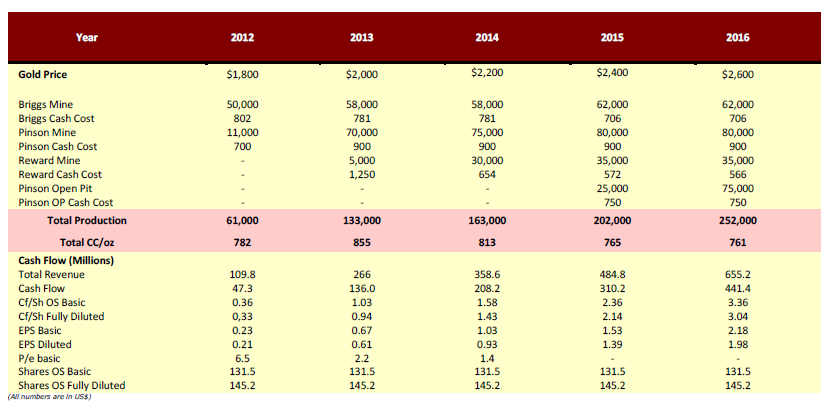
Then I got to this table:

I did a double take when I looked at the 2013-2016 cash flow numbers.  $1 per share in 2013?  Is that possible?  Could Atna really generate that much cash flow that quickly?

The work I have done

When I looked at the table and contemplated the numbers it occured to me that I had never actually looked at the year by year cash flow that the company might generate once Pinson is up and running.  What I spent quite a long time looking at was the net asset value of the company.  I did that analysis right before Christmas.

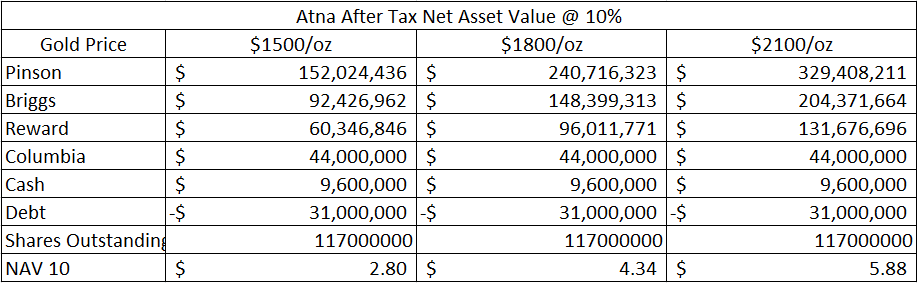
What I found out was this:

After I came up with the NAV estimates I basically wrapped up my analysis  and put it under the Christmas tree.

See, I don’t have oodles of time to do miscellaneous research.  When I get a set of numbers like the one’s in the table above, where the only conclusion that can be drawn is table pounding buy, I don’t tend to spend too much more time splicing out the details.  Atna is going to make a lot of money and that is not baked into the price of the stock.  End of story.  Go buy the stock.

Anyways that was my thinking at the time.  So I never really looked at the year by year cash flow in any detail.  Until I read the Gecko report and that made me curious.  Could it really be that high?

Looking at cash flow

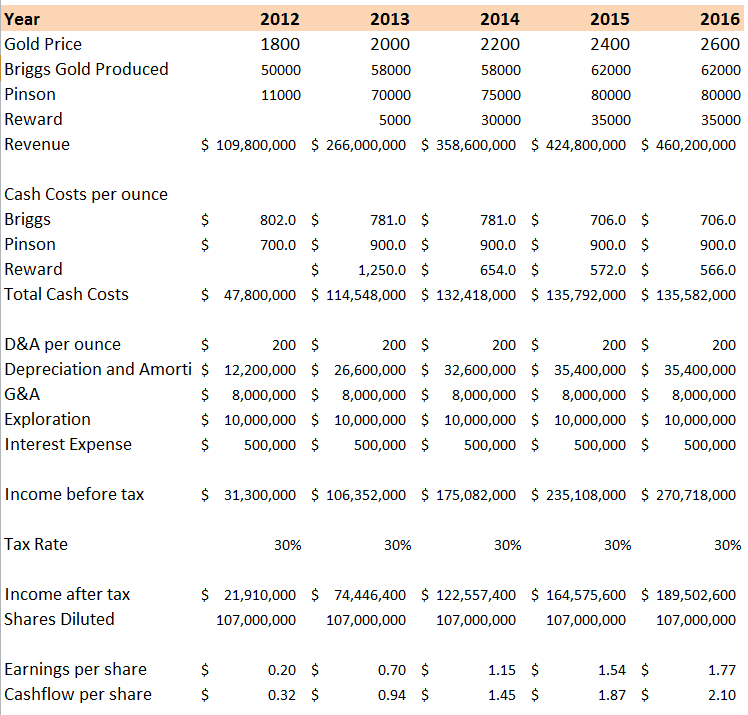
The best way to check the numbers is to run them yourself.  I took the inputs Gecko provided and created my own little cash flow spreadsheet.

The first thing that should be pointed out is that Gecko is using, to put it mildly, optimistic gold prices.  I don’t think there are any analysts out there using $2600 per ounce gold for 2016.

Second, I had to make some assumptions. For D&A I assumed a constant $200/oz produced which I think is likely going to be on the high side.  For G&A I used $8M per year, which was based off of the average of what I saw from some other companies (Argonaut, Aurizon, Allied-Nevada, Alamos), and no I did not intend to only compare the company against other companies that started with the letter A.

Exploration was assumed to $10M per year, which may be on the high side but Atna has a lot of other properties so I wouldn’t be surprised if they start working on them once they have the cash.

Taxes are based on the nominal rate provided by the company.

The results I came up with were not too far off what Gecko did.

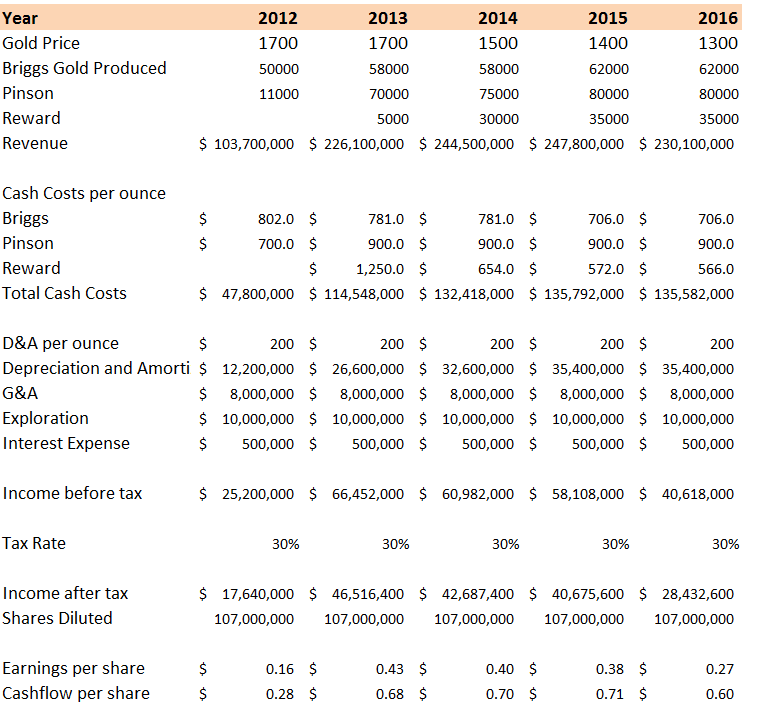
And using the BMO price deck…

Since I had the spreadsheet built I started to look at other scenarios.  Probably the most illustrative was to look at what Atna might be generating based on the BMO price deck.   The BMO price deck could be considered to be a “realistic” price deck, with the term realistic being defined as generally accepted until it is proven to be horribly wrong.

But that is for another rant.

BMO is predicting the following gold price going forward:

You still get some pretty gaudy cash flow numbers:

Financing?

Another point that was brought up in the Gecko report was the chance of a financing.  Gecko thinks this is going to happen.  I hadn’t really thought about the possibility too much until they brought it up, but I can see the logic.

Even though Atna has the possibility to grow only from internal cash flow, we think that Atna will raise money through an equity financing some time during H1/12, likely during Q1. We believe C$20 million will be sufficient to take Atna through 2012 with the development of Pinson and to fast track the studies of Pinson Open pit. This will also assure that long lead-time equipment for the Reward Mine will be ordered in time. We assume an equity raise will be done at C$1.50 by issuing 13.33 million shares.

It’s a fair point.  While they can probably squeeze by without one, they don’t have much cushion.  As long as its done at a high enough price, I have no problem with it

Haven’t sold a share

Over the past month Atna has gotten its butt kicked along with the rest of the gold sector.  It probably went too high too fast and now its come back to earth.

I don’t love gold right now. With the economy improving I can imagine that selling pressure will remain on the metal.  My favorite sector right now, the regional banks, are the antithesis of gold.  Its hard to imagine both going up together.

Yet I haven’t sold a single share of Atna.  I bought more shares when it dropped into the $1.12-$1.15 range late last week.  I don’t really expect much upward pressure on the shares until they begin to announce more news about Pinson.  In particular I think the full permitting of the project would be big news.

Aurizon Mines: Maybe growth is finally on the horizon of Aurizon

Sorry about the title.  That was a terrible rhyme.

I didn’t set off with the intent of writing a long post on Aurizon Mines this morning.  I have other research projects to spend my time on that hold more near term potential.  In particular, I have regional banks to evaluate, mortgage lenders to learn about, and mortgage lending podcasts to listen to and transcribe.

Nevertheless I must have a masochistic side because I am always more fascinated by the times I am wrong and the things that I don’t understand than with what is working and making sense.  And nothing has been wrong or made as little sense to me as the downward spiral of Aurizon Mines.

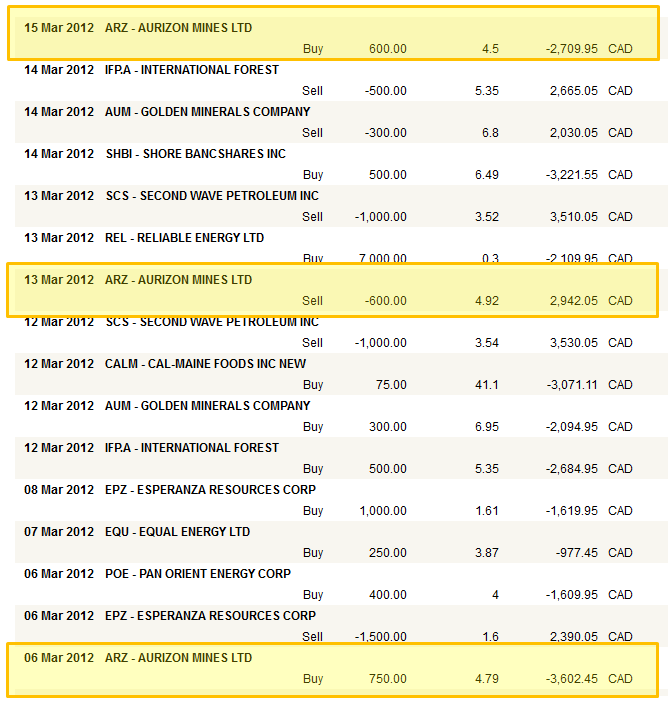
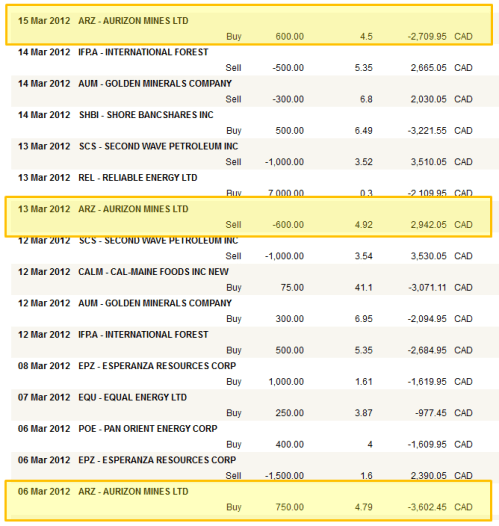
Over the past 6 months I have (somewhat unintentionally) been swing trading Aurizon Mines.  I hold a core position but around that position I buy more at or just under $5 and I sell what I buy at around $5.75 or $6.  It worked well a couple of times last year, however this year not so much.   The stock stalled out a few weeks ago at $5.50, it didn’t stay there long, and I ended up jumping out of some of my non-core position in the $5.30 range.  After that I sat as a bagholder with the rest, watching the stock tumble below $5.

In the last couple weeks I have been in and out some more, buying at $4.80, getting out at $4.9 before buying back on Thursday at $4.50.  The frequency of my indecision is telling. I clearly don’t know what to think about the stock.
To be honest, I didn’t think Aurizon would get this low.  The company holds $1.31 in cash and would be considered to be one of the lower cost gold producers. It has consistently met targets.  Its not a management disaster like so many gold miners.  These are solid operators.

The Alamos Gold Comparison

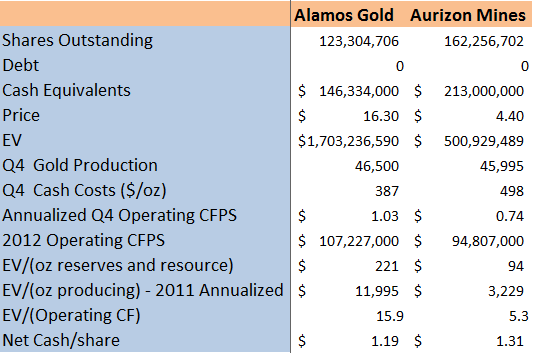
I did a comparison a few months ago between Alamos Gold and Aurizon Mines to demonstrate the disconnect.  I think it is instructive to dig up and refresh that analysis now that the Q4 numbers are out:
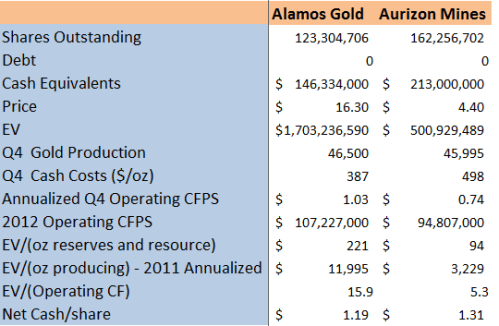
Instead of focusing on the valuation discrepancy and how the market has it wrong, I want to focus instead on why the market is willing to value Alamos at 2x to 3x the value they are willing to assign to Aurizon.

I think its all about growth and costs.

In the Alamos Q4 report, the company forecast that they would increase production from 153,000 ounces to over 200,000 ounces in 2012.  They also predicted that costs would come in about the same as they did in 2011.

In 2012, the Mulatos Mine is forecast to produce its one millionth ounce of gold. Ongoing exploration success has resulted in a track record of mined reserves being replaced. In 2012, the Company expects production to increase to between 200,000 and 220,000 ounces at a cash operating cost of $365 to $390 per ounce of gold sold ($450 to $475 per ounce of gold sold inclusive of the 5% royalty, assuming a $1,700 gold price). The Company expects that gold produced from the gravity mill, which will process high-grade ore from Escondida, will add a minimum of 67,000 ounces of production in 2012 at a grade of 13.4 g/t Au. Based on bulk sample testing conducted in 2007, the Company believes that there is the potential for higher production from the gravity mill as a result of realizing positive grade reconciliation to the reserve grade.

The high-grade gravity mill has been constructed and is currently undergoing commissioning and is expected to be operational with high-grade production by the end of the first quarter of 2012. The current life of the Escondida zone is approximately three years and exploration efforts in Mexico in 2012 will continue to focus on sourcing additional high-grade mill feed. Metallurgical testing completed in 2011 on higher grade ore from San Carlos demonstrated that it is amenable to gravity processing, potentially doubling the amount of available mill feed. Further optimization and metallurgical studies are underway in order to increase the amount of high grade ore that can be processed through the gravity plant.

On the other hand a look at Aurizon’s Q4 report shows the following outlook:

It is estimated that Casa Berardi will produce approximately 155,000 – 160,000 ounces of gold in 2012 at an average grade of 7.5 grams of gold per tonne. Average daily ore throughput is estimated at 2,000 tonnes per day, similar to 2011. Mine sequencing in 2012 will result in ore grades that are expected to be approximately 6% lower than those achieved in 2011. Approximately 42% of production will come from Zone 113, 41% from the Lower Inter Zone, and the residual 17% from smaller zones and development material.

Assuming a Canadian/U.S. dollar exchange rate at parity, total cash costs per ounce for the year are anticipated to approximate US$600 per ounce in 2012. Onsite mining, milling and administration costs are expected to average $134 per tonne, up approximately 6% from 2011 costs as a result of higher stope preparation costs and smaller stopes.

Flat production.  Higher costs.

$600 costs are not high by most gold mining standards.  With those sort of costs Aurizon would still sit in the top quartile of low cost producers.  I think that in this case Aurizon is guilty by association.  There have been SO MANY gold miners that have began to predict higher costs only to see those costs spiral much higher than was originally anticipated. The market is on guard.

The Sinking Growth Ship

As for the growth, the problem is that the company’s flagship growth project is not inspiring confidence.   I stepped through the news timeline at Joanna in a previous post.  Since Aurizon has made it a habit of updating the street with quarterly reminders of just how shitty the Joanna PEA is going to be, let’s do the same thing here.  Below is the time line of events:

May 12th 2008

Aurizon first commissioned a pre-feasibility study on Joanna.

November 11, 2009

Aurizon finally received that pre-feasibility study and proceed to a full feasibility study.

September 14th 2010

Aurizon notifies shareholders that the original recovery process assumed (called the Albion process) would show lower recoveries and higher costs than first anticipated. Additional metallurgical test work would be done and the study delayed until mid 2011.

August 11, 2011

Aurizon delays the feasibility study for Joanna again, saying: “the projected capital and operating costs appear to be significantly higher than previously anticipated. The increased scope of the project, as a result of the expanded mineral resource base, has increased capital costs, including those associated with an autoclave process. The costs of ore and waste stockpiles, tailings and of materials and equipment have also all been trending higher, along with the gold price.”

January 11, 2012

Another update giving an ETA: Feasibility study work on the Hosco deposit will continue in 2012 with completion of the study anticipated by mid-year. The feasibility study will incorporate a reserve update based on the increased mineral resource estimate announced on June 13, 2011, together with results of metallurgical pilot tests, a geotechnical study, updated capital and operating cost estimates, and other relevant studies.

As I wrote at the time:

Its been almost 4 years since the original pre-feasibility study on Joanna was complete! At this rate they should be mining by 2100.

The time line can now be updated with the latest installment from the Q4 report and the following comment:

While some studies are still in progress, based on its review of information currently available the Company believes that the feasibility study is sufficiently advanced to conclude that the projected capital and unit operating costs will be significantly higher than estimated in the December 2009 Pre-Feasibility Study, due in part to the change in the scope of the project, the expanded mineral resource base, the selection of an autoclave process and a decision to process the ore on site.

I think this is about the 3rd time the company has warned investors not to get their hopes up about Joanna.  Keep in mind that the original numbers for Joanna weren’t exactly thrifty (if I rememver right they were $200M + capital and $700 costs).

If I was going to translate this news-release-speak into plain english it would sound something like this:

It is surprising even us with how shitty this project is turning out to be

But that’s just my interpretation.  I could be wrong.

Takeover talk!

I have found 3 articles (here, here, and here) discussing a post-earnings release interview (or maybe it was on the conference call, I haven’t had a chance to listen yet) done by George Paspalas, the company’s CEO, where he said that the company has been approached by potential suitors and that the company is also looking for companyies they could takeover.

With respect to the potential for an acquisition, Paspalas said the following:

To receive the company’s interest, a target would have to be producing around 120 000 oz/y, and at similar profit margins to Aurizon’s flagship Casa Berardi mine in Quebec.  “We’ve looked hard, I can tell you that,” Paspalas said, speaking in a telephone interview from the firm’s Vancouver headquarters.   “There are a lot of companies out there…that are at a point where they have a pretty good project, but they don’t have any cash – and the shareholders are saying ‘enough’s enough’ in terms of dilution,” commented Paspalas.  “We have five or six opportunities in our grade one category,” he said, adding that one of these could close in the near-term if there weren’t any pitfalls in the technical due diligence or price negotiations process.

He went on to say that they are shifting their focus from looking at acquiring a producing mine to instead acquiring a near-term project.

The one report also said that Aurizon “has itself received informal approaches regarding potential mergers.”

Cautiously Optimistic

I think this is quite good news.  The problem with Aurizon, as I have tried to lay out above, is that the market wants growth and the market isn’t buying Joanna as the vehicle for that growth.  It’s too bad they will have to pay up a good chunk of their cash hoard to acquire a project but the argument could easily be made that the cash is being ignored by the market right now anyways.  If you remember Argonaut Gold, their adventure to double digit share prices began when the company took over Pediment Gold and with that acquisition bought themselves a stable of near term production projects.  A similar acquisition by Aurizon would be a positive.  It would allow the brokerages to start prjecting realistic growth  into the future, and from those higher production numbers they can begin to tag a higher multiple onto the stock.  Then everyone gets excited about the prospects and we all jump on the bandwagon and a couple of fund managers get on BNN and hype the stock and pretty soon you have Argonaut Gold all over again, going from $3 to $10 in a little over a year.

Its a plausible scenario.   If the takeover happens and it looks like its the right takeeover, I will no longer swing trade the stock and instead will begin to hold it for the longer term.  But without the takeover I am just not willing to put too many of my eggs in the Joanna feasibility basket, which is sounding more and more to me like it has a big hole in it.
Back into Geologix

I was out of Geologix for a couple of days (part of my sacrificial purge) but I decided to jump back in this last week after my thoughts on the liquidity situation crystallized. If we are indeed going to be liquidity driven for a time, then you might as well own the stocks most sensitive to it.

The basic premise behind Geologix remains what it was when I first bought the stock a few months ago:

The PEA that was published on Tepal a few months ago put the NPV5 of the project at $412M based on $1000/oz gold and 2.75/lb copper.  Geologix has $14M of cash on hand.  With 145M shares outstanding, the market capitalization of the company was $28M at my entry price of 20 cents.  That puts half the market cap in cash and the other half in a project with an NPV that is nearly 10x the value of the company.  Something has to give here.

The market capitalization has increased since that time but its still a fraction of the overall NPV of Tepal.  In other words, there remains plenty of room for the speculative elements to move the stock higher.

Tepal remains a fairly high start-up cost, fairly high operating cost, deposit that will only go ahead at a decent copper and gold price.  Thus Geologix is acutely sensitive to the market perception of liquidity (it needs money to build the mine) and the future (Geologix needs high metal prices to make the mine economic).  Whether it all comes together an the mine gets built is anybody’s guess, but so long as the liquidity is a flowin I believe the market will be inclined to look positively on the potential, while ignoring the risk.

New Drill Holes

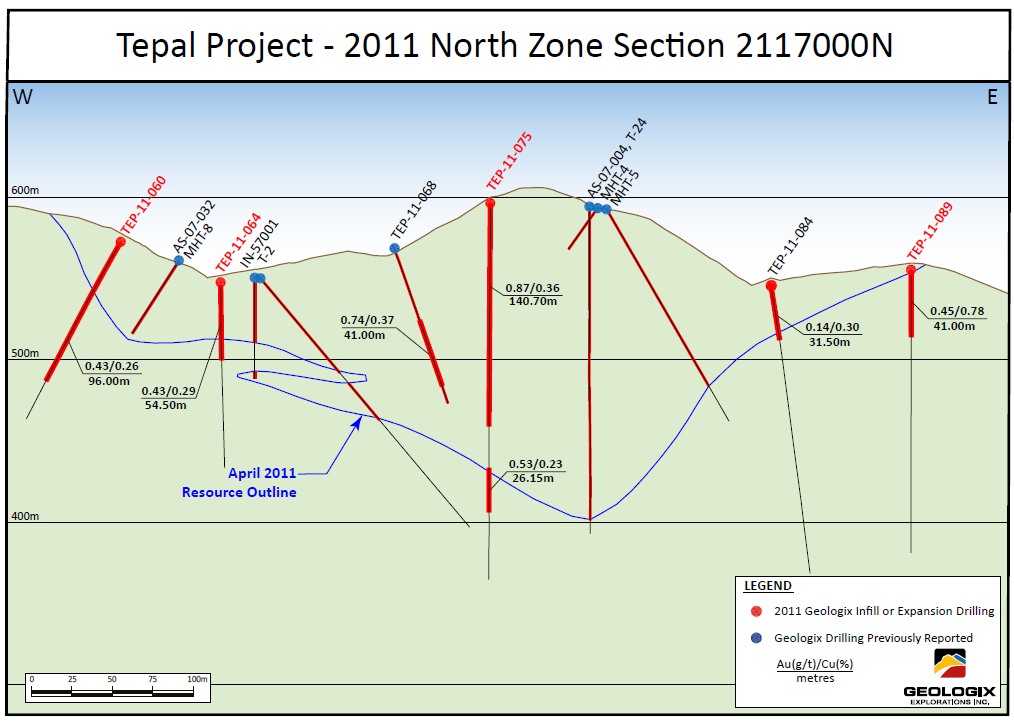
On February 16th Geolgix announced the results of infill drilling at Tepal.  There were some higher grades in these result (though we are still talking about extremely low 0.7-0.9 g/t grades).  Below is a cross section that identifies a couple of the higher grade holes against the lower grade historic holes.

As you can see from the intercepts, the deposit does hold together rather well across a long length. In addition, the North deposit, where the mining will start, takes well to the shape of a pit.  If it wasn’t that the grades were so low, it would be quite a nice little deposit.

The higher grades in these recent holes do perhaps bode favourably for better economics early on.  That could help the NPV of the project.  As stated by the CEO of Geologix in the news release:

“We are pleased with these latest results as eighty (80) of the last ninety-one (91) holes being reported encountered mineralization equal to, or greater than the Company’s internal North Zone cut-off and represent the final data required to complete the upgraded resource estimation currently being conducted by Micon International Limited. Additionally, multiple holes drilled within the central portion of the North Zone returned intervals of gold and copper grades well in excess of the 2011 Preliminary Assessment North Zone’s mine plan average grade of 0.37 g/t gold and 0.24% copper. These elevated grades found over substantial intersections support the potential for the North Zone to host a sizable higher grade starter pit which could positively impact Tepal’s production profile, specifically within the critical early years of the project’s mine life.”

Bottom Line

I’m still unsure whether Tepal will ever become a mine or not.  It just seems like such a low grade.  It will inevitably put the company on a knife edge between being profitabilty and cost overruns, and wil require an able operator with a strict eye on the budget.  Every mistake will be amplified.  Nevertheless, the mine is not yet built and so that is not really my concern.   In this period of liquidity, I am willing to put some dollars into Geologix on the expectation that the market will push the stock back up to its pre-euro-crisis levels in the 60 cent range.   This does not seem unreasonable given that the case can be made that in a perfect world Tepal would be worth $3 per share.  Its kind of like Greece and the rest of Europe: why worry about tomorrow before its here?

The story of gold supply and demand

A couple of weeks ago I said that I needed to get a better handle on the supply and demand dynamics that were driving gold.  I thought it would help me from my constant waffling of late; into and out of the gold stocks with every move up or down in the price.

Well it remains to be seen how much it helps with my waffle (I was pretty darn close to dumping OGC, AUM and CAN on Friday morning), but I did the work and here are the results.  I used data from the World Gold Council for all the estimates.

Its all about Asia

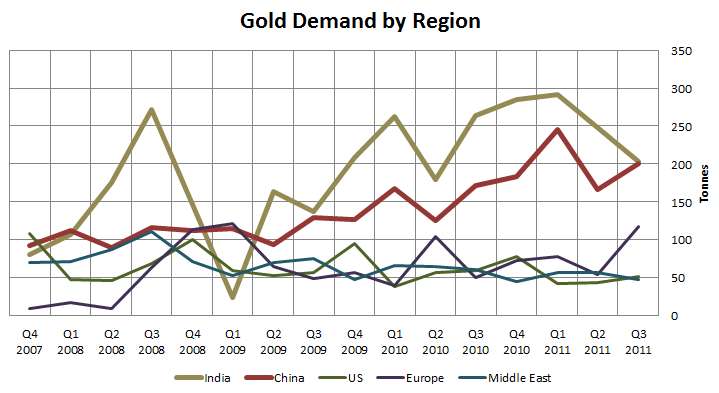
So the first thing that I was a little surprised by was by just how much India and China mean to the market.  I mean for all practical purposes, India and China are the market.  Take a look:

Maybe this helps explain why when gold keeps getting hammered down intraday here in North America, those moves to the downside can’t gain any traction.  When you think about it, the big, sustainable moves down of late have all come overnight.  The main reason I didn’t include a number of my gold stocks in my sacrificial orgy on Friday was because it seems to me that someone is doing their best to bring gold down, and isn’t having much luck with it.  The outsized influence of China and India on the demand side show why.

The other point to make, just in passing, about the above chart is that Chinese demand is a lot more stable than Indian demand.  If I had to pick out who was at the margin here, I’d have to say it was the Indians.

The jewellery buffer

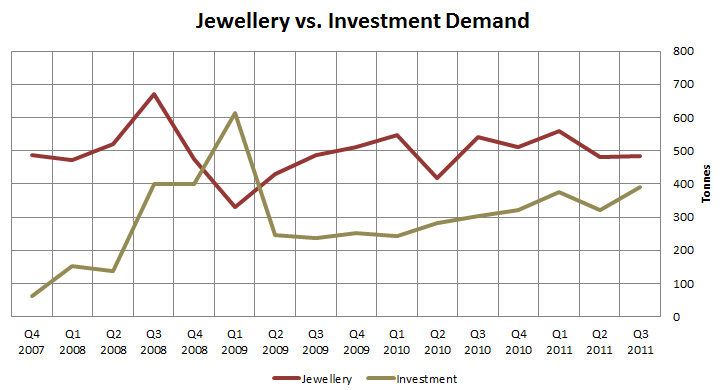
This second chart isn’t really telling a surprising story. Its just confirming the one we know, and that is that investment demand is driving demand increases.

A couple of more nuisanced comments about the chart.  First, the chart is in tonnes.  So what you say?  Well if jewellery demand is flat in tonnes it is “to the upper right” in dollars.

Look, when you go out and decide to buy a piece of jewellery you don’t say to yourself “well I think I will by a 0.1 oz gold ring.”  You say, “I think I will buy a $300 gold ring”.  The point is that the key metric for understanding jewellery demand is probably not mass.  Its dollars spent.  And if demand in tonnes is flat, then demand in dollars spent is going up pretty substantially.

If you put this together with the previous fact that much of the demand is coming from developing Asia, you are left with the conclusion that there is a rather firm underpinning of jewellery demand brought on by the rising wealth of the Chinese and Indians.  If the gold price ever stalls out for a year, or heaven forbid goes down, I would expect to see a substantial uptick in jewellery demand as those increasing “dollars spent” buy more gold.

I think you can look at jewellery demand as a big old damper.  If prices go up too fast than the dollars spent number isn’t increasing in concert and so you see a reduction in demand from jewellery.  If, on the other hand the price goes down the opposite happens, and jewellery demand puts a floor under price as the same dollars spent buys more tonnage.

Mine supply versus recycled supply

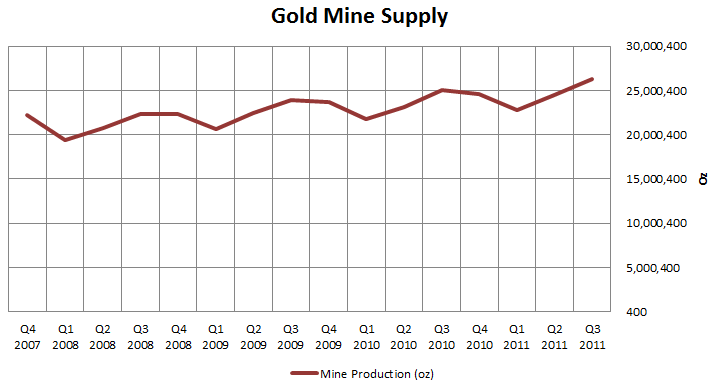
Last chart.  Mine supply.  First thing about mine supply is that all the data is in tonnes and no one I know thinks about the amount of gold a mine produces in tonnes, so this chart is in ounces.

Does anyone else think its kind of wild that there are only 25 million ounces of gold produced every year.  You could basically fit a whole years production of gold into one of those big 500 tonne mining trucks.

Second, supply is growing.  It is growing, but mine supply alone does not match demand.  Mine production was 746 tonnes in the third quarter.  Recycled production was 427 tonnes.  So recycling of gold makes up almost 50% of the total supply.

Again this is all about what is the drive at the margin.  Clearly its the recycled gold that is going to come when gold prices go up and go away when gold prices go back down.  Just as with jewellery demand, this is another great dampening factor.  Somewhat more intriguingly, one has to wonder if a point will be reached where the recycling has run its course, or at least all the easy recycling has been done.  No signs of a drop so far, but one could point out that even with vastly higher gold prices, recycling has been pretty flat for the last couple years.