Skip to content

Posts from the ‘Gold Stocks’ Category

Letter 24: Risk and Reward, Atna Analysis, More Community Banks
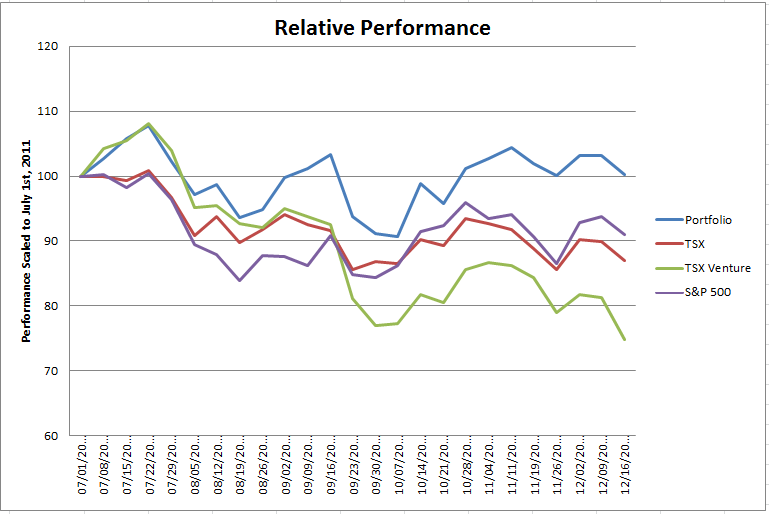
Last week I wrote that I did not understand why  the market was reacting as favourably as it was to the European proposals that came out of the Dec 9th summit.

A tweak here, a tweak there and pretty soon you have… well not a whole lot to be honest.

In a way I felt vindicated  by the market collapse that occurred in the early part of this week.  In another way I felt sick to my stomach, because though I have been creating an evermore conservative weighting to my portfolio, when the shit hits you still feel it.

Kyle Bass was on CNBC this week giving some more detail on his doomsday-like expectations:

The observation that deposits are leaving Greek banks at an annualized rate of almost 50% is somewhat frightening.  Clearly this crisis is going to come to a head soon.

John Mauldin publishes a great conversation between Charles Gave and Anatole Kaletsky.   It is quite provoking, and its hard to walk away after reading it without feeling the impending doom that awaits the Eurozone.  Kaletsky and Gave both make the quite reasonable point that perhaps Germany would prefer a break-up of the Eurozone.  If you watch what Germany is doing, and ignore the platitudes they are saying, you might question their motives.  Kaletsky points out that of the necessary measures to fix the Eurozone, Germany seems to be steadfastly opposed to both Eurobonds and to ECB intervention.  Absent those  measures, what hope does the Eurozone have?  Perhaps that is the plan all along.

Gold Stocks – I should went all out

Gold stocks got CREAMED this week.  I had been lightening up on my gold stocks the week before in anticipation that something might be about to hit.  I didn’t like the way gold was going, I didn’t like the fact that the WSJ was penning articles describing a dearth of Indian demand, and I didn’t like that Draghi talked tough during the EU summit, suggesting that money printing was still some time off.

Nevertheless being that I was not fully out of gold stocks, I got smacked about pretty good over the course of the week.   Atna, Aurizon, and with Lydian all performed quite miserably.

What’s Wrong with Aurizon?

Aurizon is a surprise to me.  I expected the stock to hold up better than it has been.  I might have expected its performance to be closer to that of Alamos.  Both are low cost producers.  Both are single mine operations.  Yet the valuation difference between the two is somewhat staggering.
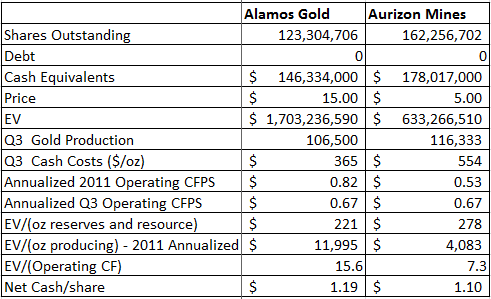
I can only guess that there is a strong seller of Aurizon out there that wants to be out of the stock by year end.  I can only hope that the new year will bring some sanity to the stock.

While reviewing Aurizon, I began to wonder how much having a AMEX listing hurts the stock.  Anecdotally it appeared to me  that the Canadian stocks with AMEX listings are much more volatile then those without.  I decided to take a closer look.

I grabbed price data since August 1st for 9 stocks, 5 with AMEX listings and 4 without.  From the web I grabbed a visual basic function that calculates volatility based on the following Black-Scholes formula.

For purposes of Black-Scholes calculations, volatility is the standard deviation of the periodic percent change in prices, divided by the square root of time.  Volatility is emphatically NOT the same as “beta”, which measures the correlation of a security’s price movements with those of the overall market.  Neither is volatility simply a measure of the standard deviation of a security’s closing prices over time.

Here is the volatility of each security:

Is there a correlation?  Perhaps, though its not as clear a one as I had suspected.   The distinction is most clear between Aurizon, Alamos and Argonaut Gold.  There is no reason, in my opinion, that Aurizon is so much volatile than these other two stocks.  But apart from that, volatility seems similar between stocks on the two indexes.

I bought back some of the shares of Aurizon at $5.07 that I had sold at over $6 a few weeks ago.

The NPV of Atna

Another stock to get clobbered this week was Atna Resources.  I mentioned a couple weeks ago that I had finished an analyses of the company and would post shortly.  I never did that post, until now.

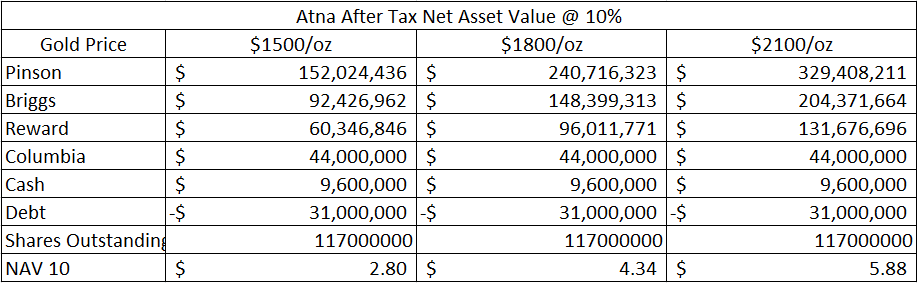
Below is the after tax NPV10 that I calculated for Atna at various gold prices.
I based my model on the following assumptions:

Briggs:

  • A 11year mine life, at 40,000 t/d
  • Total produced ounces of 476,000 oz over LOM
  • 0.017 oz/t resource over the mine life, strip ratio of 4 and with 80% recoveries
  • Resulting in gold production of  39,700 oz per year
  • Mining costs of $1.30/t mined, milling costs of $4/t milled and G&A costs of $1.7/t mined
  • Cash costs of $898/oz over LOM

Pinson:

  • A 15 year mine life, beginning at 350t/d and ramping to 750t/d by year 4.
  • Total produced ounces of 940,000 oz over LOM
  • 0.4 oz/t resource over the mine life, diluted by 30% with 90% recoveries, resulting in gold production beginning at 50,000 oz and ramping to 75,000 oz.
  • Mining costs of $110/t, milling costs of $50/t and G&A costs of $11/t
  • Cash costs of $687/oz over LOM

Reward:

  • A 8 year mine life, at 24,000 t/d
  • Total produced ounces of 292,000 oz over LOM
  • 0.026 oz/t resource over the mine life, strip ratio of 4 and with 80% recoveries
  • Resulting in gold production of  36,400 oz per year
  • Mining costs of $1.30/t mined, milling costs of $4/t milled and G&A costs of $1.14/t mined
  • Cash costs of $560/oz over LOM

Columbia and Cecil:

  • To the current resource of each I assigned a simple asset value per ounce of $40/oz measured and indicated and $20/oz inferred on the total resource of both properties

Atna is, in my opinion, is one of the best gold stock investments out there.  As demonstrated above, the stock is trading at about 1/3 of its NPV 10 at $1500 gold.  If I wanted to get more aggressive in my evaluation, I would note that many companies are moving to value feasibility on NPV5.  On an NPV 5 basis Atna is worth $3.86 per share at $1500/oz gold.  That number jumps to almost $8 per share at $2100/oz gold.  Clearly there is upside once the momentum begins to build.

I added to my position in Atna on Friday at 78 cents.

Taking Advantage of the Collapse

In addition to Atna and Aurizon, I also added new positions in a few juniors.  Call it the beginnings of a basket; I added a couple of non-producing juniors with deposits to my portfolio this week:

Geologix was recommended by Rick Rule as a takeover candidate on BNN about a year ago.  Since that time the stock has fallen significantly.  The company has a very low grade copper-gold deposit called Tepal in Mexico.  The PEA that was published on Tepal a few months ago put the NPV5 of the project at $412M based on $1000/oz gold and 2.75/lb copper.  Geologix has $14M of cash on hand.  With 145M shares outstanding, the market capitalization of the company was $28M at my entry price of 20 cents.  That puts half the market cap in cash and the other half in a project with an NPV that is nearly 10x the value of the company.  Something has to give here.

Esperanza Resources is another old Rick Rule recommendation.  Rule doesn’t talk much about specific stocks anymore, but there is some evidence that he is still interested in the company.  http://www.investmentu.com/2011/September/why-gold-mining-stocks-will-skyrocket.html .  The company certainly fits the bill of the sort of stock Rule likes.  Esperanza has 1Moz of gold in Mexico.   It’s a heap leach project so it should be able to be brought on production without a massive capital requirement (about $100M).  Like Geologix, the company has almost half its market cap ($100M) in cash on hand ($50M).

I plan to add more to both of these stocks in the coming weeks.

Regional Banks: A  Position in Community Bankers Trust

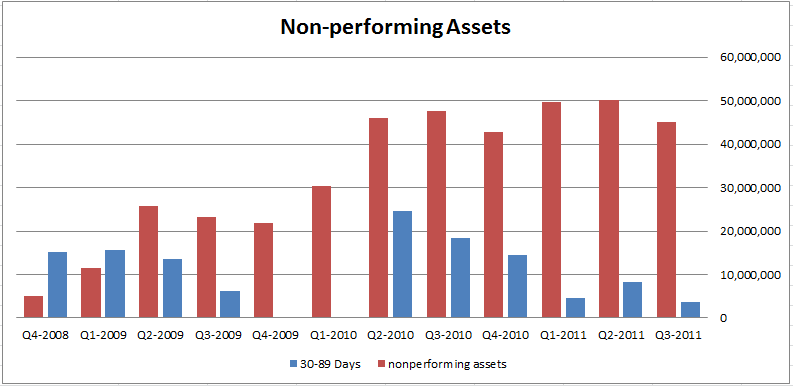
Community Bankers Trust (BTC) hit my bid when it sold off back down to a dollar this week.  BTC is trading at 27% of tangible book value.  This is, of course, partially because of the large number of non-performing loans on their books.  Non-performing loans make up 8.9% of total loans in the Q3 quarter.  This was down from 10.1% in Q2.  In fact, there are some encouraging signs that the worst of the loan losses are behind us.  The company has shown 3 quarters of lower loan amounts 30-89 days past due.  This trend is beginning to show up in the total non-performing loans, which decreased for the first time in a year in Q3.
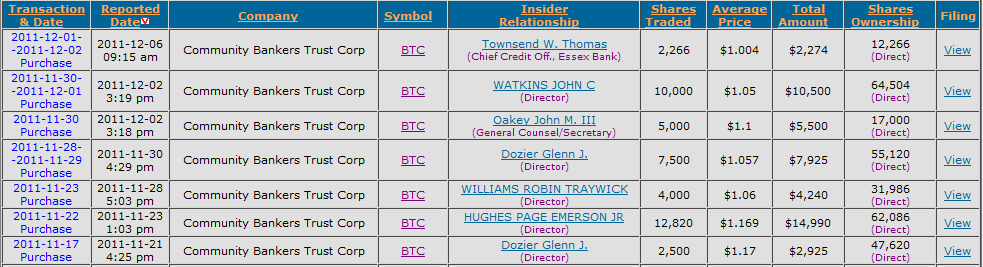
Moreover, as I have pointed out previously, insiders continue to buy the stock.  Third quarter purchases by insiders were a little less than $50,000.
And Another Regional Bank Position in Atlantic Coast Financial

To be perfectly honest, I might have made a mistake here.  I’ve only put a very tiny amount of capital at risk, but even that may have been too much.   Atlantic Coast Financial (ACFC) is a lottery ticket.  I bought the stock at $1.70 on Friday.  There is just as much chance that it will go to zero as there is that it will double.

ACFC is a former Mutual Holding company that did their second step bank in February.  The second step added cash to the balance sheet and resulted in a bank trading well below book value.  ACFC trades at a rather crazy 10% of tangible book.  Clearly there is more to the story.

The more to the story is that the bank is centered in Jacksonville Florida.  They primarily make residential real estate loans.  Real estate in Jacksonville has not done particularly well over the last few years (though it appears to be bottoming).
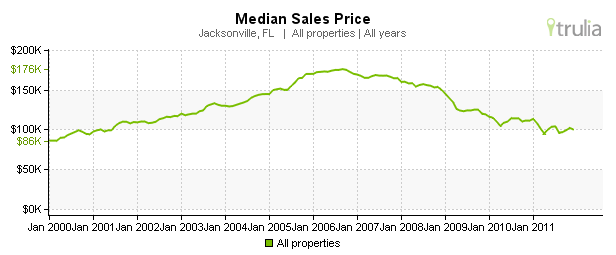
The falling real estate prices have led to skyrocketing non-performing loans.  Those non-performing loans have not shown any sign of peaking yet (thus the possible mistake on my part).
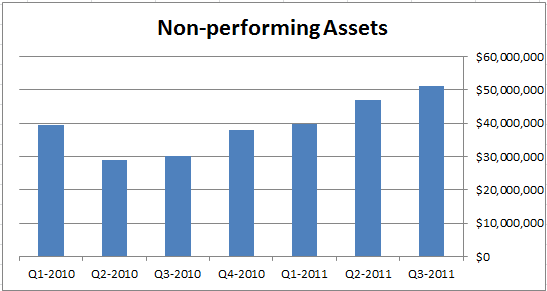
The questions are, how many of these nonperforming loans will eventually be written down, and will there be value left in the equity once the non-performing loans are written down.

What drove me to take a small position in the stock was in part that an improving economy, and stabilizing home prices in Jacksonville, may mitigate further deterioration of the bank assets.  As well, the bank is generating decent earnings before provisions.  Ignoring provisions in Q3, the bank earned $1.16 per share.  In Q2 that number was $0.55.

What is going on at ACFC is something akin to a tug-of-war, whereby on the one hand loan losses strip away value every quarter, while on the other earnings power of the performing loans adds value back.  The share price is so low that it doesn’t take much a a shift in the dynamic between these two forces to change the value equation substantially.  Its easy to see how a stabilization in non-performing loans could quickly allow the earnings power to win the race and shareholder value to go up substantially.

The other factor in my decision to buy was the recent announcement that the company was looking into strategic alternatives.

On November 28, 2011, Atlantic Coast Financial Corporation issued a press release announcing that its Board of Directors has engaged Stifel, Nicolaus & Company, Incorporated to assist the Company in exploring strategic alternatives to enhance stockholder value

Part of the reason that the company is looking for options is that they are not in compliacne with the Individual Minimum Capital Requirement (IMCR) agreed to by the Bank with the Office of Thrift Supervision on May 13, 2011.  Under the IMCR, ACFC agreed to achieve Tier 1 leverage ratio of 7.0% as of September 30, 2011. Tier I capital at the bank is 6.22% right now.

It is a far from perfect scene.  Nevertheless, an improving US economy and stabilizing housing prices could give me a decent return on the stock.  The book value of $19 is unrealistic, a return to $3 is not.

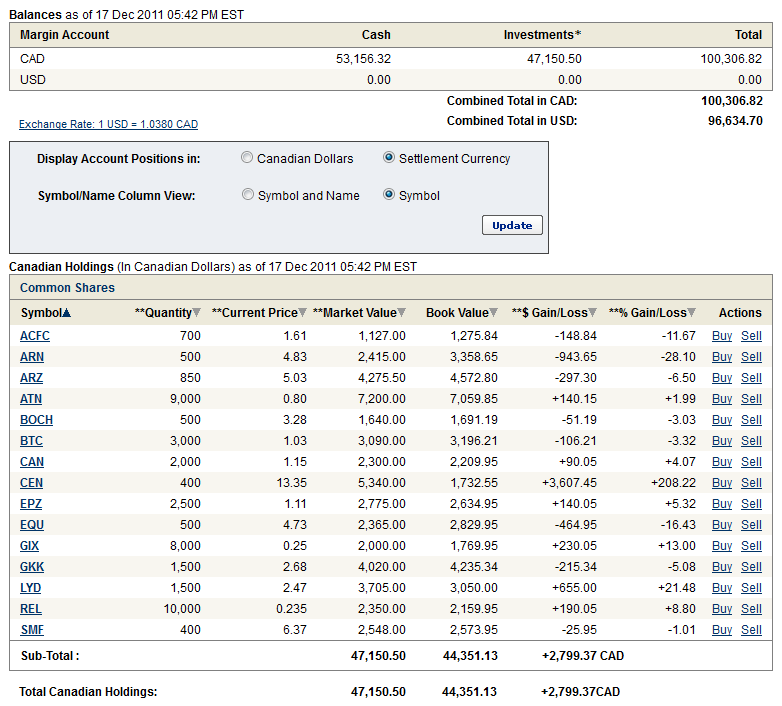
Portfolio Composition
Stepping through the NAV of Aurizon Mines

The following post, originally published on November 23rd, 2011, has been updated to reflect the calculation of NPV after tax rather than being limited to before tax treatment only, as was the case before.

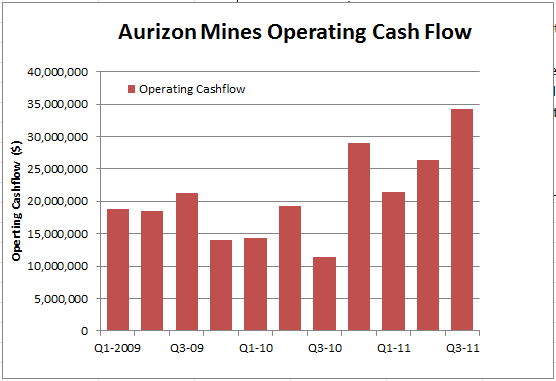
A couple of days ago I looked at the current cashflow generation capacity of Aurizon Mines. Contrary to popular market opinion (Aurizon continues to drop as though it would be bankrupt at $1500 gold), from my analysis I concluded the following:

  • …about 20% of Aurizon’s market cap is in the form of cash on the balance sheet. The enterprise value of the company is only $740M after subtracting this cash. Annualizing the last four quarters, the company is trading at about 9x its free cash flow generated. That would be using an average gold price of about $1500/oz.
  • Looking at the company on the basis of free cashflow, if you annualize the third quarter, where the realized gold price for Aurizon was $1695/oz, the company is generating free cash at a rate of $104M a year. This puts the company valuation at a little less than 7.5x free cash flow.
  • On an operating cash flow basis, in the last four quarters (when there has been an average gold price of $1500) Aurizon generated $111M of operating cash flow This gives the company a 6.6x EV/opcf multiple for the ttm. If you annualize the third quarter operating cash flow alone you get $136M, which leads to an EV/opcf multiple of 5.4x.

So those are some basic conclusions that can be drawn based on production, revenues and costs. Now I want to expand the analysis to look at what net asset value of the company.

To look at the NAV I am going to sum up all the parts of the company, subtract any liabilities and debts and then divide by the shares outstanding to estimate the value of the assets on a per share basis.

Let’s start with Casa Berardi.

Casa Berardi

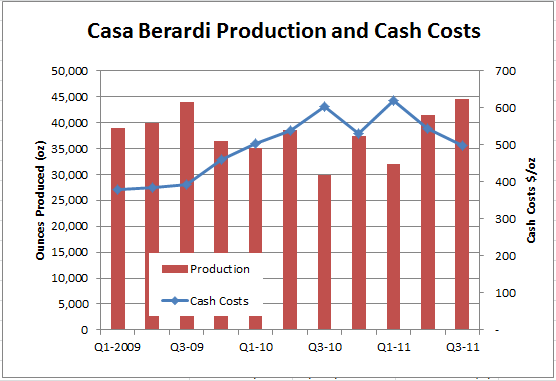
Casa Berardi is Aurizon’s single producing mine.  Casa Berardi has been a steady producer over the last number of year, both in terms of produced ounces and costs.

In the current environment which has been wrought with gold companies missing cost estimates, it is particularly impressive that Aurizon has been able to actually reduce costs for the last two quarters.

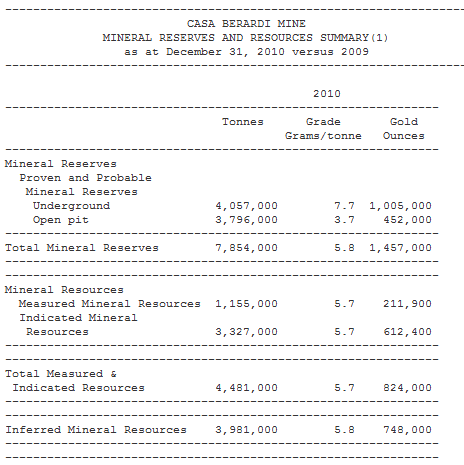
Casa Berardi has the following reserves and resources

Note that some of the resource is open-pittable. The expectation is that the open pit production will begin near the end of the underground mine life when the underground is no longer supplying sufficient ore to the mill.

On March 31st Aurizon filed an updated technical report on Casa Berardi that looked specifically at the feasibility and economics of the open pit.  That report can be found on Sedar.  I have used the data in that report extensively to come up with my own estimates.

In the report the evaluators, Roscoe Postle, only considered mineral reserves for both the underground and open pit when determining the production schedule. I believe this is too conservative. I have instead incorporated 70% of the measured and indicated resource in my production profile. I have included none of the inferred resource. I believe that I am being conservative in these assumptions.

The inferred and  M+I resource that I did not include in the production profile will be added to the Aurizon NAV  based on a $/oz valuation.  These ounces will have a lower value than those included in the production model, but still have some value assigned to them.

Because some of the M+I resource was added to the production profile, the profile I used is not the same as what was used by Roscoe Postle. I basically spread out the open pit production over twice as long of the period, and overlapped the production with a reduced but extended production profile from the underground. The specifics of how Aurizon eventually will sequence the underground and the open pit are a guess to me, but I don’t think that they will dramatically effect the result I am trying to achieve, which is to understand the NAV of the company.

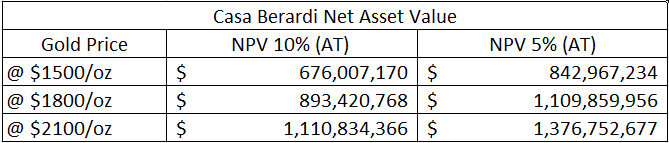
I determined the following after tax (AT) value for Casa Berardi:

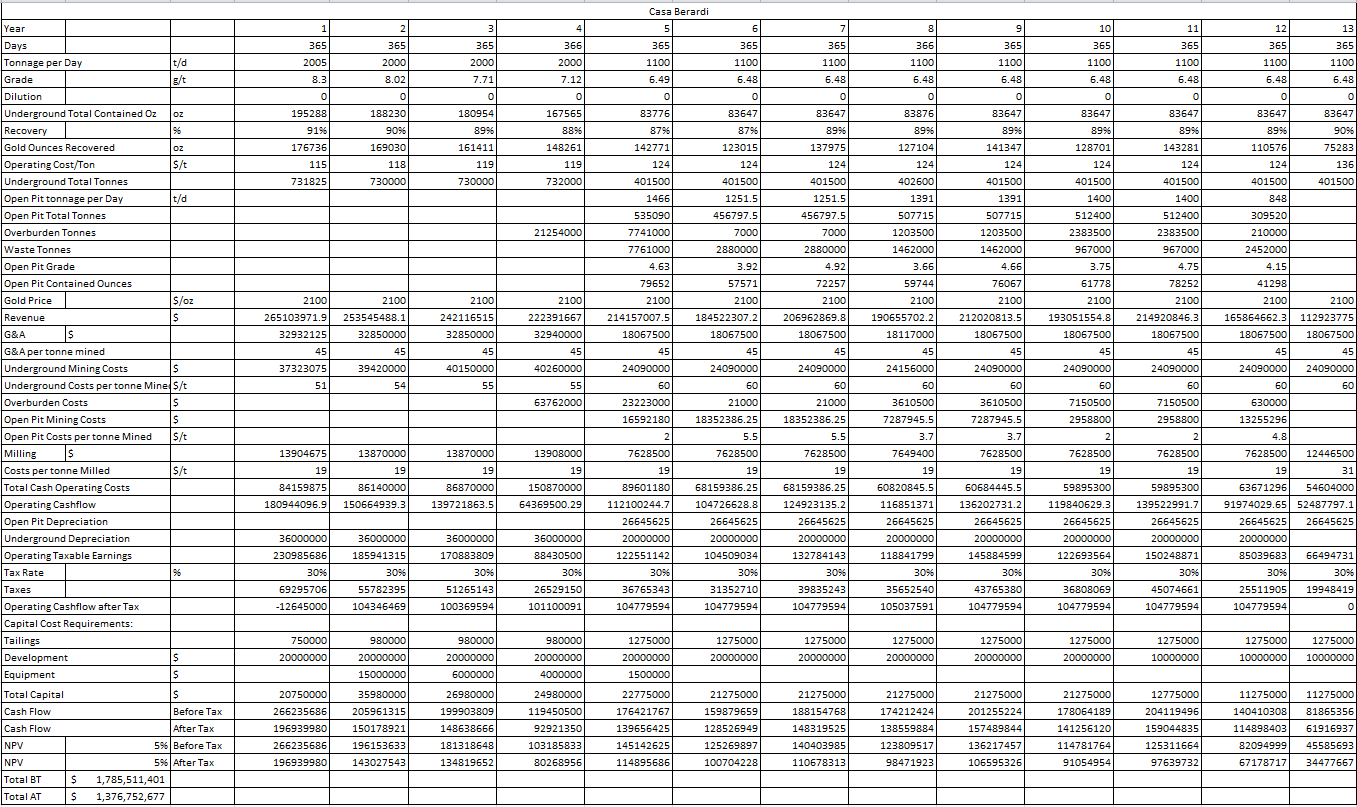
The details of the spreadsheet I used to come up with the estimates is provided below.  The cost and processing assumptions are almost exclusively based on the Roscoe Postive report. The grades of the underground are based on the grades expected from the mine sequencing of the current reserves, and the stated grade of the M+I resource.  Open pit grades are from Roscoe.  Taxes are determined based on a 30% tax rate (includes provincial and federal tax) with depreciation deducted from the before tax income.

Joanna

Aurizon has an advanced stage development project called Joanna. The company is completing a feasibility study on Joanna as we speak. The feasibility study has taken a bit longer than anticipated because it was originally expected thta Joanna would mine the ore, form a concentrate, and then ship the ore to Casa Berardi for final processing. Aurizon got about half done the feasibility study using this assumption before the drilling results at Joanna forced them to re-evaluate. The company is now producing a feasibility study that includes full mill and processing circuit on-site.

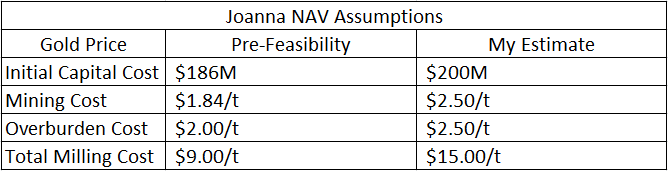
My analysis tries to incorporate this new on-site milling. The mining and base milling assumptions were determined from the pre-feasibility study that was done for Joanna December 22nd 2009. However I updated a number of the capital and operating cost numbers to better reflect both the cost increases, the mill on-site, and to add some conservativeness. The differences are listed below:

I am probably being conservative with all these assumptions.  I’ve hiked the numbers rather substantially.

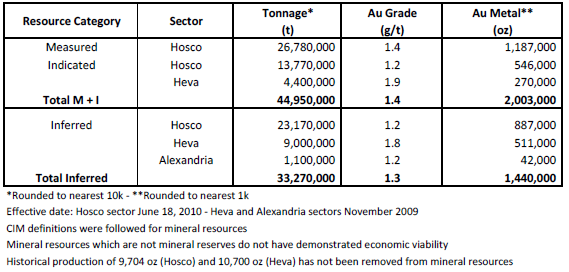
My analysis assumes ultimate production of 1.4Moz of in-situ gold (pre-recovery).  This compares with the following estimate of gold resource at Joanna.

Clearly I am being conservative in basing my work on a 10 year mine life and 8,000t/d.  There appears to have at least 2Moz and potentially 3Moz of gold in-situ.  And the deposit remains open to more exploration.

As with Casa Berardi, any M+I or inferred resource not included in the production profile will be given a valuation based on a per ounce estimate.

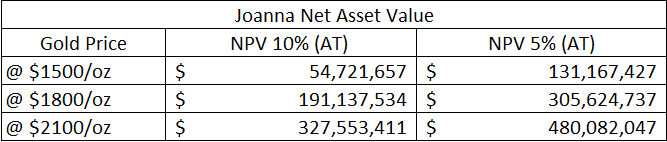
Like Casa Berardi, I looked at 3 gold price scenarios; the trailing four quarter gold price ($1500/oz), the current gold price $1800/oz, and a future possible rise in the gold price ($2100/oz).  Below is the before tax NPV of Joanna under each scenario.

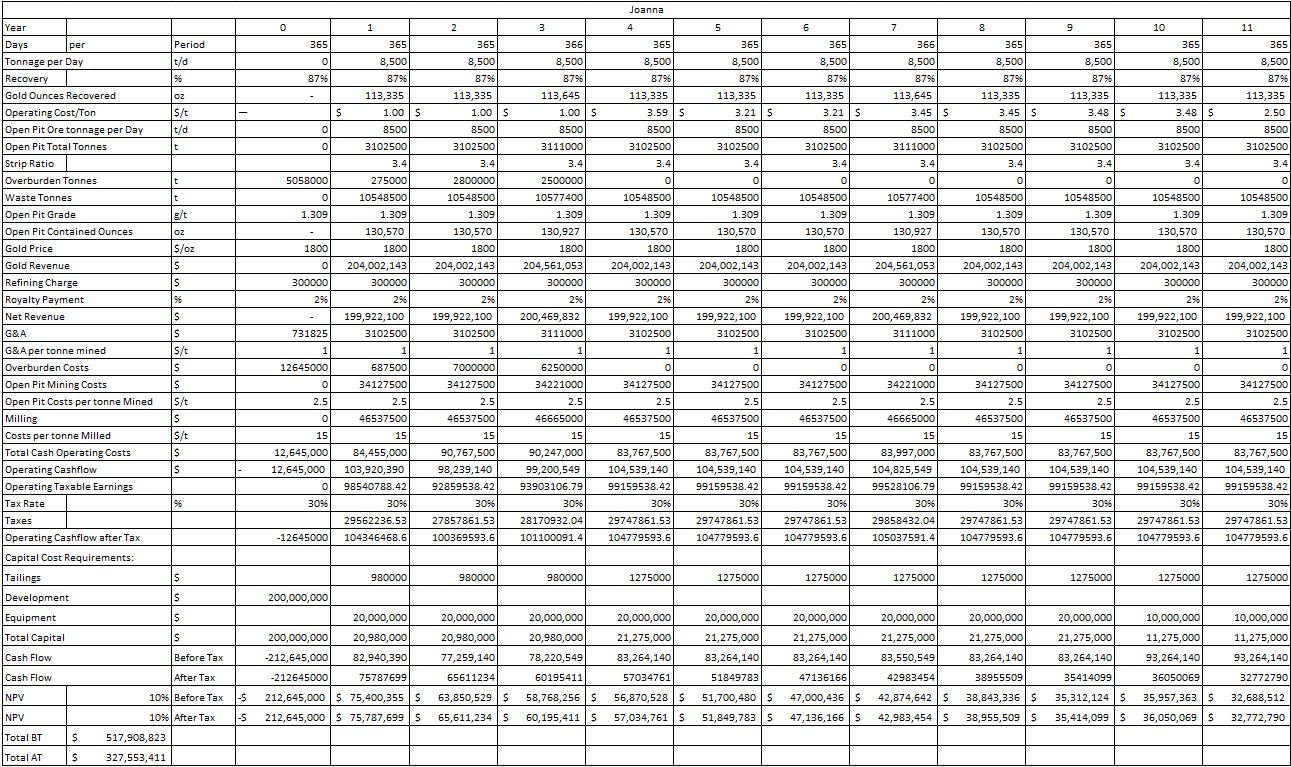
The details of the spreadsheet I used to come up with the estimates is provided below.

Other Projects

Aurizon is involved in a number of other much earlier stage development projects.  There of these already have legitimate (albeit small) deposits.  There is exploration work being done on all three of these projects to increase the resources.  I am not going to include any of the potential in the NAV calculation, but  I will include the current resource value.

Because these projects are still years away from a feasibility type study, and because they represent a very small value in comparison to Casa Berardi and Joanna, I have chosen to value them on a very simple $/oz basis.  In the case of Marban, as part of the earn in Aurizon has to pay $30/oz M+I and $20/oz inferred for 50% of the ounces defined in the final NI 43-101.  That is why I have assigned a lower value to ounces in the Marban-Norlartic deposits.

The total value to Aurizon of these projects is about $12M.

At this point we will value the ounces that were not included in the production profile at Casa Berardi and Joanna.  The value of each ounce is somewhat arbitrary.  It really represents a risked value of what the NPV10 of that ounce would be if produced.  M+I resource is worthe more than Inferred resource.  Similarly, Casa Berardi ounces would need to be worth more than Joanna, because with a mill already built on-site and a mine in production, the risk profile of an ounce at Casa is less than at Joanna.  Another consideration is the price of gold that ounce is being valued at.  In the table below I have considered all 3 variables in my determination of the value of each ounce.

There are a number of sources that can be used to determined the average value of an ounce in the ground.  All are bound to be wrought with error bars.  One such study, performed by Edison Investment Research, drew the following conclusions:

we have been able to determine that the average value of a ‘measured’ resource ounce globally is US$340/oz, while that of an ‘indicated’ ounce is US$159/oz and that of an ‘inferred’ ounce is US$34/oz

Another study, published by Casey Research, determined some slightly lower numbers, though I suspect this was because the CaseyResearch team was mostly focused on junior exploration and development companies, or in other words companies that do not yet have a mine built, and where therefore the value of each ounce should be expected to be somewhat less:

1. Inferred: US$61.20 per ounce (up 179.5% from Dec 2010)

2. M&I: US$69.30 per ounce (up 56.4% from Dec 2010)

3. P&P: US$232.70 per ounce (up 1% from Dec 2010)

My estimates are quite conservative.  They can be seen below as a function of the gold price they are being evaluated at.

Adding it all up

The last piece of the puzzle before we add up the numbers is corporate expense.  This has been fairly consistent for Aurizon at around $15M.  I assumed a continuation of the $15M expense going forward over the 11 year mine life of the production profile I developed for Casa and Joanna.

I did not include the NPV of any exploration expenses that Aurizon will incur in the future.  I did not think it was correct to include these expenses without being able to estimate the offsetting assets they create.  Obviously we can’t hope to know what the drilling may find, so I decided to leave this expense out of the calculation entirely.

As noted above, Casa Berardi and Joanna production profiles all assume a 30% tax rate to net mining profits.  No tax rate has been assigned to the valuation of “other ounces”.  It is assumed that the $/oz number that is used for those ounces implies the value of the ounce after tax.

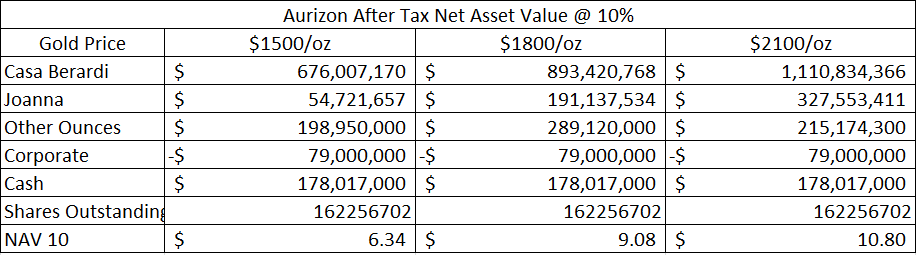
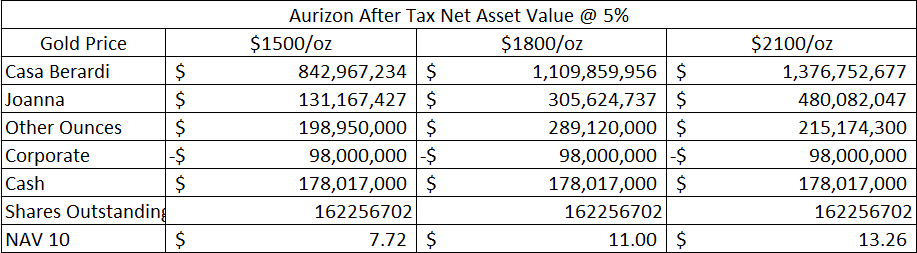
The individual parts can now be added up to determine the net present value of the company at various gold price scenarios.  This is shown in the two tables below, first discounted at 10% and then discounted at 5%.

A couple observations about the final result:

  • The valuation of the company is quite dependent on the price of gold.  The net asset value of the company varies by almost 50% depending on whether the valuation is done at $1500 gold or $1800 gold.  Perhaps the violent swings in the share price with each $10 move in the price of gold are not as unwarranted as I have thought?
  • The numbers vary significantly with the discount rate.  There is a 20% swing depending on whether you want to discount at 5% or 10%.  I think what this really puts in perspective more than anything is just how subjective the valuation can be.
  • Based on my assumptions, Joanna isn’t worth that much at $1500 gold.  But my asumptions are likely wildly conservative compared to what Aurzion’s upcoming feasibility study will show.  Why?  My production profile for Joanna did not include about 2Moz of resource.  I ended up valuing those ounces separately at a much lower amount.  If you add them to the production profile the value of Joanna would rise by 40-50%.
  • Aurizon is fairly priced in the $6-$8 range if you believe in $1500/oz gold for the long term.  Aurizon needs to move well into the double digits to begin to price in $2000/oz plus gold.

Overall, the work gives me confidence that there is unrealized value with Aurizon, and that if and when a gold price of $1800/oz begins to get accepted as a sustainable one, the price of the stock should move up significantly to reflect that.

A Rick Rule Example: Aurizon Mines

“Top mining companies are finally generating dramatically higher profit margin. Free cash flow is now “gushing” and will double in the next year as huge capital investments by the majors pay off.

That quote comes from a recent interview with investor Rick Rule.

The observation that gold equities are undervalued has been coming from a number of fronts of late.  Donald Coxe, David Einhorn, heck even Cramer was touting gold stocks a few months ago before his favorite, Agnico Eage, ran into stability issues at Goldex and scared Cramer silly.  Rick Rule said the following recently about the attractiveness of gold equities:

“There have only been two times in the past ten years when, from our own calculations, gold and silver equities were attractively priced relative to the metal, that being 2001 and 2008.  We are back strongly in that territory.

I believe if current gold and silver prices hold up, and I believe they are actually going to increase, that we are going to see a rather dramatic jump higher in the prices of select gold and silver equities on a go-forward basis.

The point, made best by Rule but also by others, is that gold miners are finally in the business of making money, not just producing gold.  A case and point of Rule’s comments: Aurizon Mines.

Here is a company that gets no respect from the market.  The company can release an excellent quarter, as they did two weeks ago, and the market will yawn.  If the price of gold falls a few bucks on any given day, the stock will crater 3% or more.  You’d think the company was some sort of fly-by-night chop shop given the way the market treats their paper.  Yet nothing could be further from the truth.

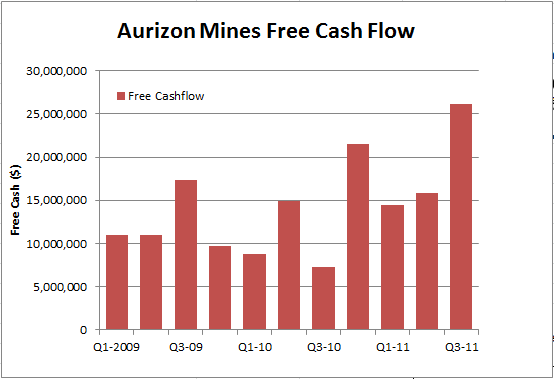
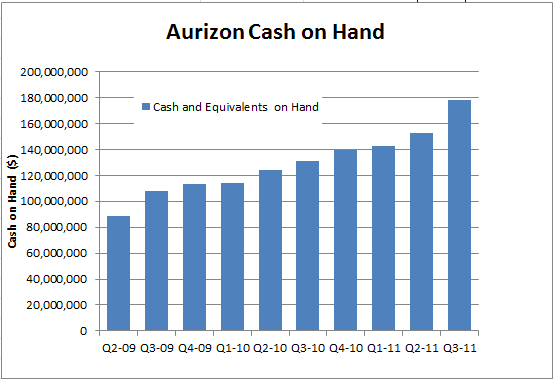
Below is Aurizon’s free cash flow and cash on hand on a quarterly basis.  Free cash flow is cash flow from operations less capital expenditures. Keep in mind that at its current price of $5.80, Aurizon has a market capitalization of $940M and no debt.

The free cash is allowing the company to grow its cash on hand significantly every quarter.

As the above figure points out, about 20% of Aurizon’s market cap is in the form of cash on the balance sheet.  The enterprise value of the company is only $740M after subtracting this cash.  Annualizing the last four quarters, the company is trading at about 9x its free cash flow generated.  That would be using an average gold price of about $1500/oz.

If you annualize the third quarter, where the realized gold price for Aurizon was $1695/oz, the company is generating $104M in free cash a year.  This puts the companyvaluation at a little less than 7.5x free cash flow.

It is important to recognize that what I am talking about here is free cash flow.  This is different then the metric that is often touted by the mining analysts in their evaluations.  They focus on the operating cash flow, which ignores any capital expenditures a company has.  I’ve chosen to look at free cash because:

  1. As I pointed out last week in my comparison between Jaguar Mining and Aurizon, companies generating similar amounts of operating cash flow can have drastically different expenditures required to maintain that level of cash flow.
  2. Free cash is what ultimately goes to the bottom line and increases the cash position of the company.

If I was going to look at cash flow from operations for Aurizon, here is what I would find.  In the estimates below I have removed the exploration expense to get a true picture of cash flow from operations.  Exploration expense is a tricky beast, because a company can choose to expense or capitalize the cost, which can work to obscure comparisons.  I prefer to leave it out when talking about operating cash flow (though I left it in when we talk about free cash).

  • In the last four quarters Aurizon generated $111M of operating cash flow (6.6x)
  • Third quarter annualized operating cash flow was $136M (5.4x)

On either metric the equity is cheap.

So Aurizon is cheap on a basis of four quarter trailing gold prices (~$1500/oz) and certainly on the basis of current gold prices $1700/oz.  I am certain that if you did the same analysis for other gold companies you would draw similar conclusions.  Some would come out astoundingly cheap.  OceanaGold comes to mind as a gold producer priced particularly inefficiently.

The next step I want to focus on is how Aurizon looks on a NAV basis.  Cash flow is the metric to evaluate current profitability, but to fully appreciate all the assets of the company, and the productive life of those assets, you have to look beyond the current cash flow and into the expected cash generated in the future.  But I will leave that for a later post.

Bad Timing

Sometimes your timing is so bad that you have to wonder if there is some intervention!

Shandong Gold Group Co., parent of China’s second-largest gold producer by market value, made a $785 million offer to buy Jaguar Mining Inc. (JAG), two people familiar with the deal said.

Shandong bid $9.30 for every Jaguar share, said the people, who asked not to be identified because of the information is confidential. That’s 73 percent more than Jaguar’s closing price of $5.39 yesterday in New York. The company has 84.4 million shares issued, according to data compiled by Bloomberg.

Full story here.