Skip to content

Posts from the ‘Macro’ Category

A Light Goes On (understanding why Greece matters again)

I’m can be slow to understand the implications of things. I don’t immediately see what in retrospect should be obvious.  Instead I have to get people to spell things out for me before I get it.

I think this is partially a consequence of not being able to spend as much time thinking about the world as I need to.  I have a job, I have a family and so I really don’t get a chance to sit down and work out all the potential impacts on a regular basis.

I’ve been looking at some private equity stocks lately, trying to understand them better and determine whether they are buys.  As part of this research I stumbled upon a market commentary from Michael Novogratz, a principle at Fortress Investment Group.  He crystallized for me why we are seeing the carnage we are in the markets (you have to wait until about 4 minutes in).

The key moment in the interview for me was when Novogratz spelled out that the Greek election was a game changer.  If Greece leaves the Euro it is, in his words, a Lehman moment.   If they leave, we don’t know for sure who owes who what or whether they can pay it back or if the assets and liabilities of any particular entity are going to balance out.  Novogratz is saying that Greece could breed the sort of counter-party uncertainty that could cause credit markets to seize.

That’s when I suddenly got it.  Its not that anyone can say with certainty that its going to end well or end badly.  Novogratz himself said that the ECB and the Europeans governments have been preparing for a Greek exit for months.  Its possible that they have worked out all the contingencies.  But at the end of the day no one really knows.  If Greece leaves it all goes out the window.   You are really just guessing to bet what happens next.

Just to throw out some of the uncertainties, there is the effect of funds and banks with mixed liabilities of Euro’s and Drachmas’.  There are the TARGET2 balances between Greece and other Eurozone countries that now become debt.  There is the strange consequence that a Greek exit destroys all the capital of the ECB.   There are the cross-border balances of companies that trade across the Eurozone.  There is the deep recession in Greece that results.  There is the investor response to Portugal, Italy and Spain sovereign debt.  There are simply a lot of moving parts and it is perhaps impossible to estimate how they all play out.

It has the same flavour of uncertainty as Lehman did.  And one thing that I learned from Lehman is that the decision makers know far less about the consequences then I thought they did.   They aren’t that much smarter than the rest of us.  Nobody knew what was going to happen when they let Lehman go until stuff started to happen after they let it go.  I think its the same thing with Greece.

Today I raised 20% cash.  I just sold a bit of everything, and I sold all of Gramercy Capital (GKK) because I wasn’t sure about it anyways.  It helped that gold stocks rallied.  It hurt that PHH and Newcastle had bad days.  Maybe this is a terrible time for it.  We could rally because we are so oversold. But I feel like I have no choice.  Now that it makes sense to me it seems like too much risk.  I want to get back to at least 50% cash by the Greek election or until there is a resolution that makes it clear Greece is staying.

Cat and Mouse

Quite often these days I feel like I am playing a game of cat and mouse and I am the mouse.  I sneak out of my hole and buy a few stocks that look to me like they are cheap, and I hope that I can make some money with these stocks and get back to my hole in the wall before Europe the cat comes into the room and raises its own form of hell.

This weekend I read another terror inducing installment about Europe from John Mauldin.  What I appreciate about Mauldin’s pieces is that they actually delve into the numbers involved.  I find it difficult to wrap my head around just how bad it is without getting into the numbers that demonstrate that badness.  Of course once you do get into the numbers, it becomes clear that the numbers don’t add up and that, at some point, more numbers are going to have to come from somewhere.  It also becomes clear that if no more numbers do come from somewhere (ie. the ECB doesn’t create any new numbers out of thin air) then the numbers in my portfolio are going to be smaller numbers than they are right now.

Such is this game of cat and mouse.

One new number that I learned from the piece and thought worth mentioning was that of the Spanish banks non-performing assets.  According to Mauldin non-performing assets are about 20% of assets on average.  He actually says capital in the report but I am pretty sure he means assets because 20% of capital is really nothing terrible in the grand scheme of things.  But 20% of assets is and so that scared me quite a bit.  But it seemed like such a high number that I thought I should get it from another source and the best source for all things Europe remains FT Alphaville.  They came through once again with the following chart:

As an aside I wonder if Mauldin looked at this same graph but got the left and right axis mixed up.  Right is unemployment, and it is indeed at 20% plus.  Left is bad loans, and they are at a little over 8%.  8% is less than 20% but 8% is still not very good.  Especially when its the average of all the banks.  And extra-especially when the trend seems to have taken on the look of a hockey stick.

So regardless of whether Mauldin has his numbers right or not, they still don’t add up without help from the ECB.  That was the basic point of Mauldin’s article this week. It basically still comes down to a stark choice between the 3 alternatives described in this old Edward Harrison article that I have brought up in the past.  Harrison stated those three alternatives as being:

  1. Monetization
  2. Default
  3. Break-up

When Harrison wrote his piece in late 2010 he figured the response would be some combination of default and monetization.  He has since tweaked his view with the addendum that Greece will likely have to leave the Eurozone, so now we have a combination of all three.  But monetization has always been the expected route to get through most of the angst, as it is in the easiest one.

Back to Mauldin, he points out that there are signs that the Germans are warming up to the idea of monetization.  There was news this week from the German Bundesbank that the German are expecting (read: grudgingly accepting) higher rates of inflation.  They expect this because they anticipate that higher rates will be necessary to stabilize the Eurozone.  That sounds an awful lot like “we realize that Spanish bonds are going to go back up through the roof if we don’t get the ECB to continue their paper money patch job of the hole in it.”

Anyways that’s what it sounds like, and if its true its good in the short term because if they do then the cat will leave the room for a while and I can come out and actually make some money instead of being on a rollercoaster ride where all I really need to do in  the morning is watch CNBC and check the Spanish stock market quote to know whether my portfolio of regional banks, mortgage originators and servicers, junior gold stocks and the odd oil stock, all of which have virtually no business is Spain, will be up or down.  It gets tiresome.

So I welcome another respite from the ECB.  I would only ask that they do it sooner rather than waiting until the world is back on the precipice as it was in late November.  These last two months haven’t been a lot of fun.

The US Economy: Is the data bad?

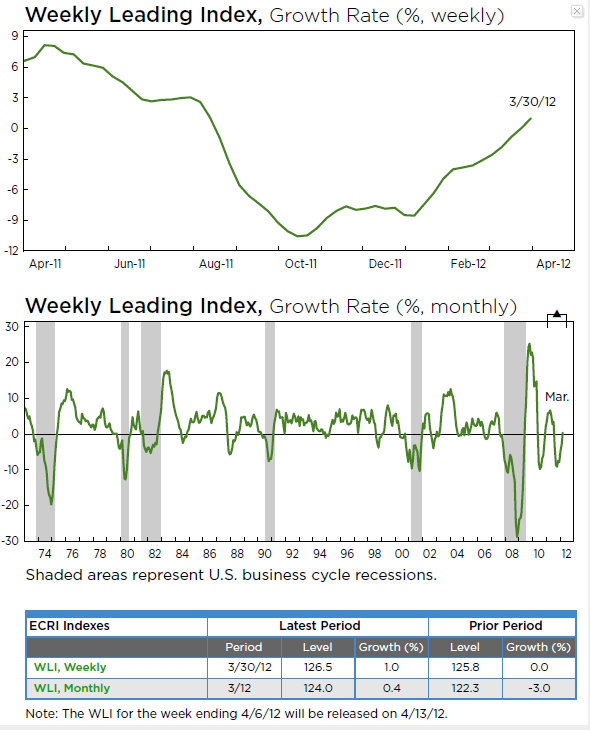
I put a lot of emphasis on the Weekly Leading Index published by the Economic Cycle Research Institute.  The index is a leading indicator of US economic growth.  The index and its smoothed annualized growth rate have both turned up recently.

Presumably this suggests an improving economy.   Yet the ECRI has been sticking to a prediction that the US economy is going to fall back into a recession.

Why?

I was reading through the ECRI’s publically available articles trying to find out why when I ran into this article.  It describes a problem that has developed with the seasonal adjustment algorithms.  It seems that the economic collapse that followed Lehman Brothers in 2008-2009 has led to a skew in the adjustment that is being made.  Many of the seasonal adjustment algorithms are interpreting the downturn that occurred in Q4 2008 – Q1 2009 as a seasonal event that should be adjusted for.

Most data, both public and private, are seasonally adjusted. But the nature of the Great Recession seems to have had an unexpected impact on the statistical seasonal adjustment algorithms that are hard-wired to detect when the seasonal patterns evolve and change over the years. This is normally a good thing, but when the economy fell off a cliff in Q4/2008 and Q1/2009, it was partly interpreted by these procedures as a lasting change in seasonal patterns. So, according to these programs, data from Q4 and Q1 would be expected thereafter to be relatively weak, and therefore automatically adjusted upwards. Our due diligence on this subject indicates a widespread problem, resulting in many recent economic headlines being skewed to the upside.

The article was written in mid-March but as recent as last week the ECRI remained behind its conclusions and their conviction that the pick-up in growth is illusory.  This SeekingAlpha article quoted Lakshman Achuthan (who is the chief economist and spokesman for the ECRI) recentlyas saying that year over year (yoy) growth, which would not be distorted by the 2008-2009 numbers, is not improving.

Please note that PCI growth yoy is still -2.2% and even q-o-q is -4.9%… With yoy growth in all the coincident indicators (GDP, industrial production, personal income and sales) all staying in cyclical downturns, and yoy payroll job growth, which had been the only holdout, now rolling over — as we had predicted a few weeks ago — it’s pretty clear that for now U.S. economic growth is worsening, not improving.

The rub is that the data we have been looking at from January through March may be overly optimistic.  It is being overly adjusted to the high side.  Now that we are into April, that is about to end.

The data isn’t great

Indeed we are seeing something like that in the recent numbers.  The monthly jobs report was a big disappointment.  The jobless claims number that came out last week spiked to 380,000.

Home sales, which to me would be the true sign of a pick-up in the economy, remain depressed.

Add to this the fact that gasoline prices are about the only thing that have recovered to pre-recession highs.

What does it mean?

The situation feels to me like another false start.  To use the phrase coined by John Maudlin, we are in for more muddling through.  Low growth rates, low interest rates; maybe the ECRI will prove to be right and we will dip into another recession.

As for my portfolio, I am of the mind that I am mostly in stocks that should perform well in this environment.

Given the bleak outlook, gold and gold stocks should do well.  Of course gold stocks have done anything but well lately.  I have to remind myself of the volatility of these stocks, how they can bounce up and down like a yo-yo and turn on a dime.  I think that as it becomes more clear that the skies remain grey and the horizon dark, the gold stocks should recover.  I am certain that the reason we have not seen a breakdown in the price of gold itself is because there is smart money out there that sees the same picture I am drawing.

The mortgage servicers, Newcastle, Nationstar, and PHH, should hold their own in this environment. Servicing revenues are not dependent on an uptick in home sales to the same extent as other housing related businesses.  Interest rates remain at such low levels that these companies continue to accumulate incredible assets (in the form of new servicing rights) that will outperform in years to come.

The regional banks are a bit of a tougher choice.  However when I look at many of the regionals, they remain below their price level before the European shock in the summer.  The US economy may not be getting that much better, but it is slowly healing, and to see these stocks at lower levels is, in my opinion, a disconnect.

Turning Greeks into Germans

On my ride into work this week, on Tuesday I think, I listened to the Planet Money program, In Greece, How Office Politics Could Take Down Europe.  Its a very interesting podcast, and I recommend it to everyone.

Office politics and Europe have a lot in common.  Office politics are mostly about power struggles between competing elements.  They typically put forces of the status quo against forces of change.  The winners tend not to be those with the best ideas, but those with the most clout.  And in the end the losers of the battle have to either conform to the dicatates of the winners, or get out and find at new place to work.

Such is the case with Germany versus Greece and the rest of the periphery.  Greece is getting closer to that bifurcation where they have to either conform or get out.

Serpico

The podcast describes the travails of a lone Greek Technocrat, Andreas Georgiou, sent back to Greece by his employers in Brussels to go through the books.  Of course, the books are cooked and the more our technocrat (hero?) delves into them, the more he finds out not only how cooked they are, but also how difficult it is to get the truth out.  Eventually they try to put him in jail for his efforts.

It reminded me of one of those old “one good cops” stories, where it seems like everyone on the force is on the take and how can our hero ever persist?

Unfortunately, he probably can’t.

Debt Crisis Delayed, not Over

What I think the story illustrates is just how deeply rooted the problems in Greece are, and just how hard it is going to be to get those attitudes to change. With the focus centered around the default of Greece and whether there will be private sector involvement or ECB involvement and how much the haircut is going to be and whether the ISDA is going to call it a credit event or not, it seems like we’ve kind of gotten side-blinders on and are thinking that once Europe gets through the default its all good.

Of course its not.  As the podcast pointed out, the basic premise of the EU strategy is that in the future when a country starts misbehaving, so when Greece starts running a big government deficit again or some other misdeed occurs, technocrats will swarm the country and force measures of austerity before it gets out of hand.  Greece and the rest of the EU are essentially to give up their economic sovereignty.

Well, Georgiou is a bit of a canary to that coal mine, and he is facing jail time for his attempt.

It’s the Economy Dummkopf

This is all just another way of stating the basic argument that Michael Lewis made in his Germany piece in Vanity Fair.  This article was a bit of an eye-opener to me; it was the point where I saw for the first time just how intractable the problems in Europe are.  In the article Michael Lewis pointed out the dilemna that the periphery faces:

The Greeks (and probably, eventually, every non-German) must introduce “structural reform,” a euphemism for magically and radically transforming themselves into a people as efficient and productive as the Germans. The first solution is pleasant for Greeks but painful for Germans. The second solution is pleasant for Germans but painful, even suicidal, for Greeks.

For the solution to work (and by solution I do not mean the short term papering over that we are accomplishing with the LTRO, the next bailout tranche or the cohersion of the private sector to accept a 70% cut), the Greeks have to become Germans.

And that is just not going to happen.

As I pointed out in my now clearly ill-timed post about the ineffectiveness of the LTRO, eventually the interpretation of Europe is going to come back to the economy.  When it does, and when the somber assessment that the Greeks are still not German sets in, well then the fact that we’ve shaved some debt off the top is going to matter a bit less.

These guys are done.  And not just Greece.  The whole EU.  Its like a walking dead, being propped up by the printed money of the LTRO.

But that’s fine.  I am in no rush to have the market turn over.  I’m in stocks that I think for the most part will outperform the market significantly in an upcycle.  I just have to not forget that the key to investing, at least right now in these debt-ridden times, is to accept the necessary short-termism, but always with a wary eye on the inevitable long term.