Skip to content

Posts from the ‘Market’ Category

Week 34: Its a bull market (for the moment)

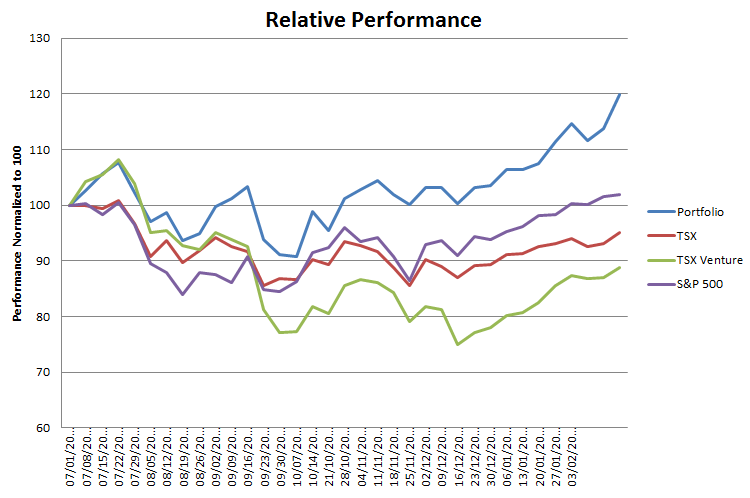
Portfolio Performance:
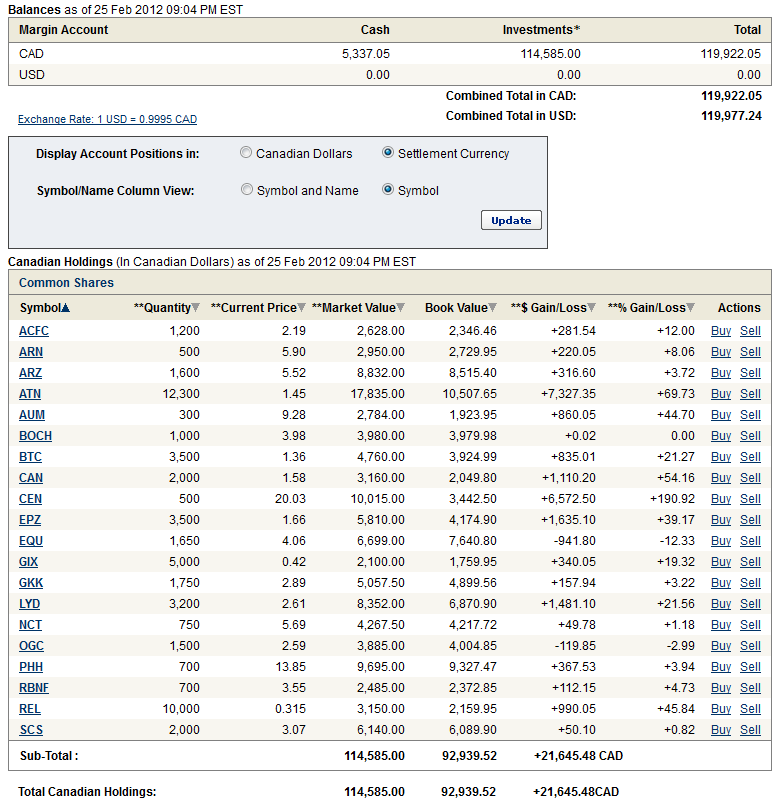
Portfolio Composition:
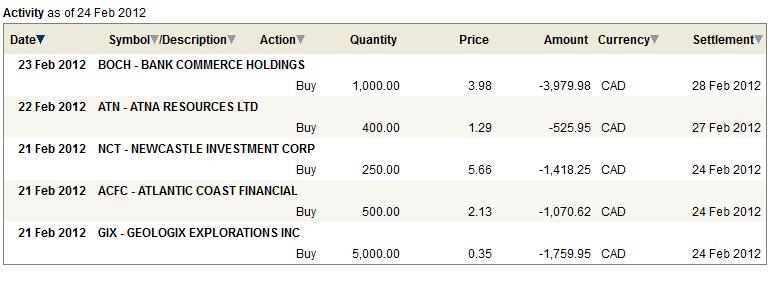
Trades:
Europe to the sidelines (for the moment)

Eric Reguly had a worthwhile article in the Globe and Mail this weekend.  He outlined the reasons why Greece and Europe are still as badly off as they were a couple of months ago.   Apart from the markets perception, nothing has changed.

The basic problems in Greece, and in the rest of the periphery, he says, remain.

The country’s economy and its social fabric are unravelling at an alarming pace and the second bailout, combined with a sovereign bond haircut, will do next to nothing to stop the horror show.

So why is the market rallying when these problems have not gone away?

I think that there are a lot of similarities between the markets reaction to Europe today and the reaction of the market in 2007 and 2008.  During the housing crisis, what drove the market down was not so much the fear of falling housing values, as it was the fear that falling housing values would cause banking problems.

At times, when it appeared that the housing problems were going to create only housing problems, the market rallied.  When the spillover to the banking system was evident, the market fell.

There are different types of bear markets.  There are bear markets that are economic and those that are financial.  When an economic bear market hits, some sectors get hit hard, some get hit, and there are always some that actually don’t do too badly at all; the idea being that there is always a bull market some where.

When a financial bear market hits, everything goes down.  Because in this case what drives the bear market is a lack of liquidity to buy stock.  So all stocks fall.  To be sure, this eventually hits the economy and causes a financial bear market, which happened in late 2008-2009 and compounded the problem.  But there is a fundamental difference here in that during an economically driven bear market, though it may be more difficult a stock picker can still pick stocks.  In a financial bear market you can’t pick anything and you just have to get the heck out.

How this relates to today is seen in how the market does not seem to care whether Greece goes into a severe recession.   This is because Greece is an insignificant spec in the world economy.  The market only cares if the problems in Greece spill over into the banking sector and cause banks to fail, not lend, seize up, and other worrying verbs, thus precipitating another financial bear market.

I wrote a long piece on the LTRO a month ago.  As it turns out this has been the most popular blog post that I have ever written.  This is somewhat unfortunate because this isn’t intended to be a blog about Europe, I am not an expert on macro economics or on banking, and the post is only tangentially related to the purpose of this blog; the stocks I own.  At any rate, in the post I argued that the LTRO may have a short term psychological impact, but over the long run it wasn’t going to do much for the Greek, Portugese, Italian and Spanish economies because none of the problems those economies are having have been dealt with.

I still think this will be the case.  Reguly highlighted the reasons why (referring specifically to Greece) in his article:

Labour costs remain too high. The economy is sinfully undiversified and laden with low-value industries, like stuffing tourists onto cruise ships. Corruption is rife. The tax-collection systems are primitive. The professional protection rackets – from truck drivers to doctors – remain intact. The country lacks a working land registry. The bureaucratic red tape leaves entrepreneurs and land owners in despair.

This is all really bad stuff.   And its stuff that applies in large part to Italy, to Spain, and to Portugal.   However, what is forgotten, and what I think I neglected  in my post about the LTRO, was that while all this is true, it was also true a year ago, two years ago, long before Greece came to be a headline and before it began to cause markets to collapse.

The LTRO has accomplished an extremely important objective and that is that is has (temporarily) removed the mechanism for a banking collapse.  The banks in Europe were on the precipice because they were overlevered (see my analysis of Deutsche Bank which remains levered at an insane 60:1) and they faced problems funding that leverage.  Now, with the help of the LTRO, the banks are still overlevered but can get all the funding they want from the ECB.

Juggling Dynamite

I was listening to the Canadian money program Money Talks yesterday.  The had Danielle Park, who writes the blog Juggling Dynamite, on as a guest.  You can listen to the interview here by selecting the 10:00 am segment for February 25th.  Parks basic argument is that this rally is a sham.  Its built on liquidity, will die by liquidity, and there is no evidence that the economies of the world are getting better.

The main theme is the incoming recession… its already underway in Europe, Japan and the UK, what has been going the last several months is all about liquidity injections again, but the reality is it doesn’t fix things, we don’t have any solutions, debt has to be written off…

She argues that individual investors have to be very careful right now.  They have to be careful about chasing the market up here, careful about jumping into dividend stocks to try to get a bit extra yield, and to be extra careful about fixed income because the yield you are getting there are miniscule.  She has some very good comments about how dangerous the current environment is to the individual and moreover, how criminal it is that central bankers continue to punish savers and try to force risk averse individuals into risky assets.

Now, if you look at what I have done over the last few weeks, I have moved from almost 50% cash to basically no cash.  So I must be completely at odds with her assessment right?

Wrong.

I think she’s dead on.

This is a false rally.  This is a liquidity driven rally.  This remains “the banks in Europe are not going to implode tomorrow so they must be worth more today” rally, which is not a positive pronouncement about anything other than that the end of the world is postponed.

CNBC had Lakshman Achuthan on this week to talk about his recession call from a few months ago.  Last week I talked about how one of the indicators I follow, the ECRI’s WLI, was perking up, and that this perhaps portended to a strengthening US economy.
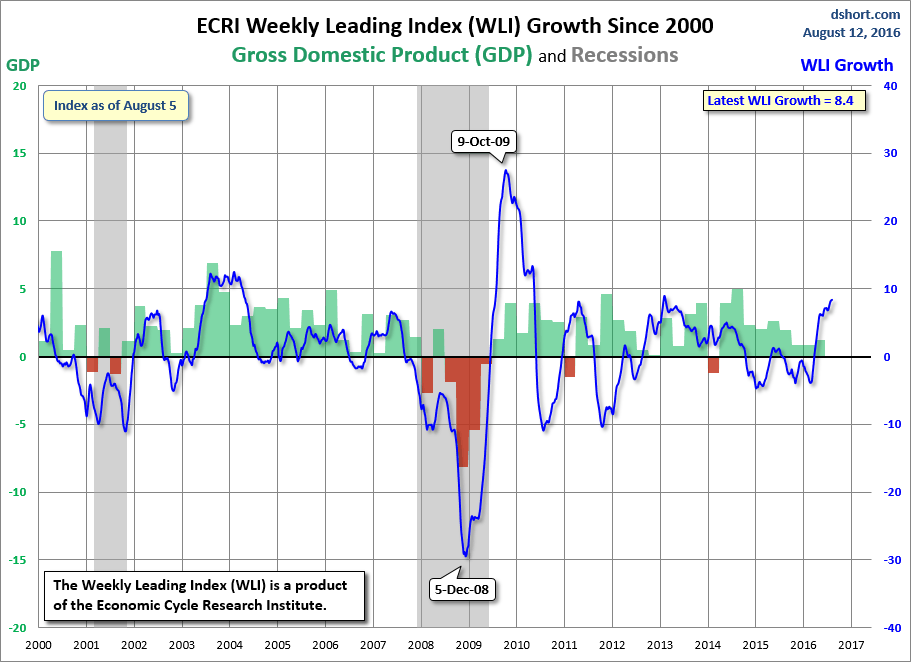
Maybe I have been too quick to look for confirmation.  The counterpoint is that it is indeed simply a liquidity driven event.  Achuthan also argues, much like Park, that it is.  Central bankers are printing money and that money has to go somewhere.  Real economic activity is weak and so the money goes into speculative investments instead.  Achuthan said that given the amount of money being pumped into the system, he is surprised that the WLI has not risen more than it has.

Here’s the entire clip:

But what can you do?

So rally is on weak legs.  Nevertheless, its a rally. If you recognize it as a liquidity driven rally then really, what you want to invest in (temporarily) is liquidity driven stocks.  If you look at the stocks I am buying lately, they are exactly that. I am doing the right thing, even if perhaps I have not fully understood the reasons.

I like to call the junior gold explorers, companies like Geologix, Golden Minerals, Canaco, little liquidity eaters.  The stock price of these sorts of companies have much more to do with the availability of liquidity then they do with the price of gold.  That is plain to see by looking at a chart of any stock in the sector.  Every stock suffered through 2011 even as the price of gold rallied hard.  Every stock soared beginning in 2012 once the LTRO was announced and it became clear that liquidity would be in abundance again.

But these are trades.  I do not expect to be holding any of these stocks 2 years from now.  Absent some sort of paradigm shift like a move to the gold standard, these are stocks to hold for the run up and then cut loose when it looks like they are turning the taps off again.

But in the mean time, in the words of Jesse Livermore, from whom I stole my blog title and my avatar:

“But I can tell you that after the market began to go my way, I felt for the first time in my life that I had allies- the strongest and truest in the world: underlying conditions”

The underlying condition right now is one of liquidity.  It is not the intent of this blog to philosophize (too much) on the eventual consequences of such liquidity.  There are plenty of folks, like the wonderful Ms. Park, who are already describing those consequences eloquently.  The intent here is to try to evaluate those conditions clearly, and to describe how I am acting to capitalize on those conditions.

For the moment anyways, that means that I own stocks.

Of course next week could be a different story.
Not Buying this Rally

While I have been happily taking part in the rally this week I remain skeptical in its sustainability.  The positives right now are all in the “price action”.  If you look beyond the improving prices of the stocks, there is not very much positive to be said about the underlying conditions.

Lets take, as our first exhibit, Europe.  The market rally seemed to get kicked off this week with the news out of Brussels that Sarkozy and Merkel had a plan.  Or the makings of a plan.  Or a plan of a plan.  They had talked anyways, and the market deemed this to be significant and positive.

It is worthwhile here to look at some of the details of what was said by the two leaders.  In particular, the emphasis that they made that changes were needed to the actual constitutional treaty that underlies the EU.  Here is what Dennis Gartman said on the matter:

We continue… perhaps too dramatically… to dwell upon the statement by Ms. Merkel that France and Germany “will make proposals in a comprehensive package… that will include changes to [the] treaties” that established the European monetary and political unions. Ms. Merkel went out of her way Sunday and again yesterday to reiterate that “treaty” statement so that no one anywhere would misunderstand the seriousness of the situation. Changes to the treaties of Maastricht, Amsterdam, Lisbon and Nice require passage by either public referenda or by vote of the parliament in individual nations… that is left to the nations themselves… and importantly the votes must be unanimous. Not one… not a single nation in the “unions” in question… can vote against such changes. They are not passed by mere majorities of the member nations, nor by super-majorities, but by unanimity. Essentially, Slovakia must agree with Germany and Germany must agree with Ireland and Ireland must agree with Austria and so on to unanimity… Unless Ms. Merkel was lying openly and often in the past two days regarding the need to revise these seminal treaties at the core of the political and monetary unions, we find it difficult if not wholly impossible to believe that this unanimity can be achieved within anything less than one year…

The situation in Europe is far from resolved.  I would even argue that given the difficult nature of what it looks like they are now trying to accomplish, things just got a bit worse.

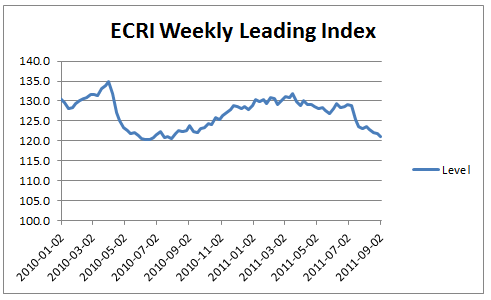
Meanwhile, one of my most trusted gauges of economic forecasting, the ECRI, has been getting more and more negative on the outlook for the US economy, and last week they tipped officially into the recession camp.  Now these guys are no David Rosenberg; they are not making a recession call based on a theory or the historical precedent of credit contractions elsewhere, no the ECRI is looking at the long leading indicators that have traditionally foretold economic strength and weakness and these indicators are, right now, pointing solidly downward.

I think its worth mentioning that during the sharper but shorter downturn in the index that occured in the spring of 2010, the ECRI was adamant that this did not signal a recession.  A lot of other bears did, I remember reading Rosenberg at the time and he conveniently used the WLI data to foretell a recession that never came.  But the ECRI did not.  I think they key difference is the “persistance” of the current move down.  The index has been moving down steadily since March.

The index also seems to be a very good indicator of stock market turns.  It turned almost co-incidentally with the market during the March 2009 bottom.  As you can see from the chart above, this year it turned down almost at the same time as the market topped.  I would have somewhat more faith in this rally if the index was not foretelling more economic weakness ahead.

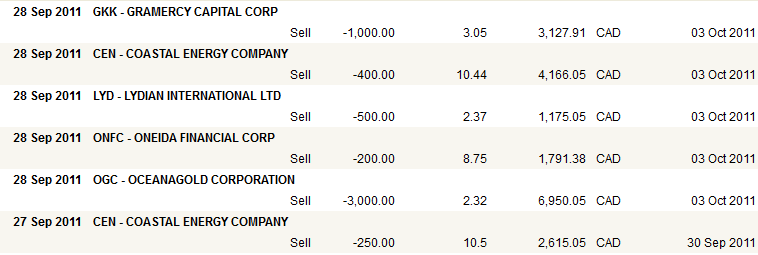
This week I sold out of Gramercy Capital.  Gramercy was the last of my US real estate related holdings, as I have already sold out of Oneida Financial and Home Federal Bank of Louisiana.  With the US economy slowing, this doesn’t seem like a particularly good time to be making long bets on real estate. FT Alphaville posted an interesting article on the state of prime mortgages in the US.  It seems that a number of the prime mortgage indexes have fallen off preciptiously in the last few weeks.

Now these indexes only represent a sampling of the outstanding MBS, and it very could be that they are skewed to areas of the country (ie. Califronia) that are currently experiencing more weakness then the country as a whole.  Still its a sobering thought to contemplate that the housing downturn has another leg left in it.

Tying this back to Gramercy, while the company remains in a much better position than it has been in for the last few years, being no longer overly leveraged and generating significant cash flow, the lifeblood of that cash flow is still tied to the US economy, and so Gramercy is not going to be immune to a US recession.  You saw that this was the case last week when news came out that CDO-2005 failed its overcollateralization test for September.  When the company released their delayed 10-Q’s, they had this to say about CDO-2005:

“We expect that the overcollateralization test for the 2005 CDO will fail at the October 2011 distribution date”

Now this is not the end of the world for the company.  Indeed, Plan Maestro pointed out on one of the boards that it likely gives Gramercy more chances to buy the CDO bonds at distressed prices.  CDO-2006 is still generating lots of cash flow.  My point is that in an environment of a deteriorating economy, and in a world where the collapse of the second largest reserve currency is still very much a possibility, one needs to err on the side of caution.

I suspect that absent some sort of private equity take-over of the company, I will be able to buy Gramercy back at a cheaper price than I sold it at.  Just a couple weeks ago the stock was trading in the $2.60’s.  I sold at $3.20.  I suspect I will be able to pick it back up in the $2.60’s once the dust settles and Europe is found to be still wearing no clothes.

Some last bits of news, again of the positive sort, was, first of all, that Crescent Point participated rather significantly in Arcan’s recent financing.  So while retail was selling stock at sub $4, Crescent Point was buying it at $5.45.  The market is somewhat ridiculous, isn’t it?  I picked up a few shares of Arcan during the “panic”.  I’ve been contemplating reducing my position back to its normal size now that the stock has moved up, but I haven’t done so yet.  But I will; I want to use this rally lower risk in my portfolio right now, and so scaling back on everything is prudent I think.

Last night Coastal Energy released what looks like some very good news.  The hope has always been that the Bua Ban North A and B reservoirs were actually a single, larger reservoir.  The latest well seemes to confirm this:

“We are extremely pleased with the results of the A-08 well, which further supports the conclusion that Bua Ban North A & B are likely in communication in the western fault closure of the structure. We now plan to drill an additional delineation well halfway between the A & B fields on the western side of the structure to further confirm this. This well will spud by this weekend.

Coastal was another stock that I bought a bit more of on fire sale.  I don’t think I’m going to sell any of this one.  Its too cheap and the results remain too good.

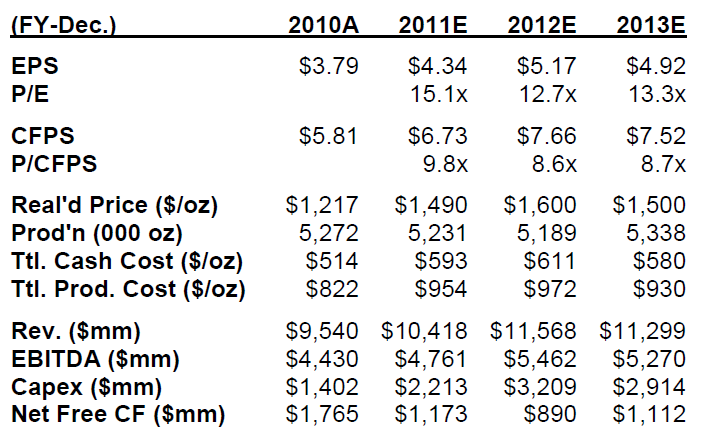
The last thing I have been doing this week is paring my positions in my junior miners in favor of a position in Newmont. Why Newmont, you might say.  A couple reasons.  First, as the below snapshot from BMO illustrates, Newmont is not expensive.  In fact the stock is trading as cheaply now as it ever has.

Second, if you look at the price performance of Newmont through the recent downturn, it has performed admirably well.  While the juniors got decimated during the two week downturn, Newmont did not.  An while I still really like the idea of gold stocks, I don’t totally trust that if Euope goes into freefall again that they won’t put in a repeat performance of this themselves.  I’d rather own a little bit less of the volatility provided by Jaguar and OceanaGold and a little bit more of the stability (and dividends!) provided by Newmont.


Going to Cash

There was another fairly high profile figure came out with some less than inspiring comments about Europe yesterday.  The following came from Attila Szalay-Berzeviczy, global head of securities services at Italy’s biggest lender UniCredit SpA. (UCG), as per Bloomberg.

“The euro is beyond rescue,” Szalay-Berzeviczy said in an opinion piece for index.hu., a Hungarian news portal, which he signed as former chairman of the Budapest Stock Exchange. “The only remaining question is how many days the hopeless rearguard action of European governments and the European Central Bank can keep up Greece’s spirits.”

There is getting to be a fairly long line of high placed officials giving extremely dire warnings about the outcome in Europe.  Given the predisposition of people in high places to keep their mouth shut, this is more than a bit concerning.  We also have the unnamed BNP Paribas executive:

“We can no longer borrow dollars. U.S. money-market funds are not lending to us anymore,” a bank executive for BNP Paribas, who declines to be named, told me last week. “Since we don’t have access to dollars anymore, we’re creating a market in euros. This is a first. . . . we hope it will work, otherwise the downward spiral will be hell. We will no longer be trusted at all and no one will lend to us anymore.”

On the analyst side we had the following from Jefferies:

The road map for Europe is still 2008 in the US, with the end game a country by country socialization of their commercial banks.

And UBS:

It is also worth observing that almost no modern fiat currency monetary unions have broken up without some form of authoritarian or military government, or civil war.

I don’t think that this is a time where you can reason out an end game.  And you cannot look to the economy for clues.  I remember saying over and over again throughout September 2008 that the economy looked fine. The numbers were fine, well they suggested slowing but they didn’t suggest a collapse.  Coal imports were ok, ag trade was ok, oil demand was ok.  You can go back and read my posts in Sept 2008 on the Investors Village vt.to board and see what I said, how I scratched my head over why there was no sign of what the market was pricing in, and how that turned out to be wrong.

In 2008 the stock market was the first thing to collapse and then the economy collapsed.  There was no foreshadowing.

And remember, the stock market didn’t collapse until after Lehman.  It wobbled and got volatile before Lehman, just like now, but it wasn’t until after Lehman that it really fell hard – I think that was because the market just can’t price in such a tremendous collapse until it actually happens.  Until the probability is 100%.  It would hedge its bets by falling some, but you can’t price in that kind of event until its taken place.

In my opinion this situation has the potential to have a similar outcome.  If one of these sovereigns default and there is not adequate capital provisions and adequate emergency facilities in place then it could turn out badly.  And I’m not so sure the market can price something like that in until it happens.

Of course this might not happen.  If everyone is fully prepared and banks do not lose confidence in one another, then it may be a non-event.  But how can you predict that?  Who has enough insight into the banks in question, into the derivitives of the sovereign debt that they do or do not hold, to be able to conclude how it will turn out?

I sure don’t.

I sold a significant amount of stock yesterday.  I managed to get out of some of the gold stocks before the price of gold fell further, and I managed to sell some Coastal before it began to fall.

I admit I have been wrong about gold.  What worried me is that it is now behaving like a risk asset, like a commodity.  Thats why I sold OceanaGold and some Lydian today.  If the market isn’t going to view gold as a safe haven, then who am I to argue.  I am still persauded by the idea that gold will be a safe haven as this crisis persists, but until it starts behaving like one again (and going up when bad news comes out) I am going to be defensive.

I am now am about 50% cash.  And it could go higher.

An Afternoon with Donald Coxe

This afternoon Donald Coxe talked at the Hyatt hotel in Calgary.   I was fortunate enough to listen to him speak.

Before I get into the details of what he talked about I want to recount something he said on one of his weekly conference calls a couple of weeks back.  During the question and answer session, a questioner asked what Coxe thought would be the outcome of the European crisis.

Coxe hesitated and walked around the question for a time, before finally explaining that he had to watch what he said on the conference call since they were now being transcribed.   He was worried about being quoted to a comment that might be too candid.

Well I guess that the talk that Coxe gave tonight wasn’t transcribed, because he was very candid and  he spoke plainly about what he thought of the situation in Europe.

What he said wasn’t terribly encouraging.  Nor was it terribly surprising.

We are in a financial crisis.  The economy is taking a back seat to the events in Europe.

The problem that he described is well known and one that I have brought up myself numerous times in the last couple of months.  It has guided my own investment decisions, those perhaps not enough.

Along with the euro came a strange presumption among banks and ratings agencies that countries of disparate histories and lifestyles could now be considered to behave as one and that the same terms of credit could be applied to their debt.   At the extreme of this conclusion was Greece, whose bonds were valued a mere 10 basis points above the Germans, and whose debt was triple A.

Unfortunately the historically profligate countries lived up to their reputation. Equally unfortunate is that so many European bankers fell for this ruse.   The problem that we now face is not so much that Greece and the other PIIGS cannot repay their debts, but that the holders of those debts are European banks that do not have the capital to cover the losses of default.

In the question and answer session the same question that had been posed on the call was posed to Coxe again: How was this mess in Europe going to turn out?

Coxe, being free of transcription, was much more candid in his answer.

First, he said that the process, whatever it may be, was bound to be messy.  He pointed out that the EU has no escape clause that allows for a country to leave.  It is the quintessential “roach motel”.  This lack of a way out makes it very difficult to map out the sequence of events that will precipitate from a default.

But defaults, at least in the case of  some of the PIIGS, is inevitable.  Thus, a recapitalization of some of the banks (he made reference the French ones) is inevitable too.

The tax paying public of the European countries who will have to anti up for these bailouts are not going to be happy.  How strong the response is we can only speculate, but Coxe did point out that each of the 5 French constitutions written in the countries history were, like the EU, devised without a clause for their unwinding.  In each case the constitution was eventually unwound by “the mobs of Paris”.

But that was not the end of Coxe’s forthright appraisal.  When the dust settles, Coxe said he would not be surprised if the Eurozone rolled all the way back to its beginning, and was reduced to its original 6 member nations.

I’m not sure if the audience grasped the gravity of that forecast.  The Eurozone is right now 17 countries.  That means he sees potentially 11 countries leaving the EU and returning to currencies of central banking of their own.  One can only shutter at the dislocations that would be involved in such tectonic shifts.

Well, in a world where the earth is moving  miles under our feet and where the admittance that the debt the PIIGS owe will not be repaid must be owned up to, what does one do?

Invest in the asset class that is the opposite of such un-payable liabilities.

Gold.  And gold mining stocks.  Gold is no one’s liability.

Lately we have had lots of commentary attributing the movements in gold to what the Fed is going to do or what the US economy is not going to do.  Well tonight Donald Coxe did not mention Operation Twist once in his primary comments, nor did he mention Bernanke, and he only once mentioned the US economy, but it was in a passing comment, one that actually was referring to the reality that it was not the economy that would drive the direction of the markets in general, and gold in particular, going forward.

To Coxe, trying to peg each movement of gold to a Fed comment, to operation twist or to a disappointing economic data point is akin to predicting the movement of the poles by watching which way the wind blows.

There are far greater forces at work.

The basic point that he made was that the reason to invest in gold and gold mining stocks right now is not the traditional one.  It is not the expectation of inflation, or the anticipation of a clever monetary trick by Bernanke.  The investment case for gold lies in the 500 million people living within 17 different countries that have their savings, pay cheques, and pensions tied to a currency that was based on a theory and seems by the day to have less of a tie to reality.

Coxe does freely admit, however, that the move up in the bullion must be consolidated.  With gold having risen dramatically, Coxe feels that the gold mining stocks are the better place to put your money.  He said that this kind of disparity between the bullion and the mining stocks has only existed one time before in history. So while he feels gold will go much higher, he also believes that more value lies in the gold stocks at the moment.

In particular Coxe passed along his usual recommendation:  look for companies with long life reserves in secure areas of the world.  Put less emphasis be put on near term earnings and more emphasis on long term asset value.  And if possible, find companies that have large peripheral deposits that will become or have recently become economic with the rise in the price of gold.

As Europe slowly and painfully gets resolved, Coxe thinks that gold is going to work its way back into the monetary system.  The Keynesian economists are going to fight it, and they are not going to like it, but in the end the only way to reinstate solvency in these otherwise bankrupt and soon to be currency-less countries is going to be to accept that gold must be used in some form to bring some confidence back to their system.

Coxe was short on words to describe how this process may play out.  But he did say, quite emphatically, that it would happen at a much higher gold price then the price we have today.