Torn
This is a very difficult time to invest in stocks.
I am torn. I want to stay invested in companies that I believe will grow their business in a normal, even slow growth, environment. And I want to get out of all stocks because I have no faith that the situation in Europe will return to a normal environment any time soon.
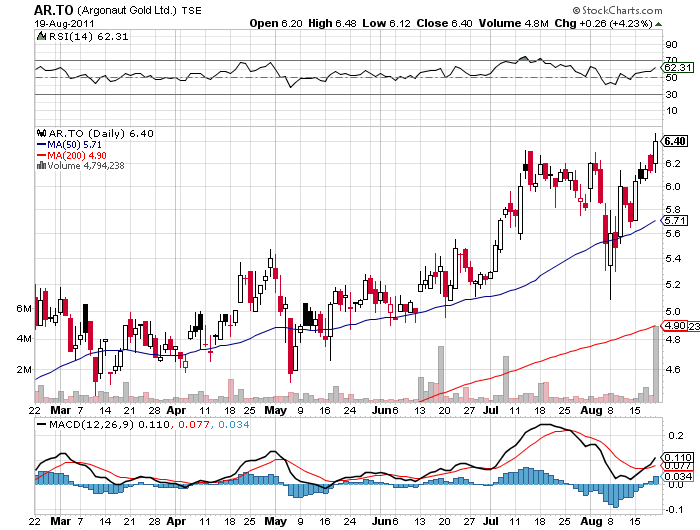
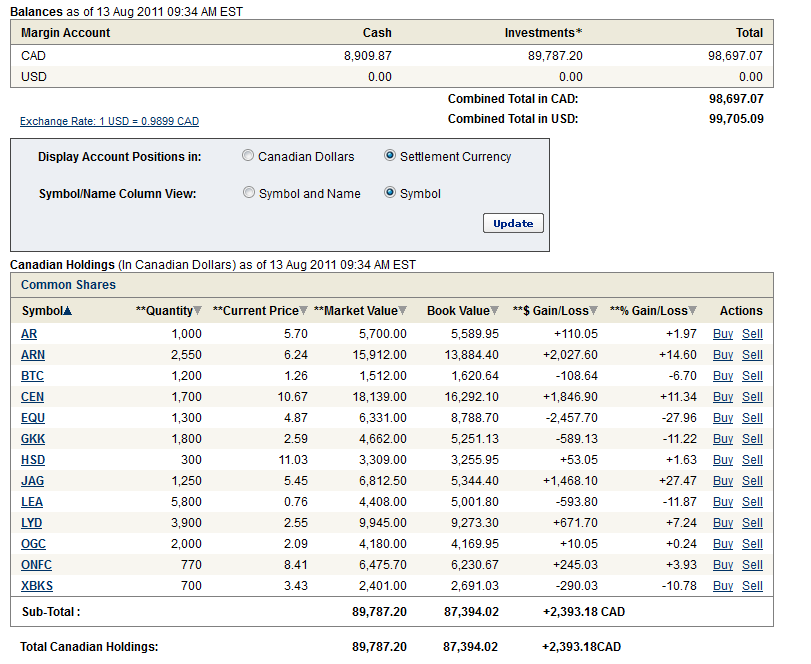
On the bright side, the gold stocks that I own broke out yesterday. Jaguar Mining was up 6%. Argonaut gold was up 4%. Lydian International was up 4%. Even OceanaGold was up 4%, and at one point was up more than 10%. When I saw Jaguar Mining up first thing in the morning I added to my positions in Argonaut and OceanaGold. I reasoned that if Jaguar is on the move, then something must be up.
The chart of Argonaut Gold looks particularly good.
Jaguar Mining is potentially on the verge of breaking out.

The positive move in gold stocks yesterday more than offset the losses I had in my non-gold holdings. Coastal Energy and Arcan Resources were both down a couple percent. Gramercy Capital and Equal Energy were down less than a percent. Leader Energy Services is looking more and more like a terrible mistake, and was down more than 5%. My small position in Community Banker Trust took a drubbing, down 10%, though I don’t know why?
I changed the composition of my short positions yesterday. I exited my short in St. Joe and in Migao, and I added shorts to a number of banks. I shorted Citigroup, HSBC, and UBS.
As for the gold stocks, I had a friend remark yesterday that he was finally seeing his gold stocks act as a hedge of his positions. My reply was:
Gold stocks have had so many false breakouts and so many months of disappointment that its hard not to be skeptical.
Having said that, I think that there are a few legitimate reasons here for gold stocks to move higher.
First, you have to always remember that the best environment for gold stocks is a low growth economy. Gold stocks do best when the price of gold is doing well, but the prices of the basic inputs for gold mining (oil, metals, labour) are not doing well.
You saw this last year. Gold stocks did great from August to October, when the economy was still perceived to be sluggish and a double dip was still on the table. Once oil and other costs began to take off, gold stocks faltered. The market rightly perceived that costs would rise for gold miners. They did. The market is smarter than you think.
So now, as growth expectations are ratcheted down and as oil prices come down, expected margins for gold producers are expanding. The market is probably anticipating this.
The second cause could be the expectation that Bernanke will react next week at Jackson Hole. The following is an excerpt of a Goldman Sachs report released yesterday. Goldman discusses what Bernanke might propose at Jackson Hole.
The Fed has three main easing tools: 1) communication; 2) asset purchases; and 3) cutting the interest rate on excess reserves. At the August meeting, it exercised option #1 by making a conditional commitment to keep the funds rate low until mid-2013. Option #3 is often mentioned but in our view is unlikely for several reasons. That leaves only option #2, asset purchases.
We believe Bernanke’s Jackson Hole speech will include a detailed discussion of the potential for more easing through large-scale asset purchases. A variety of indicators suggest many investors already expect more QE. For instance, a recent CNBC survey shows that more than $300bn of purchases may already be priced in. The sharp decline in forward real rates is also partly related to QE expectations, in our view (Exhibit 2).5 Based on our conversations with clients, we believe investors would be very surprised if the speech did not include a discussion of asset purchases.
We see two main reasons why Fed officials may prefer to change the composition of the balance sheet as a first step. First, as we showed in Monday’s US Daily, if used aggressively this could have a sizable impact. For example, if the Fed were to sell its Treasury securities that mature over the next two years and buy securities in the 10- to 30-year part of the curve—apportioning them based on amounts available in the market—it could take a similar amount of duration risk onto its balance sheet as in QE2 (around $350bn in 10-year equivalent terms, or 80-90% of QE2). The policy could be scaled up further by weighting purchases toward even longer maturities, or by changing the mix of the mortgage portfolio.
Second, policies that keep the size of the balance sheet (and excess reserves) unchanged may be less controversial among politicians and the broader public. A detailed discussion of possible changes in balance sheet composition seems a likely component of the Jackson Hole speech.
Bernanke may of course also discuss conventional QE. Arguments in favor of this approach include a less complicated exit strategy—if securities mature faster, the Fed may not need to sell actively—and potentially a larger impact on confidence and expectations. We do not think Bernanke will signal anything more unconventional, such as a higher inflation target, price level targeting, or a long-term interest rate target.6 However, these ideas may turn up in the FOMC minutes published on August 30.
While listing the easing options looks probable, Bernanke is very unlikely to pre-commit to taking action next week. This is a monetary policy decision, and any announcement would come at an FOMC meeting. In addition, core inflation continues to accelerate, and Fed officials seem to have a rosier outlook than our forecast or the consensus. While we expect additional QE and the odds are rising at the margin, it is not yet a done deal.
So what GS is expecting is not the same type of QE that occured last time. They expect a rearrangment of the Federal Reserve balance sheet to longer dated securities. True QE means an expansion of the Fed balance sheet, so what is expected to be proposed is not true QE. So its not directly supportive of higher gold prices. What these sort of policies would be supportive of is lower long dated rates. In other words lower interest rates for a longer time.
I remember reading Mish Shedlock a number of years ago. He was (still is?) of the mind that gold prices at the time were in for a rough ride because interest rates were headed up and the real rate of return on treasuries were going to get more positive. His basic reasoning was that if you can get a real return from a safe interest bearing asset you will move out of gold into that asset. Conversely, if the real rate of return is close to zero (or negative!) you will tend to prefer gold.
At the margin demand for gold is determined from the real rate of return on other (perceived) safe haven assets.
What the Fed would be doing is effectively lowering interest rates across the curve.
That should be supportive of gold and good for gold stocks.


 Reminiscences of a Stockblogger