Skip to content

Posts from the ‘Mortgage Co’s’ Category

Stepping through the Nationstar Mortgage Income Statement

I have spent the last couple of nights reviewing the first quarter (and first ever) Nationstar Mortgage financial statement.

While the statement is not overly complex, it does have a few tricks.  At the end of the day, I am trying to determine an earnings estimate for each business segment.  To do that, need to make sense of the each of the line items that constitute the GAAP earnings, and then decide which are legitimate revenues and expenses, and which are just accounting items that need to be excluded.

What is the Business of Nationstar?

Nationstar operates three businesses:

  1. Mortgage Servicing
  2. Mortgage Origination
  3. Legacy Business

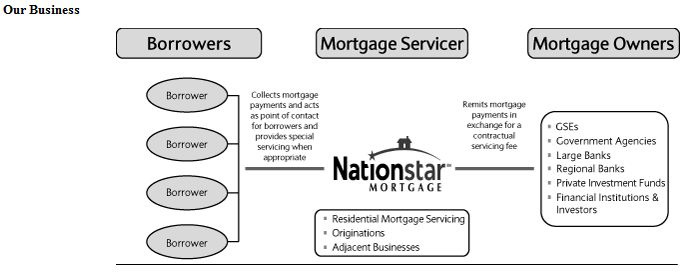
Through the mortgage servicing business Nationstar services a portfolio of loans.  The portfolio consists of loans that they have originated, loans for which they have bought the servicing rights from another party, and loans that they have agreed to subservice for a set fee.  Nationstar collects principal and interest payments and generates ancillary fees related to the mortgage loan.  In return Nationstar receives a fee, usually defined as a percentage of the unpaid principle balance of each loan.

The mortgage origination business originates residential mortgage loans.  Most of the loans that Nationstar originates are qualifying loans, meaning that they are eventually bought by and securitized through one of the GSE’s (such as Fannie Mae or Freddie Mac).  Nationstar runs this business as as feeder for their servicing business.  The vast majority of the loans originated are refinancings of existing loans that Nationstar previously serviced.

The legacy business consists of a number of legacy portfolios.  The portfolios  of what are basically pools of mortgage loans whose cash flows pay interest and principle to note holders sit on balance sheet and are in run-off.

Why you can ignore the legacy Business

Each portfolio of loans and its related outstanding notes under the legacy business segment constitute what is called a variable interest entity (VIE).  According to the GAAP accounting rules, Nationstar has to carry VIE’s on its balance sheet and consolidate the profits and losses of on its income statement.

According to GAAP, the rules for consolidating a VIE is such that if Nationstar is the primary director of activities of the entity and if Nationstar holds a beneficial interest or obligation to the entity, they must be consolidated on the books.  Nationstar meets these criteria and so the entities go on the balance sheet.

Yet in Nationstar’s case, the liabilities are non-recourse to the company.  Thus Nationstar is not liable for any losses that these entities incur.   This makes the consolidation somewhat misleading. The losses experienced by the VIE’s are not transferrable to Nationstar, even though they pass through the income statement like they are.

I decided to take a bit closer look at these VIE’s to understand exactly what they are and make sure they weren’t boogey men in the closet.

Nationstar accounts for the VIE’s with the following assets and liabilities on its balance sheet.
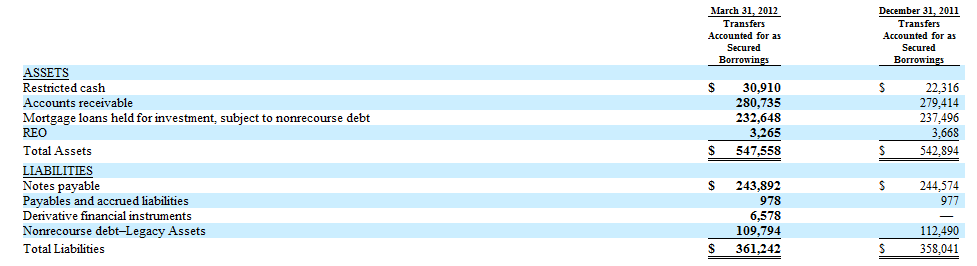
The VIE’s are of two types.

  1. Securitizations of residential loans transferred to trusts
  2. Special purchase entities (SPE)

In both cases, Nationstar is considered the director of activities because they are the servicer of the mortgages that make up the assets of the entity.  So that’s the first criteria met.  In the case of the securitizations, Nationstar has retained one or more of the subordinate securities from the securitizations, and so this qualifies them as holding a beneficial interest.  In the case of the SPE, because Nationstar remains in control of the mortgages transferred.  The result is that in both cases these entities must stay consolidated on the books as per GAAP.

But the key point is that the debt holders do not have recourse to Nationstar.  The assets within the VIE’s structure are the only assets that can be used to repay debt.  So in reality, the VIE is quarantined from the rest of the balance sheet.

The other side of the coin is that Nationstar may be able to see income from the interests they do retain in these entities.  However this is unlikely.  That’s because the entities are full of a lot of non-performing mortgages that were originated before the mortgage market blew up.  Nationstar says the following about their prospects in the last 10-Q:

As a result of market conditions and deteriorating credit performance on these consolidated VIEs, Nationstar expects minimal to no future cash flows on the economic residual

With no likely benefit from the VIE’s, and with all losses experienced by the VIE non-recourse to Nationstar, there is basically no reason to consider the VIE in any evaluation of the company.  And that is what I plan to do here.

The Mortgage Servicing Business

I’m going to start the analysis of servicing by providing the segments income statement and then going through each item in the statement line by line.
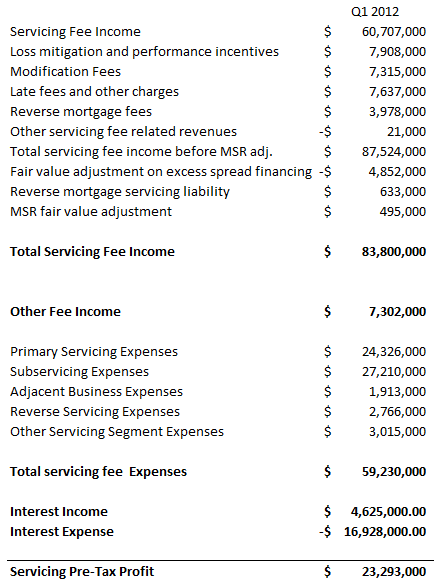
Servicing Fee Income:  This is the base fee that Nationstar receives.  A servicing fee is generally a percentage of the unpaid principle balance of the mortgages being serviced.  The unpaid principle balance averaged  $96,107,000,000 in Q1.  Nationstar earned fees of 60,707,000 off of that.  That puts the average servicing fee at 25 basis points, which is the typical fee received for servicing Fannie Mae and Freddie Mac qualified mortgages.

Loss Mitigation and Performance Incentives:  Fannie and Freddie compensate servicers if they successfully complete a repayment plan or loss mitigation on a loan that is 60 days or more delinquent.  The guidelines Fannie has set out for this are:

  • The mortgage loan must be 60 or more days delinquent when first reported with a Delinquency Status Code 12 – Repayment Plan – by the servicer.
  • The mortgage must be brought current upon the successful completion of the repayment plan.
  • Once a repayment plan incentive fee has been paid, a 12-month period must elapse from the date the related mortgage loan became current before another repayment plan incentive fee will be paid on that mortgage.

Nationstar receives fees when they mitigate a loan meeting these guidelines.  I didn’t look for Freddie’s guidelines but a imagine they are similar.

Modification fees:  These are special fees that Nationstar earns through modifying loans that qualify through the government sponsored HAMP and non-HAMP Modification programs. As per the FHFA servicing paper:

In certain instances and programs, servicers can also earn revenue in the form of incentive fees available under proprietary modification programs (generally in accordance with the Enterprises’ Servicing Guides) and through federal government modification programs (e.g., the Home Affordable Modification Program (“HAMP”)).

Late Fees and other Ancillary Charges:  According to FHFA, “servicers are also entitled to certain ancillary fees under the Servicing Guidelines, which include, among other things, late fees assessed on delinquent payments, charges for issuing payoff statements, fax charges, biweekly payment fees, and advertising supplement fees.”  That sums up what these are.

Reverse Mortgage Fees:  These are fees from their reverse mortgage portfolio of servicing right.  In terms of the servicing fee structure, the fees accrue to Nationstar but I’m not sure if Nationstar actually gets paid in cash until the property is  sold and the mortgage (and all its accrued interest) is paid off.

Change in Fair Value on Excess Spread Financing:  This has to do with the Newcastle deal.  Nationstar and Newcastle have entered into a couple of servicing arrangements whereby Nationstar performs all the servicing for a base fee (usually 7 basis points) and Nationstar and Newcastle share in the excess servicing right (with Newcastle getting a cut because they put up a substantial portion of the capital to purchase the rights). When Nationstar sells their partial interest in the excess servicing right (usually 65%) to Newcastle they treat that on the balance sheet as a financing.  So they book a liability associated with the loan and an asset associated with the underlying servicing rights.  The loan liability is recorded at fair value so Nationstar has to mark the value up and down each quarter.  In my opinion this is a pure accounting item and shouldn’t be included in earnings.

MSR Fair Value adjustment: This one is tricky.  The MSR fair value adjustment is comprised of 3 parts:

  • Actual prepayments of the underlying mortgage loans
  • Actual receipts of recurring cash flows
  • Market-related fair value adjustments

The fair value of the mortgage servicing portfolio is affected when the loan is repaid because the value associated with that particular mortgage servicing right gets written off.  The value of actual receipts of cash flows could be considered to be the basic amortization of the mortgage servicing right.   The Market-related fair value adjustment is the adjustment to the value of each servicing right based on the likelihood it will prepay in the future or not.  It’s the market-related fair value adjustment that we want to remove from the earnings calculation. Unfortunately Nationstar doesn’t break out the fair value adjustment between these items so its impossible to know how much of the adjustment is market related and how much is due to prepayments and recurring cash flow and how much is the fair value adjustment.

To give an example of what each of the three components might look like, PHH breaks them out into separate items.  Here is an excerpt from their first quarter 10-Q.

The reason that its important to deduct actual prepayments and actual receipts of recurring cash flows is because Nationstar is capitalizing the servicing portion upon origination.  So they are booking the earnings at the start, and that is only legitimate if they are amortizing that capitalized servicing right over the life that they receive fees.  If you ignore the amortization but not the capitalization you would be double counting earnings.

Given that Nationstar does not break out the items, I think that the only way I can properly handle this is by deducting the capitalized servicing from the origination segment and ignoring the entire fair market adjustment.  If I ignore the capitalization of the servicing and the fair market adjustment, then I don’t have to worry about its amortization over time.

Expenses and Impairments:  In the 10-Q Nationstar doesn’t breakout what the individual expenses and impairments are.  However, in the prospectus they do.  They reported the following expenses and impairments for the last 2 years:

I do note that none of these items are impairments so I’m not sure what that’s all about.

Interest Income:  It looks like the main source of interest income for Nationstar comes from the reverse mortgage servicing that they hold.  To be honest I am not sure what aspect of the reverse mortgage this interest income is coming from.  I know that Nationstar  receives a fee in return for servicing the reverse mortgage, but it’s not clear to me whether some of this fee is defined as interest as opposed to just being a fee.  My guess on this is that when a reverse mortgage is created Nationstar collects interest on the as of yet unadvanced amount.  But I don’t know for sure whether this is the case or not.  If its not I don’t know how they are are collecting interest.  In the end it’s a small sum.

Interest Expense:  As a servicer you are responsible for payment of late principle and interest amounts.  You are also sometimes responsible for taxes and insurance if the escrow funds set aside for the borrower aren’t sufficient.  All of these funds will eventually be paid back, but in the mean time you have to get the money from somewhere.  Nationstar sets up servicer advance lending facilities with banks and draws on these funds.  The cost of funds is generally a LIBOR plus arrangement.  Interest expense also includes interest from the senior unsecured notes that the company has outstanding.

The Mortgage Origination Business

Following in the same vein as servicing, here are the numbers for the origination business, followed by a description of the items involved.
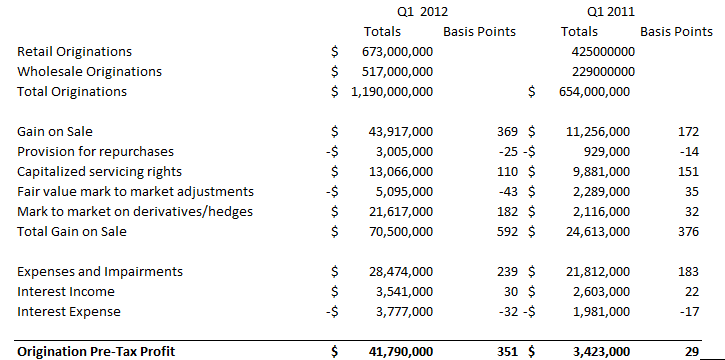
Gain on Sale:  According to the prospectus, “transfers of financial assets are accounted for as sales when control over the assets has been surrendered by Nationstar”.  So unlike PHH, which books revenues when the interest lock commitment is made, Nationstar does not book revenue until the mortgage is transferred.  Margins were high in the first quarter, at 369 basis points.  PHH also recorded extremely high margins in the first quarter, so Nationstar was not the only one.  In the PHH 10-Q the company suggested that these margins are expected to remain high for the remainder of the year, and that they may stay high for longer as the increased risks associated with the industry are being realized through higher margins.

Provision for repurchases: I can’t be positive because Nationstar doesn’t provide any details about this line item, but I suspect that it is a provision taken for repurchase requests from the GSE’s.  Nationstar originate the vast majority for their loans for the GSE’s and there have been notable putbacks by them on originators for poorly originated loans during the boom.  PHH took a $65M provision in the first quarter.  Given that Nationstar was a fairly small originator until just recently, the $3M provision by Nationstar seems comparable to me.

Capitalized Servicing Rights: I already discussed this item to some extent in the servicing segment.  Nationstar capitalizes the expected profit from the servicing cash flow stream and books that as profit up front.  Changes to that capitalization are realized in subsequent quarters on a mark to market basis as part of the MSR Fair Value adjustment.  The important point to note is that Nationstar capitalized its servicing at 110 basis points.  This means that Nationstar is capitalizing servicing at roughly 4x the servicing fee.

Fair value mark-to-market adjustments: These are adjustments that are made on the mortgage loans held for sale.  Nationstar originates mortgage loans and there is always a pipeline of these loans that have yet to be sold to a GSE or other securitization.  The changes in the value of this pipeline from quarter to quarter is recorded as this line item.  I don’t think this item should be considered in earnings.  The loans will eventually be sold and at that time will be recorded as gain on sale. Until that time the marking up and down of the unsold loan portfolio is really just an accounting fiction.

Mark-to-market on derivatives/hedges:  There are 3 types of hedges/derivatives that Nationstar uses:

  1. The first type of hedge that Nationstar has is an interest hedge on the Interest Rate Lock Commitment (IRLC).  The IRLC is a commitment by Nationstar to provide a particular interest rate to the borrower for a certain amount of time. We have all gotten these when we went to a lender for a loan.
  2. The second type of hedge that Nationstar enters into is one that de-risks changes in value of the mortgage that will eventually be originated and sold from the IRLC.  Nationstar enters into forward sales of MBS against IRLC’s in an amount equal to the portion of the IRLC expected to close, and against mortgages held for sale in amount of the mortgage to be sold.
  3. The third type of hedge is a interest rate swap that it will use to hedge the interest payments on its debt.  Nationstar always has short term warehouse lending facilities drawn upon to fund its origination pipeline.  These lending facilities are typically variable rates and base on LIBOR.  Nationstar will enter into a swap to essentially fix that rate.

Origination Segment Operating Costs: According to the prospectus, the originations segments operating costs include staffing costs, sales commissions, technology, rent and other general and administrative cost.  Pretty basic stuff.  Making a comparison again to PHH, Nationstar had operating costs that were about the same on a per origination dollar basis.  Expenses and Impairments for Nationstar were 239 basis point of Total Originations.  For PHH costs were 246 basis point.

Interest Income: This is income that Nationstar earns on originated loans prior to selling them to the GSE’s.

Interest Expense: Similarly to interest income, interest expense is the cost of funds required to originate a loan.  Nationstar taps warehouse funding to bridge the gap between the day the loan is signed off and when the loan is eventually delivered to the GSE or other third party who will ultimately securitize the loan.

Adding it all up to Earnings

The point of going through all of the above was to determine which of the line item revenues and expenses should be included as part of operating earnings.  To review, I concluded that I would ignore the expenses due to the Newcastle arrangements, the fair value adjustments to the servicing portfolio, the capitalized portion of the origination, and the fair value adjustment to the originated loans that have yet to be sold to the GSE’s.

I also have to come up with a tax rate.  In the 10-Q Nationstar said that they expect a tax rate in the range of 20-28% for the period ending December 2012.  I have chosen the midpoint, 24% as the rate I will use here.

Igoring the items and applying the tax rate results in the following first quarter earnings for the company
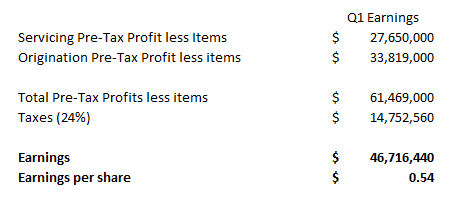
Its not bad.  These earnings would put the current share price at a little under 10x earnings.

The key point for putting this valuation in perspective is to not that Nationstar is growing at a phenomenal rate.  The company grew their servicing portfolio at 50% last year, after having grown it at 100% the year before.  The Aurora transaction will expand the unpaid principle balance of the servicing portfolio from $97B to $160B, or about 60%.   The deal that Nationstar is negotiating with ResCap is even bigger.  The Rescap deal is for an unpaid principle balance of $374B.  Now Nationstar is splitting this between themselves, Newcastle and Fortress Investment Group.  Presumably though Nationstar will be doing all the servicing work, with the other parties just stepping in to provide capital and take a piece of the excess servicing fees.  Obviously, such a large deal would represent tremendous growth to Nationstar, upwards of 300%.  While one has to wonder if Nationstar can pull off the logistics of such quick growth, there is little doubt that the earnings potential of the company will increase exponentially if this deal goes through.   And you get that potential for about 10x their operating earnings.  The bottomline with Nationstar is that you get to participate in an impressive growth opportunity without having to pay up for that growth.

You can be a Stock Market Genius… by Buying PHH Corp

I swear its the name of a book, not the punchline of an infomercial

You Can Be a Stock Market Genius was written by Joel Greenblatt in 1999.  It is an oft recommended book by value investors.  The recommendations, however, generally come with the following caveat, or something similar in effect:  “Now I know the title is awful but…”

If you can get past the cheesy title and into the meat, the book provides an investor with a wealth of knowledge, focusing on areas of the stock market that are overlooked by the most investors, and explaining how you can find value there.

One opportunity that is discussed at length in the book is the spin-off. A spin-off typically occurs either when the company feels that the sum of the parts is greater than the whole, or when a bad business is overwhelming the perception of a good business.  Usually a spin-off involves two or more businesses that are mostly mutually exclusive from one another.

The basic premise of the spin-off is that the underlying businesses will be realized for a higher value separately then they are being realized for together.  In his book, Greenblatt focuses on the inefficiencies with the spin-off process.  In many cases investors of the original security will be more interested in one of the resulting securities than the other.  In some cases the spin-off will result in one entity that is far smaller than the other, and institutions with size limitations on what they can hold will be forced to sell.  These reasons lead to a lot of selling pressure over a short amount of time, which can depress one of the spin-off companies and lead to a good value situation.

I want to focus here on the basic premise of a spin-off; that the businesses that underly the parent company are undervalued as a whole, and that often there is money to be made simply from the recognition of value brought about by their separation.  The intent of the spin-off is to create value, and often times it works.  There are plenty of examples of company’s whose stock popped on the announcement of a spin-off or divestiture.  With investors being more able to focus on the simpler business structures of the resulting spin-off companies, the value is more readily perceived.

The Spin-off Potential of PHH Corp

I believe that PHH Corp is an ideal candidate for a spin-off or a divestiture that would create significant value for shareholders.  Moreover, even if a spin-off never happens, the value is there to be realized and the market appears to be in the process of reevaluating its worth.

PHH is involved in two businesses that, from what I can tell, have very little efficiencies with one another apart from the fact that both involve money.

  1. Mortgage Origination and Servicing
  2. Fleet Management Services

When I became interested in PHH Corp a few months ago it was because of the Mortgage Origination and Servicing segment.  PHH is one of the few large originators out there that trades publically.  I learned about the company while reading a 13G filing from Hayman Capital, the investment management firm run by Kyle Bass.  Bass took a 7.9% stake in the company.

My initial investment analysis focused on the servicing and origination segment of the business.  I was pretty sure I could see the value that Bass saw, and I will get to that in a minute.  I bought the stock soon after and watched it do well for a couple of weeks.

Well at some point my procrastination was overridden by my curiousity and I thought I better take a look at this Fleet Management business.  To be honest, I didn’t even know what Fleet Management was.  What I was shocked to learn was not only that Fleet Management is a solid, growing business, but that an argument could be made that its value alone could be worth a large percentage of the PHH market capitalization.  I can imagine a scenario where the Fleet Management business is spun off or divested from the mortgage business, with the result being a significant realization of shareholder value.

What is Fleet Management?

The best definition I could find as to what the business of fleet management is all about came from wikipedia:

Fleet management is the management of a company’s vehicle fleet. Fleet management includes commercial motor vehicles such as cars, vans and trucks. Fleet (vehicle) management can include a range of functions, such as vehicle financing, vehicle maintenance, vehicle telematics (tracking and diagnostics), driver management, speed management, fuel management and health and safety management. Fleet Management is a function which allows companies which rely on transportation in their business to remove or minimize the risks associated with vehicle investment, improving efficiency, productivity and reducing their overall transportation and staff costs, providing 100% compliance with government legislation (duty of care) and many more. These functions can be dealt with by either an in-house fleet-management department or an outsourced fleet-management provider.

Its a fairly simple business, and one that has proven to be consistently profitable even through one of the worst recessions ever.

The hidden consistency of Fleet

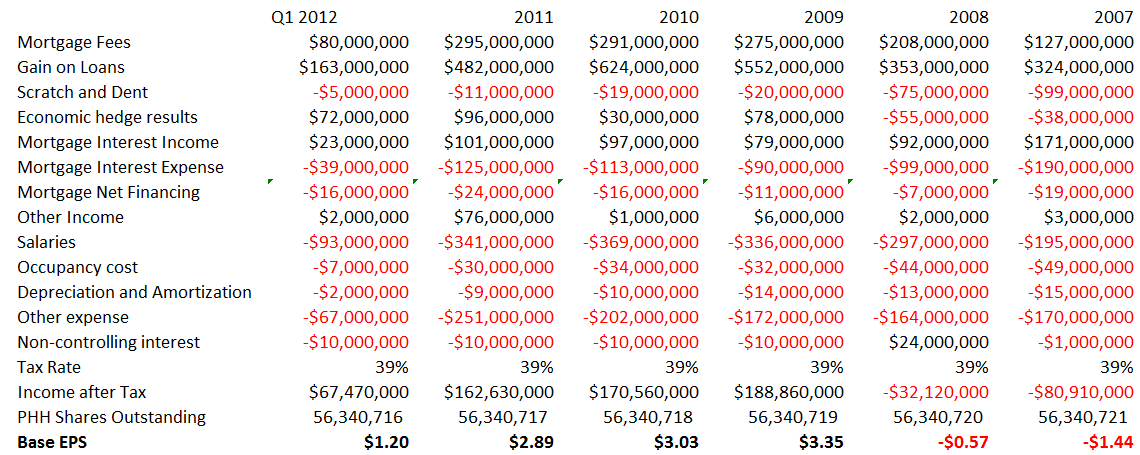
I went back a few years and looked at the earnings numbers on the PHH Fleet business:

Average earnings from Fleet over the past 6 years have been $0.83 per share of PHH.   Even in the depths of the 2008-2009 recession Fleet delivered respectable earnings.

The Fleet business continued its operational performance in the first quarter of this year and looks ready to break above a $1 per share in earnings for the first time since 2007.

Think about that for a second.  Here you have a business that has shown the ability to earn money consistently, even through what was probably the worst recession of our generation.  It could quick likely earn $1 per share of earnings this year.  Earnings have grown in the high teens for the past 3 years.

What would you value such a business at?  12x earnings? 15x earnings?  Maybe more?

If you use either of those multiples on the average and peak earnings numbers, it becomes clear that the Fleet business is worth something not too far away from the current stock price.  Or in other words, when you are buying PHH you are buying the mortgage business for very little.

Moreover, as one would expect, the Fleet Management business is going to improve along with the economy.  As per last year’s 10-K:

The fleet management industry continues to be impacted by the relative strength of the U.S. economy. As the U.S. economy improves, we expect to see continued improvement in the industry. We believe that improvement in the economic conditions will be reflected in continued growth in our service unit counts.

If the US economy is indeed improving, the Fleet business could turn out to be a cash generating machine.

This all leads to the speculation of whether there could be a spin-off or sale of Fleet from the rest of the company at some point.  A sale of Fleet would provide the cash needed by the servicing business to grow and allow PHH to continue their correspondent lending business at higher levels.  A spin-off would most likely realize value for shareholders, as the value of each individual business would be more easily identified.

There was a question on the Q4 conference call that alluded to the possibility of some sort of divestiture.  Management did not deny it, saying only that it wasn`t an appropriate topic for a public forum.   On the fourth quarter conference call the CEO, Glenn Messina, was asked about the possibility of bidders to the Fleet business (as well as the mortgage servicing business).  His response was:

As it relates to anything regard to Fleet or Mortgage, this public forum is not the place to have any discussions about anything like that. I’m focused on maximizing shareholder value. We’ve laid out our four strategies and that’s what we are going to be pursuing.

That certainly is not a no.

But wait, there’s more!

So a spin-off or sale of Fleet is certainly a possibility.  But that is the not the only source of value hidden within PHH.  PHH is in the business of mortgage origination and mortgage servicing.  The company breaks origination and servicing up into two distinct segments.

Mortgage Origination

Mortgage origination basically consists of finding a person that needs a loan to buy a home, showing that person a list of mortgage options of how they could finance that loan, qualifying the borrower for loan guarantees such as those from the GSE’s, processing the loan (doing all the paperwork) and passing it through to the eventual lender institution (usually to Fannie, Freddie or a bank that will either keep it on their books or sell it to another investor).  PHH takes a cut in the process, or an origination fee, that is typically between 1/2% and 1%.

Mortgage Servicing

Mortgage servicing happens after the loan is made. The servicer is responsible for determining how much the borrower owes and collecting that amount.  If a loan is not being paid then the servicer takes on additional responsibilities such negotiating a workout upon default, looking after the foreclosed property and such.  There are also other contingent responsibilities such as taxes and insurance, depending on the specifics of the servicing agreement.

The natural hedge of servicing and origination

PHH refers to the servicing and origination businesses as a natural hedge of each other.  Why?  Because they are inversely correlated with respect to interest rates.

Let’s say interest rates fall.  What happens?  People that have mortgages at higher rates refinance those mortgages.  That’s great for the origination business.  They are writing up refi’s and taking in the fees.

Not so great for the servicing business. When a mortgage is refinanced the right to service that mortgage no longer exists.  Of course this can be mitigated if PHH is able to originate the refinance and thus takes on the servicing rights for that refi so the old mortgage servicing right (MSR) is replaced with a new one.  PHH has proven to be quite good at “recapturing” loans in this manner.  But there’s no guarantee.

When rates go up and the opposite situation occurs.  Origination suffers, no one is refinancing at the higher rates.   But mortgage servicing rights are not being lost either, and PHH is collecting cash on these rights for longer.

There are a number of developments happening in the mortgage business right now from which PHH stands to benefit.

Origination: Generating consistent earnings, but needs to grow

Since 2008 PHH has had a steady stream of earnings from the mortgage origination business.   However, probably not surprisingly in the current environment, they have not been able to grow the business substantially.  Below are earnings of the business over the past 5 years, as well as for the first quarter of this year.

I believe there are a few opportunities in the origination space that could change the growth profile of the business  The first is if the company could take advantage of the pricing opportunity that exists in correspondent lending.

Correspondent lending

So first of all, what is a correspondent lender?

Consider the following. Imagine a mortgage broker who develops significant business volume, earns the confidence of wholesale lenders who will authorize him to approve their loans, and has accumulated some capital. He can now obtain a credit line from a bank that can be drawn against to fund loans, repaying the loans when they are sold to wholesale lenders. Under the law, the broker has morphed into a “lender” – the type called a “correspondent lender”.

This has been a business the big banks have traditionally taken a large piece of.   Until now.  In August Bank of America reported that they were exiting the correspondent lending business.  Ally Financial, who lends through GMAC, retreated from correspondent lending back in December before recently announcing that they would get back into the business on a limited basis.  Met Life announced that they were winding down their origination business entirely in January.

This isn’t small potatoes.  The above 3 companies were in the top 12 correspondent lenders by volume in the third quarter.

There are rumors others are leaving the business. I thought this quote from a Mortgage News Daily article was spot-on:

One can just hear large lenders talking in their boardrooms. “Do we really want to be in this business, given the regulatory, legal, financial, and public relations issues? Where the value of servicing has dropped dramatically in the market, and could drop further depending on Basel III? Where the mortgage insurance tax deductibility has gone away? Where every week brings a new lawsuit – when will we have more attorneys on staff than originators?”

Its a low margin, highly competitive business.   But the opportunity is that it could become less so with some of the big players moving on.

In the 4th quarter PHH announced that they would be reducing their own correspondent lending business.  But even at the time of the announcement they hedged their bet, saying they would remain opportunistic and take advantages of periods of high margins.  With so many other large lenders cutting back or completely exiting from the business, its a good time to be opportunistic.

Here is what management said about the correspondent business on the Q3 2011 conference call:

Yes I’m going let – yes the answer to the question is yes, we think there are better opportunities but once again we’re really pretty opportunistic in that channel. So we pay close attention to margins in that channel. As you know it’s probably the most cost competitive channel, it is the most cost competitive channel that we operate in and we’ve seen some really strange behavior in that market in terms of where margins are being priced. Some of our competitors are in the market, when they are in the market they’re very aggressive in terms of their pricing and then they back off and they’re out of market and that’s why we stay really opportunistic in that market.

On the Q1 2012 call, when questioned about the outlook of the correspondent business going forward, management began to change their tune.  CEO Glenn Messina said the following:

Right now we think by year end we’ll probably ramp it down to about 20% of the total, but yes, I do want to caution everyone. Last quarter I talked about managing the correspondent operations to a cash budget, and given where margins are today, cash cost origination tends to be very low.

So within the right quality parameters, and we’ve established defined quality parameters around who sells loans to us and the quality of their originations, we may flex up or down depending upon what the cash cost originations is.

So basically what Messina is saying is that margins are so good right now that while we originally figured to be ramping down correspondent lending,we would be crazy to do that in this environment.  Analysts have already ratcheted down estimates for the origination business as a whole based on expected declines in the correspondent segment.   PHH is in a good position to now beat those estimates.

Signing up new partners

The second possible growth vehicle for the origination business is a continuation of the success they had in the latter half of last year in signing up some big partners for their origination business.  From the Q3 CC:

We also made significant progress in growing our nationwide sourcing footprint over the past two quarters signing five new private label accounts. The new relationships include Barclays which we mentioned on last quarter’s call and today we’re pleased to announce that we’ve added Ameriprise and Morgan Stanley Private Bank along with two other financial institutions all as new PLS partners.

PHH did also lose one significant client in Charles Schwab last year, but overall the company expects to gain significant production from the new clients over and beyond the lost ones:

We expect the five new PLS accounts in the aggregate based on their 2011 production and taking into account ramp up time and anticipated launch schedules to produce about 7 billion in closing volume in 2012, about double what we predicted for Schwab.

There haven’t been any further announcements of major partnerships since the third quarter.  I imagine that these relationship get reviewed close to year end, so we will just have to wait and see.  Given the propensity for the big banks to scale back and outsource their mortgage business, it seems reasonable to me that PHH will be able to grow its book through further relationships.

HARP II could provide some short term support to origination

HARP stands for the Home Affordability Refinance Program.  HARP II is the name that has been coined for the new version of HARP.  It supersedes the original HARP.  HARP I was a total failure.

The HARP program has helped far fewer borrowers than its proponents estimated — roughly 894,000 borrowers since Aug. 31, 2011. — and many less than the estimated 11 million U.S. homeowners who owe more than their homes are worth.

Why was it a failure?  A few reasons:

1. Put back risk: Basically when a bank participated in the original program they were worried that they would get stuck with the original mortgage.  I think what happens here is that to rewrite the original loan to new terms, the loan is going to be scrutinized.  The banks and other underwriters know that the quality of many of those original documents are sketchy at best and they would rather not have to pull out the skeletons.

2. LTV Limits: This is probably the biggest problem.  The original HARP program dealt with current loans with LTV’s of 80-105.  That was expanded to 125 in 2009, but that still wasn’t enough.  I was surprised by that until I read this:

This should have a big impact in certain parts of Nevada, Arizona, and Florida where many borrowers owe more than 125% of the value of their homes. In Nevada, for example, two thirds of all loans backed by Fannie Mae are underwater, and half of all loans are above the 125% loan-to-value cut-off.

3. Appraisal costs: the borrower had to have an appraisal done to qualify for the original program.  That appraisal could cost $400.  Borrowers were reluctant to take this cost on when there was no guarantee they would be accepted by the program

HARP II aims to correct these mistakes.  The LTV limit is gone.  Appraisals are no longer required.  And banks are protected against the put backs.Says Brian Ye, analyst at J.P Morgan Chase & Co:

“We are of the opinion that there are enough changes to the program that bank servicers could really change their behavior, and this could be one of the first times that the administration has under-promised and over-delivered,”

There is one particular element of the new program that helps out PHH is that servicers get a head start over third party originators.   I confess I don’t know just what of impact this is going to have, but it is interesting and potentially significant, so I think its worth mentioning.  Servicers like PHH have been writing borrowers up for the program since the beginning of the year.   A third party originator cannot submit any documents to Fannie or Freddie until March.   This was done to entice the banks into the program, but the corrollary is that a company like PHH has been able to capture business up front without the competition.

More information on the new HARP program can be found here.

Will HARP II work?

This is, of course, the big question. The program is aimed to attract two million borrowers by the end of 2013.  This would be a little more than twice what the original program attracted.

However if the program works, and if JP Morgan turns out to be right and the administration “under-promised”, there is certainly a lot of room for upside.  According to CoreLogic:

10.9 million, or 22.5 percent, of all residential properties with a mortgage were in negative equity at the end of the second quarter of 2011.  Eight million borrowers with negative equity, or nearly 75 percent of all underwater borrowers, have above market rates. The disparity is even greater for those with severe negative equity. More than 40 percent of borrowers with 125 percent or higher loan-to-value (LTV) ratios have mortgages with rates at 6 percent or above, compared to only 17 percent for borrowers with positive equity.

Apart from the obvious fact that these numbers show just how staggeringly bad housing has become, if you prefer to see the glass half full those numbers also suggest that there are a lot of borrowers out that could benefit from a program like this.

Mortgage Servicing Rights and the Mortgage Servicing Disconnect

I wrote a long article on Seeking Alpha (The Opportunity in Mortgage Servicing Rights) describing the factors that have caused the mortgage servicing industry to fall into disarray.  I am not going to repeat that thesis in detail here.  To summarize its conclusions by way of analogy, the opportunity in the mortgage servicing industry right now is similar to the opportunity in correspondent lending.   Many of the traditional big players in the industry are getting out of the business and that has left a void.  The void has caused servicing valuations to collapse and has opened up the potential for servicers like PHH to take on new business.

PHH Corp is perhaps not the best way to play the valuation gap in servicing rights.  There are other companies like Newcastle Investments, Nationstar Mortgage Holdings, and Home Loan Servicing Solutions that are actively purchasing 3rd Party portfolios of servicing rights on the cheap, and in my opinion stand to gain substantially from their eventual reversion to historical norms.

PHH, on the other hand, does not buy servicing rights outright from 3rd parties.  They do, however, keep the servicing rights of the mortgages they originate, and they do perform subservicing of portfolios owned by others. It is perhaps in the subservicing business where PHH can take advantage of the exit of other large players, developing new relationships as subservicer.  Right now the subservicing business is a fairly miniscule component of the overall servicing revenue (a little less than 3% of total fee revenue in the first quarter) so I am going to leave this as a possibility, but not one to count on.

The other potential opportunity for PHH lies with the effect rising interest rates will have on its existing servicing portfolio.

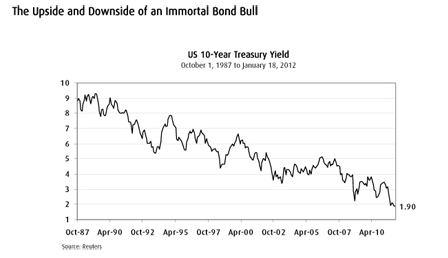
Interest rates have done nothing but fall for more than 20 years.

At some point this trend is going to reverse.  Rates are going to head upwards.  David Einhorn published an interesting opinion piece this week in the Huffington Post.  He argued that the Federal Reserves policy of zero interest rates and quantitative easing is counter-productive; that it is not enticing risk adverse investors into stocks.  He goes on to argue that if the Federal Reserve were to allow interest rates to rise, you would see investors begin to shy away from the bond market, as what has been a one way winning trade for 20+ years would show signs of waning.

Falling interest rates have been a plague on the mortgage servicing industry.  Every time a borrower refinances, the servicing right associated with the original mortgage ceases.  This has put companies like PHH on a treadmill of generating originations to replenish their servicing pipeline, and forced them to work hard to recapture the borrowers that are looking to refinance.

When interest rates begin to head back up, the opposite scenario is going to prevail.   PHH is going to be left with a servicing portfolio that is chaulk full of low interest rate loans that will not refinance for years.  Everyone who can refinance their mortgage will have already done so.  Meanwhile, the quality of the loans being originated since 2008 is some of the highest it has ever been.  No one has dared make a risky loan in the current environment.

There are 3 risks associated with holding a mortgage servicing right.  The first risk is the risk of refinancing.  The second risk is the risk of default.  The third risk is the risk that the house is put up for sale.  We are in an environment where the first two risks are likely to be lower going forward than they have been for quite some time.  A rise in the risk of the house simply being sold implies an economy that is recovering.   Thisis probably a positive for PHH, as higher home sales will drive it origination business.

The end result is that the servicing portfolio that PHH owns is going to be generating cash for longer than it has in the recent past.  This is going to help PHH grow its portfolio further, for the simple reason that the portfolio won’t have as much turnover.

A brief look at the effect of mortgage servicing rights on tangible book

Another effect of rising interest rates is that which it will have on the book value of the servicing assets.

PHH provides an estimate of its tangible book value every quarter as part of its investor supplementary material.  Below is the estimate at the end of the first quarter as well as at year end 2011.

The company is trading at a reasonably significant discount to tangible book, which in itself says something about the unrealized value.  But if you look at the book value a bit closer, you realize that there is a lot of hidden value within the assets on the books.

Baked into shareholder equity is the value of the mortgage servicing assets that PHH carries on their balance sheet.  The servicing asset was carried at $1.3B at the end of the first quarter.  As I already explained, this asset is marked to market every quarter based on interest rates and the perceived threat of prepayment and default of the mortgages underlying the asset.   The asset represents the future value of servicing an unpaid principle balance of $149.6B in mortgages.  According to the latest earnings release, the average yearly fee that PHH receives for servicing those mortgages is 30 basis points, or about $450M of servicing fees per year.  A simple ratio comparing the current value of the servicing right ($1.3B) to the expected income of that portfolio ($450M) tells you that PHH is valuing their servicing portfolio at about 2.9x its yearly servicing income.

I’ve done a bit of research into the matter, and while right now mortgage servicing rights are selling at multiples of anywhere from 1x to 3x the yearly income, in the past servicing rights sold at 4x to even 6x yearly income.  Once servicing rights return to the mean, the book value of PHH will rise substantially.  At 4x servicing book value would rise byapproximately $450M to $34 per share.  At the high end of 6x book value would be $50 per share.

Another way that higher rates help servicing revenues

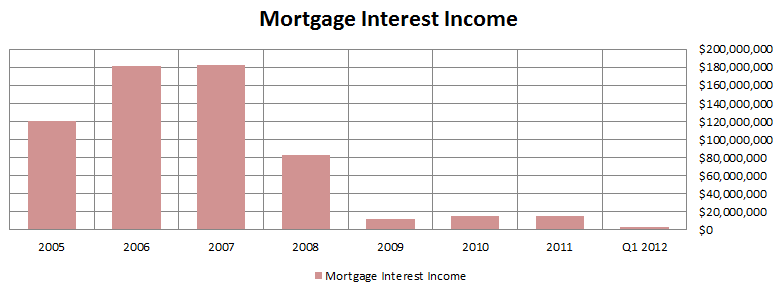
There is another rather obscure way that higher interest rates are going to improve earnings at PHH.  As part of the mortgages that PHH services PHH is charged with managing escrow accounts that are used to hold funds designated for taxes and inusurance.  PHH receives a benefit for these services by way of receiving the interest on these accounts.  The interest benefit is recorded under the Mortgage Servicing segment accounting item Mortgage Interest Income.

Beginning in 2008 mortgage interest income collapsed.  Since then it has fallen to a fraction of what it was pre-2008.

Taking a look at the PHH 10-K for 2008, when the collapse began, PHH said the following about the reduction in mortgage interest income.

Mortgage net finance income decreased by $86 million (89%) during 2008 compared to 2007, primarily due to lower interest income from escrow balances. This decrease was primarily due to lower short-term interest rates in 2008 compared to 2007 as escrow balances earn income based on one-month LIBOR.

As interest rates rise, the interest associated with these escrow accounts are going to rise substantially.  In 2007 one month LIBOR averaged around 5.3%.  In 2011 it averaged around 0.3%.  When (perhaps if) the economy finally begins to show some strength, LIBOR rates will rise.  To give a sense of this affect on PHH, in 2007 PHH was pulling in almost $3/share worth of revenue from these escrow accounts.  In 2011 that had dropped to $0.30 per share.

The Fannie put back

Since 2007 PHH has had a continual drag on its mortgage servicing income caused by the put-back of mortgages from Fannie Mae.  Over the past couple of years Fannie Mae has been reviewing their loan book for the periods from 2005-present and looking for any breaches in contractual terms, poor underwriting or defective documentation.  When it finds a mortgage that has one of these flaws, it puts it back on the lender.

PHH can fight these repurchase requests, but only up to a point.  Bank of America has been probably the most vigilant in fighting Fannie, and in return Fannie decided not to renew their contract to buy loans from BoA.  Fannie holds the trump card in this battle, and so PHH is going to be pretty much stuck with paying up for many of the repurchase requests put back to them.

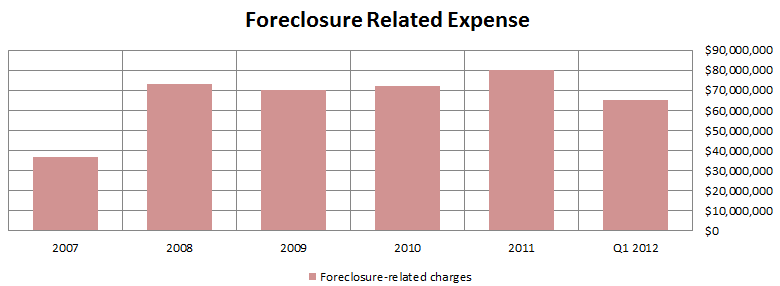
Since 2008 PHH has been taking significant writedowns due to the repurchase requests including a big charge at the end of the most recent quarter.

The topic was discussed in depth on the first quarter conference call.  Messina had the following comments:

Based on our ongoing discussions with the GSEs, we believe that by the end of 2012, they may be substantially complete with their review of our seriously delinquent and defaulted related to origination years 2005 and prior, and by the end of 2013, they may be substantially complete with their review of our seriously delinquent and defaulted loans related to origination years 2008 and prior.

Almost 78% of our standing repurchase requests at quarter end are related to the 2005 through 2008 origination years. Given the results of the first quarter, our ongoing discussions with the GSEs, we believe it’s reasonably possible that future losses related to repurchase and indemnification requests may be in excess of our recorded foreclosure-related reserves.

Assuming that the elevated level of repurchase demands that we have recently experienced continues through the end of 2013, and the company’s success rate in defending against such requests declines, and that loss severities on repurchases remain at current levels, the estimated amount of possible losses in excess of our foreclosure-related reserves is $140 million.

The bottom line is that repurchase requests are likely to be a drag on earnings for the next two years.  The company is outlining $140 million in addittional charges, presumably broken up over the next 7 quarters.  This works out to about $20 million a quarter, which is fairly consistent with the level of charges over the past 3 years.

When core earnings matter

Whenever a company publishes core earnings you have to look good and hard at why they are doing so.  You never know what they might be trying to gloss over by eliminating some of the more unsavoury elements of the income statement.

PHH reports core earnings every quarter but they do so for a very good reason.  Core earnings are a far better representation of the company’s profitability than are GAAP earnings.

The problem with GAAP earnings is that they are obscured by changes in the mark to market value of the mortgage servicing right portfolio.  The accounting nature of the servicing right is such that PHH has to write up and down the mark to market value of each right with changes in interest rates.  A servicing right is in many ways no different than an interest only mortgage security.  The biggest risk is the prepayment of the security and with most mortgages this risk is closely tied to interest rates. When rates go down mortgage servicing rights have to be written down in value to reflect this increased risk of prepayment.

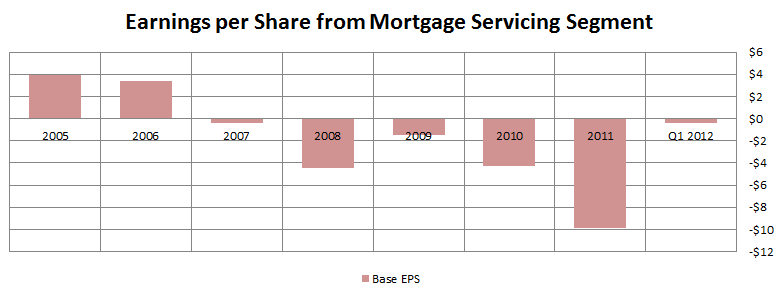
The fluctuations on the income statement caused by these mark to market moves are huge.  Up to $400M in some quarters, which for a company the size of PHH (there are only 55M shares outstanding after all), leads to massive moves up and down.  If you look at quarterly GAAP earnings over the past couple years they look like a scatter chart.  Below is a chart of earnings from the mortgage servicing segment that includes the effects of the mark to market adjustment.  With interest rates having fallen so precipitiously in the last few years, PHH has had to take pretty massive GAAP writedowns on their servicing portfolio.  Below are the before tax earnings per share from the mortgage servicing segment.  Much of the swing is the result of the mark to market adjustments to the servicing portfolio.

The reality of the mortgage servicing right is that as long as the company is replenishing the existing pool with more rights from new originations and recaptured refinances then its losing to payoffs, its all good.  As I already noted, PHH is doing that and then some.

The core earnings number that PHH reports is quite simply GAAP earning less this mark to market effect. And if you look at that core earnings over the last few years you can see that they have have been growing consistently and that the current stock price of $17 is not expensive relative to earnings.

So what did Bass see?

Let’s review the core elements of the thesis with PHH:

  1. The company is trading at about 65% of a tangible book value that perhaps undervalues the servicing assets by 25-50%
  2. Core earnings, which are a relevant metric of company profitability, are over $3 per share and growing
  3. The Fleet business itself has the potential to earn $1 per share in 2012 and provides a reasonably steady earnings stream even during recessions
  4. There is upside potential for PHH to take advantage of the current disconnects in the mortgage market, both in servicing and in originations
  5. The potential of a divestiture or spin-off of Fleet from Mortgage or vice versa

The downside is that the stock has moved well off its lows and that because of the sensitivity of the mortgage business to overall economic activity, the share price is volatile.  Bass bought his shares at around $10 and in full disclosure I bought most of my shares in the $12 range, though I have added recently with the break-out above $16.  While I can’t say for certain that PHH will eventually divest the Fleet business, I think that the story has enough elements that even if they don’t, there is plenty of room for upside appreciation in the share price.

Answering questions about Nationstar Mortgage: Part I – Getting to know them

A couple of weeks ago I parsed out the business of Nationstar , stepping through the prospectus the company put out in March, but I never got around to posting what I learned.  While I’m not yet ready to do a full write-up of the company, I want to share that here,  since I have had a fairly large position in the stock for about a month now, but written very little about it.

Often when I am first learning about a company I will ask myself some basic questions about the business and then look through the available materials for answers.  Below are the first 9 questions of what will be a two (or maybe three) part series on the business of Nationstar.

1. What do they do?

The following excerpts are all taken from Nationstar’s prospectus:

  • We have been the fastest  growing mortgage servicer since 2007 as measured by growth in  aggregate unpaid principal balance (“UPB”), having     grown 70.2% annually on a compounded basis.
  • As of  December 31, 2011, we serviced over  645,000 residential mortgage loans with an aggregate UPB of  $106.6 billion (including $7.8 billion of servicing     under contract), making us the largest high touch non-bank     servicer in the United States.
  • Our clients include national and regional banks, government organizations, securitization trusts, private investment funds and other owners of residential     mortgage loans and securities.
  • We service loans as the owner of mortgage servicing rights (“MSRs”), which we refer to as “primary servicing,” and we also service loans on behalf of other MSR or mortgage owners, which we refer to as “subservicing.”
  •  As of December 2011, a GSE ranked us in the top 5 out of over 1,000 approved servicers in foreclosure prevention workouts.
  •  In 2011, we were in the top tier of rankings for Federal Housing Administration-(“FHA”) and Housing and Urban Development-approved servicers, with a Tier 1 ranking (out of four possible tiers).
  • As of December 31, 2011, our delinquency and default rates on non-prime mortgages we service on behalf of third party investors in asset-backed securities (“ABS”) were each 40% lower than the peer group average.

2. How do they generate revenues and earn income?

Nationstar has two businesses. They originate mortgages, and they service mortgages.  The mortgages that they service are split between those that they originate, those that they purchase the servicing rights to, and those that the contract out subservicing to.

Nationstar refers to servicing that they own as primary servicing.  They refer to mortgage servicing rights that they don’t own as subservicing.  With primary servicing Nationstar takes a sliver of interest each month in return for performing servicing duties.  With secondary servicing, Nationstar receives a contracted fee in return for performing the servicing.

This is an excerpt from the prospectus describing the primary servicing business:

We have grown our primary servicing portfolio to $45.8 billion in UPB as of December 31, 2011 (excluding $7.8 billion of servicing under contract) from $12.7 billion in UPB as of December 31, 2007, representing a compound annual growth rate of 37.8%.

There has been noticeable growth in what could be thought of as a hybrid subservicing business. In this business model Nationstar enters into agreements like the ones they made with Newcastle in the fourth quarter of last year and first quarter of this year.  Speaking generally of this strategy in the prospectus:

We acquire MSRs on a standalone basis and have also developed an innovative model for investing on a capital light basis by co-investing with financial partners in “excess MSRs.”

Nationstar partnered with Newcastle on two mortgage servicing right portfolios. One of the portfolios has an unpaid principle balance of $63B, while the other has an unpaid principle balance of $9.9B.

These two investments are significant relevant to the existing subservicing portfolio.

We have grown our subservicing portfolio to $53.0 billion in UPB as of December 31, 2011 by completing 290 transfers with 26 counterparties since we entered the subservicing business in August 2008.

Below are excerpts from the prospectus describing the origination business.

  • We are one of only a few non-bank servicers with a fully integrated loan originations platform to complement and enhance our servicing business.
  • In 2011, we originated approximately $3.4 billion of loans, up from $2.8 billion in 2010.
  • We originate primarily conventional agency (GSE) and government-insured residential mortgage loans and, to mitigate risk, typically sell these loans within 30 days while retaining the associated servicing rights.
  • Our originations efforts are primarily focused on “re-origination,” which involves actively working with existing borrowers to refinance their mortgage loans. By re-originating loans for existing borrowers, we retain the servicing rights, thereby extending the longevity of the MSR

3. How big is Nationstar’s servicing business?

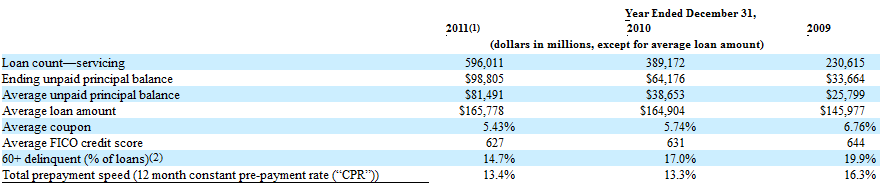
Nationstar ended 2011 with UPB of $99B.

The company has shown quite impressive growth in servicing assets over the last 3 years.  Unpaid balance owned more than doubled from the year end 2009 to 2010, and was up another 50% from year end 2010 to year end 2011.

4. What will be the upside of the recent servicing deals that Nationstar has done?

In 2011 Nationstar produced 24 cents of earnings, or about $20M, on an average unpaid balance servicing balance of $81B over the year.  However, 24 cents is not representative of the true earnings of the company.  That number  includes losses from non-recourse legacy assets that are pooled as variable interest entities on the balance sheet.  It also includes changes in valuation of servicing rights that is not generally considered a core expense to servicers.  I am going to spend my second installment talking about earnings, but for the purposes of answering this question, lets just go with the roughly correct estimate of 80 cents (or $70M) of core earnings for 2011.

They have since done two deals with Newcastle, one for $63B UPB and the other for $9.9B UPB.  They participated with a 35% interest for those deals.  So they’ve added another $25B to their UPB, not including that for the full loan amount of $73B they are doing the subservicing.  They have also added $18B in UPB at the end of 2011 in a deal with a Merrill Lynch affiliate.  So in total they have added an UPB of $43B in the last 4 months.

My work on Newcastle suggested that they would get $14.8M the first year on the 9.9B deal.  They should be able to get $110M on the full $73B in the first year.  So Nationstar is going to get $60M from the same deal.

Plus Nationstar is going to collect 6 bps on the full deal so that is another $43M.

I don’t know any of the details of th reverse mortgage deal with Merrill but presumably based on the size of the deal Nationstar should be able to generate in the area of $60M to $80M from it.

Total income from the three deals comes to somewhere between $160-$180M.

The company had revenue from servicing of $280M in 2011 so these deals are not inconsequential, being worth in the neighbourhood of a 60% increase in servicing revenues.

5. What revenue should we expect out of the KB Homes deal?

KB Homes and Nationstar recently reached an agreement whereby Nationstar would take on the role of preferred borrower.  Historically KB Homes had its own in-house originator:

KBA Mortgage originated residential consumer mortgage loans for 67% of our customers who obtained mortgage financing during the period the unconsolidated joint venture operated in 2011. In 2010, KBA Mortgage originated such loans for 82% of our customers who obtained mortgage financing during that year.

In Q1 KB Homes had new orders for 1,197 homes versus 1,302 homes the previous year.  Homes delivered in Q4 were 1,150.  So let’s say that KBH sells 1,200 homes per quarter.

The average selling price of the homes sold was $219,000 for Q1.  The price was $205,700 a year earlier.  On the CC they said “Going forward, we expect our average selling price to continue to increase and to exceed an average of 240,000 for the year.”

Assume $220,000 per home and 1,200 homes per quarter  that together and you have a total balance of $264M per quarter.

So let’s assume NSM captures 50% of origination and that has a 20% down payment on average.   That would add $419M of unpaid balance per year to NSM.  Which isn’t that significant to total UPB for a single year.

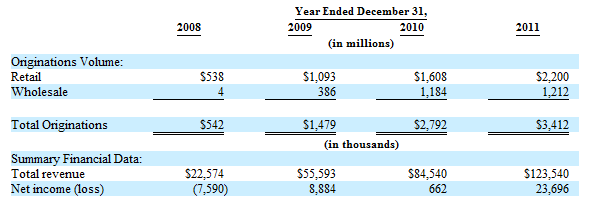
It is significant origination volumes though.  The company has the following origination statistics over the past 4 years.

So this is another $400M or 12% of originations.  And if they can capture a greater percentage it could be double that.

6. How many of the loans is Nationstar recapturing through re-origination?

One of the questions I am interested in answering both for my investment in Nationstar and for my investment in Newcastle is how good Nationstar is at keeping its servicing clients.  if a servicer can retain clients that are refinancing their mortgages it makes it far easier to sustain strong growth.  In the case of Newcastle, it will mean a longer stream of cash flow on the servicing rights they have bought in partnership with Nationstar.

We recaptured 35.4% of the loans we service that were refinanced or repaid by the borrower during 2011 and our goal for 2012 is to achieve a recapture rate of over 55%. Because the refinanced loans typically have lower interest rates or lower monthly payments, and, in general, subsequently refinance more slowly and default less frequently, these refinancings also typically improve the overall quality of our primary servicing portfolio.

Newcastle has made the assumption of a 35% recapture rate on the servicing packages it has invested in.  This compares favorably with Nationstar’s average recapture rate in 2011.

7. How many shares did they do in the offering?

They are offering 16.7M shares.  After the offering they will have about 87M shares outstanding.  At the current price of $14.50 the market cap is $1.26B

Before the offering Nationstar was wholely owned by Fortress Investment Group through one of their private equity funds.  Fortress remains the majority holder in the company with 70M shares, or about 80% of the shares outstanding.

8. How much of the offering did they spend on the Newcastle deal?

They spent $115M on the Newcastle deals.  They offered $233M worth of shares.  So they spent about half of it.

9. How much debt do they have?

Next…Part II

In the next installment I am going to look at the earnings power of Nationstar and how there are a number of GAAP accounting rules that are fogging up what would otherwise be considered to be an attractive valuation.

Pounding the table on Mortgage Servicing Rights

In my opinion mortgage servicing rights (MSR’s) are the best opportunity in the market right now. The potential is there for returns as much as 30-40% IRR for the companies involved. The companies involved are not trading at premiums that reflect this, and in some cases they are trading at discounts to the market (PHH) or with extremely attractive dividends (Newcastle).

I believe the opportunity is being ignored by a market for three reasons:

  1. The market lumps MSRs in as just another housing play, and housing is still 2-3 years away from recovering
  2. MSR’s are complicated and most market participants don’t want to take the time to understand them
  3. MSR’s have traditionally been a crappy business and over the past 5 years they have been a really crappy business

In order to consistently beat the market I have learned that I have to look for value in typically crappy businesses and be willing to learn complex and sometimes opaque things.  When I started investing I knew nothing about oil and gas.  A few years ago I knew nothing about potash.  A couple of years ago I knew nothing about the pulp industry.  A year ago I knew nothing about regional banking.  And two months ago I knew nothing about mortgage servicing rights.

I continue to go wherever my nose takes me.  And right now it has lead me straight to mortgage servicing rights.

What is a mortgage servicing right?

A mortgage servicing right (MSR) is a list of conditions and responsibilities that are completed in return for a payment.

I’m going to simplify the details, but essentially here is how it works.  When a mortgage company originates a loan, along with the note that binds the borrower to making payments, they get a right to a tiny sliver of interest that will be paid in return for making sure that the money gets from the borrower to the lender (along with some other responsibilities, most of which deal with what happens in the case of delinquency).  Usually this sliver of interest is around 25-50 basis points.  For example, for a loan for $200,000 will include the right to receive $250-$500 a year in return for making sure that the money gets collected from the borrower (among other responsibilities).

Its that sliver of interest that is paid in return for the collection and other servicing duties that is called the Mortgage Servicing Right.

As a mortgage originator you have two choices of what to do with the mortgage servicing right.  You can keep it, in which case you will collect the sliver of interest from now until the mortgage is either  paid off or defaults.  Or you can sell it to someone else in return for cash up front.

Traditionally it has been the preference of small originators to sell the MSR for cash up front. Origination is a cash heavy business and managing cash flow is key.  So while it might be nice to have a steady monthly income flowing in from the MSR, typically the more immediate concern is getting cash on the books right now.

When the originator sells the MSR up front they receive a servicing release premium (SRP).  This sounds like a complicated term but its not.  All a SRP is, is a lump sum payment that is paid in return for the stream of cash flows from the MSR that you are giving up.

If you are interested in an even more detailed explanation of a MSR, there was an excellent discussion paper put out by the FHFA that is accessible here.

The collapse of the SRP

Of course, to make it worth your while to sell the MSR you need to get a decent amount of cash up front for it.  Traditionally SRP’s have fetched in the neighborhood of 4x to 6x the underlying MSR yearly payment.  Going back to our theoretical mortgage above, if you were receiving $250 a year from the MSR, you might have expected to fetch $1000 (or maybe even $1500 if you are lucky) up front for that income stream.  To the buyer of the SRP it would become a good deal if the mortgage didn’t go into default or get repaid for more than 4 years.  After 4 years they get their money back, and every year after that they get incremental return.  For you as the cash strapped originator that needs to pay your employees and keep yourself liquid to make further originations, the $1000 up front helps you stay afloat and generate further originations.

A little over a month ago I wrote about a great discussion on the Lykken on Lending mortgage banking podcast.  Lykken had Austin Tilghman and David Stephens, CEO & CFO respectfully of United Capital Markets, on the program for an interview.  These fellows are industry experts in the mortgage servicing market.  The discussion begins about a half hour into the podcast.   Here is a particularly relevant comment from Stephens on the current state of the SRP market:

Prior to the meltdown the price paid for an SRP [servicing release premium] was generally 5x or more of the [mortgage] service fee.  That multiple dropped to 4x a few years ago and we are hearing that its dropped to 0x in some cases today.

This comment was followed up by Andy Schell, a co-host on the broadcast.  Schell said that he had recently done an analysis of SRP’s and MSR’s and, in his words, “I couldn’t believe the numbers are so low.”  He reiterated that the SRP’s are in some cases approaching zero.

As an originator, maybe it made sense to sell the MSR in return for a SRP that was 4x or 5x as much as you would get from the MSR in the first year.  But now you are looking at a SRP that is approaching 0 in some cases.  Even in the case of strong originations (good quality loans with low default rates) you aren’t going to get more than 2x the MSR’s yearly return, and are probably going to get somewhere between 1x and 2x.

It doesn’t make as much sense.

Take our example: would you give up an income stream of $250 a year if you were only going to get $350 or at best $500 for it?  If you held it instead you could return double that amount in only 4 years?

Who is selling MSRs at these bargain basement prices?

I think that there are two reasons that MSR’s are getting sold down to such low prices:

  1. The big banks are getting out of the business
  2. The little guys have difficulty getting into the business

The big banks

There are a couple of things going on with the big banks.  First of all,  there are regulatory capital changes about to take place that are going to effect how much capital a bank has to keep on its books to hold an MSR.  Under Basil III requirement of how much capital must be held for an MSE changes dramatically:

One of the biggest changes in capital definitions for U.S. banks involves mortgage servicing rights (MSR). Under Basel III, banks will be allowed to include only a maximum 10% of MSR in their capital measures. Any amount above that is deducted; and then, in combination with financial holdings and deferred tax assets (DTA), that can only be up to 15% of aggregate capital. In contrast, under current rules MSRs are included in capital up to 90% of fair value or book value, whichever is lower.

The second reason is simply the consolidation of the banking industry.  Again referring to David Stephens:

Its the aggregation of the aggregators.  In 2007 an originator might have 20 take outs for the loan they produced.  After the spectacular failures of 2008 and the combination of large companies into even larger ones there may have been 10 takeouts.  Recently we’ve seen BoA and Citi getting out of the market and you can count on one hand the number of people that account for 50% of the market.  And they have their own capacity limitations.  It just gets tougher and tougher to find a takeout and then those that are left are becoming more selective about what they buy.

A third reason that the banks want out of the business is the way that MSR’s are accounted for.  The GAAP accounting standards for MSR’s forces banks to account for them on a mark to market basis.  This means that a bank has to revise the value of the MSR every quarter.  The nature of the MSR is that it is going to be extremely sensitive to interest rates.  If interest rates go down then more borrowers are going to look to refinance their mortgage.  When a mortgage is refinanced the existing mortgage is paid off and the MSR that is tied to the existing mortgage stops paying interest.  So as interest rates go down the probability of prepayment increases, bringing the value of the existing MSR’s on the books down.

Banks have been writing down MSR’s for a number of years now as the Fed does everything in its power to lower interest rates.  They are sick of having to book quarterly writedowns on the MSR assets.  In addition, they have been booking further writedowns because so many mortgages have gone into default over the past 5 years.  If you add to those factors the stigma of being involved too heavily with the mortgage business, you can see why so many banks are either getting out of the business entirely (Bank of America) or scaling back on the business considerably (Citi and JP Morgan).

And there you have it.  A simple supply and demand imbalance where demand for SRP’s has been decimated by the housing collapse have caused a disconnect in servicing valuations.

The little guys

The reason that more originators aren’t keeping the MSR on their books is simple.

  1. They need the cash up front and they can’t wait a couple of years to recoup it
  2. They don’t have the cash to make the start-up investments to get into the business

We are in a period where originations are strong because of the strong refinancing activity that has been brought about by low interest rates.  This creates more pressure on the smaller originators to sell their MSR’s and realize the cash up front.  Meanwhile the drop in SRPs creates what is almost a snowball effect.  Getting less cash for the MSR’s you sell precipitates the need to sell more of your MSR’s in order to meet your cash needs.

It is also not an easy process to get approved as a servicer if you are an originator that has traditionally sold off your MSRs but you want to begin holding them on your books.  According to Tilghman:

Its not an easy process.  Some started the process a couple of years ago, had their approvals in place for this market opportunity.  It is daunting though… there is a huge backlog at Ginnie Mae and at the GSE’s… the people we talk to says this is still incredibly slow and its taking months for companies to get approvals.  We talked to one subservicer and he as 20 companies waiting for approvals. And frankly we are talking to 30 companies that 6 months ago weren’t interest in owning MSRs and are now looking to get approvals. 

Selling at the bottom

The irony is that all this selling is taking a place at a time when underwriting standards have never been better.

The quality of the servicing has never been better, low interest rates, tough underwriting, good appraisals, those are the positives.  A lot of potential for the servicing to gain value in the future when rates go up, but most importantly to have it in place when rates go up as a hedge against your production dropping maybe 80%.

As the servicer of a mortgage, there are 3 things you don’t want to see:

  1. The house get sold
  2. The loan get refinanced
  3. The borrower defaults on the loan

There isn’t much that can be done about number one.  But two and three are functions of the market and of loan quality, and they are notably strong right now.

Interest rates are probably as low as they are going to get.  This has led to the boom in housing refinancing that I mentioned earlier.  The refinancing boom has been a hit to servicers who have seen their MSR’s stop paying out when the house gets refinanced.  The upside of this is that the new loans being put on the books are unlikely to be refinanced for some time.  Rates are more likely to go up than down.  The opportunity is there to realize servicing revenues on new loans for a significant period time.

Banks were hit hard when subprime borrowers walked away from their homes.  Because loans weren’t getting paid, neither were the servicing fee.  Compounding the problem, servicing rights often have clauses whereby the servicer incurs additional responsibilities when the borrower goes into the foreclosure chain.

Now we have the opposite scenario.  Lending standards are so tight that only the most fool-proof borrowers are able to get loans.  The risk of default should be greatly reduced.  The result again is for the MSR to stay on the books, paying out cash, for longer.

The risk of regulation

The main risk to the thesis that I see is regulation.  There was a lot of concern that that the FHFA was going to change the servicing model for agency servicing model, either by reducing the fee that a servicer received or by changing the structure to a fixed fee that was independent on loan value.  The FHFA put out a talking paper to talk about the proposed changes back in September of last year.

In its talking paper, FHFA once again floats the idea of paying a set dollar amount for servicing loans, while keeping open to the idea of maintaining a minimum servicing fee model similar to the current structure, but one with a reserve account option. “The reserve account would be available to offset unexpectedly high servicing costs resulting from extraordinary deteriorations in industry conditions,” the talking paper notes.

There was a lot of resistance against the proposed ideas, particularly from the smaller servicers, who said that the reduced servicing premium would basically squeeze them out of the business. The FHFA recently stepped back from the proposals, but they have yet to put an end to the discussion completely.  Tilghman said the following about the matter:

We are continuing to be disturbed that the FHFA refuses to clearly state the servicing compensation issue that it is off the table.  The responses to their December proposal were 80% against any change or for a moderate change and yet they will not acknowledge that and continue to leave open the potential for that issue.  If they understood the markets and were serious about competition well frankly that is going on as we speak, they’d provide certainty and they would kill the issues that have no substantive support. 

How to invest

Finding companies to take advantage of the opportunity hasn’t been easy.  The two obvious one’s that I have owned since the start are Newcastle Financial (whichI have written about here) and PHH Corporation (which I have written about here).

There are also a couple of new IPO’s for companies looking to take advantage of the opportunity.  Both Nationstar Mortgage Holdings (NSM) and Home Loan Servicing Solutions (HLSS) have had IPO’s in the last month

Nationstar is a well established servicer that had been held by Fortress Investment Group (FIG). Nationstar looks to be in the same vein as PHH; an originator with a large servicing business. Nationstar also has a large subservicing business, which means that they take on the servicing responsibilities for servicing rights held by other companies in return for a fee.

Fortress Investment Group is also an interesting idea. FIG owns about 80% of Nationstar. That puts FIG’s investment in Nationstar at a value of about $900M. If you look at FIG, the stock is at $3.75 right now and fully diluted Class A and Class B shares are a little less than 500M. So just roughly here, FIG has a market capitalization of $1.875B, meaning that Nationstar alone is worth half the market cap. FIG has about $43B in total assets under management so in the grand scheme of things Nationstar shouldn’t be that big of a part of FIG.

It’s a situation that brings up your spidey senses. Is the value of Nationstar sneaking in under the radar of FIG shares? The problem is that I can’t be sure yet. I am looking at FIG right now and it’s a tough slog; its difficult to get the details about what they actually own and what the value actually is because of the nature of their corporation of funds structure. You can do a search through the 10-K and the name Nationstar isn’t mentioned once. But I’m going to keep investigating. FIG smells to me like one of those 5-bagger opportunities, but I just don’t understand the company enough yet to say for sure.

Finally, Home Loan Servicing Solutions is a spin-off of Ocwen Financial. Having read the prospectus, it appears that HLSS will be a income vehicle. They are going to buy up the MSR’s currently on Ocwen’s books in return for a portion of the servicing fee. Ocwen would still do the servicing on the mortgages (acting in the capacity of subservicer) and in return they would be paid a base fee plus an incentive fee that is structured to entice Ocwen to keep as many of the borrowers current as possible.

It’s a similar sort of deal to what Newcastle and Nationstar are doing. Its structured a bit different, with the main difference being because the loans involved are subprime and not agency. Servicing subprime loans has an extra aspect that doesn’t occur with agency loans. When you are dealing with subprime loans, the servicer is responsible for putting up money in the short term when the payments are late. This means that the servicer has to have access to a credit facility, (or some other sort of funding) that they can borrow from when they need to cover payments. And that funding costs you in interest.

Now admittedly my understanding on this isn’t completely clear yet, but from what I’ve read I don’t think the servicer is ultimately on the line for payments they put up. They are eventually reimbursed, either from the borrower when the payment is made, or from other payments in the pool if the mortgage goes into foreclosure and the payment will never be made. But they do have to put up cash in the interim.

So along with the servicing commitments, HLSS is taking over a number of credit facilities that had previously belonged to Ocwen. In this case they are commercial paper facilities, and they provide access to the short term credit that HLSS needs to have so it can cover any late payments to the pool. HLSS has to pay the interest on these facilities and that comes out of their profits

So that’s the downside of a subprime deal versus an agency deal. The upside of a subprime deal is that HLSS is taking a bigger piece for less up front than Newcastle did. HLSS is getting 32.5 bps in servicing fees and, based on the Dec 31st estimate of fair value, they will only pay 41 bps up front. In the first Newcastle deal, which was all agency, Newcastle paid 60bps and is getting 29 bps in servicing fees. In the second Newcastle deal, which was only 25% agency and 75% private label, Newcastle paid 42 bps. Its not clear to me whether Newcastle is going to have to manage the cash on the private label, but given the cheap price I wouldn’t be surprised.

I am looking for more ideas in the mortgage servicing sector. Please comment or write me (liverless@hotmail.ca) if you have any ideas.


In my opinion mortgage servicing rights (MSR’s) are the best opportunity in the market right now.  The potential is there to return as much as 30-40% IRR for the companies involved. The companies involved are not trading at premiums that reflect this, and in some cases they are trading at discounts to the market (PHH) or with extremely attractive dividends (Newcastle).