Skip to content

Posts from the ‘Portfolio’ Category

Letter 27: My Deutsche Bank Short, Increasing my Gramercy Capital Long, and trading in OceanaGold for Golden Minerals
Why I am Short Deutsche Bank

Its been a while since I talked about my shorts.

I typically wouldn’t have much in the way of shorts.  At the most they would make up a couple percent.  I don’t have a great track record of predicting when companies are going  to fall.

I tend to pick them too early.  I think its a classic trap of a value investor;  you see an overvalued company and you conclude that it has to go down.  Unfortunately that is not the way the market works; until there is a catalyst a stock can continue to become more overvalued to the point where you as an investor have no value.

Right now, however, shorts make up a fairly significant percentage of my account.  About 15% (though not the practice account I post here because shorting is not supported by RBC).  These are extraordinary times.

I have a small short in Argonaut Gold that I mentioned last week.  I continue to have a short in Salesforce.com that has done quite well as the cloud computing phenomenon has come back down to earth.  I have a short on Tourmaline, an albeit well managed but highly valued natural gas producer in an environment of dismal natural gas prices.

The biggest short I have is in Deutsche Bank.  It makes up about 8% of my overall portfolio.   I added to it over the last week as DB made yet another failed attempt to stay above $40.  Together with a smaller short in UBS, it makes up my “at some point Europe is going to go down the toilet” bet.

Why Deutsche Bank?  Simple thesis – it is insanely levered.  Here is a snapshot of the European banks common equity to assets.  Note the location of Deutsche Bank on the x-axis.

Since that time Dexia blown up.

Jim Grant makes the same point on Deutsche Bank about half way into this interview on CNBC.

Wholesale Funding

The other thing about Deutsche Bank, and to a lessor extent UBS, is that they are not strong depository institutions.  What that means is that they do not have a large base of deposits to fund their assets.  Particularly in the case of Deutsche Bank they go to the market and borrow money from other banks, from money markets, from pretty much anybody who is willing to lend it, and this is the money they use to fund their lending.  When times are good this is a great strategy.  Deposits are a more expensive (higher interest rate) form of funding then these wholesale channels (wholesale is kind of the catch-all term that defines all these short term lending sources).  But when times are bad, these channels dry up a lot faster then deposits.  They can be called quickly in the event of a loss of confidence.

A good proxy for the degree of reliance on wholesale funding is the net stable funding ratio.  FT presented the ratio, along with the following graph, in an article a few months back.

One good proxy for this reliance is the net stable funding ratio (NSFR) we have regularly discussed in all our recent sector and company reports. Currently, CASA and SG are among the Euro banks with the lowest NSFR, together with Bankia, UniCredit, Commerzbank + Intesa.

While Deutsche Bank isn’t the worst of the bunch, it is far from the best.  Combine that with high leverage and you have a recipe for instability.

All the Devils are at Deutsche Bank

I mentioned last week that I was reading “All the Devils are Here”.  Towards the end of the book there is a chapter on the demise of Countrywide.  Countrywide, like Deutsche Bank, was not a depository institution.  As a result, like Deutsche Bank, Countrywide depended on the wholesale funding markets to fund their assets (in their case mortage loans).  It was pointed out by Kenneth Bruce, the Merrill Lynch analyst that followed the company at the time, that “liquidity Is the Achilles Heel” of Countrywide.  Said Bruce:

“We cannot understate the importance of liquidity for a specialty finance company like CFC.  If enough financial pressure is placed on  CFC, or if the market loses confidence in its ability to function properly, then the model can break.”

The difference, at least so far, between what happened to Countrywide and what has happened to Deutsche Bank is that Countrywide went to the Federal Reserve and pleaded with them to use their emergency lending authority.  The Fed refused, perhaps because months earlier CFC had switched away from the Fed’s regulatory oversight to the Office of Thrift Supervision (OTS)  because they saw greater advantages (read: less strict rules).

Thus far Deutsche Bank has been saved by the unlimited lending arm of the ECB.  They certainly would be struggling to fund themselves through their traditional wholesale channels.  We know that liquidity has dried up in Europe.  We know that the wholesale funding markets (money markets, collateralized repo’s) are getting harder to access and are acceptable less and less forms of collateral (read: German bonds are the new holy grail).

Meanwhile while DB has reduced leverage to the peripheral sovereigns over the last year, they still have fairly significant gross exposure.  This gets lost in the shuffle however, because the news tends to focus strictly on the sovereign exposure.  For example, this WSJ article points out that:

Deutsche Bank has a relatively low total of €4.4 billion in exposure to the sovereign debt of the troubled euro-zone nations. Its exposure to Italy grew to €2.3 billion at the end of the third quarter from €1 billion at the end of the second quarter…Deutsche Bank has largely hedged its Italian exposure, much of which was inherited as a result of its Postbank acquisition, from €8 billion at the beginning of the year.

True… but gross exposure to the region is significantly higher.   You have to look past the sovereign.  Below are estimates of DB’s gross exposure to credit in the periphery.  DB equity is about E53B for comparison.

Having significant exposure to financials, corporates and retail in Italy, Ireland and Spain is not a good thing right now.  Given the austerity measures being imposed how bad do you think the inevitable recession is going to be in these countries?  I think its going to be pretty bad.

You might also ask a question about what othe exposure DB has.  Given that assets total around E2.2t and periphery exposure is around E100B, clearly there are other things on the balance sheet.  Well as it turns out they have a fair bit of exposure to something nebulously called “credit market debt”.

As per a WSJ called “Old Debts Dog Europe’s Banks”:

Four years after instruments like “collateralized debt obligations” and “leveraged loans” became dirty words because of the massive losses they inflicted on holders, European banks still own tens of billions of euros of such assets. They also have sizable portfolios of U.S. commercial real-estate loans and subprime mortgages that could remain under pressure until the global economy recovers.

The Journal provided the following comparison of this “credit market debt” exposure for the various European banks:

Again to the Journal, this time speaking specifically about the make-up of Deutsche’s credit market assets:

Legacy assets are also haunting Deutsche Bank AG. The Frankfurt-based bank is holding €2.9 billion in U.S. residential mortgage assets, including subprime loans. It has an additional €20.2 billion tied up in commercial mortgages and whole loans. The bank says it has hedged nearly all of its residential mortgage exposure.

Analysts at Mediobanca estimate that Deutsche’s exposure to such assets amounts to more than 150% of its tangible equity—a key measure of its ability to absorb unexpected losses.

Deutsche Bank said it plans to let most of its legacy assets mature, so it won’t face losses selling them at discounted prices.

And don’t forget the fact that the main business of Deutsche Bank is investment banking.  With the seizing up of credit in Europe, that business has to be feeling some pain.  Indeed, after reporting 3rd quarter results the CEO Josef Ackerman said:

“During the third quarter, the operating environment was more difficult than at any time since the end of 2008,”  adding that the bank’s performance was “inevitably” hit.

Management Matters

One final point. Deutsche Bank announced back in  July that their long time CEO (Ackerman) was stepping down and would be replaced by co-CEO’s.  now getting back to the book All the Devils are Here, if there was a common trait that pervaded all of the worst of Wall Street in the years leading up to the 2008 crisis, it was turmoil within upper management.  Maybe the change over at DB will go swimmingly.  But co-CEO’s sounds like a recipe for secrecy and oneupmanship to me.  As the WSJ reported:

The bank is resorting to a dual CEO structure for the fourth time in its history, despite the potential for conflict and even a power struggle between the two, because handing the reins to Mr. Jain alone was seen as too much of a culture shock, according to people familiar with the matter...The bank has been working to diversify its earnings mix away from investment banking, which has recently accounted for about 70% of its profit. In the third quarter, investment banking accounted for less than 10% of total profit.

In the end…

Look  I don’t have crystal ball that says that Deutsche Bank is inevitably going to fail.  I’m sure there are plenty of analysts out there that understand the in’s and out’s of the company’s business better than I have time to do.  What I do know is that the evidence points to the conclusion that Deutsche Bank is a bank very dependent on the ECB.  The whole bet on Europe is, in my opinion, a bet of whether the ECB eventually steps up to the plate and starts bailing out the sovereigns (and either directly or indirectly the banks) or they don’t.  If they don’t, DB, being very dependent on ECB largesse, has to do poorly.  Thus, the hedge.

The Confusing Balance Sheet of Gramercy Capital (and yet I’m still buying more)

Gramercy has been in a bit of a free fall of late.
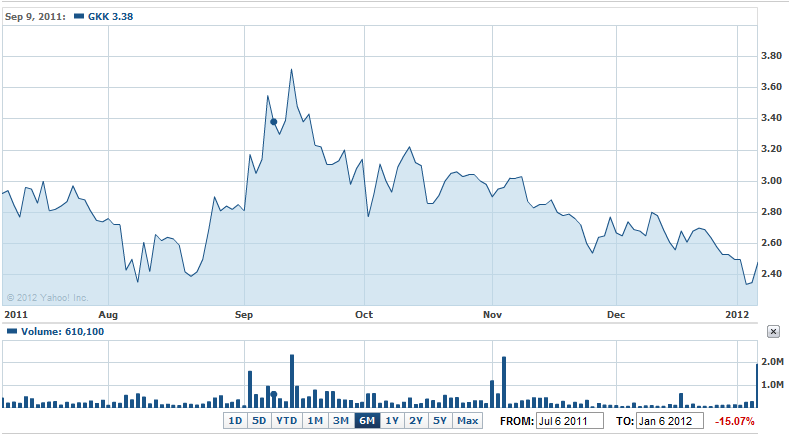
The decline in the stock price to the $2.30 area made me want to re-evaluate my position in the stock.  Not so much with the intention of liquidating my position mind you.  I was far more interested in whether I should buy more.

I began by stepping through the Gramercy third quarter 10-Q, followed by the recent filings, in particular the 8-K filing made on December 8th that detailed the pro-forma financials ex-realty.  Unfortunately, as tends to be the case with Gramercy, the review left me with as many questions as answers.

I have to say that Gramercy has some of the most difficult financial statements that I have ever seen.  I spent two years researching Dynegy and even with all their SPE’s and off-balance sheet transactions it was still easier to understand what they were up to then it is with Gramercy.  The problem with Gramercy is a combination of

  1. it being difficult to determine what is held at corporate and what is held in the CDO’s and until recently realty
  2. there being overlap between the holdings of corporate and the CDO’s and realty and so some items are netted out even though their liability is non-recourse to corporate
  3. the fact that the CDO’s are basically a black box unless you have access to the managers report and that is not public knowledge (I am still using the only publicly available report which is from March and so therefore somewhat dated)
  4. the company really doesn’t make much of an effort to clarify any of the above.

Anyways, with all that in mind, lets try to draw some conclusions.

Net Asset Value vs. Book Value

One positive of late is that for the first time it is relatively easy to determine the book value of Gramercy corporate.  Up until now the mess of CDO and Realty divisions made it a nightmare.  With Realty gone, proforma statements were released in mid-December and stated clearly that there are $260M in assets, $40M in liabilities, and $88M in preferred.

Book is $132M or $2.60 per share.  Done deal right?

Wrong.  Everything is more complicated then it seems with Gramercy.

The first complication is that Gramercy corporate owns a number of reasonably senior securities from their CDO.  Because these securities are also liabilities (in the CDO) they are netted out and disappear on the balance sheet.

“In addition, as of September 30, 2011, the Company holds an aggregate of $54.0 million of par value Class A-1, A-2 and B securities previously issued by the Company’s CDOs that are available for re-issuance. The fair value of the repurchased CDO bonds is approximately $40.3 million as of September 30, 2011.”

However the liability in the CDO is, like all else in the CDO, non-recourse, and so the asset on corporate is legitimately accreditive to book.  So even though the value of the notes are not on the balance sheet, they should be.

The next thing that is terribly confusing is what is included in the real estate investments.  According to the pro-forma those investments total about $80M at cost:
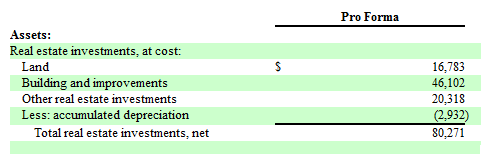
And maybe that’s the end of the story. The problem is that the company said in their last 10-Q (which is for the same period as these pro-forma results) that real estate assets after the transfer of the realty division was complete would total $121.3M with corresponding mortgages held in the CDOs:

“The Company anticipates that all transfers will be completed by December 31, 2011, after which, the Company expects to retain a portfolio of commercial real estate with an aggregate book value of approximately $121.3 million, encumbered by non-recourse mortgage debt held by the Company’s CDOs totaling $94.3 million, which mortgage debt is eliminated on the Company’s consolidated financial statements.”

The (unanswered) question that I have is whether the netting out of the assets and liabilities of these real estate assets includes is included in the above $80M?  My guess is that it doesn’t; that because the asset and liability are both on the balance sheet (with the liability being within the CDO) they are netted out just like the CDO notes.   But I’m not sure.  If I’m right, then the true book should reflect the extra $27M of the commercial real estate portfolio above and beyond the mortgage debt.

But what’s it worth?

The last, and perhaps most ambiguous question about the balance sheet  is what the assets are actually worth if they are sold.  As noted above, the real estate investments are recorded at cost.  I assume the $121.3M is a number also recorded at cost, though that is not clear.  But what could this real estate fetch today?  Is it substantially less then cost? It wasn’t clear in the pro-forma whether Gramercy chose cost because it was the lessor of cost/fair value, or because they just had to value them at cost.

As for the CDO’s, the notes are recorded at fair value, which means they are being valued at quoted market prices.  In reality the CDO debt is either worth all or nothing.  Either the CDOs have the cash in run-off to pay back the A-1, the A-2 and the B or they don’t, so its more likely the number is either $54M as they are fairly senior notes and so they are likely to get paid off.

To help make my point with the real estate investments take a look at one of Gramercy’s investments that you do have the information to analyze to some depth.

The joint venture 200 Franklin Square Drive, Somerset, New Jersey is carried at $558,000. Yet income from the property was $29,000 in Q3 and $90,000 for the first 3 quarters. So based on its book value it is returning 20%. I think the book value needs to be higher.


Now this is a case where the book is on the low side. There could just as easily be cases where the asset is booked on the high side. The point is, this whole valuing Gramercy is a ballpark game at best.

What is the deal with CDO-2005?

The deal is that CDO-2005 failed its over-collateralization test again in October after having passed it the previous quarter.

Presumably the main catalyst in the failure was the write down of whole loans to Las Vegas Hilton and Jameson Inns.  Together these loans were carried at $42.5M on the CDO books.
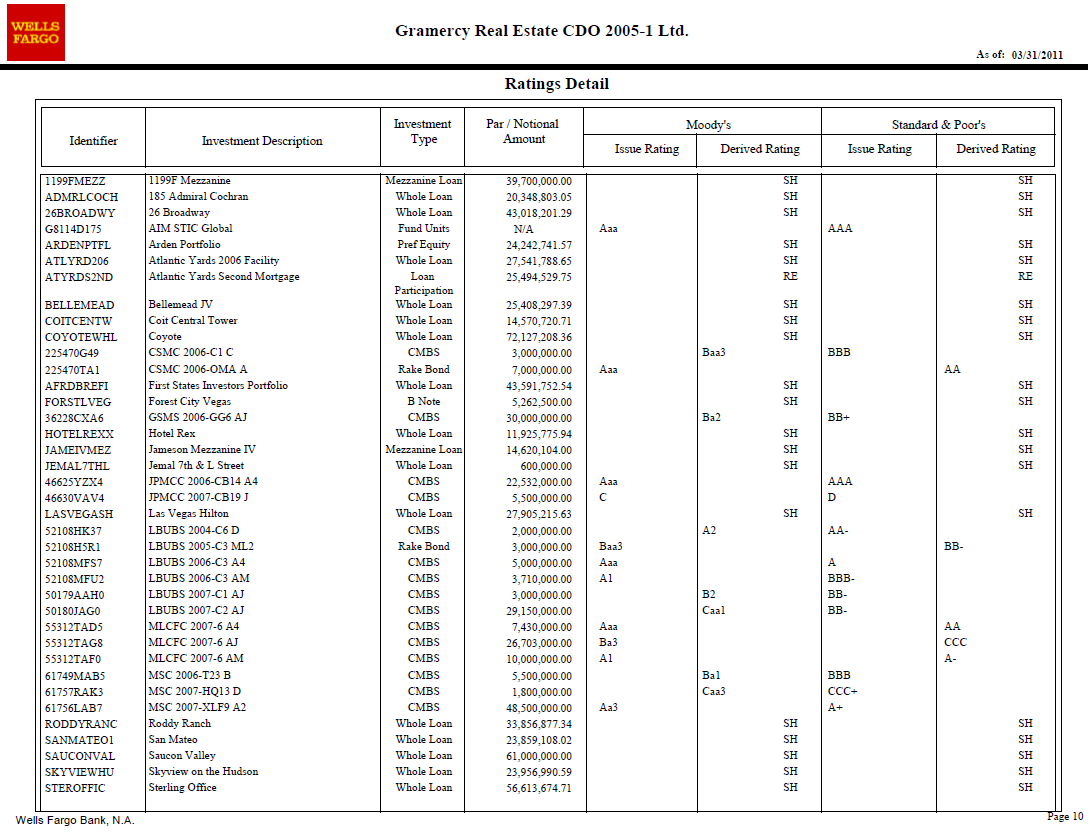
The question now is just how far underwater is CDO-2005 and will that CDO be able to cure itself and begin to paying out money to Gramercy again?  Well while I don’t have the most up to date data, I can still take a stab at answering that.

As of March 2011 CO-2005 had an outstanding note balance of about $741M.  Presumably in curing that balance the first time round (it was cured in July), the note balance was reduced somewhat, to lets say $700M.   Based on the current over-collateralization of 115.53%, that would mean current assets in the CDO are around $810M.  In order to pass the test with $810M of assets, the outstanding note balance has to be reduced to $686M.  In other words the company needs to see a $14M cash infusion to get the CDO passing again and begin seeing cash flow to corporate.

Where is that cash going to come from?  From the interest that is diverted to paying down principle for as long as the CDO is not in compliance.  As shown below, that interest, which was paid out in the previous quarter as the CDO was in compliance, is a little less than $5.5M per quarter.

The other possibility is that as loans within the CDO are paid off both the numerator and the denominator of the over-collateralization test drop (the assets decline as well as the notes that are paid off with the proceeds).  Eventually this would cure the CDO though it would take a lot more run-off, about $90M by my calculation.

The conclusion here is that CDO-2005 is not dead by any means, but that we should not expect to see cash flow from it for another couple of quarters.

Management Incentive

One of the concerns with any of these REIT’s is whether the interests of management are aligned with shareholders.  The concern is generally that management wants to keep getting paid and so they won’t necessarily jump at the chance to sell the company, instead preferring to live of the cashflow (and in a worse case the cash) to pay their salaries and bonuses.  I think this is the concern of Indaba, who as a large preferred shareholder is attempting to add a board member to get that cash used in share holders interests.

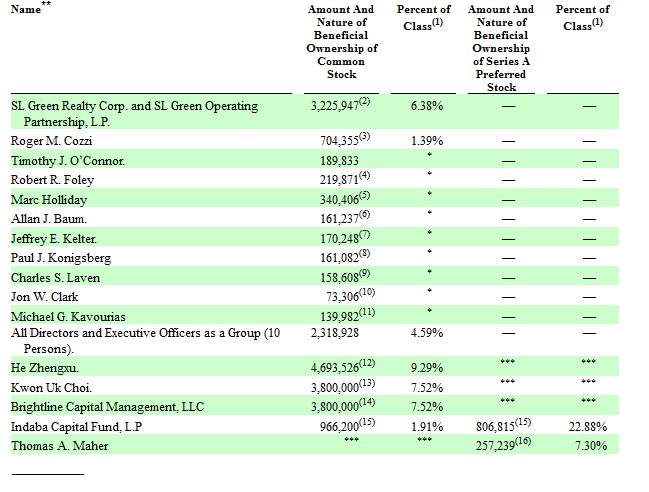
Along those lines though, it looks to me like recent efforts have aligned management fairly well. The have been provided with incentive to sell the company by the end of June 2011.  Below is a list of significant shareholders of the company published as part of a 14C on December 19th.  Executive Officers as a group own 2.3M common shares in the company, including over 700,000 shares owned by Cozzi.
What I Think

Adding it up, there is no question that there is a lot of question marks here in the numbers.  It is difficult to determine the true value of the real estate owned. It is difficult to determine when and if CDO-2005 will cure.  It is difficult to know with confidence whether there are loans in CDO-2006 that may fail, causing it to fail its over-collateralization test and thus putting the company in the position where there really is minimal cash flow coming into corporate.

The best I can do is to take the fact that the book is $2.40/share, that $150M of that book is cash, that there is another $50M off balance sheet that is invested in higher end securities in CDO-2005 and CDO -2006 that are almost certain to pay off at par eventually, and that given that the US economy appears to be stabilizing and not falling back into a severe recession, it is reasonable to presume that CDO-2006 will continue to pay out $7M of cash to corporate every quarter for the forseeable future.

Given all of this, I added to my position in Gramercy this week, and I will continue to add as long as the stock trades below the $2.40 level.  I was sad to see that we had a bump up in the price on Friday.  We will have to see if it sticks.  If not I will be ready to buy more.

Gold (and now Silver!) Stock Update

Apart from Gramercy, I made a few small changes to my portfolio this week.  I sold out of OceanaGold at $2.45.  I had planned on holding the stock until the $2.60 range again but I saw better opportunities but was reluctant to become even more leveraged into gold stocks at this point.

That better opportunity that I saw was Golden Minerals.  My broker told me to get in on a private placement of AUM back in the fall of 2010.  Nah, I don’t think so I said.  I think that placement was at $18.  The stock got as high as $24.  I bought it this week for $6.25.   Pays to wait.

Golden Minerals is another one of these junior explorers (though they do have a small silver mining operation in Mexico now) that has gotten obliterated in the last year.  The stock is down 75% off its high.  Luckily for the company, that private placement went through with some other poor bastards taking the brunt of it, and so the company is flush with cash.  With AUM you are paying $6 and getting a company with a little over $2/share in cash and an indicated and inferred resource of a little over 6Moz ounces of gold equivalent at a 50:1 silver to gold ratio.

The company’s producing mine in Mexico, Velardena, looks promising, but it remains to be seen if they can ramp up production as expected (they want to be producing 4,000oz of gold and 214,000oz of silver by Q4 2012).  More interesting to me is the project in Argentina, where they have a fairly high grade (300g/t) silver deposit that sits at 60Moz right now and looks like it has lots of room to grow.

At any rate, its another example of a beaten up junior that was worth a heck of a lot more a year ago then it is now.  It seems like a reasonable speculation that it will recover at least some of that value this year if gold and silver prices don’t crater.

Portfolio

Letter 26: A Move in ACFC, the end of tax loss selling for gold stocks, Mispricing of Aurizon Mines, and All the Devils are Here

All the Devils are Here (though most have probably moved to Europe)

Over the winter break I read the book All the Devils are Here, by Bethany Mclean and Joe Nocera. The book essentially traces out all the strands that culminated in the panic of September 2008. The book identified the following factors:

  1. A reliance on ideology instead of analysis. In particular this applies to the Federal Reserve and Alan Greenspan, whose ideological “market is always right” view permeated the decisions of the Fed and to some extent those of the other regulatory bodies. But more generally, ideology, specifically free market ideology, seemed to permeate through all the political and financial institutions to the point that it replaced a sober look at reality. Similarly, for many traders and investment bankers, an ideological reliance on “the model” often led to an ignorance of the potential risks of an outlier scenario
  2. The absence of regulation. For a variety of reasons (the power of the lobby groups, the political infighting between the regulatory bodies, the ideological free market view of the participants and the myopic focus on regulators on Fannie and Freddie) an attempt to regulate the subprime industry was hardly even contemplated until it was too late.
  3. The development of securitization. The most important consequence of the innovations to pool mortgages, to tranche pools, and then to create pools of pools (CDO’s) was that the lender and the borrower became further and further divorced by more degrees of separation. The securitization process created so many layers of intermediaries between the party who actually ended up with the loan on their books and the party that took the money that risks were easily lost in the translation.
  4. The rubber stamped AAA status provided by the ratings agencies. Some books focus on how the rating agencies didn’t understand what they were rating. Mclean and Nocera point out that the revenue structure of the agencies was doomed to be corrupted. A system where the raters are paid by the producers of the securities they rate might be considered to be an insane one. The result was that the agencies were played off against one another by the investment banks; market share went to the most relaxed rating. Add to this the fact that the agencies, particularly Moody’s, became focused on profits at the expense of their inherent conflict of interest, and you had a situation ripe for abuse.
  5. Greed. Politicians more concerned with their own campaign donations than with promoting sustainable public policy. Company executives intent strictly on their own promotion and profit. Mortgage originators with essentially no moral compass at all. The system was (and is) corrupt.
  6. A lack of understanding. The same characters at play as with greed. So few people saw the disaster coming. Sure some did, there were a few regulators and a few hedge funds that saw how unsustainable the leverage being piled on in the mortgage sector was. But the vast majority didn’t have a clue. Even the supposed smart money didn’t really get smart until 2006-2007.

It is this last point, the lack of understanding, that I think is most relevant to what we face today. It really surprised me how little the people in influential and powerful positions understood the concepts that they were making decisions with regard to. Even Hank Paulson, who is actually portrayed in quite a positive light, was completely blind to the corruption and leverage being amassed in the mortgage market.

This naturally begs the question of Europe: how many of the politicians and bureaucrats in the EU really understand the situation they are trying to navigate? Do they really know the risks inherent in the decisions that they are making? Do they even really understand the banking sector they are trying to protect?

The last 6 months for me has been an education in how the modern banking system works. I have been trying to read all that I can, all the boring, technical aspects. And I don’t think for a minute think that I’ve wrapped my head around it. There are so many moving and interdependent parts. It’s also not a very tangible subject. It simply isn’t something that is easily understood.

Thus I think it’s a legitimate question as to whether the bureaucrats of Europe have the understanding required to navigate the minefield of sovereign defaults and banking bankruptcies. As Lehman showed, it only takes one mistake to create a loss of confidence that spirals uncontrollably.

How can you take on risk with this in mind?

The end of (tax loss) selling?

The week after tax-loss selling is always an interesting one.  It provides the first glimpse into whether a security has been facing unrelenting selling because of investors simply wishing to take their losses (and their tax breaks) and move on, or whether something more nefarious is at play.  Along the lines of the former, this week provided a rather marked jump in a number of the regional bank stocks that I have initiated a position in.  Most conspicuous of these moves was that of Atlantic Coast Financial.

A Take-over Imminent for ACFC?

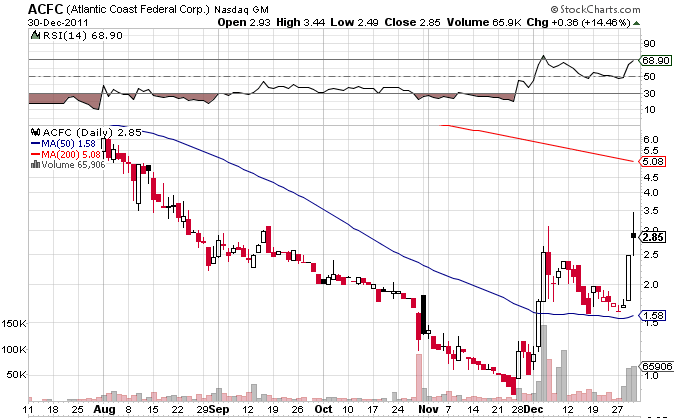
ACFC had a rather astounding 50%+ move this week.  I really have no idea what precipitated the move.  To take it with a grain of salt, the volume for the stock this week was less than spectacular, though the same could be said for almost the entire move down.

As I pointed out last week the stock is a bit of a flyer; the bank is a mortgage lender in one of the most crippled mortgage markets (Florida), they have bad loans coming out their wazoo, and a stock that has fallen from $10 to $1 in less than a year generally does not do so on speculative panic alone.  Nevertheless, part of the story is the book value, which even with 3 years of bad loan write-downs lies at a rather surreal $19 per share (versus a share price of $1.70 when I bought it).

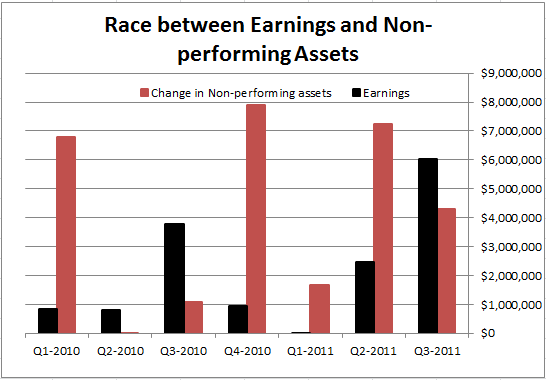
The other part of the story is simply the realization that what is going on with this bank (and many of these little community banks that got caught up in making bad loans at the wrong time) is a race between the write-downs of their past transgressions and the earnings of their current performing loan book.   With ACFC it is not at all clear to me that the bad loans will win out; in fact I tried to make the case last week that with a little luck (and an improving economy) the performing book may very soon be able to out-earn the losses on a consistent basis.  If this happens, the shares are clearly worth more than 10% of book value.  Even if it just becomes a possibility, a shrewd competitor may be tempted to take a plunge.  I constructed the chart below to try to see where ACFC is in that process.  The chart compares earnings before provisions (black) to the quarter over quarter change in non-performing loans (red).  Its basically a look at whether the company is out-earning the loans going bad each quarter.  The 3rd quarter was the first in four that the black won out.

Community Bankers Trust: Another Regional Bank with a Move of its Own

While ACFC was the best of the lot of regionals, there were others that showed signs of life.  Community Bankers Trust surged on Friday.  The stock remains at about 1/3 of book value.  If it were not for Europe and the ever-impending doom there, I would add more.  As well, Oneida Financial continues to push higher.  Unlike ACFC, BOCH and BTC, Oneida is a terribly boring bank trading at about book that is probably going to do nothing but increase in price by 10% a year and pay a 5% dividend until one day it gets bought out.  At some point I might get bored with with relatively low return, but in this environment, I am happy to take a reward with so little risk.

Will Gold Stocks Rise now that Tax-loss Selling is over?

As for the golds, Esperanza, Canaco and Geologix all are showing classic signs of a let-up in tax loss selling.  All are well above where I bought them.  Aurizon, on the other hand, continues to be sold rather indiscriminately.  Yes, I realize that the price of gold is getting clobbered on a regular basis.  I can appreciate that investors may be questioning the wisdom of holding gold as a hedge to anything given the fact that it seems to dramatically underperform on risk-off days.

Still, I scratch my head at Aurizon.  Here is a low cost gold producer that is comparatively less correlated to the price of gold than most of its competitors.   For one, if you are low cost you are by definition high margin.  Thus, a $30 move in the price of gold is of much less impact to a producer with $1000/oz margin (like Aurizon), than say a producer with a $500/oz margin.  Yet Aurizon regularly trades down MORE than your average gold producer on the down days.

Going Short Argonaut Gold and long Aurizon Mines

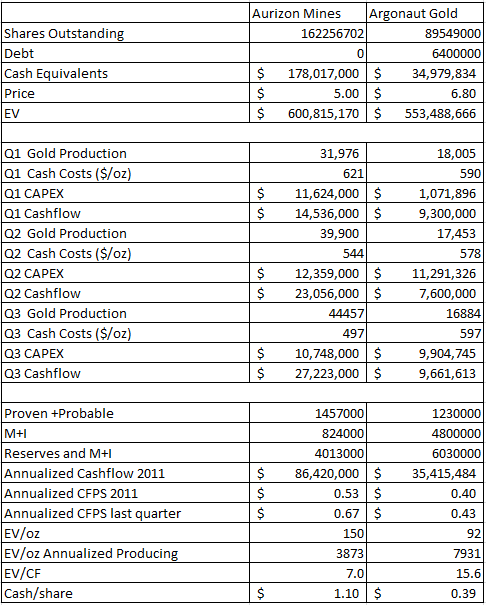
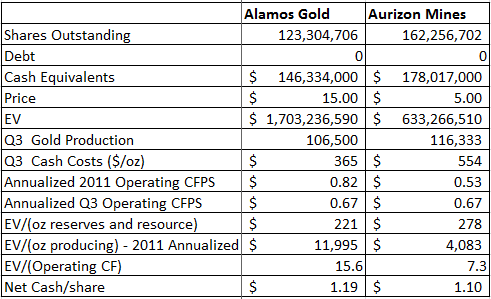
So confounded have I been that in order to hedge my risk with Aurizon I have decided to take a short position in a fellow gold producer, Argonaut Gold.  To be sure, there is nothing wrong with Argonaut Gold.  I wrote the company up rather glowingly a couple months ago.  However that was at $5, and now AR trades at $7, while in the same time Aurizon has fallen to less than $5. Below is a comparison of the key metrics of both companies.

So to briefly summarize the above, Aurizon produces more than twice as much gold, it produces over double the cash flow, and to top it off, Aurizon’s 3rd quarter was stronger than Argonaut’s.  Argonaut potentially has a better pipeline of projects, but this is more than nullified by the fact that Aurizon trades at almost half the price on a per producing ounce basis, produces those ounces at $50-$100 cheaper, and has over $1 in cash on its balance sheet while Argonaut has a mere 30 cents. It simply doesn’t make sense.

While I remain bullish the price of gold, I also remain wary that I am not very right in this bullishness at the moment, and so it seems like the prudent thing to do to short what seems relatively over valued and buy what seems relatively undervalued.  Anyways, that is what I did.

I also bought back OceanaGold for another run.  Its getting to be repetitive, but it has been a consistant source of profits.  Buy OceanaGold below $2.20 and sell it above $2.70.   I must have done this 3 times already in the last 9 months.

Portfolio

Letter 25: Tax Loss Buying

I am on vacation with limited computer access so this is going to be a short letter.

There was some good news for the oil stocks in my portfolio this week.

News that should help Equal

Equal Energy has not performed very well lately.  I don’t expect much from the stock until something is announced with the companies Mississippian lands in Oklahoma.  While we wait, Sandridge, the biggest landholder in the Mississippian, jv’d 363,000 acres of their land to Repsol this week for $1B.   That works out to $2,754/acre.

SandRidge will sell an approximate 25% non-operated working interest, or 250,000 net acres, in the Extension Mississippian play located in Western Kansas and an approximate 16% non-operated working interest, or 113,636 net acres, in its Original Mississippian play. The 363,636 net acres in total will be sold to Repsol for an aggregate transaction value of $1 Billion. Repsol will pay $250 million in cash at closing and the remainder in the form of a drilling carry. In addition to paying for its working interest share of development costs, Repsol will pay an amount equal to 200% of its working interest to fund a portion of SandRidge’s cost of development until the additional $750 million drilling carry obligation is satisfied.

Admittedly, this is a little on the low side compared to some of the earlier deals.  That is because this deal included 250,000 acres of the second Mississippian play that Sandridge is involved in.  The second play is newer and riskier.

The fact that Sandridge was able to get $2,750 per acre while only including 113,000 acres of the prime land (in Oklahoma the heart of the Mississippian is Grant, Alfalfa and Woods) provides another positive data point for Equal.

Equal has 20,000 acres of land in the heart of the Mississippian.  This is another deal that suggests that the land is worth around $70M.   At $4.50, the stock trades at an enterprise value of $300M and with a market capitalization of $150M.  It is clear that that the Mississippian land is not priced into the stock.

I bought some more Equal on Thursday at $4.50.  I believe the recent decline in the share price is simply tax loss selling.  I believe that the stock would be undervalued at $7/share.  At $4.50, its a little ridiculous.

Coastal Energy News

Coastal Energy has been the best performing stock for me over the last few months.  They have hit on well after well after well.  The string of success continued with the B-09 well news released on Tuesday.

“The Bua Ban North B-09 well encountered the largest pay zone we have seen to date in this field. We are particularly excited that we have encountered oil across five Miocene zones. This confirms the lateral extent of the deeper pay zones below our main producing reservoir. Following this successful result in the deeper zones, we plan to drill further appraisal wells to continue testing the 63.0 mmbbl of prospective resources defined in the RPS report ofNovember 15, 2011, which are incremental to the 67.0 mmbbl of 2P volumes defined in the report.”

What is most important about the result is that it begins to prove up the lower miocene sands.  First Energy noted the following:

The Bua Ban North B-09 well discovered 3-4 mmbbl in deeper Micocene sands which could open a new play for Coastal with an overall prize of 63 mmbbl prospective resources.

The Miocene sands that Coastal is drilling into are actually a number of layered sands as shown in the illustration below.  Up until the B-09 well, Coastal had been focusing on the upper two layers.  The B-09 explored the lower layers.  The RPS report distinguished between reserves and prospective resource in the Miocene.  While the news release did not say so specifically the above snippit implies that most if not all of the prospective resource is in the deeper sands.

There is an excellent summary of the Micoene sands that Coastal is drilling into that was posted by Oiljack on the Investorsvillage Coastal board.

Midway gets us Excited and then…

The moment I noticed that Midway Energy was halted I went out and bought shares in Second Wave.  I thought for sure that the halt was due to a takeover bid and that there would be a subsequent boost to the other Swan Hills players (Arcan and Second Wave).  Unfortunately, while a takeover bid may indeed be in the works, the clarification by Midway left the waters muddied.

Midway Energy Ltd. (“Midway” or the “Company”) announced today that it has become aware that information may have entered the market with respect to certain potential transactions. The Company has not entered into any definitive agreement with respect to these transactions and will issue a press release when and if a successful transaction has been negotiated.

Nothing like clarity.  Nevertheless the stock popped when it opened and Second Wave popped along with it.

I think I will hold onto Second Wave for a while; their latest update was mildly disappointing with a few of the recent wells producing at far less than the earlier more prolific Crescent Point JV wells.  However according to an Acumen Capital report, the lower production rates can be attributed to a failure of the packer equipment during the frac operations, while the 100% WI well drilled to the south (08-23-062-10W5) was limited to 100bbl/d by the surface pumping equipment.  I’m not sure I understand that second one entirely, I mean why would the company install insufficient surface pumping, but nevertheless I hold out some hope that the going forward results for SCS will improve on these numbers.  Meanwhile SCS does not appear to be as encumbered with infrastructure requirements as Arcan is in the short term, so  capital is going to be spent drilling wells.

Unfortunately, as seems to happen from time to time, the practice account I post here had my SCS order rejected because of a lack of margin, something that clearly isn’t the case (I don’t think RBC spends much time updating and debugging the practice accounts functionality).   I am reluctant to try to re-buy the stock now after the pop so for the moment I will not have my SCS position reflected unless it falls back to the $2.45 range that I bought it at in my actual accounts.

Gold Stocks

I am not sure if it was a smart thing to do but I added positions in a couple of gold stocks this week.  These should not be considered long term positions; they are simply me trying to take advantage of what I see as the severe underperformance of the stocks when compared to the bullion.  I added a position in Semafo at $6.40.  Semafo is a mid-tier producer that has generally held up well in the market but that got taken down to new lows of late.  I also added a position in Canaco.  Canaco has had a rather spectacular decline from over $5 a share to a low of a $1.  That is where I bought it.  The company has what looks to be a decent deposit in Tanzania.  Moreover, at $1 they have a market capitalization of $200M and with cash on hand of $115M.

Portfolio

Letter 24: Risk and Reward, Atna Analysis, More Community Banks

Last week I wrote that I did not understand why  the market was reacting as favourably as it was to the European proposals that came out of the Dec 9th summit.

A tweak here, a tweak there and pretty soon you have… well not a whole lot to be honest.

In a way I felt vindicated  by the market collapse that occurred in the early part of this week.  In another way I felt sick to my stomach, because though I have been creating an evermore conservative weighting to my portfolio, when the shit hits you still feel it.

Kyle Bass was on CNBC this week giving some more detail on his doomsday-like expectations:

The observation that deposits are leaving Greek banks at an annualized rate of almost 50% is somewhat frightening.  Clearly this crisis is going to come to a head soon.

John Mauldin publishes a great conversation between Charles Gave and Anatole Kaletsky.   It is quite provoking, and its hard to walk away after reading it without feeling the impending doom that awaits the Eurozone.  Kaletsky and Gave both make the quite reasonable point that perhaps Germany would prefer a break-up of the Eurozone.  If you watch what Germany is doing, and ignore the platitudes they are saying, you might question their motives.  Kaletsky points out that of the necessary measures to fix the Eurozone, Germany seems to be steadfastly opposed to both Eurobonds and to ECB intervention.  Absent those  measures, what hope does the Eurozone have?  Perhaps that is the plan all along.

Gold Stocks – I should went all out

Gold stocks got CREAMED this week.  I had been lightening up on my gold stocks the week before in anticipation that something might be about to hit.  I didn’t like the way gold was going, I didn’t like the fact that the WSJ was penning articles describing a dearth of Indian demand, and I didn’t like that Draghi talked tough during the EU summit, suggesting that money printing was still some time off.

Nevertheless being that I was not fully out of gold stocks, I got smacked about pretty good over the course of the week.   Atna, Aurizon, and with Lydian all performed quite miserably.

What’s Wrong with Aurizon?

Aurizon is a surprise to me.  I expected the stock to hold up better than it has been.  I might have expected its performance to be closer to that of Alamos.  Both are low cost producers.  Both are single mine operations.  Yet the valuation difference between the two is somewhat staggering.

I can only guess that there is a strong seller of Aurizon out there that wants to be out of the stock by year end.  I can only hope that the new year will bring some sanity to the stock.

While reviewing Aurizon, I began to wonder how much having a AMEX listing hurts the stock.  Anecdotally it appeared to me  that the Canadian stocks with AMEX listings are much more volatile then those without.  I decided to take a closer look.

I grabbed price data since August 1st for 9 stocks, 5 with AMEX listings and 4 without.  From the web I grabbed a visual basic function that calculates volatility based on the following Black-Scholes formula.

For purposes of Black-Scholes calculations, volatility is the standard deviation of the periodic percent change in prices, divided by the square root of time.  Volatility is emphatically NOT the same as “beta”, which measures the correlation of a security’s price movements with those of the overall market.  Neither is volatility simply a measure of the standard deviation of a security’s closing prices over time.

Here is the volatility of each security:

Is there a correlation?  Perhaps, though its not as clear a one as I had suspected.   The distinction is most clear between Aurizon, Alamos and Argonaut Gold.  There is no reason, in my opinion, that Aurizon is so much volatile than these other two stocks.  But apart from that, volatility seems similar between stocks on the two indexes.

I bought back some of the shares of Aurizon at $5.07 that I had sold at over $6 a few weeks ago.

The NPV of Atna

Another stock to get clobbered this week was Atna Resources.  I mentioned a couple weeks ago that I had finished an analyses of the company and would post shortly.  I never did that post, until now.

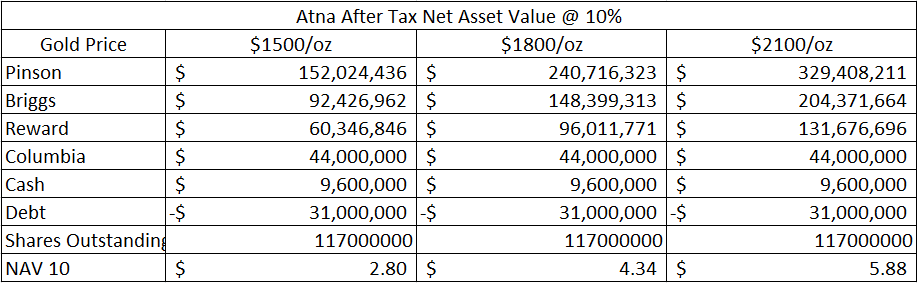
Below is the after tax NPV10 that I calculated for Atna at various gold prices.

I based my model on the following assumptions:

Briggs:

  • A 11year mine life, at 40,000 t/d
  • Total produced ounces of 476,000 oz over LOM
  • 0.017 oz/t resource over the mine life, strip ratio of 4 and with 80% recoveries
  • Resulting in gold production of  39,700 oz per year
  • Mining costs of $1.30/t mined, milling costs of $4/t milled and G&A costs of $1.7/t mined
  • Cash costs of $898/oz over LOM

Pinson:

  • A 15 year mine life, beginning at 350t/d and ramping to 750t/d by year 4.
  • Total produced ounces of 940,000 oz over LOM
  • 0.4 oz/t resource over the mine life, diluted by 30% with 90% recoveries, resulting in gold production beginning at 50,000 oz and ramping to 75,000 oz.
  • Mining costs of $110/t, milling costs of $50/t and G&A costs of $11/t
  • Cash costs of $687/oz over LOM

Reward:

  • A 8 year mine life, at 24,000 t/d
  • Total produced ounces of 292,000 oz over LOM
  • 0.026 oz/t resource over the mine life, strip ratio of 4 and with 80% recoveries
  • Resulting in gold production of  36,400 oz per year
  • Mining costs of $1.30/t mined, milling costs of $4/t milled and G&A costs of $1.14/t mined
  • Cash costs of $560/oz over LOM

Columbia and Cecil:

  • To the current resource of each I assigned a simple asset value per ounce of $40/oz measured and indicated and $20/oz inferred on the total resource of both properties

Atna is, in my opinion, is one of the best gold stock investments out there.  As demonstrated above, the stock is trading at about 1/3 of its NPV 10 at $1500 gold.  If I wanted to get more aggressive in my evaluation, I would note that many companies are moving to value feasibility on NPV5.  On an NPV 5 basis Atna is worth $3.86 per share at $1500/oz gold.  That number jumps to almost $8 per share at $2100/oz gold.  Clearly there is upside once the momentum begins to build.

I added to my position in Atna on Friday at 78 cents.

Taking Advantage of the Collapse

In addition to Atna and Aurizon, I also added new positions in a few juniors.  Call it the beginnings of a basket; I added a couple of non-producing juniors with deposits to my portfolio this week:

Geologix was recommended by Rick Rule as a takeover candidate on BNN about a year ago.  Since that time the stock has fallen significantly.  The company has a very low grade copper-gold deposit called Tepal in Mexico.  The PEA that was published on Tepal a few months ago put the NPV5 of the project at $412M based on $1000/oz gold and 2.75/lb copper.  Geologix has $14M of cash on hand.  With 145M shares outstanding, the market capitalization of the company was $28M at my entry price of 20 cents.  That puts half the market cap in cash and the other half in a project with an NPV that is nearly 10x the value of the company.  Something has to give here.

Esperanza Resources is another old Rick Rule recommendation.  Rule doesn’t talk much about specific stocks anymore, but there is some evidence that he is still interested in the company.  http://www.investmentu.com/2011/September/why-gold-mining-stocks-will-skyrocket.html .  The company certainly fits the bill of the sort of stock Rule likes.  Esperanza has 1Moz of gold in Mexico.   It’s a heap leach project so it should be able to be brought on production without a massive capital requirement (about $100M).  Like Geologix, the company has almost half its market cap ($100M) in cash on hand ($50M).

I plan to add more to both of these stocks in the coming weeks.

Regional Banks: A  Position in Community Bankers Trust

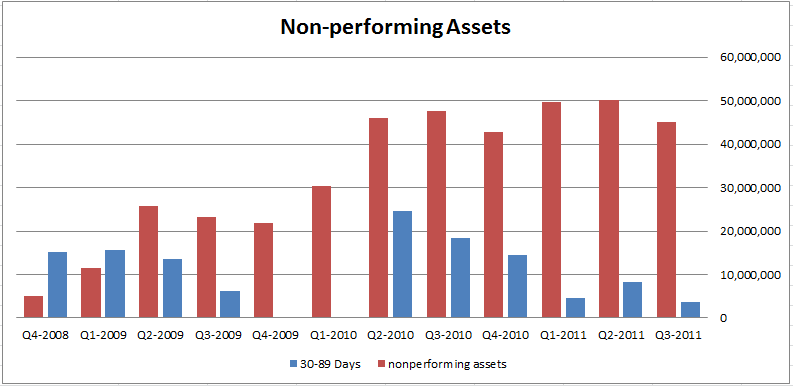
Community Bankers Trust (BTC) hit my bid when it sold off back down to a dollar this week.  BTC is trading at 27% of tangible book value.  This is, of course, partially because of the large number of non-performing loans on their books.  Non-performing loans make up 8.9% of total loans in the Q3 quarter.  This was down from 10.1% in Q2.  In fact, there are some encouraging signs that the worst of the loan losses are behind us.  The company has shown 3 quarters of lower loan amounts 30-89 days past due.  This trend is beginning to show up in the total non-performing loans, which decreased for the first time in a year in Q3.

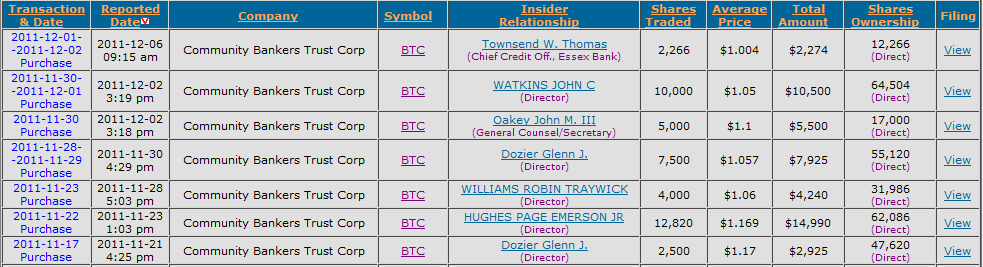
Moreover, as I have pointed out previously, insiders continue to buy the stock.  Third quarter purchases by insiders were a little less than $50,000.

And Another Regional Bank Position in Atlantic Coast Financial

To be perfectly honest, I might have made a mistake here.  I’ve only put a very tiny amount of capital at risk, but even that may have been too much.   Atlantic Coast Financial (ACFC) is a lottery ticket.  I bought the stock at $1.70 on Friday.  There is just as much chance that it will go to zero as there is that it will double.

ACFC is a former Mutual Holding company that did their second step bank in February.  The second step added cash to the balance sheet and resulted in a bank trading well below book value.  ACFC trades at a rather crazy 10% of tangible book.  Clearly there is more to the story.

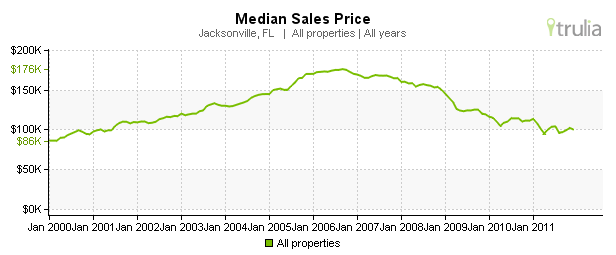
The more to the story is that the bank is centered in Jacksonville Florida.  They primarily make residential real estate loans.  Real estate in Jacksonville has not done particularly well over the last few years (though it appears to be bottoming).

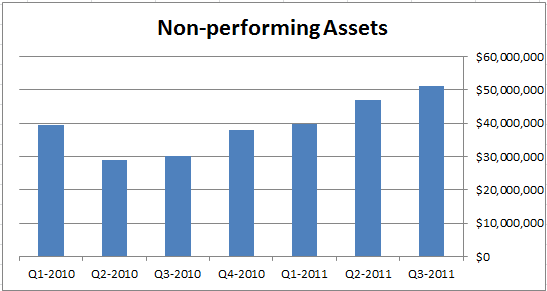
The falling real estate prices have led to skyrocketing non-performing loans.  Those non-performing loans have not shown any sign of peaking yet (thus the possible mistake on my part).

The questions are, how many of these nonperforming loans will eventually be written down, and will there be value left in the equity once the non-performing loans are written down.

What drove me to take a small position in the stock was in part that an improving economy, and stabilizing home prices in Jacksonville, may mitigate further deterioration of the bank assets.  As well, the bank is generating decent earnings before provisions.  Ignoring provisions in Q3, the bank earned $1.16 per share.  In Q2 that number was $0.55.

What is going on at ACFC is something akin to a tug-of-war, whereby on the one hand loan losses strip away value every quarter, while on the other earnings power of the performing loans adds value back.  The share price is so low that it doesn’t take much a a shift in the dynamic between these two forces to change the value equation substantially.  Its easy to see how a stabilization in non-performing loans could quickly allow the earnings power to win the race and shareholder value to go up substantially.

The other factor in my decision to buy was the recent announcement that the company was looking into strategic alternatives.

On November 28, 2011, Atlantic Coast Financial Corporation issued a press release announcing that its Board of Directors has engaged Stifel, Nicolaus & Company, Incorporated to assist the Company in exploring strategic alternatives to enhance stockholder value

Part of the reason that the company is looking for options is that they are not in compliacne with the Individual Minimum Capital Requirement (IMCR) agreed to by the Bank with the Office of Thrift Supervision on May 13, 2011.  Under the IMCR, ACFC agreed to achieve Tier 1 leverage ratio of 7.0% as of September 30, 2011. Tier I capital at the bank is 6.22% right now.

It is a far from perfect scene.  Nevertheless, an improving US economy and stabilizing housing prices could give me a decent return on the stock.  The book value of $19 is unrealistic, a return to $3 is not.

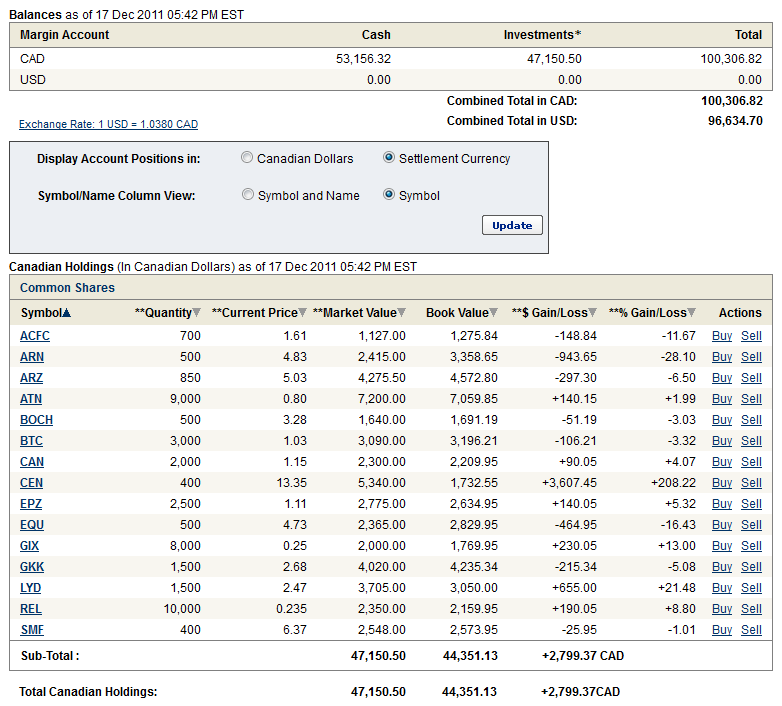
Portfolio Composition