Skip to content

Posts from the ‘Portfolio’ Category

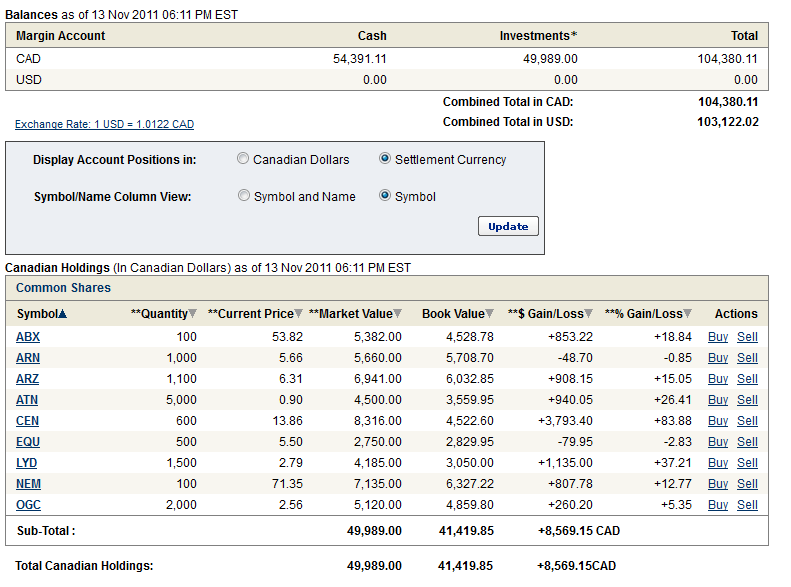
Week 19: Liquidating Jaguar, Adding to Atna, Aurizon
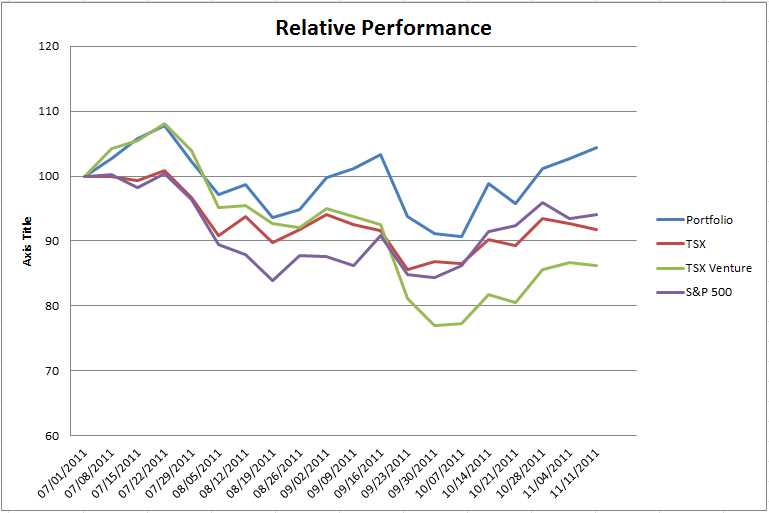
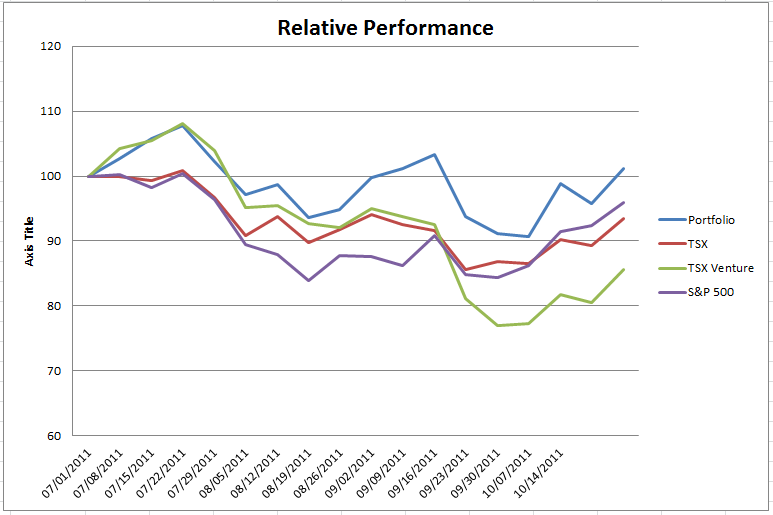
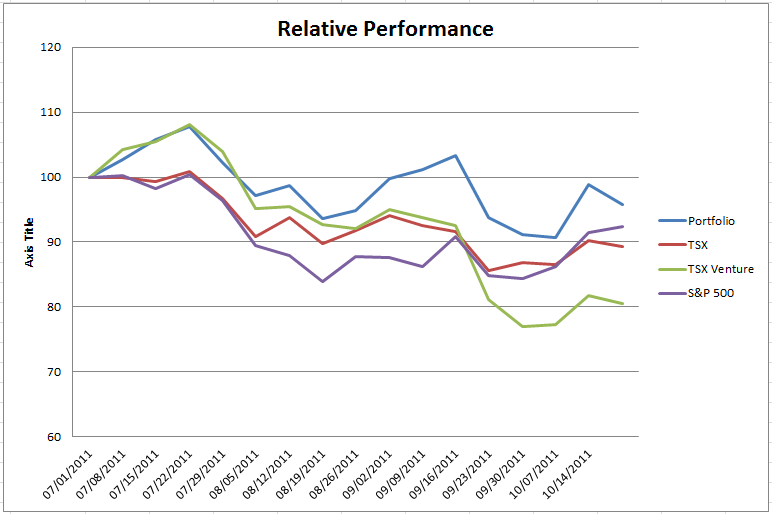
Last week was another good week for my portfolio.  I tend to perform well in sideways markets.  In down markets, especially those like we’ve had recently where the correlation of all asset classes go to one, I tend to underperform on an individual equity basis, because the stocks I own are for the most part small caps and commodity stocks, and they get hit harder than the broader market.   I’m trying to mitigate that with my currently high cash position, and it has done its job and  dampened the effect.

I would, however, like to reduce my cash position at some point, as it is har d to make money when so much of it is doing nothing.  To do that though I would have to see some sort of light at the end of the European tunnel, and that is not likely forthcoming.

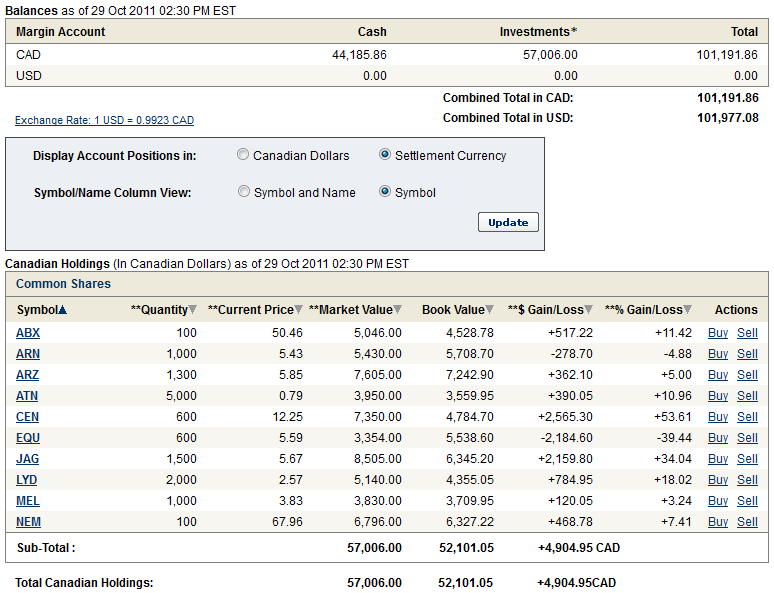
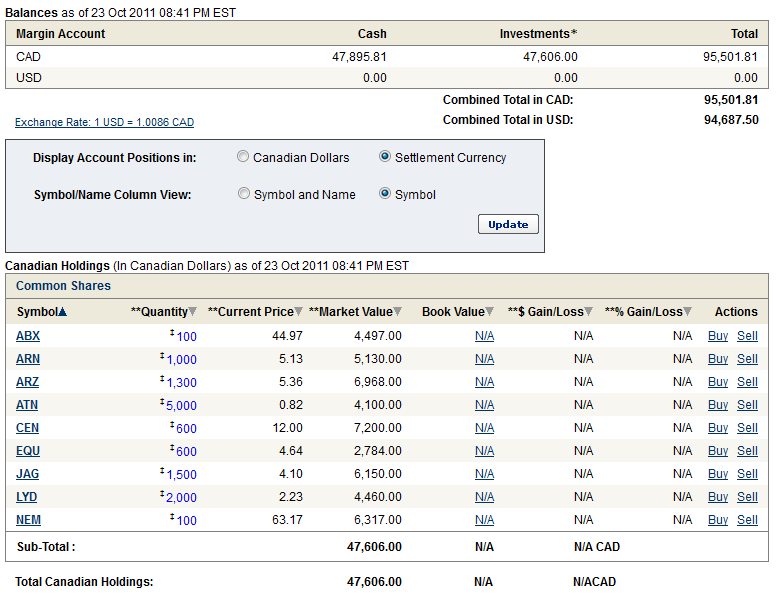
The only significant portfolio change I made last week was to sell my position in Jaguar Mining, and using the subsequent cash to increase in my positions in both Aurizon Mines and Atna Resources.  There will be more to come on both Atna and Aurizon in a future post.  I see Atna in particular as a interesting and soemwhat unique situation.   Atna recently received 100% interest in the Pinson deposit.  This is a game-changer for the company, and one that is not even close to being priced into the stock price.  Because Pinson does not have a full feasibility study complete, or even a PEA, investors are not aware of the economics of this high grade underground project.  But more on this later.  For now though I want to spend a few minutes talking about Jaguar Mining.  Since I have written about the company fairly extensively, I think its worthwhile to review why I have now chosen to go the path of full liquidation.

I can point to a number of reasons for getting out of Jaguar Mining.  At the top of that list is the company’s inability to generate free cashflow, even though the gold price has risen some 40% over the past 9 months.   The way that Jaguar has managed to match any increases in operating cash flow with correpsonding increases in capital outlays is uncanny.
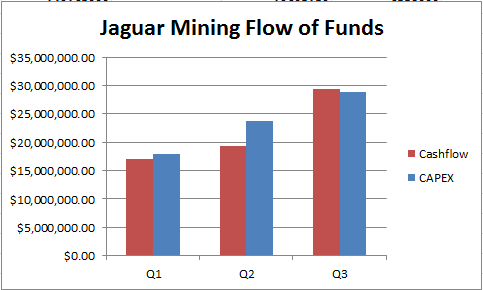
Let’s compare this to another holding of mine, Aurizon Mines.
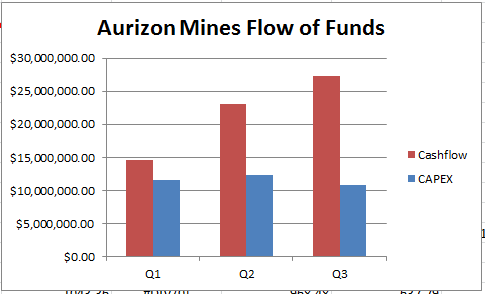
Aurizon, on the other hand, has done exactly what you’d expect a company to do in a rising gold price environment.  They have generated a great deal of cash.  The cash position of Aurizon has increased almost $40M since the beginning of the year.  Jaguar’s cash position, on the other hand, has actually decreased if you remove the effect of the convertible denbenture issued in the first quarter.

Of the two companies, the one that you would have to say is in a better position for expansion would be Aurizon.  But never a management team to be daunted by lack of available funds, Jaguar said in a separate press release that they are going forward with the development of the Gurupi project.

At the beginning of the year Jaguar provided a longer term outlook  of what to expect from the company.  I’ve provided one of the tables from this outlook below.  Pay particular attention to the requirements of Gurupi (which as the table indicates was supposed to start development this year, by the way), an estimate that one analyst on the conference call referred to as outdated and not in the “that number is too high” kind of way.

Jaguar is going to be forced to raise a lot more capital to fund Gurupi.

On top of that, Jaguar plans to refinance their outstanding debentures with senior debt.  Between the Gurupi financing and the convertible refinancing Jaguar is looking at a bond offering of $400M+.  This seems like a bit of a heroic expectation for a company that is struggling to produce any free cash flow at record high gold prices.

Another analyst on the call pointed out that the market might not be quite as responsive to new debt from the company as Jaguar management seems to think it might be.  Quite reasonably, the analyst referred to the existing debentures, which the market is currently valuing at a 13% interest rate.  He speculated that the market is suggesting that Jaguar debt would take a 15-17% coupon.

Management said that the offer sheets they had received were in the 9-11% range.  Forgetting for a minute that 9-11% interest rates are extremely high, you have to be a bit suspicious of the company’s ability to raise money at this level when there are debentures outstanding that carry the upside conversion option, at a 20-40% discount.

I could go on.

I bought Jaguar because in the low $4’s it was a undervalued NAV play.  The projects, if you tally up the value of each, are worth around $6-$7 per share, and maybe more at $1800 gold.  But at $6 per share, which is about the average price that I unloaded my position at, that NAV story is replaced by a cashflow story that to be quite frank about it, just isn’t there.

I’ll stick with Aurizon, with Atna, and with the big boys like Newmont and Barrick.

Week 18 Portfolio Update: Still Cautious but Getting More Optimistic

Last week I posted how I was of two minds; that while I still saw significant risks over the medium and certainly the long term, that I could also imagine a scenario where the market rallied in the short run.

I still think that is a likely scenario.  Especially after having watched Greece peacefully resolve not throw itself and the rest of Europe into utter chaos.  Yet I ended the week with more cash on hand then I began the week with.  Its just a tough market to hold any conviction with.

I am, however, a little more confident about the prospects of Europe than I was a week ago.  Why?  Well this weekend I spent my spare time looking  at Italy.  Last week I wrote a pretty negative piece about Italy. Having re-read those comments tonight, I think that I need to retract them in degree.  I had perhaps  read too many articles slanted with a negative spin on the Italian debt situation.  In truth, I think the situation there is somewhat more balanced than the WSJ, FT, and my other sources have given credit.

I plan to put out a post later this week describing what I have learned about Italy (as well as Japan, but more on that in a minute), but I’ll briefly summarize the main conclusions here.

Without a doubt, Italy has its problems; they have a lot of debt outstanding (120% of GDP), they have a dysfunctional political system that seems to readily make promises but not able to follow through on them, and they have an economy that almost certainly will be in a recession for months to come.

Still, Italian debt is not at the level yet that threatens the ability of government revenues to service it.  And that is really the bottom line.  While the path that Italy is on is not one of prosperity, it is going to take a lengthy recession and a move to even higher interest rates (8-9% at least), to really put the country’s ability to service its debt in jeopardy.

None of this is to say I have turned wildly bullish.  Greece, Portugal, and Ireland all look to be in a whole lot of trouble.  Its really just a matter of time.

What’s more, the real point of my research this weekend was to investigate Japan, and what I found there was frightening.  More on that later this week.

Anyways, back to the portfolio.  I actually lightened up a little on my gold stock holdings on Friday.  This is not an indication of any wavering of my thesis on gold.  It was simply prudent portfolio management.  The gold stocks I own have had a heck of a run over the last couple weeks.  Jaguar Mining has moved over 50% in the last two weeks.  Aurizon had a one day move alone of 10%.  Newmont has moved 15%, as has Barrick.  Gold stocks are finicky and they could just as easily fall back next week as they could break out.

A break out is possible however, and many of these stocks are back to that breakout level that they tested and then subsequently failed at in September.  This week should tell the tale.

On the oil side of the ledger, Coastal Energy is supposed to be releasing results of the A-09 well, which tested between the Bua Ban North A and B fields.  A hit in this area would prove up even more reserves for the company.  I continue to hold Coastal in hopes that with any market turn upward it will begin to be valued to reflect these recent discoveries.  Equal Energy continued to move higher last week.  In a normal market, without the overhang of Europe, I would be significantly more long Equal than I am right now.  Sandridge announced results last week and they showed better than expected production from its Mississippian wells so far.  Its just a matter of time before Equal begins to drill their Mississippian land and gets revalued upwards for it.  Equal remains cheap (look at my oil and gas comparison spreadsheet posted Friday for an idea of just how cheap).  As for Arcan, I await news both on the production front, and hopefully someday, on the takeover front.

I still have a bid in for Gramercy Capital at $2.75.  One of these days the market will have a crippling sell-off and that order will be filled.

Week 17 Portfolio Update: Of Two Minds

My portfolio was up rather substantially last week, along with the rest of the stock market.  To be honest, I would not have expected it to happen that way.

My portfolio is constructed against what I see as an eventual calamity in Europe, and my expectation that as the dominos begin to fall, perhaps extending as far as Japan, that investors will reconsider the grand 40 year experiment with fiat currency , and with that they will reconsider gold.

(I’m really starting to sound like a gold bug, aren’t I?)

The market, on the other hand, looked at the plan (or plan of a plan depending on how exact you want to be with your language) that the EU laid out on thursday and apparently began to wave the all clear flag.

So what happened?  How did gold rally at the same time as the broad markets?  Isn’t this a conflicting signal?

Well it is and it isn’t.  I think you have to look that the situation through two lenses to truly understand the response of gold, of the stock market and of the bond market.

The first lens is reality. This is what the bond market and the gold market are telling you, and it is all about the inadequacy of the bailout.

The WSJ laid out a fact based piece on the front page of the Saturday Journal.  Sometimes the facts are as damning as any commentary.  While the market rallied on Thursday, the bond market hardly budged.  Sometimes a chart is worth a thousand words.

Worse, on Friday Italy held an auction and was forced to issue 10 year bonds at above 6%.

In Friday’s bond auction, Italy was forced to pay more than 6% interest on its new 10-year debt, approaching levels that some analysts said the country can’t afford for long.

Its actually somewhat surprising that the market has so far shrugged this off.  First, it is a pretty scathing critique by bond investors.  One day after the grand plan announcement and Italy is paying higher rates than it was even a few months ago.

Moreover, as the above quote alludes to, this crisis began in August when Italian bonds rose from 5% to 6%.  The reason that this seemingly innocuous move up was met with such fear by the market is because Italy is basically on the precipice of falling off the cliff of solvency and 1% can throw them over the edge.  While Italian government revenues can withstand a 5% interest payment, they cannot withstand 6%.

That is how thin the thread is that Europe hangs to right now.  Italy owes $1.9t of debt.  When you owe that much debt, over the long run (as that debt comes due) whether you are solvent is more a question of perception than anything else.

Right now the perception isn’t so good.

And let’s look at little closer at some of the details of the plan.  First, the EFSF.  Do you really think that the EFSF, which according to the same WSJ article is expected to guarantee only the first 10% of Italian and Spanish debt after default (I thought this was supposed to be 20%?) is going to appease investors at future Italian and Spanish bond auctions who have just watched Greece take a 50%+ haircut?

And do you really think that Greece is going to be able to live up to the forecasts laid out in the plan?  The recap agreed to will lead to a Greek debt load that will peak at 186% in 2013 and that will fall to 120% by 2020.   That alone is worth reading twice.  But it gets better.  This will take place if you presume their growth scenario of 1 1/4% by 2013 and 2 1/4% by 2015. Seriously.

Given the scenes I’ve seen from Greece the last few days I wouldn’t be betting my pennies that the country will be growing at 1.25% in a little over a year.  It looks like a country in collapse mode.  As the WSJ points out in another article on Saturday:

Greece is the canary in the euro zone’s coal mine. The bloc’s prescription for a crisis spurred by overborrowing and overspending is a dose of radical fiscal rectitude, delivered fast. To regain the confidence of skittish investors, countries are being asked to rip up paternalistic policies that provided stability and comfort to legions of citizens but left the state reeling from the bill. The question is, can it be done without igniting society into revolt?

Greece has youth unemployment of 43%.  They have total unemployment of 16% and rising at a pace that is beginning to look parabolic.  And they haven’t even begun to fire the civil servants that they need to in order to meet the austerity measures they have agreed to.  The country is being ripped up at the roots and it is supposed to grow again in a year?

Moreover, the one mechanism that could make Greece competitive is off limits.  They are stuck with the Euro, which means they are stuck playing on a level currency field with Germany even when they are clearly world’s apart.

On final point.  The bailout, and future bailouts, are all going to have to be be paid for by someone.  Those someones are Germany and France.  Neither of these countries are a fortress of debt virtue.  Both have debt to GDP ratios of around 80%.  This point seems to get forgotten.  The bailout-ers are really not in that much better shape then the bailout-ees.

I could go on.  But you get the point.  This is not over by a long shot.

But, having given my critique, I did say that I was of two minds right now.   What is the other?

Well I was re-reading The Big Short this weekend for perspective.  By the summer of 2007, when the two Bear Sterns hedge funds collapsed, pretty much everybody that mattered knew that sub-prime was a big problem.  By February 2008, when Bear Stearns collapsed, you would have had to be in a bubble to manage money and still not know anything about subprime mortgages.  Yet the market plodded along, rallying at times, until the fall of 2008.  And it wasn’t until after the shit hit the fan, after Lehmans went belly up and credit essentially ceased to flow, that the stock market actually began to plummet.

I think that what has to be remembered is that most money managers investing in the stock market are not really being paid to quantify the scenarios in Europe.  Its out of scope to have to account for that sort of risk.  They probably just want it to go away so that they can return to what they are paid for and go home when they are supposed to.

This deal appears to give them the out, for a while, that lets them do that.  What this deal has done is stave off the final denouement for another few months.  Enough time that the market can perhaps gleefully rally and pretend again that all is well.

And who am I to argue with that logic?  I’m certainly not going to go out and buy bank stocks based on it, but if the market is going to tread water for a while longer, there are a number of stocks out there that could benefit.

With that in mind, I bought some stock this week.  The first is I bought back some Equal Energy on the news of their property disposition.  As I have already written this is a good deal because it is a deleveraging one.  And Equal remains extremely cheap by any metric.  There was a very good post on IV that pointed out that Equal’s Mississippian land in Oklahoma is worth $60M to $75M alone at the going rate of recent transactions.

I also opened a new position in Midway Energy.  Again pointing to a post on IV, Midway is trading very cheaply based on its current production and cashflow.  As teh excerpt below points out, you aren’t even fully paying for the Garrington assets, let alone the potential in the Beaverhill Lake.

With the stock only trading at $3.61/share we believe the stock is not even fully reflecting the value of the Garrington Cardium assets let alone any value for the Swan Hills Beaverhill Lake play. Our base valuation reflecting the 2012 cash flow is $3.00 and the Garrington upside potential adds another $2.50. We therefore believe that investors are getting a free ride on the 40 net sections of Beaverhill Lake rights at Swan Hills with their investment in MEL.

As well I have sold down the extra shares I bought of Jaguar when it got into the low $4 range, and replaced them with shares of Aurizon Mines in the mid $5 range.  Jaguar, which was up 35% this week, is an enigma.  There was no reason for it to fall as much as it did two weeks ago, and there is no reason it rose last week.  I think its pure manipulation.  I decided to lighten up before the manipulators changed their stripe.

Finally, one stock that I have not yet bought (back), but that I plan to is Gramercy Capital.  The company is cheap, and it probably is going to sell itself sooner or later.  I will be buying on any significant correction downward.

Week 16 Portfolio Update

I can’t believe how weak the gold stocks have been.  While the price of gold has held up reasonably well, the stocks got pummelled yet again this week.  Gold stocks seem to be reacting to each tick up or down in the price of gold as if their business was operating on the slimmest of margins.  Yet nothing could be further from the truth.  The gold producers are pulling in record margins, and should report record cash flow for the third quarter.

With that in mind I “leveraged up” on the gold stocks this week, buying a position in Barrick Gold on Friday (as it hovers around its 52 week low), adding to my position in Newmont, and re-starting a position in OceanaGold.  I’m seriously considering trading out of Jaguar and into OceanaGold for no other reason than I am so sick of having the stock sitting on my watch list.  But we will see if cooler heads prevail there.

I’ve also been listening to a number of interviews with Kyle Bass this week.  I learned about Bass recently while reading an article about Michael Lewis’s new book Boomerang.  Bass was one of the few that predicted and then bet on the subprime debacle.  Lately Bass has had some very interesting things to say about what is taking place in Europe.

I’m happy to report that his views are not much different than what I’ve been saying since the beginning of August. That means that he also thinks the EU is unlikely to be able to deal with their debt issues in a sufficient manner.

Others agree.  William Buiter, the Chief Economist of Citigroup called the EFSF a “pea shooter earlier last week”.  Then on Friday night the European Commission released a report where they suggested private bondholders will be pushed to take 50 or 60 per cent haircuts on Greece.

All of the solutions being proposed right now are instances of the same basic idea.  Layer on more new debt to pay back the old debt.  How is this going to work?  How is it going to appease the market?

Its the type of world where I am not comfortable owning much of anything, but it is one where I still have to believe that owning gold is a reasonable choice.  Simply, how is it that we can have the second largest currency in the world under continued pressure and possible collapse, and it not be good for the asset class that is the “anti-currency”.

What’s more, it may be that the world’s third largest reserve currency is much closer to its own demise than anyone gives credit for.

Again, to the talented Mr. Bass (I just learned how to embed videos from CNBC so I’m all over that right now).

We might be on the verge of a far larger shift in the global reserve currency system than anyone imagines right now.

So I added a bit of Barrick at its 52 week low.  I don’t want to get crazy or anything.