Skip to content

Posts from the ‘Uncategorized’ Category

Peabody Energy and why it is very tricky to make a decision right now

It is very hard to know what to do with commodity stocks right now. For those that have held commodity stocks into the run-up (which could even mean “since Monday” given the incredible melt-up we have had), we are sitting on big gains.

Do you sell on those gains or are bigger gains to come?

In my last post I described some of the risks of holding commodity stocks right now. They are:

  1. Some sort of peace agreement
  2. The removal of Putin from power, one way or another
  3. Global recession
  4. Western countries outside of Europe getting fed-up with paying high prices and starting to view this as a “Europe problem”

All of these are on the table I think.

On the other hand, you have the reward of holding commodity stocks. Yes, they are up a lot, but how much higher could they go in a scenario where prices are higher for longer?

Let’s take the case of Peabody Energy.

The great thing about looking at Peabody is they laid out their 2022 guidance in very understandable terms a few weeks ago. So it is very easy to model what their cash flow will be under different scenarios.

Peabody is, in a way, at the epi-centre of the crisis. Russia is the third largest thermal coal exporter. Russian coal accounts for roughly 30 per cent of European metallurgical coal imports and over 60 per cent of European thermal coal imports.

This guy put together a nice spreadsheet of Peabody. I’ve copied that below with a couple of changes.

The first scenario I’ve modeled is at $200 thermal and $365 met coal (Peabody receives a 15-20% discount on their met/pci coal). This is actually below current prices but well above the historical norms.
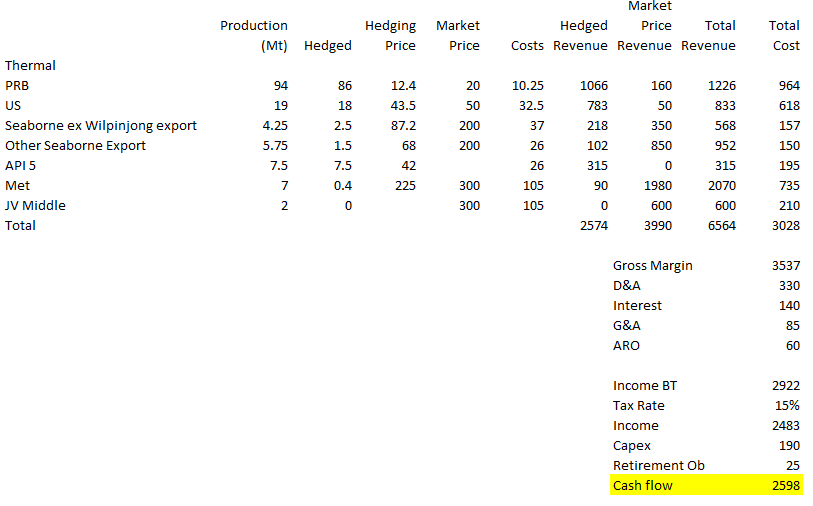
Peabody has a market cap of $3.3 billion and an enterprise value of $4.2 billion. So under this scenario, if these prices were realized for a full year, Peabody free cash flow would be roughly 80% of their market cap and 60% of enterprise value.

Now let’s look at the extreme. Right now, thermal coal is at $400. I don’t know what PRB coal is at, but the last time thermal was $400 PRB went to $30. What happens then?

While this scenario seems very unlikely over any long period of time, it could be approximate to what they earn in the very short-run. Peabody’s free cash is about $1 billion more than its current market cap.

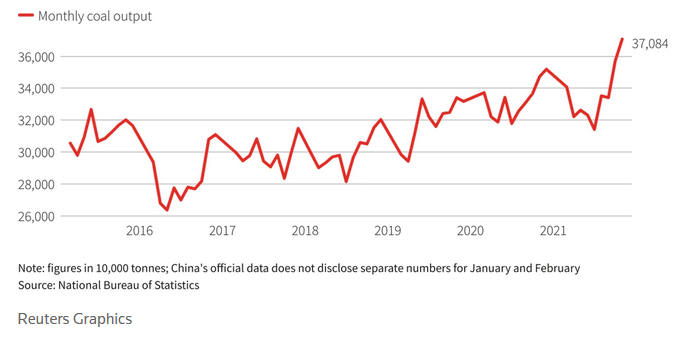
Russia supplied about 200 million tonnes of coal to the world last year. China produces 4.07 billion last year. China had to push their producers late-last year to get to that level. You can see that below:
Australia is a big coal producer but this was their response a few days ago.
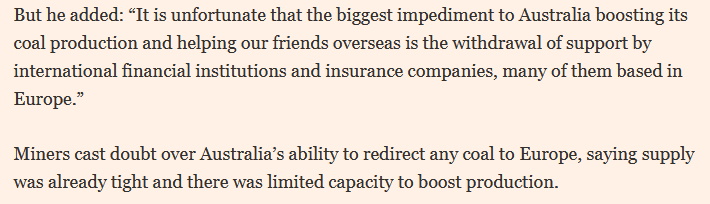
It is not entirely clear that the world can quickly make up any deficit.

That means the big questions are:

  1. How long will the spike last
  2. What is the new equilibrium if sanctions continue for a long period of time

The thing is, if there are still sanctions through 2023 much of the contracted coal that Peabody signed at lower prices is no longer under contract. The PRB coal, for example, is only 55% committed for 2023. It is pretty easy to see how even at much-reduced prices (from current levels), but still very high historic prices, 2023 would set up as another huge cash flow year for Peabody.
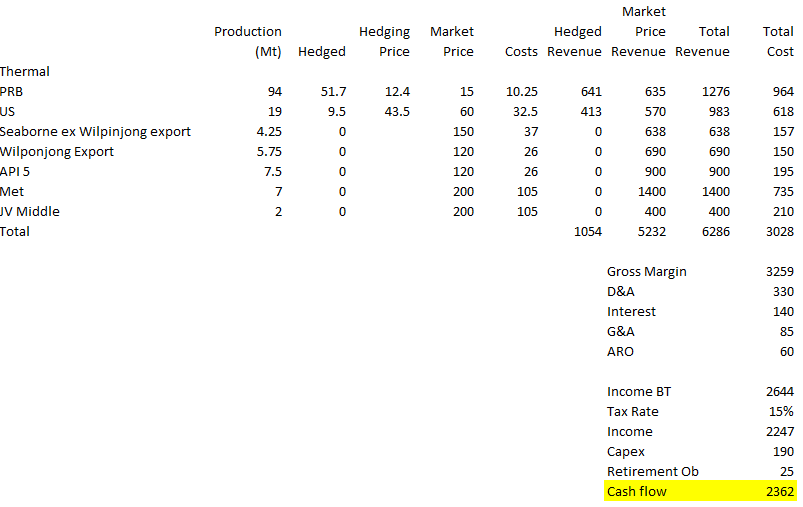
Are these the right prices for that scenario? I don’t know. But this is a scenario where we are in a conflict through 2023. If that is the case I know the prices are going to be higher than the 2021 prices. How much, its really hard to say.

Peabody is an easy example because they have given such detailed guidance. But working though similar scenarios with my other positions. Its the same result to varying degrees. For example, Cardinal, my biggest oil position, should do $400+ million of free cash at current prices. Cardinal’s market cap is $1.1 billion.

But… I am not actually trying to make the case to own Peabody or Cardinal or any other commodity stock here. FWIW I sold some of my position in Peabody (which I had added only on Monday) because it was up 40% in 5 days and I mean, holy cow, it feels irresponsible not to take some profits on that. I sold a little of Cardinal as well.

What I am trying to say is that it is really, really, really tricky to know what to do. It is truly about balancing the risk and reward based on your own individual circumstance and tolerance. Because Peabody could be a $50 stock in 6 months but it could also be a $15 stock in two weeks.

Outcomes to the upside and downside have suddenly become more extreme. That is why one of the only things I’m fairly certain of is you have to take down exposure to both.

World on tilt.
Don’t be a hero

It’s a bear market in stocks. It’s a bull market in commodities.

You don’t want to overthink that too much. But in bull markets there are times to be long, times to be very long and times to take some off.

I think we are at #3 now. While the rise in commodity prices makes it tempting to just keep adding to copper stocks, steel stocks, oil stocks, ag stocks, gold stocks and so on, that FOMO is usually best taken inverted. I have taken the opposite tact and started taking some profits on these names.

Rising commodity prices are your best friends until they are their own worst enemy.

I’m unsure what these rising prices mean for the global economy. I’m really unsure what rising food prices mean.

Consider these quotes:

  • The Black Sea region (Russia and Ukraine) accounts for more than 30pc of global wheat exports
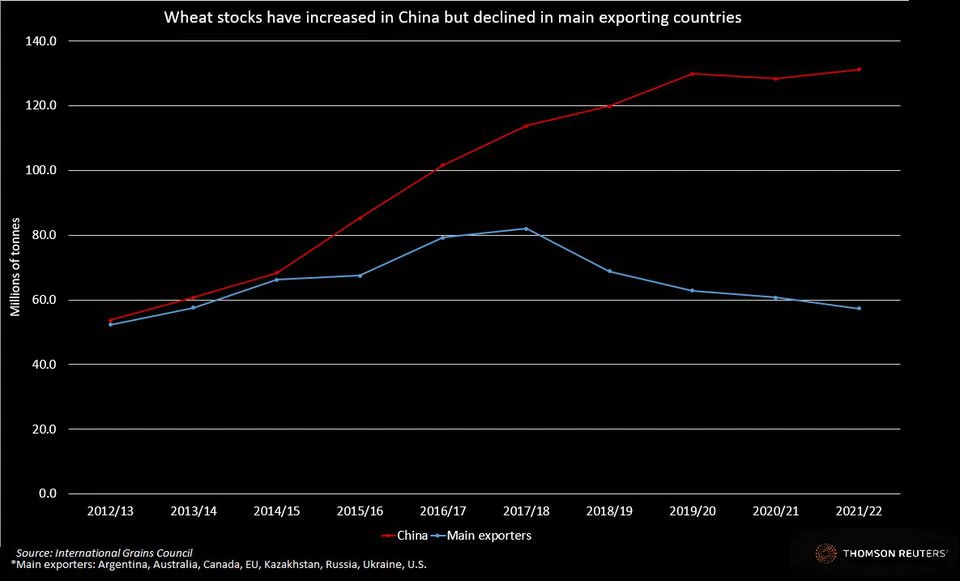
  • Stocks in major wheat exporters – the European Union, Russia, the United States, Canada, Ukraine, Argentina, Australia and Kazakhstan – are set to fall to a nine-year low of 57 million tonnes by the end of the 2021/22 season, International Grains Council (IGC) data shows.
  • If Russia and Ukraine are excluded, other major exporters account for 16% of global stocks or enough wheat to feed the world for less than three weeks.
  • Russia is a major low-cost exporter of many kinds of crop nutrients. “No other nation has the same breadth of readily exportable fertilizer supply,” says Alexis Maxwell, an analyst with Bloomberg’s fertilizer analysis and news publication Green Markets. “Their fertilizers move to all continents.”
  • ..in Russia, the share of imported seeds is almost 40%? And for potatoes, the share of imported seeds is 90%? That is, of course, farmers will come up with something over time, but at least in the short term, we should expect a shortage of basic agricultural products and a sharp rise in prices. And that’s not all either..
  • The Ukrainian planting season comes up in less than 4 weeks

Meanwhile, China has been slowly accumulating wheat for some time now:

I don’t mean to imply a doomsday picture of food shortages. I really don’t know. In this blog I talk about what I see and how it influences the decisions I make with my investments. These headlines and the details make me uncertain. And I always lean to cash when I am uncertain.

That said, I don’t want to be too short. We have seen so many bad things happen over the last two weeks. If something good happens the market could flip on a dime.

I mean, what if Putin is taken out? That would be great for the world, a relief for everyone, but probably less so for commodity stocks and (maybe…) shorts of everything else. It seems a low probability, but its not impossible. I think its important not be to positioned to get punched in the face if some “white swan” like that happens.

I want to be careful to all possibilities.

Meanwhile the shorts I hold have been so bad (which is to say good to be short) that I am left wondering how much lower they can go. These names (I’m talking mostly about SaaS/momentum/covid beneficiary stuff) go down every day, even when the market rallies. There has to be some sort of bottom at some point.

The shorts I am more inclined to keep are those that are economically sensitive. At this point I’d rather have that small short dependent on consumer spending that has seen its price appreciate to an unseen level during covid than I would the SaaS name that has already fallen all the way back to where it started and is still growing 30%.

You add it all up and you end up with more cash. Less positions and smaller positions. My portfolio had a good couple weeks. I’m back to the highs. I don’t feel like this is the time to press.

It is worth taking a step or two back from the action in front of your eyes. It is not going to matter if you miss the last leg up or down or if you don’t time the bottom to the day. There are times to take risk because you can see that the market is at your back. There are times not to, because the winds, while not necessarily in front of you right now, are swirling unpredictably and so you can’t be sure just how they will settle.

Most important, I would rather wake up each morning and not have to worry too much at all. Except for the Upper Colorado River snowpack of course. I’m okay worrying about that. Its going to snow there this weekend by the way, but I think it will not be enough. It will be an average year at best and that is not going to change the trend.

Overhaul in a Day

I decided to make a number of changes to my portfolio today.

I wrote on the weekend that I hadn’t really changed much leading into the invasion of Ukraine, other than adding a bit more on the hedge side. I think that is because the uncertainty of the situation has taken a while to sink in for me.

So today I changed tact. I sold a lot of stocks. And I bought a few others that are tied to the commodities Russia exports.

What sparked this was a search through the brokerage document database I have access to. I started searching for the word “Russia”. I quickly came across documents that showed just how large its influence on various commodities was.

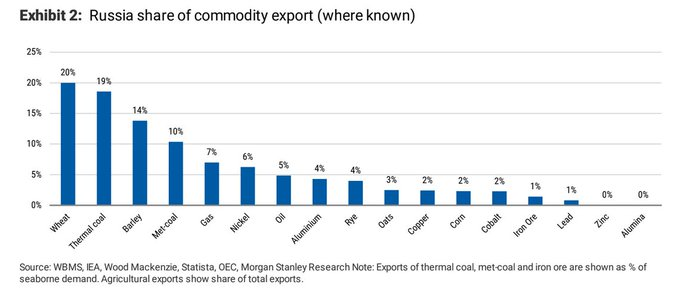
I don’t think I realized just how big of a commodity exporter Russia is. And that really got me wondering how this is going to ripple through the world economy.

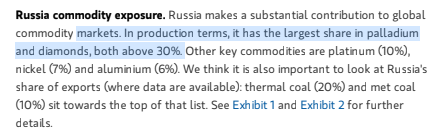
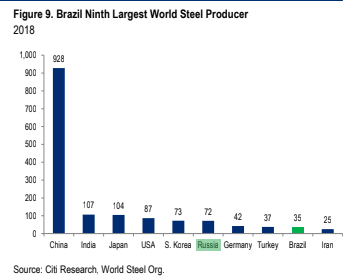
At the end of this post I’ve snipped a bunch of the tables and charts I found. Russia is just such a big player in the export of so many basic commodities. And then on top of that Ukraine is a large grain exporter and they actually export a fair bit of other commodities as well – steel for example.

I was already on edge about market exposure. So when the market almost got to even today, I said to myself that I would be crazy not to take this opportunity to make wholesale changes.

I sold a lot of my bank positions and a lot of my biotech positions. I now only own a little BCBP, a little BSVN, and a bit of a few biotechs trading well below cash. I added to my index short some. And then I added some small-ish commodity stock positions like Stelco, Algoma, Peabody Energy, and Diamcor Mining (Russia is 30% of the diamond industry!).

(Note: I also bought JJG, the grain ETF, and added a little to BIOX. I forgot those ones in the original post).

None of these long positions are very big. I just thought if I’m going to have some long exposure, this seems to be the place to do it.

My basic thought here is that A. I have no idea how events are going to unfold but B. It seems unlikely that something will happen in the near-term to lift the sanctions that are going to impact all these commodities that Russia exports. I guess what I am saying is that while I don’t know what the world will look like tomorrow or next week, it is hard to imagine a fast return to status quo.

That said, let me emphasize – small positions. I tweeted today that the “best advantage a tiny retail investor has is ability to just sit it out”. I did that during COVID and I made a pretty big move in that direction today.

This is all just to hard to figure out. I’d rather stand aside and wait.

Image

Probably (another) Bear Market Rally

I don’t really think the market rally on Thursday and Friday is based on sound footing.

The rally is being led by all the same stocks that are in the middle of a triple waterfall decline. It seems to be being driven by a combination of very over-sold conditions, having some “relief” that the invasion is now upon us and not just a foreboding specter on the horizon (a thought that makes me ill), and the expectation that this will slow the Fed tightening.

It just doesn’t ring true to me, not with this disaster that is unfolding. The only one of the 3 points above could produce a lasting rally is this: if the Fed stopped tightening (though it hasn’t started right?).

Whether or not the war in Ukraine puts the Fed on hold, I don’t see how it is not going to make inflation worse. It is going to make shipping more arduous, make food prices go up, make energy prices stay up. And if the Fed does decide not to act, won’t the bond market eventually do it for them?

So I’m staying very cautious. I’ve avoided the slaughter so far, and this does not seem like a good time to change tact.

That said, I’ve made a few changes to my portfolio since I last wrote. Not too many, but a few.

The biggest change I made was to sell my gold stocks on Thursday. Pretty much the whole lot – I still own a little Calibre Mining (this was my old Fiore position) and Superior Gold, but that’s it.

Partly, this is sentiment driven. I saw the big red candle developing after the invasion announced and I know enough about gold to realize that big red candles are rarely shrugged off. As gold stocks sold off during the day on Thursday, I sold mine too.

I might buy back but I’m not really sure how this plays out. The thing that worries me is that with the sanctions being announced, the one thing Russia can sell is gold. Gold bugs can argue all they want that this is a good thing, that it justifies gold’s place as a reserve currency, but it seems to me that selling is selling.

Other than that, on the long side I added a small position on Diana Shipping, which so far has worked out, a position in Copper Mountain, and I should have added to Rada but I’m an idiot. Oh, and believe it or not I actually added a SaaS name – Alteryx!

Don’t get me wrong, I am still more short SaaS/momentum than long. Thursday-Friday was a bit painful in that regard. But Alteryx is something foreign to the SaaS world. A company that raised growth guidance to ~30% and has a low (6x) Price/Sales ratio. I might be wrong, Alteryx may just be a bad business. I’m still trying to figure that out so I won’t say much else about it until I do.

One-Hit-Wonders

But the short-SaaS/momentum story feels like it is getting old. Yesterday’s news. I am moving away from those shorts and towards some other, more industrial, shorts instead.

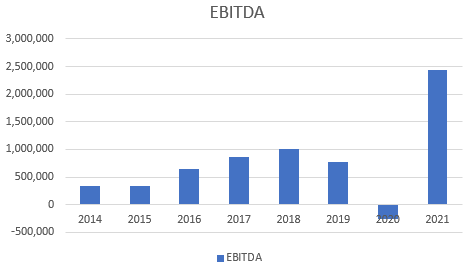
It strikes me that there are a lot of businesses, where if you go back and look at cash flow and EBITDA over a 10 year period, there has just been this massive spike in the last year and a half that is completely unprecedented. And the more I think about it, the more I think this is a bubble itself.

It is not a “valuation” bubble. These stocks tend to trade at less than 10x EBITDA, sometimes well under that. Single digit FCF in some cases. But I think that might be because the bubble is in the business instead.

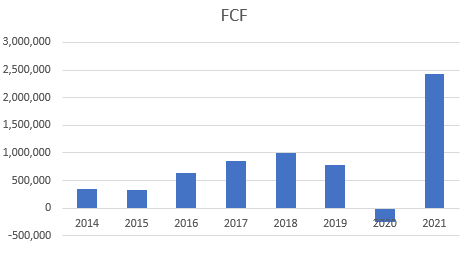
Consider Olin. I owned the stock for a bit last year. But I got to thinking, in part because the price action seemed so poor, about whether this was really sustainable. Take a look at how Olin’s EBITDA and FCF compare to prior periods.

While I would love to believe that Olin is in a new paradigm, I have my doubts. And Olin is far from the worst in terms of the one-hit-wonder factor. There are far more egregious offenders. All the building material companies, the retailers – particularly the sports stores (remember BGFV?), steel, maybe even aluminum eventually. The list is very long.

While the triple-waterfall SaaS and momentum collapse gets all the headlines, these sorts of names look suspiciously similar to me.

Vidler

With the Ukraine situation so fluid and just so awful, I’m going to go in a completely different direction here and talk (again) about a stock that has a thesis untied to most of this geopolitics.

This is the routine that I have every morning since mid-November:

  1. Get up and go downstairs
  2. Put on the coffee in the coffee maker
  3. Get the coffee and go to my workspace
  4. Open Chrome
  5. Check the snow pack of the Upper Colorado Basin.

The irony is that I don’t live anywhere near the Upper Colorado Basin. I’ve never been to the Upper Colorado Basin. But for the last 4 months it has been the most important piece of data for me.

I wrote about Vidler back in early December. It was then and is again my largest position. If you follow my portfolio though, you’ll notice that for a few weeks I sold some of the stock, and then bought it back.

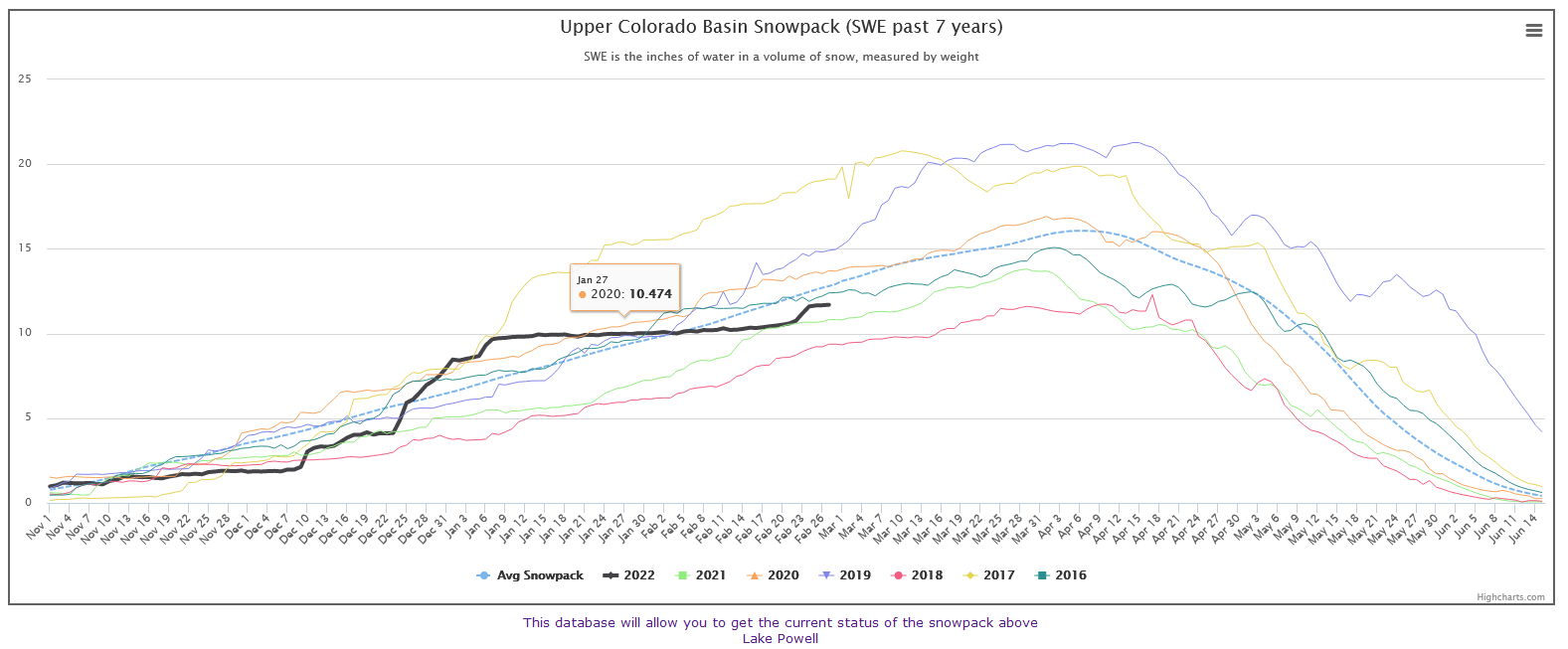
That sale and repurchase relates to this chart:

Wouldn’t you know it that about a week after I wrote about Vidler, the Upper Colorado Basin had the biggest snowfall that it has had in years.

Through the Christmas break I was sweating bullets. Every day I’d watch the snowpack rise. And I’d get more nervous.

I’d get nervous because at the end of the day, Vidler’s near-term stock price is all about drought. While the long-game is water shortages accruing over decades, over the short run the stock price is about whether there is a problem right now.

Investors care about what happens next quarter or at most this year, not what is going to happen over the long-run. While Vidler’s sale of water in December is a big positive, at the beginning of January I was not convinced that Vidler’s stock would do well if we saw a record snow pack in the Upper Colorado Basin. If Lake Powell and Lake Mead began to rise significantly, and investors began to look at the story as an “eventually” and not an “emergency”, I feared the stock would be re-rated down.

So I reduced my position in Vidler by about 1/3, to a point where I slept better with that concern. And I waited to see just how much snow would fall.

I waited. And I waited. Just as the amount of snow that fell from Christmas Eve to New Years Day was nearly unprecedented, the lack of snow since then has been equally unprecedented.

We did have a blip of snow last week. But even so, the Upper Colorado Basin snow pack is now below the 5-year average. And that 5-year average is not a good baseline – it is the baseline of a drought.

We are starting to see the articles pop up again. This article from the Colorado Sun says that projections for Lake Powell are too rosy.

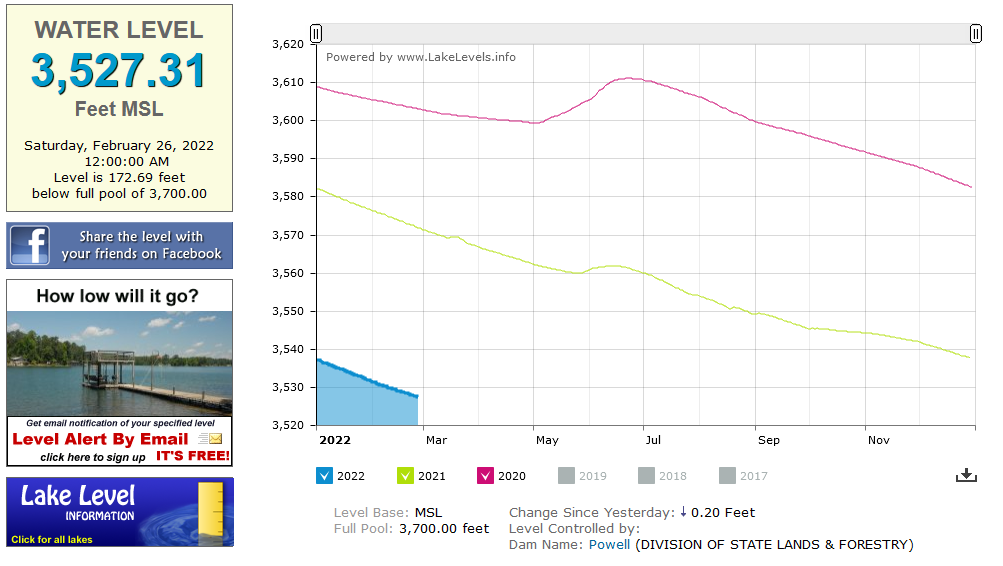
In the article, they point out that “Ten or 20 feet can make a big difference at Lake Powell these days. Water managers are closely watching whether the water level will drop below 3,525 feet above sea level. If it does, it threatens the ability of Glen Canyon Dam to generate power.”

Lake Powell is 2 feet away from that level right now. And it is going down every day.

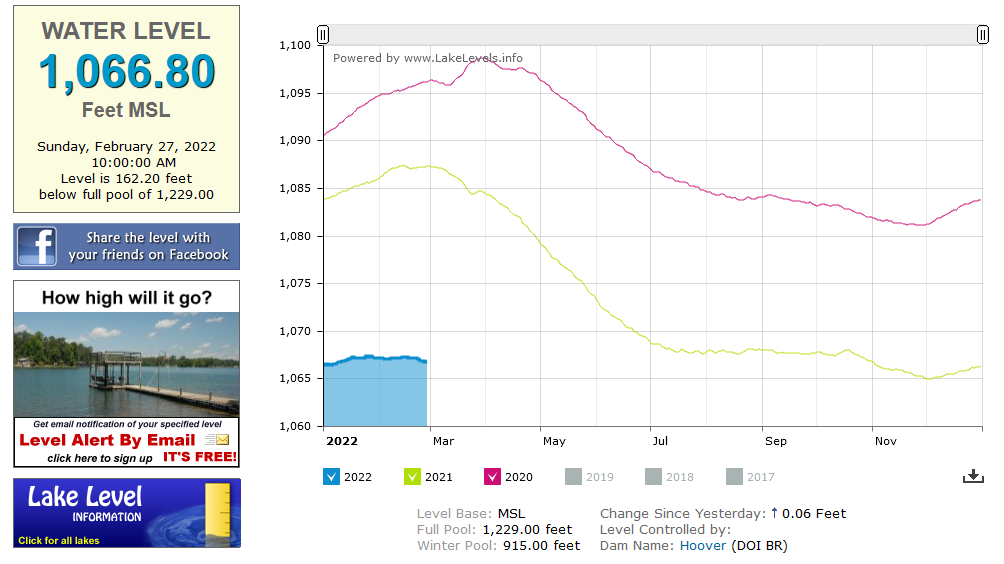
Lake Mead is no better. The usual winter bump has basically not happened this year.

The other thing about this article is that it is about the models, and how the models aren’t predicting accurately. I find that interesting. This is a case where the models are painting the picture that everyone wants to hear. So it kind of makes sense that no one (up until now) is questioning them. This isn’t the first time I’ve read that the models are too optimistic. It has come up here and there. And I really wonder if the problem here could be much bigger than anyone has admitted, because the consequences are so severe.

Anyway, we’ll see.