Skip to content

Posts from the ‘Uncategorized’ Category

Breaking my rule for Pan Orient

One of the rules that I try to follow is not to add to a stock that has fallen below my purchase price. I have been burnt a number of times by doing this.  I have ended up trapped in the position, and further averaging down only adds to the problem.

The rule, like all rules, is not of the steadfast sort, and so I do break it from time to time.  But when I break it, I do so tentatively, I think about the consequences, and make extra sure that my decision makes sense.

I broke the rule with Pan Orient on Tuesday.

I had a fairly small position in Pan Orient and had been waiting for something of a correction before I added to that position.  I didn’t expect the extent of the correction that occured, but after some reflection I decided to add to the stock.

The news that sent the stock down was this news release. What sent the market scurrying was twofold; news that the L44 block exploration was not finding economic oil, and probably more importantly the news that the L53 block was experiencing a relatively high water cut.

In particular, in the news release the company said that the L53-DST3 well had been producing at 540 bbl/d of oil with a 60% water before it was shut-in and cased to perform a sidetrack of a deeper zone.    In the February 27th news release the L53-DST3 well was producing at 1,200bbl/d of oil with no water cut.

This is potentially negative news, but its really anybody’s guess at this point just how negative it is.  Since the reservoir is high porosity / high permeability it could be water from coning.  It could also be that the perforated interval extended down below the oil/water contact or that it partially perforated a water zone.  There are also plenty of examples of fields that successfully produce at high water cuts for years.  The downside is that the watercut may be creeping into the oil zone and continue to increase with time until the well is uneconomic.  Only time will tell.

The market neglected to put any value on the good news from the release.  The L53-DST3 well tested a slightly lower sandstone zone (1,179m TVD versus 1,142 to 1,163m m TVD for the previous 2 zones) and that zone was flowing at 400 bbl/d.

In the L53-D2 well, Pan Orient tested the 5 zones that it had previously not tested but had referred to in the original news release of the L53-D2.  In that January news release the company said:

Pan Orient is pleased to announce that the L53-D2 exploration well is currently on 90 day production test flowing 27 API degree oil at a rate of 1,015 barrels per day through 17.8 meters of perforations between 1110.8 meters to 1154.7 meters measured depth (860 to 890 meters true vertical depth), within one of six conventional sandstone reservoir intervals interpreted as oil bearing based on oil shows while drilling and open hole log and pressure data analysis.

The news release on Tuesday told us that 5 untested zones have now all been tested and all 5 were found to be oil producing.  One zone tested at 929 bbl/d of oil while two others tested above 500 bbl/d.  These zones are in addition to the originally tested zone from the January news release that tested at 1,1015 bbl/d and produced 40,917 bbl in the first quarter, which if you assume it was flowing for the full 90 day period means that the well flowed at an average rate of 454 bbl/d for that period.

The bottom line for me is that Pan Orient is finding a lot of oil zones and even if a couple of them don’t work out to be as wonderful as say Coastal’s Bua Ban, they are still going to produce a lot of oil and book a lot of reserves from them.

At this point it comes down to valuation.

Thailand production averaged 2,725 BOPD in the month of March, of which 1,702 BOPD was produced from Concession L53 and a combined 1,023 BOPD from Concessions L44, L33 and SW1. Production in the first quarter of 2012 averaged 2,541 BOPD.  Based on the March production number and the basic shares outstanding of 56.7M, Pan Orient is valued at $52,000 per flowing barrel.

According to slide 5 of Pan Orient’s January 9th presentation, yearly cash flow at 2,500 bopd and at $100/bbl WTI should be around $60M, and at 3,000bopd it should be $68M.  Again, with 56.7M shares oustanding, that puts the valuation at around 2.5x cash flow.

The company has cash and working capital on hand of $58.5M according to their January 9th presentation.  So about $1 of the current shares price is attributable to cash.

Capital expenditures are expected to be $37M for the year so 2,000 bbl/d of cash flow more than covers capital expenditures.  With the cash on hand in addition to the cash flow Pan Orient has a CAPEX cover that is rarely seen in the oil and gas junior industry.

I just think this looks over done.  I wish now that I had waited another day to buy, as the stock trades at $2.50 whereas I added at $2.76.  But I didn’t want to wait too long.  The company will be releasing a reserves update on the L53 structure within a week or two and I think that could be a catalyst for the market realizing it has overdone the downside.

 

Atna Resources, Coastal Energy and the 80-20 rule

I do not know if an 80-20 rule has ever been expressly stated for a portfolio.  However I do feel that such a rule exists.   Anecdotally, I am pretty sure my portfolio follows an 80-20 rule of sorts.  20% of the stocks I own are responsible for 80% of the gains.  Or thereabouts anyways.

If you take a look at the gains in my current online portfolio you will notice the following:

Atna and Coastal make up a massive amount of my current gains.

Albeit this is far from scientific but it is not the first time that I have noticed that I make all my outperformance from a couple of stocks.  In 2010, I’m pretty sure that most of my gains were due to Tembec, Mercer and Avion Gold, all of which tripled or better.  In 2009, it was Western Canadian Coal, Grande Cache Coal Mirasol Resources and Teck Resources (call options), all of which rather insanely increased some 5x to 10x during the year.  2007 and the first half of 2008 was all Potash and Agrium (in the second half of 2008 nothing went up but puts and the dollar).

A couple of points come to mind:

1. Do more of what’s working

First of all, you have to know when you’ve got a winner and when you have a winner you have to add to it.  I have done this of late with Atna.  I bought more Atna this week at $1.30 after having bought more at $1.15 after having bought more at $1 after having bought more at 90 cents.  I have bought it all the way up.  I did the same thing with Coastal (though that acccumulation was unfortunately interrupted by the European fiasco) during the first half of last year, as it ran from $4 to $10.

Of course the obvious question is: Why not just buy more of the position at the start?  It’s a great idea if you know the winners in advance.  Unfortunately you don’t.  At least I don’t.

I come up with lots of ideas.  Some turn out to be really good ideas.  Some turn out to be so-so.  I’ve gotten better at it over the years, so less turn out to be full-on stinkers.  Yet I still get a majority of so-so ideas that do nothing, and a couple winners that go to the moon.  And I generally have very little idea at the beginning which one an idea is going to be.

Take for example PHH right now.  This one feels to me like it could be the next big winner.  It’s worked out so far.  I have been adding some on the way up. But do I know whether the stock is going to be $25 or $12 6 months from now? Nope.  It could go either way.  Nevertheless when it hits $16 I will add more.  And when it hits $18 I will add more again.  If then, it gets to $25 it will be a big winner and I will be talking about PHH like I am talking about Atna and Coastal.  On the other hand, if PHH goes back to $12, I will likely carry a much reduced position in the stock, if I am not out entirely.

2. Don’t give stock tips

This leads me to my second point.  Giving advice on an individual stock, such sharing a stock pick with a friend or relative, or putting the name up on an investment board, is dangerous when taken out of the context of the portfolio as a whole.  My portfolio has had between 12 and 20 stocks in it over the last 8 months.  Unless I know which two or three are going to be the big winners (I don’t) then trying to give someone a tip is a losers game.  There is an 80% chance (give or take a few percent) that I am going to give them a loser (or at least not the big winner)

More on why you need to Consider the Position of French Banks to Buy Canadian Oil Stocks

Just a quick note before I head off for the day.  The following was reported in the WSJ this morning.

“We can no longer borrow dollars. U.S. money-market funds are not lending to us anymore,” a bank executive for BNP Paribas, who declines to be named, told me last week. “Since we don’t have access to dollars anymore, we’re creating a market in euros. This is a first. . . . we hope it will work, otherwise the downward spiral will be hell. We will no longer be trusted at all and no one will lend to us anymore.”

The full article is available here for subscribers.  For non-subscribers, FT published some thoughts here.

I’m surprised that so far the market is taking this in stride.

The article goes on to explain the source of the concern.

BNP, Société Générale and Crédit Agricole together hold nearly $57 billion in Greek sovereign and private debt, versus $34 billion held by the largest German banks and $14 billion at British banks. And then there is Spain and Italy. French banks held more than €140 billion in total Spanish debt and almost €400 billion in Italian debt as of December, according to the latest figures from the Bank for International Settlements. If either of these governments were to default on their debts, their banking systems could collapse and take the French system along with them. BNP, Société Générale and Credit Agricole all say that their finances are in order and the market worries are unfounded.

In the event of a Greek default the French will need to bailout their banks just as the Germans will need to bail out theirs.

The problem is that the French banks are so large compared to French GDP.  This is the question FT asks.

Now, let’s say the French government is forced to recapitalise its banking sector. What would that mean for its AAA rating?

It would not be good for it.

The situation in Europe is evolving and not in a good way.  I think that the market opening up today presents another good opportunity to reduce risk.

Lydian International

Its honestly not my intention to write exclusively about gold stocks on this blog.  But they do make up a significant fraction of my portfolio right now, and I think the gold stocks hold the most chance of significant upside in the short term.  Yesterday is evidence to that.  Gold stocks jumped to the upside.  Now one never knows is such moves are breakouts or fakeouts, but we can only hope for the former.

As for Lydian International., its too bad I didn’t start my blog a few months ago.  This post on Lydian would have been writing about the stock near its lows.  Since then the stock has moved up 25%, including almost 10% yesterday alone.  I still think its going to go much higher, but its always nice to catch the low end of the trading range before the breakout.

Recommended by Trusted Folks

At any rate, I’ve held Lydian International since late last year, when I was first introduced to the stock during a BNN interview with Rick Rule.  Since that time it has been recommended here and here by Brent Cook, a geologist that writes a newsletter I used to subscribe to.  I’ve gotten a lot of stock ideas by searching for and listening to interviews with Rick Rule and Brent Cook.  That they both own Lydian is encouraging.

Looking at Lydian’s Deposit

As Rule describes in the interview, Lydian is a little gold company with a decent sized gold deposit called Amulsar, located in Armenia.  The deposit is about 2.5Moz, its low grade, near surface, and will be surface mined using bulk tonnage techniques.  The deposit that Lydian has have a number of things going for it:

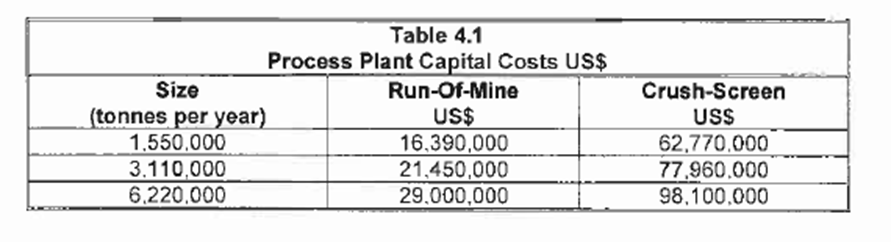
1. Its a oxide gold deposit – oxide gold can be extracted from the rock using a heap leach process that requires very little in the way of capital costs.  You don’t need to build a complicated mill circuit.  To put this in perspective, if the deposit was not oxide the CAPEX to build a mill would probably be around $300M to $400M.  In the 2008 scoping study it was determined by Golder that Lydian would have to spend less than $30M CAPEX to bring on a large enough  run of mill heap leach operation to process a 3Moz deposit (see figure below).

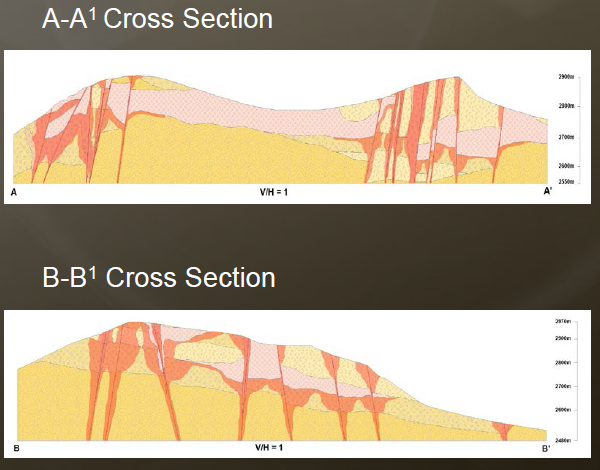
2. The strip ratio looks like it should be quite low.  The deposit sits right on top of a hill (see cross sections below).

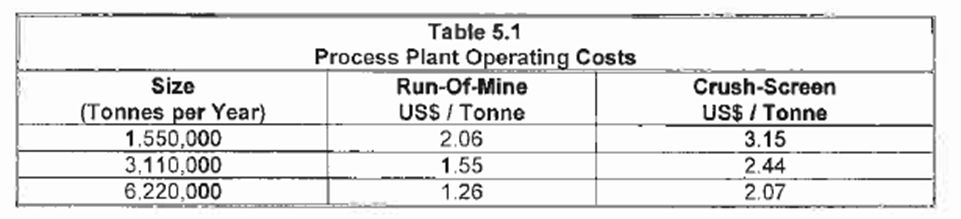
This will make it much easier to get at the ore without having to dig through a lot of overburden first.   That means lower cash costs.  Below are the operating costs assumed by Golder in the scoping study.

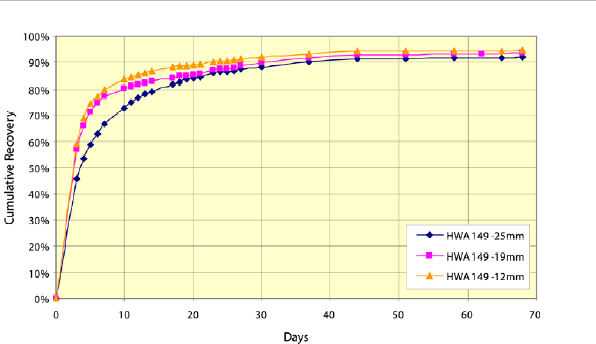
3. The metallurgy looks favorable.  I already mentioned the oxide nature of the gold.  That’s great.  But sometimes its difficult to get a large percentage of the gold out.  Take a look at Aura Minerals as a contrasting example.  Aura has struggled on and off with recoveries with each of their deposits.  Albeit part of those problems has been the mix of oxide and sulphide ore, but it just goes to show how metallurgical complexity can ruin an otherwise good deposit.  Lydian shouldn’t have that problem.

4. Permitting should be in hand by the end of the year.

What’s Amulsar Worth?

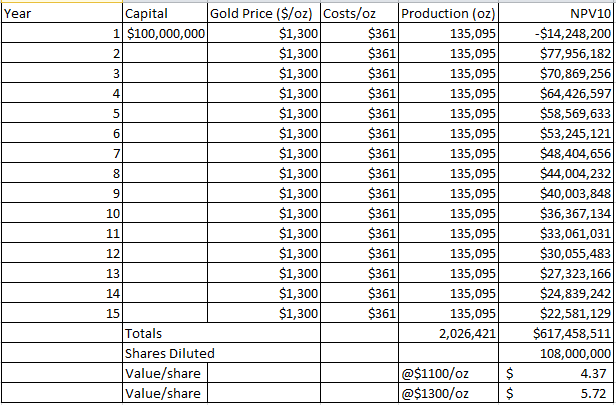
Using the numbers from the scoping study that the company performed, I worked out a spreadsheet of what the net present value of Amulsar is.  Here is a list of the assumptions I used, followed by the results of the spreadsheet.

  • Total production is expected be 135,000oz per year to occur over a 15 year period
  • Strip ratio is 0.5 each year
  • Recovery is 92% each year
  • Mill grade is 0.9g/t each year
  • Operating costs are $4/t mining and $2.5/t milling (I checked these against some other heap leach ops to make sure they were reasonable).
  • The capex is $100M.  This is conservative but it also includes $15M that they have to pay to Newmont and another $15M contingency I added on.
  • Taxes of 20% base plus 12.5% excess profit are included.

I looked at two scenarios.  One with gold at $1100/oz and the other with gold at $1300/oz (I’ve attached the original spreadsheet to the end of the post).

You can see that the upside to the stock, even at $1100/oz long term gold price, is still fairly substantial.  Also note that cash costs should be less than $400/oz.  This would put Amulsar on the map as a very low cost producing mine.

A lot of brokerages seem to be using NPV with a 7.5% discount these days.  If you use that discount rate the NPV rises to $6.82.

An Eventual Takeover?

Honestly, I think what will happen with Lydian is that they will be taken on before they get the mine into production.  I think this will occur at a substantially higher price than what its currently at (even after the run up yesterday).

One possible candidate for a takeover is Newmont.  They own 9% of Lydian shares.  There are probably also a number of mid-tier producers that would be happy to take on 150Koz per year production with cash costs of less than $400/oz.

The company should have an updated Preliminary Economic Assessment out any day now.  It was scheduled for June but these things are inevitably late.  The PEA will (hopefully) go a long ways to confirming some of the numbers I have put forth here.

Appendix

This is the original spreadsheet that I used to calculate the NPV.  Also included is a low case sheet.  This was done when the resource Lydian had was only 1.4Moz, so the low case incorporates that smaller resource.  Now that more gold has been found, the low case is not realistic.