Skip to content

More MBIA Research: Spending some time listening to Jay Brown and friends

A couple of weeks ago I posted my original investigation into the business of MBIA Inc (MBI).  Over the two weeks since I have tried to better understand the business by reading or listening to every MBIA conference call from the last 4 years.  My bike rides, lunch hours, and early morning coffees have been spent  listening to or reading CEO Jay Brown and his management team provide their quarterly updates on MBIA.  In total I have went through 14 conference calls from start to finish (as an aside, if anyone knows of a good program that will turn streaming media files into mp3 files please let me know – having conference calls iPod-able makes them so much easier to listen to).  I have also read in whole or in part through the last 3 10-Qs and the last years 10-K.

By going through all of this information the conference calls I was hoping to answer 4 questions:

  1. What exactly it is that MBIA has insured
  2. The progress that MBIA has made on reducing what they have insured
  3. The probability that the lawsuits against and for MBIA will settle in their favor
  4. Whether or not, having bought MBIA, I have made a terrible mistake

I’m going to try to answer all of these questions in this post.

What MBIA has insured and how they making progress getting out of it

If I was going to label the conference calls from 2008 to present with a theme, it would be one of opportunistic deleveraging.  Slowly but surely MBIA has been able to reduce their exposure to the future default of the structured financial products that they had insured and that have since blown up.

These structure financial products can be broken up into 4 categories:

  1. First Lien Residential Mortgage Backed Securities (RMBS)
  2. Second Lien RMBS
  3. Collateralized Debt Obligations (CDO’s) and CDO Squared
  4. Commercial Mortgage Backed Securities (CMBS)

First Lien RMBS

First Lien RMBS has had very little in the way of problems and very little in the way of loss reserves or payouts.  MBIA generally insured the triple A tranches of each first lien RMBS.  So in effect if you took a bucket of 1000 mortgages, MBIA would begin to pay out insurance after the best 400-500 of those mortgages defaulted.  Being first lien, the underlying loans tended not to be of the exotic types that have suffered so greatly in the past few years.  Even with the problems that the housing market has had, that insurance has not been called upon and it remains unlikely it will be.

Second Lien RMBS

Second Lien RMBS are securities full of loans of the more exotic type, and they have been the source of much consternation for MBIA.  The second lien RMBS securities consist mostly of home equity line of credits (HELOC’s) and closed end second portfolios.  These securities were full of loans mostly originated by Countrywide, Rescap and IndyMac.  Of those three, Countrywide was “by far” the largest originator.

All three of these lenders are well known for their less than scrupulous tactics during the boom.  And thus it is that most (if not all?) of the defaulted second lien RMBS securities that MBIA is now paying out insurance on are subject to the put-back litigation.

So why can MBIA cry foul?  Basically, when MBIA and the originators created the terms of the insurance, it was with the expectation that the loans were of a certain quality, met certain criteria, and that, most importantly, that the documentation for each loan was correct and accurate.  On the Q2 2009 call MBIA defined a breach in these terms:

An example of a credit breach would be a loan that exceeds the debt to income or combined loan to value ratio guidelines for the relevant program. Compliance breaches would be things like missing good faith estimates or Reg Z forms in the files.

The terms of the insurance contract stated that MBIA did not have to review each individual loan.  Instead they could rely on the originators representations and warranties that the loans were on the up and up.  Of course, as it turns out many of the loans were not on the up and up and so now MBIA is in a position to litigate against the breach of the contract.

Once the securitizations began to default, MBIA began to review the loans that made them up.  And as soon as MBIA began to review the loans, they found breaches to be endemic, and they began to put-back the loans on the originators.  On the second quarter 2009 conference call (available on Seeking Alpha) the company said that:

Our loan level forensic review experts have re-underwritten nearly 24,000 loan files from 24 securitizations originated by four seller/servicers and they’ve found that over 18,000 had serious breaches of risks and warranties.

Until just recently (when a court ruling deemed further review no longer necessary, more on this later), MBIA has reviewed more loans each quarter and with that increased the size of the put-back litigation.  The last time that MBIA put a number to the loans that were in breach was the second quarter of 2010, when they said that “sometimes as low as 75% and some cases as high as 90% of the loans in the securitization are in violation of reps and warranties”.

Once MBIA began to initiate court proceedings they became more tight-lipped about quoting individual loan volumes that were being put-back.   However they did continue to provide an estimate of total the loan balance being put back as well as the booked recovery.  The latest estimate, from the Q1 2012 call, was that $4.8B worth of loans had been put-back on originators and were now the subject of the legal battle.  Of that $4.8B, MBIA has booked an expected $3.2B in recoveries from the litigation (I’ll provide some more detail on this a little later on).

It should be pointed out that all along MBIA has been paying out  insurance on these defaulted second lien RMBS securities.  Most of the $3.2B in expected recoveries relate to cash that MBIA has paid out to investors on the securities.  Another aspect of the insurance contracts is that MBIA has to pay out the cash regardless of whether there was a misrepresentation or not.  The terms specify that it is up to MBIA to recover money paid out on breached loans directly from the originator.  Of course this is exactly what they are trying to do.

When I thought about the MBIA put-back case with this in mind, it began to see the very strong position that MBIA is in.  This isn’t some claim of damages due to missed opportunity.   This is about real dollars that MBIA has paid out as they have held up their end of the bargain on the insurance contracts they agreed to.   And now they want the originators to come clean in cases where they didn’t hold up their end.  MBIA wants their money back.

That there was massive fraud in the years leading up to the mortgage crisis in 2008 does not seem to be very much in doubt.  The terms of the insurance state clearly that MBIA was relying on the originators to insure that the loans being put into the securitizations were legitimate.  MBIA has been paying out money on these securities since most of them have defaulted.  That MBIA is entitled to get its money back seems like a no-brainer.

CDO and CDO Squared

MBIA insured 3 different types of CDO’s.  There was CMBS CDO exposure, which were CDO’s made up of commercial mortgage backed securities the multi-sector CDO exposure, which were CDO’s made up of a whole range of whole loans, RMBS and CMBS, and there was CDO squared exposure, which were CDO’s that were made up of other CDO’s .

As you can imagine, when the bankers had drained the swamp to the point where they were making CDO’s of CDO’s, the sludge in the bottom was quite toxic. As such, the CDO squared positions were the first to blow up and the first to be mitigated.  But that was soon  to be followed by the multi-sector and plain vanilla CMBS flavors.

In each of these cases MBIA has reduced the exposure in two ways: by commutations (basically paying a fee up front to have the insurance annulled), and where applicable by put-back litigation.

Commutations are a fancy word for saying that MBIA gave the insuree some money up front in exchange for not having to pay if the security blew up later.  The costs of doing so aren’t cheap, but they generally are done at a significant discount to the actual cost of insuring the security if it does fail.  MBIA also may have benefited in its commutation negotiations earlier on in 2009-10 because some of the counter-parties looked at MBIA’s insurance at risk and then looked at the economy and said we should probably take something while we can still get it.

MBIA has talked regularly about the volume of commutations that they have done.  The amounts are significant.  With respect to the CDO squared positions, they have been reduced from over $10B at the beginning of 2008 to nothing as of the end of the year 2011.  Multi-sector CDO’s, which are basically securities that could have everything and anything in them (think the Gramercy Capital CDO’s that I analyzed in some detail as an example of a multi-sector CDO) have seen exposure reduced from $25B to $6B.  Commercial Real Estate CDO’s have gone down from $13B to a little over $5B.

MBIA hasn’t talked specifically about the CDO put-backs for quite some time.  The last time they did, which was the Q4 2009 call, they said the amount under litigation was significant:

For the CDO related litigation the amount at stake represents a significant portion of the $2.5 billion of present value of ultimate incurred loss that we are estimating for our CDO portfolio.

What’s not very clear is how much of the $3.1B in booked recoveries is related to CDO breaches.  It may not be that much, because interestingly, while a significant amount of reserves have been booked against the remaining CDO portfolio, there has yet to be a payout from the default of any of the (remaining and as of yet not commuted) CDO’s.

Commercial Mortgage Backed Securities (CMBS)

The CMBS portfolio was a bit of a laggard in terms of generating losses for MBIA Corp, but it has made the best of its potential to play catch up.  Commercial mortgages didn’t fall apart until late 2009 because, unlike residential mortgages, they weren’t so much in a bubble or being held up by out-and-out fraud but instead they went south for the good, old fashioned reason that the economy tanked.  MBIA Corp has been reserving against losses on its CMBS insurance since about that time.  As late as the second quarter of 2011 the company said:

At this point in time, we would say 2/3 to 3/4 of the remaining volatility in our balance sheet centers around CMBS reserves.

Since that time the losses in CMBS have continued to mount.  In particular, Q1 2012 saw a big increase to CMBS reserves, but it wasn’t because of further deterioration to the loan book.   Just like with the CDO exposure, MBIA has been reducing its CMBS exposure through commutations.  In the first quarter 2012 conference call the company said the following:

Losses for commercial real estate transactions this quarter were $296 million. About $60 million of that incurred loss on CMBS was driven by deterioration in the small number of remaining transactions. The balance reflects cost of commutations executed or agreed to that were in excess of the year-end 2011 reserve levels. In aggregate, we’ve commuted or agreed to commute $11.5 billion of exposure since January 1.

As I already said, commutations aren’t cheap, particularly now that MBIA solvency is not of such immediate concern.   The commutations on CMBS are costing more than was initially anticipated, thus the bigger hit to the reserves.

But while the commutations have cost a few pennies, they have also taken the most dangerous loans off the books.  If you look at MBIA’s disclosures as of December 31st, total CMBS exposure was about $18B.  Of that amount, only $6B was BBB rate or lower.  The rest was higher rated collateral that should be less susceptible to default.  That they have since commuted $11.5B of exposure suggests that most of the commutations are behind them and that most of the most volatile loans are now off the books.

On to the Lawsuits…

Meanwhile, the court cases drag on.  Likely the next case to get a significant ruling will be the transformation case.  To refresh on what I already touched on in my previous post, in early 2008 MBIA Inc. made efforts to transform itself into two legally independent entities.  One entity (MBIA Corp and please be careful to remember that this is MBIA Corp while the parent is MBIA Inc.) would handle all of the structured finance insurance (as well as the asset management business) while the other (National) would handle the municipal insurance.

A number of banks took issue with the transformation, purportedly because they were concerned about the solvency of MBIA Corp and its ability to pay its claims, but more realistically because they saw the massive put-backs that MBIA was about to shuffle on back to them and they wanted leverage to counter that litigation.

Sure enough, slowly the number of banks has dwindled down as MBIA has settled its put-back settlements with the banks, to the point today where the case is being made by two banks: Bank of America and Societe Generale.  Bank of America is the ringleader here, which is not surprising since Bank of America has the most to lose from a successful put-back of Countrywide loans.

The transformation case has gone through its hearings and is expected to be ruled upon by the judge by August (for an excellent synopsis of the hearings, go here).  It turns out that the case will not go to a full trial, because as per the New York state law the hearing is intended to be “expeditious”, with a judge only hearing and ruling.  Given that the process started back in 2009 I might question the validity of the term.   Nevertheless, the trial/hearing has come to an end.  Not that we should expect this to be the last round.  As Alison Frankel, who has been covering the case in her column “News and Insights” has pointed out, regardless of the ruling it is almost assured that the case will go to appeal.

So far, however, what has occurred has been mostly in the favor of MBIA.  That there were no witnesses called during the hearings, with the judge instead relying on documents and transcripts, has to be seen as a positive for MBIA.   If the judge really felt that there were questions of fact, she would have wanted to hear from the various regulators in charge of the case.

Also in MBIA’s favor was Bank of America’s failed attempt to change the question at hand.   The subject of the trial is to be whether the New York Insurance Department (NYID – the regulator that approved the transaction) acted in an “arbitrary and capricious” manner.  Bank of America appears to have made numerous attempts to change that focus  to one of whether MBIA “deceived” the NYID by not providing them with all and/or accurate information about the financial state of MBIA Corp and National post split.  Well the judge nixed that attempt, leaving only at question whether the regulators were openly negligent in their decision.

Everything I read about this case suggests to me that MBIA should win it.  Consider that MBIA initiated the process of transformation in early 2008 and it was decided upon well before the collapse of Lehman.  I don’t think that anyone (aside from perhaps a few rogue traders like Michael Burry, Kyle Bass and Steve Eisman) was anticipating the eventual collapse that was occurring in the housing market.  The general consensus (which was albeit based on the flawed assumptions and misinformed opinion) was that housing might decline gently or stabilize soon.  Bank of America itself was buying Countrywide in early 2008 in hopes of having a coup when the housing market recovered.   Hell, even Bernanke was asaying he saw the sky clearing up ahead, what with sub-prime contained and all.  I think that to make the case that the NYID acted in a manner that was “arbitrary and capricious” you would have to go down a rather imaginary road that assumed that they, and they alone,  knew what was coming before anyone else did.   And I simply don’t see how that flies.

Also, the whole case wreaks of such cynicism that I can’t imagine the judge is not plugging her nose just a little at it.  The question of the solvency or insolvency of MBIA Corp is directly related to the fraudulent mortgages that they insured that were (I’ll be darned) originated by Bank of America themselves (through its Countrywide subsidiary).  Does this not seem a bit disingenuous?   Had it not been for the breaches of reps and warranties, MBIA Corp would quite possibly be in quite a solid financial position.  You might not even need to have a transformation at all.

The Put-back Cases

MBIA has put-back cases in various states of proceedings against a number of the largest originators.  The company has litigation against Bank of America, Residential Funding Company (Rescap).  The first of the put-backs likely to be settled, and also by far the biggest of the bunch, is the case against Countrywide and Bank of America.

In the last 10-Q MBIA presented a 10 point summary of why they feel confident about the outcome of the put-back case:

  1. the strength of the Company’s existing contract claims related to ineligible loan substitution/repurchase obligations;
  2. the settlement for $1.1 billion of Assured Guaranty’s put-back related claims with Bank of America in April 2011;
  3. the improvement in the financial strength of the sellers/servicers due to mergers and acquisitions and/or government assistance, which should facilitate their ability to comply with required loan repurchase/substitution obligations. The Company is not aware of any provisions that explicitly preclude or limit the successors’ obligations to honor the obligations of the original sponsor. The Company’s assessment of any credit risk associated with these sponsors (or their successors) is reflected in the Company’s probability-weighted potential recovery scenarios;
  4. evidence of loan repurchase/substitution compliance by sellers/servicers for put-back requests made by other harmed parties with respect to ineligible loans; this factor is further enhanced by (i) Bank of America’s disclosure that it has resolved $8.0 billion of repurchase requests in the fourth quarter of 2010; (ii) the Fannie Mae settlements with Ally Bank announced on December 23, 2010 and with Bank of America (which also involved Freddie Mac) announced on December 31, 2010, and (iii) the Company’s settlement agreements entered into on July 16, 2010 and December 13, 2011 respectively, between MBIA Corp. and sponsors of certain MBIA Corp.-insured mortgage loan securitizations in which the Company received consideration in exchange for a release relating to its representation and warranty claims against the sponsor. These settlements resolved all of MBIA’s representation and warranty claims against the sponsors on mutually beneficial terms and in aggregate were slightly more than the recoveries previously recorded by the Company related to these exposures;
  5. the favorable outcome for MBIA on defendants’ motions to dismiss in the litigations discussed above, where the respective courts allowed MBIA’s contract and fraud claims against the defendants to proceed;
  6. the favorable outcome in the Countrywide litigation on MBIA’s motion to present evidence of liability and damages through the introduction of statistically valid random samples of loans rather than on a loan-by-loan basis;
  7. the favorable outcome in the Countrywide litigation denying Bank of America’s motion to dismiss MBIA’s claims for successor liability as well as a decision from the New York Supreme Court Appellate Division, First Department, which lifted the stay on discovery related to successor liability claims at Bank of America;
  8. the favorable outcome in the Countrywide litigation on MBIA’s motion regarding causation and MBIA’s right to rescissory damages;
  9. the unanimous ruling from the New York Supreme Court Appellate Division, First Department, in the Countrywide litigation allowing MBIA to pursue its fraud claims; and
  10. loan repurchase reserves and/or settlements which have been publicly disclosed by certain sellers/servicers to cover such obligations.

Its worth noting all the “favorable outcomes” on the list.  Almost all of the decisions thus far have sided with MBIA.  The most recent decision that affirmed the position of MBIA was a ruling in favor of Syncora, in a case against the former MBS origination wing of Bear Stearns.

“…on every other point, the federal judge sided with Syncora and its lawyers at Patterson Belknap Webb & Tyler, and in ways that may protect Syncora when the state appeals court reviews Bransten’s ruling in the Countrywide case. Bransten began her analysis with the insurance contracts between the monolines and Countrywide, concluding that under state insurance law the bond insurers simply had to show that Countrywide misstated the risk profile of the underlying mortgage pool when it induced MBIA and Syncora to insure the mortgage-backed notes. She declined, however, to grant summary judgment to Syncora and MBIA on the broader question of whether Countrywide breached MBS servicing agreements — as opposed to insurance contracts — merely by misrepresenting the quality of the underlying loans, or whether insurers (and, by extension, investors) could only assert put-back demands for defaulted loans.”

As I briefly mentioned earlier, up until recently MBIA had been stepping through securities on a loan by loan basis, looking for breaches that would allow them to put back the securities on the originator.  Not any more.  Another recent decision concluded that MBIA will not be forced to investigate each loan individually to determine whether it was in breach or not, instead being able to rely on statistical sampling.  According to the last 10-Q

Legal decisions have led the Company to conclude that the practice of reviewing individual loans for the purpose of assessing put-back recoveries is no longer necessary. The Company determined in the context of the favorable decision on its motion in limine addressing the use of sampling to establish breach-of-contract claims in the Countrywide litigation (MBIA Insurance Corp. v. Countrywide Home Loans, Inc., et al, Index No. 602825/08 (N.Y. Sup. Ct.)) that a sufficient number of loans in each securitization have already been reviewed to demonstrate widespread breaches of the contractual provisions of the agreements with the sponsors. Furthermore, MBIA has received subsequent opinions which have confirmed that the Company is not limited to a loan-by-loan put-back remedy and can seek a pool-wide remedy based on sampling and extrapolation, as well as decisions in MBIA’s favor related to causation and rescissory damages.

As I already mentioned, the outcome of the put-back litigation will essentially determine whether there is value in MBIA Corp (the financial structuring wing) or not.  If the outcome is favorable, the value is not inconsequential.  Below is the adjusted book value of MBIA Corp.   Adjusted Book Value accounts for all expected loss payments by MBIA, all expected premium receivables, and most importantly, the $3.1B that MBIA thinks it has coming back to them from litigation.
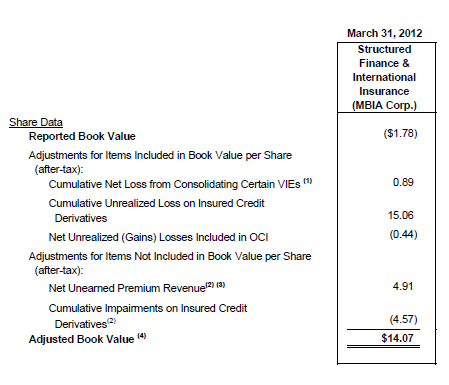
Like the transformation case, the put-back case looks strong for MBIA.  The rulings thus far have narrowed the banks ability to deflect the blame or limit the scope.  In addition to the above rulings, perhaps the biggest win for MBIA was the court decision that in order to put-back loans MBIA only had to show that the loan was breach, and not that the breach was responsible for the default.   MBIA had found billions of dollars of breached loans within months of beginning their investigative process, and the tone of management on the conference calls was always one of confidence and to a large extent dismay when they spoke of the scale of the fraud that they were uncovering.

A terrible mistake?

I don’t think so.  In fact just the opposite.

I wish that MBIA had not risen so soon after I first discovered the idea.  I would have liked to have a larger position.  As it is, the stock accounts for about 4% of my portfolio.  While I had originally hoped for a move back down to the single digits, I now think I would be inclined to buy more if it dipped to even the low 10’s.

Both the put-back case and the transformation case are winding down and we should not have more than 6 months before we see some significant rulings on both cases.  I have to think we will see a settlement with Bank of America before it goes that far. I just can’t see Bank of America stringing this out, the risk of a ruling that puts into question the much larger

A settlement in the $3B range would leave MBIA Corp with an adjusted book value of around $14 per share.  National has an adjusted book of $20 per share.  Netting out holding company debt and you are left with a valuation of the holding company of above $30.

What’s more, that valuation is looking strictly in the rear view mirror.  Considering only the premiums earned and the expected claims paid.  There is nothing in the valuation about new insurance written.  If MBIA begins to write municipal insurance again what is the stock worth then?  How about if they can get themselves back into some of the simpler first lien RMBS under-writings?  I hesitate to put a number to the eventual value of the company, but suffice to say that I think the upside potential is tremendous.
Mr. Hyde Buys Barkville Gold Mines

I am two investors rolled up into a single portfolio.

On the one hand there is the meticulous researcher, searching out value that has been overlooked by the market.  This fellow is the investor that does most of the writing here, drawing logical conclusions from stepped out deductions and well thought out inferences.  We might call him Jekyll the Investor.

But there is another fellow that haunts these pages from time to time and who comes from a somewhat different place.  He likes to jump into more speculative positions, sometimes with no more reading then a news release, a quick scan of the company’s presentation and a few back of the napkin calculations.  While he still does more work than most do on the stocks he chooses, it is not with the same care as his counterpart.  Time is of the essence to him. He is especially attracted to gold and oil stocks that hold the opportunity of a big score, and you saw his work with the purchase of Gold Standard Ventures a couple of months ago or with the purchase of Mart Resources a couple of weeks ago (while he perhaps isn’t so thorough, he is still often quite lucrative).  We could call him Hyde the speculator.

Now to be fair, Hyde is not some sort of willy nilly gambler.  He has honed his craft with over 10 years of studying the business of getting commodities out of the ground.  The reason that he can take such quick action is because he has made enough moves, both good and bad, to develop an intuition about it.

Hyde begins to watch Barkerville Gold

I’ve had my eye on Barkerville Gold Mines (CA: BGM) for a month now.  It wasn’t a close eye, and I wasn’t really interested in buying stock in the company so much as I was curious about what they would do next.

I owned Barkerville 2 years ago for a brief one month stint when gold prices were going up and the best thing to buy was the cheapest junior with a story and a property.  I wrote about my purchase of the stock here, and then about my sale soon after here. I think I summed up my reason for being so quick to be in and then out quite well with this comment:

My experience is that you can make some money on juniors by projecting out cash flows based on a successful mine and then waiting for other people to make those same calculations.  But you are better off selling out before you test out the theory of whether those cash flows are realized.  

Mining is hard, and its pretty easy to screw up a mine and there seems to be just as many disasters as there are successes.  So unless you are willing to play this ‘greater fool’ game with your finger on the trigger, you’re probably better off in the long run with the big producer.

This is something I am trying to remember with these gold juniors we have been talking about lately.  The numbers we and the analysts are throwing about are legitimate for a trade, but don’t start believing them.

I added the bold and I think it is a sentence that shouldn’t be forgotten.  Even with mining stocks where I have the honest intention of holding through the duration of development (ala Atna), it is important to remember that numbers are just that, numbers, if things appear to be going wrong, it is always better to sell first and ask questions later.

Since that brief run I haven’t followed Barkerville very closely.  I took a quick look again about 6 months ago but was turned off by what looked like the high costs of maintaining a mill that couldn’t be delivered enough ore.   They seemed forever doomed to struggle with the high costs that come from a mill running at partial capacity.   Their eventual savior was another deposit that was unfortunately a number of miles away and that had some long-lead time permitting to be done before it could be brought to production.

I started following Barkerville again after beginning to lurk on a junior mining message board over on Silicon Investor called Microcap Kitchen Canadian Stocks.  What drew me to the board was that one of the posters, diddlysquatz, was listing companies that were trading at a price below or equal to their net cash position, and I’m always a sucker for cash on hand.

The folks on that board have been pointing to Barkerville for some time, and they have done an excellent job of picking out the run before it happened.  I saw the stock going up but I didn’t know why so I didn’t make any plunge myself.  But I was intrigued when I saw that Barkerville Gold was halted for trading Thursday morning.  I wondered if there might be some sort of merger, or maybe a drill hole, and the more cynical  part of me wondered if a diluted offering was in the works.

Well today at lunch I saw the stock trading up some 50% and it was pretty clear this wasn’t a dilutive offering.  I did a quick scan for news and almost didn’t believe what I saw.

The indicated resources, between the elevations 3,550 feet and 4,550 feet above sea level (town elevation 4,000 feet), estimated by Geoex for the Gold Quartz open pit model on Cow Mountain are 69,039,000 tons with an average grade of 0.154 ounces gold per ton (5.28 grams/T) and 10,626,100 ounces of contained gold as summarised in the following table.

In fact, I didn’t believe what I saw.  I wrote the following on twitter:

$BGM:CA Barkville resource at 10Moz? Is this for real? If it is the stock is suddenly very cheap

And while Jekyll has difficulty swallowing the thought of buying JC Penney up 2% on an up day, Hyde does not even consider that Barkerville Gold is up some 50% in the last hour when evaluating his potential purchase of the stock.  So I jumped in, albeit with a small position.

Honestly however, I’m still skeptical.  It just seems too good.  10Moz at over 5g/t of open-pittable indicated resource?  I put indicated in italics because this isn’t an inferred resource estimate.  Indicated ounces generally have some substance (I would ignore the geologic potential that the company provided, if anything it makes me wonder what they are doing here, building a resource or promoting a stock).   And at what looks like a strip ratio of a little over 1?  It seems extremely low for a pit that will contain 5 g/t gold.  I keep thinking I must be missing something, because even with the stock up some 50% on the day, it does not appear to be up nearly enough.

I took a quick look at the company that performed the resource estimate, Geoex Limited, and they aren’t some sort of one hit wonder.  They have produced estimates for Rubicon and San Gold in the past.

This is purely a speculation that there is not something here I am missing, and that the basic points of resource size, grade and strip are all legitimate estimates.  There’s no report available on Sedar yet, so I really can’t evaluate this on anything more than the numbers from the news release, which are the basic figures and not much more.  We’ll have to see what the stock does on Tuesday when it opens; if I am not missing anything, we should see it move higher.  If it doesn’t than I am probably best to assume someone knows something and that I would be better off leaving the speculation for someone else.

Nevertheless, Hyde felt it was worth a couple of bucks to speculate that the resource is indeed without a hitch.  If it is, then this stock is going much higher.

Week 51: A Couple of New Positions

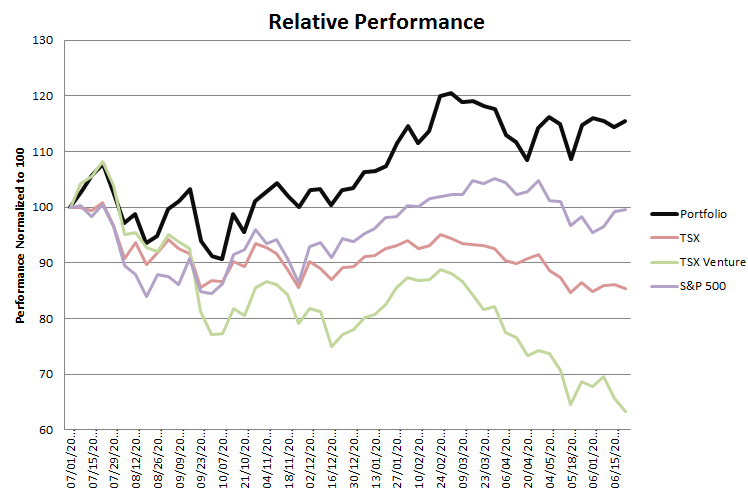
Portfolio Performance

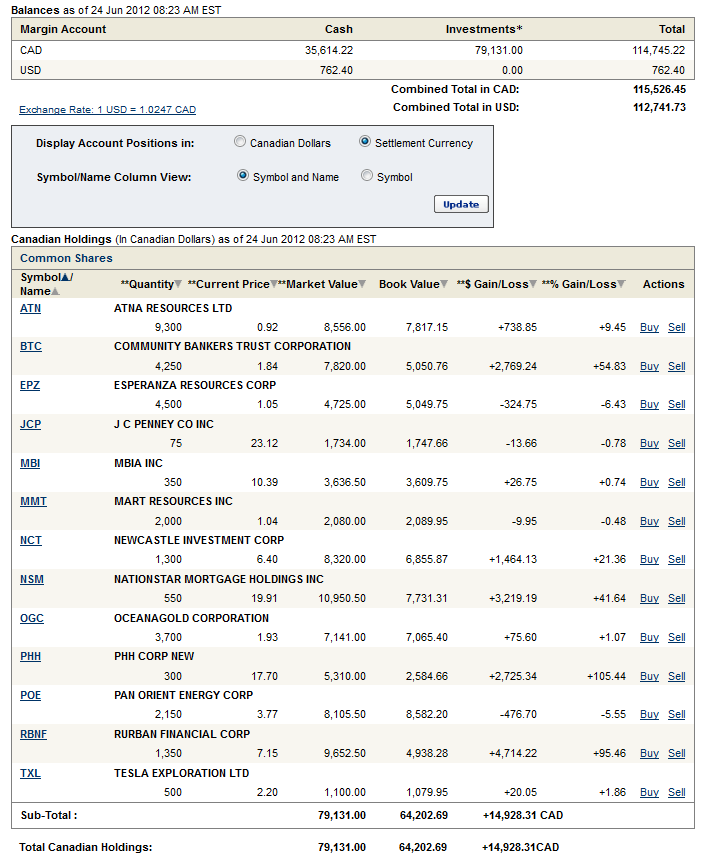
Portfolio Composition

Staying Smallish

I broke down and bought a position in MBIA at the end of the week last week.  I had mentioned in my post on the company last week on the company that I had planned to wait for lower prices.  I didn’t.  Over the past couple of weeks I have read through all the conference calls and the latest quarterly’s and the more I read about the court cases between MBIA and Bank of America, the more that I think that if I were Bank of America, I would be looking to settle before any further rulings come out.  With the first ruling (on the transformation of MBIA into two distinct entities that is being opposed by Bank of America and Societe Generale) due out in August I decided that I was willing to take the risk that the stock falls back to the $8-9 range in return for the potential reward if that settlement comes out.  I haven’t bought a lot of the stock, just enough to feel like I am participating. If it does fall back to $8 I would buy more.

I also started a very small position in JC Penney.  I could see it getting significantly larger.  I plan to put out a very detailed post at some point in the near future (probably next weekend) but to briefly summarize, I am fairly comfortable that the problems that JC Penney has will be worked through and that in time the stock will trade much higher.  What I am less comfortable with is whether the stock can trade much lower first.  I have been reading everything I can find about the company and I cannot believe how hated it, and its CEO Ron Johnson, have become.  Moreover, there seems to be a consensus that because the pricing strategy change that was announce in Q1 was not immediately successful, it should be concluded that the management team is a bunch of bumbling idiots who got lucky with Apple and will suffer a fate worse than death with JCP.  Yet as Johnson said on the first quarter conference call, they are trying to turn the titanic into a bunch of little speed boats, and that is going to take time.  The turnaround that Johnson is attempting will not miraculously happen in the next month or two, so there is room for further disappointing numbers.  I would love to see the stock fall to below $20, at which time I would load up.  I actually expect that it will, I mean there isn’t an immediate catalyst to the upside, and the negativity is so strong that its taking on a life of its own.

I haven’t added to my position in gold stocks, but I have changed it up a bit. Out is Canaco Resources, and lightened up on is Atna Resources.  In are Esperanza Resources and OceanaGold.

In the case of Esperanza, they are a company with a low cost development project (~$100M capex) and low expected operating costs (~$450-500/oz) that has been beaten up because they did a share offering that was over-subscribed and that diluted the share base.

I’m looking at the offering from the other side.  That is: they managed to do a share offering that was oversubscribed in this environment.  I think there are probably some games going on with the stock post-offering, and I suspect that is why we are able to get it as cheap as we are.  The only potential negative I have heard with Esperanza is that apparently because the offering was oversubscribed there were some unhappy subscribers who didn’t get all their shares.  Some have said that this could lead to lawsuits.  I admit I don’t fully understand the legal impacts of this, but it would seem to me that the ultimate responsibility would lie with the sponsoring bank and not Esperanza.

OceanaGold is a bit of a flyer.  I bought the stock at $1.80, I sold some, but not enough, at $2.15 to book some profits, and now its back to almost where I started at $1.90.  I placed this “bet” on OceanaGold based on the following expectations:

  1. The gold price is about to rise
  2. Didipio is going to be added into 2013 estimates shortly at which point the corporate cash costs of OGC will drop to sub $800 per ounce.
  3. The falling NZD and falling oil prices are going to start working in OGC’s favor rather than against it, as has bee the case for the last couple of years

The problem with OceanaGold is that it is a trading stock and trading stocks can go up and down like a yo-yo while you wait for what you think should happen to play out. Its excruciating and it’s a reason to only have a small amount of your overall capital invested in such names.  I have a small amount of capital invested in OceanaGold right now and I would be hesitant to add more.  We’ll see how it plays out.

Next week marks Week 52 since I started tracking my portfolio on-line. I will try to publish a short wrap-up of the year.


My Investigation into MBIA

How MGIC became MBIA

A couple of weeks ago I set out to learn more about MGIC (yes, MGIC not MBIA).  MGIC is a monoline insurer whose primary business is insuring residential mortgage bonds.   Needless to say, MGIC has had its troubles over the past few years and the stock price has been hammered down from over $70 in 2006 to a little over $2 right now.  I had spent some time investigating MGIC at Christmas and had gotten frustrated by the opaqueness of the company.  It was very difficult for me to determine true risk of default of the loans it had insured and I couldn’t figure out how I could invest in the company without getting a better handle on this.  I thought that in taking a second look at the company I might come to a better understanding of the business and whether it was about to go bust (which it is certainly priced for) or whether there is unrealized value.

What does this have to do with MBIA?

Well as it happens MGIC and MBIA have very similar names and they operate a similar business.  It’s quite understandable that someone may get the two companies mixed up.  And in fact someone did get the two companies mixed up and in the course of my research I ended up following a link to a message board that was purportedly a discussion of MGIC but was actually a discussion of MBIA.

It took reading only one message before I clued in that this was a different company than I had been researching before.  The discussion was focused around the separation of the structured finance insurance wing (not very different from the residential mortgage insurance provided by MGIC) and the municipal insurance wing (different from MGIC).

In retrospect I  was quite lucky that the message board began with what was an excellent synopsis of both of the businesses that MBIA is involved in, and a solid description of the investment case.  If it had been your typical message board, full of quips and rantings, I probably would have moved on without giving it a second thought. But instead I saw a company that sounded intriguing and potentially quite undervalued.

What’s the idea?

Below is a quote from Jay Brown, CEO of MBIA (taken from the Q4 2008 conference call transcript via Seeking Alpha):

“…are MBIA Corp and National separate with respect to the contributions that they make to enterprise value?  The answer to that is yes.  So to the extent that the value of one of them were to turn out to be zero, the remaining value of the consolidated firm [MBIA Inc] would be the value of the other.”

In 2008, when all hell was about to break loose in the financial markets, MBIA decided to split its two primary insurance businesses (a structured finance division (called MBIA Corp) which insures mortgage backed securities (MBS), collateralized debt obligations (CDOs) and some foreign government and corporate bonds, and a municipal insurance division (called National), which insures the debt of public municipalities and their infrastructure projects) into two separate holding companies.

The reason for the split was because the structured finance insurance business was looking tipsy, and this was impinging on the ability of MBIA to write municipal insurance.  The direct cause was downgrades to MBIA’s credit rating due to the uncertainty at the time with respect to all things structured finance.  At any rate, by splitting apart the municipal insurance business from the structured finance insurance business, the municipal business would have the strength to continue to underwrite municipal bonds.

The municipal insurance business was seen as an important business to preserve at the time, not only from the perspective of MBIA but from the perspective of the regulators and the government.  With the credit crisis reaching full bloom, it was necessary to insure that municipalities would be able to continue to raise funds and roll over expiring debt at reasonable rates.  Part of that depended on their ability to have their debt insured by a third party like MBIA.

The split was approved by the New York Insurance Department (NYID) in February 2009.

Why MBIA is a play on the outcome of court cases

Not everyone was happy about the split.  In particular, the banks that had originated the CDO’s and MBS that MBIA had insured did not like the idea of Structured Finance not having recourse to the parent or to Municipal.  Moreover, MBIA transferred $5B from the Structured Finance division to the Municipal division.  This transfer was done to shore up the capital requirements of the Municipal side, but of course it left the Structured Finance side with less capital at a time when the eventual capital requirements were very much in question.

There has been a lot written about the $5B  that MBIA transferred out of the structured and into municipal.  On the face of it, it seems a little strange that they were able to shuffle money out of one division and into another at the same time they were establishing walls on the recourse between these divisions.  However, after reading through some of the conference call transcripts I found this explanation in the Q4 2008 call.

All of the $5.2 billion invested assets transferred to National came from a portion of the accumulated retained earnings produced by the US public policy holders over the past 35 years and the remaining deferred revenue for the $553 billion in municipal finance net par that National assumed from MBI Corp.

It certainly sounds like the money transferred was earned by National and therefore is National’s to take.  The NYID seemed to agree, because they approved the transfer as part of the transformation of the company into separate non-recourse subsidiaries.

Because the transaction was approved by the regulators, the only legal recourse of the banks who don’t agree with the transaction is to claim that the NYID was negligent in their decision.

The case was taken to court in April, and it just finished wrapping up a couple of weeks ago.  The judge is expected to rule in the next couple of months and from there it will likely go to appeals.

Because of the almost certain appeal process, the case is likely to drag on quite a bit further before it is settled. Nevertheless the upcoming ruling will  be important to MBIA as it will be the first ruling on the matter, and because the judge residing over the case is not known to be overturned on appeal very often.

As I have said the banks only have recourse to annul the transformation by proving that the NYID acted in a manner that was negligent.  The terms that are used to describe the behavior that the banks must prove of the regulator are “arbitrary and capricious”.  These are strong terms.  Moreover, having to prove that the regulator acted with ill-intent a lot different than simply having to prove that MBIA acted in a manner that was improper or not in the best interests of all its policy holders.

Indeed, after having read through a number of the summaries of the court hearings, it appears that the Bank of America lawyers have consistently tried to change the frame of the trial to an evaluation of whether MBIA hid or misled information rather than whether the NYID acted reasonably in their decision.  I wonder if they are trying to redirect the issue because they know the real question before the courts will be difficult to prove.

As I mentioned, the pretrial was wrapping up at the beginning of June.  The judge (Judge Kapnick) is expected to rule on the case in the next couple of months, perhaps not until August.  The opinions of the trial that I have read (a good one’s are here and here) suggest that the odds favor that the ruling will be on the side of MBIA.

As I also have already mentioned, the odds are also that there will be an appeal and that this case will drag on in one form or another for some time yet.

More specifically, it is likely that the case will drag on until there is some sort of resolution between MBIA and Bank of America in all of their court disputes.  Because you can’t really understand what is going on between MBIA and Bank of America and the conflict over the transformation of MBIA without looking at the other disputes between the two parties.  The transformation case is really just one leg of what appears to be a high-stakes game of chicken between the two companies, with the other leg being the fraud case that MBIA has against Countrywide.

The other court case

The reason that Bank of America is so intent upon challenging MBIA and its split is not only (or likely even primarily) that they are concerned about their claims on MBS insured by MBIA.  It is instead because MBIA is litigating against Bank of America (more specifically litigating against Countrywide, of whose legal losses Bank of America would be responsible for) in a case concerning mortgages originated by  Countrywide, and insured by MBIA, that have since gone sour.  MBIA is trying to recoup claims it has had to pay out on Countrywide originations by claiming that there were misrepresentations and breaches of warranties in the insurance contracts (basically that the originators at Countrywide made up numbers, overstated  incomes, or lied about the employment status, net worth etc) that were signed.

The fact that the two court cases are linked is made pretty obvious by the history.  Originally the case against the MBIA transformation was being made by about a dozen banks and other entities.  Those numbers have been whittled down to two (Bank of America and Societe Generale).  In most instances where a bank dropped their case against MBIA’s transformation there was a concurrent resolution of the breaches of representations and warranties that MBIA was claiming against the bank.

I think that the reason Bank of America is one of the last to have not settled with MBIA is because the numbers involved are bigger.   In the suit against Bank of America for breaches, MBIA is looking to recover in the neighborhood of$3B, which it the amount they have paid to investors in claims on bonds backed by Countrywide mortgages.  MBIA has often said that most of its losses, and most of its recourse, has been aimed at three parties: Countrywide, ResCap, and IndyMac and that of those three, Countrywide was “by far” the largest.

This second court case is really the first court case.  By that I mean that it went to court first, and that it has already been ruled upon in some respects.  The case was heard in pre-trial towards the end of last year.  The hearing was aimed at resolving the burden of proof that MBIA had to meetto claim a breach of representation and warranties.  The judge (Judge Bransten) made a few significant rulings.  First, it was ruled that MBIA only had to prove that there was indeed a breach involved, but that MBIA did not have to prove that the breach was responsible for the eventual default.  Specifically, the judge concluded that MBIA and Syncora “need only show that Countrywide materially misled them at the time they agreed to write insurance on Countrywide mortgage-backed notes, not that the alleged misrepresentations led directly to MBS defaults and subsequent insurance payouts”.

That MBIA doesn’t have to prove the cause of the default is a big win.  In 2008 a lot of mortgages went bad, and trying to prove the exact cause of each default would have been a difficult and time consuming task.  The ruling should make it easier for MBIA to rescind insurance that they had written and recoup the losses.

Perhaps the only negative thus far is that the judge wouldn’t produce a summary judgment that if fraud could be proven on an individual loan, all mortgages within the MBS securitization of which that loan was a part of could be put-back to Countrywide.  While I’m a little fuzzy on why the ruling here would be different than the above described judgment, it apparently it has to do with the language of the insurance contract versus the language of the securitization.

This was aspect of the judgment was clearly in favor of Bank of America but it is less important to MBIA directly than it is as a weapon in the cat and mouse game taking place between the two companies.  If Judge Bransten would have assented to this summary judgment, it would have created, at least  based on my understanding, some big problems for Bank of America.  While the rulings in MBIA’s favor makes it easier for the insurers to get out of paying claims, the summary judgment on MBS as a whole could initiate a process that would eventually lead to the put-back of untold billions of mortgage backed securities by investors who could prove fraud.

How much is untold?  Numbers that I have read range from $22B to $35B .  The point here is not so much what the number is, but that it is big.

MBIA is not a direct investor in MBS securities, so from the perspective of direct exposure, this aspect of the ruling seems somewhat irrelevant to them.  But what makes it more relevant is that MBIA can pursue this aspect in order to keep the fear in the heart of Bank of America, giving them further enticement to settle the whole thing and be done with it.

Indeed, MBIA has appealed this aspect of the verdict, and that appeal sounds like it could have some legs.  Since the time of the verdict MBIA has dug up Countrywide’s internal fraud tracking database.  They also have a line of former Countrywide employees ready to give depositions about the fraud.

I have little doubt that there is much fraud to be found.  I’ve read a number of books on the housing crisis as I’ve struggled to learn how to best play its recovery, and more than one of those books has described in detail the shenanigans of Countrywide.  In particular. All the Devils are Here, written by Joe Nocura and Bethany Mclean, laid out a nice couple of chapters on how Countrywide went from a stand-up lender to out-and-out fraudulent behavior in its pursuit of market share and Angelo Mozilla’s obsession with being the biggest and best at whatever they did.  If the only question becomes whether fraud has occurred, I can’t see there being much doubt about the answer.

If MBIA can get the summary judgment on appeal, the result would be a big win for investors looking to recoup losses on Countrywide mortgages.  Until the matter is settled, it remains a big risk to Bank of America.

Bank of America should cave

This is strictly my semi-educated opinion on the subject, but I do not see why Bank of America continues to take the risk of letting this appeal against Countrywide, an appeal that could affect a lot of mortgages and result in a big loss for the bank, go to its final judgment.  The rulings against Countrywide on the issue of breach of representations and warranties have all gone against them.  If this appeal goes the same, it will not only be easy for MBIA and other insurers to rescind the insurance that it wrote for Countrywide, but it will be much easier for all investors of mortgage backed securities to do the same.

Why would Bank of America take that risk?

To up the ante just a little bit further, Bank of America has already reached an $8.5B settlement on much of their exposure to first lien mortgages.  I read a lot of commentary about the settlement, and more than some of it suggested that the deal was far below what had been expected.  The settlement, after all, reflects $106B in defaulted loans, meaning that it covers less than 10% of all defaults.

The settlement is already opposed by some of the smaller creditors and will be going to court to settle its validity.  Its been going through appeals to determine whether it should be settled in state court or federal court.

Remember that the summary judgment that MBIA has asked for is that if a single loan is in default in a MBS security, the entire security should be able to be put-back on Countrywide. If the judge agrees to the summary judgment on appeal, you are looking at put-backs of a substantial percentage of those $106B in defaults.  To take MBIA as a case study, in the Q2 2010 conference call, before the put-back litigation was announced and therefore at a time when MBIA was still speaking freely on the matter, the company said that “sometimes as low as 75% and some cases as high as 90% of the loans in the securitization are in violation of reps and warranties”.

The other point here is that by letting the put-back trial with MBIA progress through its discovery process, you are providing opportunity for MBIA to unearth more evidence and uncover more issues.  By doing so you are putting the much larger $8.5B settlement at risk.  Would it not be better to settle with MBIA and close the books on their investigation into Countrywide?

Bruce Berkowitz, of Fairholme Funds, was quoted as saying as much last year at a Morningstar Investment Conference:

While Fairholme’s stake in MBIA may seem schizophrenic given the latter’s legal dispute with Bank of America, Berkowitz thinks this a false problem. A win for MBIA, as he sees it, will mean little to Bank of America and a great deal to MBIA. The lawsuit’s unequal impact on the two parties, as well as the high likelihood of MBIA’s eventual triumph, has moved him to take a stake on both sides of the argument.

By continuing with the transformation case against MBIA, Bank of America seems to be betting it can do one of two things:

  1. It can win the case  and annul the split of the two businesses
  2. It can wait out MBIA until the middle of next year, at which time MBIA will run out of resources for claims and have to go into receivership

They may indeed be able to achieve one of these two ends.  But in the process they run the risk of opening up a far larger can of worms by putting in jeopardy their MBS settlements.

The Investment case for MBIA

Part of what makes MBIA a compelling investment idea right now is that these court cases are likely to come to resolution in the next 6-9 months.   The potential of the two above negative outcomes occurring seems to me to be outweighed by the potential negative (for BoA) consequences of the fraud case if Bank of America allows MBIA to move ahead with it.

The other part, of course, valuation. The value to be realized in MBIA seems to be enough to justify the risk.

On this write-up I hoped to focus on the court cases.  I am going to do another write-up that provides a more detailed run-through of the value of MBIA.   But for the purposes here, there are a number of analyses that have been done by others that can be leaned on to get a ballpark feel for the upside.

First of all, as I already alluded to, Bruce Berkowitz and Fairholme Funds own a large position in MBIA bonds and in their common stock.  In particular, the Fairholme Allocation Fund owns a little over 6 million shares of MBIA common stock, which makes up a rather enormous 25% of the assets in the fund.

Though written a couple of years ago, the following quote summarizes what Berkowitz thinks about MBIA:

“Once it becomes clear that National is walled-off, you have a tremendous amount of uncertainty gone,” Berkowitz said.

More recently, Fairholme gave investors a glimpse into the valuation range they saw.  In the 2011 annual report Fairholme said:

MBIA common stock is The Allocation Fund’s largest position. Recent legal settlements paid and reserves taken by defendants are convincing skeptics of the company’s ability to more than just survive. Following GAAP, the company reports a book value of about $12 per share. Following Statutory Accounting Principles (SAP) utilized by insurance regulators, book adjusts to $16. Assuming an orderly run-off, the company calculates an adjusted book value of $35. Each method has its strengths and weaknesses and does not include a value for new business.

Another value fund, Fernbank Partners, recently published their valuation range for MBIA here.  Fernbank puts the range at between $3.2B and $6B.  That is between a 50% and 200% appreciation from the current stock price.

BTIG initiated MBIA with a buy rating and a target price of $22 last November.  Perhaps worth pointing out is that the valuation BTIG came up with is based purely on the value of National (the municipal insurance business) less the holding company debt.  No value is attributed to the structured finance arm, and no value is attributed to the future business that National may be able to write once the lawsuits are settled.

Just like all of these folks, I think that the upside to a settlement with Bank of America is compelling.  The company trades at a fraction of adjusted book value, and the basic business of insuring municipal bonds looks to be worth at least double the current stock price in the event that the business can begin to write insurance again.  The structured finance division may be worth nothing, though that is very dependent on the size of the eventual settlement with Bank of America.  A full recovery of the amount that MBIA has booked ($3.2B) would give the structured finance division an adjusted book value of around $14 per share.  So it remains to be seen whether structured finance is a write-off.

I originally bought a small position in MBIA at $9.  But have since added to it in at $10.  I wish that MBIA had not risen so soon after I first discovered the idea.  I would have liked to have a larger position.  As it is, the stock accounts for about 4% of my portfolio.