Skip to content

Regional bank earnings round-up

Over the course of last week four of the five regional banks in my portfolio reported first quarter earnings.  Since that time I have been busy reviewing those earnings and drawing conclusions on whether the stocks should remain owned, or be punted out for other opportunities.  Below I will go through my analysis and thoughts on each of these banks.

Rurban Financial (Ticker: RBNF)

Rurban Financial reported earnings last Tuesday.  Rurban does not have a particularly troubling loan book, and while they do have some non-banking related problems (such a legacy data processing business that does not appear to be doing very well) they are mostly set to generate strong earnings going forward.  So when I look at Rurban’s results, I focus on what they were able to earn.

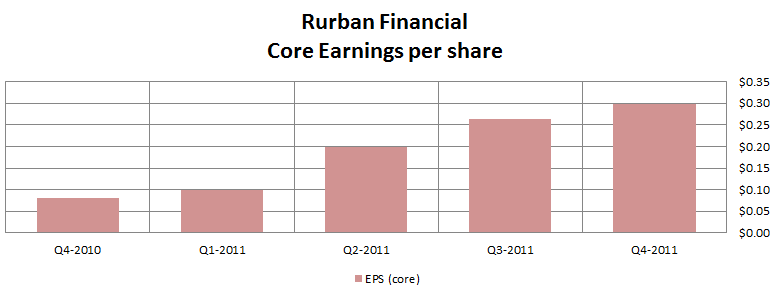
Earnings per share came in at 20 cents.  Because Rurban has a  large mortgage servicing portfolio they are subject to big swings in earnings due to the GAAP valuation adjustments that they have to take on their portfolio of mortgage servicing rights.  While these adjustments are GAAP requirements, they tell us nothing about the business and tend to obscure the true earnings of the business.  Thus, I like to look at a “core” earnings number that eliminates the valuation adjustments as well as any other one time charges and the loan loss provisions.  Core earnings came in at 19 cents.  Core earnings for the past 5 quarters are shown below:
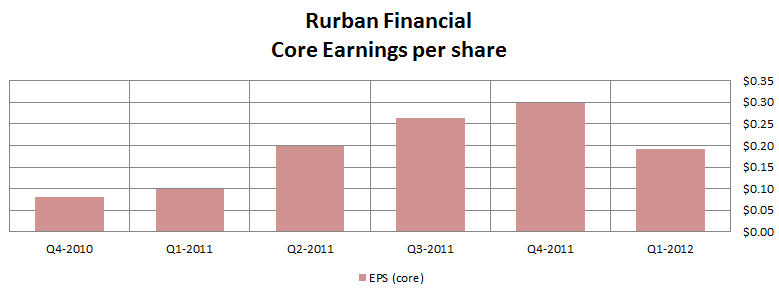
I’m not too worried about the decline in earnings quarter over quarter because a lot of it is seasonal.  Rurban sold a lot less mortgages in Q1 2012 than it did in Q4 2011 and that is just the seasonal nature of that business.  For some reason a lot of markets in the US experience high mortgage demand in Q4, and low demand in Q1.  In most Canadian markets it is the opposite of that, with Q4 being the slowest of the four quarters.

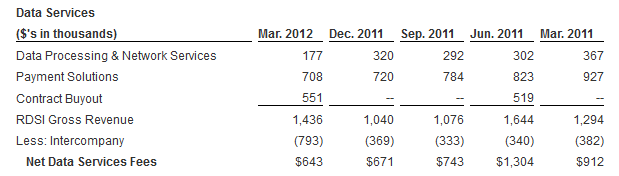
Another contributor to lower earnings was reduced revenues from the RDSI data processing subsidiary.  RDSI provides data processing services for banks across the Midwest. RDSI lost $1.4M in 2011 and doesn’t appear to be doing any better in 2012.  Its a strange situation because the big cause of the loss in Q1 were writedowns related to Rurban’s own bank deciding not to use RDSI for their banking related data processing needs.  Clearly they are cutting ties (winding down?) and maybe that will be for the best in the long run.  Below are revenues from RDSI less intercompany over the last 5 quarters.  Its become small enough that going forward it should cease to be the drag on earnings that it has been.  And that’s a good thing.
Mortgage revenue at Rurban continued to be strong; Rurban generated $1.2M in origination volumes in Q1 versus $420K in the same quarter last year.   As I already mentioned originations are always down in Q1 versus Q4, so that number was a decline from $1.5M in the previous quarter.   The year over year growth in origination led to further growth in their servicing business, which was up by another $20MM in terms of unpaid balance sequentially.  Nonaccrual assets continue to fall, down to $6.5M from $8M in the fourth quarter of last year.  And the company continues to rein in cost, witness by another drop in non-interest expense.   Negatives for the quarter were pretty much the same as those I saw elsewhere in the banking sector.  They are getting squeezed on interest margins (down from 4.07% to 3.64%), and loan growth was pretty flat quarter on quarter.

Overall Rurban announced pretty solid results and they are continuing to move towards their potential $1 per share of earnings.  There is still work to be been, ROA remained poor at 0.60%, but that is why the stock trades at only 2/3 of book value, and why the opportunity for further price appreciation remains.  I have been very happy to see the shares move up as they have over the last week.

Shore Bancshares (Ticker: SHBI)

Shore had a tough quarter.  While I had been hoping  that the company’s loan book was on the mend, the first quarter results showed that there is still some work to be done.

The loan book deteriorated over the quarter.  The company had to put aside provisions for credit losses of $8.4M, which was way up from $4M in Q4 and $6.4M in Q1 2011. Nonperforming assets rose to 8.1%.  I had been hoping that nonperforming assets had peaked in Q3 and would continue to roll over in Q1.  Unfortunately not.
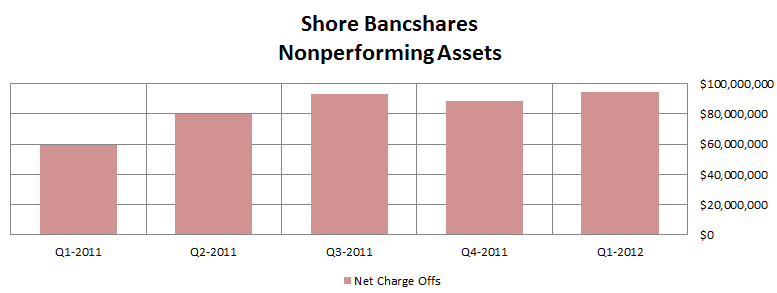
The company said that the rise in nonperforming loans resulted mainly from one relationship. 50% of the $9.1M in charge-offs were related to a single large real estate borrower.

If you can get past the loan book (and I wish they could get past their loan book), there were some positives for the quarter.  While deposits increased 4.2% on a year-over-year basis and, notably, core noninterest-bearing deposits were up 17.4% year-over-year, so the company’s borrowing base continues to move towards lower cost loans.

If you look at Shore’s eventual earnings poential, if they could stop taking massive writedowns every quarter, it remains strong.  Earnings ignoring the provisions were $0.39 per share.  Over the previous twleve months Shore has put together earnings of $1.50 per share if you ex out the loan losses.  So the potential is certainly there.  Unfortunately loan book stabilization appears to be a bit further off then I had anticipated.

I’m not sure what to do with Shore.  I am tempted to cut it and run.  I originally got the idea from Tim Melvin of Real Money.   He described the investment as a 5 year hold and a 3 to 5 bagger.  Given that the bank trades at about 1/2 of tangible book value and that it used to be a $25 stock before the collapse of 2008, and you can see where he is coming from.  However I am not quite as patient as Mr Melvin.  I like stories that are in the process of turning it around, not just with the potential to turn things around at some point.  I haven’t sold out of the stock yet, but I have an itchy trigger finger.

Community Bankers Trust (Ticker: BTC)

BTC’s earnings are always obscured by the effect of the indemnification asset that the company carries as a result of an agreement to take over a failing bank, SFSB, back in 2009.  The indemnification asset is an accounting tool that accounts for the FDIC guarantee that BTC received when they took over the SFSB loan portfolio.  Unfortunately, the accounting of the asset it such that when there is better than expected performance in the SFSB portfolio, the company has to amortize the indemnification asset on their income statement.  The size of these amortizations is extremely large relative to earnings.  In Q1 the amortization was $1.9M versus net income of $0.9M.

I always ex-out the effect of the indemnification asset when I look at BTC’s earnings.  The asset says nothing about their cash generation and earnings ability.  In fact it actually works in reverse to that underlying ability.

Ignoring the indemnification asset and a few other small one time gains and losses, BTC earned 13 cents in the quarter.  On this core earnings metric BTC has earned 52 cents over the prior twleve month, which means it remains an incredibly cheap stock trading at a little over 4x earnings.  Looking at the same sort of “core” earnings number that I did for Rurban, you can see that the bank is consistently been pulling in 10-15 cents of earnings a quarter for the last 4 quarters.
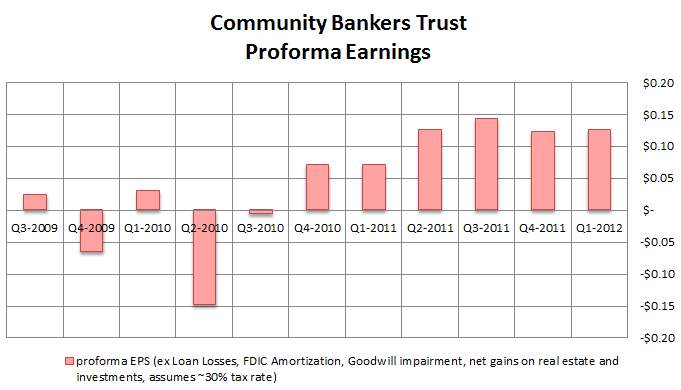
BTC has done an excellent job of pulling itself back from the brink of bad loan losses, and this continued in Q1.  Nonperforming loans on its non-covered portfolio (non-covered refers to loans not covered by the FDIC loss sharing agreement) decreased 13% or $4M quarter over quarter.  Nonperforming assets have fallen from a high of 9.7% of total assets in the second quarter of last year to 6.9% of assets in the most recent quarter.

Meanwhile the company grew its loan book marginally in Q1, which is traditionally a slow time of the year for loan growth for the company and a quarter where their loan book shrank last year.   It is also interesting to note that unlike most of their competitors, BTC managed to maintain a flat net interest margin in the quarter, at 4%.

I really like the turnaround that is taking place at BTC.  Having bought the stock at a little over a $1, I am sitting on a double already.  Yet I have no plans to sell.  BTC was a $3.50 stock as recently as the beginning of 2010 and was a $7 stock before the financial crisis hit in 2008.  I don’t see any reason why they can’t return to a level somewhere between those two numbers.

Bank of Commerce Holdings (Ticker: BOCH)

I learned about Bank of Commerce Holdings from a BNN Market Call with Benj Gallander, the Contrarian Investor guy.  He had BOCH as a top pick and I was looking for regional banks at the time so I took a look at the stock and bought some at $3.25.  Watching Market Call is a hit and miss time investment, you can sit there and watch episode after episode and get nothing out of it, but every once in a while there will be a gem.  BOCH was one of those gems.

Bank of Commerce Holdings is steady as she goes.  I’m not quite sure how they have done it, but BOCH has managed to keep nonperforming assets at reasonable levels (2.45% in Q1 which was down from 2.68% in Q4 2011) while operating in one of the hardest hit real estate markets (Sacramento).  To be fair they also operate in a second market, Redding California, which didn’t have quite as bad of a housing decline.

The company has been consistently reporting return on assets (ROA) of 1% and return on equity (ROE) of 8-9% for the last 3 quarters.
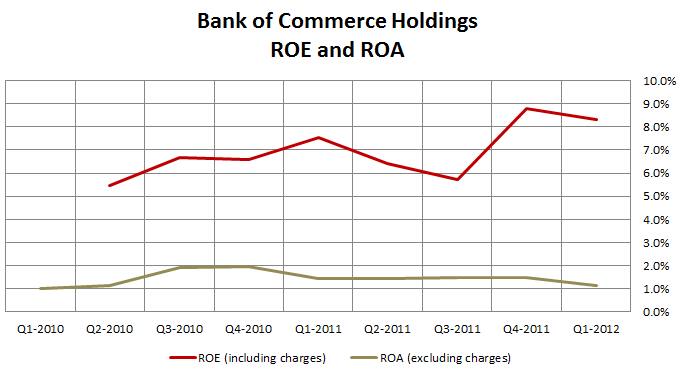
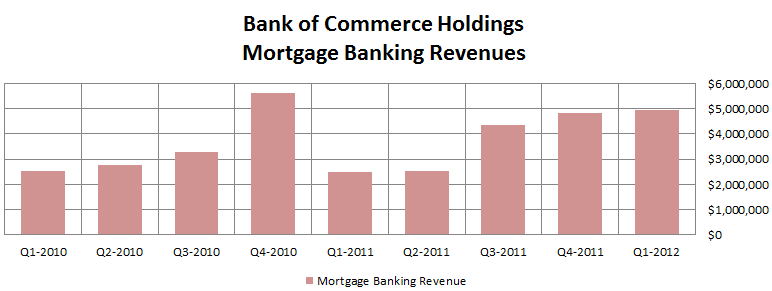
Much like Rurban, the first quarter seasonally has lower mortgage banking revenues than does the fourth quarter so I am not concerned about the decline in ROE and ROA sequentially.  Mortgage banking is a big part of Bank of Commerce Holdings banking business so they are subject to these seasonal effects.  What is more relevant is the trend in mortgage banking revenues.  They have climbed substantially from $2.5M in Q1 2011 to $5M in Q1 2012.
Bank of Commerce Holdings earned 35 cents per share in 2011 and 31 cents per share in 2010.  I would expect them to earn over 40 cents per share in 2012.  BOCH is not going to be a shooting star type of a performer.  Its not going to double in a year.  But the company is consistently profitable and consistently adding to shareholder value.  There is also the chance for them to raise ROE above 10% and ROA above 1% by increasing their operational efficiencies.  I hope to see this occur over the next year as the economy improves and opportunities present themselves.   I think it is reasonable to expect the stock to trade to the $5.50 range by the end of 2012.  That is good enough for me.

Week 43: Up and down

Portfolio Performance

Portfolio Composition

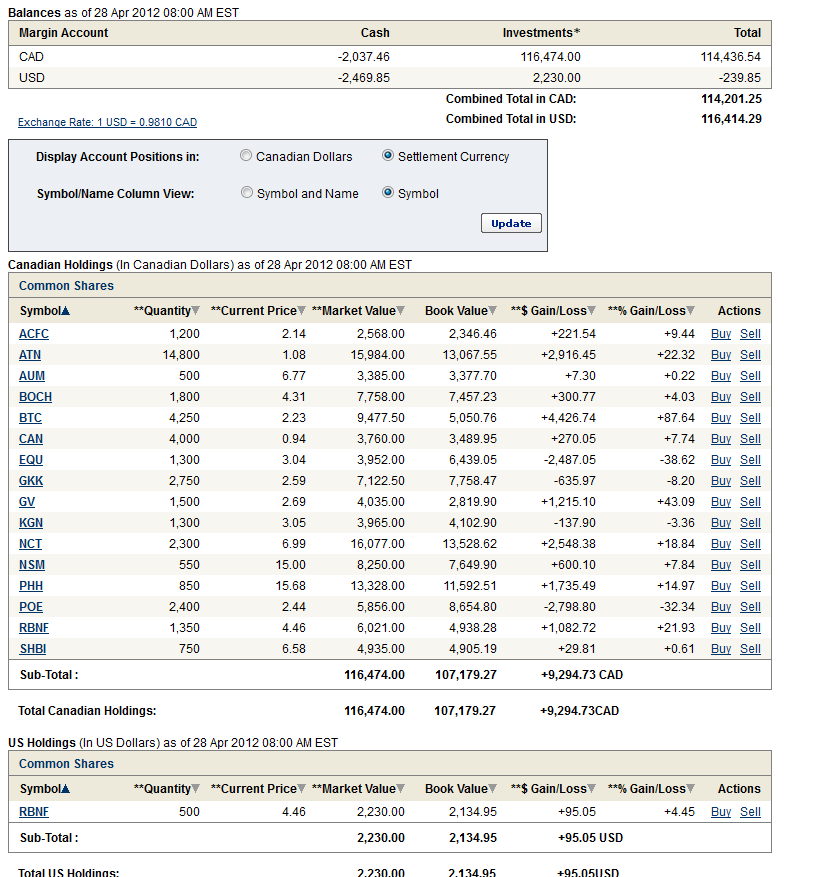
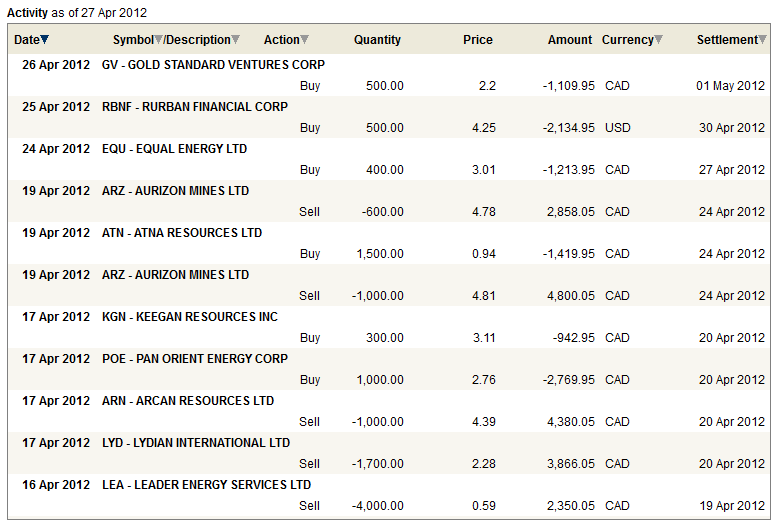
Week 42-43 Trades

Biweekly Portfolio Updates

Those who read this blog regularly may have noticed that I have begun to post my portfolio updates on a bi-weekly basis.  Every week was just too much.  First, not enough happens to my portfolio every week to devote an entire post to it.  Second, its a pain to copy and paste the pictures and update the chart every week.  That is time that would be better spent doing research.  Third, an perhaps most importantly, I have found that with weekly updates I was becoming a little too focused on my short term performance, and I think this was conflicting with my investment style.

When I think of how I have made money in the past, it has rarely been from making quick trades in and out of stocks.  I generally make my money by sitting.   Somewhat paradoxically my best investments have tended to go through a significant period of pain before eventually moving in the direction that I had originally expected them to.

I have to accept, and to some extent expect, that my portfolio is going to go through significant drawdowns at times.  Those drawdowns are challenging.  These drawdowns cause me to reevaluate, and either to strengthen my conviction in a particular position or to realize the folly.  A lot of the time I waffle back and forth on a stock, buying and selling it at the margins, before finally coming to a conclusion on whether to keep it or not.

In the course of the last year I have found that there is extra stress associated with keeping a public portfolio, where the performance is there for all to see, even though most of the people that read this blog are strangers.  I don’t want to make bad decisions.  I feel like showing my portfolio every week may be affecting my decision making ability, at least a bit.  So I am going to try showing my portfolio every two weeks from now on, as this will make the portfolio less of a focus of the blog, and will allow me to focus on the research topics that I really enjoy writing.

With that said…

Out of Aurizon Mines

Without of a doubt my most significant move over the last two weeks was to get out of Aurizon Mines.  On the downside, I got out of Aurizon before it jumped this week and became one of the TSX best performers for the week.  I’m not terribly upset with that because I bought Atna Resources, Keegan Resources, and Gold Standard Ventures with the proceeds.

The reason for swapping a producer for 2 development companies and an explorer was simply valuation.  The explorers and developers have been hit extremely hard.  I honestly never thought Atna would get back below $1.  I mentioned Keegan Resources in a previous post, pointing out that I learned of the company from this Mineweb article, where they were listed in the table below as having one of the highest cash to market capitalization ratios of any of the juniors.

Its worth noting that Canaco Resources is also on the list with a 0.65 ratio.  I bought Canaco back a few weeks ago at 85 cents and it has done reasonably well since then, trading back up to 95 cents.  I would say that companies like Keegan Resources and Canaco Resources represent fairly low risk opportunities to take advantage of the current gold price environment.  Both companies have 4x to5x more cash than their current yearly burn rate.  Both companies have large deposits and they are actively exploring so there is the possibility of these deposits getting bigger.

The downside to both is that the deposits are so-so, and they are in Africa. Those are my only hesitation with these two stocks. But I am optimistic that the takeover of Trelawney may portend to a bottom in the deposit holding juniors.  I was surprised that IAMGold chose Trelawney as a target.  It was my impression  that the deposit had disappointed and that it was going to be tougher to open pit than was at first suspected.  It goes to show there is a price for everything.  The price for Keegan Resources right now is hardly the cash in its bank accounts.  Canaco is only a little better.  I have to think that the mining intermediates must be looking at these possibilities with interest.

A future move that I could see myself doing in the next couple weeks would be to lighten up on these two companies a touch so that I can reinitiate a position in Lydian International.  I sold out of Lydian when it looked like the gold sector was about to go into tank mode.  I figured Lydian would go down (it did) but I also don’t believe that has anything to do with the validity of their project.  The work I did on Lydian 9 months ago remains true today.  The company could easily be a $7 stock if gold deposits began to be valued at $1500 gold.  It has a much better deposit than either Keegan or Canaco.

I also added to my position in Gold Standard Ventures when they announced news of a second drill hit on their Railroad property.  I listened to the conference call that was held that morning.  It is still too early to know what Gold Standard has hit upon.  What they know is that they have two large, long intervals about 300m apart, and they know from analogy that the mineralization and formation they are drilling into is consistent with some of the large Carlin gold deposits.  The stock has a market capitalization of $200M now, so its no longer a cheap speculation; there is a lot of resource built into the share price.  Still, I find it hard to lighten up at this point, when the evidence right now is pointing towards one of those large 5-10Moz Carlin deposits that would make a $1B market capitalization not out of the question.

Banks doing well… for now

The regional bank stocks that I have bought continue to perform well.  I am going to write a more lengthy post reviewing the earnings of the 4 stocks that reported this week (RBNF, BOCH, BTC, and SHBI) so I won’t go into that detail here.

What worries me about the regional banks is that there is some evidence that the US economy is softening.  In particular, the ECRI WLI, which I have been following for years, appears to have stalled out, and it fell for the 4th consecutive week this week.  This softening makes me feel much better about the gold stocks I hold, but it gives me pause on the regional bank stocks.

Spain

Also making me feel much better about gold stocks are my worries about Spain.  I now follow the Spanish 10 year and 5 year bond on a daily basis.  Both are getting ominously close to crisis levels.  It appears that my analysis from earlier this year (What is the LTRO going to do for Europe? And how does it affect my stocks?) is turning out to be correct.  In it I wrote:

Like the Fed operations in 2008, the liquidity injections led to short term spikes but no lasting impact on the market. I am willing to speculate that the LTRO response with follow suit.

The ECB needs to provide further liquidity injections as the markets in Europe are rolling over.  This time they are rolling over in response to Spain, which is somewhat more disconcerting than how they rolled over for Greece last year.  I have been hunting the net for some recent Kyle Bass commentary on the situation, but I have not been able to find any.

Losing dollars because of the dollar

I am taking a haircut on the strength of the Canadian dollar.  If you look at the difference between the Canadian and US dollar values of the account, you will notice that the Canadian dollar value is now a full 2% lower then the US dollar value.

More importantly, more than 50% of my investments are in US dollar stocks.  The regional banks and mortgage servicers that I own suffer every time the Canadian dollar goes up.  A move of the Canadian dollar to 1.10, which has been predicted by some, would hit the US stock portion of my portfolio to the tune of 10%, and my overall portfolio, in its current construction, by 5%.

I’m not ready to do anything about this at the moment.  With the problems in Spain creeping up, I can imagine a scenario where the Canadian dollar corrects rather severely, and my US dollar assets act as somewhat of a hedge.  But it is certainly something to keep an eye on.  I would hate to see myself turn out right on my US stock holdings only to see the gains wiped out by currency movements.

Answering questions about Nationstar Mortgage: Part I – Getting to know them

A couple of weeks ago I parsed out the business of Nationstar , stepping through the prospectus the company put out in March, but I never got around to posting what I learned.  While I’m not yet ready to do a full write-up of the company, I want to share that here,  since I have had a fairly large position in the stock for about a month now, but written very little about it.

Often when I am first learning about a company I will ask myself some basic questions about the business and then look through the available materials for answers.  Below are the first 9 questions of what will be a two (or maybe three) part series on the business of Nationstar.

1. What do they do?

The following excerpts are all taken from Nationstar’s prospectus:

  • We have been the fastest  growing mortgage servicer since 2007 as measured by growth in  aggregate unpaid principal balance (“UPB”), having     grown 70.2% annually on a compounded basis.
  • As of  December 31, 2011, we serviced over  645,000 residential mortgage loans with an aggregate UPB of  $106.6 billion (including $7.8 billion of servicing     under contract), making us the largest high touch non-bank     servicer in the United States.
  • Our clients include national and regional banks, government organizations, securitization trusts, private investment funds and other owners of residential     mortgage loans and securities.
  • We service loans as the owner of mortgage servicing rights (“MSRs”), which we refer to as “primary servicing,” and we also service loans on behalf of other MSR or mortgage owners, which we refer to as “subservicing.”
  •  As of December 2011, a GSE ranked us in the top 5 out of over 1,000 approved servicers in foreclosure prevention workouts.
  •  In 2011, we were in the top tier of rankings for Federal Housing Administration-(“FHA”) and Housing and Urban Development-approved servicers, with a Tier 1 ranking (out of four possible tiers).
  • As of December 31, 2011, our delinquency and default rates on non-prime mortgages we service on behalf of third party investors in asset-backed securities (“ABS”) were each 40% lower than the peer group average.

2. How do they generate revenues and earn income?

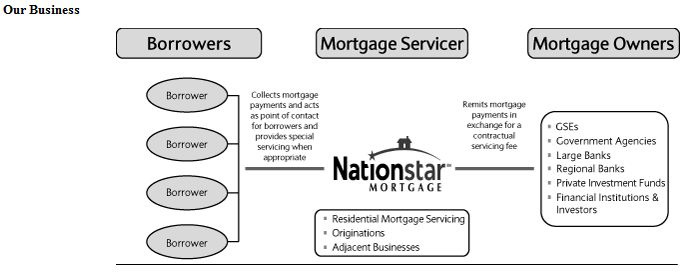
Nationstar has two businesses. They originate mortgages, and they service mortgages.  The mortgages that they service are split between those that they originate, those that they purchase the servicing rights to, and those that the contract out subservicing to.

Nationstar refers to servicing that they own as primary servicing.  They refer to mortgage servicing rights that they don’t own as subservicing.  With primary servicing Nationstar takes a sliver of interest each month in return for performing servicing duties.  With secondary servicing, Nationstar receives a contracted fee in return for performing the servicing.

This is an excerpt from the prospectus describing the primary servicing business:

We have grown our primary servicing portfolio to $45.8 billion in UPB as of December 31, 2011 (excluding $7.8 billion of servicing under contract) from $12.7 billion in UPB as of December 31, 2007, representing a compound annual growth rate of 37.8%.

There has been noticeable growth in what could be thought of as a hybrid subservicing business. In this business model Nationstar enters into agreements like the ones they made with Newcastle in the fourth quarter of last year and first quarter of this year.  Speaking generally of this strategy in the prospectus:

We acquire MSRs on a standalone basis and have also developed an innovative model for investing on a capital light basis by co-investing with financial partners in “excess MSRs.”

Nationstar partnered with Newcastle on two mortgage servicing right portfolios. One of the portfolios has an unpaid principle balance of $63B, while the other has an unpaid principle balance of $9.9B.

These two investments are significant relevant to the existing subservicing portfolio.

We have grown our subservicing portfolio to $53.0 billion in UPB as of December 31, 2011 by completing 290 transfers with 26 counterparties since we entered the subservicing business in August 2008.

Below are excerpts from the prospectus describing the origination business.

  • We are one of only a few non-bank servicers with a fully integrated loan originations platform to complement and enhance our servicing business.
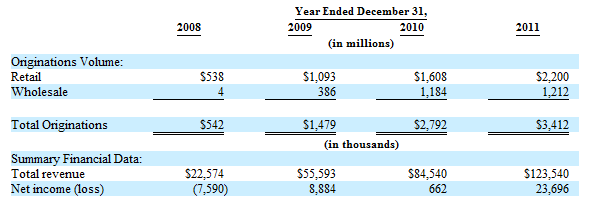
  • In 2011, we originated approximately $3.4 billion of loans, up from $2.8 billion in 2010.
  • We originate primarily conventional agency (GSE) and government-insured residential mortgage loans and, to mitigate risk, typically sell these loans within 30 days while retaining the associated servicing rights.
  • Our originations efforts are primarily focused on “re-origination,” which involves actively working with existing borrowers to refinance their mortgage loans. By re-originating loans for existing borrowers, we retain the servicing rights, thereby extending the longevity of the MSR

3. How big is Nationstar’s servicing business?

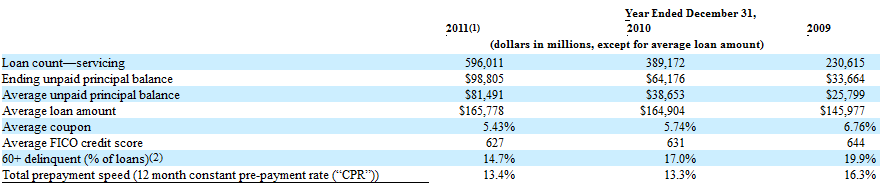
Nationstar ended 2011 with UPB of $99B.

The company has shown quite impressive growth in servicing assets over the last 3 years.  Unpaid balance owned more than doubled from the year end 2009 to 2010, and was up another 50% from year end 2010 to year end 2011.

4. What will be the upside of the recent servicing deals that Nationstar has done?

In 2011 Nationstar produced 24 cents of earnings, or about $20M, on an average unpaid balance servicing balance of $81B over the year.  However, 24 cents is not representative of the true earnings of the company.  That number  includes losses from non-recourse legacy assets that are pooled as variable interest entities on the balance sheet.  It also includes changes in valuation of servicing rights that is not generally considered a core expense to servicers.  I am going to spend my second installment talking about earnings, but for the purposes of answering this question, lets just go with the roughly correct estimate of 80 cents (or $70M) of core earnings for 2011.

They have since done two deals with Newcastle, one for $63B UPB and the other for $9.9B UPB.  They participated with a 35% interest for those deals.  So they’ve added another $25B to their UPB, not including that for the full loan amount of $73B they are doing the subservicing.  They have also added $18B in UPB at the end of 2011 in a deal with a Merrill Lynch affiliate.  So in total they have added an UPB of $43B in the last 4 months.

My work on Newcastle suggested that they would get $14.8M the first year on the 9.9B deal.  They should be able to get $110M on the full $73B in the first year.  So Nationstar is going to get $60M from the same deal.

Plus Nationstar is going to collect 6 bps on the full deal so that is another $43M.

I don’t know any of the details of th reverse mortgage deal with Merrill but presumably based on the size of the deal Nationstar should be able to generate in the area of $60M to $80M from it.

Total income from the three deals comes to somewhere between $160-$180M.

The company had revenue from servicing of $280M in 2011 so these deals are not inconsequential, being worth in the neighbourhood of a 60% increase in servicing revenues.

5. What revenue should we expect out of the KB Homes deal?

KB Homes and Nationstar recently reached an agreement whereby Nationstar would take on the role of preferred borrower.  Historically KB Homes had its own in-house originator:

KBA Mortgage originated residential consumer mortgage loans for 67% of our customers who obtained mortgage financing during the period the unconsolidated joint venture operated in 2011. In 2010, KBA Mortgage originated such loans for 82% of our customers who obtained mortgage financing during that year.

In Q1 KB Homes had new orders for 1,197 homes versus 1,302 homes the previous year.  Homes delivered in Q4 were 1,150.  So let’s say that KBH sells 1,200 homes per quarter.

The average selling price of the homes sold was $219,000 for Q1.  The price was $205,700 a year earlier.  On the CC they said “Going forward, we expect our average selling price to continue to increase and to exceed an average of 240,000 for the year.”

Assume $220,000 per home and 1,200 homes per quarter  that together and you have a total balance of $264M per quarter.

So let’s assume NSM captures 50% of origination and that has a 20% down payment on average.   That would add $419M of unpaid balance per year to NSM.  Which isn’t that significant to total UPB for a single year.

It is significant origination volumes though.  The company has the following origination statistics over the past 4 years.

So this is another $400M or 12% of originations.  And if they can capture a greater percentage it could be double that.

6. How many of the loans is Nationstar recapturing through re-origination?

One of the questions I am interested in answering both for my investment in Nationstar and for my investment in Newcastle is how good Nationstar is at keeping its servicing clients.  if a servicer can retain clients that are refinancing their mortgages it makes it far easier to sustain strong growth.  In the case of Newcastle, it will mean a longer stream of cash flow on the servicing rights they have bought in partnership with Nationstar.

We recaptured 35.4% of the loans we service that were refinanced or repaid by the borrower during 2011 and our goal for 2012 is to achieve a recapture rate of over 55%. Because the refinanced loans typically have lower interest rates or lower monthly payments, and, in general, subsequently refinance more slowly and default less frequently, these refinancings also typically improve the overall quality of our primary servicing portfolio.

Newcastle has made the assumption of a 35% recapture rate on the servicing packages it has invested in.  This compares favorably with Nationstar’s average recapture rate in 2011.

7. How many shares did they do in the offering?

They are offering 16.7M shares.  After the offering they will have about 87M shares outstanding.  At the current price of $14.50 the market cap is $1.26B

Before the offering Nationstar was wholely owned by Fortress Investment Group through one of their private equity funds.  Fortress remains the majority holder in the company with 70M shares, or about 80% of the shares outstanding.

8. How much of the offering did they spend on the Newcastle deal?

They spent $115M on the Newcastle deals.  They offered $233M worth of shares.  So they spent about half of it.

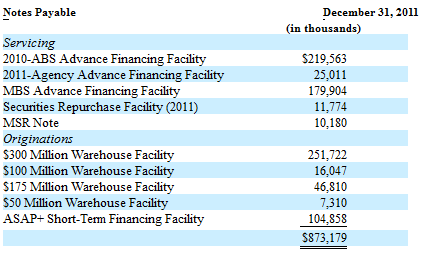
9. How much debt do they have?

Next…Part II

In the next installment I am going to look at the earnings power of Nationstar and how there are a number of GAAP accounting rules that are fogging up what would otherwise be considered to be an attractive valuation.

A look at the Rurban Financial Annual Report

Rurban Financial is quickly becoming my favorite regional banking investment.

Under the retail name of State Bank and Trust Company, Rurban operates 20 branches in Northwest Ohio, servicing the mostly rural communities of Allen, Defiance, Fulton, Lucas, Paulding, Wood and Williams.

I’ve already discussed Rurban in a small amount of detail here.

The company is generating an improving return on equity, improving earnings, and has a reasonably low amount of non-performing assets.

I just finished reading through the Rurban Financial Annual Report that arrived in my mail box a few days ago.  There were a few highlights that I thought were worth noting.

The Ohio Economy

In the CEO Letter to Shareholders, Mark Klein pointed to improvement in the Northwest Ohio economy.  He noted that the downturn in the Midwest economy occured later than in other parts of the country and so the recovery has been likewise delayed, but that signs of recovery are appearing.

Klein also pointed out that Ohio has risen to number one in job creation in the Midwest, and is up to ninth nationwide from 48th a year ago.

As part of a section of the Annual Report titled “Commitments to our Communities” Rurban profiled two farm lending relationships that they have cultivated, as well a tractor parts dealer.  Rurban’s primary clientele is rural Ohio residents and business.  I feel quite confident that grain prices will remain at profitable levels and that opportunities to service these folks will only continue to grow.

The loan book

In 2011 loans outstanding grew by a small amount, from $428M to $443M.  Unfortunately agricultural loans decreased from $40.8M to $38.4M but I would expectt this to pick up in the next year as another year of strong grain prices is under the belts of farmers.

I was pleased to see that the company has no land loans and no contruction loans.

Non-performing assets make up a fairly small 1.77% of total assets.  This is down from 2.87% at the end of 2010.

Increasing exposure to mortgage banking and mortgage servicing

Mortgage banking activity is seen as “exceptionally strong”. One of the attributes of Rurban that I like is that they hold onto the servicing rights of the mortgages they originate.  While these mortgage servicing rights (MSR’s) are not being valued very highly by the market, I expect that to change.

I was surprised to learn that Rurban will not revalue the MSR’s upward if (when) rates begin to rise or defaults begin to fall and, as a result, the valuation model used to put a value to the MSR begins to show increasing value.  As part of Note 1 to the financial statements the company wrote that “the valuation allowance is adjusted to reflect changes in the measurement of impairment after the initial measurement of impairment… Fair value in excess of the carrying amount of servicing assets for that stratum is not recognized.”

Rurban took a beat down because of the valuation adjustment that they had to make to the MSRs that they hold.  The valuation adjustment for the full year 2011 was $1,119,000.  That works out to 0.22 per share of before tax earnings.  Rurban reports the MSR adjumstent within its “core earnings” calculation, so it does not get ignored as is the case for some of the other mortgage servicers like PHH.  I’m not sure why they don’t “ex” it out of core earnings.  Its a somewhat bogus accounting requirement in my opinion.  If an asset can be adjusted up or down 25% in a single year is than you have to question the valuation period.

There has certainly been a move by the company to increase its MSR portfolio.  Below is a graph of the unpaid balance held by Rurban over the past 5 quarters.

Core earnings are increasing and not reflected in the stock price

If you ignore the effect of the valuation adjustment that Rurban has had to take on its MSR portfolio, and you look strictly at the company’s recurring core earnings, you quickly realize that the company’s stock price is not pricing in the full extent of its earnings generation or its earnings growth.

To come up with core earnings I have taken GAAP earnings and made the following adjustments:

  • OREO impairments
  • Goodwill impairments
  • Provisions for loan losses
  • Gains on securities
  • MSR valuation adjustments

Earnings have been improving both because of loan and mortgage business growth as well as because of prudent management of costs.  Looking at the income statement I was struck by the degree of cost cutting that the company has done in the past 3 years.  Looking at salaries and employee benefits, they were reduced from $21M in 2009 to $18M in 2010 and to $14M in 2011.   Similarly, professional fees fell from almost $3M to less than $2M.  Even postage and delivery expenses fell, from $2.1M to $1.1M.

Going forward in 2012, Rurban is going to focus on growth in revenues.  I expect loan totals to increase along with originations.  I expect further increases to mortgage banking activity.  Both of these should drive further improvements in earnings.

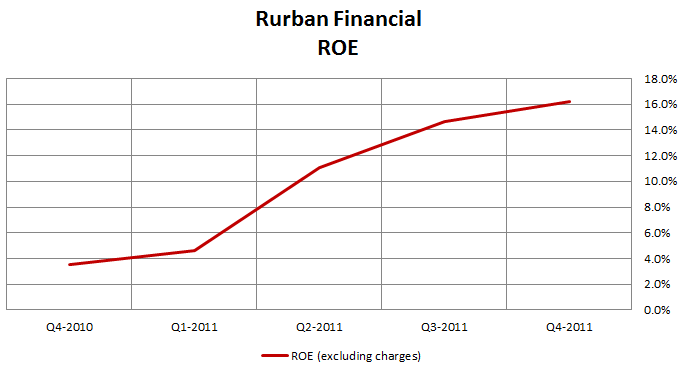
Improving return on equity

In the chart below I am looking at core earnings return on equity, which ignores one time charges and MSR valuation adjustments.

Why doesn’t the market care?

It seems kind of crazy to me that a bank with a solid loan book, decent growth and with earnings that look set to top $1/share in 2012 can be trading at less than $4.  But I guess that is why the regional banking sector remains the trade of the decade.

Listening to the financial news for the last couple of weeks, I am starting to hear some positive comments made about the large money centre banks.  I think this is the first step in the healing process of investor sentiment towards the banking industry.  It may take some time yet, but at some point solid regional and community banks like Rurban are going to benefit from that change in sentiment.

Rurban trades at 4x core earnings and at about 60% of a tangible book value that is valuing their MSR portfolio at an extremely low level.  That just doesn’t seem sustainable to me.  As the cycle turns I would expect to see the company trade at a premium to book value and at a double digit earnings multiple. Both would suggest a share price over $10 per share.