Skip to content

Atna Releases Q3 and Moves Ahead in a Big Way

I had been waiting to post more on Atna until I finished the analysis of Pinson I have been working on, but today Atna released their 3rd quarter results today and they were strong.  I bought some more stock on the results, and I wanted to post a summary of what the quarter was like and why things are looking good for the company.

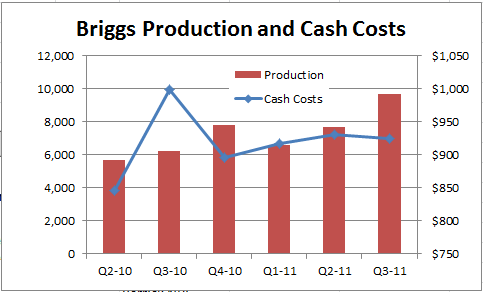
Atna’s one operating mine, the Briggs mine in Nevada sold 9,700oz of gold.  This was 2,000 oz more than Q2. Production has been increasing steadily for 3 quarters now.

Cash costs as stated on the income statement were stable the last two quarters, albeit still fairly high, at $924/oz of gold sold (Atna calculates costs based on produced gold and also subtracts silver credits so the cash flow number that will come out with the MD&A will vary somewhat from my estimate).

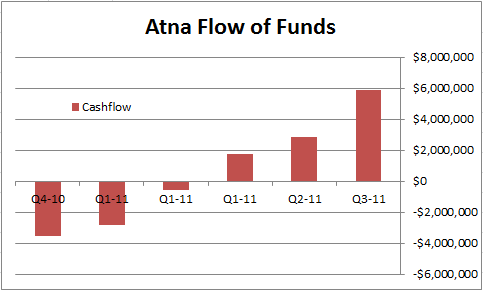
What is most impressive about the quarter is the cash generation of Briggs. The Briggs mine produced $7.4M of operating cash flow.  Below is the corporate cash flow generation of the company.

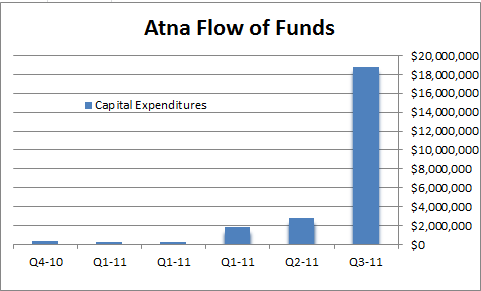
The cash generation of the company is going to go a long ways to financing the development of Pinson.  Capex spent in the quarter jumped substantially, suggesting that Atna has already moved ahead with starting mine development.

Even with the expenditures the company ended the quarter with a cash position of $10.5M

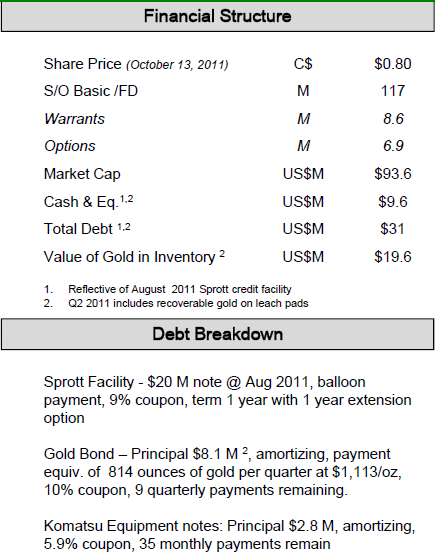
Atna is in the enviable position of having a stable producing mine that is throwing off enough free cash to fund the development of their star project, Pinson.  I’ll write more about Pinson shortly, but even ignoring that eventual production, the Briggs mine is now producing at a rate of almost 40,000 oz per year.  The company has a market cap of a little over $100M and with debt only $120M (see financial structure below).  A 40,000 oz producer trading at $100M is a reasonable deal in its own right.

If you add Pinson to the mix, not even to mention the potential of a 3rd mine in a few years at Reward, you have the makings of a very cheap stock.   Given the growth prospects of the company, if you believe in a rising or even stable price of gold, you have to like what you see.

Week 19: Liquidating Jaguar, Adding to Atna, Aurizon

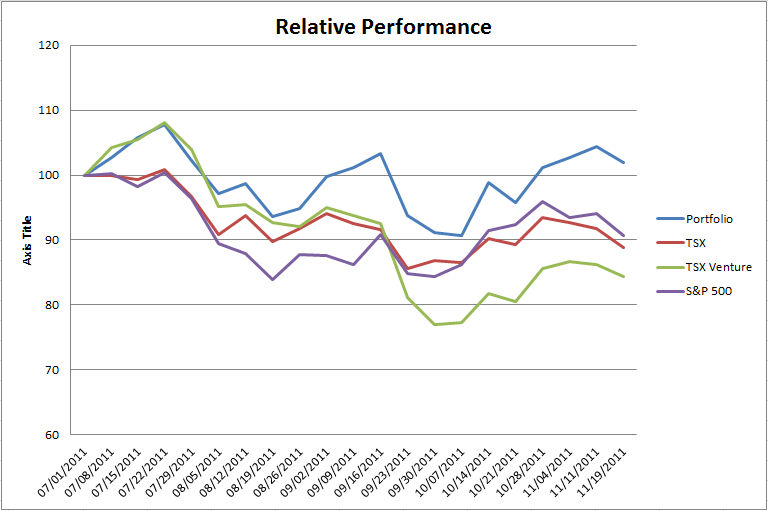
Last week was another good week for my portfolio.  I tend to perform well in sideways markets.  In down markets, especially those like we’ve had recently where the correlation of all asset classes go to one, I tend to underperform on an individual equity basis, because the stocks I own are for the most part small caps and commodity stocks, and they get hit harder than the broader market.   I’m trying to mitigate that with my currently high cash position, and it has done its job and  dampened the effect.

I would, however, like to reduce my cash position at some point, as it is har d to make money when so much of it is doing nothing.  To do that though I would have to see some sort of light at the end of the European tunnel, and that is not likely forthcoming.

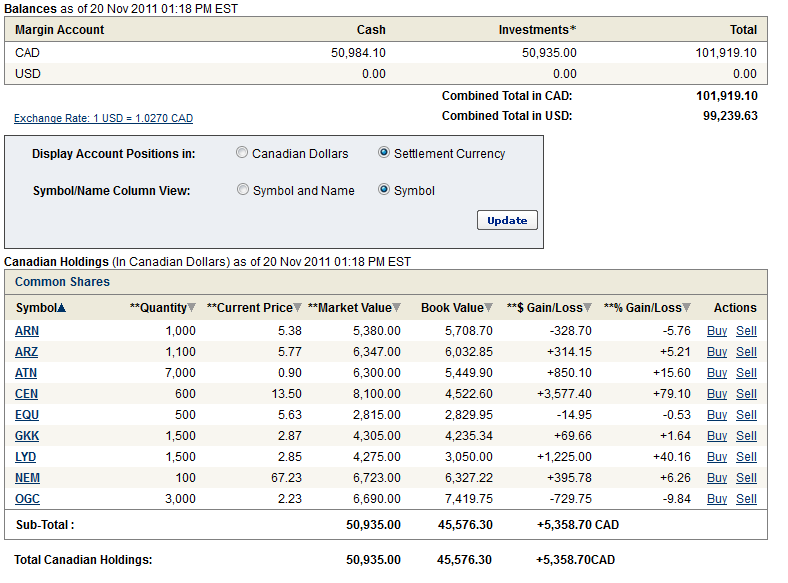
The only significant portfolio change I made last week was to sell my position in Jaguar Mining, and using the subsequent cash to increase in my positions in both Aurizon Mines and Atna Resources.  There will be more to come on both Atna and Aurizon in a future post.  I see Atna in particular as a interesting and soemwhat unique situation.   Atna recently received 100% interest in the Pinson deposit.  This is a game-changer for the company, and one that is not even close to being priced into the stock price.  Because Pinson does not have a full feasibility study complete, or even a PEA, investors are not aware of the economics of this high grade underground project.  But more on this later.  For now though I want to spend a few minutes talking about Jaguar Mining.  Since I have written about the company fairly extensively, I think its worthwhile to review why I have now chosen to go the path of full liquidation.

I can point to a number of reasons for getting out of Jaguar Mining.  At the top of that list is the company’s inability to generate free cashflow, even though the gold price has risen some 40% over the past 9 months.   The way that Jaguar has managed to match any increases in operating cash flow with correpsonding increases in capital outlays is uncanny.

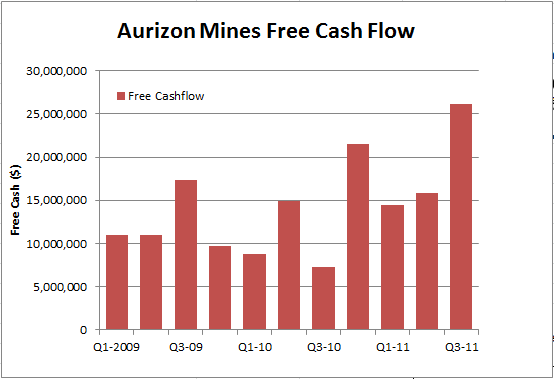
Let’s compare this to another holding of mine, Aurizon Mines.

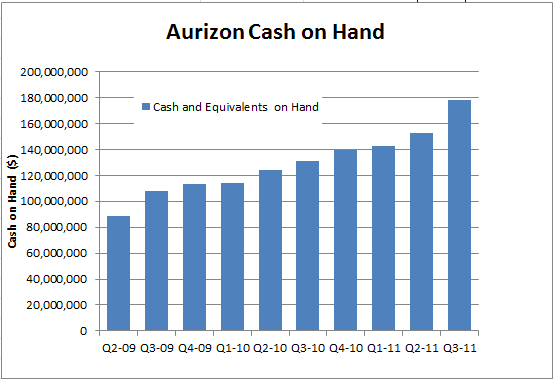
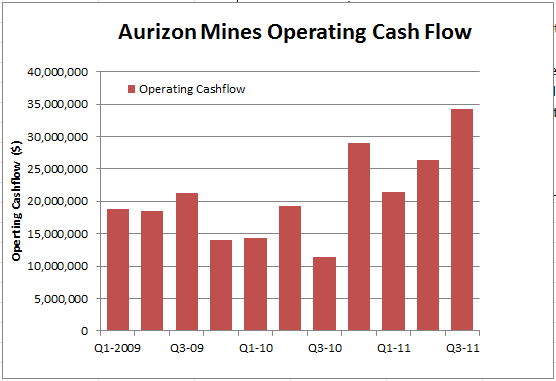
Aurizon, on the other hand, has done exactly what you’d expect a company to do in a rising gold price environment.  They have generated a great deal of cash.  The cash position of Aurizon has increased almost $40M since the beginning of the year.  Jaguar’s cash position, on the other hand, has actually decreased if you remove the effect of the convertible denbenture issued in the first quarter.

Of the two companies, the one that you would have to say is in a better position for expansion would be Aurizon.  But never a management team to be daunted by lack of available funds, Jaguar said in a separate press release that they are going forward with the development of the Gurupi project.

At the beginning of the year Jaguar provided a longer term outlook  of what to expect from the company.  I’ve provided one of the tables from this outlook below.  Pay particular attention to the requirements of Gurupi (which as the table indicates was supposed to start development this year, by the way), an estimate that one analyst on the conference call referred to as outdated and not in the “that number is too high” kind of way.

Jaguar is going to be forced to raise a lot more capital to fund Gurupi.

On top of that, Jaguar plans to refinance their outstanding debentures with senior debt.  Between the Gurupi financing and the convertible refinancing Jaguar is looking at a bond offering of $400M+.  This seems like a bit of a heroic expectation for a company that is struggling to produce any free cash flow at record high gold prices.

Another analyst on the call pointed out that the market might not be quite as responsive to new debt from the company as Jaguar management seems to think it might be.  Quite reasonably, the analyst referred to the existing debentures, which the market is currently valuing at a 13% interest rate.  He speculated that the market is suggesting that Jaguar debt would take a 15-17% coupon.

Management said that the offer sheets they had received were in the 9-11% range.  Forgetting for a minute that 9-11% interest rates are extremely high, you have to be a bit suspicious of the company’s ability to raise money at this level when there are debentures outstanding that carry the upside conversion option, at a 20-40% discount.

I could go on.

I bought Jaguar because in the low $4’s it was a undervalued NAV play.  The projects, if you tally up the value of each, are worth around $6-$7 per share, and maybe more at $1800 gold.  But at $6 per share, which is about the average price that I unloaded my position at, that NAV story is replaced by a cashflow story that to be quite frank about it, just isn’t there.

I’ll stick with Aurizon, with Atna, and with the big boys like Newmont and Barrick.

It Helps to have Some Shorts

I’ve mentioned before how I can’t short in the RBC practice account that I post here. But I do own a number of shorts in my actual accounts.  On a day like we had yesterday, where everything is down, those shorts help a lot. That’s especially true when one of them implodes like it did last night.

I mentioned on my October 19th post that I had shorted Green Mountain Coffee Roasters (GMCR) after receiving a Google alert that they were the subject (victim?) of a David Einhorn presentation outlining the negative case for the company.

As an aside, I would really recommend having a google alert account set up.  Its easy to do, you just have to create a google account and list a number of key words for which you want emails sent to you when the googlebots find them.  One of my key words is Einhorn.  I was sent my first alert about his presentation about 10 minutes after the fact.  The stock had already dropped $7 but I sold it short at about $83.

I added to that short on Monday, rather presciently it appears, after reading Einhorns presentation in full over the weekend.  It anovervalued company, and the anecdotal accounting and inventory management schemes do sound rather fishy.  But even above all of that, we used to have various single serving coffee packet systems at work, including one for a while that used the Van Houtte brand, and they simply aren’t very good.  A number of us got headaches from drinking the coffee.  It gave you some weird buzz.  It just wasn’t normal coffee.  The machine we have at work now makes its single servings on the spot from real beans.  There is no comparison.

But enough about GMCR.  That boat has sailed, as it dropped some 30% last night in after hours after missing revenues.

Most of my shorts are put on as hedges against the current macro risks.  Therefore most of my shorts are bank stocks.   GMCR was one of two exceptions to this.   The other exception is Salesforce.com (CRM).  Unlike GMCR, which has already crated and the easy money made, I think there is plenty of downside left in Salesforce.com.  This article from Smart Money does a pretty good job of describing the bear case for the company.

One of the two bank shorts that I have accumulated is Bank of America.  Its my single largest short position, which is to say it is about the size of my average long position.  I shorted Bank of America for a number of reasons:

  1. Exposure to the US housing market.  As described in some detail in this testimony to the Senate by Laura Goodman, there is probably more risk of another wave of defaults as there is of an imminent recovery.  If the PrimeX index is any example, housing defaults will soon spill over into prime mortgages.
  2. Exposure to Europe.  In itself their exposure to Europe ($15B) is not going to send BoA to the edge.   But it doesn’t help.
  3. In need of capital.  The sale of preferred shares to Warren Buffett, the sale of the China Construction company stake, and recent overtures in SEC filings about raising capital all suggest more money is needed
  4. Unintelligible financial statements.
  5. They are, after all, king of the big bad banks.  This may mean they get bailed out if things get really bad, but it also means they remain near the center of the male storm that is Europe

UBS is my other short bank position.  To be honest, it wasn’t my first choice.  I have tried to short Deutche Bank and RBS in the past but can never get shares.  UBS seems to have problems whenever something blows up, and recent events just showed that the company does not have the best capital controls.

Finally, I have a small short that I just took in Home Capital Group (HCG.to).  They are a bit of a darling of the Canadian market, and do not trade expensively, at 10x earnings.  What they have against them is that they fund a lot of the non-convention loan demand in the Canadian mortgage market.  So they fund the loans that CMHC won’t insure or that need to meet special criteria to get them to insure.  I’ve put on and taken off the short in HCG a number of times, and this time will likely be no exception.  I like to have a short on them when the market is going into a liquidity crunch because the company is at the center of those liquidity markets.  I also like to have a short on them because its a free option on something eventually going wrong with the Canadian housing market.  While that has not happened yet, it seems to me likely to happen at some point.

The Big Problem is going to be Italy… No Scratch that: Japan

I had a few days off work last week which gave me the change to re-listen to the big idea that Kyle Bass proposed at the Delivering Alpha conference hosted by CNBC and available for replay on their website.

The idea presented by Bass was another “big short” (he made his name by being one of the few short sub-prime), this time on sovereign debt, but, uniquely, not on Europe.  Bass is short Japan.

Now this is scary stuff.  Japan is huge.  Given that the disorderly default of Greece strikes fear in the hearts of fund managers, imagine what the disorderly default of Japan would be like.   It is hard to imagine all the fall out.

The basic argument that Bass points out in his presentation is that Japan is in the very precarious position where even slightly higher interest rates will make them insolvent.  And as Bass points out, we already have an analogue for how this situation goes from “everything is fine” to “Japan is insolvent” in a heartbeat, and that is Italy.

Thinking of the sudden change in perception of Italy reminded me of an email I wrote to a friend on August 5th, right about the time when things began melting down the first time because of Europe.  I wrote: “A month ago I didn’t even know Italy had a  problem.  Now the country seems to be on a fast track to insolvency.  Am I that out of touch?”

Well, it turns out I wasn’t that much more out of touch than anyone else, because that view was pretty much the consensus pre-summer view.  And that is because before July, Italy did not have a problem.  Take a look at the Italian 10 year.  This morning it has jumped even higher – to 7.3%!


Before July, Italian yields was stable.  Yields were below 5%, they had been for some time, and it could be extrapolated easily with a ruler that they would be for the forseeable future.  But then July happened and at 6% the ability of Italy to repay its debt became an open question.

So why was did a 5% “everything is ok” interest rate turn into a 6% “OMG its a crisis” moment?

Looking at the Numbers

According to Italy’s Ministry of Economy and Finance, Italy’s outstanding debt is around E1.85B or USD$2.5t (2010 figure but Italy is close to a balanced budget so its probably nearly the same this year).  Government revenues in 2010 were E729B or  USD$950B.  To do a little simple math then, every increase in the Italian rate of borrowing of 1% results in an eventual increase in borrowing costs for Italy of about $25B, or about 2.5% of government revenues.

In 2010 Italy paid E80B in interest expenditures. So right now the average interest rate that Italy is paying is about 4.3%.  A 1% rise therefore raises the average interest rate to 5.3%.

The other relevant consideration is how quickly Italian debt comes due.  In other words, what is the duration of outstanding Italian debt.  I found the following excerpt from Morgan Stanley (are they still around?) that describes how quickly the impact will be felt:

Will an increase in interest rates of, say, 100bp be immediately reflected in the cost of servicing the debt? The answer is no. It all depends on the average maturity of the debt, which is roughly seven years in Italy. This means that it will take seven years for the cost of servicing the debt to fully reflect a 100bp increase in interest rates.

Taking all of this together, what it suggests to me is that the 1% move from 5% to 6% does not, in itself,  put Italy in a dire predicament.  Instead, I think that what has the markets concern is the trajectory.   Italy hasn’t always been able to borrow at sub-5%:

Once the market starts to determine that you are on a road to insolvency, its pretty easy to get pushed on the fast track.  In the case of Italy, 6% is starting to get closer to 7% every day.  If yields rose 3-4%, then Italy would begin to have a problem with the interest that had to pay on their debt.

But the real reason I wanted to go through a study of Italy was because I wanted to use Italy, which is sort of the poster child of the big-country-government-profligacy, as a sort of baseline of Japan.

Japan is a Lot Like Italy, but its a Lot Worse

Japan’s net government debt is Y988t or USD12.3t at the end of the second quarter.  Tax revenues collected by the Japanese government in 2010 were Y37t, or roughly about $500B in 2010.  Doing the same math as we did for Italy leaves us with the incredible result that a 1% rise in the borrowing rate for Japan is a bit over $100B, or more than 20% of government tax collection.

To put this in an even starker light consider the following.  Below is a table I made that shows the tax revenues collected by the Japanese government and the interest paid by the Japanese government over the last 20 years. Amounts are in millions of Yen.

Right now debt service is more than half of government tax revenues.  In terms of the servicing costs of the debt, debt service was about 2% of overall debt in 2010, which as I mentioned above is Y988t.

To extend those two statements to a far more frightening conclusion, a doubling of the average interest rate the Japanese government pays on debt, which would be an increase of 2% across the board, and debt service jumps to well beyond government tax collection revenue.

So with a 2% increase in interest rates, Japan is done.

This is what Bass called in his presentation the “Keynesian endgame”.   When your interest payments exceed your revenues, its game over for your government.  Of course for all practical purposes, Japan is dead in the water long before a 2% increase because as soon as the trend is established, it won’t take much for investors to start doing the extrapolation.

Also, unlike Italy, Japan does not have a long duration on its outstanding debt to stave off the crisis once interest rates begin to rise.  In fact, Japan has a notably  short duration of about 6 years.

So far though, the market doesn’t care about Japan.  Yields have actually fallen during the Eurozone crisis.  As Kyle Bass pointed out in his presentation, he is getting sovereign CDS on Japan for only 100 basis points.

Of course the market also didn’t care much about Italy 5 months ago.  Things change.

Why Now?

One of the questions that Bass fielded after he presented was by Leon Cooperman, who pointed out that the short-Japan trade has been a “widow maker” for years and asked why now?  Why would Japan begin to run into problems now when it has been had the same unsustainable dynamic for years and the market has never cared.

The answer to that question, says Bass, lies in the change in the Japanese flow of funds that are available to purchase newly issued government debt.

The primary reason that Italy is considered a problem and Japan is not is that Italy requires foreign capital to fund itself.  I think you can get a sense of how different Japan and Italy are in this regard by looking at the capital account of each country for their balance of payments.  Keep in mind the chart is perhaps counterintuitive; a negative number translates as an excess of domestic capital going abroad (a financial outflow).

To be sure, the capital account is an imperfect barometer of what the actual magnitude of available capital is that can be invested in government bonds.  For example, much of the capital going abroad from Japan is being invested in new and existing production by company’s with satellite operations.   Its not available on demand to buy debt. Nevertheless, the capital account does demonstrate just how different these two countries are with respect to their dependence on foreign capital; a country exporting capital abroad is going to be less indebted to foreigners than one that needs an inflow of capital just to maintain their current level of consumption.

What Kyle Bass has done in his various presentations on Japan is refine the measure of available domestic capital in Japan to only include that which would reasonably be invested in government debt.  And when you look at that metric, you notice there has been a bit of a sea-change of late.

Bass pointed out that the two sources of capital available to finance the deficit in Japan are private household savings and corporate profits.  He summed this up as “national savings” in the chat below.  Up until very recently, the debt issuance of the government (the red line) was less than the national savings of the country.  Therefore there was more than enough domestic savings available to sop up the new government debt.

But this has recently changed.

It took me a while but I was able to verify his construction by creatingapproximately the same graph from public data.  If you add the private residential and private non-residental savings (available here from the MOF) and then subtract the depreciation of existing assets from that amount it can be compared against the government debt issuance (available here)to create the same relationship as shown above.

A similar point has been picked up by some others.  Notably, ftAlphaville ran a story a little over a year and a half ago where they referred to the work done by Dylan Grice of SocGen. Grice pointed out the specific case of the Government Pension Investment Fund, which demonstrates the general problem of “there’s not enough Japanese around to the buy the bonds we need to print”:

The biggest JGB holder on the planet – the Government Pension Investment Fund (GPIF) – which has already admitted it’s no longer able to roll maturing bonds, has announced that it will open credit lines so it doesn’t have to sell them to fund its obligations…

FT generalizes this to the following simple yet troubling point:

The obvious [point is] how household savings can continue to fund government debt and start retirement spending as Japan’s ageing crisis bites.

One might add that retiring folks in Japan are going to have a particularly tough time funding a retirement on 1% yields.  They will undoubtedly be forced to dip into their principle.

When you look at the magnitude of the problem here; the amount of debt that Japan has outstanding, the sensitivity of the country to a small change in interest rates, and the demography that almost necessitates less capital being available for investment, it is a terribly ugly situation.  It can’t end well, its just a question of how much longer it can go on.

And I still haven’t gotten to the scary part.

The most frightening part of the whole Bass presentation was his following comment:

I still have people selling me risk, 23 year old kids in investment banks, selling me five and a half billion clips of risk for one and a half basis points.  This is hundreds of billions of dollars of AIG happening again in the sovereign space.

This just struck me as so eerily reminiscent of 2008.  I mentioned in an earlier post that I had just finished reading The Big Short for the second time.  What fools are selling Japanese default insurancein the same way the  subprime mortgage insurance was sold?  Keep in mind that if you are selling it for one and a half basis points you will need to sell a lot of volume to make it worth while.

And some day its all likely going to blow up.

That is going to be an ugly day on the market.

Appendix

http://fundmanagernews.com/short-japanese-bonds

http://ftalphaville.ft.com/blog/2010/03/08/167701/japans-brewing-fiasco/

http://www.economywatch.com/economic-statistics/country/Japan/

http://elibrary-data.imf.org/DataReport.aspx?p=1449284

http://www.tradingeconomics.com/japan/government-budget

Japan: How bad is the fiscal mess?

http://www.business-standard.com/india/news/martin-feldstein-japan%5Cs-looming-savings-crisis/409620/

http://ftalphaville.ft.com/search?q=japan&p=9

http://www.mof.go.jp/english/budget/statistics/201006/index.html

http://www.planbeconomics.com/2011/05/12/dylan-grice-japan-tax-revenues-no-longer-cover-non-discretionary-spending/

http://fundmanagernews.com/short-japanese-bonds