Skip to content

Gamblers Intuition

On friday I wrote that after having sold Gramercy Capital a couple of days before, I had decided I couldn’t stay away from the stock and had bought it back (some 20cents higher).  Call it gamblers intuition, or call it luck, I just had a feeling that a settlement of their Realty loans was around the corner.

Well that’s not strictly true.  There were signs.  The stock was rising in a falling market.  Volume was up.  A call to the company by a poster on Investors Hub returned an answer that they were getting closer to a settlement.

Last night after the market closed Gramercy announced that they had settled their mezzanine loan with Goldman, KBS, and Citigroup.

The terms of the deal look quite reasonable.  The company basically hands over their Realty division (less 58 encumbered properties that Gramercy will continue to hold).  In return they get a $10M per year management fee with incentive structure that will provide a  minimum of $3.5M per year.

Gramercy has about 50M shares outstanding, so the fees they will receive from Realty management going forward are around 25 cents per share.  That isn’t small potatoes for a stock trading at $2.80.

More importantly though, the overhang of the unknown is over and investors can begin to value Gramercy on their remaining assets.  Going a long way towards that will be that Gramercy is now able to file its 10-K’s and 10-Q’s.

I expect that the financial statements will show a company with net asset value of $5+ per share.

The sale also leaves a company that is ripe for takeover.  From Bloomberg:

“What remains of Gramercy may be an attractive acquisition target both for buyers of discounted financial assets and someone looking to acquire a public real estate platform,” Ben Thypin, director of market analysis for New York-based Real Capital, said in a telephone interview. “The company may be an appealing target for private-equity firms with dry powder committed to real estate that they need to deploy.”

I am very glad I bought back on Friday.  If it wasn’t for what I perceive as some serious problems in Europe on the horizon, I would probably buy more this morning.

Oceanagold: Don’t Confuse the Headline with Cash flow

Over the last few weeks I have bought back a reasonably sized position of OceanaGold. This after having been out of the stock since the day of their Q2 update. When the Q2 update came out I took one look at the cash cost number ($900+) and one look at the production number (60,000 oz) and figured it was best to run to the sidelines and wait for the inevitable shakedown to pass.

That turned out to be a good decision.

When I read bad news, I have found it is usually better to sell first than it is to wait for the reaction to play out.  It is better to “panic”.   Why you would buy and hold a stock that you know is sure to go down, even if it is only in the short run?  In OceanaGold’s case, it was clear that at $2.70 or even $2.50, the share price was too high given the severity of the quarter.  The stock had traded to $2.20 only weeks before news of the quarter came out.  Certainly one could expect it to trade to at least $2.20 once such news was public.

And it did. The stocks traded all the way down to $1.80 in fact. I was glad that I had “panicked” on the morning of the press release and gotten out at $2.58.

But one has to be careful not to confuse the reaction with the facts. The initial market reaction can be based on the inefficiencies of investors/speculators who do not read past the headline, do not know what they own, or are selling on technicals. The trick, I think, is to understand enough to both know how bad the bad news will be taken, as well as how bad the news actually is.

In OceanaGold’s case, the perception was clearly going to be a short term drag on the stock. The headline numbers were awful and that is what is most important to most investors. Equally important though, was the knowledge that the details of the quarter were not quite as disasterous as they appeared at a glance.

The majority of the miss from the quarter can be attributed to three reasons. First, the New Zealand dollar appreciated far further than I think anyone has expected. Second, the mine plan is causing the company to expense more costs. Third, they lost some of their underground workforce.

There is, of course, nothing OceanaGold can do about the New Zealand dollar.

However the latter two problems are worth expanding on.

The issue with mining costs took place at Macraes open pit. The problem, as the company explained it, had to do with a change to the mine plan and the effect it had on the accounting treatment of strip mining. When the company is pre-stripping a new orezone, the company can capitalize that strip. It will show up some time later as depreciation on the balance sheet. However once the company reaches a new orezone, all strip needs to be expensed as it is incurred.

What happened in the second quarter is that there was far less pre-strip incurred then has been the case in previous quarters. And so most of the costs of mining were expensed directly on the income statement as opposed to having some of those costs expensed.

More specifically, the original mine plan had the Company mining an area (stage 4) of the open pit that, after drilling, was determined to be uneconomic.   Some of the mining fleet was supposed to be utilized prestripping stage 4 but because the area was determined uneconomic the fleet was used instead for waste mining of stage 5.  Because the ore from stage 5 is already accessible, this waste mining could not be capitalized and had to be expensed.

As an aside, it’s interesting to note here how this scenario demonstrates how cash costs are not really cash costs. Cash costs are actually the expensed portion of costs for that particular period. Depending on the accounting treatment, a company could spend much more cash in a quarter than what gets attributed to cash costs.

In the case of OceanaGold, the best way to see this effect is to look at the total cash outflow that OceanaGold has been spending on producing its mines over the past few years. This cash outflow includes both expensed production costs (the costs on the income statement) and capitalized production costs (the pre-stripping that only shows up on the cashflow statement). This is shown in the chart below.  Now unfortunately you can’t just look at Macraes alone.  The cashflow statement gives the combined capitalized costs of all operations.  But still, you get the basic idea of how costs were higher in Q2, but not as much higher as the cash costs would suggest.

The key point to be made by the graph is that while cash costs per ounce increased a whopping 25% quarter over quarter, total mining costs, as shown in the graph, increased 6%.

To get an idea of just how much money was deferred in the second quarter, when compared to previous quarters, the following chart plots total capitalized production costs on a quarterly basis. You can see how relatively little was capitalized in the recent quarter.

So really, from a cost of mining perspective, OceanaGold did not have nearly as bad of a quarter as the headline appears.  Make no mistake, it also wasn’t a great quarter, but it wasn’t nearly as bad as the headline.

At Reefton, management said the problems are entirely attributable to workforce turnover. They had a bunch of their miners quit, and the new miners weren’t as efficient. So they had to mill low grade stockpiles. You can see the low grade milling in Q2 versus previous quarters below.

What is somewhat puzzling about the reason given is that when you looking at the mining output at Reefton over the last few quarters, it really doesn’t suggest that severe of a deficiency in ore.  And from the figure above, mined grade for the quarter was actually quite a bit higher than milled grade (~1.8 g/t versus ~1.4 g/t).

I’m not really sure what to make of this.  Either A. they’re lying about what the problems are, or B. the problems were more temporary than the company is letting on and recovered even during the quarter (they said Reefton wouldn’t fully recover until Q4)

I think the more likely explanation is  that they are quietly hedging their future expectations.

Management also said they are bringing on-line the smaller Souvenir deposit at Reefton. This is somewhat interesting. Souvenir is a fairly narrow, almost vertical vein that hosts about 10,000 oz of reserves and another 30,000 oz of resource. The grade is somewhere between 3g/t and 4g/t; based on drill results it is probably closer to 4g/t but because there is sparse drilling at Souvenir the auditors decided to err cautiously.

Souvenir should help make a dent in cash costs at Reefton by bringing up the overall grade through the mill. But given the small size of the deposit, this is not really a long term solution to the labour force issues. Those need to be (and hopefully are being) addressed.

Valuation

The thing about OceanaGold is that they are just so cheap compared to their peers. Therefore, if you can’t discount the company’s value because of major operational issues (which I have tried to show is not the case) then there is just no reason for it to be trading as cheaply as it is.

BMO wrote a great report on the gold miners a week ago.  OceanaGold was included in the comparisons.  Below I have cut and paste a couple valuation metrics that BMO used in a recent report on precious metal miners. These comparisons show clearly just how undervalued OGC is relative to its peers.

The company trades on metrics that are only comparable to low caliber junior miners and larger miners with high cost operations that cannot generate cash flow. Heck, there are some miners that haven’t consistently generated cash flow that trade at a premium to OceanaGold. Its ridiculous.  OceanaGold has consistently been generating between $30M and $40M of operating cash flow.  They should be able to bring on their next project Didipio, without having to raise any money and while maintaining a decent cash balance.

As I’ve tried to point out above, while the company has had some operational issues, these are by no means debilitating. Moreover, the company has a strong growth profile, with Didipio expecting to add to gold production at low costs (because of copper by-product credits) in a little over a year. The company should, if anything, be trading as a growth story, not at the tremendous discount that it is given.

So I bought a position. We’ll see how it goes.

Week 8 Portfolio Update


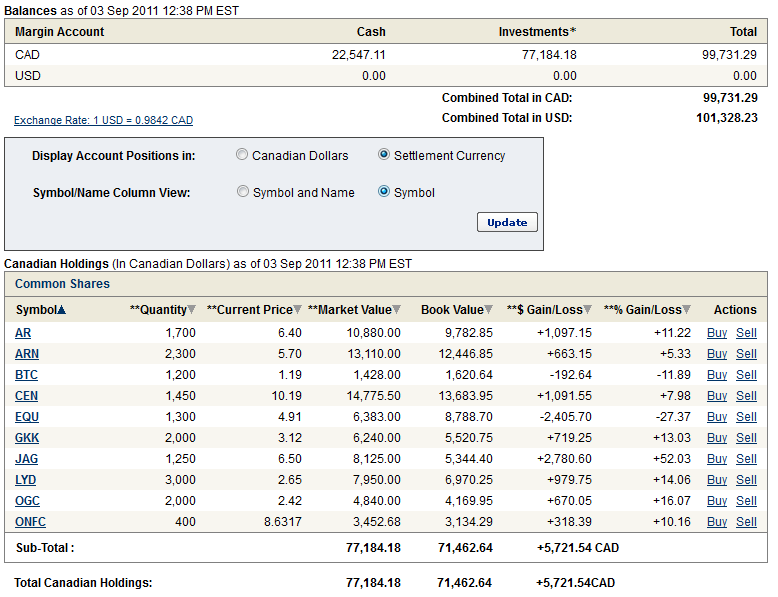
My portfolio is down a little more than 5% since its inception on July 1st.  Given the ill-time nature of that inception, that is not too bad. The TSX is down about 9% in the same time frame.

As I have previously discussed, this week I sold all of the Leader Energy Services from the Portfolio.  I also sold my stake in Xenith Banchsares and half of my stake in Oneida Financial.   I added to my position in Argonaut Gold on Wednesday when it dropped back below $6.  I also added to OceanaGold on the same day.

My cash position is still lower than I want it, and it is lower in percentage terms than my cash position in my actual account. There are two reasons for this.

The first reason is that I keep adding to my gold stocks.  I’ve built up a large position in Argonaut Gold now, and I have a reasonable position in OceanaGold again. I want to write up on both of these stocks at some point soon.  For the moment suffice to say that Argonaut Gold is trading at a valuation below its peers yet has a above average growth profile for the next few years.  OceanaGold is trading at a valuation well below its peers and its second quarter results, which crushed the stock, were not as bad as they look at first glance.

The second reason, which I have already alluded to in a previous post, is that in my actual account I like to trim positions over time, selling 10% every day or two, rather than all at once.  This doesn’t work great in the practice account, because the amounts are small (its only a $100K account), and the commissions are higher (they are $9.95 versus the $6.95 that I actually pay).

In the first month I was following my account moves exactly and I found that I spent over $200 on commissions in the practice account.  That’s over 2% of the portfolio annualized.  So that wasn’t going to work.

Therefore, in the practice account I have decided to buy an  sell stocks in larger blocks.  The downside of this is that I can end up with smaller or larger positions in the practice account than I would like.  This is the case at the moment.  In my actual account I have smaller position percentage-wise of Equal Energy, Lydian International, and Arcan Resources right now.  I have a larger position of Jaguar Mining where I have been buying on dips in small amounts.

…Couldn’t Stay Away

I couldn’t stay out of Gramercy.  I bought back in yesterday at the end of the day, at $2.80. I sold more Oneida Financial to keep my overall cash position the same.

I know, my decision making is flailing a little here.  I admit, I’m finding it difficult to make decisions here.  I see plenty of opportunities out there.  Even beyond the stocks I own.  There are oil companies, for example, trading at a third of what they were a few months ago.

Take Emerge Oil and Gas (EME.to).  Does it deserve to have been cut down by 60% in a few months?  Oil prices are still at $80/bbl after all.  The company’s production has declined slightly but nothing too severe.  Still, a 60% decline in share price?

There are lots of stories like that out there.  Lots of stocks that I would jump on in normal times.  But as I wrote about last week, I don’t think these are normal times.

The latest evidence I’ve read describing the lack of solidarity in the Eurozone came from this FT article.  Don Coxe said on his call this week that the default of any European sovereign would be “a nightmare”, except that the analogy was flawed because you do eventually wake up from a nightmare.

Scary stuff.

So I bought back Gramercy.  I saw the volume over the last few days and I have heard the company say themselves that they are getting closer to a settlement of realty, and so I was loathe not to be long the stock coming into a Monday morning where news might be sprung.

But that hasn’t changed my outlook or my strategy.