Newcastle Investment Dividend Ratio
I’m not much of a dividend investor. Maybe when I get older I will covet the security of knowing I’m getting 3-4% back from the company every year. But not now. Right now that 3-4% doesn’t seem like a lot to me. I’m certainly not going to be changing my lifestyle any time soon on a 3-4% return. I’m trying to build capital and to do that I need to have a few home runs, not a bunch of sacrifice flies. I certainly don’t put in as much work as I do so I can make a couple more points than the rest of the mutal fund / index fund / ETF crowd. Dividends don’t normally excite me.
When a dividend gets to 10%. like Newcastle’s is, then it starts to pique my interest. But just barely. 10% still doesn’t cut it. If the best I can do is 10%, than I still think I should quit and hire an adviser. That’s my thinking anyways.
So when I bought Newcastle, it was with the understanding that the dividend was a nice feature, but not the reason to buy the company. The reason to buy the company is because I think the price of the shares are going to go up.
Of course…. Newcastle is a REIT the main driver of the share price is the dividend. So the two are intertwined and therefore I need to understand the relationship.
As the dividend goes, so goes the stock price
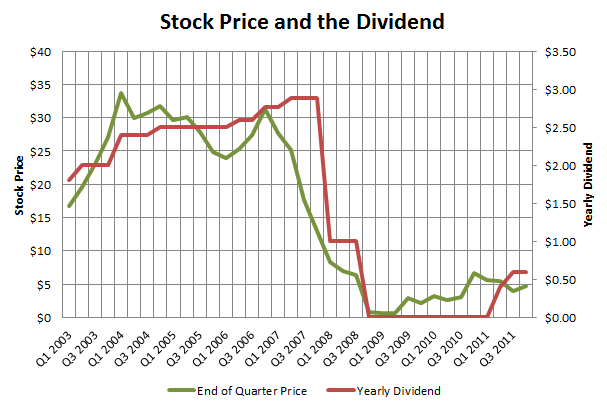
I went back through the last 6 years of Newcastle’s 10-K’s and came up with the following graph that helps illustrate how closely the dividend and stock price are linked.
Here is what I found:
The stock price is clearly linked to the dividend. In most cases (as you would expect) the stock price leads the dividend.
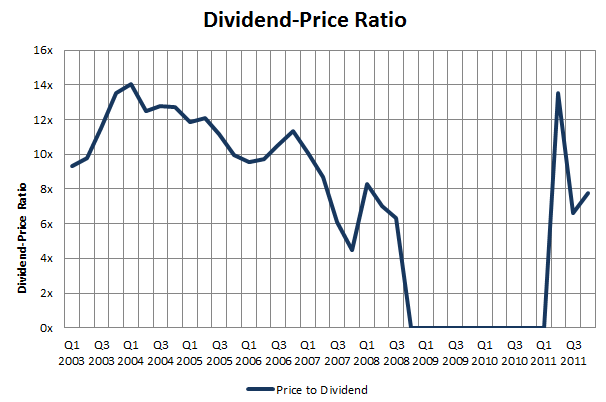
The stock price usually falls within a broad range of 8x to 12x the dividend. It depends if times are good or if times are bad. Right now, times are improving, so perhaps a move to 12x is not out of the question.
 I haven’t run the numbers in full on the second MSR deal that Newcastle announced. Until I do I won’t be able to say what I think the dividend will eventually be. But to ballpark, based on a sustainable cash flow of 10 cents per share from the first dividend, and given that the second deal is roughly 4x larger than the first, I think that a sustainable dividend in the 80-90 cent range is not unreasonable. Tacking on a 10x to 12x multiple and we get a share price range of somewhere between $8 and $11.


 Reminiscences of a Stockblogger