Framing Oracle
Apart from the shitshow that is Coreweave, Oracle is probably the most maligned of the datacenter providers.
Oracle gets a lot of attention because it is the tweener. It sits in between the hyperscalers (Google, Amazon, and Microsoft) and the Neoclouds (Coreweave, Nebius, all those bitcoin miner conversions, etc).
Unlike the neoclouds, Oracle has businesses outside of the AI datacenter build. But unlike the hyperscalers, these are not insanely profitable businesses throwing off wads of cash that can be shovelled back into the buildout.
This all makes Oracle sort of an interesting case study of what the risk and reward of the AI buildout is.
One of the best parts of AI for me has been its ability to make financial models that I otherwise wouldn’t have been able to make. While making a model is not that hard, the math is easy, digging through all the filings and transcripts to gather all the assumptions and projections from management, analysts, competition and customers is a lot of work and usually requires shortcuts. But with AI, much of this is at your fingertips.
I did it for Oracle this weekend and it really didn’t take that long.
I’m going to step through it, starting with the assumptions. The guts of what I did was focused on one segment, called Oracle Cloud Infrastructure (OCI). I don’t think the rest of ORCL is all that important, certainly not to AI and it certainly isn’t going to determine the big question that I am interested in, which is under what circumstances Oracle is likely to succeed or fail.
The conclusions to watch out for are:
- Oracle has a decent amount of debt and there is a reason that S&P cut Oracle to just one notch above junk in July
- To complete the buildout of the announced capacity, Oracle will have to add to their debt beginning in about a year, and the amount is not insignificant
- Over that same period, if the base case holds out, Oracle is going to go through a period of revenue growth and significant earnings growth. Yet because of the buildout of capacity, they will have negative free cash flow
- The outcome of whether this all plays out positively or negatively to the business and the stock hinges mainly on demand for AI compute over the next couple years.
One last conclusion that is worth mentioning. Even though Oracle seems to be constantly in the headlines for their New Mexico datacenter, which is always under some sort of opposition, these very large 1 GW+ datacenters are really not anywhere near the whole story of the buildout. In fact, much of Oracle’s datacenter build is from small, unnamed capacity that we don’t even know where it is. I bring this up because, in general, we hear about the massive datacenters as being so central to the story. And they are to an extent, but many, smaller capacity additions are equally important.
Here’s the model.
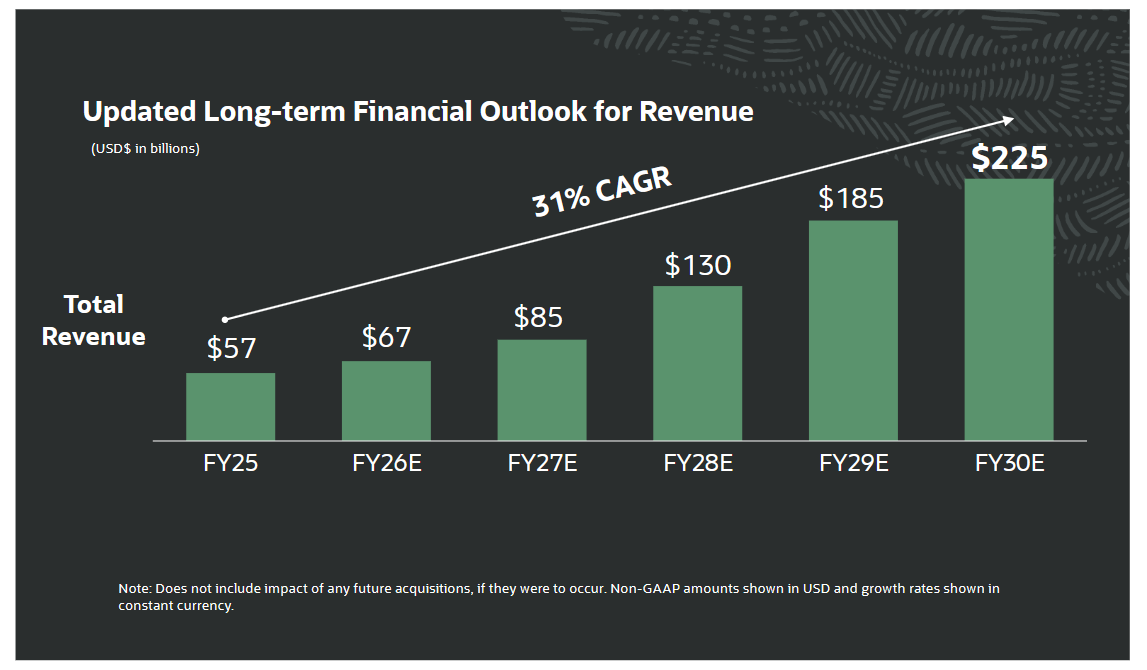
Let’s start with the top line numbers and where they come from. I am going with this forecast for total revenue, updated by the $5B increase they expect now for 2027.
I am estimating the following prices for Oracle’s new datacenter capacity. These are flat number through the time frame because really, who knows what pricing will be. They are a little higher than what Oracle said at their Investor Day last year and inline with what you need to get their stated 35% margin on $30M/MW equipment costs.
- Revenue per MW per quarter for Blackwell: $2.75/MW/Q or $3.67/GPU-hr
- Revenue per MW per quarter for Rubin: $2.75/MW/Q – $4.58/GPU-hr (The shift to Rubin from Blackwell begins in the August 2027 quarter.)
I can tell you, these prices are well below spot prices today. The Google/SpaceX agreement, which is a short-term spot agreement from June, was priced at $11.50/GPU/hr.
I am assuming the following large datacenter buildout ramps:

One of the interesting things I learned is that these five sites don’t really comprise all of the capacity add that Oracle is doing. Oracle must have multiple smaller sites that they are building to get to the capacity adds they expect in 2027 and 2028. I say must, because Oracle, and no one really, details out every datacenter they have, so you just have to assume there are a bunch of small ones.
The model estimates 300 MW of capacity adds of these small, unnamed datacenters every quarter between now and F229. That works out to 2.7 GW of the total 7.7 GW of added capacity between now and then.
Revenue from this additional capacity is determined by prices that are largely fixed and we are assuming they are fixed roughly inline with the above pricing.
Margins on the new capacity being added depend on depreciation, power and any other operating costs. Oracle has pegged gross margins on their new capacity at 30-40%. I am using 35% at steady-state, increasing from 0% at the beginning of the ramp.
Apart from the AI datacenter business, the model assumes non-AI OCI growth of 35%, which is high, but it is what you have to assume to get to ORCL’s own guidance numbers.
Using the above assumptions about when Oracle’s AI datacenter capacity comes online, how much revenue it generates and the margins of that revenue, you can come up with an OCI segment model over the next 2 years that looks like this:
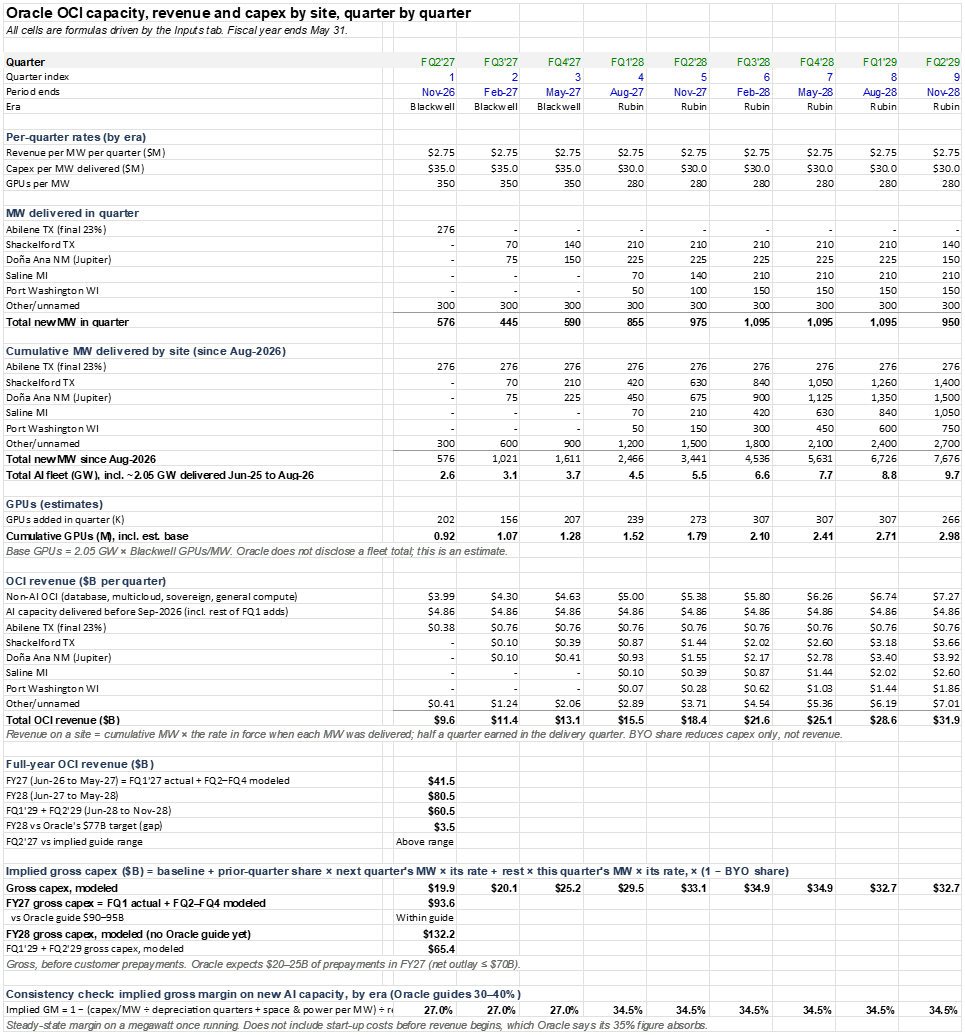
It’s a lot of rows and columns but you can focus on just a few of them. The six rows under “Cumulative MW delivered by site (since Aug-2026) are the new datacenter additions (in MW) coming online each quarter. The “Total new MW since Aug-2026” row is Oracle’s total capacity coming online.
The row labeled “Total OCI revenue ($B)” is how revenue for the segment grows as those datacenters come online.
Finally, the “Gross capex, modeled” is how much capital expenditures Oracle is ploughing in to bring the datacenters online each quarter.
And that’s it for the OCI segment. You can’t really draw conclusions from it on its own so now I have to take those results and integrate them into the rest of Oracle.
Oracle also has non-OCI businesses which are largely cash generating and slow growth. This is their software business (what most people know Oracle for), their hardware business and their services business.
Their software business is on-premises, not a cloud business. It is products like Oracle Database, Java SE, E-Business Suite and other older applications. Most of this is a license business where customers pay annual fees for updates, patches and support.
Oracle’s hardware business comes from a very old acquisition of Sun Microsystems in 2010. This includes racks and servers that run Oracle database, and an older server and storage rack business. This is a funny business that has actually been in decline for years but has started to grow more recently. I haven’t seen an explanation.
Oracle Services business is the fastest growing of the three legacy businesses. This is Oracle Consulting, which has professionals that come in and help you migrate to Oracle Database or use the other products. More recently it seems that some of the OCI integration and education gets uptake here, which may be why its growing a bit faster (~10%).
None of these businesses are forecast to grow all that much. They just generate consistent cash. I have growth from 0% to 8% for these segments. I am not spending nearly as much time figuring out the details here because these aren’t the businesses that are under the microscope.
Below I model out how these non-OCI businesses and the OCI business together impact Oracle’s cash position from quarter to quarter.
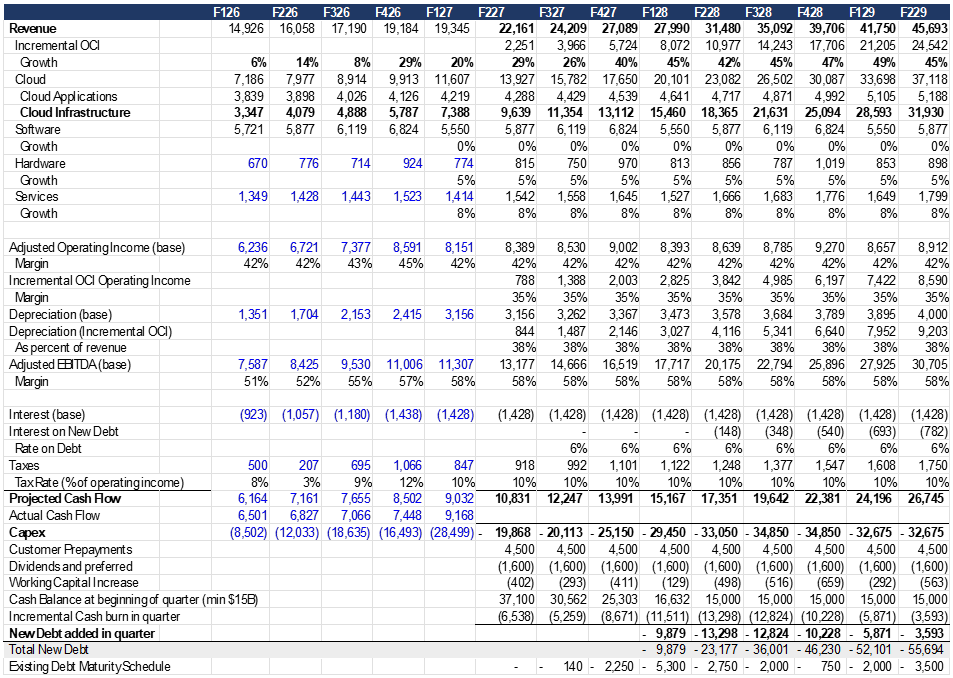
The inputs from the OCI model come into play in the “Incremental OCI” row, which is the additional revenue Oracle gets every quarter when a new datacenter comes online, and the “Capex” row, which is the gross capital expenditures Oracle has each quarter.
Oracle has a cash position today of $37B. That cash will pay for the buildout through the rest of their fiscal 2027. But come 2028, assuming they need to fund all gross capital expenditures with cash and want to maintain a balance of $15 billion or so, they will need to begin to take on new debt in fiscal 2028. Oracle will likely get ahead of this, and they have said they plan $20 billion of debt for 2027.
The row “Total New Debt” is showing how much additional debt Oracle has to add to complete the buildout to Q229. This debt accumulates every quarter and reaches $56 billion by F229.
This is a super important point to reflect on. Because $56 billion (second last cell from the bottom right) of more debt by Q229 is a lot! Unless…
The word “gross” in “gross capital expenditures” is important for watching how cash changes. Oracle’s capital expenditures do not necessarily line up with their cash usage.
The reason is that Oracle can finance those expenditures in ways that don’t require them to put up cash.
One way, which is in the above model in the row “Customer Prepayments” is through, well, customer prepayments. Oracle has said that they expect FY27 capex of $90–95 billion, with net cash capex (after customer prepayments) of no more than $70 billion.
Customer prepayments are lumpy but will average a little over $5B per quarter in F2027. I modeled them at $4.5B for the rest of the fiscal year. I don’t know what they will look like in FY28 and FY29 so I assumed they are the same.
The other way that Oracle can fund capex without cash, which is not in the above model, is with vendor financing. This is, quite honestly, the #1 scare tactic of bears right now. They point to Nvidia funding purchases of their own chips by their own customers. We see AMD and Broadcom doing it as well.
Multiple things can be true at once and if you don’t consider all the sides, it is easy to get lost in one narrative. Which is the case with vendor financing.
The nefarious narrative is simply that vendor financing is bad because it is usually hiding something. I mean, it’s true, most business-based revenue scams have some origin in financing revenue growth via your own balance sheet. It reminds me of banks allowing for the payback of unpayable loans with the proceeds from a new loan. Its not sustainable.
The less nefarious narrative is that this is everyone’s best interests. It is an acknowledgement that this is a very capital intensive business and if you want to participate you have to raise a large amount of capital before you can hope to see payback on it.
For a vendor like Nvidia to finance an investment in Nvidia GPUs and agree to participate in the return they believe it will generate instead of cash upfront is not necessarily nefarious. Especially if they are doing it in plain sight, which they are. If they believe that return is likely, which if you listen to Jensen Huang he clearly does, then it probably makes a lot of sense.
It certainly makes sense for Oracle. Without it, they wouldn’t be able to grow their datacenter business as fast and they would likely lose out to hyperscalers that can grow more easily.
Consider this exchange from Oracle’s F127 call in September:
Mark L. Moerdler
Bernstein Institutional Services LLC, Research Division
Ken, we’re going to be sorry to see you go, but I’m sure you have an amazing bucket list ahead of trips and things to do. So I’d like to focus in on the RPO. Can you give us more details on the drivers of the growth of RPO that is not requiring additional CapEx, the prepaid and bring your own chips? Is this AI labs? Is it semiconductor companies? Or is it that sovereign? In fact, we’ve not discussed sovereign cloud in a while, and we haven’t discussed sovereign AI at all. Can you explain how that side of OCI is going and how that will impact CapEx and margins?
Clayton M. Magouyrk
Chief Executive Officer & Director
Sure. So let me make sure we clarify one thing first, and then I’ll dive into the pieces. I didn’t say — and I don’t think myself nor Hilary said that it doesn’t require additional CapEx. We said it doesn’t require additional cash from Oracle, right? So the — I’m not an accountant, but I get to play one on TV sometimes. But the intention of what we’re trying to say is that while there clearly are capital expenditures, it does not require Oracle to go out and find additional cash to do it.
Now the question becomes, well, how do you do that? Well, we have a variety of different models. Sometimes it’s working with our suppliers through different financing arrangements that allows us to pay for the capacity as the customers pay us. That’s one mechanism. Another mechanism is that a customer says, “Hi, I’d like to pay for the hardware, but use your operational ability and your cloud infrastructure, technology assets in your data center to go out and actually turn that into an AI cluster.”
Magouyrk says that additional Capex “does not require additional cash from Oracle”. He then outlines the two ways – vendor financing and customer prepayments.
Now to be clear, he is not necessarily talking about all the capex in the model. Its not really clear at all how much of the F28 and F29 capex is going to come from customers or vendors. We can only guess. But some of it will.
Which leaves us to consider that Oracle’s cash debt needs will be something less than $50 billion. Maybe $30 billion? Maybe $40 billion? Tough to say.
How hard will it be for Oracle to do that?
That’s the big question that has the stock, and the stocks or Coreweave, Nebius and other even more precariously positioned datacenter plays, in volatile straits.
If you listen to the bear voices that were yelling this last week, you would conclude that financing is not going to happen.
But before I just assume that Oracle can’t possibly fund those requirements, I want to see how the income statement actually performs as these commitments begin to generate revenue.
So far, I’ve just focused on the free cash flow. And the easy tack, if you want to just make the bear case and leave it at that, is to stop right there.
But the more correct thing to do is to look at the whole picture. Which shows Oracle massively growing revenue and earnings over that time.
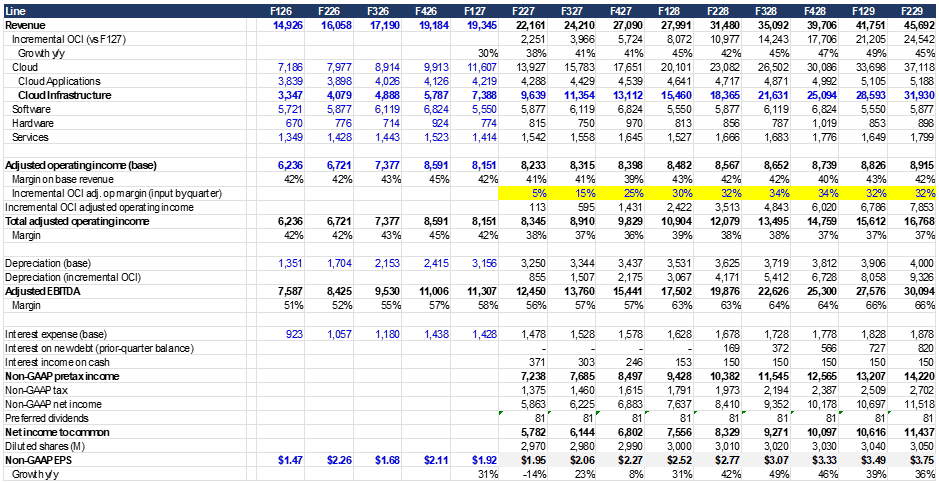
The relevant numbers are:
2027 EPS = $8.20 per share
2027 Revenue Growth = 38%
2028 EPS = $11.69 per share
2028 Revenue Growth = 45%
Yes, Oracle is committing to a large buildout in capacity. On the flipside, they already have revenue commitments for the space from Meta, Nvdia, OpenAI, xAI and even TikTok. And those commitments are going to put Oracle on one heck of a growth path.
The strange confluence that Oracle is going to see over the next few years is that they will transition to accelerating revenue growth, accelerating earnings, and increasingly negative free cash flow.
Here’s my take.
If we get to the end of Oracle’s fiscal 2027 and Oracle puts out the above 2027 numbers and they are forecasting numbers inline with what I have above for 2028, it is hard to imagine that A. Oracle won’t be able to secure the debt they need and B. that the stock will be at $130.
That’s the base case. Now we can look at some scenarios.
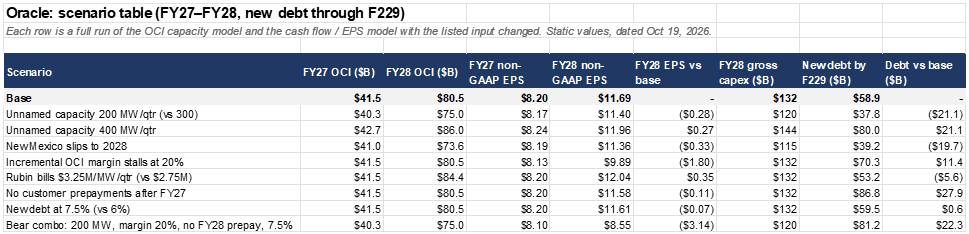
I have one big take-away from these assumptions. Nothing really matters all that much except for one thing: demand.
Here again it is worth revisiting the assumptions. Or at least the 10,000 foot view that instructs those assumptions. And the big assumption here is that demand for AI compute grows enough to cover the growth in capacity so that Oracle can bring on its capacity, have it used, and generate (at least) the margin it expects.
We can speculate this and postulate that and what about the CDS spread, and maybe the 10-year yield will rise and well you know the Anthropic IPO may not go off in November, and is OpenAI losing market share to Muse and blah, blah, blah but really, what really matters is demand. If AI demand growth meets the expectations of tech executives a year from now then it is impossible for me to imagine Oracle stock being lower than today, let alone at risk of some sort of debt default.
If demand growth expectations are wrong, then the bears are right and this is an overbuild that will materialize in the next year – and let’s be clear, I mean in the next year, not what is going to happen in 2030 or 2032 or some far off year where no one really knows and the market isn’t going to pretend they do – well if it all falls apart and Oracle is going to be tough sledding.
That’s the frame.


