CoreWeave – AI in a Nutshell
I can’t believe I am going to talk about CoreWeave again. It pains me. I don’t care about the stock. I don’t even think it matters that much to the overall market in even the medium term.
But CoreWeave epitomizes the bull vs. bear tug-of-war in the market. So I keep being pulled back in..
Fortunately, nowadays it is much easier to run a few sets of numbers on a stock and get an idea of where it stands. Which is what this post amounts to.
Yesterday I got pulled back into asking questions about CoreWeave with this tweet.
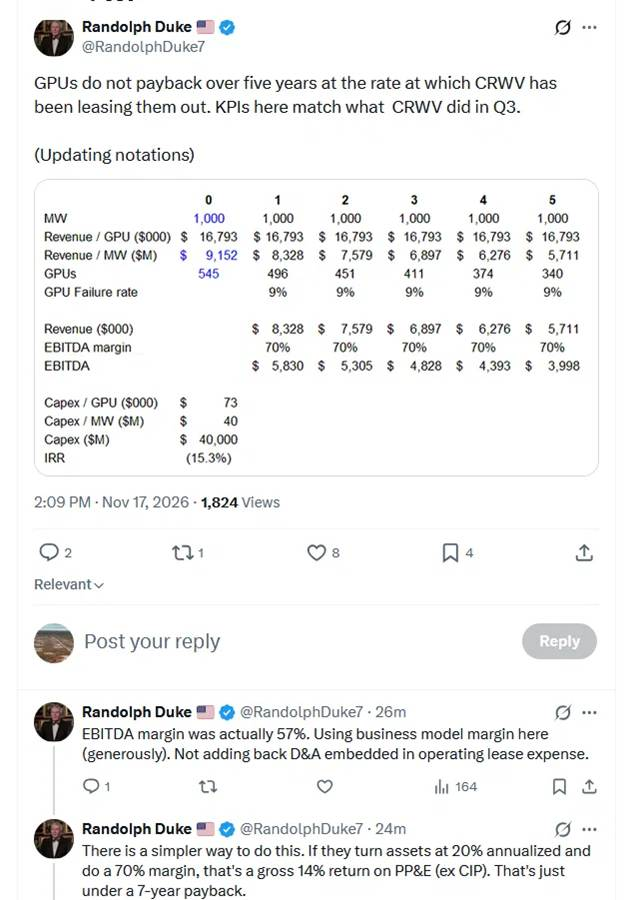
Randolph Duke is basically saying that the IRR of CoreWeave’s GPU purchases is negative if the life is 5 years. Looking at the numbers, they seem reasonable enough. I was like, hmm, this looks pretty bad for CoreWeave.
I asked Claude about the model and whether it was accurate.
The key is the assumptions. The −15% IRR rests on two big assumptions:
- A 9% a year GPU failure
- Pricing new $40M-per-MW builds at the fleet’s blended revenue per MW
The failure rate does seem high. I think it comes from Meta’s Llama 3 training run that is detailed in a few places (like here and here). If GPUs and their memory fail at Meta’s rate, the annualized failure rate will be about 9%.
But those were job interruptions on a training cluster, not dead GPUs. Which doesn’t mean they failed permanently.
Also, these were failures during training, which is more intensive than inference. I don’t know CoreWeave’s breakdown between training and inference, but it isn’t 100% training.
Bottomline, I think the failure rate is pessimistic. I’ve seen other places that 3% failure is about right.
The second assumption is pricing. This is the big one.
The table is based on revenue coming in at $9.15M/MW. That is the fleet average for CoreWeave.
That’s the whole fleet. It includes the older Hopper-era capacity that costs less per MW, as well as some even older A100 chips that are basically running for free at this point (they are fully depreciated).
CoreWeave’s Q4 guidance implies about $10.9M/MW across the whole fleet. It’s already higher than the $9.15M/MW number. CoreWeave’s exit run-rate guide of $20.5B on 1.85 GW works out to about $11.1M/MW. New capacity has to be above both, because older capacity pulls the average down.
All this underscores the linchpin, which is simply price. Randolph Duke is using this $9.1M/MW number. What if I use $11M/MW as a base case with Claude? With a failure rate of 3% instead of 9%.
I get a somewhat more palatable IRR. At least it’s positive!
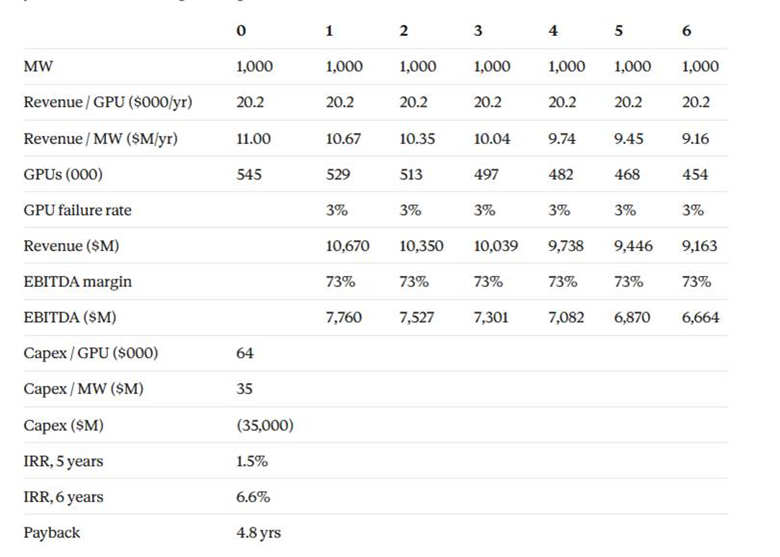
But this is still not a great result for CoreWeave. Both the 5 year and 6 year IRR are below CRWV’s cost of capital.
So what’s going on here? Is CoreWeave a time bomb? Can their management not do math?
The trick here, and this is why CoreWeave really sums up the AI trade so well, is that the $11M/MW may be too low.
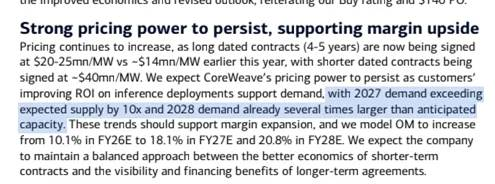
CRWV said they were signing deals for $14M/MW earlier this year and $20M/MW+ now. This comes from Bank of America:
So what does the IRR look like at those prices? A LOT better.
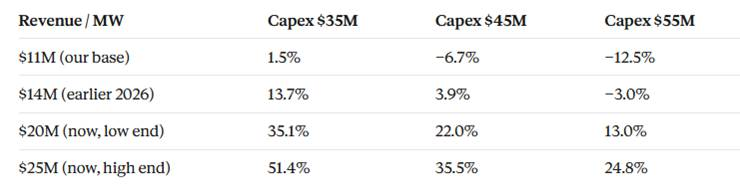
At the high end, we have a pretty good 51% IRR.
Now is that revenue number legitimate? I think that is entirely dependent on your view. What I will say is that it is not necessarily wrong.
CoreWeave isn’t just making that number up. SpaceX is thought to have signed a deal at $50M/MW with Anthropic for short term contracts.
Just what this number should be in the medium term is the whole debate. Should it be $9/MW? $25/MW? Somewhere in between? Somewhere even higher? Lower?
Within such an extremely large range, CoreWeave could easily be a $0 or a 3-4-bagger from here.
Given where the stock is right now, I would probably lean long over short. I recognize that it is easy enough to justify both positions. The downside is real. CoreWeave has $47 million of debt. There are lots of claims above equity. If those data centers don’t produce a decent IRR, the equity is toast.
But with the range of outcomes so large, the stock feels like a long-dated option. Honestly, the thing this reminds me of the most is the E&P shale-shitcos when the shale revolution was going full-steam ahead. And how many of those companies traded more like options than equities when the sledding got rough. Much blood was spilled explaining why they should go to zero, but some never did.
$40 for an option that could go to, say, $140 (this is Bank of America’s target on the stock) feels like a better risk/reward than going short at $40 and hoping the move from here is a straight line to $0.
But both are in play.
AI in a nutshell.


