I first bought OceanaGold at $1.80 at the end of May. I originally bought it strictly as a trade.
The price subsequently moved up and I added to the position twice, first at $1.98, and later at $2.14. You’ve heard me say it before – do more of what’s working and less of what doesn’t.
Well sometimes that backfires. When gold got pummeled in mid-June, my position in OceanaGold got hammered back below $2. It happened so quickly that I did not have time to react, and I ended up losing all of my profits and a little more on top of that.
Such is the difficulty of owning a trading stock with a secular thesis.
From that time until this week OceanaGold didn’t do much of anything. It sat in the 1.80’s, would briefly rise into the 1.90’s but never for more than a few days. I held, not wanting to sell near the low without justification and not having the time to do the work I needed to do to get that conviction. But over the weekend (last weekend), I stepped through their recent reports and presentations, made a few runs at their numbers, and I decided I might just stick this one out.
Two reasons to stick it out
OceanaGold had a terrible first quarter. Costs were up and above $1000 per ounce. Production was down over 20%. The mines that it is currently operating in New Zealand have been struggling with costs pressures for some time now. But the first quarter was particularly bad.
Part of the bet I was making when I bought OceanaGold at $1.80 was that the first quarter was an aberration. And, having stepped through that first quarter in some detail now, while I don’t expect costs to drop back to pre-2011 levels, I do find it plausible they they fall back into the low $900’s an ounce. Similarly, production could easily return to 60,000 ounces plus per quarter. The progress made in its second quarter earnings release on Thursday suggests this just may be in the process of playing out (note that I wrote most of this post before the Q2 earnings were released so I won’t be talking in detail about them).
The other part of the bet on OceanaGold is the expectation that the company will be reevaluated for the better once the Didipio project begins to produce substantial ounces. Because of the by-product credits from copper production, Didipio will produce gold at negative cash costs for the first couple of years.
Let”s step through this two-pronged thesis in more detail.
Production Costs should come down
Productions costs on a per ounce basis were bad in the first quarter and they have been rising for some time now.
When you look closely at the rise in production costs over the last number of quarters you can attribute the rise to essentially 3 factors:
- Rise of the New Zealand Dollar
- Fewer Ounces produced
- Changes in the amount of the total costs that can be amortized as pre-stripping
I was quite astonished by just how much of the company’s costs increases could be attributed to these 3 factors. In fact all of it. If you look at the total operating costs in New Zealand dollars over the last few years, including costs that were amortized as pre-stripping, they are remarkably flat.
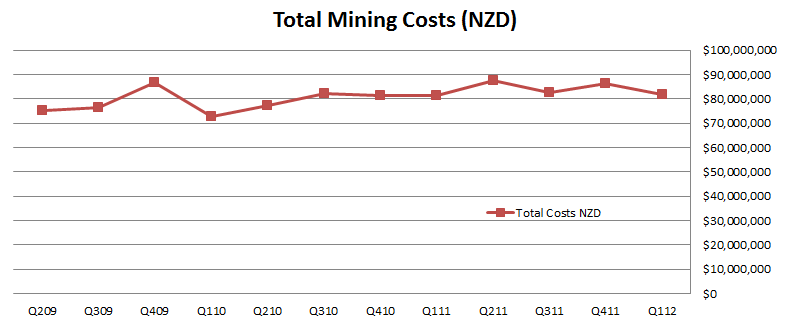
Note that I did this work before the Q2 earnings release so it is not included in the chart.
What the chart illustrates is that this a story of a company dealing with cost pressures due to their local currency appreciating and the natural evolution of the mine plan with changing grades and changing strip ratio.
Looking ahead, I don’t expect much further appreciation of the New Zealand dollar. With a global slowdown at hand, it seems reasonable to expect the NZD to weaken against the US dollar. The fewer ounces produced has been a function of various issues that occurred in Q1. There were issues at the Macraes open pit, at Fraser underground and at Reefton. The good news is that it appears the company made progress on all fronts in Q2 (production in Q2 was 55,000 ounces versus a little over 50,000 ounces in Q1) and expects production back to normal (which would be around 60,000 ounces per quarter) by Q3. As the above chart of total costs indicates, costs per ounce are primarily a function of ounces produced. A return to 60,000 ounces per quarter would show a drop in costs to about $900 per ounce.
Didipio
The other part of the bet on OceanaGold is the expectation that the company will be re-evaluated once the Didipio project begins to produce ounces. Because of the by-product credits from copper production, Didipio will produce gold at negative cash costs for the first few years and over the life of the mine cash costs will be substantially lower than the existing New Zealand operations. This is going to dramatically bring down corporate cash costs. I expect that analysts will be more inclined to give OceanaGold an average mid-tier multiple once their cash costs settle in-line with other mid-tier producers.
In the table below I have estimated the impact of Didipio on corporate cash costs in 2013 and 2014.
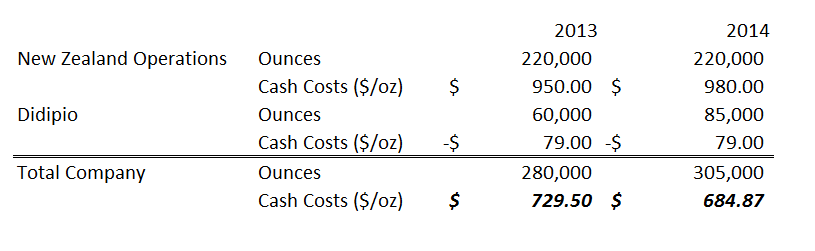 By way of analogy, consider Agnico Eagle. In the first quarter (again I wrote most of this post before second quarter numbers were out) Agnico recorded cash costs of $594/oz. Agnico’s largest mine in terms of gold production for the quarter was Meadowbank, which produced 79,000 ounces for the quarter. Meadowbank produced those ounces at costs of $1,020 per ounce. Taken alone, Meadowbank would be a high cost producer and receive a low multiple. But Agnico offsets the high costs at Meadowbank with costs of $278/oz at Pinos Altos and $216/oz at LaRonde.
Looking at the latest BMO report on Agnico Eagle, I note that the company gets a cash flow multiple of 10x. This compares to OceanaGold at 4x cash flow excluding Didipio and 2x cash flow including it.
Clearly, there is room for an upside re-evaluation.
Gold Price
The last factor that is going to determine the future direction of the share price is the price of gold. I have some thoughts there, but I am not going to go into them in detail here. Suffice it to say that this is the piece of the puzzle that I am least confident about. Its unfortunate that I am so uncertain about whether gold will continue to rise or whether it will stall out and potentially fall. Because given the other factors at hand, OceanaGold would seem to be a good place to build a large position at today’s prices.



 Reminiscences of a Stockblogger