Skip to content

Posts tagged ‘investment idea’

Combimatrix Fourth Quarter Update: I don’t think the market has this one right

When you are speculating in small cap stocks that have only 3rd or 4th tier analyst coverage (if that), it’s always an adventure when an earnings report comes out.

The market reaction is not always immediate, nor is the first one always correct.  Short term considerations; a heavy short interest, a big holder who wants to use the volume to reduce an overweight position, or a long or short pump by a pennystock newsletter, can overwhelm the otherwise expected response.

Unlike large market capitalization companies that generally are well understood and where the news is quickly reflected in the stock price, the sort of tiny micro-caps I play in have responses to news that can be erratic for days or weeks after a news event.

In the face of noisy feedback, you just have to trust in your work.

I first wrote about Combimatrix a little under a month ago.  The company performs a number of diagnostic tests centered around reproductive health.  Combimatrix has been around a long time and only recently has started to gain traction on insurance coverage with their tests, which in turn has begun to translate into earnings.  The reported results last Tuesday.

My thesis centers around the company’s claim that they will be cash flow positive by the fourth quarter of this year. I just don’t think the stock is anywhere near pricing in that possibility.

Combimatrix has a history of burning through cash.  The stock trades at a level that says nothing has changed.  Even after the recent run-up (when I first looked at Combimatrix it was a $3 stock versus the current price over $4) the stock trades at 0.5x revenue.  If they achieve their goal of becoming cash flow positive they should trade at multiples of that.

The fourth quarter results moved them closer to the goal.  Revenues were up 32% year over year and 10% sequentially.  EBITDA continued its upward march toward the black.  They are on track to exceed guidance and be cash flow positive even earlier.

ebitdaq4

The stock’s immediate after hours response was what I expected.  It quickly ran above $5 and my expectation was we would soon see $6.

But that wasn’t to be, at least not yet.  After opening a little under $5 the next morning it was pressured the rest of the day and only closed up about 5%.  There was more pressure on Friday, it actually got below its pre-earnings close for a short time, but fought its way back to flat by the end of the day.

I don’t know what has held the stock back for the last two days but I don’t think I’m wrong about where its going.  Maybe there are shorts making a last ditch attempt to push it down, maybe there is a big holder who has already made the decision to reduce their position into strength and doesn’t care about the results.  I don’t know.

The bottom line is the results are good, the company continues to increase revenues, show increases in test volumes for their core tests, and show excellent cost control (G&A, Sales and Marketing and R&D costs are all at levels at or below what they were at the beginning of 2015).

I added to my position.  I had already been adding prior to earnings but I added some more.  It’s getting to be a big position, especially considering the entire company is only worth about $7 million net of cash.  I’m okay with that.  I think this is a disconnect in an under-followed, mostly hated, perennially disappointing micro-cap and few are willing to give them the benefit of the doubt.  So I will.
Hortonworks Fourth Quarter Update – The hadoop adoption cycle continues

Hortonworks is the second of the three companies I own that reported on Thursday night.  The first, Ichor Holdings, I wrote about yesterday.   The third, Radisys, I’ll get to shortly.

I originally wrote about Hortonworks along with another company Attunity in November after doing some research on Hadoop and concluding that its adoption presented a good growth opportunity for the companies involved.  At the time the stock was trading at $6, had recently been issued a sell recommendation from Goldman Sachs, and was pretty hated all around.

Nevertheless the company was growing like a weed (40% annually).  It was also bleeding cash flow like a sieve.  But at an enterprise value of less than 2x revenue I found it difficult to pass up the growth.  Knowing Wall Street loves those growth stories, I figured a couple solid quarters would put the stock quickly back on its feet.

Fast forward a few months and that is exactly what you got.  The company is still growing like a weed (revenue was up 39% in the fourth quarter, guidance was for 28% year-over-year growth in 2017), they are not bleeding cash flow quite so materially (cash flow in the fourth quarter was actually close to flat), and the stock isn’t hated quite so much.

At $11 and with a $1.40 of cash the stock is still trading at 2.4x revenue.  So the valuation is actually not that different than when I bought it.  One key difference is that back then the cash level was higher (roughly $130 million), the shares outstanding were lower (the company issues stock like toilet paper) and the price per share was lower, so cash was a much bigger piece of the overall valuation and that was partly what I found interesting.

The most interesting thing about the fourth quarter was that growth in their Hortonworks Data Flow platform has really taken off.  I wrote about HDF in my original write-up.  I’ll repeat how the company described HDF at the Pacific Crest conference last year:

Now [customers] want to have the ability to manage their data through the entire life cycle.  From the point of origination, while its in motion, until it comes to rest and they want to be able to drive that entire life cycle.  It fundamentally changes how they architect their data strategy going forward and the kind of applications and engagements they can have with their customers.   As they’ve realized this in the last year its changed everything about their thinking about how they are driving their data architecture going forward starting with bringing the data under management for data in motion, landing it for data at rest and consolidating all the other transactional data.  So it’s a very big mind shift that’s happening.

I still think HDF could be a big growth driver for the company and we are starting to see that.  They said on the fourth quarter conference call that HDF grew 6x year over year in the fourth quarter.

So there is lots of reason to think growth will continue.  Nevertheless, I am reluctant to add.  It’s the cash flow that still gives me pause.   While the fourth quarter number was good, they’ve approached break even cash flow in the past only to diverge again into big losses the following quarter.   They said on the call that they expect mid-teens negative operating cash flow in the first quarter.

More optimistically, they also said that they expect break-even cash flow in the third or fourth quarter.  So that would be a turning point.  But then in response to a question about whether we should expect free cash flow after that, if felt like they were trying to scale back expectations:

Yes, I don’t want to talk beyond that yet, Q3, Q4 seems a long way out, but from a – if you think about free cash flow we have been running may be $2 million to $3 million a quarter on CapEx. Q4 was a little light, I think it was under $2 million, but I think once we get to the sort of breakeven number sometime between Q3 and Q4 we will reassess to how much above that we want to punch.

So I’m not sure what to think.

Hortonworks also issues a lot of stock, which while it doesn’t factor into the cash flow number, does dilute shareholder value.  The shares outstanding have gone up by almost 3 million in the last couple of quarters.

On the other hand is my experience with Apigee.  Another high growth company, with cash flow, that was issuing lots of shares, and the company never really sorted any of that out yet the stock tripled from the $6 price I bought it at to the almost $18 where it was bought out by Google.  Hortonworks could easily follow that path.

There are certainly reasons to add.  Strong growth, ramping of HDF.  They announced another new product launch, enterprise data warehouse in February, and are gaining traction on their Azure and AWS offerings.  They also stand to gain visually from accounting changes enacting in 2018 that will allow them to defer less revenue and spread out commission expense, in turn improving the income statement.

Nevertheless my gut, informed by the aforementioned concerns about cash generation and stock issuance, is telling me not right now.

I think if the stock pulled back on a market pullback I would be more likely to add.  But it’s hard for me to double up at this price, as I have been prone to do with other ideas that start to work.

So I’ll probably sit with my 2-3% position and watch what the stock does.  I prefer to take the safe route when my gut is giving me pause.

Fourth Quarter Update: Ichor Holdings beats and beats

I have a lengthy update on Oclaro that I finished a couple of days ago and was planning to post this weekend but it will have to wait a few more days because I wanted to write a few short posts about what was a busy day on Friday.  After going a few days without any significant earnings updates, I was blitzed on Thursday night with 3 sets of year end results: from Radisys, Ichor and Hortonworks.

Two of these companies, Ichor and Hortonworks, produced unquestionably solid reports.  The third, Radisys, was considered a disappointment by analysts.  Of the three names, I added to my position in one, and it wasn’t the one with positive results.

I’ll start with the beats in this post by talking about Ichor.

Ichor Holdings

I wrote up the reasons for taking a position in Ichor about a month ago.

This was the first quarter that Ichor reported as a public company.   The report was very good, and the guidance for the first quarter was excellent, but all of this was expected.  Ichor pre-announced both in early January.

The most interesting new tidbit came from the conference call, where in response to a question asking ‘what if things get even better?’, management described their recent capacity additions.  They said that they had recently added or were adding enough capacity to support $200 million of quarterly revenue.  This is quite a large number.  Consider that with the “big beat” in the fourth quarter the company had $131 million of revenue, and that they are guiding to $150 million in the first quarter.  Only a year ago Ichor was generating a little over $60 million a quarter.

As strong as business has been, this has to be considered an indication that management sees it getting even stronger.

Given the growth (over 104% year over year and 24% sequentially in the fourth quarter), the concern of many, myself included , is that at some point this turns.  These capacity adds, which presumably are being done now because of some visibility of what is to come, allay those concerns in the near term.

The company supplies its gas and liquid delivery systems to two major customers, Lam Research and Applied Materials.  These two customers make up 90% of its revenue.  Both of these companies have projected a slower second half.  But even that level, which was described as a 55/45 H1/H2 breakdown on the call, is significantly higher revenue than Ichor was generating a year ago.

The company trades at a reasonable multiple considering the growth that is occurring.  If you annualized the fourth quarter results, the stock price is at 7x EBITDA.  The multiple shrinks to even less than that as revenue ramps higher in the first quarter.

Yet I struggled to add to my position on Friday even as the response to the report was somewhat muted.  I worry about being blindsided when the turn comes, as I feel like I have very little insight into the catalysts that will precipitate it.

It could happen in second quarter or in two years, I just don’t know.  The company suggests it may be more prolonged than many expect, as the drivers, which are 3-D NAND and multi-layer designs, are becoming ever more prevalent, and in the gas delivery business they have room to take market share from smaller competitors.  They are putting their money on that by investing in more capacity today.  But I wonder if Ichor is so far down the food chain that when the inflection comes they will be one of the last to know.

Thus I suspect that Ichor is destined to remain a 3-4% position for me, which I hope through appreciation eventually becomes a 5-6% position, but which I find unlikely I will be inclined to accumulate further and make it a portfolio changing score.

Nuvectra: New position, didn’t even know it was a spin-off

I don’t go out of my way looking for spin-offs.  I read Joel Greenblatt’s book You Can Be a Stock Market Genius years ago, I even did a take-off on the title a few years back, so I understand the value that can be there, but it has seemed like a saturated niche since value investing has gone mainstream.

Maybe the best way to find a spin-off is to unwittingly stumble upon one.  That’s what happened to me with Nuvectra.  I came up with the idea from a retweeted tweet by @ValuewithaCatalyst pointing to their large cash position and $0 enterprise value.

I looked into the company and found that Nuvectra is indeed trading at cash but that they also are burning through it.  The company is in the early stages of a ramp of a new neuro-stimulation therapy, called the Algovita SCS system.  They’ve hired a salesforce (headcount of 42 at the end of the third quarter and expected to reach 50 by year end) to begin marketing the product across the United States.  They have kept up a decent sized R&D program (run rate of $3.5 million per quarter) and they are only just starting to generate revenues.

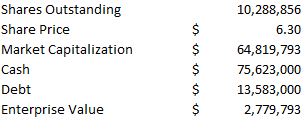
The consequence is they have a fairly significant cash drain of $5-$6 million per quarter.  This plays against a market capitalization of around $60 million and an enterprise value that, up until Friday, was close to zero (I’m using the numbers based on my purchase price below because I started this post before the stock moved the last couple of days):

ev

Their Algovita SCS system reduces back pain by stimulating the spinal column with small pulses of electricity.  These pulses stimulate the nerves and override the pain sensation, replacing it with a tingling that eventually disappears entirely.

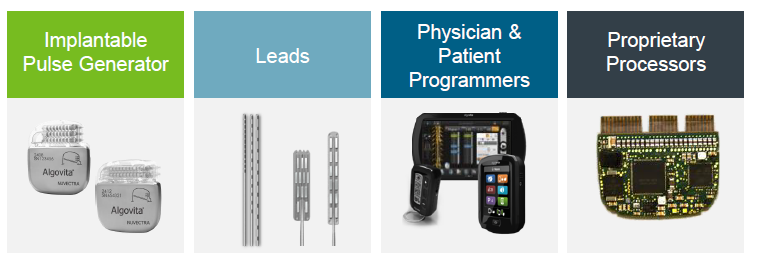
The system consists of a pulse generator, leads that are surgically inserted into the spinal column, and programmable GUI devices for the patient and physician.

algovita

There is a good video that describes the procedure in general here.

Algovita was approved in late 2015 and began to launch in the US in 2016.  So its early in the ramp.  Because Algovita is in the early stages, the market is not giving much credit to the product yet.  There is also a lot of competition.  The incumbent products are made by Boston Scientific, Medtronics and St. Jude, and a more recent newcomer is Nevro.  From what I have read, Algovita’s feature set stacks up well against the incumbents but Nevro has a very good product that may or may not be superior to Algovita.  Without question this is a very competitive landscape and that is at least partially responsible for the low enterprise value.

At this price, I think its worth seeing how the sales ramp plays out.  The company said late last year at the Piper Jaffrey conference that within 12-24 months of the beginning of a sales ramp they expect a sales territories to generate $1-$1.5 million.  This works out to 75 trials resulting in 50 permanent implants at $20,000-$25,000 a pop.  Thus the expectation from the current hirings should be at least $50 million in annual revenue.  The vast majority of their reps were hired in the third quarter and after, so we should start to see their benefit in the upcoming quarters.

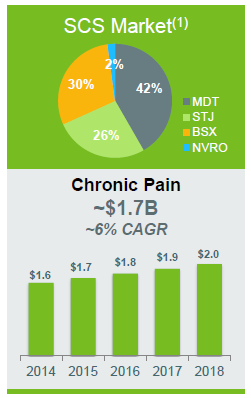
The total addressable market (TAM) is fairly big, so reaching $50 million is only taking a sliver of market share away from their competitors (note that SCS stands for spinal cord stimulation):

scsmarket

Algovita revenue was $1.1 million in the third quarter.  This was up from $569,000 in the second quarter.  The third quarter was the first real quarter with any sales traction in the United States.  The company is still mostly in the trial stage with its early adopters.  At one of the conferences management said that trial revenues were only a fraction of permanent implants.

There are likely to be bumps in the road.  In addition to the newly trained salesforce, Nuvectra is making slow progress to get insurers on-board and work through hospital approvals.  The process entails agreements on doing business, payment terms, etc.  It takes time.  In smaller settings this happens in 1-3 months, while in larger regional systems it can take 3 months to a year.

In addition to Algovita the company has a strategic development agreement with Aleva Therapeutics that allows Aleva to market Algovita for use in the direct brain stemp (DBS) market for the treatment of Parkinson’s disease.

aleva

DBS is $600 million market today, dominated by Medtronic, Boston Scientific also in market.  Nuvectra will receive $6 million in aggregate payment, and recognized $1.1 million in the third quarter related to this.  Once in production Nuvectra will receive a royalty, though I actually wasn’t able to find the details on the royalty payment yet.

Finally, Nuvectra has a “world class group of neuroscientists” that they refer to as Neuronexus (interesting website here).  This group “creates probes and other neuro-technology for clinical applications and labs around the world.”  The company expects sales from Neuronexus, would be around $5 million in 2016.  I don’t get the sense that the business will be a huge revenue driver, but their research gives insights into the latest developments in neuro-stimulation.

So there is a lot of innovation, and hopefully some of that innovation translates into revenue growth.  Its not a perfect investment case of course, none of my ideas are; there is a cash drain, there is plenty of competition, and there are insurance approval hurdles that could take months.  I am prepared for a lumpy ride, and as usual I have kept my position small until I can see sales get more traction.

Nevertheless, if they prove that they can meet their goal of $1-$1.5 million in sales per territory in the next year or two, the stock should trade at a decent multiple to revenue, which is multiples of what its trading at now.  And the cash drain will be no more.