Skip to content

Posts tagged ‘mortgage origination’

Impac Mortgage: Where the money comes from

When I first bought Impac Mortgage (back at the beginning of August) it was on the basis of GAAP earnings (which were 50 cents per share in the second quarter), and revenue growth from the mortgage origination business.  Soon after, when I looked more closely into earnings, I determined that much of what was reported in GAAP was obscured by mark to market adjustments and a legacy business that is no longer operating.  Fortunately if I ignored these effects, the resulting picture was even better than the one painted by GAAP.

So I left it alone and went on to other things.

To digress for a minute, this is my process.  Once I feel like I have a clear answer on a stock, I don’t look too much further into the details.  When I look at a stock I look hard, and I usually come up with a fairly accurate picture, but after I feel able to draw a conclusion, I don’t spend a lot more time quibbling over the details.

I don’t have time.  I have time to look into maybe 2 stocks per week.  If I spent week after week evaluating a single security, it is simply inefficient.

Does this lead to mistakes?  Absolutely.  Sometimes I miss a key aspect that changes the equation.  But to mitigate mistakes I have learned to reevaluate when the market tells me I am wrong, and to act quickly when it turns out I am.  And actually, this has been one advantage of starting this blog.  There have been a couple of cases where readers have pointed out something that I have missed.  And I’ve saved money as a result.

Given the amount of time I have to allocate to investing, this remains, in my opinion, my most efficient process.  Study the business, figure out what the key drivers are and where problems are most likely to arise, evaluate those drivers and problems, make a decision and move on to the next one.  Take another look if things start to go amiss.

With respect to Impac, as the stock moved up from $2.50 to $10, I wasn’t that concerned with getting a better grasp on the specifics of earnings.  My initial analysis showed me the drivers, and they led me to conclude that the stock wasn’t even close to reflecting those drivers, and that was enough for me.

But now, with Impac hovering between $10 and $11, further analysis is warranted.  My intent below is to understand how each of the businesses that Impac operates generates earnings, and to compare the earnings generation capacity to GAAP, hopefully eliminating some of the confusion introduced by GAAP. Read more

Further investigation into Impac Mortgage Part I: Non-recourse trusts

I did more research into Impac Mortgage (IMH) over the weekend, and I plan to share my findings in a series of 3 posts.

In this first post I want to focus on the trust assets.  While the trusts are somewhat peripheral to my investment thesis in Impac, an explanation of how they work is central to the following posts I plan to write about earnings, and understanding the trusts helps quantify what potential they might hold for Impac if the housing market recovery becomes robust.

Impac Mortgage was a $250 stock in 2004 (I am including the 10:1 share consolidation that took place).  Obviously it has been a long way down.   The fall in the stock price from then to now has been entirely because of the mortgage market collapse.   This is something to keep in mind while I step through the next few paragraphs.

As I have explained in previous posts, I bought Impac Mortgage because of the growth I anticipate from their origination business.   But while the current business model centers around mortgage origination, it hasn’t always been that way.  Prior to 2008, in addition to originating mortgages Impac created and ran a number of off-balance sheet trusts.  These trusts would buy mortgages, mostly one’s originated by Impac, and pay for those mortgages by selling securitized mortgage obligations to investors.  The trusts would pay interest on their obligations from the cash collected on the mortgages. Read more

Impac Mortgage: Out of Nowhere

Sometimes you have to act before you know the whole story.

I’ve been on holidays all week and have had pretty limited access to the internet.  I’ve checked my emails maybe once a day at most.  On Tuesday night I checked and I noticed the following google alert (by the way I would highly recommend using google alerts for all key words and company names.  Its an invaluable tool).

I had never heard of the company but I’ve been looking for other ways of playing the origination and servicing industry, especially through smaller companies.   So I read the earnings release.

50 cents per share earnings in the second quarter. Most of the earnings appear to be coming from plain vanilla mortgage origination (same business as PHH).  The company almost doubled origination revenue year over year.  They also hold on to their servicing rights and appear to be growing their servicing portfolio.

Then I check the stock price on yahoo.  The stock had a $2.30 close before the earnings release.

Wait a minute.  This company just earned 50 cents in the quarter and its trading at $2.30 per share?

Well before I went to bed I thought about what I needed to clarify before the market opened the next day if I were going to buy the stock.  I needed to make sure that the share structure was what it appeared.  I needed to make sure that the earnings were legitimate (that they were coming from mortgage origination and not from a one time mark to market valuation change).  And I needed to make sure that there wasn’t some sort of debt or financing issue (for example some sort of GSE putback overhang) that would put the company close or perhaps over the precipice.

I read through the 10-Q, which was released with earnings, and I read through the 10-K risk factors. I didn’t see any red flags.  So I took the optimistic attitude that maybe this stock was simply mispriced.  Maybe it was like all the other mortgage related stocks and the mortgage industry itself and it was just hated to the point where it no longer reflected reality.

First thing in the morning before everyone woke up and I had to get off the computer (it was a vacation after all) I bought some stock.  I took a 1% position in each of my portfolios, including the one followed here:

By the end of the day, the stock was trading over $4.

I give this history in part because I hate to write up a stock after its had a run like Impac has.  I’m sure its going to sound to some like a pump and dump or an unlikely piece of luck.  Yet this blog is about the stocks I’ve bought so that’s what I have to write about and that’s what I’m doing.

As well, specifically regarding the outlook of Impac Mortgage, even though the stock has run up a rather ridiculous 100+ percent in the last 4 days, I think it may go a lot higher.  If I’m reading it right and not missing anything (which keep in mind I very well could be), the stock has room to run.  After all this was a $250 stock in 2005 and even after the run up, the market capitalization is a miniscule $30 some million dollars (though there are additionally some preferred’s outstanding). I’m not just talking the talk.  I doubled my position on Friday at $4.26.

So with a word of warning that any stock that has risen 100% in less than a week should be carefully considered before buying, let’s take a look at what the company does.

On to the company…

The story here is a simple one. Impac is a mortgage originator that has been growing it origination volumes substantially for the past year, and that growth has finally reached the inflection point where it has become profitable.
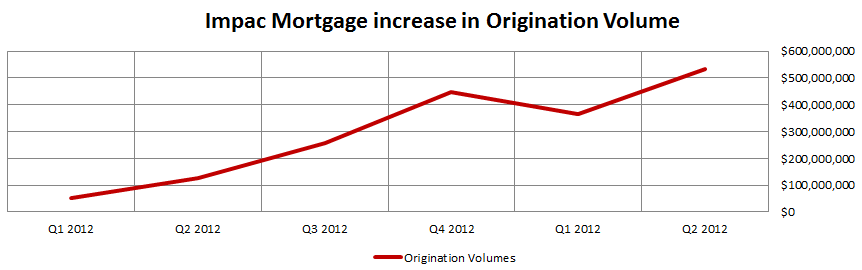
The company originates mortgages through retail, wholesale and correspondent channels.  A breakdown of origination volume by channel for the second quarter is illustrated below:
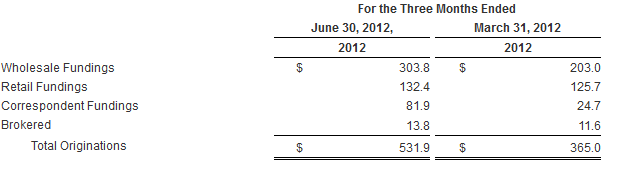
The company has developed a significant retail platform.  Retail lending is when the company deals directly with the borrower, as opposed to wholesale and correspondent lending where they are acting through independent brokers and correspondents who are originating the actual loans which are then sold to them.

The retail business is more often the higher profit business (because there is no middle man taking a cut) but it also requires more up front capital and fixed costs as you have to develop the infrastructure, the marketing, the people and the relationships required to interact with the borrower directly.  These higher start-up costs were at least partially responsible for the losses incurred in previous quarters.  The company made the following statement with respect to this in the year end 10-K:

 In 2011, the mortgage lending operations has been successful in increasing its monthly lending origination volumes to be in excess of $100 million. However, although the mortgage lending revenues increased in 2011, expenses associated with the mortgage lending activities significantly increased also. The increase in expenses was primarily due to start-up and expansion costs with opening new offices, hiring staff, purchasing equipment, investing in technology and the supplemental default management team as discussed above. Specifically, as the Company attempts to build a purchase money centric platform with a significant amount of retail originated loans; the related start-up costs for this type of origination platform will be higher than a wholesale refinance focused mortgage operation. In addition, the Company has made small investments in proprietary technologies that will further support our expansion of retail originated purchase money mortgages along with more competitive recruitment of realtor direct loan officers. The Company believes this is the right strategy in the long term as interest rates on mortgage loans are expected to rise in the future, which will greatly reduce the percentage of refinance transactions to more historical percentages. In order for the mortgage operations to achieve profitability, we will need to (i) increase overall origination volumes, (ii) improve lending revenues by originating a higher percentage of retail loans and products with wider margins and greater loan fees and (iii) reduce lending operating costs through increased operational efficiencies, or some combination of them.

While in the second quarter most of the growth was from the wholesale channel, future growth is expected to be driven from retail.

Second quarter volumes in the wholesale and correspondent lending channels led to significant volume increases over the first quarter; however, retail expansion during the second quarter is expected to lead to a corresponding increase in retail production during the 3rd quarter. Retail production is also expected to increase from the opening of the previously announced Reverse Mortgage operations.

Moving on to margins, Impac’s margins on mortgage lending look comparable to other companies I follow.  The company booked mortgage lending gains and fees of $15.1 million on $531.9 million of loans originated.  That is a total gain of 283 basis points.  To compare, PHH recorded a total gain on loans of 308 basis points in the second quarter.  Nationstar meanwhile recorded gain on sale of 306 basis points.

The company also earns money from mortgage servicing, and they have been growing their servicing portfolio every quarter.  I appreciated the company’s comments that they saw opportunity in holding on to the service rights of the mortgages they are originating given the ultra-low rates and high quality loans that are being written.

Excel expects to continue building its mortgage servicing portfolio as management believes a servicing portfolio of agency loans during a period of low interest rates and high credit quality focus is a good investment for the Company.

It’s the same line I’ve been saying for months now.

The company hasn’t been reporting the total balance of loans serviced for very long, but below the increase over the last 3 quarters is illustrated:
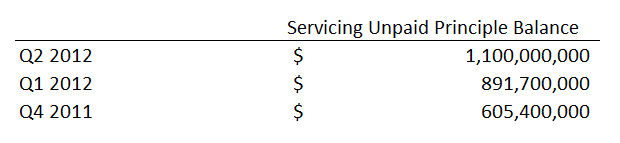
The company hires a subservicer to perform the servicing activities.  Assuming 25 basis points for the servicing fee and 7 basis points going to the subservicer, the company stands to pull in around $2 million in servicing revenues per year.

All of the loans originated and serviced are conforming, meaning they are being sold to Fannie Mae, Freddie Mac, or Ginnie Mae.

Things to be concerned about…

With this all said, the company does have some hair.

For one, they do not do a very good job of explaining their mortgage lending revenues.  While PHH and Nationstar both provide enough information to determine what they are valuing the capitalized servicing rights at, I can find no way of doing that with what Impac provides.

Second, the company appears to mark to market just about everything, including their long term debt. As noted in the 10-Q:

…long-term debt had an unpaid principal balance of $70.5 million compared to an estimated fair value of $12.0 million

Huh?  I don’t know if I am misunderstanding this or what because I have never seen a company mark to market their own debt and I didn’t even know you could do that.  Nevertheless, it seems to be what they do and its something worth contemplating the implications of.

Potential upside from The Long Term Mortgage Portfolio

An interesting sort of call option that Impac has embedded into its value comes from their residual interest in a number of securitization trusts.   Before 2007 the company originated and packaged mostly sub-prime loans and sold them off to investors through non-recourse trusts.  The company kept a residual interest (the equity) in these trusts.  The residual interest was the lowest rung on the ladder, being the first to not receive payment in the event of defaults within the trust.

These trusts are basically securizations of mostly Alt-A loans (meaning loans where the borrower does not have full documentation of income or net worth or some other metric that Fannie Mae and Freddie Mac requires).

Probably the most important thing about these trusts is that they are non-recourse to the Company, so the economic risk is limited to the residual interest only.

A break-down of the current fair value estimate of residual interest in the trust by year (taken from the 10-Q) is shown below:

These trusts are carried at fair value and the debt associated with them is also carried at fair value.   The difference between the expected fair value of the trusts (which is $5.469 billion) versus the debt (which is $5.446 billion) is $23 million.

While Impac seems to point to this number in its 10-Q I don’t think its terribly relevant.  For one, the future value of the trust assets (the mortgages within each trust) are based on a lot of assumptions, including future default rates, prepayment rates, interest rates, and so on.

Probably more importantly, at maturity the debt associated with each trust has to be paid in full, not at fair value.  While the overall fair value of the trust assets is a little less than $5.5 billion, the outstanding principle balance of the debt is $9.1 billion.  So clearly the debt outstanding outweighs the trust assets.  Nevertheless, the trusts are clearly not all a worthless asset.  In the second quarter the company collected $4.4 million in cash from the trusts, representing residual interest payments from those trusts that are presumably in a strong enough position to meet the collateral requirements that must be met before cash is paid to the residual interest holder.   Value is being realized and the potential for more value to be realized exists.

What I think is worth highlighting is that the future cash flow potential of these residual interests is basically a pure play on the US housing market.  Less defaults, stronger cash flow performance from the underlying mortgages, and Impac stands to take in a decent amount of cash from these trusts.  If housing goes down for a triple dip, well then you can probably write them off to something pretty close to zero.

Conclusions…

The stock is a bit of a flier, no question about it.  The market capitalization is miniscule, the analyst and brokerage following is non-existent, and the disclosure is not as complete as I would like it.

Nevertheless, the industry is right and, if my thesis about the housing market bottoming and potentially surprising to the upside pans out, the timing is right.  The company, if you ask me, is doing exactly the right thing at the right time by building its origination business and retaining as much servicing as cash flow will allow.  I’ve taken a position and added to it once.  If it continues to play out as it appears to me it could, I will continue to add on the way up.

How much can Newcastle Investments make from its MSR deals?

When I started to write this post a couple of days ago, Newcastle had a single $44M investment in mortgage servicing rights.  On Tuesday the company announced a second MSR deal worth significantly more ($170M).  Rather than have to re-write my post from scratch, I am instead going to focus here on the original $44M MSR deal.  I will look at the larger, subsequent deal in another post.

Newcastle and MSR’s

I got interested in MSR’s after having become a regular listener to the Lykken on Lending mortgage lending broadcast.  I have listened to a number of episodes where the mortgage professionals on the program describe the disconnect in the mortgage servicing world right now and the opportunity it has created with mortgage servicing rights.  I invested in both PHH and Newcastle with the hope that that I can capitalize from this disconnect.

I have already written extensively about what a Mortgage Servicing Right is in this previous post.

The first MSR deal

In both their first and second forays into the mortgage servicing rights, Newcastle made a deal with Nationstar. Nationstar is a mortgage servicing company.  The specifics of the deal, as put forth by Newcastle in a recent presentation, are as follows:

  • The deal is for the mortgage servicing right of a pool of mortgages with a $9.9B unpaid balance
  • Nationstar will be the servicer of the loan portfolio and will invest alongside Newcastle, purchasing a 35% interest in the Excess MSR
  • Newcastle will not have any servicing duties, advance obligations or liabilities associated with the portfolio
  • Newcastle received a private letter ruling from the IRS that allows for treatment of an Excess MSR as a good REIT
  • Asset and the income that Newcastle generates from the deal will qualify as REIT income and not be subject to double taxation

The mortgage servicing right for the package of mortgages is, on average, 35 basis points per year of the unpaid balance.  Of that 35 basis points, 6 basis points will go directly to Nationstar to cover the cost of the servicing.  The other 29 basis points will be split between Newcastle and Nationstar 65/35.

It’s a good deal for both companies.  Nationstar participates in a much larger mortgage servicing package than they would have been able to purchase with their own cash.  They also participate in some of the upside of the MSR.  Newcastle gets a high return investment that does not require them to develop any mortgage servicing abilities in house.

The Upside

Newcastle says that they are expecting a baseline return from the investment of 20.9%.  That’s a great number, but what I equally interested in is whether there is upside to that number.

In particular, Newcastle is assuming the following:

  • 30% recapture rate.  This means that Newcastle thinks that Nationstar can recapture 30% of the mortgages that go up for refinancing.  If a mortgage goes up for refinancing and is captured by Nationstar, it remains in the pool.  As Newcastle has suggested rather optimistically on their conference calls a couple of times, if you could recapture 100% of the mortgages that go to refinancing, you would have a perpetual money making machine
  • 20% CPR.  CPR stands for Constant Prepayment Rate.  This term defines the number of mortgages that go up for prepayment short of their term.  There are two reasons a mortgage will be prepayed early.  Either the owner refinances or the owner defaults on the loan

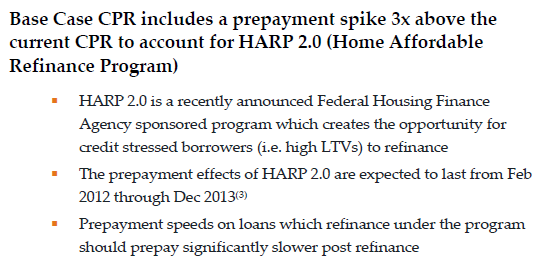
Its worth pointing out that so far the 1 month CPR on the pool of mortgages Newcastle has purchased is 9.7%. The 3 month CPR is 7.3%.  However, you have to expect that the CPR is going to increase rather substantially over the next couple of years.  Why?  Because of the government’s HARP II program, which allows homeowners with upside down mortgages to refinance those mortgages.  Presumably this program is going to garner a lot of interest from folks with high loan to value amounts and you are going to see a refinancing spike.

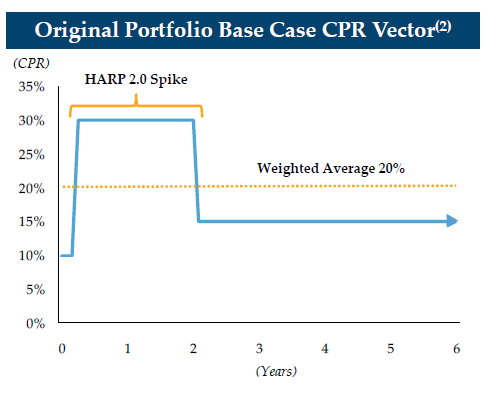
Newcastle has actually modeled the effect of HARP II assuming a spike in prepayments to 30% for the duration of the program (until December 2013). That 20% number that I mentioned is actually a weighted average over the life of the MSR’s.  Newcastle provided the following chart to show how they are accounting for the spike in refinancings expected due to HARP II.

Newcastle also provided the following HARP II assumptions in the appendix:

Modeling the Baseline

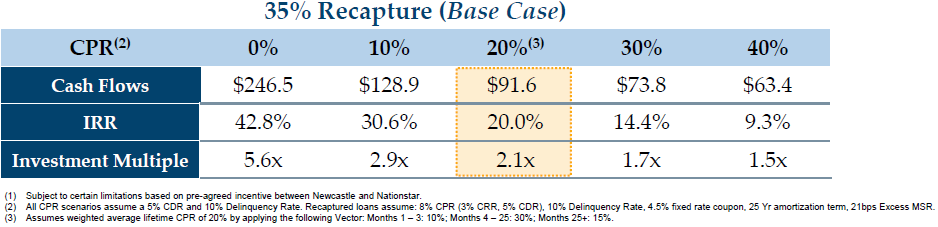
I always find it useful to create my own models, so that I can understand the dynamics at play and see what the cash flow really is.  I started off by trying to match to the baseline assumptions  put together by Newcastle.  That scenario and the assumptions provided by Newcastle in the footnote are below:

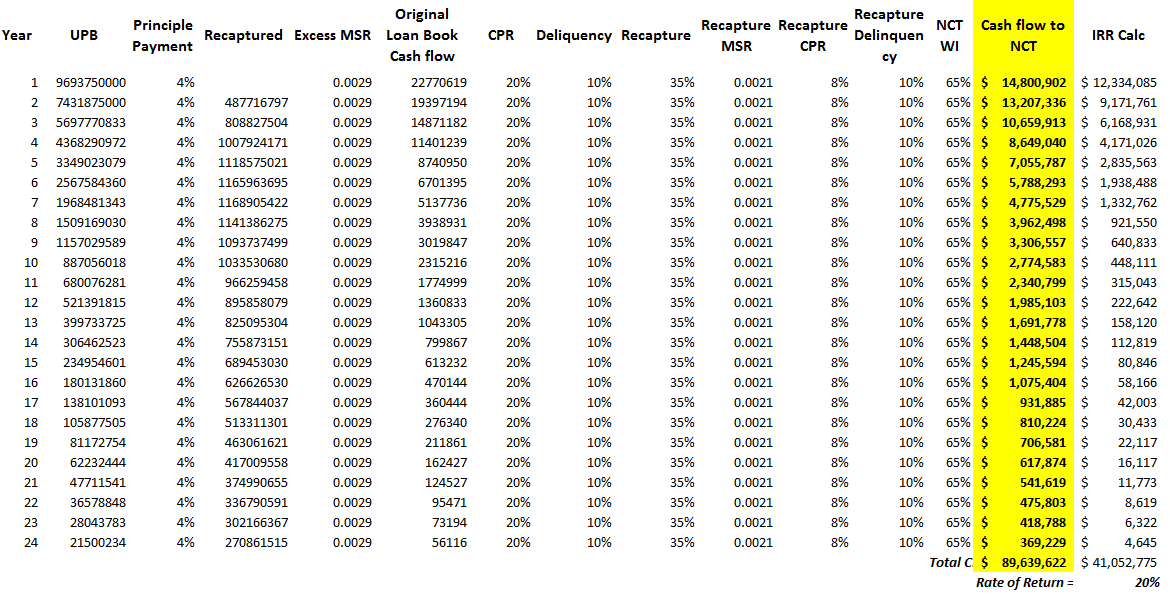
My model came up with the following:

 Model Validation

How close is my model to the model that Newcastle is using?  The primary differences between my model and the one Newcastle is using are that my model is done yearly (versus a monthly model completed by Newcastle) and I did not try to break out the increase in CPR due to HARP II, instead just using the weighted average 20% throughout the entire period modeled.

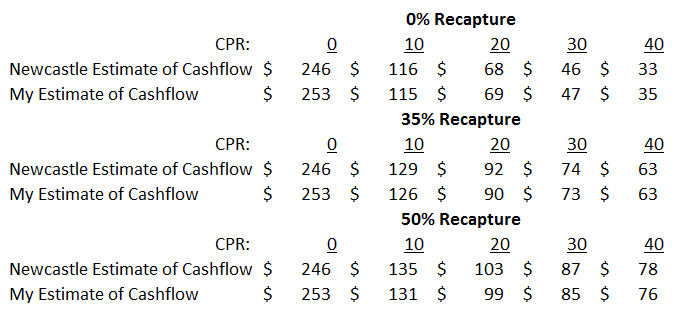
I made a comparison of the cash flow estimated by my model for each of the scenarios that Newcastle illustrated on Slide 8 of their presentation.  My results along with the original Newcastle estimates are shown in the table below.  All amounts are in millions.

Close enough.

What does the model tell us?

The first point illustrated by the model is how much the cash flow changes from year to year.  This is not a fixed return investment.  The cash flow from an MSR is heavily weighted to the front end.  The Year 1 and Year 2 cash flow decrease substantially as you move forward.  While its always good to get paid out quickly, it also means that we have to be careful with respect to what we define as a sustainable dividend based on that cash flow.   I’m not entirely sure whether a REIT like Newcastle has any say in the matter (they may just have to distribute 90% of their cash flow irrespective of how that cash flow stream may decline in the future, I’m not sure, I haven’t done the work to understand the rules of the REIT structure in the US carefully).  But if Newcastle pays out the full $14M+ in the first year, the cash flow stream is going to decline substantially in subsequent years and Newcastle is going to have to find equivalent return investments to sustain that cash flow.

Investments that return 30%+ of capital in the first year don’t exactly grow on trees.

The second point is simply that the dividend hike should be significant.  At even $12M, that is a hike of 12 cents per share, or 20% higher than the current 60 cent dividend.

A closer look at the upside

There are two potential sources of upside on the MSR’s.

  1. If there are fewer homeowners that refinance than the baseline scenario estimates than the cash flow stream goes up
  2. If more of the refinancing homeowners are retained than the baseline scenario estimates than the cash flow stream goes up

Newcastle already looked at the sensitivity to cash flow in their presentation, but they only showed a cumulative cash flow comparison.  I am interested in seeing what the cash flow is in those first couple of years, because that is what is going to influence the dividend in the short term.

Let’s look at the first case.

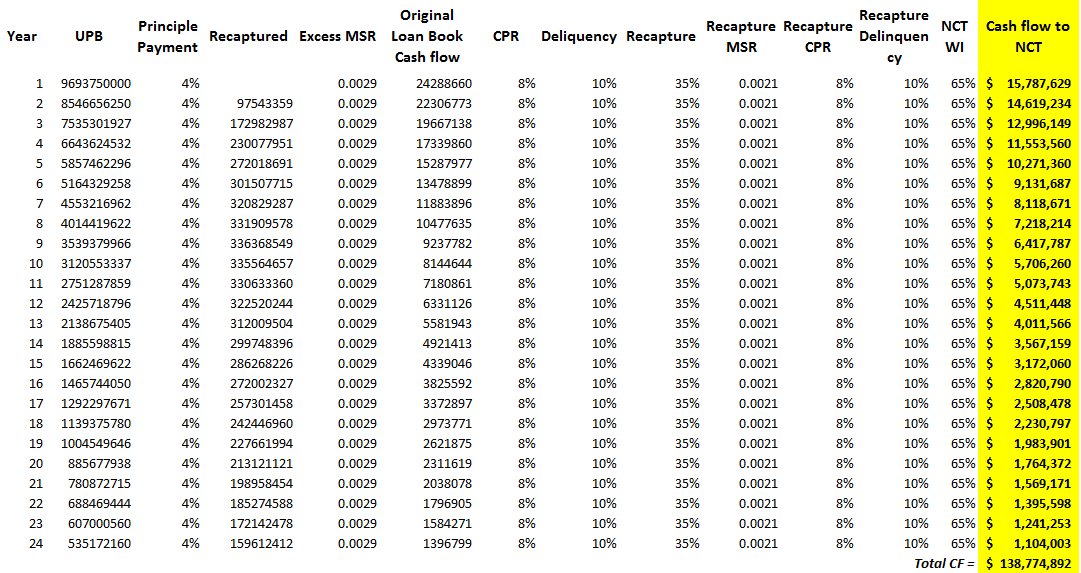
To pick a rather significant deviation from the base case I am going to assume that the total CPR, so the total number of mortgages in the mortgage pool that refinance, comes in at 8% rather than the 20% weighted average assumed by Newcastle.

If this occurs I get the following cash flow profile.

Note that the ROR increases to about 40%.

What is interesting is that the scenario shows how, as one might expect, the cash flow in later periods is effected much more than the cash flow in the earlier periods.   This makes sense as I am really just adjusting how many of the original borrowers are lost in subsequent years.

So the conclusion that can be drawn is that changes in the CPR affect the later years cash flow, but they do not influence the current year’s cash flow significantly.  While my analysis was done at lower CPR’s, the same can be said if you looked at a much higher CPR.  Assuming that Newcastle is strictly bound to pay out a dividend on this years cash flow, that  dividend would be similar under a wide range of CPR scenarios.  Of course the sustainability of that dividend could fairly widely depending on the actual CPR that occurs.

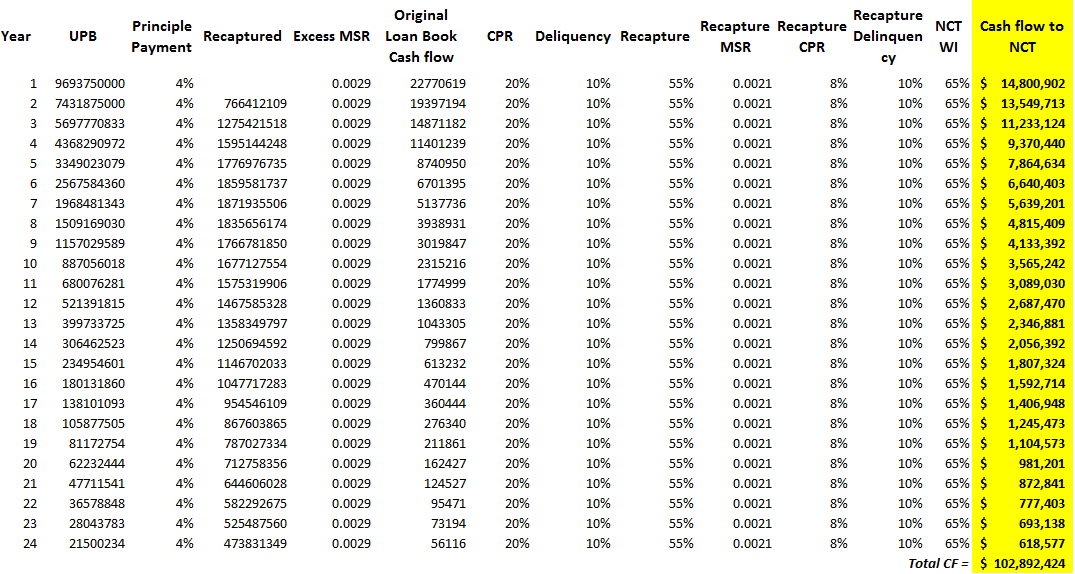
In the second scenario I am going to assume that the recapture rate ends up being significantly higher than the 35% estimate that Newcastle assumes.  I’m going to assume 55%.

How valid is this? Funny you should ask.  As chance would have it Nationstar is doing an IPO at the moment.  As part of the IPO prospectus the company had the following to say about its recapture rate:

 A key determinant of the profitability of our primary servicing portfolio is the longevity of the servicing cash flows before a loan is repaid or liquidates. Our originations efforts are primarily focused on “re-origination,” which involves actively working with existing borrowers to refinance their mortgage loans. By re-originating loans for existing borrowers, we retain the servicing rights, thereby extending the longevity of the servicing cash flows, which we refer to as “recapture.” We recaptured 35.4% of the loans we service that were refinanced or repaid by the borrower during 2011 and our goal for 2012 is to achieve a recapture rate of over 55%. Because the refinanced loans typically have lower interest rates or lower monthly payments, and, in general, subsequently refinance more slowly and default less frequently, these refinancings also typically improve the overall quality of our primary servicing portfolio.

So its a valid target.  Here are the numbers at 55%:

The cash flow really isn’t that sensitive  to changes in the recapture rate.  The change in cumulative cash flow is about $10M over the 24 year period.  The change in IRR is between 2% and 3%.

What are the assets?

The last thing I looked at were the assets involved in the transaction. Newcastle provided, as a supplement to their mortgage servicing presentation, a summary of the assets that were acquired in the original Newstar deal.

The loan package has a decent but not great average FICO score of 687.  Typically, subprime has been considered to be below 640, whereas FICO scores above 700 are considered to be excellent lending opportunities.  This loan package is somewhere in the middle.

I was a little surprised that full documentation loans only accounted for 52% of the loans in the package.  I also am not sure what to make of the “% Delinquent 30 days but making some payment”.  46% seems to be an awfully big number, but maybe that is not uncommon? On the other hand, the one and three month CPR seems to be quite good, and the high loan to value, meaning that the loans are basically the same value as the house right now, will make it more difficult to refinance in the future.

The bottomline  is that I need to investigate the asset quality further, and to some extent, just watch closely how it plays out.  I’m still learning this whole mortgage business, and so I have more questions than answers right now.  I’ve raised a few questions here, and I will report back when I have some answers.

Bottomline

The bottomline is that Newcastle is getting a high return investment (IRR of 20% on the base case) that is going to pay out the majority of the cash in the first few years.  The investment also has some upside if the refinancing surge predicted to coincide with the HARP II program falls flat.   There is also upside if interest rates rise, making refinancing less attractive to borrowers.

The investment should allow Newcastle to make a substantial dividend increase (one that should increase even more with the announced second MSR deal that has been made).  In the recent past it appears that the stock price of the company has followed the dividend reasonably closely; when the hike to 60 cents was made the stock moved quickly into the $5-$6 range.  A hike to 72 cents is likely based on the first MSR deal alone.  I haven’t worked through the numbers on the second MSR deal but I imagine a substantial hike higher is in the cards.

In my opinion the company has proven themselves extremely shrewd by getting into the MSR business when they did.  I have pointed out in the past that much of the buzz in the mortgage brokerage business right now is around how MSR’s are trading ridiculously cheap and how can one get into the business.  Lykken on Lending, a radio broadcast I have mentioned in the past, has done 4 programs in a row dedicated to understanding the MSR industry.  Every one of those broadcasts (the last of which was so good that I plan to do a short synopsis of tomorrow) reiterated the point that the opportunity in MSR’s right now is unprecendented.  The quality of the loans has never been better, the refinancing surge over the past couple of years makes it likely that those loans will stay on the books for longer, and the prices for MSR’s are trading at extremely low multiples, a disconnect that has been caused by so many of the big banks getting out of the busines (Bank of America, which was previously the largest mortgage servicer, being the most commonly sited example).

Newcastle may not be a 10 bagger, but with a 10% payout right now and a high payout coming, I think it will prove to be a very profitable investment for me.