In my opinion mortgage servicing rights (MSR’s) are the best opportunity in the market right now. The potential is there for returns as much as 30-40% IRR for the companies involved. The companies involved are not trading at premiums that reflect this, and in some cases they are trading at discounts to the market (PHH) or with extremely attractive dividends (Newcastle).
I believe the opportunity is being ignored by a market for three reasons:
- The market lumps MSRs in as just another housing play, and housing is still 2-3 years away from recovering
- MSR’s are complicated and most market participants don’t want to take the time to understand them
- MSR’s have traditionally been a crappy business and over the past 5 years they have been a really crappy business
In order to consistently beat the market I have learned that I have to look for value in typically crappy businesses and be willing to learn complex and sometimes opaque things. When I started investing I knew nothing about oil and gas. A few years ago I knew nothing about potash. A couple of years ago I knew nothing about the pulp industry. A year ago I knew nothing about regional banking. And two months ago I knew nothing about mortgage servicing rights.
I continue to go wherever my nose takes me. And right now it has lead me straight to mortgage servicing rights.
What is a mortgage servicing right?
A mortgage servicing right (MSR) is a list of conditions and responsibilities that are completed in return for a payment.
I’m going to simplify the details, but essentially here is how it works. When a mortgage company originates a loan, along with the note that binds the borrower to making payments, they get a right to a tiny sliver of interest that will be paid in return for making sure that the money gets from the borrower to the lender (along with some other responsibilities, most of which deal with what happens in the case of delinquency). Usually this sliver of interest is around 25-50 basis points. For example, for a loan for $200,000 will include the right to receive $250-$500 a year in return for making sure that the money gets collected from the borrower (among other responsibilities).
Its that sliver of interest that is paid in return for the collection and other servicing duties that is called the Mortgage Servicing Right.
As a mortgage originator you have two choices of what to do with the mortgage servicing right. You can keep it, in which case you will collect the sliver of interest from now until the mortgage is either paid off or defaults. Or you can sell it to someone else in return for cash up front.
Traditionally it has been the preference of small originators to sell the MSR for cash up front. Origination is a cash heavy business and managing cash flow is key. So while it might be nice to have a steady monthly income flowing in from the MSR, typically the more immediate concern is getting cash on the books right now.
When the originator sells the MSR up front they receive a servicing release premium (SRP). This sounds like a complicated term but its not. All a SRP is, is a lump sum payment that is paid in return for the stream of cash flows from the MSR that you are giving up.
If you are interested in an even more detailed explanation of a MSR, there was an excellent discussion paper put out by the FHFA that is accessible here.
The collapse of the SRP
Of course, to make it worth your while to sell the MSR you need to get a decent amount of cash up front for it. Traditionally SRP’s have fetched in the neighborhood of 4x to 6x the underlying MSR yearly payment. Going back to our theoretical mortgage above, if you were receiving $250 a year from the MSR, you might have expected to fetch $1000 (or maybe even $1500 if you are lucky) up front for that income stream. To the buyer of the SRP it would become a good deal if the mortgage didn’t go into default or get repaid for more than 4 years. After 4 years they get their money back, and every year after that they get incremental return. For you as the cash strapped originator that needs to pay your employees and keep yourself liquid to make further originations, the $1000 up front helps you stay afloat and generate further originations.
A little over a month ago I wrote about a great discussion on the Lykken on Lending mortgage banking podcast. Lykken had Austin Tilghman and David Stephens, CEO & CFO respectfully of United Capital Markets, on the program for an interview. These fellows are industry experts in the mortgage servicing market. The discussion begins about a half hour into the podcast. Here is a particularly relevant comment from Stephens on the current state of the SRP market:
Prior to the meltdown the price paid for an SRP [servicing release premium] was generally 5x or more of the [mortgage] service fee. That multiple dropped to 4x a few years ago and we are hearing that its dropped to 0x in some cases today.
This comment was followed up by Andy Schell, a co-host on the broadcast. Schell said that he had recently done an analysis of SRP’s and MSR’s and, in his words, “I couldn’t believe the numbers are so low.” He reiterated that the SRP’s are in some cases approaching zero.
As an originator, maybe it made sense to sell the MSR in return for a SRP that was 4x or 5x as much as you would get from the MSR in the first year. But now you are looking at a SRP that is approaching 0 in some cases. Even in the case of strong originations (good quality loans with low default rates) you aren’t going to get more than 2x the MSR’s yearly return, and are probably going to get somewhere between 1x and 2x.
It doesn’t make as much sense.
Take our example: would you give up an income stream of $250 a year if you were only going to get $350 or at best $500 for it? If you held it instead you could return double that amount in only 4 years?
Who is selling MSRs at these bargain basement prices?
I think that there are two reasons that MSR’s are getting sold down to such low prices:
- The big banks are getting out of the business
- The little guys have difficulty getting into the business
The big banks
There are a couple of things going on with the big banks. First of all, there are regulatory capital changes about to take place that are going to effect how much capital a bank has to keep on its books to hold an MSR. Under Basil III requirement of how much capital must be held for an MSE changes dramatically:
One of the biggest changes in capital definitions for U.S. banks involves mortgage servicing rights (MSR). Under Basel III, banks will be allowed to include only a maximum 10% of MSR in their capital measures. Any amount above that is deducted; and then, in combination with financial holdings and deferred tax assets (DTA), that can only be up to 15% of aggregate capital. In contrast, under current rules MSRs are included in capital up to 90% of fair value or book value, whichever is lower.
The second reason is simply the consolidation of the banking industry. Again referring to David Stephens:
Its the aggregation of the aggregators. In 2007 an originator might have 20 take outs for the loan they produced. After the spectacular failures of 2008 and the combination of large companies into even larger ones there may have been 10 takeouts. Recently we’ve seen BoA and Citi getting out of the market and you can count on one hand the number of people that account for 50% of the market. And they have their own capacity limitations. It just gets tougher and tougher to find a takeout and then those that are left are becoming more selective about what they buy.
A third reason that the banks want out of the business is the way that MSR’s are accounted for. The GAAP accounting standards for MSR’s forces banks to account for them on a mark to market basis. This means that a bank has to revise the value of the MSR every quarter. The nature of the MSR is that it is going to be extremely sensitive to interest rates. If interest rates go down then more borrowers are going to look to refinance their mortgage. When a mortgage is refinanced the existing mortgage is paid off and the MSR that is tied to the existing mortgage stops paying interest. So as interest rates go down the probability of prepayment increases, bringing the value of the existing MSR’s on the books down.
Banks have been writing down MSR’s for a number of years now as the Fed does everything in its power to lower interest rates. They are sick of having to book quarterly writedowns on the MSR assets. In addition, they have been booking further writedowns because so many mortgages have gone into default over the past 5 years. If you add to those factors the stigma of being involved too heavily with the mortgage business, you can see why so many banks are either getting out of the business entirely (Bank of America) or scaling back on the business considerably (Citi and JP Morgan).
And there you have it. A simple supply and demand imbalance where demand for SRP’s has been decimated by the housing collapse have caused a disconnect in servicing valuations.
The little guys
The reason that more originators aren’t keeping the MSR on their books is simple.
- They need the cash up front and they can’t wait a couple of years to recoup it
- They don’t have the cash to make the start-up investments to get into the business
We are in a period where originations are strong because of the strong refinancing activity that has been brought about by low interest rates. This creates more pressure on the smaller originators to sell their MSR’s and realize the cash up front. Meanwhile the drop in SRPs creates what is almost a snowball effect. Getting less cash for the MSR’s you sell precipitates the need to sell more of your MSR’s in order to meet your cash needs.
It is also not an easy process to get approved as a servicer if you are an originator that has traditionally sold off your MSRs but you want to begin holding them on your books. According to Tilghman:
Its not an easy process. Some started the process a couple of years ago, had their approvals in place for this market opportunity. It is daunting though… there is a huge backlog at Ginnie Mae and at the GSE’s… the people we talk to says this is still incredibly slow and its taking months for companies to get approvals. We talked to one subservicer and he as 20 companies waiting for approvals. And frankly we are talking to 30 companies that 6 months ago weren’t interest in owning MSRs and are now looking to get approvals.
Selling at the bottom
The irony is that all this selling is taking a place at a time when underwriting standards have never been better.
The quality of the servicing has never been better, low interest rates, tough underwriting, good appraisals, those are the positives. A lot of potential for the servicing to gain value in the future when rates go up, but most importantly to have it in place when rates go up as a hedge against your production dropping maybe 80%.
As the servicer of a mortgage, there are 3 things you don’t want to see:
- The house get sold
- The loan get refinanced
- The borrower defaults on the loan
There isn’t much that can be done about number one. But two and three are functions of the market and of loan quality, and they are notably strong right now.
Interest rates are probably as low as they are going to get. This has led to the boom in housing refinancing that I mentioned earlier. The refinancing boom has been a hit to servicers who have seen their MSR’s stop paying out when the house gets refinanced. The upside of this is that the new loans being put on the books are unlikely to be refinanced for some time. Rates are more likely to go up than down. The opportunity is there to realize servicing revenues on new loans for a significant period time.
Banks were hit hard when subprime borrowers walked away from their homes. Because loans weren’t getting paid, neither were the servicing fee. Compounding the problem, servicing rights often have clauses whereby the servicer incurs additional responsibilities when the borrower goes into the foreclosure chain.
Now we have the opposite scenario. Lending standards are so tight that only the most fool-proof borrowers are able to get loans. The risk of default should be greatly reduced. The result again is for the MSR to stay on the books, paying out cash, for longer.
The risk of regulation
The main risk to the thesis that I see is regulation. There was a lot of concern that that the FHFA was going to change the servicing model for agency servicing model, either by reducing the fee that a servicer received or by changing the structure to a fixed fee that was independent on loan value. The FHFA put out a talking paper to talk about the proposed changes back in September of last year.
In its talking paper, FHFA once again floats the idea of paying a set dollar amount for servicing loans, while keeping open to the idea of maintaining a minimum servicing fee model similar to the current structure, but one with a reserve account option. “The reserve account would be available to offset unexpectedly high servicing costs resulting from extraordinary deteriorations in industry conditions,” the talking paper notes.
There was a lot of resistance against the proposed ideas, particularly from the smaller servicers, who said that the reduced servicing premium would basically squeeze them out of the business. The FHFA recently stepped back from the proposals, but they have yet to put an end to the discussion completely. Tilghman said the following about the matter:
We are continuing to be disturbed that the FHFA refuses to clearly state the servicing compensation issue that it is off the table. The responses to their December proposal were 80% against any change or for a moderate change and yet they will not acknowledge that and continue to leave open the potential for that issue. If they understood the markets and were serious about competition well frankly that is going on as we speak, they’d provide certainty and they would kill the issues that have no substantive support.
How to invest
Finding companies to take advantage of the opportunity hasn’t been easy. The two obvious one’s that I have owned since the start are Newcastle Financial (whichI have written about here) and PHH Corporation (which I have written about here).
There are also a couple of new IPO’s for companies looking to take advantage of the opportunity. Both Nationstar Mortgage Holdings (NSM) and Home Loan Servicing Solutions (HLSS) have had IPO’s in the last month
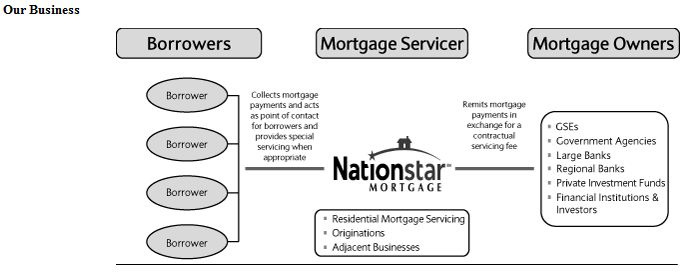
Nationstar is a well established servicer that had been held by Fortress Investment Group (FIG). Nationstar looks to be in the same vein as PHH; an originator with a large servicing business. Nationstar also has a large subservicing business, which means that they take on the servicing responsibilities for servicing rights held by other companies in return for a fee.
Fortress Investment Group is also an interesting idea. FIG owns about 80% of Nationstar. That puts FIG’s investment in Nationstar at a value of about $900M. If you look at FIG, the stock is at $3.75 right now and fully diluted Class A and Class B shares are a little less than 500M. So just roughly here, FIG has a market capitalization of $1.875B, meaning that Nationstar alone is worth half the market cap. FIG has about $43B in total assets under management so in the grand scheme of things Nationstar shouldn’t be that big of a part of FIG.
It’s a situation that brings up your spidey senses. Is the value of Nationstar sneaking in under the radar of FIG shares? The problem is that I can’t be sure yet. I am looking at FIG right now and it’s a tough slog; its difficult to get the details about what they actually own and what the value actually is because of the nature of their corporation of funds structure. You can do a search through the 10-K and the name Nationstar isn’t mentioned once. But I’m going to keep investigating. FIG smells to me like one of those 5-bagger opportunities, but I just don’t understand the company enough yet to say for sure.
Finally, Home Loan Servicing Solutions is a spin-off of Ocwen Financial. Having read the prospectus, it appears that HLSS will be a income vehicle. They are going to buy up the MSR’s currently on Ocwen’s books in return for a portion of the servicing fee. Ocwen would still do the servicing on the mortgages (acting in the capacity of subservicer) and in return they would be paid a base fee plus an incentive fee that is structured to entice Ocwen to keep as many of the borrowers current as possible.
It’s a similar sort of deal to what Newcastle and Nationstar are doing. Its structured a bit different, with the main difference being because the loans involved are subprime and not agency. Servicing subprime loans has an extra aspect that doesn’t occur with agency loans. When you are dealing with subprime loans, the servicer is responsible for putting up money in the short term when the payments are late. This means that the servicer has to have access to a credit facility, (or some other sort of funding) that they can borrow from when they need to cover payments. And that funding costs you in interest.
Now admittedly my understanding on this isn’t completely clear yet, but from what I’ve read I don’t think the servicer is ultimately on the line for payments they put up. They are eventually reimbursed, either from the borrower when the payment is made, or from other payments in the pool if the mortgage goes into foreclosure and the payment will never be made. But they do have to put up cash in the interim.
So along with the servicing commitments, HLSS is taking over a number of credit facilities that had previously belonged to Ocwen. In this case they are commercial paper facilities, and they provide access to the short term credit that HLSS needs to have so it can cover any late payments to the pool. HLSS has to pay the interest on these facilities and that comes out of their profits
So that’s the downside of a subprime deal versus an agency deal. The upside of a subprime deal is that HLSS is taking a bigger piece for less up front than Newcastle did. HLSS is getting 32.5 bps in servicing fees and, based on the Dec 31st estimate of fair value, they will only pay 41 bps up front. In the first Newcastle deal, which was all agency, Newcastle paid 60bps and is getting 29 bps in servicing fees. In the second Newcastle deal, which was only 25% agency and 75% private label, Newcastle paid 42 bps. Its not clear to me whether Newcastle is going to have to manage the cash on the private label, but given the cheap price I wouldn’t be surprised.
I am looking for more ideas in the mortgage servicing sector. Please comment or write me (liverless@hotmail.ca) if you have any ideas.
In my opinion mortgage servicing rights (MSR’s) are the best opportunity in the market right now. The potential is there to return as much as 30-40% IRR for the companies involved. The companies involved are not trading at premiums that reflect this, and in some cases they are trading at discounts to the market (PHH) or with extremely attractive dividends (Newcastle).




 Reminiscences of a Stockblogger