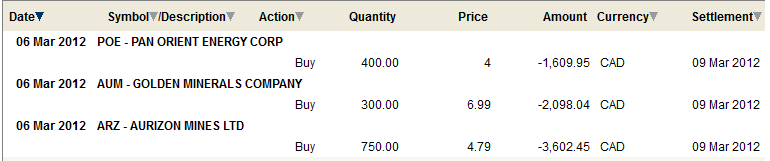
I decided to take a position in Pan Orient energy yesterday after the company released the following results from their L53-DST3 (L53-D EAST) Exploration well off the coast of Thailand.
Pan Orient is pleased to announce that the L53-DST3 appraisal well is currently on a 90 day production test flowing 38 API degree oil at a rate of 1,200 barrels per day through 8.8 meters of perforations between 1,142.7 meters to 1,163.2 meters true vertical depth (“TVD”), within an interpreted gross hydrocarbon bearing interval extending from 1,119 meters to 1,187 meters TVD with approximately 20 meters TVT of net oil pay.
This is the second successful well for Pan Orient in what they are calling the L-53-D prospect. The first well, which was drilled in early January, had equally good results.
Pan Orient is pleased to announce that the L53-D2 exploration well is currently on 90 day production test flowing 27 API degree oil at a rate of 1,015 barrels per day through 17.8 meters of perforations between 1110.8 meters to 1154.7 meters measured depth (860 to 890 meters true vertical depth), within one of six conventional sandstone reservoir intervals interpreted as oil bearing based on oil shows while drilling and open hole log and pressure data analysis.
It’s worth pointing out that these two wells are producing from different sets of sands. The first well produced from an interval 860m to 890 true vertical depth (TVD), whereas the second well produced from an interval 1,119m to 1,187m TVD. In the news release for the original L53-D2 discovery well Pan Orient described 6 potential producing zones:
the L53-D2 exploration well, drilled into the L53-D East exploration prospect, encountered approximately 65 meters of interpreted net oil pay averaging 20% porosity within five to six separate conventional sandstone reservoirs between the depths of 550 to 940 meters. This interpretation is based on numerous pressure data points indicating oil pressure gradients, oil shows while drilling and independent third party open hole well log analysis
Its too early to say whether all 6 zones will be as profilic as the first two appear to be. If they are though, this could turn into a major discovery for the little company.
About the little company
Pan Orient is pretty small, so it doesn’t take a huge discovery to have a big impact on the company. According to the January presentation on the company’s website, there are currently 56.7M shares outstanding, with a little over 60M fully diluted. As of the same presentation company has $58M of working capital, so there doesn’t appear to be any immediate financing concerns.
How much oil is there?
I’m somewhat confused about the prospective reserves in the L53-D prospect. The reason is that it is not completely clear whether the OOIP estimates being provided by various sources are for the L53-D block or for the entire L53 concession, and likewise it is not clear whether the OOIP estimates provided by the company were for one zone or for all 6.
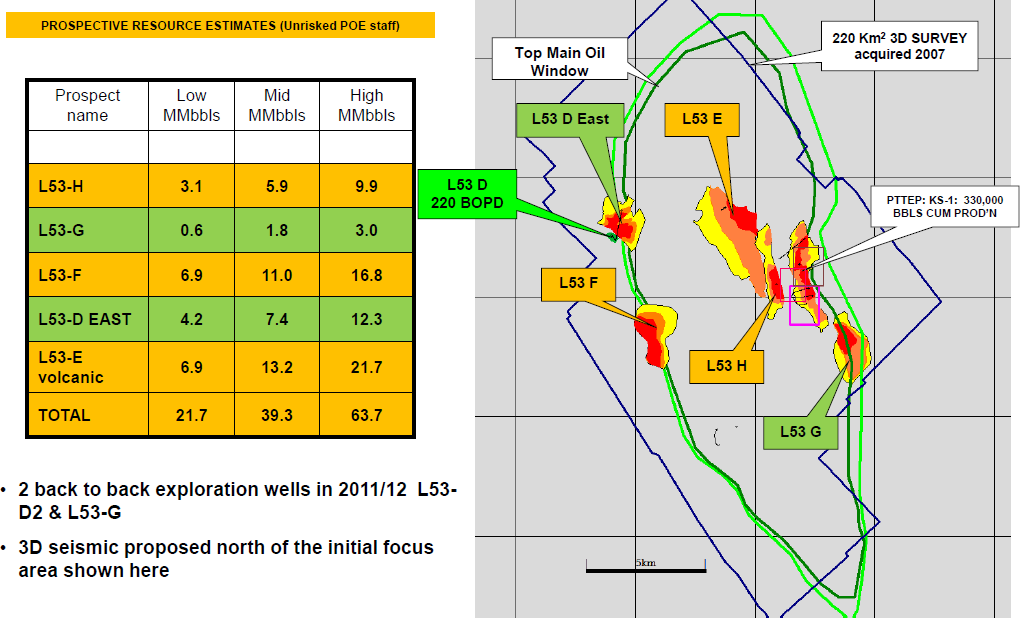
From the company’s presentation, which was put out before either of the two discovery wells were drilled:
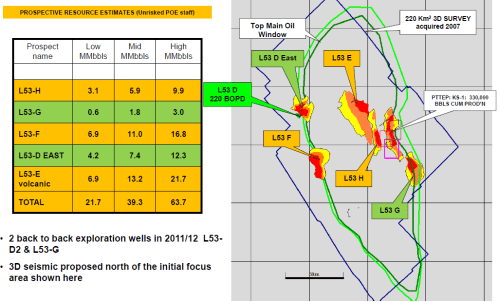
The company was assigning somewhere between 4.2MMbbls and 12.3MMbbls of oil ot the L53-D prospect.
A recent report from Paradigm (posted on the investorsvillage board, which is a great source of information on the company) suggested the following resource for the entire block:
The L53 fault structure is targeting 30–50 mmboe of potential recoverable reserves in three faulted compartments. Management believes each compartment has the potential to add 3,500 bbl/d
Where my confusion lies is that there is some suggestion that the resource estimates for the L53-D block only refer to a single set of sands, and that with 6 sands being intercepted there is actually a much bigger resource at stake.
This point was articulated clearly by an Investorsvillage poster algrovenew, who wrote the following:
I don’t think most people have fully grasped the significance of this discovery. The aerial extent might be limited, although still significant. However, what is really significant is the layering of the production zones. Take whatever aerial extent you want (2 to 6 sq. km, depending on whether the other fault blocks are saturated or not) and then multiply by 3 or 4 or 5 times.
The point that the pre-drill estimate may have been far too low was echoed in another post by sculpin, who I believe was posting a piece of a Paradigm note:
The L53-D2 discovery well and the L53-DST3 appraisal well have evaluated the first of three fault compartments of the L53-D East Structure. Results to date have been better than pre-drill estimates and could result in a substantial increase in reserves. The mid-case pre-drill resource estimate of the L53-D East structure is 7.4 million barrels (Figure 1).
What’s the discovery worth to the company?
As of the last reserve report POE had 32MMbbl of proven and probable reserves of which 7.4MMbbl is proved. Of note is that most of these reserves come from “volanics” which are reservoirs in offshore Thailand that have proven themselves prone to watering out and under-producing estimates. These new discoveries are more traditional sandstone reservoirs, which should be be deemed less risky by the market than the volcanics. Even the mid-point of the original prospective resource estimate (7.4MMbbl) would be a significant addition to reserves.
Macquarie placed the following valuation of the original prospect (my bold):
Pan Orient’s most recent P50 resource estimate for the L53-D East prospect is 7.4mbbl. The terms of the L53 concession are similar to Pan Orient’s core assets at L33/44, where Proven reserves are worth ~US$23.00/bbl (PV10AT, ~US$90.00/bbl crude pricing). On an unrisked basis, we estimate the L53-D discovery would be worth C$2.97/sh. Pan Orient indicates that it has at least two other fault compartments to test in the vicinity of this discovery, which would be additive to our unrisked valuation.
Pan Orient is not expensive
Even before the discovery Pan Orient was not trading at a high multiple. The company produced a little over $13M of cash flow in both the second quarter and the third quarter off of production of about 2,000 bbl/d. That puts the company at a trailing cash flow multiple of 5x, and at a trailing EV/boe of $90K. Of course with the two new wells the company will presumably be able to nearly double production, and as per the last news release they have plans to drill a number of development wells in the area starting in May, which should increase production further.
Buying a stock up 25%
I hated to buy the stock at $4.20 yesterday, up 25% for the day. I really had to plug my nose to do it. And it may turn out that I got carried away in the short run; I always find it difficult to can tell if a short term blow off top is upon a stock, and with further drilling delayed until May it may very well be that the stock settles back down into the 3’s before moving higher.
I am fairly confident however that the stock will eventually move higher. Even taking only what is current known, the stock should be able to trade at least a couple dollars higher as they drill more wells and bring production up to 6,000-7,000 bbl/d. If a few of these other zones prove productive, well then the potential is even greater.


 Reminiscences of a Stockblogger