Skip to content

Posts tagged ‘stock picks’

Third Quarter Earnings Update: SUPN

I bought Supernus over a month ago and added to that position after the election result.  With concerns of political attacks on the biotech industry abating I wanted to increase exposure to biotechs.  Supernus seems like a good vehicle for that.

But going into last Friday I was getting a bit worried.  The company had not announced its third quarter results or given any indication of when they would announce them.  More often than not such silence foretells a negative event.

In this case however, there was no such concern.  On Friday Supernus did announce (ominously) that they would have to restate prior results (generally the worry when you have radio silence leading into a quarter) but the reason behind the restatement was benign.  A $30 million royalty from 2014 was previously classified as revenue and is to be reclassified as debt.  The change came up after their accounting firm was given guidance by the SEC for another company in a similar situation.

I dug into the details a bit and to be honest it doesn’t make much sense to me why a royalty not being paid back has to be classified as debt but whatever, its water under the bridge.

The preliminary third quarter results, announced on Monday, were quite good. The company reported strong growth and raised guidance.

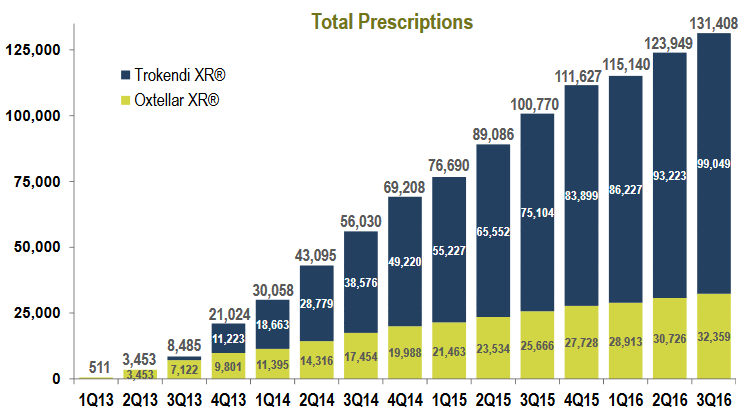
Year to date consolidated sales were $149 million, which is a 48% increase year over year.  Total prescriptions for both Troxendi and Oxtellar were 131,000 for the quarter, an increase of 30% year over year.  Troxendi prescriptions were up 32% while Oxtellar’s were up 26%.

q3prescriptions

As had been previously announced, there was a tentative approval from the FDA for Troxendi to be used in the treatment of migraine, which should help continue sales momentum.

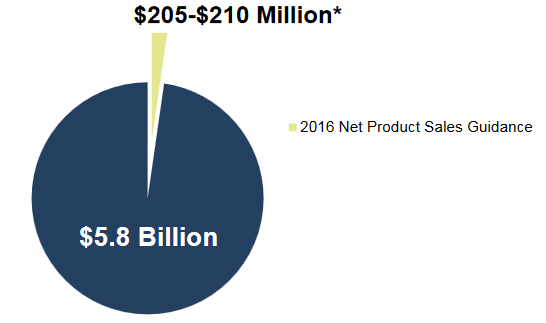
The company illustrated the total addressable market for these drugs in their slide presentation.  The opportunity for growth remains large.

q3tam

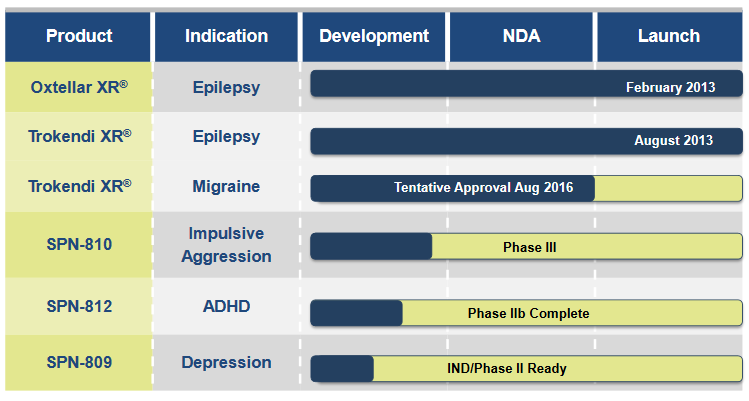
The drug pipeline consists of two drugs in later stages of development, SPN-810 and SPN-812. Both are being trialed for children, the former for impulsive aggression and the latter for ADHD.

q3pipeline

SPN-810 had been struggling with enrollment and in the second quarter the company took steps to address this.  In the third quarter update they listed a number of initiatives taken (engagement of an enrollment agency, increasing the patient screening period, giving more education to caregivers on proper diary compliance) and gave color that these had a “positive impact on patient referrals”.

Results of the Phase 2b study for SPN-812 were announced a month ago.  Following up on those results, management commented that they would begin discussions with the FDA on a Phase 3 trial.  An interesting development is that the trial may include a higher dosage than those used in Phase 2.

Being a non-stimulant gives SPN -812 an advantage with side-effects but stimulants also typically have higher efficacy.  That did show through in the results from the Phase IIb trial, where results were “remarkable” for a non-stimulant, but still not quite on par with its stimulant comparatives.

There is a market for SPN-812 as a non-stimulant for patients where stimulant side-effects are too severe.  However there is a much bigger opportunity if SPN-812 can show efficacy that is in-line or better than a stimulant.  The Phase 2b trial did not take the dosage high enough to test out this possibility.  However the benign side effects and the strong efficacy at lower dosage suggest it has a chance.

Both SPN-810 and 812 are a couple of years away from approval.   The company would like to fill the gap between now and then with an approved or nearly approved drug.  Ideally they would be looking for a drug in neurology, where they could leverage the existing sales staff, or in psychiatry, where they could gain an early foothold before 810 and 812 are launched.

Supernus was a bit of a gift in the mid teens but its moved quickly back to $23 in the last couple of weeks.  At this level it trades at an enterprise value of 5x revenue.  Growth is over 40% and not slowing down.  I continue to like Supernus and am happy with my current position size.

Week 270: Change is in the air?

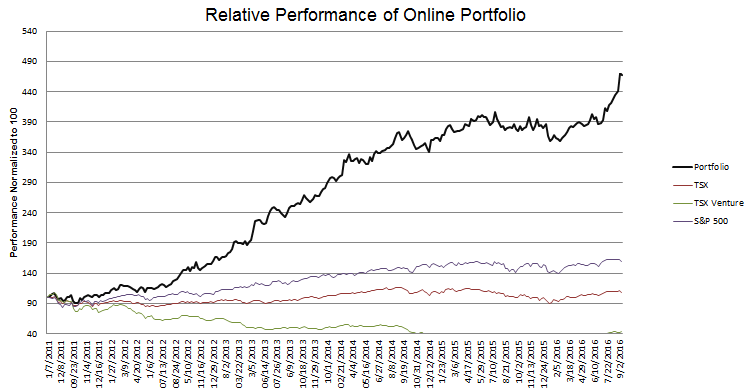
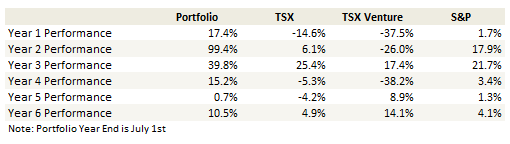
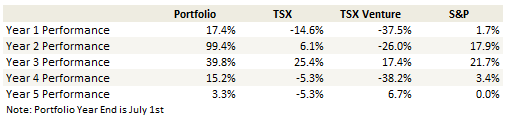
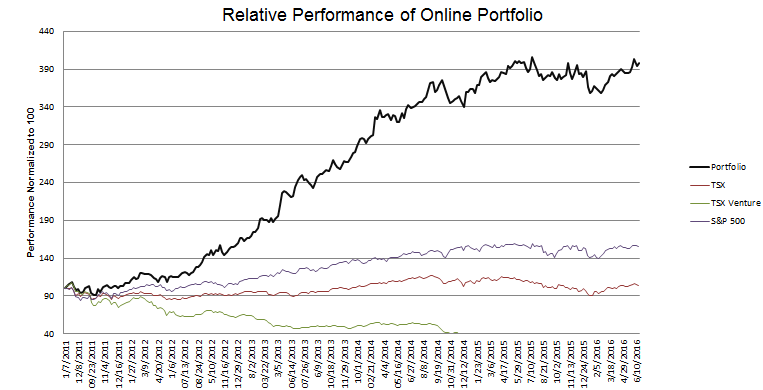
Portfolio Performance
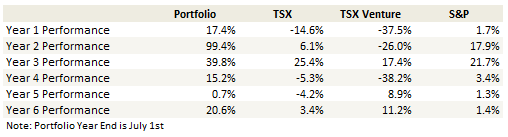
week-270-yoyperformanceweek-270-performance

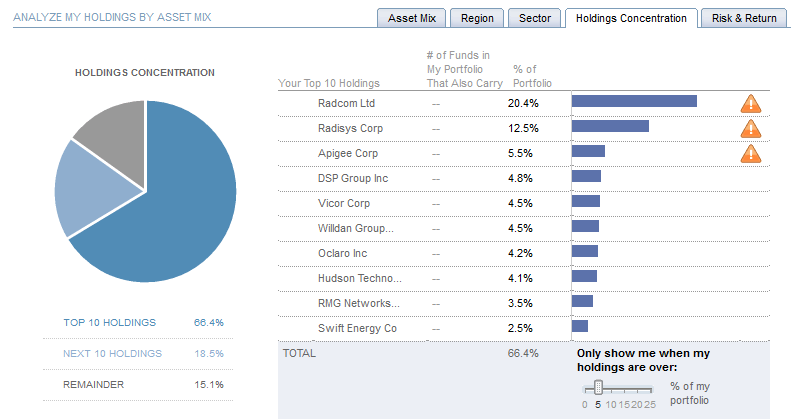
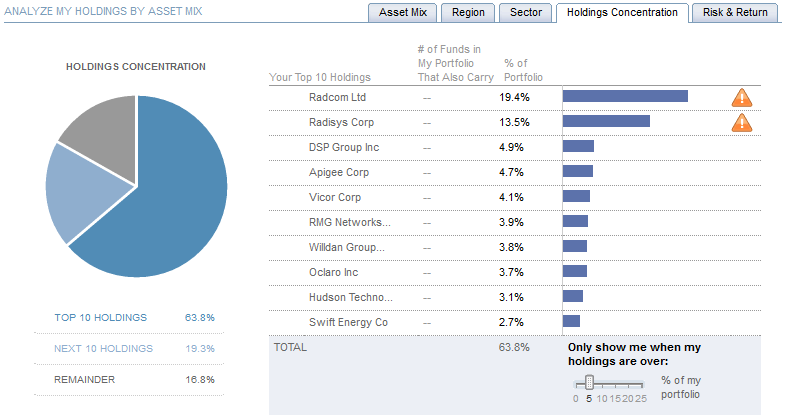
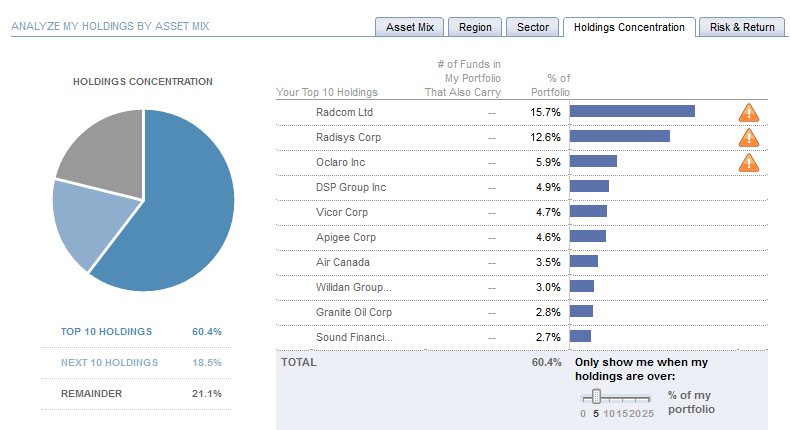
Top 10 Holdings

week-270-holding-concentration

See the end of the post for my full portfolio breakdown and the last four weeks of trades

Thoughts and Review

The second quarter results are finished and as I look back on August I can’t help wondering if something has changed.

Since February the market has done well but for the first time in over a year I have done better.  I had a miserable first month of the year but after deciding things had gone too far in early February, its really turned around.

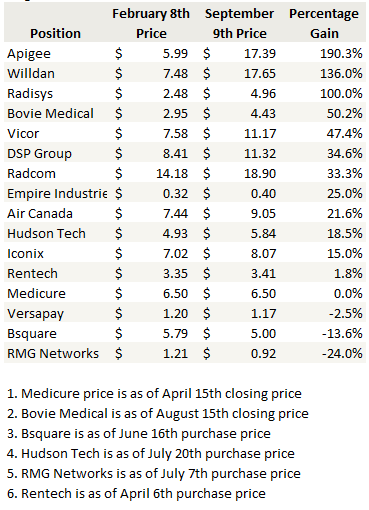
Here is the performance of my more significant individual non-oil related positions since that day.

gains_since_the_bottom

August was a particularly good month.  I was up over 10%. I’ve had a number of big movers over the past few months.

But its more than performance that makes me think that something has changed.

The way that the small and micro-cap stocks I own have been acting has been different than the past year and a half.  For reference, in August of last year I pondered whether you could have a bear market that was never actually defined as a bear market.  At the time I wrote:

When I raise the question of whether we are in a bear market, its simply because even though the US averages hover a couple of percent below recent highs, the movement of individual stocks seems to more closely resemble what I remember from the early stages of 2008 and the summer of 2011.

Through most of 2015 and into the first couple of month of 2016 the movements of small company stocks just didn’t feel right.  Every move up was pressured.  Every move down was too easy.  This of course climaxed with the selling stampede of January and February of this year.

But I have noticed a change in temperament in the subsequent months, and this seemed particularly evident through the second quarter earnings season.   I still had misses.  BSquare had miserable results.  CUI Global was lackluster.  Both stocks fell.  But even then, the moves down didn’t have quite the same conviction as similar such moves in the past year.

Its hard for me to put my finger on exactly what it was that was different, so maybe this is all just sophistry, but it was almost like these stocks were going down grudgingly, because they had to, not because they wanted to.

Even Friday, which was a brutal day for the indexes, didn’t seem as bad as all that through the lens of my positions.  Radcom ended up.  Radisys spent most of the day green before giving up the ghost in the last 30 minutes.  A number of other positions started the day poorly but didn’t really follow through, almost to be saying yeah, we have to be down because the averages are down but there is no reason to panic.  A couple  of the oil stocks I’ve recently added (more on that below), fell at the open only to grind their way back up.

To be sure, part of my perception may be that I’ve picked up my game and picked better stocks.   It took me a while to figure out what my theme was for 2016 but once I settled on growth stories it has served me well.  This replaced sectors like tankers and airlines and REITs where I tried to find gain in 2015 and for the most part failed at it.

So maybe that’s the source of the change.  I’m staying away from value, looking for growth, and that’s what is working.

I’m wary that we have had a big move up, that each of the prior moves up over the last couple years has been followed by a precipitous fall, and that the election in the United States isn’t really setting itself up to be market friendly.

Nevertheless I can’t lose the thought that while we never had an official bear market we did have an extremely ugly period for small and micro-cap stocks and maybe that bear market capitulated in the first couple of months of the year and we are on to something new.  Its worth keeping an eye on.

Oil and my oil stocks

Inline with my tweets over the last few weeks I have been increasing my oil exposure.  I added a number of names and been adding to a couple of others.  Here are the tweets.  I’ll talk about each of these below.

I also took a position in Journey Energy (JOY) late this week but I’m not going to write about that one in this update.

Nevertheless they are all small bets.  Other than Granite Oil, which is about a 3.5% position for me, my oil bets are in the 1% range.

I don’t have a crystal ball on oil.   I am sympathetic that the builds we have seen (up until this week’s rather massive 14mmbbl draw) are due to the drainage of floating storage.  I’m hopeful that once this runs its course we could see some surprising draws in the shoulder season (this thesis has been expressed by a number of investors on InvestorVillage, not the least being Robry825, who describes his position here and  here).  I’m also cognizant that oil wells do decline and that we simply aren’t drilling like we were a few years ago.  Still, as I’ve said on many occasions before, I play the trend till it ends but when it ends I really don’t know.

Its also worth noting that while the US election could turn out to be a gong-show for stocks in general, it sets up as having very little downside and a fair bit of upside for the Canadian oil stocks.  Either Clinton wins and its status quo, which has been already heavily discounted in the disappointment of investors with Canadian oil stocks, or Trump wins and well, regardless of what chaos that entails, he did say he will approve Keystone, which would be a big tailwind for energy producers, particularly given the boondoggle that’s taking place with Energy East.

Nevertheless I don’t like not being in oil.  Part of this is simply hedging.  I am a Canadian investor who primarily invests in US stocks.  Therefore I am naturally short oil via the Canadian dollar.  If oil prices go up, so with the Canadian dollar and I will lose.  Owning some oil stocks helps to balance that out.  If I can hit the odd rocket ship like Clayton Williams or Resolute Energy have been recently, then all the better (note that while I have talked about Clayton Williams in prior posts I haven’t mentioned Resolute because I got the idea from a subscription service run by Keith Schaeffer.  He’s had a few winners for me since I took a subscription and would recommend it).

Empire Industries – China Theme Park Deal

On September 1st Empire Industries announced a “strategic cooperation agreement” with a Chinese company called Altair to build out a new space theme park in the Zhejiang province of China.  The announcement coincided with Justin Trudeau’s visit to China and apparently he was on hand at the signing.

The stock shot up on the announcement and to be honest I got a little too caught up in the hype and added to my position at 45 cents.  While I think those shares will ultimately deliver a positive return, there were some details left out of the news release that warrant caution.

In particular, this article from Business Vancouver fills in some of the details.

On the positive side, Empire will be delivering 6 attractions to the park for a price of $150 million.  This is significant dollar amount that will more than double the backlog.

Also, Empire will have an option to take a 20% stake in the amusement park.  Guy Nelson, president of Dynamic Attractions, the amusement park ride manufacturing subsidiary to which the work is directed, said they would likely exercise this option.  Given that the park has a price tag of $600 million, a 20% stake is a big investment for a company the size of Empire.  It would also makes you wonder about how Empire is going to get paid, as it seems a little too coincidental that their ownership opportunity is about the same dollar value as the cost of the attractions they are to deliver.

The other consideration that contributed to the stock pulling back from its highs was that construction of the park depends on getting the land.  Currently the land belongs to the Chinese government and the agreement that Altair struck was as the reserve bidder, meaning that they get the land if no one else places a bid.

I’m not selling any of the shares I own.  If the deal goes through it should still be a significant positive for the company.  But I should have been more wary of any Chinese dealings and I will wait for more news before acting further.

Granite Oil – Enercom

Granite presented again at the Enercom conference in September. They gave a presentation that an engineer would love and an investor would shrug at.  I don’t believe I heard the acronyms ROR or EBITDAX or even NAV a single time.

Last month I wrote that I had reduced my position in Granite.  After further consideration, a little more research and a more optimistic attitude towards the oil price, I decided to add back what I had sold.  The stock had also sold off into the low $6’s which has been good support in the past.

During the first six months of the year Granite focused on infrastructure.  They drilled one well in the first quarter and three more wells in the second quarter.  They converted a number of older wells into injection wells and added compression to facilitate the gas injection process (as I’ve written before their primary and only asset, Ferguson, is a large oil field where they are implementing an early enhanced oil recovery (EOR) strategy via gas injection.

In the second quarter the company achieved 100% voidage replacement in the heart of the Ferguson field.  The reservoir is now pressurized back to its original pressure.  Granite can move ahead with development drilling and expect the pressure support to limit well declines.

In the second half of the year the company expects to drill 5 wells.  On September 6th they announced results from the first of these wells.  Over a 96 hour test the well flowed at an average 815 boepd and ended the test at 995 boepd.   The company well costs are $1.2 million, down from $1.9 million in the first quarter of the year.

One number Granite did mention at Enercom was that the total contingent original oil in place (OOIP) at Ferguson is 457 million barrels. This is actually from a fairly old estimate by Sproule in 2012.

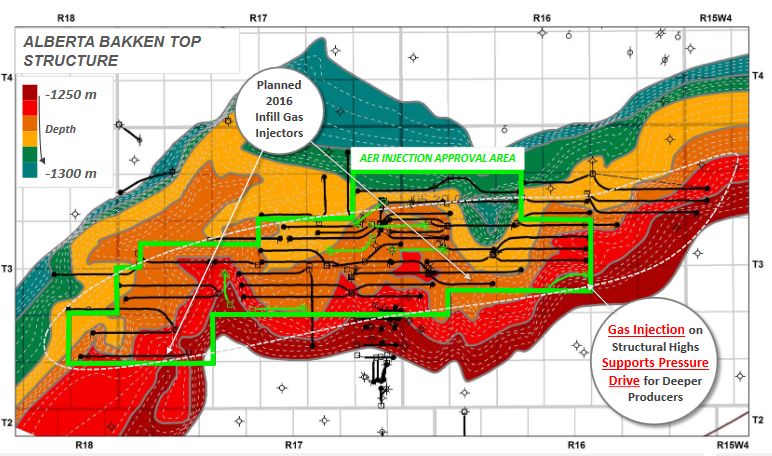
I contacted the company to clarify how much of their land package the estimate accounted for.  Their response was that the estimate encompassed an area a little larger than the current EOR approved area.  The EOR approved area is about 23 sections, shown below:
eor-approved

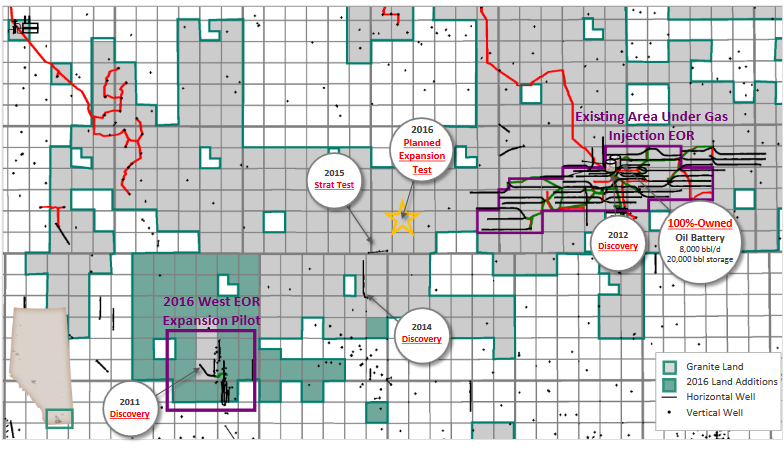
The entire land package held by Granite is over 550 sections.  This includes two other discovery wells to the south west:

entire-land-packageIts an extremely large package for a little company with a $200 million market capitalization and very little debt.  The wells aren’t as exciting as Permian wells, but they also come in at about 1/8th the cost.  The company doesn’t get much respect, but I hope that changes if they show some growth in the second half, which is possible as they finish out their drill program and see the full effect of the EOR.

There were a SeekingAlpha article written about Granite here.

Update/Summary of Accretive Health

I’ve owned a small position in Accretive Health since late last year.  And I owned the stock once before that, in 2014.  Yet I’ve never actually written about it.

Part of the reason I have stayed quiet on the position is because it has, until recently, been very small.  But I’ve also kept quiet because the thesis is hard to get behind.  This is the definition of a flyer.

Accretive Health has a few problems:

  1. They have been investigated for abusive billing practices.  There is a VIC article written around the time these issues arose that explains the claims in some detail here
  2. The abusive billing practices were followed up by an SEC investigation into revenue recognition.   The result of the investigation was that the company did not release its financial statements for the period of 2012-2014 until just last year. This article is a decent source for that episode.
  3. The conclusion of the SEC investigation led to a restatement of GAAP results and the subsequent GAAP accounting practices that were enforced make their financial statements pretty much useless.  Accretive can’t book revenue from a client until either the end of the contract term or when the agreement is terminated.  This means they go long periods with very little revenue and if they lose a client (generally a bad thing) they can show a big profit.
  4. Much of their business is dependent on Ascension Health.  Ascension is a large non-profit hospital operator.  They are also a large owner in Accretive.  They have shown their willingness to exploit their leverage as they did when they tried to take Accretive over with a a low-ball offer in mid-2015

Sounds exciting doesn’t it?   Nevertheless the potential upside holds my interest.  Here’s some details about how Accretives business works.

Accretive provides revenue cycle management for hospitals.  This means that they help streamline front- and back-office operations, including patient registration, insurance verification, coding compliance and collections.

Hospitals operate on extremely tight margins.  I have gathered margins can be as low as 1-2% if they are profitable at all.  Accretive’s model is to insert experts into the hospital, integrate their software into the hospital software, and work together with hospital employees to reduce costs, more effectively bill patients (for example finding insurance options, correctly classifying patient visits, etc), and improve revenue collection.

The contract with the hospital is performance based.  Accretive receives a percentage of the savings that they are able to achieve for the hospital, compared against a pre-contract run rate.  They also receive incentive fees that are based off of additional revenue the hospital generates due to their improved collection and billing processes.

This business model means that Accretive doesn’t get anything until later in the contract, after they have implemented their solutions, made changes to the processes, and the hospital has begun to reap the results.

It’s also a tricky business model for revenue recognition; billings are in part based on costs not yet invoiced by the customer and that have to be estimated, and the agreements typically include clawbacks if cost reductions aren’t maintained.  The consequence is that GAAP accounting insists that very little revenue be booked until the end of the contract.

Now lets talk about Ascension Health.  Ascension is Accretive’s biggest customer.  Accretive was actually born out of Ascension in 2004.  In 2015 Ascension accounted for 59% of gross cash generated (Gross cash generated is effectively the company’s internal metric of revenue equivalence it uses to get around GAAP accounting. I’m just going to refer to it as revenue from this point forward.  Likewise, I am going to refer to their net cash generated as EBITDA, which is basically what it is).

The relationship with Ascension is not always friendly.  Just around the time when the black cloud of lawsuits and SEC investigations was beginning to lift Ascension dropped a bomb on Accretive, writing a letter where they discussed taking the company private for about 50% of what was then the market capitalization (around $2.50 per share).  In a not so veiled threat Ascension said that if the takeover didn’t proceed they didn’t plan to enter into a new master services agreement with Accretive once the existing one expired in mid-2017.

In December of last year Accretive came to an agreement with Ascension whereby Ascension would drop the takeover offer, not walk away from their relationship, and enter into a new long term agreement for services.

The agreement is for 10 years.  Right now Accretive is responsible for about $6.5 billion of Ascensions net patient revenue.  The new agreement will add another $8 billion of net patient revenue from new Ascension hospitals and affiliates.

As part of the agreement Ascension gets an even larger piece of Accretive.  Accretive issued them $200 million of preferred stock paying 8% and convertible into shares at $2.50 (so 80 million shares).  Ascension also received 10 year warrants for 60 million shares at a price of $3.50.

Accretive has about 107 million shares outstanding not including any of the above conversion.  The market capitalization is about $200 million, cash is about $200 million and apart from the preferred there is no debt.

To put the size of the deal with Ascension in perspective, Accretive has provided guidance of $200-$220 million of revenue in 2016.  This would be “pre-Ascension new deal” revenue.  On the fourth quarter call management said that for every $1 billion of net patient revenue they on-board, they expect $40 million of revenue (they reiterated this statement on the second quarter call).

So basically Accretive stands to more than double revenue at the end of the on-boarding, which is expected to take 3 years (including this year).  The new business from Ascension will initially be at similar margins to the existing business, and those margins will improve as time passes and Accretive’s own systems and processes are implemented.

The tumult of investigations and Ascension related distractions has caused Accretive to lose some other business over the past year.  Ironically, the company had a blow-out first quarter on a GAAP basis, generating $167 million in net income.  But that’s because of customer attrition, which allowed them to recognize deferred revenue that had been accumulating for those customers.  The last thing you want to see with Accretive is strong GAAP results.  Hospital count dropped from 77 in the first quarter to 72 in the second quarter.

Nevertheless, the amount of new business coming from Ascension is substantial.  Accretive said that they expected EBITDA margins on the combined business  showed be in the mid to high teens.  At $400 million to $500 million of revenue Accretive stands to generate significant cash for a company with a $200 million enterprise value.

Still, there is enough uncertainty to warrant only a small position.  Will Accretive be able to turn around the business outside of Ascension, keep existing customers and win new customers?  Or have the last 4 years been too much.  And what is the state of the company itself?  Presumably after all the lawsuits, restatements, executive shuffles and unrest morale must be low so will they be able to execute?  Finally, the new agreement with Ascension is a departure from the legacy model; Ascension employees will be joining Accretive and Accretive will be taking over most aspects of the revenue cycle, as opposed to just advising and consulting.  Will this new model work and will it ultimately be as profitable as management predicts?

Lots of questions.  Nevertheless, if the questions are answered positively the upside is going to be significant.  While I did add to my position recently, I will keep it relatively small (its a little over 1%) until some of the answers become more clear.

Radcom Moves

Radcom has had no significant news since my last update.   Yet we still only have a single NFV deal.

I’m not too worried about how this plays out in the long term.  What I am bracing myself for is the scenario where Radcom presents third quarter results, gives a positive qualitative update on the pipeline but no quantitative progress.

Radcom has a $220 million market capitalization and a $170 million enterprise value.  It trades at 5.7x EV/sales.  I figure this means they need to grow revenues at 30-40% next year to justify that multiple.  That means another AT&T sized contract.

The market is going to want to see that happening by the third quarter report.  If it doesn’t the stock is likely going to sell back down to a multiple that reflects more skepticism.  Unfortunately these carriers aren’t known for their fast movements.  What’s another 3 months for a CSP looking to overhaul their network?

If such a sell-off occurs, it may be a great buying opportunity, but I’m not thrilled with the idea of getting from here to there.  Nevertheless the opportunity with Radcom seems to still outweigh this risk.  I sold a couple shares at $19 but less than 5% of my position.  So I’m just bracing myself for a potential pullback if carriers live up to their name.

New Position: CUI Global

I bought CUI Global because it has a new and better technology (for measuring gas composition) than the current standard, and they can sell that technology into a large addressable market (gas transmission companies and chemical plants).  But so far its been a struggle to gain a foothold into old-school industries that are not used to change and that are currently dealing with a protracted downturn.

Given this trajectory, it’s most likely that even if the story works out it will A. be delayed longer than anyone would have expected and B. have a number of false-starts and hiccups before finally showing consistent growth.

CUI Global operates two segments, Electronics and Natural Gas Integration.  The electronics business has been treading water and while it may have some medium term potential its not really the focus of my purchase.  There is a good discussion of the electronics division in the Q&A of the last quarter conference call.  For this write-up I am going to focus on Natural Gas Integration.

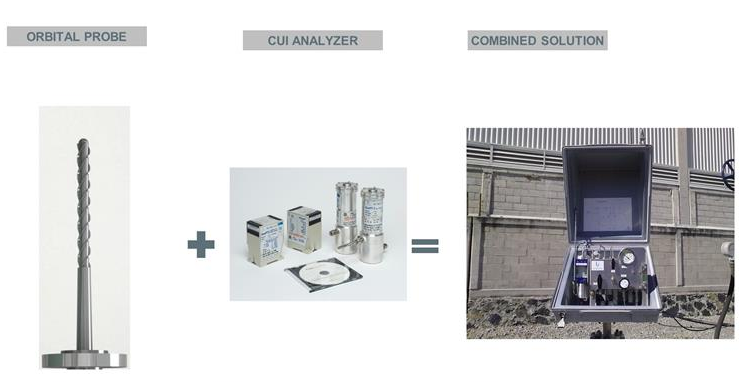
The natural gas integration segment sells a product for sampling and analyzing gas composition that is quicker and graceful than the existing technology.  Called the GasPT system, it consists of a probe and analyzer, both of which are unique in design and operation:

GasPTThe GasPT system is faster and cheaper than existing solutions.  These legacy techniques have been around for 60 years.  Their process works like this: gas is pulled out of the pipeline using a high pressure probe, transported to a gas conditioning unit which lowers the pressure to sea level, and transported through the low pressure pipeline to a gas chromatogram located in a shed where it takes 20 min to analyze the gas and report to operator the chemical content, from which energy content is inferred.

Installation of the incumbent technology costs a quarter of a million dollars, is a 6 week job, requires that a kiosk is built on site, that concrete, pipe, is laid and the carrier gas has to be replaced monthly.

In comparison, the GasPT system resides right on the pipeline, measures gas directly via the Orbital probe, there is no ancillary gas required, the cost of installation is $55,000 and it takes 90 minutes to install.   There is no operating overhead and the gas is analyzed in seconds.

Management has said on numerous occasions that during the bid process for the recently won Snam Rete business (more on that in a minute), they went up against Emerson, ABB and Elster and the head to head competition demonstrated that there is no comparable technology on the market.  They have also said that they are at least a couple years ahead of the competition in terms of development.

The company sells the GasPT system into two verticals:

  1. Natural Gas Transmission Operators
  2. Process Control for compressors and turbines.

The transmission operators they are trying to sell into are large national pipeline companies that aren’t easily receptive to change.  It took some time but early this year they began to make some inroads.  The company inked a contract with Snam Rete, an Italian gas transmission company, in February 2016.

The initial purchase order was for 400 units.  CUI Global has been delivering units at a rate of 50 per month.  The  total volumes of the contract is for 3,300 units with the opportunity for that to expand to 7,000 units.  They expect that next year volumes will ramp to 100 per month.

The thesis here is that

  1. The Snam Rete will ramp to 100 units next year and that will be enough volume to move the natural gas integration segment to profitability
  2. The Snam Rete contract will open the door to other national transmission operators.

CUI Global is engaged with transmission companies in France, Spain and Germany.  Listening to management I get the impression that they are furthest along in France, where in the second quarter they announced a distribution agreement with Autochim for sales of GasPT units in France and Africa.  They also talked on the second quarter call about their recent engagement with Transcanada Pipelines.

Worth noting is that Snam Rete is a low pressure pipeline delivery company, which is unusual.   Almost all gas transmission at a large scale is done at high pressure.  Because of the unique nature of their operations, Snam Rete did not have to purchase the whole solution from CUI Global, they took the analyzer but not the probe.  The other potential customers will be taking the full GasPT solution.

They are also gaining traction in its second market vertical, gas processing facilities.  On the last couple of calls they have talked about a contract with an ethylene plant operator in Texas.  In the first quarter they said:

Recently Orbital NA announced its receipt of a purchase order from a large scale ethylene plant operator in South Texas to design, build and deliver nine patented, ultra fast and accurate in depth, VE sample probes and sample systems and another purchase order for an additional six VE sample probes. That order totaling almost 1.8 million is a trial project which may result in a similar deployment of our technology across 54 other facilities operated by the same customer worldwide.

In the second quarter they qualified the potential of this operator as being a $100 million opportunity if they can expand the order to all the plants run by this operator.

Extending their reach into North America a bit further, a couple of weeks ago they signed a licensing agreement with Daily Thermetrics for the sale of the VE Technology, which is the probe portion of the GasPT unit.

I’m not sure what to make of management.  They tell a good story.  I came across the idea from a conference they participated in (the rebroadcast has expired but I can provide it if you email me).  What they described was compelling.  But going back through their old calls and financials, the execution hasn’t been great, though this may also be more of a function of the businesses they are trying to tap into.

CUI Global has a market capitalization of $110 million and cash and debt come close to cancelling one another out on the balance sheet.  When I model their business, it looks like they need to double the sales of the energy segment to get meaningful profitability for the company.

That may be a tall order.  But the contracts in the pipeline are big numbers.  The energy segment is operating at a run rate of $7.5 million per quarter.  The contract with Snam Rete for the 3,300 units was for $60 million Euro.  Presumably contracts with other transmission providers would be similar.  Likewise, the potential of this single ethylene plant operator is $100 million.

So the total addressable market (TAM) appears to be significant.  The company addresses its TAM on slide 11 of this recent presentation.

The question, which remains valid, is whether they can really gain traction and become the go-to solution.  The thing is, its binary.  Either they get more contracts or they don’t.  I don’t think you can sit on the sidelines and wait and see how it plays out.  Because the next contract, if it happens, will likely be the big move when it happens, and the stock will gap before you can react.

New Position: Jones Energy

I took a position in Jones Energy because of their recent acquisition of STACK/SCOOP acreage. Jones has long had a large acreage position in Oklahoma, but their target has been northwest and southeast of the STACK/SCOOP prospect, where they have targeted the Cleveland formation.  The new acreage should give better returns and more prolific well results.

The story you want to see play out is one where attention grows for the STACK/SCOOP and the play becomes recognized for its multi-zone potential that is close to, if not on par, with the Permian.   That should push up the price per acre and make the acquisition look even more attractive (it already looks like a good deal to me compared to other recent transactions.  Meanwhile an upcoming drill program should give some prolific IP30 results that will add excitement to the story.

At the moment the STACK/SCOOP does not have quite as good of returns as the Permian but they aren’t far off. Demonstrating the viability of the play even at these prices, Newfield points out (in their June presentation) that rig count is rising at a similar rate as the Permian:  

There are a number of large operators in the STACK. Devon has the biggest position, and Marathon, Cimerex and Newfield are also players. Newfield was the first mover in the play. Gastar (who I will talk about shortly) provides a good map of where the operators are.

Continental is a player in both the STACK and the SCOOP. They have acreage that is in the northwest for STACK (Blaine, Dewey and Custer county) and in Grady county for SCOOP.

Jones acreage (see the map below) is in the southern part of Canadian county, so around the Chaparral acreage, and south of that into Grady county. The northern border of Grady is roughly where the STACK ends and the SCOOP begins.  The STACK and SCOOP regions are considered distinct because the geology changes, as the Meramec formation dips down and is replaced by the upper and lower Sycamore.

Jones bought their acreage at $7,600/acre which is on the low side of other transactions I’ve seen. Marathon bought 61,000 acres at $11,800/acre (here they define their position). Newfield bought 42,000 acres from Chesapeake at $10,000/acre. Back in December Devon bought acreage at $17,000/acre. Continental recently sold SCOOP acreage that is in south Grady and further SW into Garvin county for about $9,000/acre adjusted for production. I don’t see too much evidence that Jones bought an inferior acreage position, other than that the STACK acreage is further to the southwest than the core STACK region at the intersection of Blaine/Kingfisher/Canadian.

As I said, STACK results look comparable but slightly less prolific than Permian. Most of the results are drilling into the Meramec formation, some drilling into Woodford. Well costs seem to be in the range of $4.5 million to $6.5 million for a 10,000ft lateral, which is a big range but I think that is because of changes in depth across the play. Continental is an outlier, they operate much further west than the rest of the operators and their wells cost $9-$10 million. The IP30 for the wells are around 1,500 boepd, with some wells delivering as high as 2,000 boepd.  Continental has seen its more expensive wells hitting 3,000 boepd. EUR per well is around 1 MMboe with again Continental being much higher at 1.7 MMboe. All operators report ROR that is consistently in the range of 70-80% at $50 oil.

The northern part of Jones acreage is prospective for the Meramec but transitions to the Sycamore as you go south (so where the STACK becomes SCOOP).   Though there isn’t a lot of information I’ve found on the Sycamore, what I have gathered appears to validate that well performance is similar to the Meramec.  Jones provides a few well results from Marathon and a company called Citizen Energy (who unfortunately is private and so there is no information on their website) in the map I showed above.

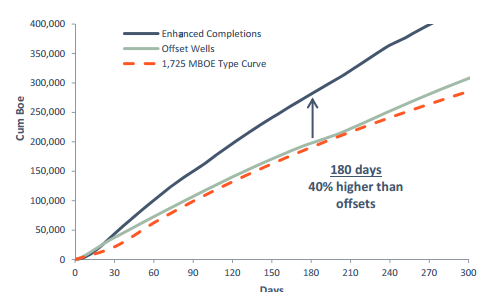
A second prospect in the STACK/SCOOP is the Woodford shale.  Their are a few Newfield well results in the Woodford referred to in the Jones map.   Continental seems have cracked the Woodford code recently.  Continental talks about how they are seeing a 40% increase in EUR on offset wells from recent wells where they have tweaked the completion techniques for $400K incremental cost.

clr-woodford

This is pretty interesting, especially because Jones acreage looks like it is in same area as Continental.  Below outlines where Continental has been drilling:

While the STACK/SCOOP lags the Permian in performance, the perception I get from listening to comments from Marathon, Cimerex and Newfield is that the area is earlier in the learning cycle, and we should expect further improvements (like we may have just seen with Continental in their Woodford SCOOP wells).

Cimerex in particular has acreage both in the Permian and in the STACK and they are allocating significant capital to both plays.  The gave a good presentation at Enercom, where they talk about both the Permian and the STACK/SCOOP making it easy to draw some comparisons.

Jones also has legacy acreage that is not too far away from the STACK/SCOOP.   They have 100s or maybe 1,000s of wells in this area targeting the Cleveland formation. In total they have 180,000 acres in Ellis, Roger Mills and Beckham county in OK and in Lipscomb, Ochil tree and Hemphill county in Texas. This acreage is to the northwest of the STACK but its not that far northwest. Much like the STACK/SCOOP, the acreage has multizone potential.  Jones has identified a number of potential zones in addition to the Cleveland. There is the Marmaton and Tonaka for example. Neither has been tested much. This article does a good job of delineating each of the STACK, SCOOP and the Cleveland/Tonkawa.

With respect to the multizone potential of the STACK/SCOOP and their legacy Cleveland land I thought the following comment was interesting from their second quarter call:

John Aschenbeck Got it, very helpful. One more if I could sneak it in on the Osage [ph], I’ve had a few operators say that Meramec EURs could potentially be possibly on the Osage as well leading you to believe Meramec-like returns in the Osage as well. Have any thoughts on that?

Jonny Jones We’ve got a 21-zone stack in the western Anadarko basin, of which these are just a couple of zones. We’ve been believers for a long, long time that there’s many pays out here, some of which are the ones you just mentioned, that really have not been exploited with modern technology. We have a lot of them in our section. People are just now starting to parse all the different trenches of the Mississippi and then that’s all they are. But there is a lot of other things out here besides those zones that are attractive. I think you’re going to see that come to fruition over the next six to nine months as folks actually start trying these different zones. The stack, the scoop, all these different zones right now are not one zone. There’s multiple pays here.

New Position: Gastar Exploration

Gastar is the other Oklahoma operator that I have taken a small position in.  By any traditional metric Gastar is a disaster.  They have about $575 million of debt versus a $125 million market capitalization.   Absent their hedges they aren’t generating enough cash flow to cover their interest payments.

But they own a lot of acreage (84,000 acres) right around the heart of the STACK:

The big question is whether the land in Kingfisher, which is a bit north of where Marathon, Newfield, Devon et al are drilling, is as prospective as the land further south?  I’m not sure, though from a number of presentations I’ve seen delineating the extents of the STACK it is clear the play extends well into Garfield county, so Gastar’s acreage is far from the edge of the formation.

While Gastar fails miserably on traditional valuation techniques, the stock looks pretty attractive if you apply acreage valuations that are comparable to recent land sales prices in the area.  By my calculation the current share price is reflecting about $6,000/acre for the STACK position and $4,000/acre for WEHLU (the WEHLU is on the eastern edge of the STACK and I don’t have as much information on how prospective it is but Gastar has been drilling decent Hunton wells there for a number of years).  The NAV is very levered to appreciation of this acreage.  At $8,000/acre for the STACK acres the NAV rises to $2.22.  If you use $11,000/acre the NAV is over $4/share.

I don’t know if Gastar gets revalued up to reflect the going rate of a STACK acre or whether the company sinks into bankruptcy.  I know they are going to do some drilling to prove out some of their STACK acreage and those results will be the key.  I also know from what happened to Resolute that when a company goes from reflecting bankruptcy to being valued based on current acreage prices the move can be pretty amazing.

New Position: Zargon Exploration

Unlike the first two positions oil and gas positions, Zargon isn’t a play on the STACK/SCOOP.  The company’s operations are primarily in Alberta with a small amount of production in North Dakota that is likely to be sold in the near future.

Up until July Zargon had too much debt and there was some thought that the company would eventually become a victim of bankruptcy.  At the end of the second quarter the company had $122 million of net debt to go against second quarter funds flow of $3.5 million.

But on July 22nd  Zargon announced the sale of is southeastern Sasksatchewan assets for net proceeds of $87.5 million.  The transaction significantly reduces debt and makes it much more likely that the company will make it through to the other side of this oil price downturn.

With the use of proceeds put towards the debt, the company’s net debt position is expected to be around $35 million.  I was buying the stock a bit lower than it is now, but even at 90 cents the market capitalization is only $27 million, meaning that the enterprise as a whole is going for $62 million.

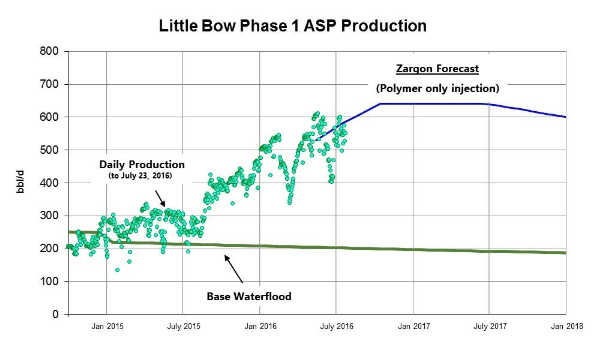
This doesn’t seem like a bad price to me considering what you get.  After the asset sale Zargon is left with about 2,800 boepd of production, 79% of which is liquids.  The production breaks down to 400 boepd from North Dakota, 2,000 boepd from various Alberta land packages, and 530 boepd from their Little Bow Alkali-Surfactant-Ploymer flood project.

All of these properties are low decline.  Little Bow production should actually increase through the end of the quarter before stabilizing at over 600 boepd.  This number could go higher if oil prices recover as the company has suspended alkali and surfactant injection because of the economics of the project at current oil prices.
littlebow

The other properties are very low decline, 14% according to the September presentation.

The properties as a whole have a proved PV10 of $108 million and and a proved plus probable PV10 of $176 million.  The enterprise value trades at a discount to the proved value of the reserves.  This is at forecasted prices though, and that forecast is assuming a slow oil price recovery through to 2030.

I think the current price is probably reflecting about $45 oil.  What I like about the stock, and why I took a position, is that at $55 oil the stock is probably a double at least.  Its probably not a great long-term hold, as I don’t see anything in particular about the properties that excites me, but as a vehicle for playing a price recovery in oil I think its worth a position.

One Last New Position: Limbach Holdings

I took a position in Limbach Holdings after one  of the funds I follow, Dane Capital, took a position.  Dane Capital is the same fund that I got the idea for RMG Networks from.  They have written up Limbach in two pieces on SeekingAlpha (here) and I’m not going to add more on the name right now because they describe the thesis quite well.

Portfolio Composition

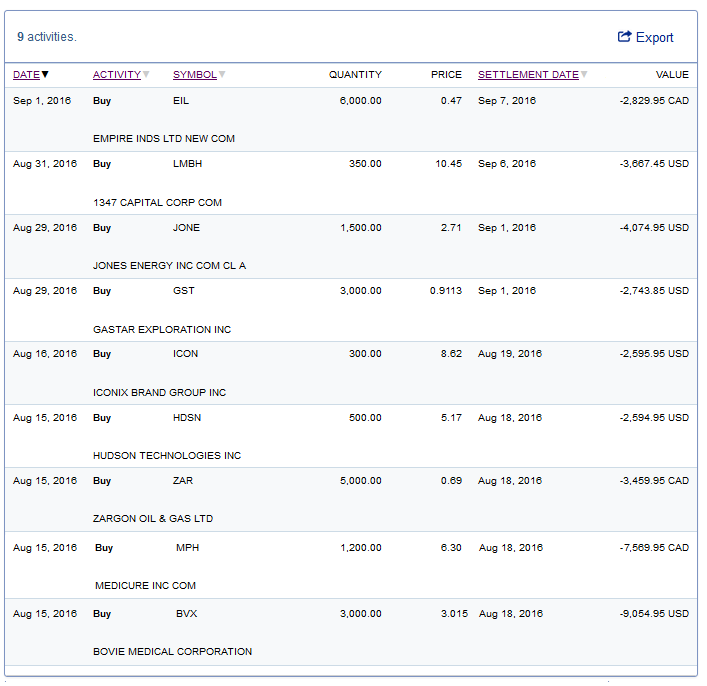
Click here for the last four weeks of trades.

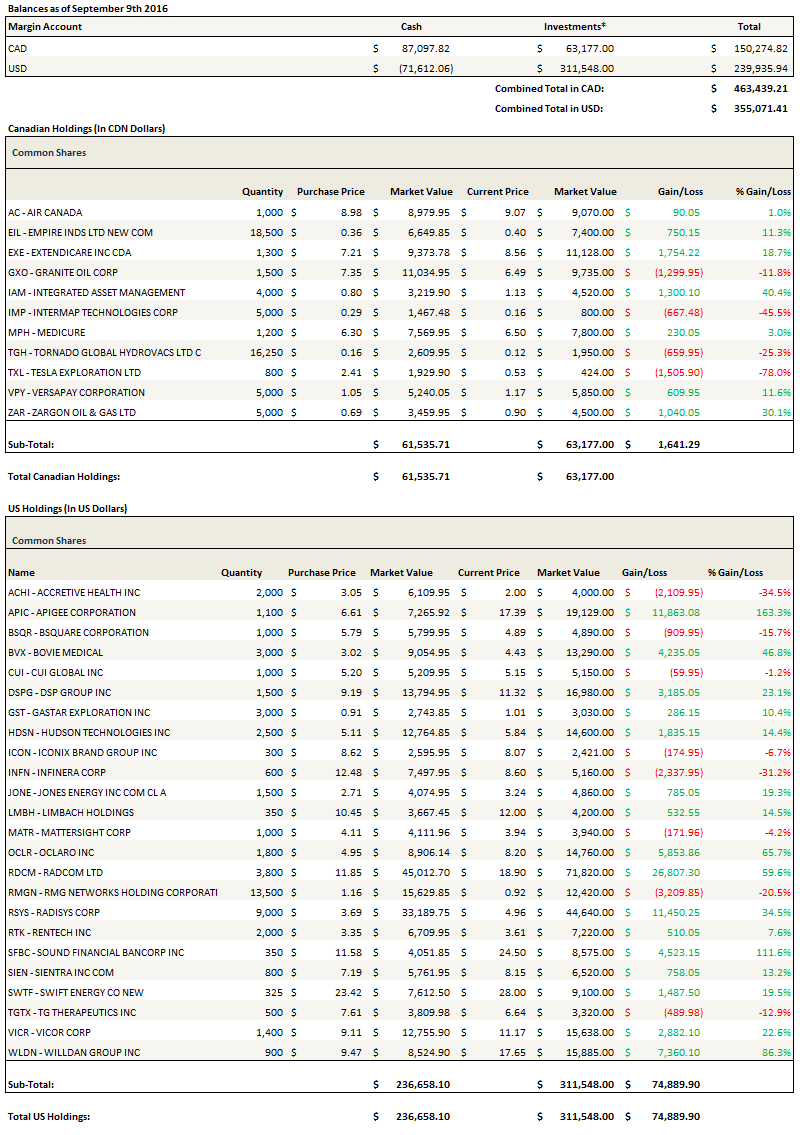
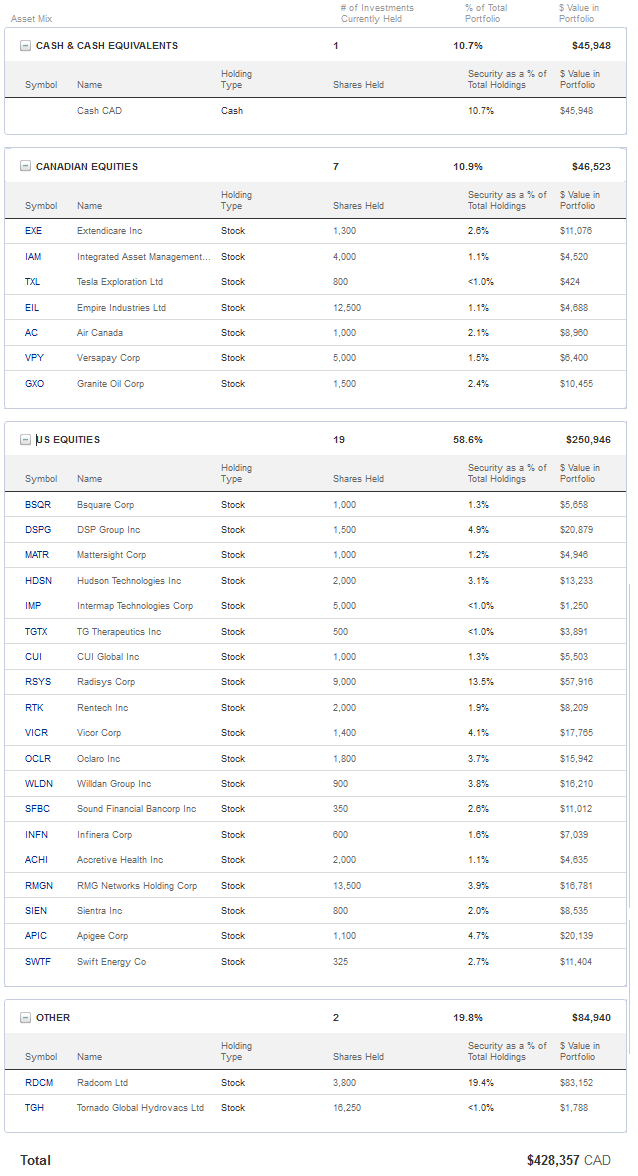
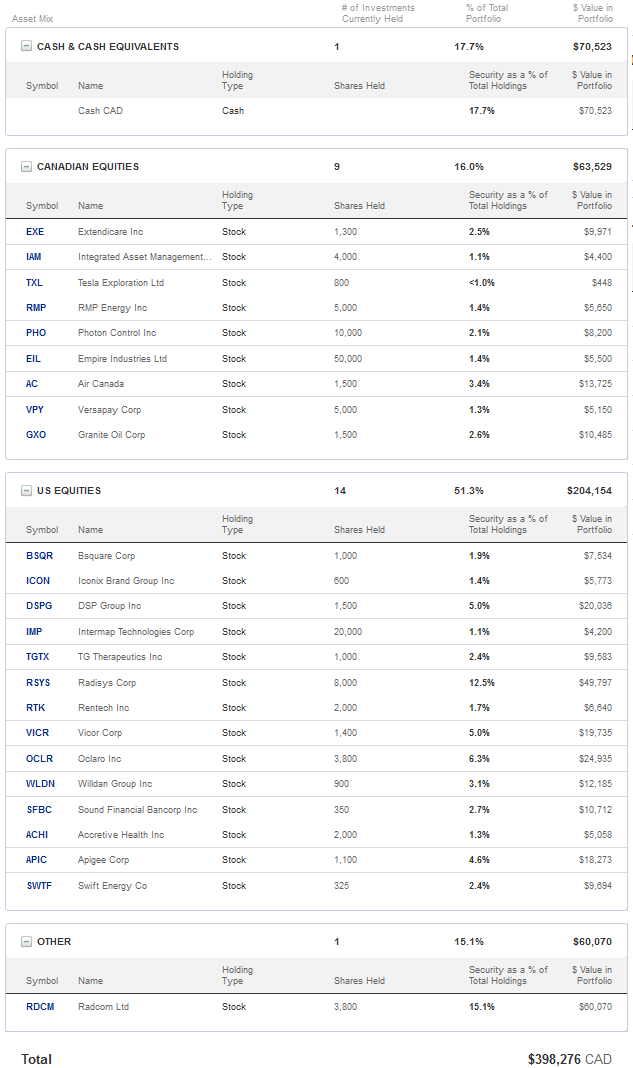
Below you will see that I’ve gone back to my old format for portfolio composition.  Those of you who have followed the blog for a while will know my love/hate relationship with RBC Practice Portfolios.  I used to be able to use the portfolio holdings page provided by RBC, but then they introduced a bug which basically screwed up the gain/loss on a position if you partially sold out or added to an existing position.  So I started tracking my portfolio via spreadsheet as well as with the RBC portfolio.  This is time consuming so when RBC introduced a new portfolio summary that wasn’t great but at least wasn’t totally out to lunch, I began to report it and have used it for the past few updates.  Well this week I realized that this summary has a bug as well, so I am back to reporting via spreadsheet.  I also took the time to add a function to my code that colors the gain and loss columns in green or red.

week-270

Week 266: Loving the lack of volatility

Portfolio Performance

week-266-yoyperformance

week-266-Performance


Top 10 Holdings

week-266-holding-concentration

See the end of the post for my full portfolio breakdown and the last four weeks of trades

Thoughts and Review

Its been a good market for my approach to investing.  Volatility is low and the market isn’t really making any big moves.  Individual companies are being judged on the merits of their business and the macro picture is taking a back seat.

I believe I have also benefited from being more selective.  As I have written previously, I’m taking fewer flyers, being more suspicious of value, staying away from dividend payers and focusing on growing businesses and emerging trends.

As a result these have been the best couple months that I have had in a while.

I made a number of changes around the edges of my portfolio, adding starter positions in a number of names, reducing position size in others, but I remained relatively constant in spirit: I have two large positions: Radcom and Radisys, and a number of small 2-4% positions where I am waiting for a reason to make them bigger.

With respect to my two biggest positions, nothing was said or reported over the last month, including their second quarter results, that deters me in my allocation.  I will give a quick synopsis of Radcom’s quarter below.  With Radisys I spent a lot of time on them a couple of months ago so I will wait until the next update to say more. In short though, the results were fine, they are engaged with a lot of carriers, they seem extremely confident that those engagements will lead to more deals and we will wait and see what new business the second half brings.

I did add five new positions to my portfolio in the last month.  I’m not sure what it was about this month that made it such a boon for ideas.  It wasn’t because I worked unusually hard to find them.  I just went about my usual process and for some reason kept coming up with interesting stocks.

I’ll talk about 3 of those positions (Bovie Medical, Hudson Technologies and Sientra) in this post.  In the interest of space I will leave the other two, Mattersight and CUI Global, for next month.  This being an August update I have a lot of earnings news I want to talk about and I don’t want things to go overly long (though I suppose it always goes overly long, so relatively anyways).

With that I will cut-off my general comments and get straight to it, starting with some company updates followed by my new positions.

Radcom – waiting on the next deal

Radcom announced results on August 8th but more importantly was a separate news release giving an official endorsement of Radcom’s technology from AT&T along with the recognition of the role Radcom will be playing in AT&T’s open source NFV backbone ECOMP.

The press release from AT&T validates the work that Radcom has done, and should make the company the go-to player for other service providers following in AT&T footsteps with ECOMP.  I have always felt the big risk with Radcom was the execution of such their large and cutting-edge deployment with AT&T and that something went off the rails.  That seems off the table now.

As an aside, I found this webinar, which includes a description by AT&T of what they are trying to accomplish with ECOMP, to be quite useful in trying to understand the platform.

While the second quarter results were inline, on the conference call Radcom’s CEO Yaron Ravkaie made a number of bullish comments.  He said that Radcom was now in discussions with 9 carriers, up from 5 in the first quarter, and that the earlier discussions had progressed positively, with feedback coming back from carriers that “this is exactly what we need and we want to progress with it”.

Interesting new opportunities are also opening up.  Radcom has soft launched a new adjacent product to MaveriQ that Ravkaie called a “very important component of NFV implementation”.  I am assuming this was a joint effort with AT&T to some degree since the product is already being used by AT&T even though they have only started marketing it to other carriers.

A final interesting comment was made at the end of the call when Ravkaie referred to a Tier 1 carrier that was recently in their office in Tel Aviv, their “head of their NFV program spend hours with them”, he went “deep into their NFV strategy” and was interested in “partnering” and “co-creation of cutting edge stuff”.

The negative with the story is timing; we don’t know when the next deal signs and telecom providers are notoriously slow footed.  I felt like Ravkaie was cautious about timing, making the following comment on the second quarter call:

the next coming quarters is going to change some of these into deals, and again I can’t really comment on when it’s going to happen, and on exactly when is the next order is going to come in, because everything is so new, so it’s hard to predict. And because as of the end of the day, big solutions in the telecom’s environment, so it does take time

Nevertheless it remains a great story.  The stock has moved up strongly since earnings.  I’m not sure where it goes in the short run, it all depends on the “when” with the next deal, but I see no reason to believe they won’t get that next deal done at some point.

Willdan looks good

The single sentence story on Willdan is that the company had very strong second quarter results, beat estimates significantly, guided higher for the year, said on the conference call that they have signed contracts that will be deployed in 2017 that they just can’t announce yet, said that revenue in 2017 will show further sequential growth, and said that their micro-grid strategy is taking hold with “increasing evidence to suggest that overall spending on microgrids will increase significantly in the coming years and we are well positioned to capitalize on this emerging market opportunity.”

Willdan reminds me of Argan, which was a little engineering, procurement and construction company that I found on the Greenblatt Magic Formula list back in 2011 (I just checked and its still there!) when the stock was $8.   I bought the stock but sold it a few months later at $14.  Argan continued to run from single digits to almost $50 now on the back of successful growth of their engineering services.

Argan demonstrates how engineering services can be very profitable if you have a team of the right professionals and you are delivering a service along the right trend.  I have said before that I think that we are on the cusp of changes to the power grid that will mirror what we saw first in computing and storage (ala the advent of the datacenter) and currently in telecom service providers (which is why Radcom and Radisys are my biggest positions).  If I am right about that Willdan is positioning itself to be in the middle of the build-out.

Oclaro was fine but Infinera made it a bit of a debacle

Oclaro had an excellent quarter, beating estimates and putting out strong growth guidance which was good news.  Unfortunately I only held about half the position that I had only a few days before.

I got turned around by a report out of Needham entitled “Optical Super Cycle”.  I don’t get Needham research, but I caught wind of a report they had in mid-July that described an optical upgrade super-cycle and managed to get my hands on it. Its compelling; the explosion of data is causing metro, long-haul and data-center interconnect to require upgrades simultaneously.

Its exactly the reason I am in Oclaro.  But after being convinced by Needham, I felt like I needed more.  So I went with one of their recommendations, a company called Infinera that seemed to be well positioned in long-haul, had the ability to take market share in metro, and wasn’t expensive compared to its peers.  No problem right?

Well Infinera announced results three days later and gave probably the worst guidance I have EVER seen.  Ever.   The company guided third quarter revenues of $180-$190 million versus Capital IQ consensus of $271 million.

This caused a couple of things to happen.  First I lost a large chunk of my investment in Infinera.  Second, it really shook my confidence in Oclaro, which is a much larger investment for me.  After some back and forth I decided to cut the position in Oclaro in half.

My reasoning hear was admittedly a bit suspect.  Infinera didn’t appear to be a big Oclaro customer.  Oclaro has significant business in China, a market where I don’t think Infinera plays at all.  The evidence from the call was that much of Infinera’s problems were internal, in particular that they weren’t gaining share in the metro market like they had anticipated and that a recent acquisition wasn’t bearing expected fruits.  Nevertheless what Infinera’s disaster highlighted to me is something that I have always worried about with Oclaro; that I will be the last to know when the optical cycle turns, and that these cycles turn quickly.

Well Oclaro announced their results and they were stellar.  Both their results and those of some others suggest that the cycle hasn’t turned yet.  Oclaro said they expect at least 30% growth in 2017.  Gross margins are expected to expand into the mid-30s from the high 20’s they were only a quarter ago.  Their 100G transceiver business has doubled in the last year.  The company is well positioned with the two vendors in China (Huawei and ZTE) where their growth depends.   The stock has continued to go up since, nearly hitting $7 on Friday.

But I can’t add.  I’ll stick with my half position but that’s it.   The cyclicality scares me, in particular the fact that they don’t really get to pass through price increases even when the cycle is in their favor, so the benefit is all volume and when the cycle ends or when inventory builds they will be smacked.   Needham could very well be right and maybe that doesn’t happen for 3+ years.  But I haven’t been able to put together enough knowledge to feel really confident about that.   So I think I’ll just leave that one as is.

What is going on with BSquare and DataV is interesting

Here is why I added to BSquare.   They had a crappy quarter. The stock tanked.  The company has a market capitalization of $54 million but subtracting cash the enterprise value is only $27 million.  The market has left them for dead but I’m seeing data pointing to how their new DataV product might on the cusp of taking-off.

Right now DataV has one announced customer, a $4.3 million 3 year contract with an industrial company.  Because this company is so small, and because DataV has 70% margins, it won’t take many contracts to be meaningful.

In my last blog post I highlighted a career opportunity I read about on the BSquare site.    In particular I noted the following language in one of the sales job postings:

Bsquare is investing significantly in marketing demand generation tied to its industry leading DataV IoT platform.  Market response has overwhelmed our current sales capacity, and we are looking for proven inside sales dynamos to join our team

I thought that was pretty positive.  Last week I went and looked at the job postings again.  There were a bunch of new one’s for android developers but also I found they updated the posting I referenced before, (its here) with the following additional language about responsibilities:

Responsible for making 30-70+ outbound calls (including follow up) per day to inbound leads

I don’t know if this is saying what it reads, but an inbound lead should be a company that has first contacted BSquare, so 30-70+ calls to those leads is an awful lot.  Are they exaggerating?  Or is there that much interest in the product?

They also quietly published this interview on their website, describing the integration of DataV with a heavy-duty truck environment.   Whats confusing about this is that there was a question on the first quarter call that suggested to me that the one DataV customer they had was VF Corp, which is not a trucking or industrial company.

The company has like zero following.  There were no questions at all on the last conference call.  The only intelligent questions I’ve heard in the last few calls is some private investor named Chris Cox who I am presently trying to hunt down (feel free to drop me a line if you read this Chris!).  I don’t think anyone cares about this name.  Maybe there is good reason for that.  But maybe not.

RMG Networks – will have to wait another quarter for the inflection

RMGN results were somewhat lackluster, the CEO had said that they would be growing revenues sequentially from here on out on the first quarter call and that didn’t happen. Revenues were flat, the issue was that the international business lagged and some timing of sales issues.  In particular it sounded like the Middle East was down a lot sequentially.

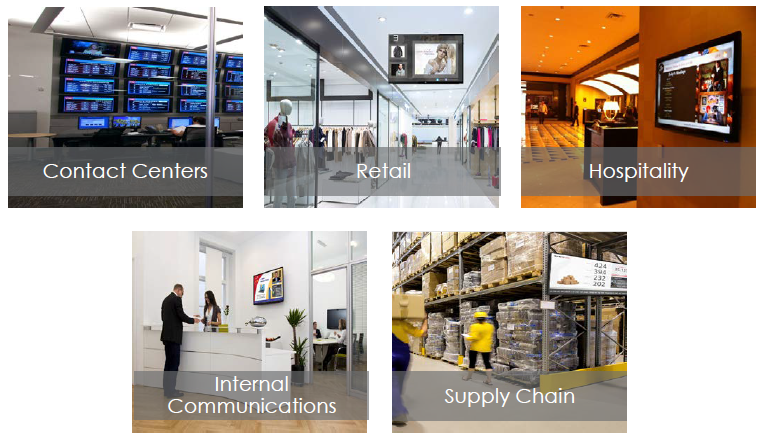
So it wasn’t a great press release but the color on the call was very positive.  In a separate news release they said they had a sales agreement with Manhattan Associates and gave further color on that relationship on the call.  RMG Networks had previously been something called a bronze partner with Manhattan which meant they would be recommended by sales if it came up but there was no compensation to the sales staff for any sales they created.  The new agreement integrates them into the selling package, most importantly now is that sales gets commission on the RMG products that they sell.  Because the products are complimentary this is expected to drive sales.  Manhattan Associates is a supply chain solution company so the partnership is right in line with what RMGN is trying to expand into and is also a $4B company so much bigger than RMGN.

They also said they have similar relationships that have been agreed to in principle but are not press releaseable quite yet with two other partners.

The second positive is that the 3 supply chain trials that they have referred to in the previous quarter has progressed into the purchase phase.  We should start to see revenues from those in the coming quarters.  The CEO gave a lot more color around the sales pipeline and how many leads they are generating and also with respect to the team that they have put together.  He really tells a good story, though that can be taken both ways I guess.  He is bringing people aboard that the market likes, signing agreements and getting their foot in the door where needed so I am inclined to believe this is just a waiting game to see how it translates into revenues in coming quarters.

Medicure has lots of catalysts, have to wait for them to materialize

As for Medicure, results again were probably a bit weak, I would have liked to see revenue at $8 million but $7.7 million is still pretty strong.  The bottom line was hurt by a large stock option expense, and they price their options as awarded so it all hits in a single quarter, you don’t get the spreading out of the option effect that most companies see.

Overall the idea is still there, they are continuing to gain market share with Aggrastat, hospital bags purchased increased 16% sequentially, the company said that June was their highest sales quarter since December and in a response to one of the questions on the Q&A they implied that the disconnect between sales and scripts should resolve itself into high sales, likely in the third quarter.

They are on-track to hear back from the FDA with respect to the bolus vial in the second half of the year, and the Complete Response they got from the FDA back in June for the STEMI indication sounds rectifiable.  They said there were 7 concerns that FDA had identified, 6 have been addressed and agreed to by the FDA and the seventh they have sent in their modification and are awaiting the response.

They also provided some color on Apicore.   It sounds like they expect to plan to purchase the other 95% of the company, said that Apicore  continues to grow over and above the $25 million of revenue they generated last year, and they have a new cardiovascular generic that they are developing along with Apicore that they expect to submit.  They were asked again about the price for their purchase option on Apicore and they again said they wouldn’t disclose, which is unfortunate.  They commented that they have built out their sales and administrative staff in response to the higher Aggrastat demand and it now has the ability to support multiple products.  In particular they can add this new generic with no additional staff increase.  They are also on the hunt for acquisitions of other drugs that are complimentary and low risk.

Vicor was Disappointing

I was disappointed in the second quarter results from Vicor given the expectation they had set the last quarter.  Much of Vicor’s backlog depends on a server standard called VR13.  The new server standard is in turn dependent on a new Skylake chipset being delivered by Intel and the chipset has been delayed (again), this time until the second half of 2017.

The consequence is that rather than orders beginning to ramp beginning in the second half, they likely won’t start receiving order for another 6 months.

I reduced my position on the news.  The company still is a technology leader and they still have the best power conversion solution for the next generation of datacenters, but six months is a long time and I’m betting I can build back the position at lower prices.

As I do continue to hold Vicor, I’ll be sure to follow Intel more closely to see where they are at with the chipset. In the mean time the best Vicor can hope for is to tread water.

New Position: Bovie Medical

I came across Bovie Medical doing a scan of 52-week highs on barchart.com.  This is a scan I like to do as much as possible during earnings season; you can catch stocks that are starting their next leg up because of recently released results.

Unfortunately I was on vacation at the time and so I caught Bovie a little later than I might have otherwise.  I bought the stock at $2.60, which was a couple of days after they had announced earnings. That was up from $2.05, which is what it had opened at the day of their earnings announcement.

Bovie Medical operates in 3 segments:

The “core business” is made up of electrosurgical medical devices (desiccators, generators, electrodes, electrosurgical pencils and lights) and cauteries.  This segment makes up largest percentage of revenues and has flat to low single digit growth historically.   Bovie has said they want to grow the business at mid-single digits which they were able to accomplish in the first half of this year.

The OEM business segment manufactures electro-surgical generators for other medical device companies.  It generated $1.6 million of revenue in the second quarter, up from $941,00 in Q1 and $648,000 in Q2 2015.

The growth from the OEM segment this year was somewhat unexpected.  It was partially due to contract restructuring that staggered contracts – they said that contracts are typically front-end development, back end production so they staggered the contracts to even out the revenue.  The company did say after the second quarter that the expected the growth rate to slow in the second half of the year but still show growth.  From the Q2 conference call comments:

…second quarter performance benefited from purchase orders signed last year and several new contracts were signed in the second quarter that should contribute to revenue growth over the next several quarters.

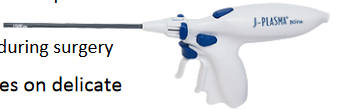
So the OEM business is posting some interesting numbers but the real reason I bought the stock is a new product called J-Plasma that Bovie recently developed.   J-Plasma is a tool that improves the outcomes of surgeries through an ionized helium stream of plasma. The result is better precision and coagulation without significant heating of the tissue.

The J-Plasma system consists of a helium plasma generator and tool disposable.  Here’s a screen cap of the disposable tool just to get an idea of what it looks like.

j-plasma

The generator (called the ICON GS plasma system) ionizes helium and produces a thin beam of the ionized gas.  You use the beam for cutting, coagulating or ablating the soft tissue.  The disposable is the hand piece for delivering the ionized gas stream.  It sounds like you replace the disposable with nearly every surgery.  There are different disposable hand pieces offered depending on the surgery being performed.  The procedure can be used on delicate tissues like fallopian tubes, ureters, the esophagus, ovaries, bowels and lymph nodes.

The initial generator purchase is in the $20,000 range, and the hand tools average $375.  Bovie said on its second quarter call that they are shifting to a pay per use option with a leasing program to bypass the upfront capital expense of the generator.

The success of J-Plasma didn’t happen immediately.  The company has had the product on the market since January 2015.  For the first year growth was in fits and starts.  In particular, the capital required from the up-front generator was a stumbling block.  The company said the following about the slow progress as recently as the fourth quarter conference call:

The operating metrics and leading indicators for J-Plasma product adoption were strong in the fourth quarter, but sales were below our expectations. We continue to face an exceedingly slow pace of J-Plasma generator sales. While we know that the long sales cycle for capital equipment is an industry wide issue, we also know that our VAC approval track record has been outstanding at over 92%, which makes this situation even more frustrating.

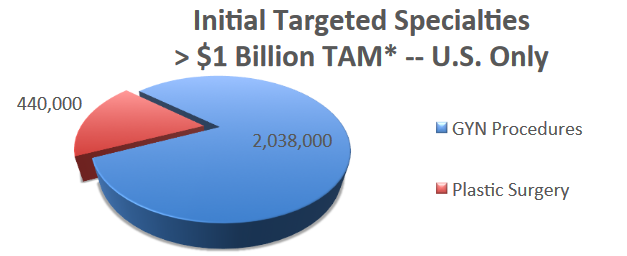
The company is targeting two verticals.   They are currently selling J-Plasma into gynecology (estimated total addressable market, or TAM, of $2 billion) and are moving into the plastic surgery business (estimated TAM of $440 million).

j-plasma-TAMThere are a number of other markets they can expand into including cardiology, urology, oncology and ENT.

There is also the opportunity for the J-Plasma system to be used in robotic surgeries.  Bovie has an expert in robotic surgeries on their medical advisory board that has begun to use J-Plasma in trials.  Results are expected in the first half of next year,  Bovie is also developing an extension to the product, due to be out in 2017, that will integrate into existing robotic surgical systems.  They said on the second quarter call that they are exploring relationships with “existing and emerging surgical robotic systems”.

Sales of J-Plasma increased substantially in the second quarter.  J-Plasma sales were $766,000.  This was up from sales of J-Plasma of $356,000 in the first quarter, which was up from $284,000 in the first quarter of 2015.

The company made a couple of moves in the second quarter that should increase exposure of the product further.  On the second quarter call they announced sales partnerships with two large distributors: Hologix (developer, manufacturer and supplier of premium diagnostic and surgical products) which will add them to their GYN and GYN Surgical line of products ($300mm line), and Arteriocyte, which will start selling J-Plasma to their network of plastic surgeons.

Given that Bovie’s sales force currently consists of a mere 16 employees and 30 independent sales reps, this should increase the reach significantly.  The company said that the two agreements are going to expand their salesforce “by multiples”.

One thing I like about Bovie is that they have a small revenue base to grow from.  In the second quarter revenue was $9.2 million.  This is up from revenue of $7.2 million in the first quarter.

Even though J-Plasma revenue remains in its infancy, incremental growth is still quite accretive to the top line because of the simple math that comes along with the company not being very big.

So we will see how things go in the upcoming quarters.  The one negative of note is when I model the growth out to next year, the company is still only borderline profitable after assuming a similar sales pace to the last couple of quarters.  So we may be a ways away from a real earnings inflection.  Nevertheless, I’m not sure that will matter much if J-Plasma sales can continue at the pace they are at.  If they do, profitability is an eventual inevitability and that is what the market will focus on.

New Position: Hudson Technologies

In an unfortunate turn of events I was listening to the Hudson Technologies presentation at the ROTH conference (the presentation is no longer available but I could send a copy I made if someone wants it) on my bike ride home a few weeks ago.   I was thinking wow, this sounds like a really interesting idea.  So I get home, take a look at the chart and boom!  The stock had jumped from like $3.50 to $5 that very day.

Sigh.

Nevertheless I continued to dig and found that in some ways the stock is actually a better idea now than it was pre-spike.

Hudson is the biggest refrigerant reclaimer in the United States.  The stock jumped on July 18th (the day of my bike ride) because of the announcement of a contract with the department of Defence:

[Hudson] has been awarded, as prime contractor, a five-year contract including a five-year renewal option, by the United States Defense Logistics Agency (“DLA”) with an estimated maximum value over the term of the agreement of $400 million in sales to the Department of Defense.  The fixed price contract is for the management and supply of refrigerants, compressed gases, cylinders and related items to US Military Commands and Installations, Federal civilian agencies and Foreign Militaries.  Primary users include the US Army, Navy, Air Force, Marine Corps and Coast Guard.

So this is a big deal for a little company.  But it wasn’t the primary reason I was looking at the stock.  The story that intrigued me centered around their reclamation of R-22 refrigerant volumes.

R-22 refrigerant, also known as HCFC, is an ozone depleting substance, much like the CFC refrigerant that we all remember from the 1990s.  In fact, R-22 took the place of CFC’s in many applications.  But because R-22 also has an negative environmental impact it was decided by a number of governments t phase the refrigerant out.  In the United States, between now and 2019, production of virgin R-22 will go to zero, as ruled on by the Environmental Protection Agency.

This article did a good job outlining the phase-out cycle by the EPA:

In October 2014, the EPA announced its final phasedown schedule regarding the production and importation of HCFC-22. The order called for an immediate drop from 51 million pounds allowed in 2014 to 22 million pounds in 2015, 18 million pounds in 2016, 13 million pounds in 2017, 9 million pounds in 2018, and 4 million pounds in 2019. No new or imported R-22 will be allowed in the U.S. on or after Jan. 1, 2020.

With R-22 production being phased out, the remaining source of R-22 will be from reclaimed refrigerant.  This is where Hudson comes in as the largest reclaimer in the U.S.  Hudson should benefit from the production restrictions as they gain market share as well as benefit from price.

Its price where things get really interesting.  Over the time period where CFC’s were phased out the price spiked from $1 per lbs to $30 per lbs.

Already we are seeing the price rise.  R-22 ended last year at $10/lbs (up from$7.50), it rose to $12/lbs in the second quarter and prices are currently at $15/lbs.  The company said on their second quarter call saying they are “showing signs of further price improvement.”

Hudson benefits directly from the price rise.  The company has said that they expect that for every $1/lbs rise in the price, 50c should fall as margin.

The opportunity won’t continue forever, but it appears to me that the runway will be measured in years.  While new air conditioning units do not use R-22, the economics of repairs for existing units work in favor of R-22.  At the Roth conference the company said the following:

…lets say you want to repair unit outside of your house, has 10lbs of refrigerant, repairs are $2,500, even if refrigerant is $100/lb its $1,000… [in comparison] new unit is going to cost you $8,000

Hudson has a market capitalization of around $165 million and there is about $30 million of debt.  The company announced 15c EPS in the second quarter.  Keep in mind that this number includes no impact from the department of Defense contract and that R-22 prices have risen another $3 in the third quarter.

I honestly thought the stock was going to take off after the second quarter.  While it flew in after hours (and sucked me in for a few more shares) it gave up those gains the next day and actually traded down 10% in the in suing days.

It turns out that company executives sold a bunch of stock over that time.  The company released a press release on the 10th saying that various executives had sold 1.1 million shares.  That’s a lot of shares for a little company to absorb.

You could of course look at this negatively, but keep in mind that these say executives still hold 20%+ of the company, and so they sold down their positions by about 10%.  They’ve waited a long time for some sort of pay day, its hard for me to put too much stock in them cashing in a bit once it comes.

I really like this idea.

It seems to me that R-22 prices have no where to go but up, that upwards trend has already affirmed itself, and the stock really isn’t reflecting this.  Nor is it reflecting the full impact of the DoD contract, which should be worth around $40 million in annual revenue at similar to higher margins than the existing business right now.  While the stock hasn’t really moved up from my original purchase price so I haven’t been adding much, the size on the high side of what I usually allocate to a new position.

New Position: Sientra

I honestly can’t remember how I came across Sientra.  It was probably some sort of screen, but I have no recollection of what I was screening with.   I’m not getting enough sleep.

At any rate, I came upon the stock the day before it released earnings, which forced me to do some quick work and decide whether I knew enough to take a position or not.

I took a position on that day only an hour before the close.  I tweeted my thought in this tweet (as an aside I’ve decided to try to return to Twitter to comment on my portfolio adds.  I feel like I am missing out on a level of feedback that was often useful).

I always wince when I make a decision like this; I’ve been bitten by acting too fast before.  Yet what drove me to act quickly was because Sientra seemed like a time sensitive situation.

Here’s the scoop with Sientra.  The company sells a breast implant.  Their product was approved by the FDA in March 2012.  By most accounts it is a better product than those that already on the market from Allergan and Johnson & Johnson.  The company was taking market share and sales were increasing.  In the first six months of 2015 sales were $26 million, up from $21 million in the comparable period the year before.  In the third quarter sales were $13 million, up from $10 million in 2014.  Unfortunately the results were overshadowed by manufacturing problems that led to the company taking a $3 million allowance for product returns and suspending further production of the impants.

A few weeks before they announced their 3rd quarterr results the company announced that on October 2nd they had “learned that Brazilian regulatory agencies announced that, as they continue to review the technical compliance related to Good Manufacturing Practices (GMP) of Silimed’s manufacturing facility.”

On October 9th Sientra released a letter that they had sent plastic surgeons regarding the issues with the facility.  Sientra relied on a single source manufacturer.  The compliance issue caused the company to put a voluntary hold on sales.  The stock dropped from over $20 to $10.

Sientra did its best to come clean.  They worked with the FDA and hired a third party firm to verify the safety of the product.  The company was silent for two months and the stock continued to fall, eventually settling at $3 in December.

On January 8th, in a published letter to doctors, the company announced that they had “submitted all of the third testing data of its products to the FDA. He says that, in the company’s opinion, the results show that all are safe and present no significant risk to patients. If the FDA agrees, then their implants will be back on the market.”

The company said that while their investigation found that there were microscopic levels of particulate matter on the products, that data also revealed that even with well controlled manufacturing processes the presence of microscopic particles is unavoidable, and the level of particles from the shedding of a typical laboratory pad would have more particles than their products.

They started selling their implants again in March.  The second quarter was their first full quarter of results. Along with the results the company provided an update on their search for a new manufacturing partner.  As I had hoped, they announced a new partner.

Sientra has entered into a services agreement with Vesta, a Lubrizol LifeSciences company and a leading medical device contract manufacturer of silicone products and other medical devices…Under terms of the agreement, Vesta is establishing manufacturing capacity for Sientra and is working with the Company to finalize a long-term supply arrangement for its PMA-approved breast implants. Sientra anticipates that all project milestones will be achieved for the Company to submit a PMA Supplement to the FDA during the first quarter of 2017.

Sales in the second quarter were $6.2 million, which is only about half of the $14.2 million in sales they had the previous year, but still a very successful initial level considering their limited launch.  In fact the company has to be very careful about how much product they sell before they get manufacturing back up and running.  They do not want to risk another supply disruption.

The response to their return to the market has been positive.  The reason I was so interested in getting into the stock sooner rather than later is because management gave a very positive review of how quickly customers were coming back.  On the first quarter call by CEO Jeffrey Nugent:

We were removed from the market voluntarily and our primary competitors naturally came in and took over those customers that we were no longer able to serve. So what encourages us, and me particularly, is the relative speed and ease of converting those previous customers to come back from those products that they used as a replacement.

So, I could give you a number of other statistics. We have a very high level of analytics inside the Company. We know exactly who is ordering what. We’re following that on a very detailed basis. But as far as pushback, we’re not seeing much. There are virtually no concerns about the safety issues that were raised and we’ve been able to convince those customers that we have the confidence and are giving them the assurance that we are not going to allow them to go back on backorder.

So customers want the product and the market for growth is there.  The breast implant market is large compared to the size of Sientra.  I had to do some searching, and most of the numbers are behind expensively priced reports, but I was able to gather that the US implant market is at least $1 billion.  Sientra had a revenue run rate of around $50 million before it ran into troubles.  It seems that there is plenty of market share left to capture.

The one negative consideration is that this story isn’t going to play itself out in the next couple of months.  The company remains supply constrained and are relying on inventory for sales.  While the details about the manufacturing partner are great, its going to be a while before they are producing new product.  The company said the fourth quarter of 2017, which I believe is probably conservative, but regardless new product is still some time off.

Nevertheless, with a positive response from customers and the path to new product clearing, I suspect we will see the stock move higher as we inch towards that date.  My hope is that we eventually get the stock back to the $20 level, where it was before the roof caved in.

What I sold

I reduced my positions in Air Canada, Granite Oil and Intermap.  Air Canada and Granite continue to be slow to develop.  I did like what I read from Granite’s second quarter earnings release on Friday, and I may add to the position again in the coming days.

Air Canada just continues to lag regardless of what results they post.  I’m keeping what amounts to a start position here, but after seeing the stock struggle for the better part of two years even as the business continues to improve, I just don’t know what it will take for a re-valuation to occur.

Intermap just keeps dragging along with no financing in place.   I sold a little Intermap in the high 30’s but mostly decided to reduce after lackluster news along with the quarterly results released Friday.

In all three cases there is also the consideration that I have come across a number of new ideas as I discussed above and prefer to make room for them.

I also sold Iconix in mid-July but bought back my position before earnings.  However, as I am want to do, I neglected to add back the position in my tracking portfolio and didn’t realize that I had not done so until I reviewed the positions this weekend.  So I will add it back Monday morning.

Portfolio Composition

Click here for the last four weeks of trades.

week-266

Week 258: In Search of the Next Big Thing

Portfolio Performance

week-258-yoyperformance

week-258-Performance

Top 10 Holdings

 week-258-holding-concentration

See the end of the post for my full portfolio breakdown and the last four weeks of trades

Thoughts and Review

I’m wrapping up the fifth year of the blog and portfolio I track here.  Unfortunately it was my worst year since inception.  With about a week to go I’ve eked out a miserly 3% gain.

In my last few posts I touched on what I think I’ve been doing wrong.  My observation is that I am spending too much time looking for value and not enough time looking for growth and finding major trends underway.

To put that in context, let’s look back at the last number of years for a minute.

I did well in 2009 and 2010 as I bought stocks that benefited from the infrastructure build-out in China, in particular a number commodity producers, mostly copper/nickel (FNX, Hudbay, Quadra) and met coal (Western Canadian Coal and Grande Cache Coal).

In 2011 I extended that thesis into pulp stocks, with wins from Mercer International and Tembec.  In 2011 I also made a few bets on gold stocks that paid off.

In 2012 I stuck with gold and began to see opportunities in small community banks that were recovering but where the market had yet to acknowledge this.  I also saw a slowly recovering housing market, and made successful bets on mortgage servicing stocks like Nationstar, which was a recent IPO, originators like Impac Mortgage, and hated mortgage insurers like MGIC and Radian.

In 2013 I continued the theme of a recovering housing market, with my mortgage insurer bets continuing to pay off, added more underappreciated community banks, and bet on a number of oil and gas opportunities that were taking advantage of the new fracking revolution.  I also correctly discerned that the market would take a more favorable attitude to debt, and so I made some of my biggest gains with stocks with debt, particularly YRC Worldwide, which rose from $6 to $36.

In 2014 my biggest gains were thanks to the ethanol stocks, in particular to Pacific Ethanol, which rose from $4 to $24.  I also did quite well playing the cyclical turn in airline stocks, particularly Air Canada and Aercap.

And how about 2015?  What led to my less than remarkable results?

For one I think that I spent too much time following tanker stocks.  While these stocks were cheap, they couldn’t and can’t shake their cyclical stigma.  Looking at the ships being delivered later this year and into 2017, maybe that is for good reason.

I focused too much on companies that were only marginally undervalued or where there was no real catalyst at hand to improve valuation.  In particular, I wasted far too much time on REITs, both simple single asset REITs like Independence Realty and Sotherly Hotels, and more complicated multi-asset REITs like Ellington Financial, Northstar Realty and even New Residential.  I remember Brent Barber commenting to me at one point to be careful with REITs in the environment we were  entering into, and I should have heeded that call.

I also spent too much time trying to justify the airlines.  As a whole the group is captive to their own history of pitiful returns.  One day multiple expansion may come, but holding too many of these stocks in anticipation of that day is not a good use of capital.

And finally, and more generally, I didn’t have a big theme or trend that worked for me.  There was no China infrastructure, pulp stocks, mortgage servicing, community bank or ethanol idea that I could ride.

For the upcoming portfolio year (beginning July 1st) I am going to focus on finding trends and growth.  The one I have latched onto so far is the move of telecom service providers to software defined networks and network function virtualization, and more generally, the continued move by businesses to locate resources to the cloud.

So far I have made the bet with Radcom, Radisys Vicor, Oclaro and Apigee.  Each of these is bearing or at least starting to bear fruit.  Unfortunately I also came extremely close to taking a position in Gigamon, a company I really like, but instead waited for it to slips into the mid $20’s. It never did and now its $37+.

While I made a couple of endeavors into bio-tech stocks last year and for the most part got taken to the cleaners on those, I’m not giving up on this sector yet.  I have been prepared to lose a few dollars under the agency of education and I am slowing learning more. I have a few more words about TG Therapeutics below.

Overall I really like the stocks that I own right now.  While the risk of what I own remains high as always, I also haven’t felt like I have had so many potential multi-baggers in some time.

I’ve been talking about some of the above mentioned names in the past few posts.  Below I am going to highlight a few others: a new position in RMG Networks, a position revisited in TG Therapeutics and some more information about Radisys.   Lastly I’ll review Intermap, which is more of a crap-shoot than the other names I own, but if the cards align it most certainly is a multibagger.

As for stocks I haven’t talked about in a while but will have to review in a later post, Swift Energy is treading water in the grey market and the warrants I received post bankruptcy don’t even trade, but I remain optimistic that when the stock gets to a big board it will go significantly higher.   While I remain wary of the Iconix debt load a few astute moves by management and the stock will trade at a more reasonable free cash flow level.  And Accretive Health, a very small position that trades on the pink sheets, is struggling through its transition but will soon begin to on-board patients via its long term agreement to manage services for Ascension, the largest non-profit health system in the United States.

It was a tough year but I feel good about the future.  Hopefully its a year that I have learned a little from, and that will set me up for a better one to come.

RMG Networks

RMG Networks provides what is called “digital signage” solutions.  They provide the hardware, content, content management system, and maintenance of the product.  The easiest way to understand “digital signage” is to see a couple of examples:

whatisdigitalsignageThis is a small company with 37 million shares outstanding and about a $37 million market capitalization at the current share price.  Yet even though the company is tiny, they do business with 70% of the Fortune 500 companies.

I came across the idea from a hedge fund letter I read by Dane Capital.  At first I wasn’t very excited about the idea; it seemed like a turnaround story with a struggling business, something I have been trying to stay away from.  It was really this quote from Robert Michelson, CEO, that led me to persist in my investigation:

I joined the company and was incentivized by two things. One, was on the company’s position in a really interesting growth industry, and two, my ability to make a lot of money and not salary bonus, but through equity. And you know, for me — I guess everyone wants to make a lot of money but I want to be able to make millions and millions of dollars. And you know I certainly go back and do the math and say, “you know, to get where I want to get to and it’s not just me — obviously, I’m doing this for the stockholders — this company needs to be significantly larger.” And I didn’t come to a company that was grow at like you 5% or 10% per year. You know, if you take a look at public companies, they get higher multiples when their growth is 20% plus.

The other thing that made it interesting to me is its size.  I already mentioned that RMG Networks has a miniscule market capitalization.  The company generated about $40 million of revenue in the trailing twelve months.  That means that relatively small amounts of new business are going to have an out sized impact on growth.  I will outline the growth strategy below.

The turnaround story at RMG began in 2014 when Michelson was brought in.  He proceeded to cut what was a fledgling international expansion, reduce the sales staff and bring back R&D spending to a more sustainable level.  We’re just on the cusp of seeing the fruits of that turnaround.

While the graphic I posted above shows five distinct end verticals the company has only made significant penetration into the contact center market.

This, in part, is where the opportunity lies.  Michelson is trying to address new markets.  His focus is the supply chain vertical and internal communications.

RMG’s supply chain solution provides real time data to distribution centers and warehouses.   Think about big screens in warehouses providing information about shipments, and performance metrics of teams.  The company currently sees a $10 million pipeline and has been seeing progress with leads with 40 prospects.   In the last few months they moved ahead with pilot programs with five of those leads.  RMG is targeting $5 billion companies with 80+ distribution centers and they expect to generate $1 million of revenue from each pilot if closed.

As for internal communications, RMG has a solution that delivers the existing content and management system but directly to employee desktop computers, mobile devices or to small screens around the office.

Internal communications is a $2 billion market.  The company has had advanced discussions with large customers to roll out their solution across their enterprise.

Maintenance revenue has been a headwind over the past two years, falling from over $4 million per quarter in 2014 to $3.4 million in the last quarter, but should stabilize going forward.  There have been two factors reducing maintenance revenue.  First has been the election to end-of-life older equipment that has componentry no longer supported by manufacturers.   Second, the new products being introduced can have a list price 40-50% less than their predecessors that were purchased 8 years ago and because the company charges maintenance as a percentage of sales, this has led to a reduction in maintenance revenue.  Both factors should begin to abate going forward.

Since Michelson started with the company a focus on sales productivity has led to an improvement in lead generation and new pilots.  Sales productivity was up 50% year over year in the first quarter as measured by sales orders per sales representative.  Michelson describes management as having “a relentless pursuit on costs” which is validated by the decline in general and administrative costs from the $5 million level in early 2014 when Michelsen took over to around the $3 million level and a decline in overall operating costs from $11 million per quarter to $5.6 million per quarter.

With the focus on the new verticals and improve productivity of the sale force new opportunities in pipeline are up over 40%.  And here is where we start to see an inkling that the strategic shift is bearing fruit.  In the sales pipeline, Michelsen said that the number of deals $100,000 or greater has increased by 50% in the last year while the number of $1 million deals have tripled.

My hope is that these early signs of sales improvements lead to an uptick in revenues in short order.

The stock is reasonably priced given the potential upside and it will only take a few good sized contracts to move the needle substantially.  I can see this one becoming a bigger position over time if they continue to execute along the current path.

Wading Cautiously back into a Biotech – TG Therapeutics

Here are a couple of thoughts on Biotechs that have begun to crystallize for me. I just finished reading a book called “Cracking the Code” and have started reading another called “The Billion Dollar Molecule”.  Please let me know if you have any recommendations for other good books or articles to help me with the sector.

While I am still a newbie in the bio-tech world, I am starting to understand a few things about the business.   I would distill the most important of my thoughts into the following three points:

  1. Approval/non-approval of any drug and the subsequent market for it is under SIGNIFICANT room for interpretation. Apart from a few obvious blockbusters that get snapped up by the large pharmas well in advance, there is a lot of uncertainty about what will work and what won’t and if it does work what kind of sales it will generate
  2. There is a big difference between the value of a company in Phase II or II trial that will eventually have to ramp up its own sales and marketing of the drug versus what that drug would be worth rolled into a larger entity that already has the salesforce, marketing engine and infrastructure in place.
  3. Biotechs in Phase 1-3 are event driven, open to interpretation, and their share price is as dependent on the capital markets as it is on the state of their particular research.  In this respect they have a lot of similarities to gold exploration companies.

With those points said, and being fully aware of what remains to be limited knowledge in this sector, as I wrote about last month I did purchase, or re-purchase, a biotech position this month.  I have been buying shares in TG Therapeutics.

The story at TG Therapeutics is the same one I wrote about a few months ago.  But that thesis has moved forward in some ways.

TG Therapeutics has two drugs that are in late stage trials for B-cell cancers.  The first, TG-1101, is what is called a CD20 monoclonal antibody.  To dissect what that means, an antibody is a protein designed to attack a pathogen, monoclonal means it is an antibody that latches on to one particular cell type, and in the case of TG-1101, the cell that is latched onto is a B cell, the latching achieved by way of a protein called CD20, which is expressed on the surface of B-cells. Once TG-1101 grabs onto the CD20 receptor it works eventually to destroy the cell.

The second drug that is in the pipeline is called TG1202, which is a PI3K-delta inhibitor.  An inhibitor blocks a particular pathway (a pathway is a series of action by which a cell changes or creates something), in this case the pathway is called the 3-kinase pathway.  The 3-kinase pathway is one of the most activated pathways in human cancers.  So the theory is that if it can be blocked, cancer development will be stunted.

TG-1101 is in Phase 3 trial in combination with an already approved drug called Ibrutinib, which goes by the trade name Imbruvica, and is owned by Abbvie.  Ibrutinib inhibits another receptor on the B-cell called Bruton’s tyrosine kinase.  Abbvie bought Imbruvica for $21 billion in 2014.   Ibruvica has been approved and has shown strong sales; it generated $1.3 billion in sales in 2015 and estimates are that sales could peak at as much as $12 billion.   TG-1101 is expected to improve both the efficacy and safety profile of Ibrutinib when used in combination and so far the results are bearing that out.

A second Phase 3 trial has TG-1101 and TGR-1202 working together.  TGR-1202 is also in a stand-alone trial.  In the stand-alone trial efficacy rates of TGR-1202 are tracking at slightly better than Ibrutinib monotherapy.  In combination, efficacy is even better.

One of the concerns that I believe has hit the stock is because of results that have recently been released for two other PI3Kdelta drugs in development.  Duvelisib (owned by Infinity Pharmaceuticals) and Zydelig (owned by Gilead), have run into issues with efficacy. The market could be looking at this that the read through to TGTX drug is that it is a PI3K inhibitor so in same class as these drugs and so maybe concerns spill over

Everything I have read suggests that Duvelisib and Zydelig had very similar structures whereas TGR-1202 does not.  More importantly, so far TGR-1202 is showing a good toxicity profile (meaning manageable side effects).  So I think we could see the current read through go in opposite direction as the data is digested.

This Barrons article quotes Wedbush as saying that the Zydelig problems have a negative read through for Duvelisib:

Zydelig safety issues raise red flags for duvelisib program. Given their structural similarities and similar mechanism of action, we believe the new Zydelig-related safety concerns provide a negative read-through for Infinity Pharmaceuticals’ ( INFI ) duvelisib program. Zydelig and duvelisib are both inhibitors of PI3K, a family of enzymes that regulate a variety of cell signaling processes, with Zydelig inhibiting just the delta isoform while duvelisib inhibits both the delta and gamma isoforms. A comparison across clinical studies suggests that duvelisib has a poorer safety profile compared to idelalisib, which we attribute to the potentially immune-weakening effect of PI3K-gamma inhibition.

Zydelig, before the recent issues, was approved and brought in $130 million in sales last year.  I saw estimates that Zydelig could reach peak sales of $1.2 billion by 2020.  If TGR-1202 can continue to show a better safety profile, presumably it should be able to take

The differentiation of TGR-1202 the other PI3Kdelta drugs was addressed by TG Therapeutics in a recent press release:

The integrated analysis, which includes 165 patients treated with TGR-1202 alone or in combination with TG-1101, demonstrates that the toxicities observed with other PI3K delta inhibitors such as liver toxicity, colitis, pneumonitis and infection are rare with TGR-1202 with discontinuations due to TGR-1202 related AEs occurring in less than 8% of patients.  We see this as particularly compelling given the recent setbacks for idelalisib with the closure of a series of randomized studies due to safety concerns.  The data presented today provides strong evidence to support the hypothesis that the adverse events seen with idelalisib are not necessarily a class effect.”

TG Therapeutics has about 55 million shares outstanding.  At the current price the market capitalization is about $380 million.  They have $85 million of cash on the balance sheet which should be good for a couple years of cash burn.

Success in the TG-1101 trial will give them a complimentary drug to the widely used Ibrutinib that can be prescribed alongside it.  Success in the combination trial will give the company a “platform” of two drugs from which others can be layered in order to attack the cancer from multiple angles and deliver the knock-out punch.  There are a couple of drugs addressing other mechanisms of attack of B-cells in earlier stages in the pipeline.  And there are investigations ongoing into whether TG-1101 can be used in the treatment of Multiple Sclerosis.

Radisys – Comments on the B Riley Conference

For some reason I get a lot of emails about Radcom and absolutely none about Radisys. I don’t know why? I would be hard pressed to call Radcom the better investment of the two. Maybe there is more upside to Radcom, particularly if they can evolve their product into something that could be used in a larger market (ie. Data center or security) but in terms of product and sales performance, not to mention stock performance, Radisys is the clear winner so far.

Radisys presented a very bullish call at the B Riley conference.  It isn’t coincidence that the stock moved up from $4.20 to $5 in the subsequent days.

To recap the story, Radisys is growing off of three products. FlowEngine, MediaEngine and DCEngine.

FlowEngine is a software defined network (SDN) friendly load balancer; basically a packet forwarding box. It already has a Tier 1 customer (Verizon) that uses it to triage packets in their network. FlowEngine had no revenues in 2014, had $5 million in 2015 and is expected to double revenue in 2016.

At the B Riley conference Radisys CEO Brian Bronson said it’s a $100 million business in the long term.  Towards the end of the Q&A Bronson pointed out a specific deal in India where they were competing against incumbent equipment manufacturers that were delivering similar functionality in a more traditional appliance for $750,000, while FlowEngine could provide the same for $250,000.

MediaEngine manages and manipulates media, is used in the conference space (I believe Mitel is a customer) as well as in VoLTE and transcoding. It’s the biggest revenue driver of the software and systems segment, had about $50 million in revenue last year, and while further growth is expected, it will not be the driver of growth going forward.

DCEngine is a rack solution for telecom datacenters.  As they upgrade service providers are migrating equipment to a data center environment, replacing the central office that they operate in today. The DCEngine rack is half as expensive as the competition. Bronson outlined that their advantage with DCEngine is that they are not the incumbent equipment provider, which stands to lose revenue and margins by replacing their fully populated custom solution with a rack populated with 3rd party equipment.

Because most of the rack is populated by third-party equipment, DCEngine is a low margin business, pulling in 15-20% gross margins though it does deliver 10% operating income. More importantly it will begin to pull through FlowEngine sales beginning in the second half of this year, as there will be as many as two FlowEngine appliances installed per rack, depending on the application.  Bronson suggested that at some point it could pull through MediaEngine sales as well but that is the first I have heard of that so I don’t know what sort of volumes we are talking here. Finally, selling the rack makes Radisys the natural player for profesional services (ie. installation, integration and maintenance) which on a gross margin basis are only about 20-30% but most of that drops to bottom line.

I gave my model for Radisys in the last update. What I have learned in the last month only strengthens my belief that I am likely going to be conservative on my revenue growth forecast.

Intermap Gambling

I had a friend go to the Intermap AGM, and some questions he subsequently asked about the company got me to review my research on the name.

I’ll review the details again but first the conclusion.  Same as what I concluded originally, this is a coin flip with a large potential upside if things pan out, and an absolute zero if they don’t.   I still feel the odds are favorable given the reward but only for a small “option” position type that I have reconciled to losing in its entirety.

Let’s review.  The story is that of an Spatial Data Integration contract, or SDI.  An SDI encompasses data acquisition, which in Intermap’s case entails crisscrossing a jet  over the country collecting IFSAR data, and data integration, which includes bringing the mapping data into Intermap’s Orion platform, integrating it with existing data (both geospatial, think LIDAR, and other layer information that can be tied to a GIS location), and building queries to automate searches and perform analytics on the data.

The SDI that Intermap has won is with the Congo.  Intermap is not dealing directly with the Congo. They are dealing with a prime contractor, of which the rumor is a company called AirMap.  The purpose of a prime contractor is to provide the local contact and regional expertise, and to arrange project financing.

The project financing is what everyone is holding their breath on.  You do project financing on a big contract like this SDI to help address the mismatch between project costs and funding timeline by the government.  It basically is put in place to insure that Intermap gets paid on time and has the cash flow to keep executing on the deal.

The project financing was supposed to be completed within 90 days of some date in February.  This would have put the deadline at the end of June at the latest.  On the first quarter conference call management implied that there could be an extension, but that the expectation was, by way of the prime contractor, that the financing would close by the end of the quarter.   Management said that financing discussions had moved away from financial details and were now focused on operational details, which presumably is to say things are progressing.

Intermap has 120 million shares fully diluted, so about a $20 million market capitalization.  They have $21 million of debt, mostly payable to a company called Vertex One.  The relationship with Vertex One is another wrinkle.  Here is Vertex One’s position in Intemap:

  • They owned 19.8mm shares in June 2015 (from here) and have subsequently reduced by 4.1mm (from this Sedar Filing)
  • 7 million warrants at 7.5c (from Gomes and from Vertex One filing)
  • They have a 17.5% overriding royalty on revenue
  • Hold $21 million of debt as already mentioned

The question is, given the distributed position, what is in Vertex One’s best interests?  I remain of the position that as long as the SDI is in play, Vertex One interests are best held by keeping their hand.  The equity upside is at least $1, the royalty will skim off the top, and they will collect on the debt through cash flow repayments.

But if the SDI is lost the relationship with Vertex likely means game over for Intermap in their current form.  Interest payments will overwhelm cash flow generated from data sales and InsitePro.

Its worth noting that InsitePro is a product sold to the insurance industry to help them identify insurance risks such as flood plains.  While InsitePro is an interesting little product, and management has noted that the addressable market is upwards of $500 million with a similar competitor product from CoreLogic currently running at $50 million annual sales, the company is really all in on the SDI and it is the success or failure of it that will determine Intermap’s fate.

So Intermap is a binary bet worth holding a small slice of if you don’t mind taking a significant risk.  I’m ok with it, I still think it makes more sense at this point that the deal closes then doesn’t.  But I won’t be shocked if I am wrong.

Extendicare’s Slide

In retrospect Extendicare was probably fully valued when it crossed above $9 into that $9.50 range. But I like the long-term trends in the business which always makes me reluctant to sell a stock like this. With the stock back down to below the $8 level it looks like I am in for another cycle. While I didn’t add any in the tracking portfolio, I did add to the stock in my RRSP.

I can’t be sure what has precipitated the sell off. It could be that the activist is reducing or exiting. The first quarter results were a little light, they are struggling with the Home Health business that they are integrating and margins are coming up a bit short.

I believe they are correct to expand into the home health space. Government is going to try to keep people in their homes as long as possible because its cheaper.  While the publicly funded side of the business is always going to be constrained by funding, it does give the company a base from which to build a private business, which they are starting to do.

I think of my wife’s parents, who take care of her mom’s parent in their home in Ontario. They get a nurse every day for an hour that is publicly funded but even with that help its becoming too much.  One option is to start paying a nurse to stay longer, or come a second time later in the day, out of pocket.  Its those kind of needs that Extendicare can serve.

What I learned about listening to Oil Bears

Its pretty interesting to look back at what has been said about the oil market on twitter over the past 6 months. From January to March there was a decidedly negative bent on oil market tweets. Many of these tweets were made by users with a large follower base, which presumed a degree of authority to their comments. I actually made a list of these tweets at the time, because I really wondered whether the market was as dramatically out of balance as was being suggested.

I’m not going to call out names, but it just reiterates that twitter has to be taken with a grain of salt.

I mostly sold out of my position in Clayton Williams Energy and Surge Energy.  I hold a few shares in one account but am out of these stocks in the practice portfolio.  I’ve replaced the position with another name that feels a bit safer with oil at these levels, an old favorite of mine called RMP Energy.  I continue to hold Granite Oil.

What I sold

I sold out of Health Insurance Innovations after the announcement of the proposed ruling by the Health and Human Services department to limit short term medical plans to three months and not allow renewals.   This is their whole business model, and if it goes I don’t know what happens to the company.  I also noticed that I have been seeing complaints about the company’s call centers aggressive sales tactics pop up, which is worrisome.

I also sold out of Oban Mining, which has been another gold stock winner for me, more than doubling since the beginning of the year.  I just don’t want to overstay my welcome here.

Also note that I did take a position in BSquare, which I will write up in the next post.

Portfolio Composition

Click here for the last four weeks of trades.

week-258