Skip to content

Posts tagged ‘stock picks’

Week 246: Hidden in Plain Sight

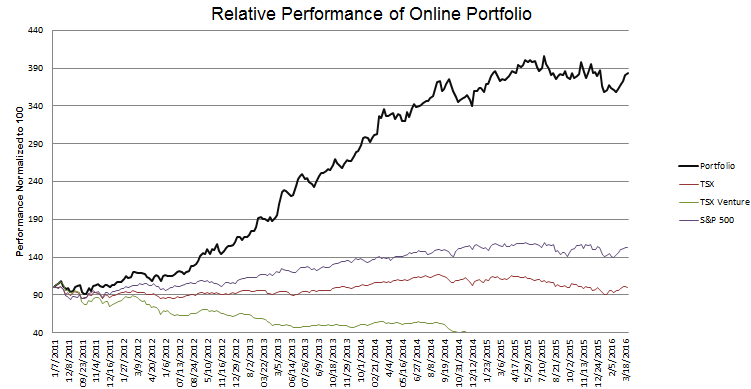
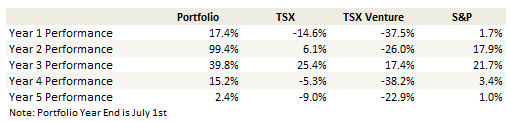
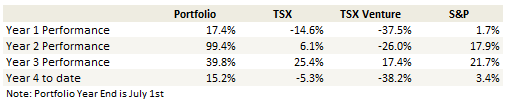
Portfolio Performance
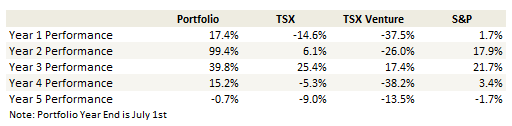
week-246-yoyperformance

week-246-Performance

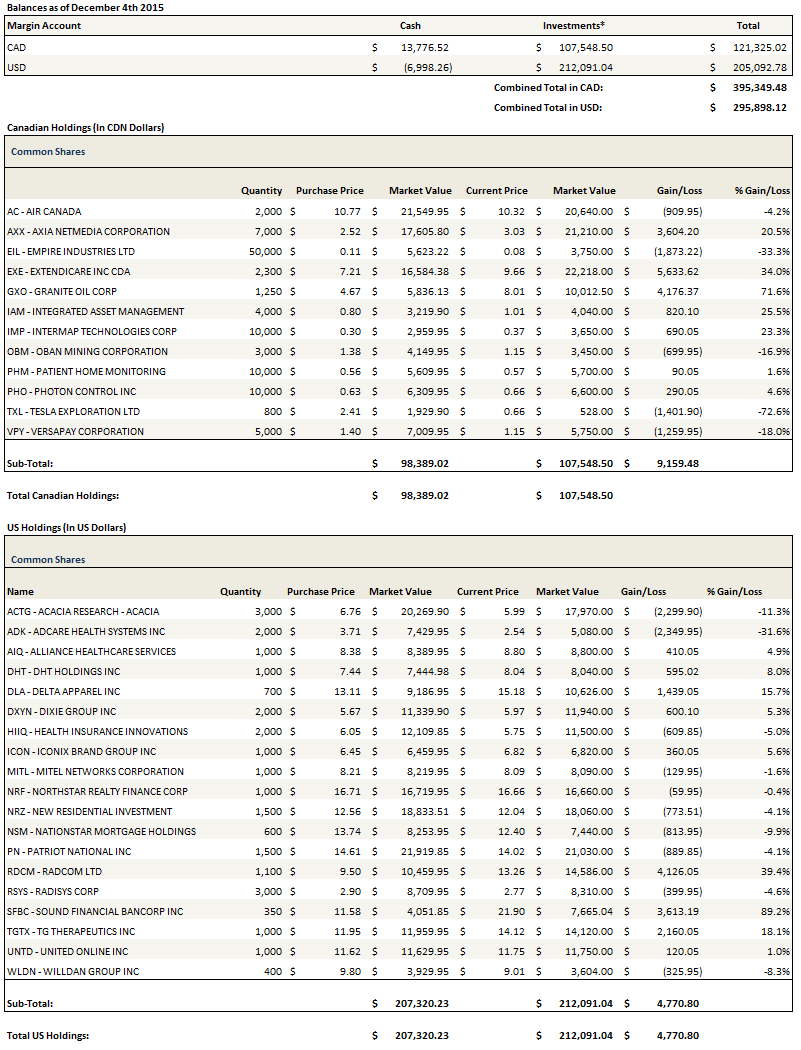
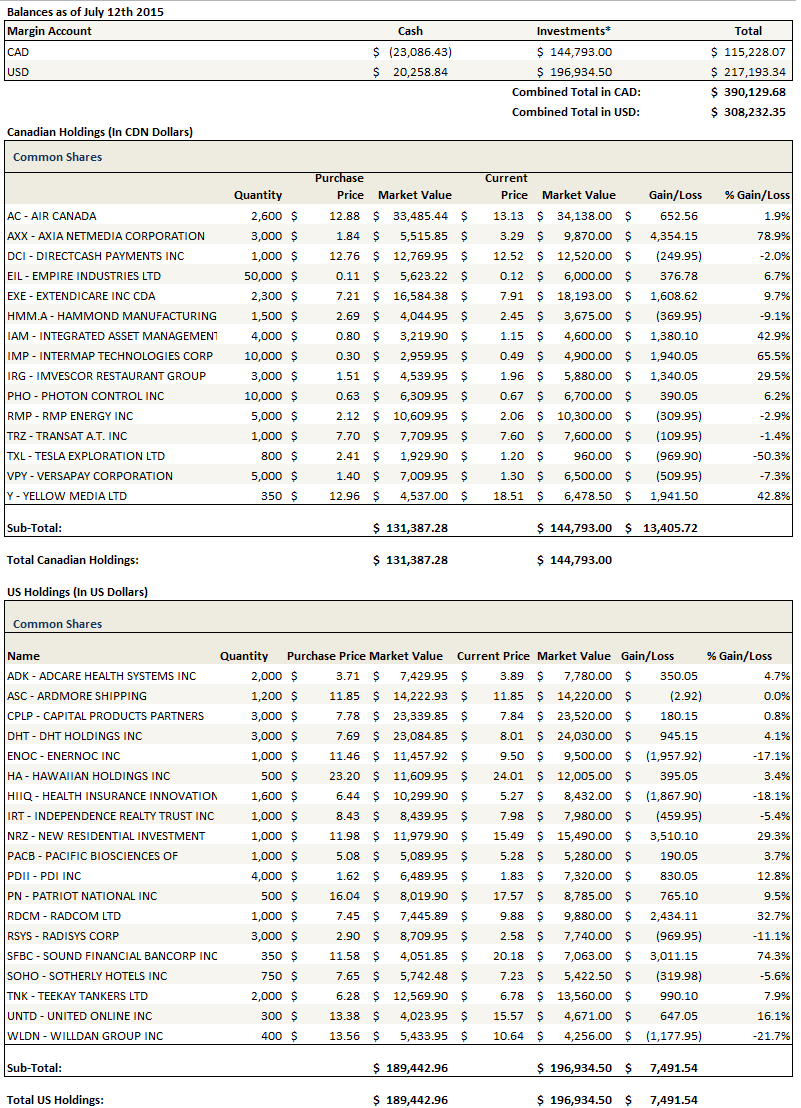
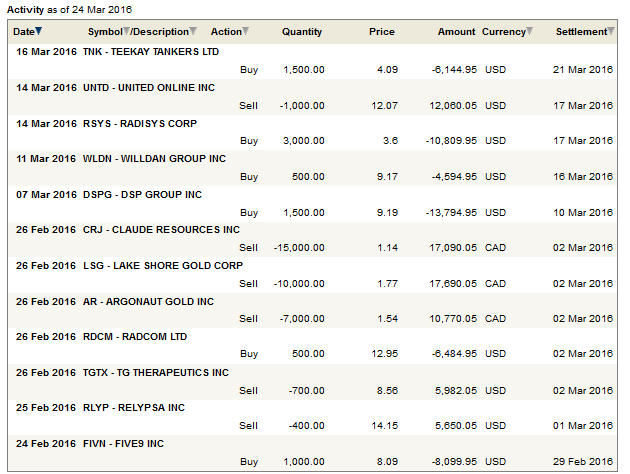
See the end of the post for the current make up of my portfolio and the last four weeks of trades

Thoughts and Review

The market was up and so not surprisingly I had much better performance in the last month.  Even so, I performed better than I might have expected given just how much uninvested cash I have sitting around.

It just goes to show how much of a drag the losers have been.  I’ve had my share of winners in the last year, but my performance has been flat because I also had a bunch of crappy losers.

It would be one thing if I couldn’t distinguish between the winners and losers ahead of time.  But when I look back at what has cost me over the last year, it has been pretty predictable; stocks where I am stretching for a trade, stocks where the value wasn’t clear, or stocks where my primary motivation was their attractive yield.

I’m going to make a concerted effort to prefer cash to those positions going forward.

In the last month I haven’t been actively looking at stocks.  I’ve been surprised by how quickly the market has bounced back and I remain skeptical that it can continue.  So with the exception of a couple of opportunities that I will describe below, I am will remain holding a high cash position until I see a reason to believe the market will sustain a move higher.

Takeovers!

I went a long time without a takeover and then in the matter of 6 weeks I got 3 of them.  First, both of my gold stock picks, Lake Shore Gold and Claude Resources, were taken over.  I bought Lake Shore at $1.12 and, after the takeover offer from Tahoe Resources to exchange each share of Lake Shore for 0.1467 shares of Tahoe, the stock now trades at a little under $2.  I bought Claude at 76c. Silver Standard Resources made an offer of 0.185 shares for every share of Claude.  At the time of the offer this amounted to $1.65.  I’ve sold some of each position and so have reduced stakes in both.  They have been solid performers and I am not unhappy.

A few days after the Claude Resources news my long held fiber-to-the-home play, Axia NetMedia, got scooped up by a private equity firm, Partners Group.   While I was happy to see a quick takeover of both of my gold stock positions, I was more divided by the news from Axia.

The problem is that the opportunity at Axia is much greater than the $4.25 takeover offer.  The company has a massive build out on its horizon in both France and Alberta.  Its becoming clear that fiber-to-the-home is not just a “higher speed-nice-to-have” but a necessary conduit to access all forms of media.  Axia’s cash flow stream once this build-out is complete will far exceed the price paid by Partners Group.

The problem is getting from here to there.  As Axia outlined on their last conference call, the capital necessary to realize the growth is a stumbling block for a $200 million Canadian company.  Axia warned on their last call that they were evaluating alternatives; that they would try to raise capital and if not consider offers by a larger entity with greater access to capital.  Partners Equity is a $50 billion investment management firm.  The only reason that a firm that large bothers with a takeover this small (Axia was a $200 million market capitalization before the offer and under $300 million at $4.25) is because they see significant upside.

Radisys, Radcom, Willden, and what the Market Misses

I’ve made a number of mistakes over the last couple of months but one thing I have done right is add to my positions in Radcom and Radisys in the face of market weakness.

Radisys has had a big move in the last month, moving as high as $4 from $2.50 in January.  I have added to my position on the way up.

The Radisys move over the last couple of weeks has been instructive.  Consider that during the fourth quarter conference call the company announced a large contract from a Tier I customer (from this transcript):

And finally, and maybe most important in this release is, we secured orders totaling approximately $19 million, the majority of which is contained in deferred revenue at year-end for our new data center product targeted at telecom and cable operators which we expect to launch more broadly in the coming months.

The stock moved a little but nothing that couldn’t be explained by what were decent quarterly results.

About three weeks later Radisys officially announced the product, DCEngine, with this press release, along with the name, details and comments from the Tier 1 customer, Verizon.

“As Verizon introduces open, flexible technology that paves the way for central office transformation, we look to companies like Radisys to assist us in that journey,” said Damascene Joachimpillai, architect, cloud hardware, network and security, Verizon Labs. “Network modernization will rely on solutions such as DCEngine that meet service provider needs with open source hardware and software technologies.”

The stock has moved straight up since this press release.

I think this demonstrates how poorly small cap companies like Radisys are followed and how slow the market can be to react to positive developments.  While I find it easy to second guess myself when what I construe as good news in announced and the stock doesn’t move, it is worth reminding myself that this isn’t always an indicator of importance.

With that in mind consider the following situations, Radcom and Willdan Group, two stocks I have had in my portfolio for some time, and Vicor and DSP Group, two new positions that I have added.  I believe all four of these situations represent similar “hidden in plain sight” opportunities.

Radcom

First, Radcom.  Radcom announced in early January that they had signed a contract with a Tier I customer for their next generation service assurance solution MaverIQ.  There wasn’t a lot of details provided, only that the initial phase of the contract would be completed mostly in 2016, and was worth about $18 million.

On their fourth quarter conference call in mid February the company gave more color.  They said the contract for NFV deployment was much bigger than the $18 million announced.  I’m pretty sure its with AT&T.

While they declined from giving guidance (historically the company has given virtually no guidance in the past so this was no surprise) they were willing to say that they expected their cash level to increase to $20 million from current $9 million by end of the first half of 2016, and that the increase in cash would be due to new revenue and not deferred payments.

They also gave an indication of just how big the deal with AT&T might be (my bold):

We just said that we received an $18 million initial deal out of a bigger deal. There is – it’s a large transformation, so it’s not – I think when you’re envisioning it, so I’m going to try to help you model it, right. So when you’re envisioning it, envision something between 2.5 to three year evolution for the very significant portion of the transformation, okay. It doesn’t mean that everything stops after three years, but envision that over the course of those three years, that number $18 million that we’ve disclosed is just an initial number out of something bigger, that’s bigger than that. And I can’t disclose the accurate numbers here. There is things that it depends on. There is – it’s more complicated just throwing other number out there, but it’s much bigger than $18 million, okay.

In addition they made it clear that they are ahead of the competition, witnessed by their comments about Netscout on the call.   They are in the process of trials  with other Tier 1 customers and believe that the next-gen service assurance market will be a “winner takes most” market where they can take the most.

Radcom is a $130 million market cap company.    They just said they can generate $10 million of free cash in the first half of 2016, that the contract they have announced is actually much larger than the announced number, and that they have a product that is significantly better than the competition.

If Radcom can win a couple more contracts in the next year the stock should trade significantly higher than it is now.  it probably gets bought out at some point.   In the mean time I think its quite a good growth story.  The market is really not paying a lot of attention to the “color” provided on the conference calls, and instead is focused on the rather puny revenue that the company generated in 2015 ($18.6 million) and the rather lofty valuation for the stock if you use that backward looking measure.

Willdan Group

Update: I got a response from Willdan IR and they say the revenue is not new revenue and is included in guidance.  I am still of the mind that this is an expansion of scope though and I am happily holding the position I added that I describe below.

Second example.  On their fourth quarter conference call, which I thought was quite positive in terms of the outlook provided for 2016, Willdan stated the following about their ongoing contract with Con-Ed:

We have the extension for 2016 at a value of approximately $33 million. We’re prepared to go beyond this baseline and expect to. The good news is that we continue to perform well for Con Ed and as a result we are in discussions to expand our scope of activity in the second half of 2016 to include more programs targeting customer segments, for example, more of Brooklyn, Queens and larger projects, 100 kW to 300 kW in our SPDI program, the type of programs that will include in the larger retail stores and warehouses and more real estate.

Note that the transcript is incorrectly referring to the SPDI program, which should read SBDI (small business direct install program).

Flash forward to Thursday. In a press release Willdan said the following:

Willdan Group, Inc. (“Willdan”)(WLDN) announced that it has been awarded a one-year, $32.8 million modification from Con Edison to an existing Small Business Direct Install (SBDI) contract.  Under the modification, which extends through the end of 2016, Willdan will be delivering approximately 86 million kilowatt-hours in electric energy savings to Con Edison’s small business customers throughout the entire Con Edison service territory. This includes the Bronx, Brooklyn, Queens, Manhattan, Staten Island and Westchester County, New York. Willdan described this forthcoming modification in its recent fourth quarter earnings conference call.

Based on the language used it seems pretty clear to me that the $32.8 million is in addition to the $33 million baseline contract.  They talked in the fourth quarter conference call about scope expansion with respect to the SPDI and this is scope expansion to the SPDI.

If I’m right, then the market hasn’t caught onto this yet.  Full year guidance is $170-$185 million and so $33 million is significant.

It’s possible I am wrong.  Maybe Willdan is just re-releasing old news.  I would be surprised though.  I have followed the company for some time and their management does not strike me as the sort to throw out a press release with a big number that is a rehash of an already disclosed contract.  It just doesn’t strike me as something they would do.

I think its equally possible that this was the Thursday before a long weekend, that there are maybe one or two analysts following the company, and so no one that was around to check the news cared enough to notice it.  Yet.

For what its worth I added to my Willdan position significantly.  What the heck; I’m buying the stock at the same price I was buying it at a few weeks ago before this announcement anyways.    What’s the downside?

DSP Group

I have been watching DSP Group for a couple of years and have owned it once in the past.  The previous time I owned it the story was primarily one of valuation.  The stock was trading at $7 and the cash and investments on the balance sheet accounted for nearly $6 of that.   But there wasn’t a clear story behind the business itself and so I sold the stock after it went a few dollars higher.

In the two years since the story around the company’s business has been evolving for the better.  The legacy business that they have, and for which I had a lack of excitement in my first endeavor, is the design and manufacturing of chipsets used in the cordless telephones.  It’s profitable and brings in decent free cash, but it’s an industry in decline to the tune of 10-12% annually in recent years.

This business has fallen off the cliff even more in the last couple of quarters.  Slower demand and an inventory build has led to 20% plus year over year declines.   These declines are expected to moderate back to trend in the second half of the year.  However the bad numbers drag down the overall revenue numbers for the company and are hiding some pretty decent growth businesses.

DSP Group has been investing in a number of new technologies that are starting to bear fruit.  Lets step through them briefly:

  1. HDClear – they have developed a new technology that will improve voice quality on next generation phones. On the fourth quarter call the company announced that they had a couple of wins and one of the wins was with a Tier I device supplier.  Turns out that is Samsung, where it has been designed into the S7.  They expect $2 million to $3 million in the first quarter and guided to lower double digit or high single digit revenue for the year.  When I look at some of the numbers I wonder whether it could be higher: according to this article from Reuters (here), DSPG should get 70c-$1 for each HDClear chip sold.  The Samsung S6 sold over 50 million units last year.
  2. VoIP – their VoIP business unit had $22 million in revenue in 2015. They have guided for 50% growth in 2016.
  3. IoT – Eight OEM’s and three service providers have launched products based on DSPG’s ULE technology. They have a ULE chipset that can be used in home automation, security, remote healthcare or energy management products.  They generated $3.8 million of revenue in 2015 and they think that can get to $5 million in 2016.
  4. Home Gateway – Home Gateway generated $14 million in 2015. It is expected to take a step back in the first quarter of 2016 with around $2.5 million of revenue, but this is going to climb as the year progresses and some new product launches, in particular a North American telecom provider.
  5. SparkPA – DSP Group announced a new product, a power amplifier to be used in the high end access point market. They don’t expect any revenues from this business in 2016 but it will ramp in 2017 and they consider the market they are tapping to be over $100 million

The company gave quite a bit of color about the revenue expectations for each of these businesses in 2016 on their fourth quarter conference call.  If you add up the expected 2016 revenue from the new businesses alone you get around $57 million.  These businesses grew at 35% in 2015 and the company said that in aggregate they expect higher growth in 2016.

When I think about a company with an $80 million enterprise value and $57 million of high growth revenue products, it doesn’t make a lot of sense to me.  I understand that overall the company’s revenue is not growing because of the out sized contribution of cordless declines.   But this business is profitable and therefore not a drag on the company, in fact it even helps fund the growth.

I think the stock should trade at least at 2x the revenue of its burgeoning new product lines.  This would be a 50% upside in the stock.  If the growth continues I would expect it to be even higher.

Vicor

I got the idea for Vicor from a friend who emails me regularly and goes by the moniker Soldout.  He gave me a second idea some time ago, called Accretive Health, that I didn’t initially buy and has done really poorly for the last half a year but that I added recently and will talk about another time.

As for Vicor, the company has a market capitalization that is a little under $400 million, $60 million of cash on its balance sheet and no debt.  The company sells power converters.   They offer an array of AC-DC and DC-DC converters that are used in telecom base stations, computers, medical equipment, defense application, and other industries.

Vicor has a history of high-end products and so-so results.  Their technological edge goes back to the 80’s, as they were the original inventor of the DC-DC brick converter, a device that allows the power converter to sit on the circuit board, which in turn allowed a single DC voltage to be distributed throughout the system and converted as required to lower voltages.  However they haven’t made a significant profit since 2010, and even then it was only 80c per share.

The story going forward is simple.  The company says that with recent design wins and product launches, in particular wins for new data centers that will utilize the VR13 standard (more on that in a second), as well as high performance computing, automotive and defense, they can grow revenue 3-5x in the next couple of years.  That estimate comes directly from management (from the third quarter call).

I think it’s fair to say that the array of products that have been introduced and the products which are about to be introduced, for which the development cycle has ended and we’re very close to new product introductions, that in the aggregate these products are more than capable of supporting the 3-by-5 revenue growth goal that we had set for ourselves, and with respect to which we suffered delays.

The increases in revenue in 2016 will coincide with the move to the VR13 class of processors made by Intel (known as the Skylake family of processors) and that are used in a number of high end computing applications.  These processors require power conversion levels that are easily addressed by Vicor’s high efficiency products.  Vicor has already had a number of design wins to be included in VR13 system designs.  The move to a VR13 based architecture has been slower than expected though, and the company has pushed back the revenue ramp from originally beginning in early 2016 to now occurring in the second half of the year.  The company describes the VR13 opporunity below:

VR13 is a class one processor, it’s a class of processors, and it’s processors that in many respects represent the significance that [inaudible] performance relative to the earlier class, which is VR12.5. Now this can be potentially look confusing because, as you follow Intel’s introductions with respect to the many different flavors of these devices, some of them play in a space where now we do not play, and other ones are targeted in particular to higher-end datacenter, more intensive — computing intensive applications. And those are the ones that are relevant to our revenue opportunity.

Vicor has significantly more design wins for the VR13 product line than they did for VR12.5 (again from the third quarter conference call):

To the extent our footprint with factorized power solutions across applications and customers will increase going from VR12.5 to VR13, this product transition is a mixed bag as it may cause near term softening in demand but should result in substantially greater total revenue as VR13 applications begin to ramp.  On a related note, we have started to see significant design wins for our new chip modules as point of load, board mount devices and in chassis mount VIA packages, which validates our expectations of market reception of these products.

Vicor’s technology differentiates them from competitors.  For example they have introduced a factorized power 48V architecture that includes components that can step down voltage directly from 48V to 5,3 and 1V without an intermediate 12V stage.  I believe they were the first company to come up with this solution and I have only seen one other advertising the capability.  Stepping down directly from 48V has higher efficiency and takes up less board space than existing architectures.  On the third quarter conference call the company said the following:

In my recent visits to customers in the U.S. and Europe, I confirmed spreading a rising level of interest in our factorized power 48-volt architecture and are now frontend solutions for automotive, datacenters, high-performance computing, and defense [ph] electronics applications among others.

The 48V products are particularly interesting to data center and server applications where power losses due to the intermediate step-down to 12V are undesirable.  Google, for one has championed a 48V server solution with a new 48V rack standard.  Vicor released a press release describing Google’s initiative:

Patrizio Vinciarelli, President and CEO of Vicor, commented: “By developing its 48V server infrastructure, Google pioneered green data centers. And by promoting an open 48V rack standard, Google is now enabling a reduction in the global cloud electricity footprint.”

The company has been building out their capacity and their existing cost structure can support the anticipated rise in revenue.

So we have significant design wins. We have been working furiously to establish automated manufacturing capacity. There’s been good progress to that end. You know, there’s equipment coming in, factory flaws, have been prepped for it, and we’re going to have a turn now in the very near future in anticipation of volume ramp in Q1 of next year.

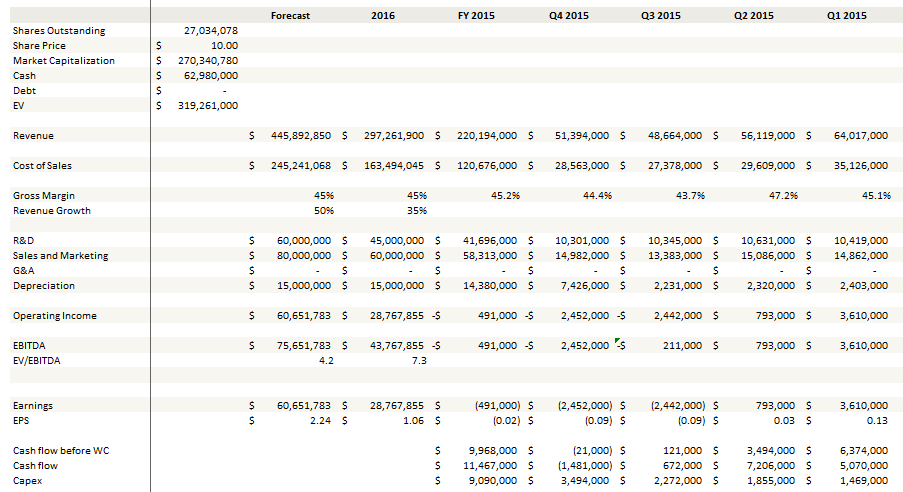
If you step through how the numbers would play out and assume that revenues double at some point, a modest increase in SG&A and no improvement in gross margins as revenues ramp, you can see the leverage to earnings that quickly develops. Note that the company has significant net operating losses that will shelter them from tax:
forecast

Keep in mind that I’m not trying to exactly predict how earnings will ramp.  This is not intended to have the accuracy of a forecast.  Its intended to demonstrate the magnitude of the earnings leverage if the company can make good on their expectations.

I have a position in Vicor and expect the stock to move significantly higher if they can realize their revenue expectations.

Tanker Stocks

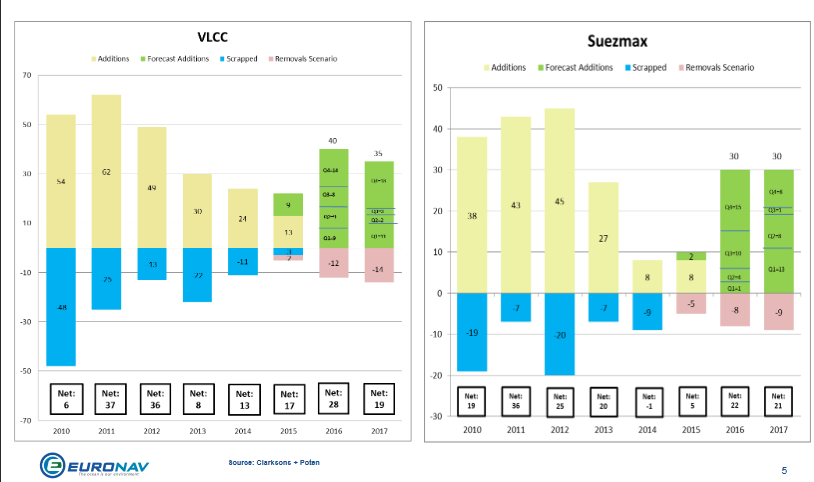
After watching the tanker stocks dramatically under-perform for the last two months I decided to take a closer look.  I concluded that you can attribute the negativity entirely to the order book for Suezmax and VLCC’s over the next couple of years.  The slide below is taken from the Euronav September 2015 presentation.
orderbook

Note that since that time the gross additions for Suezmax have fallen by 3 in 2016 and risen by 15 in 2017, while gross additions have risen by 5 in 2016 and 5 in 2017 for VLCCs.

The rule of thumb on VLCC demand is that every 500,000bbl/d of demand requires about 15 ships.  The new ships being added covers somewhere between 1Mbbl/d to 1.5Mbbl/d of additional demand.  This seems to be inline with 2016 demand expectations, which I believe are around 1.2Mbbl/d according to the EIA.

Some of the new build activity was likely a rush to procure ships before the introduction costly NOx Tier III compliance requirements which adds an additional $2 million to $3 million to the price of newbuildings (source here)

Adding it all up, this seems like a balanced market to me.  But the stock prices of the tanker equities are trading like a dry bulk type oversupply was about to occur.   I think the extremely low prices we are seeing in these stocks will be corrected at some point during the year, if for no reason other than the typical rate spikes that we see periodically.

I have taken a basket approach and bought positions in Teekay Tankers, DHT Holdings and Ardmore Shipping. Of all these names I think I like Ardmore Shipping the best because the order book for product tankers, where Ardmore has all of its fleet, is the least concerning but also think that in the $3 range Teekay Tankers seems particularly overdone.

These should be viewed as trades.  A move to $5 in Teekay, somewhere in the $11s for Euronav, $6.50 for DHT or $10 for Ardmore and I will cut them loose.  All of these price targets are well below where the stocks traded at the beginning of the year.  I just don’t think conditions have changed that dramatically to warrant the change in stock price.

Portfolio Composition

Click here for the last five weeks of trades.
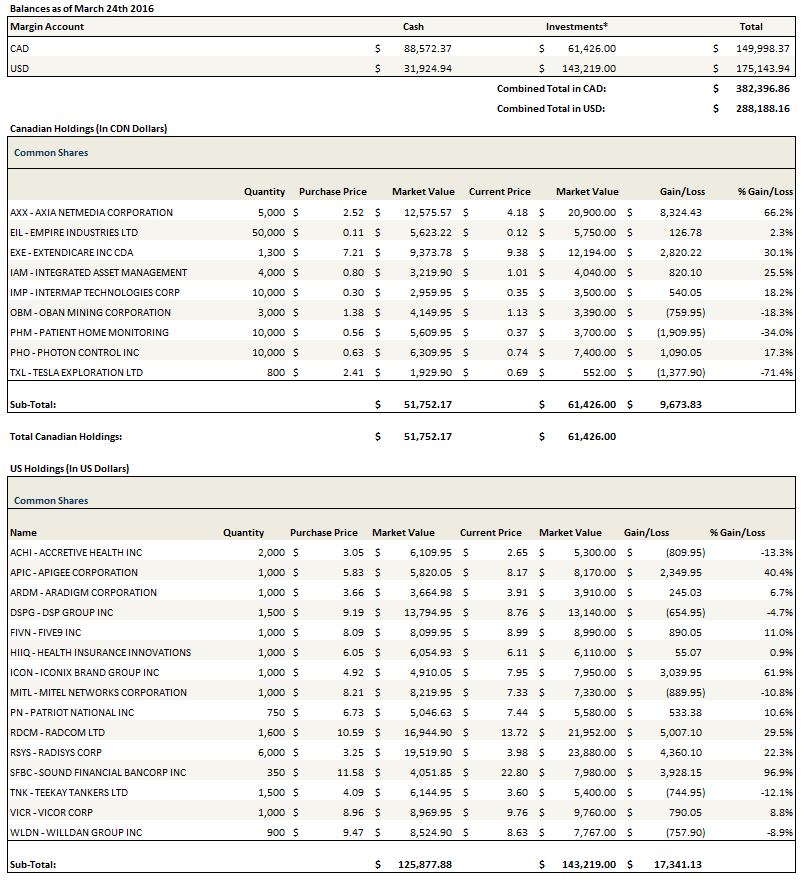
week-246


Week 231: Tax Loss Buying

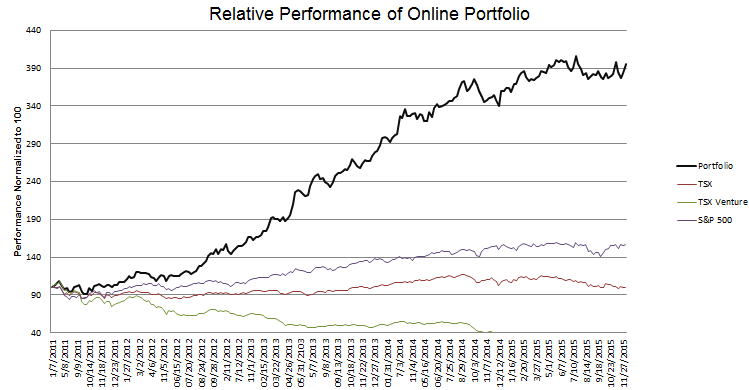
Portfolio Performance

week-231-yoyperformance

week-231-Performance


See the end of the post for the current make up of my portfolio and the last four weeks of trades

Monthly Review and Thoughts

I didn’t make a lot of trades this month.  I added a couple of beaten down stocks (Dixie Group and Iconix Brands), added to a couple of existing beaten down positions (Acacia Research and Health Insurance Innovations), added to a less than beaten down position (Axia NetMedia) and sold out of a few poorly performing positions in PDI Inc, Nevsun, Independence Realty and Hammond Manufacturing.  I also reduced two of the three out-sized positions that I talked about in my last update, New Residential and DHT Holdings on pops.  At this point the only really uncomfortably large position I have is in Air Canada, a stock that seems to do nothing but go down.

It is my experience that the last three months of the year can be very quirky.  The confluence of redemptions and tax loss selling leads to seemingly endless downward moves.  While its easy to describe this as an obvious opportunity when you limit yourself to generalizations or retrospectives, the reality is that it is not so easy to buy that which has collapsed when it goes down every day.

I have plenty of examples of stocks I am following that are examples of this. Most are either yield stocks or energy names of one type or another.

First the REITs.  I could pick from a litany of REITs here but I’ll focus on Northstar Realty because I know it fairly well.  The stock can’t seem to get out of its own way, having endless down days followed by briefing sharp rallies that are followed by further relentless selling pressure that can’t be overcome by even a 2% up day by the market like we had on Friday.  Northstar has a yield 15%.  The dividend is backed up by real estate assets, mostly healthcare and hotels.  On September 29th the company announced a $500 million buy back.  Given the current market capitalization of a little over $3 billion, this is not insignificant.  On the negative side, the stock is externally managed, something that seems to be the kiss of death right now, and its hotel properties have underperformed lately.  Risks for sure, but at what point are those risks priced in?

Another example is Navios Maritime Partners, a dry bulk/container shipper.  Navios cut their dividend in November from $1.77 to 85 cents.  They operate in an extremely tough market, but at the time of the dividend cut they made a strong case that the current level was fully supported by existing contracts with almost a 9 year period.  This outlook was confirmed in a solid analysis posted in Seeking Alpha.  The stock has went down relentlessly both pre and post dividend cut.  It’s at $270 as of Friday’s close so its about a 30% yield.

A third example that I just started looking at over the weekend is Suncoke Energy Partners.  Suncoke owns three facilities that turn coal into coke for steel making.   The company has a market capitalization of $300 million versus a tangible book value of around $500 million.  Earnings for the first nine months were $1.16 per share and full year estimates are $1.50 per share.  The stock trades at $6.59 at Friday’s close.  The steel industry is hurting and Suncoke’s partners are expected to shutdown mills that Suncoke supplies.  On the other hand Suncoke has take or pay contracts and their customers are large producers: US Steel, ArcelorMittal USA, and AK Steel.  So are they really doomed, as the stock price performance (down from $15 since August) suggests?  Or will the partners pay and this a great buying opportunity for assets that are temporarily impaired?

Here is one from the energy sector.  Surge Energy.  I’ve owned it before, in the late spring/early summer.  They are currently producing around 14,000 boe/d with 80% of their production being liquids.  In the first half of 2015 they generated $85 million of funds from operations with the oil price (including hedges) averaging a little less than $60.  In the third quarter they generated $17 million of funds from operations on an oil price of $41, so about the current price.  Capital expenditures in the third quarter were $17 million.  The company has about $140 million of debt, so less levered than most.  Is oil destined to float around the $40 mark forever, in the process sending basically the entire North American industry into bankruptcy, or will it eventually find a higher equilibrium?  If it does what will one of the survivors, as Surge would surely be, trade at?  At 5x cash flow on $60 oil Surge would be worth more than 50% more than it is today.

And one last one from energy infrastructure.  Willbros Group.  Management has been much maligned and struggled to turn a profit in the past.  This year, perhaps because of the pushing of activist investors, they’ve sold off a number of their divisions, raising cash and paying down debt.  With the recent sale of the Professional Services segment to TRC Solutions for $130 million they have reduced debt to under $100 million and they have cash on hand of $50 million.  With 63 million shares outstanding Willbros has a market capitalization of about $170 million.  They generated $2 billion of revenue in 2014 and this year, even after the sales of multiple divisions and the devastating downturn in the energy industry their revenue run rate is close to $1 billion.  The company will likely not be profitable until oil prices turn, but when they do there is a lot of leverage to margin improvement and incremental contracts.

So there are some names.  None are sure things, all can have cases made for and against.  My point is simply that at this time of year there tends to be real bargains, but pulling the trigger is a lot harder because there are also always real questions, and the answers are rarely clear.

The stocks I’m going to talk about below, with the exception of Axia NetMedia, all positions that fit into this mold.  These are stocks that have been beaten up, that have warts, but that I feel are overdone.  I just hope that I am right in more cases than I am wrong.

Dixie Group

Dixie Group is a company I have owned in the past, followed for a long time but held out from buying until it got to a price that I thought presented very little downside.

Dixie Group is a supplier of commercial and residential carpet.  They have 16 million shares outstanding at $5.50 for $88 million market capitalization.  They have $131 million of debt that consists primarily ($84 million) of a revolving credit facility that comes due in 2019.

Dixie Group has undergone a lot of changes in the last couple of years.  They made a number of acquisitions of high end commercial and residential businesses in 2013 and 2014, and have spent the last year digesting the capacity.

The results so far have been lukewarm.  Sales have shown some slight growth while the rest of the industry has seen slight declines.  But the increased scale has not translated into improved profitability.

Some of this is skewed by continued restructuring and sampling costs, and some of it is because there have been employee and quality issues that have arisen along with the capacity additions.

Revenues in the third quarter was $109 million which is flat year over year and up somewhat from the first half.  Ignoring working capital changes cash flow was in the third quarter was $8.4 million.

Even though the headline showed a big miss on both revenue and earnings, I didn’t think it was a terrible quarter in a lot of ways.

Gross margins were up to 26% which is a little above the 25% I had been hoping for two years ago when I was looking at the stock.  G&A is rising more than it should and this appears to be due to restructuring costs, increased medical expenses, consolidation of offices.  They introduced a number of new brands over the last few quarters and those new brands are requiring higher sampling costs.  So there are lots of one time things.

But I think that it is the quality problems that are holding back the stock the most.  They said the impact to quality in the third quarter was 1% to their gross margins.  While they suggested this would decline in the fourth quarter, they weren’t very specific about how quickly that decline would occur and implied it could persist into the first quarter of 2016.

I don’t think the market likes the uncertainty.  Heading into earnings the stock wasn’t that cheap if it was producing no earnings and EBITDA on a $20 million run rate.  But after the collapse from $9 to $5 much less is priced in.  The stock trades at a little under book value.

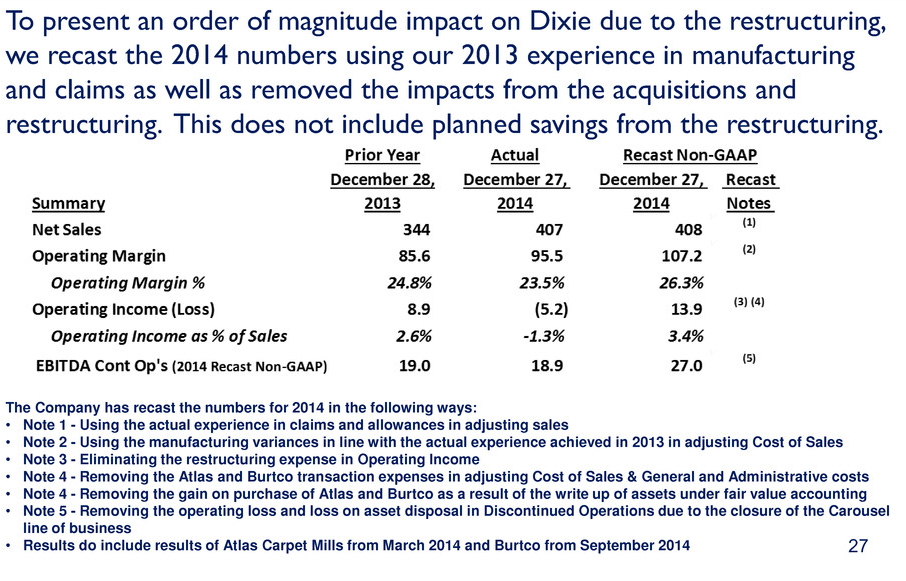
In their third quarter earnings presentation Dixie presented the following pro-forma to restructuring 2014 earnings.

proformarestructuringSo if the dust settles you are looking at a $27 million EBITDA company with a $219 million enterprise value.  So about 8x EV/EBITDA.  Its not incredibly cheap but with some growth the equity portion of that enterprise value could quickly grow back to the $9 level.

Now of course this is the carrot not a forecast.  I don’t know if Dixie will regain operating momentum, get past their integration issues, and begin to grow the business.  They have the capacity now to produce $550-$600 million of carpet.  They just need to find the customers.  What I do know is that at the current price their is not much expectation priced into the stock.  I think its worth a position, one of those stocks where if anything good happens its bound to go significantly higher.

Acacia Research Third Quarter

Acacia had a really bad third quarter.   Revenue was $13 million down from $37 million in the third quarter last year and a $44 million average revenue over the prior two quarters.

So the stock got clobbered.  For four weeks it went down almost every day, from the $9 level to almost $5.  Was it deserved?  Well, the thing about Acacia is that revenue is always going to be lumpy and one quarter does not suggest any particular trend.  The company generates revenues primarily through the settlement of patent litigation.  The nature of the business is that the counter-party in the litigation is unlikely to settle until the very last moment, usually right before the trial starts.  So Acacia’s revenue recognition is always at the mercy of court dates and negotiations.

The poor third quarter was due to delays on litigation on a number of their patent portfolios.  This quote, from the third quarter conference call kind of summarizes their thoughts on the quarter:

The third quarter developments created paradoxical outcomes. On one hand, our marquee portfolios were strengthened through Markman inter-parties review and new patent issuance wins, and now have even greater future value. But on the other hand, we experienced a delay in collecting on that value.

In particular, their Adaptix portfolio is going to trial against Alcatel-Lucent and Ericsson but that was postponed by a quarter.  This is because of the introduction of evidence that actually strengthened Acacia’s case but required delays for all parties to review.  They also announced that they had won two infringement cases on their Voiceage portfolio (HTC and LG), but that it would take time for a formal opinion from the German court that would lead to a settlement.  Subsequently, Acacia announced a settlement with HTC on November 17th.

Acacia’s business model is to partner with patent holders, applying their legal expertise in patent litigation to help the patent holder maximize the value of their asset.  On that note Acacia said that in the current environment they expected to be able to partner with other patent holders without putting up their own capital going forward.  The environment was a “buyers market”.

At a little over $5, where I was buying, the company was getting close to its cash level of $3 per share.  Even here at $6 it still doesn’t attribute a lot of value to the patent portfolio.  There are a couple of good SeekingAlpha articles that discuss the stock here and here.

Health Insurance Innovations Third Quarter

Health Insurance Innovations (HII) had a so-so third quarter. The revenue number was a little lower than I expected at $25.8 million versus the $28 million I had been hoping for.

But there are a number of changes going on at HII that make the story interesting enough for me to add to my position.   First is the development of an online insurance portal, AgileHealthInsurance.com.  They have had Agile up and running for a few months now, and reported that it had accounted for 1,300 policies in July and 5,800 policies in Q3 (suggesting it averaged 2,250 policies in August and September).  Second, through the addition of a number of former sales personnel from Assurant, HII has expanded their broker channel significantly.

Overall the business is progressing.  Total policies in force increased in the third quarter to a record 137,000, up 31.7% year-over-year and 21.2% sequentially.

The revenue recognition associated with policies procured online is part of the reason for lower revenue.   Unlike broker or call center procured policies, those come from Agile have revenue recognized over the full term of the policy while the customer acquisition cost is taken up front which in the short run will depress margins.

Going forward HII expects to gain from a shorter ACA enrollment period and the reality that premiums on ACA plans are “rising rapidly”.

On the third quarter conference call management seemed quite upbeat about how well they are doing through open-enrollment:

Our short-term medical, our hospital indemnity plans, they really fit the need and we’re seeing, unlike last open enrollment period, a dramatic increase in our sales. We can’t wait to share with you the fourth quarter results when we get to that point. This is for the first time, we’re really playing offense during open enrollment versus last year, we were playing a bit of defense.

The fourth quarter will be interrupted by the ACA period, which began in November.  Still, I think that if the company can put up a decent showing during this period the market will take notice.  Perhaps we are already seeing the start of that with the recent $1 move up.

Iconix Brands

It’s been a while since I have been drawn into a company with a recent accounting scandal.  And while I am wary that these sort of situations often go down far further than I expect, I also know that in many cases the eventual profit can be quite significant if you can get through the rough waters.

Iconix is a company that essentially rents out the usage of their brands.  They buy the rights of well known clothing and entertainment brands and then for a price licenses the usage of the brand by department stores and manufacturers.  Their portfolio of brands encompasses a wide variety of low to high end men’s and women’s fashions as well as well known entertainment brands like Peanuts and StrawBerry Shortcake.

brands

Its a pretty good business that has consistently generate 30% margins and significant free cash flow.

The company ran into problems earlier this year. In March the CFO resigned.  Two weeks later the COO resigned.  And then the biggie in August, the CEO resigned.  At the same time they announced their second quarter results and said that they would be reviewing the accuracy of past financial statements.

This was followed up on November 5th by a mea culpa by the new leadership team that past financials were not accurate and would have to be restated.  Shares which had already fallen from the $30’s to the mid-teens, got halved again to around $7.

What’s interesting though is that the accounting irregularities revolve entirely around the income statement.  Here is what the interim CEO, Peter Cuneo said on the third quarter conference call.

This review has identified errors regarding the classification of certain expenses as well as inadequate support and estimation of certain revenues, and of retail support for certain licenses. As such, we will restate our historical financial statements for the fourth quarter of 2013 through the second quarter of 2015.

A table detailing these adjustments was included in last Thursday’s press release. What should be emphasized is that the amounts of the restatements have no impact to 2013 net income. They do result in a small reduction of approximately $3.9 million or 2.5% to 2014 net income, and they are slightly positive for 2015 net income.

Further, these changes do not impact cash, do not impact historical free cash flow and do not impact debt covenants or securitized net cash flow as defined in our securitized financing facility. In fact, gross collections for our securitized brands are up 3% for the first ten months of the year, which reflects the strength and stability of the assets in the securitization.

Now that its down almost 80% Inconix, with 48.5 million shares outstanding has a market cap of about $325 million.  Iconix also has a lot of debt,  $1.47 billion.  Included in that debt is a $300 million 2.5% convertible that comes due in June of 2016.  Normally this convertible would not be an issue.  Given the company’s problems they may have to fund its repayment out of cash.  When I look at the cash on hand and cash flow they can generate from operations, they should be able to do that without too much problem.

The bullish story here is simply that once the accounting issues are behind them, what will be left is a company that generates significant free cash and trades at an extraordinarily low free cash multiple.  Iconix issued the following guidance for 2016:

We expect organic growth to be flat to up low single-digits driven by double-digit growth in our international business and U.S. revenue down slightly. We’re including no other revenue in our 2016 forecast.

Reflecting these expectations, our 2016 guidance is as follows: We expect revenue to be in the range of $370 million to $390 million. We expect non-GAAP diluted earnings per share to be in the range of $1.35 to $1.50 and we expect free cash flow to be in the range of $170 million to $185 million.

Free cash of $170 million is $3.50 per share.

There are hurdles to reaching that guidance to be sure.  On the third quarter call they said their mens apparal segment was performing poorly because of poor performance by Rocawear and Ecko, both mature brands that may be reaching end of life.

Also one of their biggest brands is Peanuts which is experiencing some headwinds.  Peanuts accounts for somewhere in the neighbourhood of $100 million of licensing revenue, so 25%.  While the recently released Peanuts movie has done fairly well in the box office and in ratings, it is suffering on the merchandising side because it has to compete with Star Wars for shelf space over the Christmas season.

Nevertheless, even with the debt, even with the accounting issues, it seems too cheap to me.  Unless there is something further that comes out on the accounting front I think the stock has to move higher at some point next year. It could go down more over the next few weeks with tax loss selling, but I can’t see it staying here for good.  The fundamentals, un-obscured by fraudulent accounting, just aren’t bad enough to justify it.

Axia NetMedia

I’ve owned Axia for years now and recently added to my position.  The company has 63.4 million shares outstanding, and at its current price of $3 they sport a $190 million market capitalization.

Axia owns and operates fiber networks in Alberta, France and Massachusetts.  Each of these networks supplies high speed connections to smaller cities and towns throughout the area.

Axia has already built fiber trunk lines that provide high speed connections to the major centers in each of their networks.  Now they are in the process of signing up homes and offices and building out fiber to individual customers (called FTTH and FTTO respectively).  The addressable market is over 1 million homes only counting the 20 largest of the 400 communities that the fiber reaches.

In Alberta they have completed at pilot FTTH in one community (Vulcan) and are in the process of ramping up in Drayton Valley and Lloydminster.  The package they offer (which I believe is via third party providers) is $59 per month for 25Mbps rates.  In Massachusetts they offer 100Mbps rates for $49 per month.

This doesn’t seem to me to be a bad package for small town households that previously were limited to slower cable or satellite connections that was intermittent or experienced outages.  Having lived in a small town and having had first and second hand experience of the existing internet options I can say that the following commitment would be a major step up:

We are confident that Axia provides the most reliable Internet possible. In fact, for business we commit to 99.9% availability and a maximum 4-hour mean time to repair in the rare event of a fibre cut.

You can view the Canadian and US plans here and here.

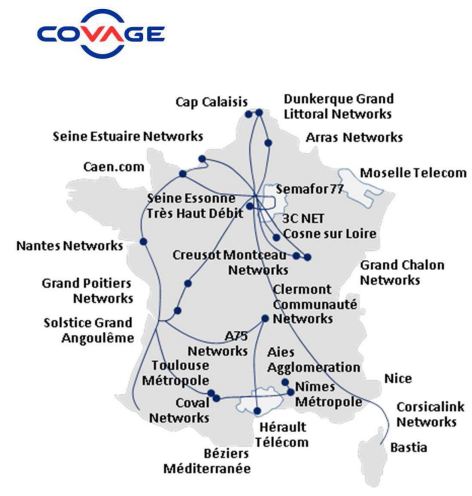
In France the opportunity for growth is even better than in North America.  Covage, of which Axia has a 50% ownership, has 10,600 km of fiber including 3,400 km of fibre backbone.

covagenetworkIn the third quarter Covage’s customer connections were up year over year 36% for FTTO and 61% for FTTH.  On the third quarter conference call Art Price (the CEO of Axia) said that “Covage has sustained growth on its existing networks and has tangible FTTO and FTTP opportunities that could more than triple Covage’s size.”

Subsequent to quarter end Covage won a large FTTO contract that encompasses an additional 22,000 businesses.  Covage currently has a little over 7,000 FTTO connections.  Bringing on 10-20% of these additional sites would mean a large uptick.

Earlier this year Axia won a contract to provide Fiber to Seine et Marne that will pass through 319,000 homes.  Right Covage has around 7,000 FTTH connections.  So think about that for a second.

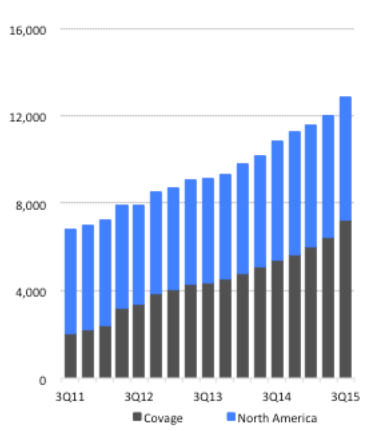
Right now they are growing steadily (see chart below) but the profitability of this growth is masked by the continued build outs of networks and connections.

connections


On the third quarter conference call they had a long discussion talking about the need for capital in the business they are in and what this means the eventual end game has to be.   I think its worthwhile reproducing the response in full:

Well, we’re looking at different options, and the way the company is harnessing the capital markets. I would say in the broad, we’ve been a company that is incrementally growing from a small size to a €200 million market cap size. But now we’re a company that has opportunities in front of us that are multiples of our current market capitalization.

And if we were just going to make the comment that where is this fiber infrastructure ultimately destined in the capital markets, well, clearly this fiber infrastructure is going to end up in billion dollar equity market cap, with capital structure that can issue its own bonds for debt. I mean that’s where this kind of investment ultimately ends up and we all recognize that.

So the question is what’s the path to get to that point? Is that path an incremental path similar to the one we have been on, but moving to a different shareholder class in a different size or is it some other path? And the Board is actively looking at that set of issues and looking at it in the context of the current market and looking at in the context of our investment opportunities having this sort of North American and France character, which some of the capital markets looks together at and other parts of the capital market look at that as segmented.

So we’re in that process, because besides the opportunity in front of us, in order to make those available or actually take those opportunities on, of course there is quite a bit more capital involved and our path is either we line up the company for that capital to rate shareholders’ evolution or we aren’t able to take advantage of the number of opportunities in front of us.

That’s a pretty interesting comment.  It basically says that they see the bottleneck and they are going to figure out what is the best way to address it.  It means they either are going to get the market to buy into the Axia story (and produce much larger share price) or try to find an acquirer with the financial clout to build out the infrastructure that they require to grow.

Either way it seems like a likely win for shareholders.  I think Axia is in the right place at the right time.  I’ve been adding.

Portfolio Composition

Click here for the last four weeks of trades.

week-231

Week 210: All about the 5-baggers

Portfolio Performance

week-210-yoyperformance

week-210-Performance

See the end of the post for the current make up of my portfolio and the last four weeks of trades

Monthly Review and Thoughts

A few weeks ago I was talking to someone who works at a large fund.   He was telling me about a retail clothing chain that their fund was interested in.  To help evaluate the opportunity, they commissioned a research firm to canvas and scout locations across the country.

That is amazing intel.  It is also wholly impossible for me to replicate.

I generally have a pretty good idea about a business before I buy into it.  I do a lot of work up front, far more than the highlights that go into these posts.  But I’m always left with elements that are uncertain.   For an individual investor with access to limited information and with limited time, certainty about one’s beliefs is more hubris than reality.

In the face of such disadvantages, my strategy is to take smallish positions and add to them if they begin to work out inline with my expectations.  If they don’t, I cut them.

By keeping my positions small until they start working and cutting my losses before they get big I guard against the big hit to my portfolio.  On the winning side of the ledger I generally end up with a similar number of winners that cancel out the losers.  But I also end up with 2 or 3 big winners that lead to out-performance.

It’s the 5-baggers that make the engine go.

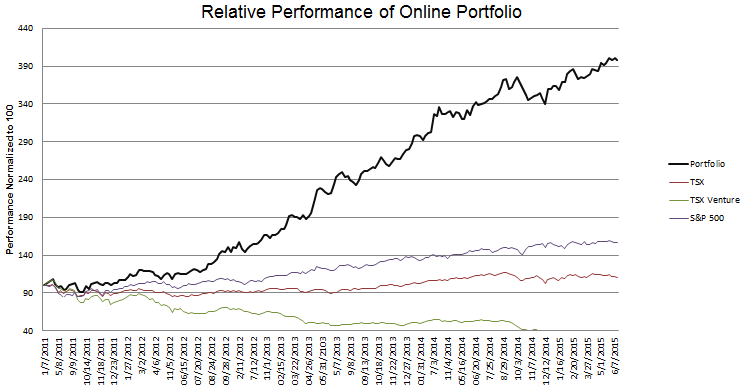
Another portfolio year has passed (I started writing this blog on July 1st 2011) and you can see from the results that the last year was not as good as the previous few.  I still did better than the market, but I didn’t do that great.

In part the under-performance was caused by not sticking to my rules.  I have already rehashed my failures with Bellatrix and other oil names in past posts so I won’t go into that again here.

But I also attribute it to my lack of “5-baggers”.  I haven’t had a big winner in the last 52 weeks.  I’ve had a lot of good picks (Air Canada, Axia NetMedia, PNI Digital, Extendicare, Radcom, Rex American, the second go around with Pacific Ethanol and so on) but only one true double and nothing that tripled or quadrupled.

Realizing how important multi-baggers are I’m sending myself back to the drawing board.  I’m not sure why I’ve failed to discover the big movers over the last year.  But I suspect that it is at least partially due to ignorance of the sectors that have had the momentum.

Up until recently I never owned a bio-tech.  I’ve stayed away from technology in all but a few exceptions.  I’ve only been in healthcare on a couple of occasions (one of those being Northstar Healthcare, subsequently Nobilis Health Corp, which I rather amazingly sold last October, at no gain or loss, literally days before it began a climb from $1.20 to over $10 in thee next six months).  Yet these sectors are where the big winners have been.

My attitude towards these and other outperforming sectors is going to change.  I have invested in a couple of bio-techs and in technology (shorts mind you, as I will explain later) and in the last couple of months.  More new ideas will follow.

What I Sold

Usually I discuss my new positions next.  While I have a couple of these, they are not significantly sized and my actions have been more weighted to the sell side of the ledger, so it seems appropriate to discuss what I sold first.

As I tweeted on a couple of occasions I have been skittish about the market over the past month and a half.  I sold out of some positions and reduced others when Greece went on tilt and announced a referendum two weeks ago.

Since that time as my worries have subsided I have bought some of those positions back. It doesn’t look like an immediate contagion is upon us, which was my main concern.  Still I’m keeping a healthy amount of cash (20%) and where I can I am short a number of stocks.

In what turned out to be an unexpected consequence of my recent research expansion, over the past month I spent a lot of research hours looking at short opportunities. Trying to take more of an interest in tech, I read through reports describing the state of business and dynamics at play in everything from telecom infrastructure to smartphone.  As I did I felt most of the near term opportunity was on the short side, and so I took positions there.

My tech shorts have been based on three-fold expectations: PC sales are declining faster than consensus, smart phone sales will grow slower than consensus, and rumors that the big data build out by cloud providers has been overdone will prove to be true and future spending will be scaled back.  Without going into the individual names, I’ve stuck mostly with the big players and mostly with semi-conductor providers, which seem to be the most susceptible to spending downturns.

I think however that this play has almost run its course.  I have been taking off some positions heading into earnings (for example I was short Micron going into their June quarter but took it off the day after earnings were announced), and plan to exit my remaining positions as earnings are released.  I don’t like to hold short positions too long.

While I have yet to take any short positions in healthcare, I get the feeling that the recent merger mania may be leading to valuations that prove difficult to justify once the feeding frenzy subsides.  I note that a top pick of Jerome Haas, who I have followed and found to be a solid thinker, was a short on Valeant Pharmaceuticals.

In my online portfolio, in which I cannot short, I sold out of my gold mining shares, my oil stock shares, some of my tanker shares (Euronav and Frontline), a hotel play (Red Lion), reduced my airline exposure in both Air Canada and Hawaiian Holdings as well as my Yellow Pages and Enernoc positions.

I also sold out of DirectCash Payments, though I subsequently added the position back later (at about the same price).  I really want to hold this one through earnings because its been beaten down so far and I still have doubts as to whether the first quarter is the secular harbinger that the market seems to think it is.  In the turned out to be an unexpected consequence of my recent research expansion

Similarly, while I sold out of RMP Energy, I bought it back (at a lower price) because I want to see their quarter before giving up on the stock.  Like DirectCash Payments, I question whether results will be as dire as the market suggests. In the same segment of his BNN appearance Haas also made DirectCash Payments another top pick.

I only added to a couple of positions in the last month.  Patriot National continues to execute on their roll-up strategy, buying up smaller insurers at accretive multiples.  The stock is up 40% from my original purchase (though in the online portfolio I forgot to add it when I originally mentioned it so its up somewhat less there) and I decide to add to the position since its working out.

Second, I added to my position in Capital Product Partners on what I believe is unwarranted selling on Greece.  The company is incorporated in the Marshall Islands, does not pay Greek taxes but does have offices in Greece, which is at the heart of the sell-off.  A scan of the company’s annual filings shows that their exposure to Greece is potentially some deposits in Greek banks and the risk that one or more of their subsidiaries could face higher taxes.  I don’t think that correlates to the 20% plus sell-off in the share price.

I also added two new positions to my portfolio.

Intermap

I have followed Intermap for years.  Its a company that my Dad owned. While it always held out the promise of a significant revenue ramp Intermap could never quite figure out how to monetize their world class geo-spatial data.

Then, a couple of weeks ago, the company signed a large contract with unnamed government for the implementation of a National Spatial Data infrastructure program.

For years Intermap was primarily a mapping services provider.  They owned 3 Lear jets equipped with radar technology that scanned and mapped large swaths of terrain.  They would land contracts to map out a country or region and be paid for providing that data.

The company always kept the rights to their mapping data and, over time, Intermap compiled a database of geospatial data for a large part of the earth.   This spatial database became a product called NextMAP.   The database can be accessed through commercially available GIS software like ArcGIS or web browser apps developed by the company. Customers can license either parts of or the entire NextMAP database for their use.

The latest version of the database, called NextMAP World 30, is “a commercial 3D terrain offering that provides seamless, void free coverage, with a 30meter ground sampling distance, across the entire 150 million km2 of the earth’s surface.”

Intermap has always had a leading technology.  But they have struggled with coming up with profitable ways of marketing that technology.   Over the last three years the company has been working on applications that can be layered over their basic mapping data.  They have a program for analyzing the risk of fires and floods (InSite Pro), a program for managing hazardous liquid pipeline risk (InSite Pro for Pipelines) and a program for assessing outdoor advertising locations (AdPro).

None of these niche solutions have resulted in significant revenue to the company.

The carrot has always been that they land a large government contract for the full implementation of a geo-spatial solution for the country.  Most investors have given up on this ever happening, but then it did.

The announced contract is for $125 million over two years, during which time Intermap will implement the infrastructure solution.  This will be followed by an ongoing maintenance contract valued at $50 million over 18 years.

When I saw the number on the contract I knew immediately that the stock would jump significantly.  Including warrants and options Intermap has 127 million shares outstanding.  So at the closing price the night before the deal was announced the market capitalization was around $10 million.  When it opened around 25 cents I figured the upside was only about half priced in, so I jumped aboard.

The implementaton of a full geo-spatial solution as per the contract will involve the implementation of the company’s Orion platform, which includes the company’s NextMAP data integrated with other relevant third party data and with applications for accessing and analyzing the data.   The platform will be used to help with decision making with infrastructure planning, weather related risks, agriculture, excavation, and national security.  Because this is basically a new business for the company, its difficult to peg margins or profitability.  So I’m not going to try.

Nevertheless, just based on the rough assessment of what $125 million in revenue would mean, at this point, with the current stock price of 50 cents the contract is probably mostly priced into the stock.  I maybe should have sold on the run-up to 60 cents, but I decided not to.

The company has suggested in the past that they have a number of RFPs in the works and some of those they have already won but cannot announce until funding is secured.  The upside in the shares is of course a second contract. That could happen next week or next year.  Its impossible to predict.

The other consideration, and something I have always wondered about, is why some large company doesn’t pick up Intermap for what would amount to peanuts, securing what is truly a world class data set and a platform that would seem to be more valuable in the hands of a large company with the resources to sell large projects to governments.  Somebody like an IHS comes to mind.

Pacific Biosciences

This investment idea is a little out of my normal area of expertise and consistent with my desire to expand my investing horizons.   Its an idea I came up with after reading  this Seeking Alpha article which I think does a good job explaining the trend we are trying to jump on.

PACB has 74 million shares outstanding, so at $5.20 (where I bought it) the market capitalization is $385mm.   The company has $79 million of  cash and investments and $14 million in debt.

They are in the business of gene sequencing.  Pacific Biosciences sells gene sequencing machines and related consumables for running tests to map an individuals gene in hopes of detecting a mutation that will diagnose the future susceptibility to disease.  The machine of course is a one-time sale but the consumables are a recurring revenue stream so the business has a bit of a razor-blade type revenue model to it.

The big player in the gene sequencing arena is a company called Illumina.  This is a $30 billion market cap company that did nearly $2 billion in revenue last year.  They dwarf Pacific Biosciences, which did around $60 million of revenue last year.

In fact I read that Pacific Biosciences has only sold around 150 machines.  One interesting thing from their presentation is that for each of the machines Pacific Biosciences sells, they generate about $120,000 of consumable sales a year.   Thus the opportunity for significantly higher recurring revenues is there if they can sell a few more machines.

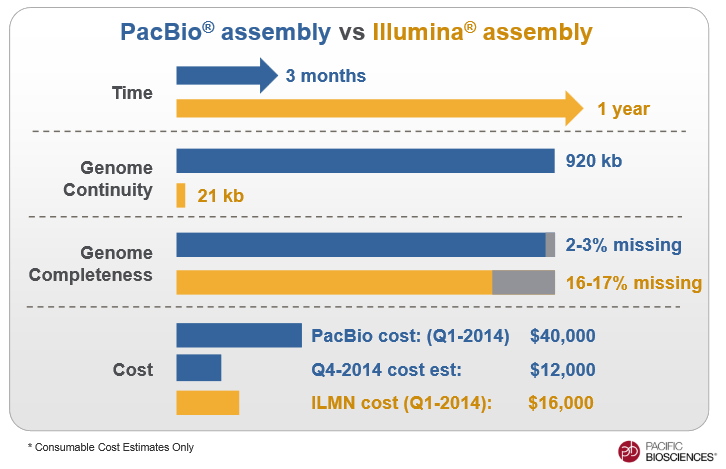
What seems to set Pacific Biosciences apart from Illumina is that their technology produces much longer gene sequencing strings which results in far lower error rates.  Below is a comparison between the two.

comparisonilluminaOne thing I am not sure of is where Pacific Biosciences sits compared to some of their non-public competition.  I was reading through some of the comments on a site called Stock Gumshoe that suggested that some private competition may have as good or better sequencing technology.

Pacific Biosciences also has an agreement whereby Roche will market their product for the diagnostics market in 2013.  In May Pacific Biosciences met the second milestone of that agreement.  The only thing that is a little disconcerting about this agreement is that Pacific Biosciences did not announce how much revenue they would be giving up once (and if) the product is commercialized.

My bottom line is that there are enough interesting things going on for me to speculate in the stock.  The key word being speculate.  There is a chance of wider adoption, there is a chance of an expansion of their relationship with Roche, there is maybe even an outside chance of a takeover.  And its an industry that is clearly growing, is in investor favor, and the stock was at a 52-week low when I bought it.

But I will flatly state that I would not take my comments about Pacific Biosciences too seriously.  My knowledge of this industry remains weak (though its improving as I read more).  They could be, or maybe even have been, surpassed by competition and I would not be the first to know.  So we’ll see how this goes and chalk up any loss to the cost of education.

Portfolio Composition

Click here for the last four weeks of trades.

week-210

Scaling back on Rock Energy

Third short post summarizing some recent portfolio moves.  First two are here and here.

Thoughts on Rock

Every once in a while you luck out and get in just ahead of the crowd. It doesn’t happen very often; usually you have to wait months before an idea begins to play out (ie. my extended comatose with Extendicare).  So when it does happen quickly, you have to enjoy it.

I first bought Rock back in August in the $1.60’s. I added to it in the $1.80’s and again in the $1.90’s. Two months later its sitting at $3.35 and has been as high as $3.70. That’s quite a move.

Nevertheless, the biggest thing that has happened to the stock between then and now are people waking up to it being cheap (I am told that Keith Schaefer for one, a newsletter writer, has apparently said some positive things about the stock).  And that gives me pause. Read more