I haven’t talked much about my investment in Equal Energy yet. The reason is probably a combination of factors. First, I haven’t been happy with the stock performance. Second, it seems that every time I try to sit down and write something substantial about a company, Europe implodes a bit further and I get distracted.
Equal Energy has been the most disappointing of my recent oil and gas investments. In retrospect the mistake I made was in jumping on a story that hadn’t begun to be told yet. Whereas Coastal Energy and Arcan are in the process of delineating their resource (and thus unfolding their story), Equal is not.
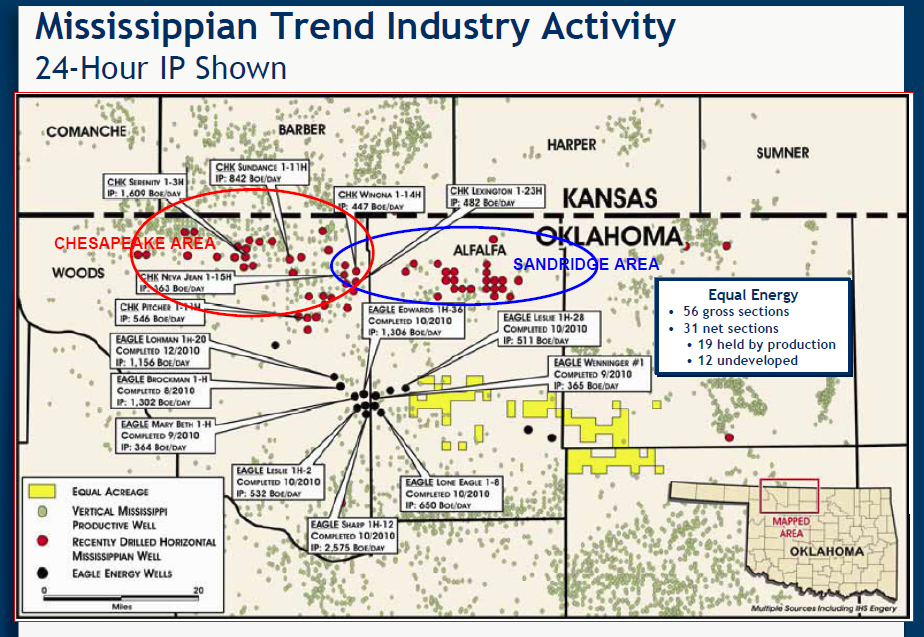
The Equal Energy story lies in its yet to be drilled Mississippian lands in Alfalfa, Grant and Garfield county.
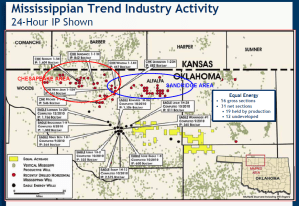
But when Equal will drill a well into the Mississippian I do not know. Management threw out a bone along with the Q2 MD&A when they said they “expect to test the Mississippian zone during the second half of
2011.”. But it could be a while before we actually see a horizontal well drilled.
I do not begrudge the company for moving cautiously on the Mississippian. Why not wait and let completion techniques get refined, well control in surrounding sections be further understood.
There is much to be gained from waiting and letting other companies do the early trial-and-error work.
But its not that much fun for an investor holding a languishing stock.
Apart from the Mississippian, Equal has 3 other plays that have the opportunity to provide short term upside:
- Gas-condensate from the Hunton in Oklahoma
- Oil from Viking in eastern Alberta and western Saskatchewan
- Oil from Cardium at lochend just west and northwest of Calgary
It is the Lochend I want to talk about here.
What about Lochend?
The Lochend play has always been the least interesting play of the bunch to me.
So why take the time to post on the subject? Well first of all, we need to understand all aspects of our investments; even those that may not be the crown jewel. Second, the technology of horizontal drilling is evolving, and so what might have been marginal in the past may be prospective in the future.
Marginal is good term to describe Lochend’s past. The economics of the Lochend have always seemed to be a weak sister to Garrington. There is much skepticism about its productivity, particularly whether rates can hold up over the long run. The net pay at Lochend is thinner than at Garrington. And while the overall Cardium zone is in the neighbourhood of 8-20m, only a portion of the pay is really prospective with recoverable oil. Unlike Garrington, the oil is generally thought to be only accessible from the Cardium “A” sands, with the “B” sands being too thin and too scattered to be productive.
Not helping matters is that all-in drilling, completing and tie-in costs are in the $3.5M to $4M range.
Equal has about 11 sections in the Lochend area, so its not a particularly large position for the company. But its not inconsequential either. To make a back of the napkin calculation, taking Equal’s 11.5 sections risked at 50%, assuming 4 wells per section and using Equal’s NPV10 per well of $2.3M, gives a risked NAV to the company of a little over $50M. A little over $1.50 a share. Not inconsequential but no home run potential.
The question that has always hung over Lochend has been whether that NAV is actually realizable.
There have been a number of data points lately that help answer that question.
Recent Drilling at Lochend
I got interested in taking a closer look at Lochend after reading the quarterly update from NAL. In it, NAL provided an update on their Lochend results, and it was a much more upbeat assessment than any the company had previously provided.
NAL highlighted one well in particular, the 3-17 well, and said they would be focusing on the land around that well.
The 2011 program at Lochend is focused around the 3-17-27-3W5M well from the 2010 program. The 3-17 well has now been on production for 12 months and is currently producing at a rate of approximately 200 boe per day, exceeding NAL’s Garrington type curve.
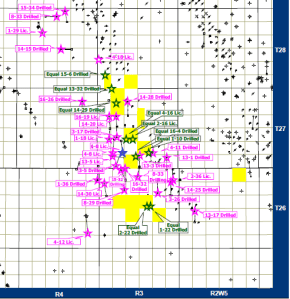
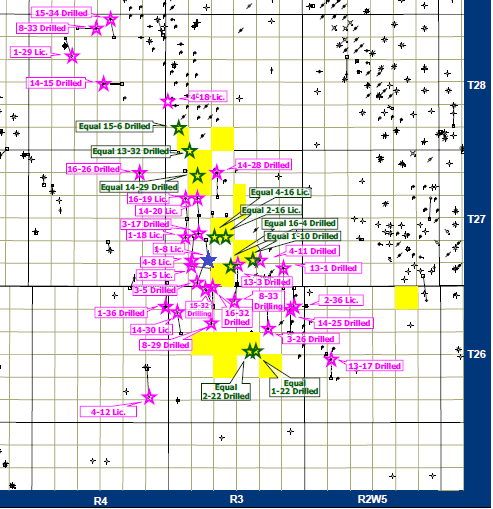
Its worthwhile to point out here that 03-17 is basically surrounded by Equal’s land. Below I colored the 03-17 well in a blue star, while Equal’s land are in yellow.
This has gotten some of the brokerages interested. Scotia had the following to say about the results.
We view the results to date at Lochend positively and with intrigue. The company has also signalled its interest with participation in a gas gathering line initiative in the area to enable future gas conservation, along with construction of its own solution gas handling facility with 2,500 boe/d of oil and 7 mmcf/d of solution gas throughput capacity. The update also notes the oil battery is expected to be operational by year-end, which should enhance operational efficiencies as the area continues to emerge. We note that our valuation of the area could have positive implications as the play continues to be de-risked.
My interest piqued, I did a bit of searching to see what other company’s operating at Lochend had been saying.
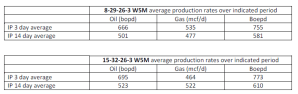
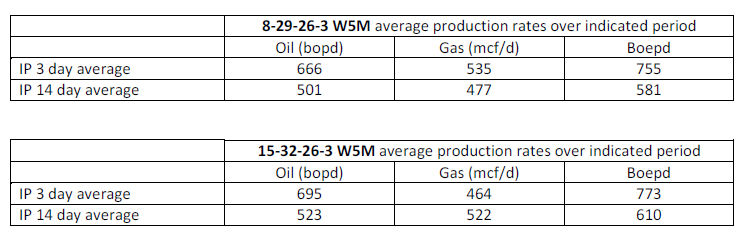
As it turns out, Tamarack Valley has also drilled a couple of Lochend wells recently. In an August 11th press release the company provided a table of the IP15 for the two wells drilled recently.
Tamarack Valley also provided some more detailed information on the play in their recent presentation (slides 11-12).
Trioil has also recently had some above expectation IP30’s. From their August 24th press release:
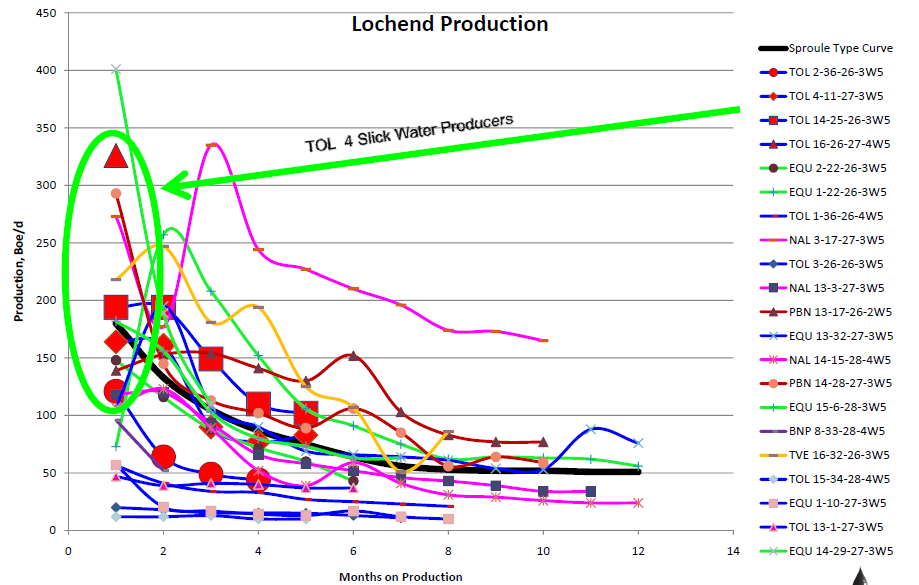
The well flowed at strong rates over its initial 14 days and continued to produce steadily once it was equipped. The well averaged 323 boe/d (86% light oil) over its initial 28 days of production. With the release of our most recent completion results, our four slick water completions to date have an average IP30 rate of over 200 boe/d, which is above our budgeted volumes.
Perhaps because they have essentially all their eggs in the Lochend basket, Trioil has been quite candid (promotional?) about Lochend in their company presentations. They posted the following profile comparison of all wells drilled at Lochend to date.
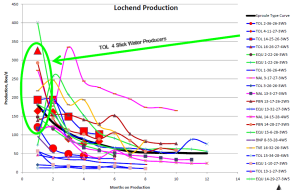
The important thing to focus on here are the 4 over-sized red curves. These represent 4 recently completed wells using oil (slickwater) fracs rather than water fracs. The point being made by the graph, and which was also made by both NAL and Trioil in their commentary on their Lochend results, is that the move to oil-based fracs has improved the economics of the play.
I decided to take a look and see if this was right.
Just how good (or bad) are the Lochend results?
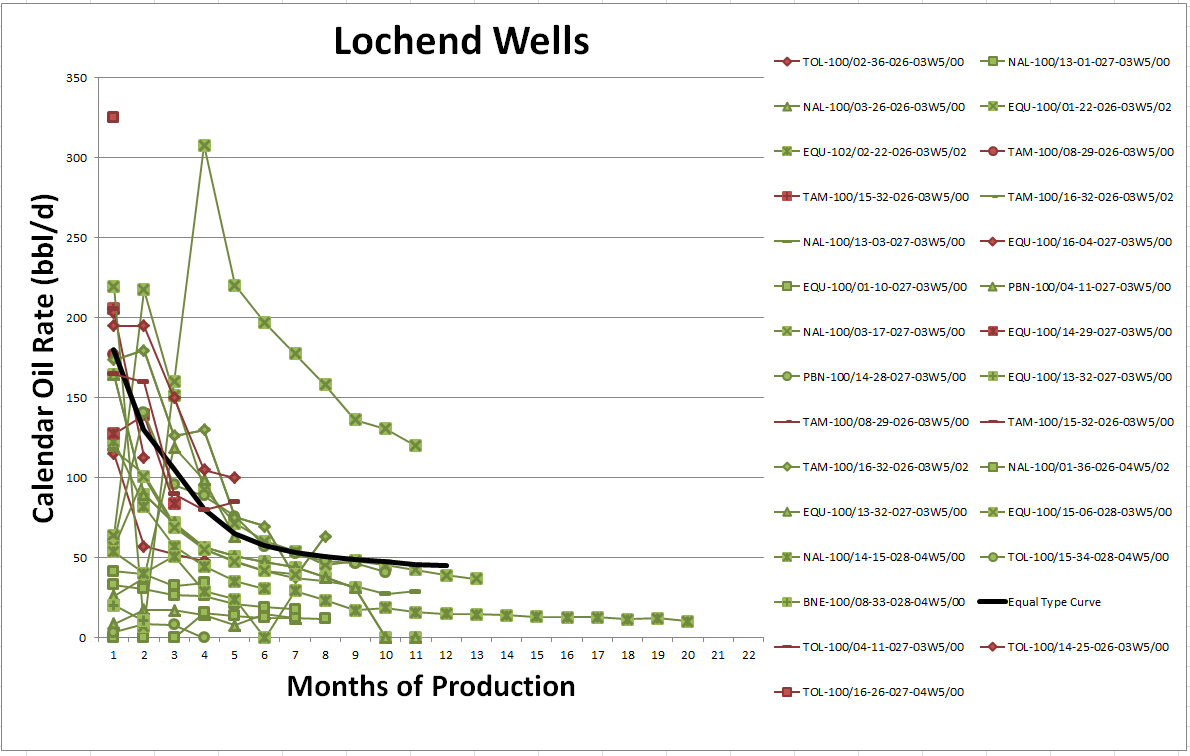
Below I graphed all the wells from Lochend (pretty much just like Trioil did).
Note that in the interest of time I just looked at the oil production. I didn’t want to spend the time to do the calculations on gas conversion needed to define a boe number for each well. Thus, when comparing the results to the type curve, keep in mind that the type curve does include associated gas, and so its somewhat higher.
In the following chart, I have color coded the production based on IP date. The purpose of the graph is to see if there is a positive trend in productivity. Wells that IP’d in Q2 and thereafter are in red. Wells that IP’d before Q2 are in green.
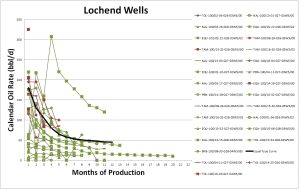
There does appear to be a significant improvement in results that has occured of late.
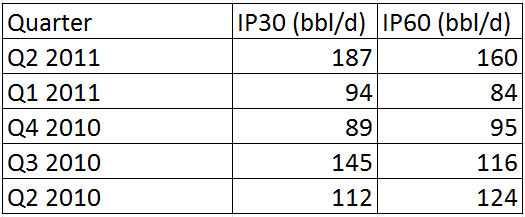
The same information can be gleaned by looking directly at the average IP30 and IP60 for Lochend wells.
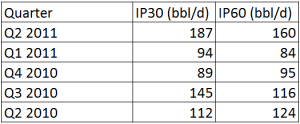
Clearly the move to the slick-water frac jobs has made a difference, at least to the early time performance of the well.
However, we have to be careful not to take this extrapolation too far. The reservoir is still the same as it was and that is, in the long run, what is going to dictate performance. At this point we have to limit our conclusion to the direct one: the slick water frac is producing higher early time production than the water based fracs that were employed previously.
It is tempting to extrapolate to the entire decline profile and shift the whole curve up. This may turn out to be valid, but I would be hesitant to make that extrapolation yet. 2 months production does not make a well. Moreover, the driving physics behind the first couple months of production is often quite different than what drives production later on. Only the near wellbore reservoir has been accessed, the results say little about how connected (permeable) the reservoir is in its extents. And it is that which will determine the performance over the next few years, and that’s what matters to the economics.
The second point that must be made that also tempers our enthusiasm is that even with these improvements, the economics of Lochend are still not tremendous. With the move to slick water it looks like the results are moving towards a moderate out-performance of the type curve. But the type curves showed only passable economics to begin with. Below are the NPV10 estimates from most of the companies in the region (note: PBN and BNP are too big and don’t breakout Lochend from their other Cardium plays and NAL doesn’t provide an NPV10 estimate).

The net result is some interesting progress worth following. But nothing yet that indicates a game changer.
So where are these high IP wells being drilled?
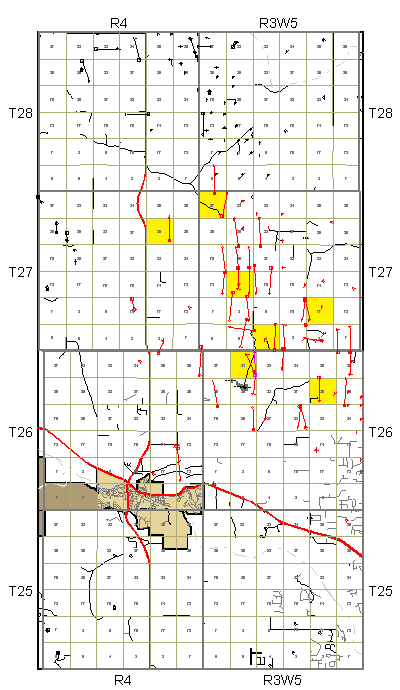
The next thing I thought it would be interesting to look at is whether there is a “sweet spot” at Lochend. Below I have highlighted in yellow any section that has had a well with an IP greater than 150bbl/d. Again I am only looking at oil production here.
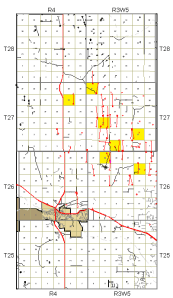 Not much of a pattern. The high productivity wells are scattered across the NW trend that goes from Township 26 to Township 28.
What’s Equal been doing at Lochend?
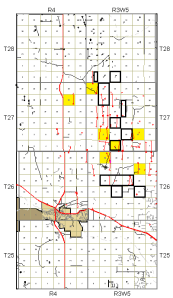
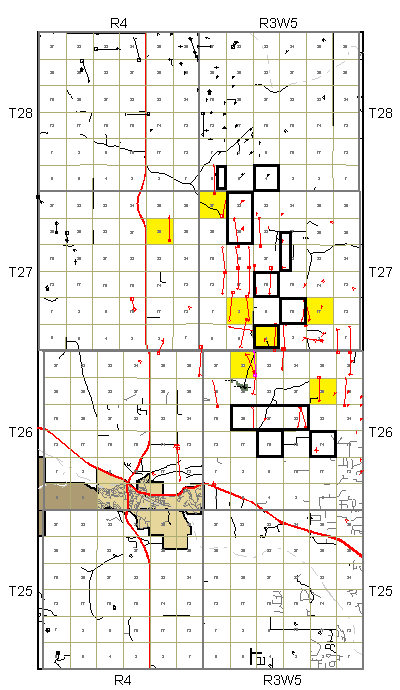
Equal’s lands are well situated with the trend. In the map below I have highlighted the sections owned by Equal with a dark black. You can see how they are mostly within the “heart” of the play. Also note Equals land surronding the 03-17 well, as mentioned previously. Equal has a number of locations defined in those sections.
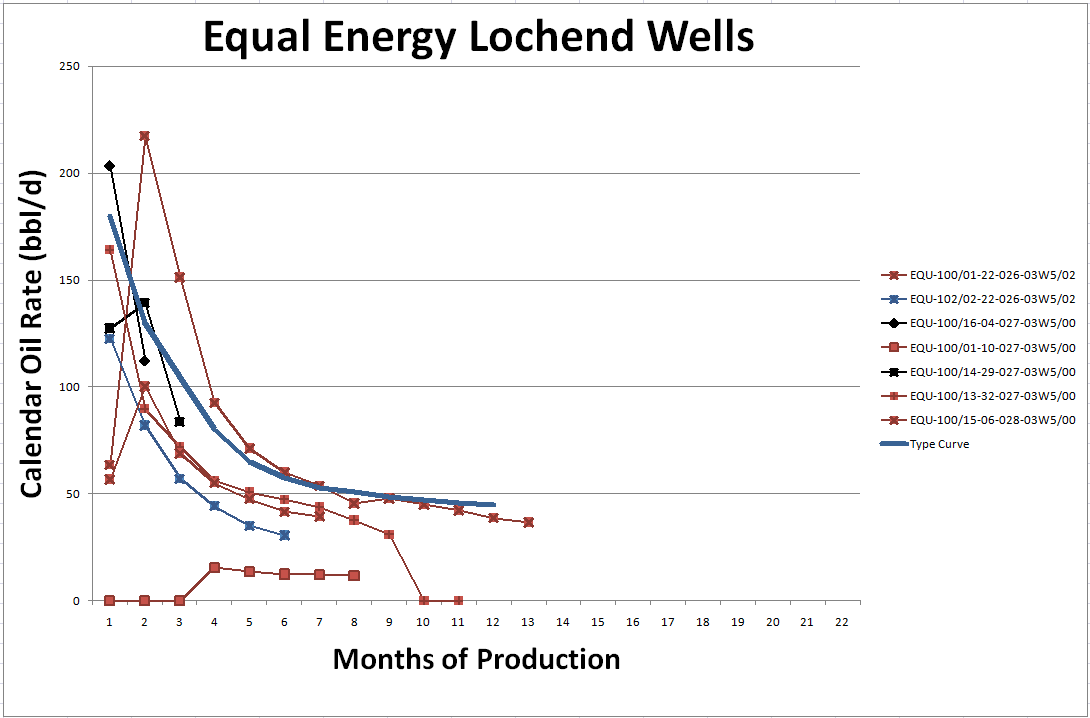
 Overall, Equal hasn’t seen results from Lochend that are as good as have been experienced by others, as shown in the chart below. They are so far mostly below the type curve provided by the company in their recent June presentation. But keep in mind most of these wells were drilled last year, and so most likely weren’t done using the slick-water frac.
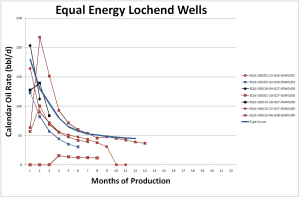
The one well that was drilled in Q2 did produce reasonably well. This was the 16-04 well. The 16-04 produced at a calendar rate of 203bbl/d (again that is oil; I’m not including associated reservoir gas in my estimate) for the first month, followed by a rate of 112.7bbl/d in the second month.
It all boils down to Economics
So what does this all suggest for Lochend economics, and for Equal in particular. I would draw the following conclusions:
- The slick water frac appears to be producing results above the expected Lochend type curve. But the Lochend type curve is not a terribly robust one ($2.3M NPV on a $4M CAPEX well is not great economics).
- Equal has land that is in the heart of the play and so one could expect similar average results from Equal’s land as what Trioil, NAL and Tamarack are seeing
- Even with the slickwater improvement, the combination of the still luke-warm economics and the uncertainty about whether the new slick-water wells will continue to perform as well as they have thus far means the play is far from being “de-risked”
I think Equal is doing the right thing with their upcoming drill program. They are planning only 1 well in the second half of 2011. Let’s get some more datapoints out there and let’s see if there can be further production improvements. Equal can drill up its sections once the uncertainty has passed.




 Reminiscences of a Stockblogger