Skip to content

Archive for

SB Financial: Like watching paint dry

This is the first of some short write-ups on the community bank stocks that I have invested in over the last month.  I mentioned in my portfolio update that I had thought the community banks taken a basket approach, buying 5 names (some of which I had already owned a small amount of in some accounts for a long time).   I’m not sure if I’ll write-up all of them, but I’ll try to do a couple.

My thoughts behind the trade are that pretty much all the community banks are going to benefit from a few tailwinds over the next year.  These are:

  1. Higher interest rates leading to higher net interest margin
  2. Lower taxes (most community banks pay over 30% in tax)
  3. Reduced regulations (reduced compliance costs)
  4. Better economic growth and a better environment for loans

I want to preface this write-up, by saying I don’t really know if any of the banks I have invested in are the best way to play a rise in community/regional bank stocks.  There are so many bank stocks out there.  I can’t possibly go through them all.  I have a list of about 40 that I looked at and I picked 5.  20 were small and 20 were larger names that I was looking at for baseline.  The stocks I bought were those that compared the most favorably.  They also seem reasonably priced to me.  But there may be (likely are) better ones out there that I just haven’t heard of.

I’m starting with SB Financial (SBFG), which is the new name of a long time holding of mine Rurban Financial.  I actually wrote about the stock first here, almost 5 years ago!  Its probably the name I like the best out of all the stocks I bought.

SB Financial operates primarily in Ohio with 18 branches, though it does have a branch and loan office in Indiana and another loan office in Michigan.
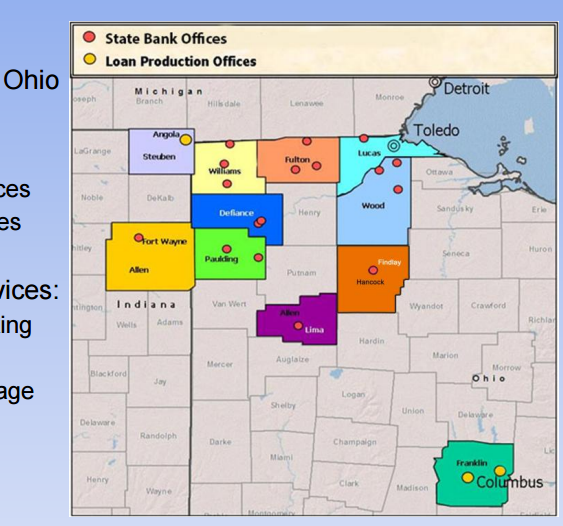
operating_area

Overall loan growth in the last few quarters has been in the mid-teens year over year:

total_loan_growth

In a 2015 presentation they describe their growth markets as Defiance, Columbus and Toledo:
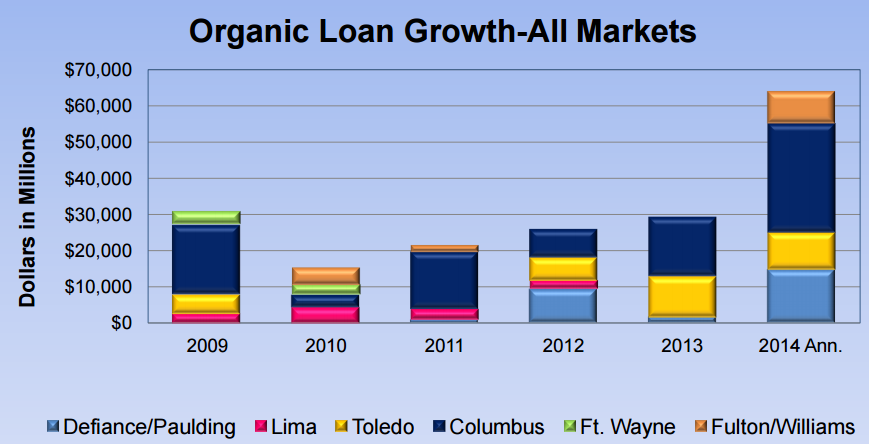
loan_growth_market

I haven’t found any newer data describing loan growth by market.

SB Financial is not as heavily into residential loans as some banks.  Only about 22% of loans are residential.  Most of their loans are either commercial, commercial real estate or construction loans. I know that construction loans are typically riskier, and the company does not break-out construction loans from commercial real estate from what I can see, so this might be seen by some as a flag.

Nonperforming assets are only 0.6% of total assets.  So at least their history is one of prudent lending.

SB Financial generates a fair bit of non-interest income.  Apart from the usual fee income, they have a mortgage origination segment that has been growing originations over the last year (up from $86 million to $117 million year over year in the third quarter).  While rising rates will have an impact on this business, on the third quarter call the company said that 88% of originations were new money, so refi’s are only a small part of the business. The company also holds a position in mortgage servicing rights that will perform well as rates rise, offsetting the impact of reduced refinancing.

Other non-interest income is generated by the asset management business. Assets under management (AUM) grew to $376 million in the third quarter, which is up 11% year over year.  Fee income was $700,000 for the quarter, so their fees are around 0.7-0.8% of AUM annualized.

To fund their loan growth the company growing its deposits by adding branches.  At the beginning of 2016 they expanded full service banking into Columbus.  On the second quarter conference call, they have pointed to a strong start for deposit growth in Columbus, up $5.8 million in first 6 months, 43% since the beginning of the year.  The company is planning a similar full service entrance into Bowling Green in the fourth quarter of 2016.

In the past few quarters deposits have been growing at a similar rate to loans, 15% year over year.
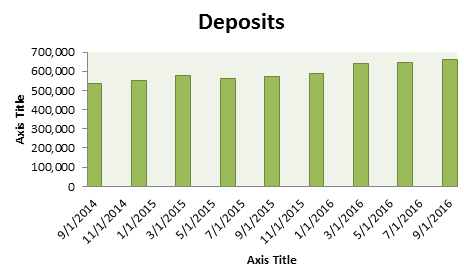
deposit_growth

SB Financial trades at 146% of tangible book value.  They have some goodwill on the balance sheet, which makes their price to book a little lower, 130%.  The P/TB is the highest of any of the banks I bought.  However they have been the best of the bunch at allocating capital.  Return on assets in the third quarter of 2016 was 1.28% and was 1.1% for the first 9 months of the year.  Return on equity was 11.9% and 10.3% respectively.  I have read that if ROA is above 1% and ROE is above 10%, the bank is doing a pretty good job.

The addition of new branches has likely been a drag to earnings.  The company’s efficiency ratio (this is the ratio of their operating expenses to revenue) was 68% in the first 9 months, which is average at best.  However as they build the branches I would expect this to come down.

The company reported $1.01 EPS in the first 9 months and 40c in the third quarter.  They trade at a little under 12x earnings on an annualized basis of the 9 month numbers.  That doesn’t seem unreasonable to me given the 15%ish growth that they are producing.

I’ve owned this stock for 5 years and its given me no surprises.  I don’t expect one going forward.  Its like watching paint dry, and that’s OK.

I expect the company to keep on generating returns on assets similar to the past, continue to build out its deposit base into new markets (first Columbus, then Bowling Green) and grow fee income through asset management and mortgage originations.  Simple story.  Hopefully with an additional boost from a federal government policy revamp the stock can trade up to 2x tangible book.
Week 286: On being wrong a lot

Portfolio Performance

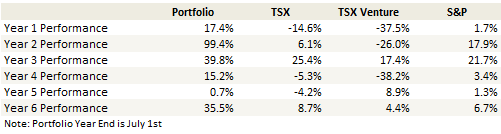
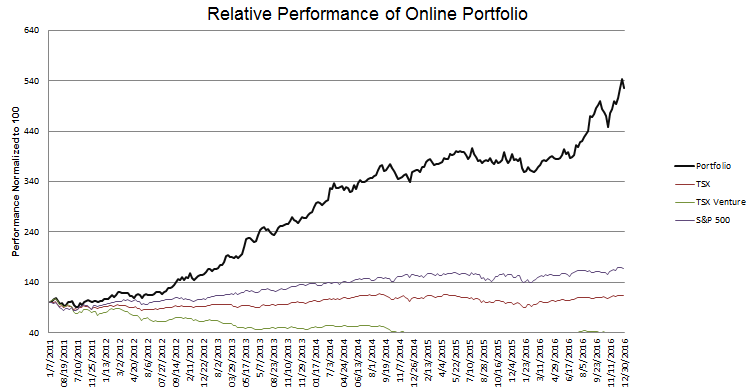
week-286-yoyperformance

week-286-performance

Top 10 Holdings

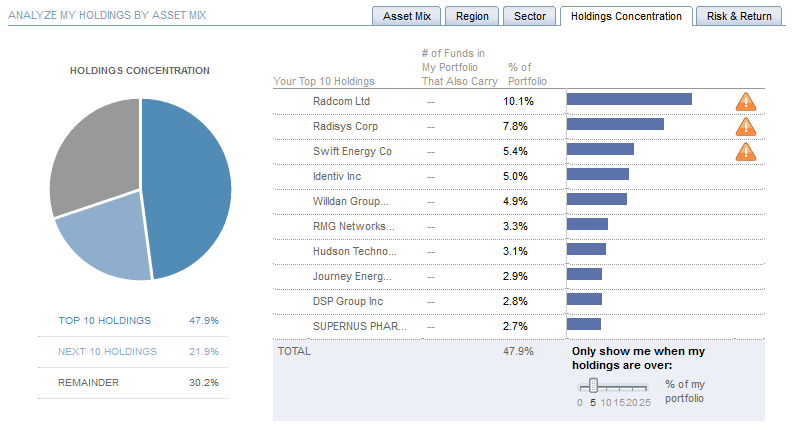
week-286-holding-concentration

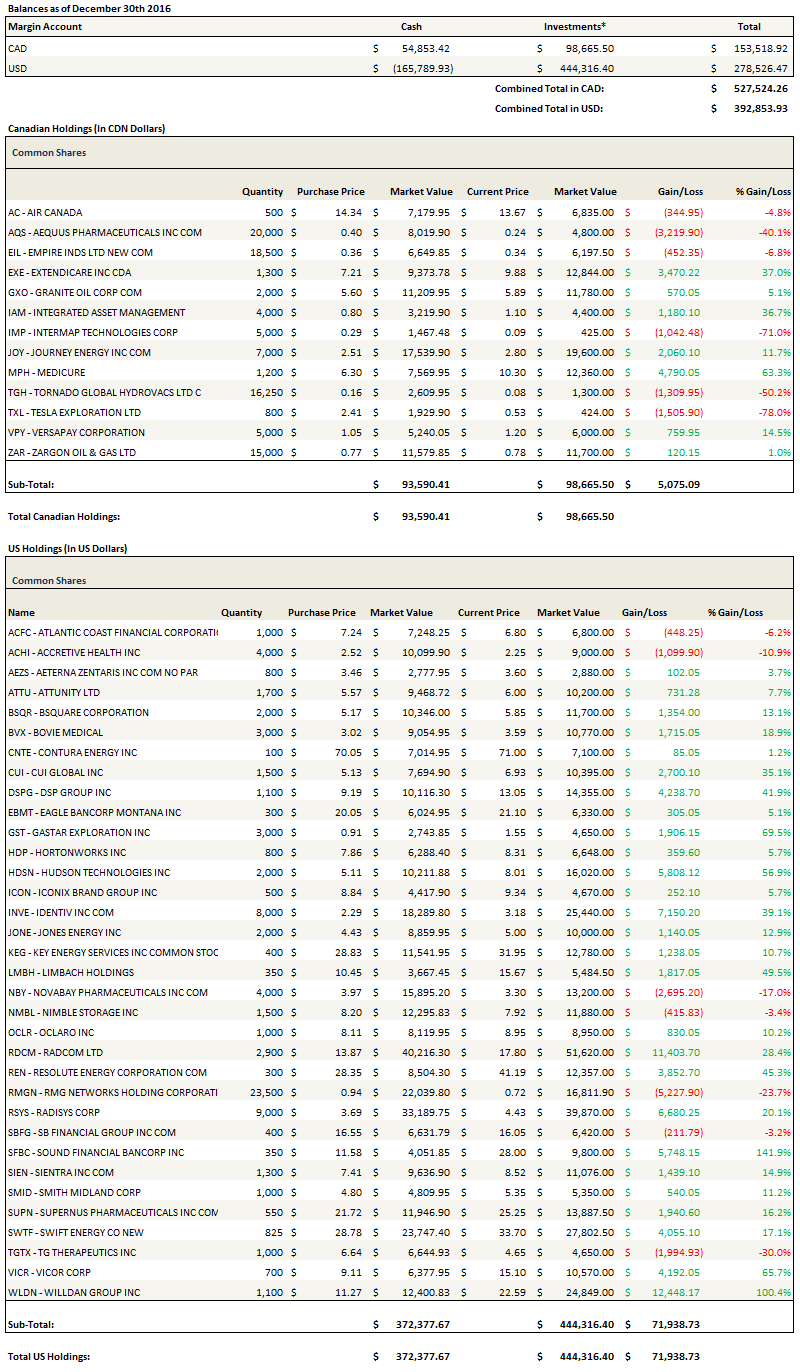
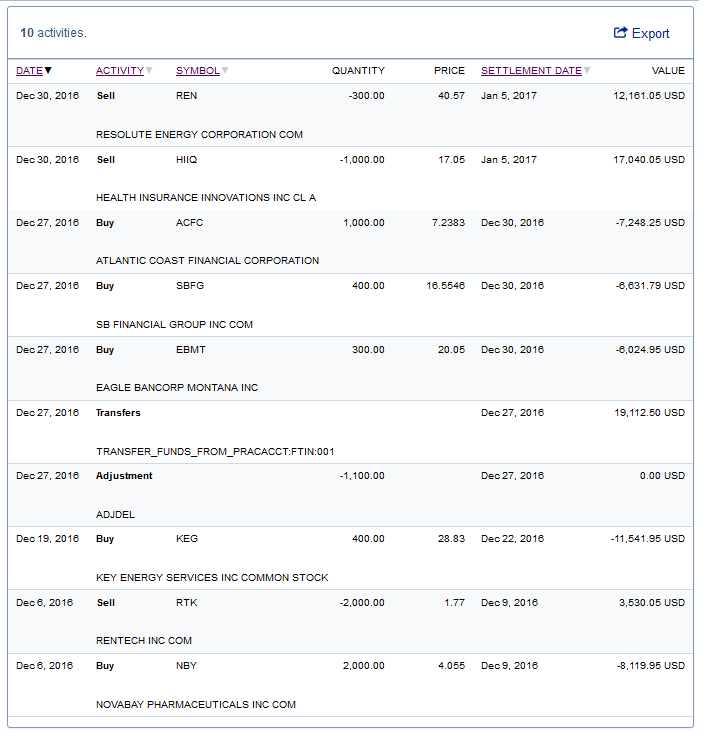
See the end of the post for my full portfolio breakdown and the last four weeks of trades

Thoughts and Review

The other day I was considering posting an article on SeekingAlpha.  I couldn’t muster the energy.  I wasn’t sure why, but I felt a strong resistance against it.

So I put it aside and in a couple of days it came to me why.

Take a look at my SeekingAlpha history.  I’ve written a few articles for it.  The list of names is, at best, uninspiring.  Hercules Offshore went bankrupt not long after I wrote about them.

The fact is, I’m wrong a lot.  At least a third of the time I pick a stock it doesn’t even go in the right direction.  In a bad market that number is likely well north of 50%.  And even when I’m right, I often miss by degree.  The last couple of months, while my portfolio has done pretty well, it would have done much better if I was not weighted most heavily in two positions that have done absolutely nothing (Radcom and Radisys).  My biggest winners are often afterthoughts where credit should only be taken with qualification.

If there is one redeeming feature about my strategy it is that I am fully aware of my own limitations.  I am never certain.  In my blog write-ups I try to phrase every position in terms of what might happen, both the positive and negative, with the expectation that I may have the thesis totally ass-backwards.  If anything, the limitations of the medium (writing) convey more conviction than I generally have.

This doesn’t play well when writing an article that is trying to convince others about what a great idea you’ve just found.  It might be, it might not. Who knows.  What I can say is that as long as I cut my losses quickly, it presents a pretty good risk/reward.  But I have no particular insight into whether its going to pan out or not.

It doesn’t make a compelling narrative.

Nevertheless after another pretty successful year, despite a whole lot of mind-changing and almost constant self-doubt, I can say that it worked pretty well once again.  To summarize:

  1. I freaked out in January when my portfolio lost over 10% in a couple of weeks.
  2. I only tentatively added back as the market bottomed.
  3. I sold out of the years big winner, Clayton Williams, about $100 too soon.
  4. I mostly missed anticipating the Trump rally apart from a position in Health Insurance Innovations and a couple of construction plays I bought in the days immediately following the election.
  5. (As I will describe below) it only donned on me that community banks should be firing on all cylinders in the last few days.

Yet I’m up about 35% since July (my portfolio year end) and about 40% in 2016 (though with the asterisk that it is with far less than $50 million in capital 😉 ).

Most occupations don’t tolerate excessive uncertainty.  I am fortunate to be involved in one of the few that reward it.

The last Month

Last month most stocks in my portfolio stagnated.  The gains I had were fueled by a few oil names (Gastar Oil and Gas, Jones Energy, Resolute Energy) as well as Health Insurance Innovations, Identiv, DSP Group, and a last day move back up by Radisys.

Health Insurance Innovations has been a big winner for me.  If only I had bought more!  The stock has more than doubled since Trump took office.  I sold some of my position in the last days of the year (I mistakenly sold all of it in the practice portfolio so that is why it doesn’t appear in the list below).

The second big winner has been Identiv.  Unlike Health Insurance Innovations, I have not taken anything off the table.  Identiv remains quite cheap, with only a $35 million market capitalization.  There is a rumor that after a presentation given at the Imperial Conference the company suggested some recent business with Amazon, which, if done in mass, could be quite a big contract for the company.  I have no idea if its true though.  The stock has pulled back in the last few days, but I’m not too worried.  As long as business continues along its current trajectory, the stock should do well in the coming year.

Key Energy Services

In mid-December I took a position in an oil services firm, Key Energy Services (KEY).  I was given the idea by someone in the comments section of the blog.  Key Energy operates a number of well services rigs, as well as having businesses in water management, coil tubing, and wireline services.  This is a tough business, and has been a disaster over the last two years.  At least 3 competitors in the space have been through bankruptcy.

At the time I bought the stock it was still trading in bankruptcy.  Similar to Swift, existing shareholders received a piece of the new company and warrants.

Since exiting bankruptcy in late December the stock has traded up quite a bit but I think there is still some value there as oil services demand rises.  What I remember from past cycles is how leveraged these companies are to improving fundamentals.  They gain on both pricing and volume. With both natural gas and oil moving up, this may be the first time since 2012 where Key Energy has had pricing of both commodities as a tailwind.

The company has reduced its G&A, reduced interest expense via the bankruptcy process, and is the first of  its brethren to make it through the restructuring process.

On the negative side, its a low margin business, I don’t get the sense that management was particularly astute heading into the slowdown, and in the current pricing environment even after restructuring they are still EBIDA negative.

Nevertheless I am willing to see if I can ride the cycle here.  Its probably no multi-bagger, but I am looking for a move into the $40’s where I would sell.

Community Banks

The last thing worth mentioning is that after a month and a half of rallying, and the astute comment of Brent Barber asking me why I wasn’t looking at them, I finally spent some time on the community banks.  Its soooo obvious, its painful to think that if I had spent a few hours on November 9th I would have quickly realized the same conclusion and ended up a number of dollars richer as a result.

Nevertheless, a good idea is a good idea.  Though the names I bought are up between 10-20% in the last month and a half, I still think they have much further to run.  I added positions in SB Financial (SBFG – former Rurban Financial, which I’ve talked about in the past and owned a small piece of of for some time), Sound Financial (SFBL – another bank I’ve owned for years), Atlantic Coast Financial (ACFC – which I have owned and written about in the past), Home Federal Bancorp of Louisiana (HFBL), Parke Bancorp (PKBK), and Eagle Bancorp of Montana (EBMT).  I took a basket approach because all of these namess are illiquid and difficult to accumulate in too much size.  I will write these up in more detail shortly.

Portfolio Composition

Click here for the last four weeks of trades.

week-286