Skip to content

Archive for

Research: Cardlytics

I was going to put this out on Friday and then I got bogged down with some other names and didn’t. It is too bad because I have a good take on it that it would seem much more clever if I had said it on Friday (before the vaccine news).

Nevertheless, what I was going to say then, and will still say, is that Cardlytics seems like a very good post-COVID/growth story to me.

The take is this. I think you can sum up the entire CDLX post-COVID bull thesis in this chart:
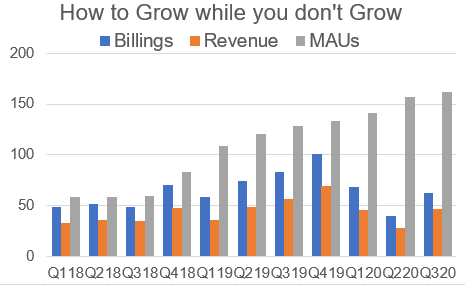
Cardlytics is continuing to grow its customer base as they expand their coupon/advertising platform with more bank customers. But their revenue is a mess because of COVID.

(for some reason Cardlytics almost never refers to what they do as offering coupons but it seems like that is basically what this is. Cardlytics offers coupons to bank clients that their customers can access through their mobile and online banking sites and when they do, Cardlytics takes a small fee).

I’m just thinking that when this all ends that revenue number is going to catch up to the MAUs. Probably pretty quickly I would think.

  • $2.5 billion market cap
  • net cash of about $100mm

What they do

  • operate advertising platform within financial institutions digital channels
  • they partner with the banks and get info about purchases and digital banking customers
  • they have access to 1 in 2 credit card and debit card transactions in the US
  • then they use this data to better target advertising to a whole bunch of merchants:

national and regional restaurant and retail chains, large providers of cable satellite television and wireless services, and increasingly, travel and hospitality, grocery, e-commerce and luxury brands

  • their financial partners include:

Bank of America, National Association (“Bank of America”), JPMorgan Chase Bank, National Association (“Chase”) and Wells Fargo Bank, National Association (“Wells Fargo”) in the U.S. and Lloyds Bank plc (“Lloyds”) and Santander UK plc (“Santander”) in the U.K

  • they have MAUs of 122.6mm – who are the users though?
  • they make a very small amount per user – $1.72 in 2019 – and this is down quite a bit from $2.30 in 2018

Competitors

  • they are the only company that enables marketing through FT
  • from ML conference in June:

The challenge you have is, first of all, we’re new. No one’s ever seen anything like us. There is no real competitive set. So you can’t say, oh, we’re just like X. And when advertisers want to spend with us, the money has to come from somewhere else. And so it is a slow process to get advertisers to understand the power of our platform and to use it and then to adopt it in a really big material way. But what’s really accelerated that process is scale. The thing is, before we launched Chase and Wells, we only had about 50 million monthly active users, and that made us a very small digital platform compared to the others that are out there.

The competition there is, like the Amex example below, is not targeted:

ML: obviously, there’s no direct competition for your inventory because you’re the only one who allowed that inventory. But there are analogs. You do have Amex offers out there. And if I look on my Amex offers right now, I happen to be a BofA customer and an Amex customer, on my Amex offers right now, I have a 100 ad units available.

CDLX: remember, all of our offers are targeted. So if you’re not using your card in the category, you’re not going to get the offer. Amex offers and I believe my knowledge should be accurate, but I don’t want to represent Amex in any way, but Amex offers are not targeted. Everybody gets the same set of offers. And so as a result of not being targeted, they also don’t generally have material revenue, if any revenue, associated with those offers. So the Amex model is very different from the Cardlytics model.

Revenue

  • comes from the marketers
  • they collect a small fee each time a transaction is made using one of their coupons
  • their revenue is gross the share that the FI takes – so that is why gross margins are low-ish – in 45% range

Q320 Results

  • billings down 25% yoy, revenue down 18% yoy
  • prior to Q3 they had every Hotel exit the channel, signed up for a “recovery campaign” in Q3
  • also in recovery campaign with one airline partner
  • Wells Fargo continues onboarding – contributing to MAU growth of 26% yoy – also saw growth from existing partners
  • planning to launch with US Bank soon – first half of 2021
  • for Q420 expecting billing of $79mm to $89mm and revenue of $55mm to $62mm – this would be down 10-20% yoy
  • they have developed a self-service tool for agencies – have two test agencies on it, are expanding customers from those agencies in Q420
  • they did a $230mm convertible at 1%

Research: More Digging on Silvergate

More of a dive on Silvergate. The stock has moved quite a bit now, so can’t really justify it as a “bank” like a few weeks or months ago.

But still, I’m reluctant to sell because you can still justify it as a “fintech” or whatever other trendy term you want. The revenue growth here is fee income, which is not really tied to the traditional tethers of a bank. If they grow the number of customers, grow members on the platform then fee income grows and its not really as important what the tangible book value is.

Also, Bitcoin has been going up, so there’s that.

  • market cap of $523mm
  • book value of $277mm

Operate Silvergate Exchange Network

  • entered space in 2014
  • Silvergate network was created 3 years ago
  • was originally just a way of gathering deposits
  • proprietary, virtually instantaneous payment network for participants in the digital currency industry
  • offer holding deposits of CC for exchanges, institutional investors, and stablecoin issuers (I think this is other in their segments)
  • so it’s a real-time, 24hr payments platform that lets you send USD from one exchange to another in a simpler and lower cost way
  • for example if you are an institutional investor, you may want to be switching dollars between exchanges for trading strategies, SEN lets you do that with little friction
  • also as exchanges, if investors move from one to the other, or trades occur from one to another, they can swap deposit dollars via the platform
  • notable exchange customers are: Coinbase, Genesis Kraken, and Bitstamp
  • one thing they do is allow their clients to receive USD payments in scalable fashion, quickly and programmatically
  • they don’t charge for use of SEN, so the fee income is from traditional banking of those deposits – wires, ACH, foreign currency exchange
  • want to keep barriers of adoption low
  • they do talk about charging for SEN though
  • the foreign exchange product is relatively new – they have launched it in the last year or so
  • foreign currency product took “a lot of work that goes in upfront to establishing correspondent banking relationships with other banks around the world, so we can trade currencies directly with them. But there’s not a significant additional technology spend that needs to happen there”
  • they have launched direct access to Swiss fran and euro
  • their wire and ACH fee is competitive (ACH stands for automated clearing house)
  • in Q220 when fee income was $2.4mm, primarily that was from ACH and wire transfers
  • fee income will track underlying activity in the CC markets
  • biggest of their exchange customers is JPMorgan Banking
  • the deposits from SEN are volatile – exchange and institutional deposits could leave at any time, don’t want to be investing in long-term assets – mortgage warehousing is a good complement to this

SEN Leverage

  • also have SEN leverage – this allows customers to get USD loans collateralized by BTC
  • can be used to lever the long book, but also to execute trading strategies
  • they launched this in Q120
  • two strategic partners for Sen Leverage – Bitstamp and Anchorage
  • bitstamp is bitcoin exchange in luxembourg, been around 4 years, seems like it is was one of more secure exchanges
  • Anchorage is DC asset platform/custodian for institutional investors, their website doesn’t work well, were written up in techcrunch,
  • don’t expect to develop their own custody services, will use these partners
  • with Anchorage – so Anchorage safely stores the bitcoin, monitors value, interacts with customer on loan draw/repayment, Silvergate services the loan
  • but I get the impression they’d be interested in acquiring one – they see having one as “table stakes” for institutional investors
  • expect to start small with SEN Leverage – less than 100% of capital – so less than $400mm
  • use example of 6000 institutional investors, if each wanted a $0.5mm loan, would be $300mm
  • they are limiting growth in this business though, they could grow faster if they wanted to
  • they yield opportunity on loans is in mid-high single digits
  • make comp to Genesis Capital, which is lending off of Bitcoin collateral:

a firm called Genesis Global Capital. And they announced at the end of the second quarter that they have about $1.4 billion outstanding in a loan portfolio related to digital assets. And Genesis has said publicly that they have about 50 clients that are making up that $1.4 billion number. So as we think about the opportunity for Silvergate, we have those 566 clients that you mentioned, Eugene. And most of those clients are looking for some type of capital efficiency or leverage on their bitcoin. So if you just took a round number and said, 300 of those 566 would be looking for, and I’m just making that number up, but looking for the loan product, and then you say, if it’s $1 million, then it’s a $300 million opportunity. If it’s $10 million, then it’s a $3 billion opportunity.

  • saw 68,361 transactions, volume of $36.7b – this is up 70% and 65% over Q220
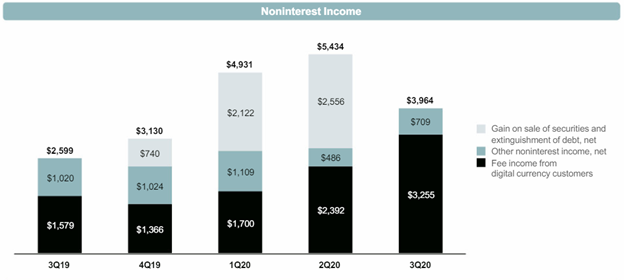
  • Digital currency fee income of $3.3mm – up 36% compared to Q220
  • say they have over 200 prospective digital currency customers
  • Digital currency deposits grew by $586mm to $2.1b in quarter – most of their deposits are digital curency, about 90%
  • overall NII was down but that was because of no GOS:
  • their fee income is exploding
  • consider that net income for the quarter was $7mm and they had fee income from digital currencies of $3.2mm and that is increasing at $1mm per quarter right now
  • meanwhile their non-interest expense barely moved, up about $150k qoq
  • ROA was 1.13% in the quarter, ROE was 10.14% – these seem like decent numbers even if you are buying it at 1.5x book

Q220 Results

  • experienced highest volume of wire transfers ever
  • deposits were down quite a bit – from $2b in March to $1.7b – they said this was caused by bitcoin volatility
  • their securities portfolio, which is large, has yield of 2.67% – balance $964mm
  • had about 13% of loans in deferrment
  • they mentioned SEN Leverage – could do $1mm to $10mm loans for the 566 institutional investors, they won’t grow that fast though
  • sometime in Q220 the gov’t announced that banks could be custodian for digital assets
  • this is important – need ability to custody an asset to be able to lend against it
  • have pipeline of 200 prospects that want to onboard with them
  • don’t see pressure on existing deposits because we are in 0-interest rate environment, they have seen pressure in the past when competitors willing to offer interest
  • have been investing in tax-exempt munis – they see some dislocations from COVID, have had experience in other banks with munis, looking to build portfolio, take advantage
  • JPM entering the space – they see as positive for industry, validation of their strategy
  • JPM providing banking to Coinbase and Gemini – both of these are clients of Silvergate
  • their exchange partners want to have multiple banking relationships
  • comments on the OCC announcement allowing banks to be custodians:

the OCC announcements and providing custody, it’s one thing to — for the regulators to come out and say that, yes, that is legally permissible. It’s quite another thing to spin up a custody service for digital assets. And one of the primary differences here, and it’s — at times, a difference that is lost on folks is that with bitcoin and other cryptocurrencies, these are bearer instruments. So the custody regimen that needs to be put in place to safely store a bearer instrument is quite a bit different. Especially a bearer — a digital bearer instrument is quite a bit different than the existing custody solutions that exist in the traditional financial markets. And so those that have been working on this for a while, and there are certainly a plethora of digital currency custodians that have been working on this, I think they’re very well positioned.

  • there are players trying to move into full-prime offerings – this is basically becoming a prime broker to digital assets
  • Silvergate sees a big part of prime broker business being able to deliver loans on the assets and that is area they are focused on
  • talked again about acquisitions to fill out that suite of services for customers with digital assets

Q320 Results

  • Silvergate exchange transactions up to 68,361 – 70% increase qoq
  • their network handled $36.7 billion of transfers – up 64% qoq
  • they generated fee income of $3.3mm from these, up from $2.4mm
  • overall though, non-interest income was down qoq because of no GOS of securities
  • they did have some fees from mortgage warehousing
  • so on a per transaction $ basis fees were $.00009/$ transferred (was about $0.0001 in Q220)
  • on per transaction basis was – $47/transaction (was about $59.50 in Q2)
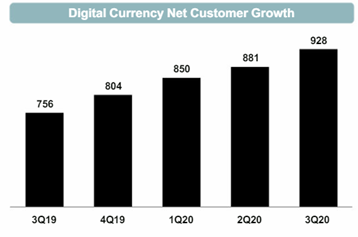
  • digital currency customers u to 928 from 881
  • digital currency deposits up $586mm – to $2.1b
  • started up “SEN leverage” – completed pilot, have approved LOCs of $35mm, up from $22mm in Q220
  • exited pilot on SEN Leverage in Q320
  • $15 book value
  • NIM was 3.19%, which is upfrom Q220 but down from Q319 (3.39%)
  • they hold a lot of securities – of $2.42b of interesting earning assets about $930mm of them are securities
  • I don’t really see much in the way of Noninterest expense
  • 95% of deposits are non-interest bearing
  • pretty much all of these deposits are digital currency deposits
  • they really saw an increase in onboarding of institutional investors with big money – so in Q220 they have 566 investors with $577mm – so about $1mm per investor – in Q320 they onboard 30 and increased deposits by $270mm – $9mm per investor
  • their loan book is residential, commercial, mortage warehousing
  • LTVS are 53% for commercial and MF, ad 55% for SF
  • they have very small NPAs – 0.16%
  • they have $143mm, or 19% of loans modified – consisted of 56 loans – but down to $32.7mm at end of Q320 – 4.4% of loans
  • on the CC one analyst (Block Research??) explained recent developments:

Just the announcements that have come out even in the past few weeks, whether that’s SEC’s second interpretive letter on banks holding reserve assets behind stablecoins, corporate treasury balances into bits from some companies, PayPal, obviously, last week. You mentioned not providing guidance on SEN volumes per se, and we talked about the strategic rationale for not charging for SEN.

Barclays Conference

  • not much new here
  • on MicroStrategy:

And then when you think about sort of what’s going on in the macro environment in terms of fiscal and monetary policy, what we’re seeing is we’re seeing macro investors look at the asset class and make an allocation to bitcoin. And I guess 2 of the examples that I would highlight are Paul Tudor Jones earlier in the year, and then recently, a publicly traded company called MicroStrategy that trades on the NASDAQ. MicroStrategy, I think, sort of took everyone some — for a surprise in the sense that they’ve looked at — they’ve clearly done their research on bitcoin. And just this morning, announced that they’ve upped their allocation in bitcoin to $425 million. To put that number in perspective, they have a total market cap, they trade on the NASDAQ, and their market cap is about $1.3 billion. As of quarter end, I think their total balance sheet was about $850 million.

Smith-Micro

I took a position in Smith-Micro after their quarter was announced Wednesday. This is probably the third (or fourth?) time I have owned the stock.

This is not a perfect situation to buy but I decided the positives outweighed the negatives.

The negative – a big one – is that revenue is not going the right direction. In particular, Safe & Found revenue is dropping. Their expected quarterly (!!) churn on Safe & Found in the fourth quarter is 7-12%, which is not good. There are some mitigating factors here, like the merger of T-Mobile and Sprint which is probably uprooting their customer base, but still.

So why did I decide to buy the stock? Because when I read through the transcript, it sure sounds like multiple new customers are very likely in the next couple of months. They talk about “multiple opportunities”, how they have added features “that are required for new accounts”, how they will need all their new people (70 hires) for new deployments in the first and second quarter, and he did not disagree to the comment “you’ve talked pretty confidently about at least a couple in the next 30 days, perhaps a third one by year end.”

It just seems that this is one of the few stocks that has not moved post-COVID and so 2 or more announcements of new customers in the next couple of months could be fair catalysts. If they don’t happen or if the response is muted, then I should be able to exit the stock before we get any more data points on those scary churn numbers.

Research: A Few Names, Kopin Industries

So. Many. Earnings reports. This is the week of the quarter where it is a little overwhelming to go through all of the earnings reports hitting my email. I think it is worse this year because of the election – all the companies that would have normally released results Tuesday delayed it a couple of days to Thursday, so yesterday morning and evening was a deluge.

I don’t have time to take notes on all of them. Read it, decide if there is anything actionable, go onto the next. I will go back to the one’s that warrant another look later.

Three names have caught my attention so far though. Two new names and one old one.

The old one is one I mentioned back in August, Apollo Healthcare and Beauty, which released results this morning. 38c EPS for the quarter, $31 million of EBITDA in the quarter and they generated roughly $35 million of free cash flow. They have a $260 million market cap. Nuff said.

First new one is Dixie Group. So first of all, this is a bit of a shitty company. I’ve followed it for a long time and they always seem to blow it, one way or another. They appear to have decent products (they sell flooring) but they can never put together a decent string of quarters.

But this last quarter, actually last two, are interesting enough to at least get me looking.

The top line is still down (which is not good as I am reminded of Scott Fearon (who wrote Dead Companies Walking) axoim, which was simply – short companies with declining revenue.

But that is largely COVID, and meanwhile their costs are down and gross margins are up. They generated free cash for two quarters and the stock has a market cap of $15 million or so.

Second new one. I added notes below. The company is Kopin Corp. They have kind of a blighted past as well, lots of years where revenue has bounced around from $20 to $30 million and the company has lost copious amounts of money.

But, they make microdisplays. So displays that you would put near your eye. Their traditional market is into military and first responder applications (thermal weapon sights, fighter pilot helmets, firefighter thermal camera masks) and I think that is why the stock is a bit weak (all these military related stocks, or even if they are perceived as being military related, seem to have taken a hit with Biden getting the vote). But the new vertical that is just developing is virtual and augmented reality.

Anyway, Kopin grew revenue yoy by 55% in Q3, which seems quite good but it was off of a weak comp. Most of the quarter was because of military.

So that wouldn’t have me particularly excited. The bigger news for me is that they are finally seeing the AR/VR market get some traction. They said “we are also very excited to see growth coming from our enterprise customers who have incorporated our displays and modules into their AR products.” and “Our view of the market is that the long-awaited adoption AR/VR system is finally beginning to come.”

This stock reminds me a bit of Vicor. A new tech that takes time to get traction with a payoff on the horizon. But I need to dig more.

Here are the notes on Kopin so far:

  • initiated by HC Wainwright Aug 25
  • market cap of $130mm
  • $15mm of cash, no debt
  • been around 30 years
  • had success bringing tech solutions to market, developing profitable tech
  • provide reflective displays, microdisplays

Microdisplays

  • these a small form factor displays used at near-eye placement
  • three microdisplay technologies:
    • transmissive – they call them their CyberDisplay products
    • reflective
    • emissive
  • at a high level the two more mature technologies are AMLCD and LCOS, the OLED is newer, and is just being designed into products
  • they “believe some customers will want to switch from AMCLDs to OLED microdisplays in the next two to three years”
  • so their development focus is: AMLCD display subassemblies for military applications and OLED display components for military, industrial and consumer applications
  • miniature transmissive active-matrix liquid crystal displays –  AMLCDs
  • AMLCDs are either transmissive or reflective
  • AMLCDs go into thermal weapon sights, fighter pilot helmets, firefighter themal camera masks, augmented reality, virtual reaity consumer products
  • they have 428 x 240 resolution to 2048 x 2048 resolution
  • reflective liquid crystal on silicon – LCOSs
  • LCOS are used in 3D optical inspection
  • these are reflective displays
  • LCOS have 1280 x 720 pixels (“720P”) resolution to 2K x 2K resolution
  • AMLCDs and LCOSs are time domain imaging
  • organic light emitting diode – OLED
  • OLED are Lightning displays
  • OLEDs are emissive displays
  • OLEDs emit light when there is current flowing thru, whereas AMLCD requires separate light source – this is probably emissive vs. the other types
  • OLED light is evenly distributed across fwd direction, so better for wide angles, and has higher contrast than AMLCDs
  • they seem to be focused on OLEDs – they say they think they can bring down costs by breaking up manufacturing into 3 parts, I think focusing on design and not manufacturing
  • their proprietary tech is in the backplane circuit design – so they will do that piece, outsource the backplane manufacturing and the layering of the OLED on the backplane wafer
  • OLEDs have 1280 x 720 (“720p”), 2048 x 2048 (“2K”) and 2560 x 2560 (“2.6K”) resolution
  • currently KOPN has two OLED microdisplays on the market:
    • a 2k display with 2048 x 2048 resolution in a 0.99” diagonal size aimed at VR/MR
    • 720p display with 1280 x 720 resolution in a 0.49” diagonal size, which is aimed at AR applications
  • they also have a 2.6K display that is in demo/prototype
  • say OLEDs are used in “Customer development programs” whatever that means – they are superior for some AR and VR applications
  • their transmissive products – they explain this proprietary manufacturing process they have for creating the transparent circuit on the transparent substrate
  • ASICs – these are ASICS to interface with the displays they make
  • backlights, optical lenses
  • they design all components, manufacture all the displays, outsource the ASIC and backlighting
  • they sell the displays standalone or in a module with an optical lens, backlight, pastic/metal housing and other add-ons
  • have a subsidiary called NVIS that sell to military – head mounted and hand held military equipment that is used for training – also may be used for some industrial applications, not sure
  • most common application is military – thermal scopes, rifle sights, aircraft headgear, missile targeting, replacement CRTs
  • this is an industry where military leads tech – subsidizes development that is eventually used in commercial applications
  • expect more commercial applications over coming years
  • commercial applications are: ophthalmic surgery, semiconductor inspection (3D metrology), visual
    • enhancement in firefighter breathing apparatus helmets
  • they design and manufacture the visual systems into modules that can be integrated into various products
  • products encompass a bunch of different display technologies: AMLCD, LCOS, OLED)
  • have wins with companies like: 3M Scott, Solos, Vuzix, and RealWear
  • they recently reduced investment in new system design other than the NVIS sub
  • focusing on just selling the display components, particularly the OLED

Market

  • micro display market currently $700mm
  • expected to grow 20-24% CAGR
  • they are targeting emerging market called “wearables”
  • describe wearables as three markets:
  • body-worn devices such as sensors, scanners and terminals which are sold to the military to improve soldier effectiveness
  • industrial markets to improve worker productivity
  • consumer market to monitor health and fitness metrics such as heart rate, speed and temperature.
  • smartphone makers looking to create products that complement/replace smartphone

Customers

  • a big chunk comes from military:
  • I think the funded R&D is generally military as well

Solos Spinoff

  • happened Sept 30/19
  • sold and licensed Solos product line and Whisper Audio technology to Solos Technology
  • received 20% equity in Solos as a result
  • it’s a related party transaction, their CEO owns 15.5% of Solos and two other family members hold 37% interest in Solos
  • sold off the product lines to focus on the display products
  • it looks like Solos makes glasses that have builtin speakers, also tie-in to a mobile app called AirGo
  • so Whisper is the sound tech that goes into the glasses – including noise cancelling algorithm

Competition

  • general commercial display market: dominated by Asian companies: AUO, BOE Technology, Himax, Samsung, Sharp, Seiko, Sony
  • their competitiveness against these guys depends on consumers wearing near-eye displays
  • also compete against cell phone displays from Samsung and Oculus – these are lower res, greater image latency, but lower cost
  • also are other AMLCD, LCOS, and OLED techs: include plasma, LEDs, virtual retinal displays

Investments

  • they own 20% equity in Solos Inc
  • they had equity in RealWear but wrote that down to 0 in Q419 – this isn’t good b/c RealWear was 20% of revenue in 2019
  • have 153 employees
  • they depend on their sales to military: F-35 Strike Fighter, FWS and other U.S. military programs
  • are in qualification for Family Weapon Sight program – which is next gen procurement program from military

Legal

  • there is a legal proceeding against them by a company called BlueRadios