WHY I THINK META MUSE COULD CREATE THE NEXT LEG FOR THE AI STOCKS
I am back posting. I have been gone for 2 and a half years but have not be gone from investing. Or from writing, I just haven’t been putting it up on a blog. I’ll maybe talk about that at some point, but maybe not. I mean who really cares right? Live in the present.
As for the present, I have been using Meta Muse for 5 days now and I think this is could be the next game changer for AI.
Which is good. Because I have been a little nervous about what will come next with AI. And that if nothing did come next, that the market may have been in for a fall.
Let’s step back in time and review. In January, it became pretty clear that the whole AI-for-coding thing was going to take off. AI was naturally good at coding because it is, after all, a language model, and coding is pretty much the easiest language to learn, at least in terms of definite structure.
And that happened. It was a little delayed is all.
During the first days of the Iran war AI stocks sold off along with everything else. But even then it felt like they were just biding their time, waiting for a pause in the war so that they could go on a run as coding took off. Which is what happened in April.
I remember what I was thinking in March. That period was a tug-a-war for me, trying to answer this question: why is the market not going down more with the Iran war a clear disaster?
I had two competing thoughts at the time.
One was the recognition of the old maxim (well, at least my old maxim) that goes something like this: “the market doesn’t care about bad things until it can’t ignore them any longer”.
This is something I have noticed over time. It is basically saying that markets don’t actually like to go down. So they don’t go down unless they have to.
However, there is a flip side to that maxim. Just because nothing really bad has happened to the market yet, that doesn’t mean it won’t. The market may still go off the cliff if things get just a little bit worse.
To that very worrisome possibility, I weighed the much more positive possibility that AI coding agents were just that big of a deal.
It was possible that the market was strong in the face of war and high oil prices simply because it saw that coding agents were that big of a deal. War wasn’t going to stop them. Inflation wasn’t going to stop them. And that you couldn’t push stocks down with them coming on the horizon.
As it turned out, it was this second possibility that was correct. Coding agents were a big deal. The market was right not to allow itself to be pushed down.
When the Iran war eased, even just at the margins, the result was a steep bull market that lasted through the spring and into the summer before it hit a wall.
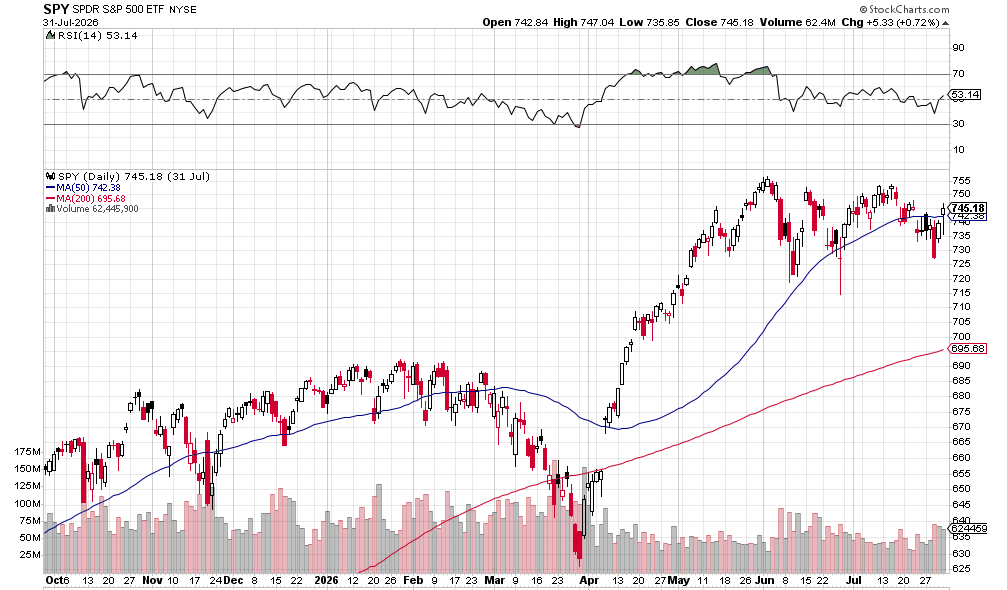
What happened at that point, and caused the pause that we are still in today, is a recognition that coding can only take AI so far.
You can replace programmers with AI. You can generate more code faster. And for a subset of the population (ie programmers and people that work with them) this can be very meaningful.
It is very meaningful to the programmers that lose their job.
It is meaningful to the companies that gain in productivity from being able to generate more code faster.
It is even meaningful to software companies, as we see now that the doomer-ism that software was about to be obsolete was wrong. That, in fact, some software was growing faster then ever, and that most software companies were more profitable then ever, because they no longer had to couple growth with more programmers.
But AI-coding agents weren’t meaningful to most people. AI had disrupted a segment. But what would happen when that segment, which also just happened to be the fastest adopters of AI (programmers love technology!), became saturated?
That question is what got me thinking about what comes next? It is something I have thought about all through the last month.
It is a big question, much bigger then it seems at a glance. To understand why “something coming next” is really, really important, consider the AI build out that is upon us…
WHY WHAT COMES NEXT, MATTERS MOST
So… the thing about the AI buildout that makes it matter really amounts to this: It is TRULY MASSIVE.
AI capacity is usually measured in GW of power consumption. Power is directly related to how many GPUs and CPUs you can run. Measuring power is the same as measuring compute capacity.
There are different ways of defining what AI capacity is. I am going to describe it as usable AI capacity, which would be what you call “frontier-grade”. Frontier grade means you could use that capacity to train or serve a big frontier model on it, just so we can put a consistent set of numbers on it.
AI capacity is expected to be about 15 GW by the end of 2026.
It is expected to rise to 45 to 55 GW in 2027.
Planned datacenter capacity is even higher. We are up to 210 GW (!!) of planned capacity that will come out in maybe the next 5 years or so.
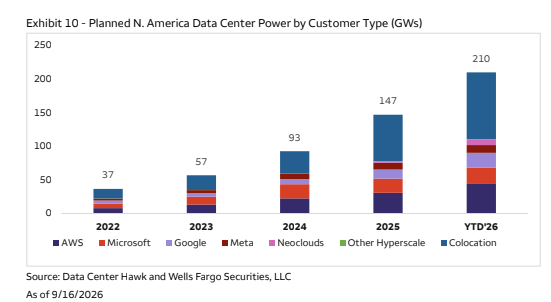
So the thing is, these numbers are essentially insane. Consider that Alberta’s total electrical generation capacity is like 12 GW.
We are increasing AI datacenter capacity by two Albertas next year. And the pipeline is for like 12-15 more Alberta’s.
Apart from the rather unreal size of what we are talking about, what made me even more uncomfortable in the summer was that it seemed like wealready had enough capacity for what we were doing with AI right now.
I use Claude regularly. I code with it. I use it in Excel. I ask it a bazillion questions, mostly about stocks.
I’ve never had Claude say, “Woah, slow down there buddy, I can’t handle all this right now, I’m a little overloaded”.
I’m simplifying this a little too much of course. There are lots of strings Anthropic can pull to manage usage without it becoming apparent to a user like me. But still, if we were really, really short of compute, I would sort of expect Claude “brownouts” on occasion, just like when the electrical grid gets overwhelmed.
That isn’t happening. Even at the margins.
Where I’m going with this is that if this isn’t happening now, and we are adding two Alberta’s of compute next year, well you start to wonder if we are going to tip over into a glut of AI capacity at some point.
Which wouldn’t be good for stocks.
AI IS THE MARKET?
There are two things that the casual observer of the stock market is not aware of right now:
- Just how many stocks have participated in the AI binge
- Just how badly stocks that are not participating in the AI binge are doing
On point #1, do you realize that companies like Enbridge, TC Pipelines and AltaGas trade at price to earnings multiples today that are about 50% higher then they were 4 years ago?
It’s true. I spent a bunch of time on this a few weeks back. These stocks used to trade at 4-6x EV/EBITDA. Now its like 8-10x.
While it is always impossible to separate out what specific reason a stock is trading higher, and you can argue that with these pipeline stocks maybe it’s the Carney government and their pro-development stance, or maybe a decline in hatred of oil and gas, and yeah, okay I concede some of that might be it.
But if you look at the charts of these stocks, they all really started going up with the AI boom.
The reason, I think, was simply the recognition that more AI means more power (ie. That 10 Albertas in the next few years) and more power means growth in moving natural gas (and a lesser extent oil) and so these companies get higher valuations because they aren’t just stagnant dividend paying pipeline stocks, they are sort of growth stocks now. If a pipeline stock is actually allowed to be called that?
That’s just one example. But it holds broadly. There are a lot of stocks and sectors that have been buoyed by AI, well beyond a bunch of chip stocks.
On to Point 2. The market is pretty close to all-time highs. But you’d never know it by looking at the average non-AI related stock. In fact, 52-week lows on the NYSE are skyrocketing and 52-week highs plummeting.
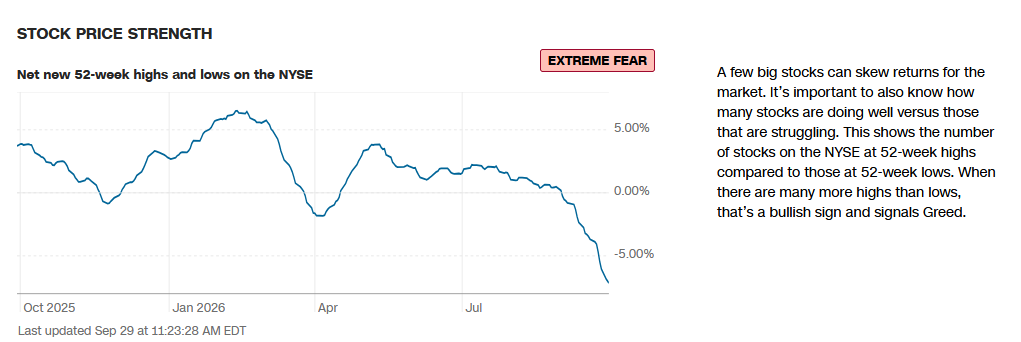
There are a lot of stocks not doing very well at all. Don’t get this wrong, I’m not making the argument that the market is a disaster. I’m just saying that, if it weren’t for AI, it probably would be doing pretty blah.
The overarching point I am making here is that if it is true that AI is being overbuilt in the short term, the market could be in some trouble.
Which brings me to Meta Muse.
MUSE DOES EVERYTHING YOU COULD ALREADY DO WITH AI, BUT BETTER (MAYBE MUCH BETTER)
Look, I’m not going to pretend that I am an AI expert with my finger on the pulse. But I do keep pretty close tabs on what’s out there, I use it every day, and so I think I have a (slightly) better than average grasp on the state of the industry.
And if I’m right, then Meta Muse is something new and different.
This isn’t immediately obvious. Muse doesn’t necessarily do anything new. I haven’t found something with Muse where I’m like wow, I couldn’t do that before.
But what Muse does, is it does things much, MUCH more easily then you could have done them before.
The product is billed as an assistant. And that is truly what it is. It is like having someone to do and keep track of all the things that are a hassle for you to do. And to do the things you never did do because you didn’t have the time to do them.
You couldn’t really say that about Claude or ChatGPT. Yes, you can get Claude to do anything, but half the time you are stuck with a python file or installing a C++ compiler. And most people don’t want to go there.
Here are some of the things with Muse I have done in the past 48 hours:
- Had it build a process whereby every Friday it scans all the local flyers for certain groceries that we buy on a regular basis. It then finds the best deals on each of them and sends an email with the list to my wife, mom and myself.
- Recreate (I already had something like this in Claude) a Daily brief newsletter in HTML format that comes out every day and summarizes all the AI content on my AI X.com list that I have curated
- Had it remind me of a bunch of tasks I keep forgetting about such as replacing a light, watching a particular video, doing a warranty call, replacing the car key battery
- Summarize a livestream on stocks that occurs every Friday afternoon. I also had it schedule in summarizing future livestreams for me, which it will do every Friday and send me an HTML of the summary
- Helped me haggle with SiriusXM to reduce our subscription price by about 65%. Also add a reminder of when this deal ends in a year so I don’t start paying full price.
- Build a Tetris game
- Create a short newsletter-style PDF of the Akamai/Anthropic deal based on my notes, model and discussion I had with Claude on the deal
- Add weekly reminders to take out recycling/green bins/waste at a particular time
- Check Calgary to Toronto flights every week for each airline to look for a deal and send an email to us with what they find each week and whether they think there is a deal worth acting on.
There are a dozen more I am mulling around in my head. All of them could have been with Claude. But Muse made them so easy to do that, unlike Claude, I actually did them.
It was literally like a few sentence description for the grocery flyer check and it was done in a few minutes. It built the Tetris game, which plays just like Tetris, in 3 minutes. The AI Daily newsletter was something I did with Claude but I had to run .bat files every day to actually generate and so I only got around to it once or twice a week, whereas with Muse it just builds and creates the newsletter every day and I have it there every morning with my coffee and I don’t have to do anything to get it.
The things that Muse has that make it more useful are, I think, twofold.
One, with Muse you get your own virtual computer with memory and compute. It doesn’t need to save things on your computer. It isn’t always asking to access your computer or install something on it. And it is set up to remember stuff for you.
That last point is really important I think. Muse can be your memory, just like an assistant would be. And it can be long-term memory. Muse is going to remind me about the SiriusXM renewal in 12 months.
Two, Muse is a chat, so you have it up on your computer and phone and its just like you are talking to your assistant.
Now of course, the worry here, which is already all over the news, is privacy.
Do you want to give Muse your data?
The thing is, none of the tasks I listed above actually had me give Muse any of my data. In fact, the only task where it would have been helpful was in haggling with SiriusXM, because if I was willing to give Muse my name, phone number, address, it would have just haggled with the online Sirius assistant, who I think it just a bot itself, for me. Because I wasn’t, instead I just copied the prompts from Sirius into Muse and asked Muse how I should respond. It worked.
But other then that, Muse doesn’t really have to access to anything. In fact, because you get this little virtual computer in the cloud, it doesn’t even need to access your computer at all (whereas Claude or GPT did for some tasks).
Of course as I have it do more things, it will learn more about me. It already knows some things about the groceries we buy or the flight we take most often. Just like any assistant would.
But these stories I’m reading about it wanting your bank info or your email access, well… you can certainly do that, and maybe at some point everyone will do that, but it is far from necessary to get value out it.
WHY ANY OF THIS MATTERS
What all of this does is make me think that maybe we aren’t about to run into an AI glut.
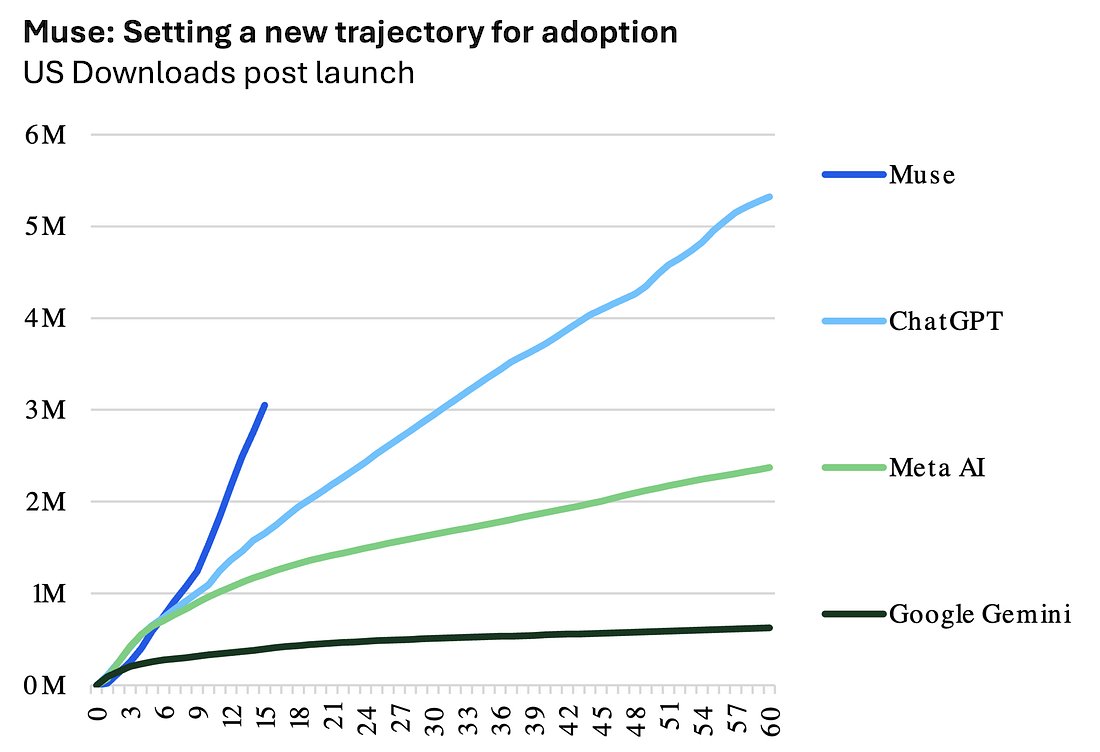
I am starting to warm up to the idea that Muse ushers in the next leg of AI.
I am certainly not the only one that sees what Muse can do and, more importantly, how easy it can do it. While AI was basically something that was super useful for programmers, researchers and people that liked to just ask lots and lots of questions, now its useful for, as Chris Camillo calls it, “the normies”.
Normies would define people who don’t really care about AI one way or another but if you can tell them where they buy coffee cheaply or alert them to a deal on flights and do it without them having to build and run a python script, and do it for free, they are happy to take advantage of it.
Muse isn’t perfect. It fails in some tasks and there are certainly some people out there that are gleefully pointing out those failures.
But I think that misses the point. Muse is just going to get better. If AI’s trajectory so far is any indication, it is going to get better quickly. And if I’m right about how this is going to open up a whole new, and larger, addressable market of people, there are going to be other Muses that come around. There will be an Anthropic Muse and an OpenAI Muse and a Google Muse in short order.
With coding agents, you had quick adoption of what is really a pretty small group of people – programmers.
With Muse, and whatever other coding agents are on the horizon, I am sure adoption will be slower. Most people won’t use it. But the pool of potential adopters is now essentially anyone that uses Facebook. So its really, really big.
Muse is free. Which gives you this massive pool of people that can afford it, even if only a small fraction of them are willing to be early adopters.
The other consideration, insofar as what this means for AI demand, is that about half the tasks I’m getting Muse to do are recurring.
With Claude or ChatGPT, it is all one-offs. Ask this, ask that. With Muse, much of what it is really useful doing is reminding, checking or doing something over and over again – every day or every week or every second Thursday.
That is real recurring usage. Which is additive.
And for now, the trend is your friend.
Finally, Meta announced just today that they have Muse for small businesses. Which makes a lot of sense. And given some of the things I am having it do for me, it will clearly be helpful to small businesses, especially if they can’t afford that assistant employee.
You add all this together and you start to see a picture of how this could play out. If Muse and its soon-to-come descendants gain traction, usage is going to increase, maybe a lot. Agents use A LOT more tokens then people.
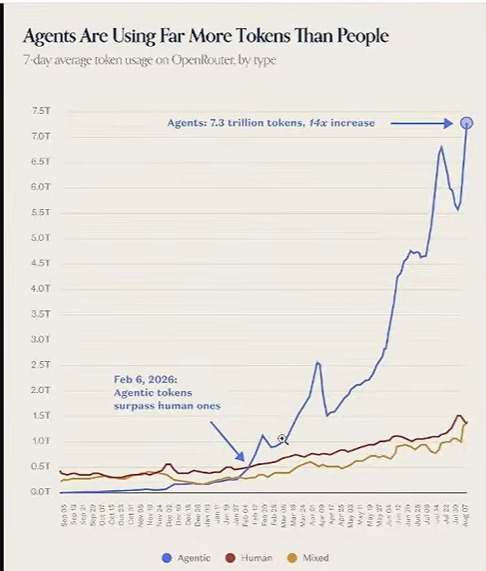
And that, is where I was going with all this.
Maybe we aren’t about to hit an AI supply wall. Maybe things are going to be okay. And maybe the AI trade has yet another leg higher in the near future?


Welcome back! It was great to see this piece this morning. Thanks.
It’s awesome to have you back writing!
Great to see you posting again!
I work in the semiconductor industry, as a broker no less. I have lived through allocations. 1999-2001 à la nortel. That ended with several dozen 53’ trailers in the Montreal parking lot that Nortel management refused to receive or recognize. We all know how that ended. Minor allocations followed, some due to die revisions, some due to natural disasters, and these are kinks in the supply chain that occur naturally and cannot be avoided. It’s the cost of global logistics, and the increasing pace of technology. These incremental tremors or perhaps aftershocks continued until COVID. The grandaddy of all allocations. I do not believe that the AI allocation is any different already hundreds of billions of dollars worth of infrastructure equipment sit idle, to your point because there’s just not enough GW to run it. Even if you own, your own gas to fuel them. Moore’s Law showed that computing power improves exponentially while older semiconductor technology rapidly loses economic value. I believe today’s AI infrastructure boom follows the same pattern on a larger scale. Accelerators, memory, networking, power efficiency and system architecture are advancing so quickly that much of the hardware being installed today could be economically obsolete within three years, even if it remains functional. Semiconductor history is filled with companies and technologies that were consolidated, sold, renamed or eliminated by successive generations. AI demand may be real and enormous, while the capital invested in today’s hardware still depreciates far faster than investors expect.
Interesting point – thanks for sharing!
Nice surprise to see you riding again (no pressure). Would be interesting to hear how your thinking around investing has evolved in the past few years. Mine certainly has.
Typo: “writing”, not “riding” (I was voice typing)
Thanks for the post!