Skip to content

Posts tagged ‘writing’

On AI, Math and Cryptography

Because I haven’t written in this blog in a little over two years, and because AI has been my primary vehicle for investing for the last two years, I have a lot of thoughts about AI that need to be prefaced before I get to anything else.

Even though some of them may sound a little dated by now, well, I have to start (again) somewhere. And while I was going to talk about a couple of stocks at the end of this post, Akamai and Circle, both of which have not done well, and explain why I think that was, but the post got out of control long so I will leave that for next time. So instead, this is just a second, state-of-where-my-mind-is-at post, and I’ll talk about more specific stocks shortly.

I wanted to bring up Akamai and Circle because they have been AI related stocks that really haven’t worked. Which makes them outliers, at least for me. AI has been the only thing that has consistently worked for me for about the last 2 years.

When I have tried to wade into an non AI name, it has had about a 50/50 chance of blowing up in my face. 

Just thinking of just the last few months, I have, at various times, gotten long Boston Scientific, Abivax, BuildersFirst Choice, and Amer Sports. All of these stocks have been somewhere between disasters and duds.

My non-AI loser stocks have definitely outnumbered the winners for some time now.

Fortunately, the AI names I have owned have mostly worked.

Yet I am always uneasy about the AI names.  Not for the most commonly held reason though.   My uneasiness is NOT that I buy into the commonly held bear case of the big AI bears, the guys like Michael Burry and Ed Zitron.  I actually suspect they won’t be proven right for quite a while yet (they will eventually of course, because stocks always have a bear market).

Even though there are a lot of different ways of saying the commonly held AI bear case, I believe you can boil it down to a few points and one big unknown that determines their outcome.  Those points being:

  1. Spending is so big that it can’t possibly realize the return that it expects
  2. GPUs depreciate too fast to have their investment realized
  3. Creative financing mechanisms are being used to keep the boom going and those will collapse like they always do

Those three points gather their potency if one future development occurs: AI does not deliver on demand.

If AI delivers enough demand, then none of the above worries matter.  Money will be made that will paper over shortcomings and the boom with continue.

For now, I think that demand will prevail and that the rally has legs.  That is my tentative conclusion (always tentative because it depends on what is happening next and, I admit, before Muse I beginning to waffle that the doomers may be right).

But anyway, this is the common bear-side worry.  But not the source of my own unease. 

Instead, my uneasy feeling has more to do with how quickly it is getting better.  And my inclination that this is just going to accelerate.

For a bit of background on where I am coming from…

In the fall of last year, I sort of decided that I was going to figure out how AI worked.

I had been in and out of different AI stocks through some of 2024 and 2025.  But I never really had conviction. I was always torn between the “it’s a bubble” bear camp and the promise of productivity and profits.  And so I was always selling out too soon.

I don’t know why it takes me so long to realize obvious things, but it was then that I realized the only way I was going to gain that conviction (or not) was if I figured out how the dumb thing worked.

I got this book called Why Machines Learn, that gave me a good headstart.  I followed that up by going through AI papers, a lot of papers, starting with this list from AI researcher Ilya Shutskeyver, who contributed many papers to the subject and was a co-founder of OpenAI, of the 30 most important papers he thinks you need to read to understand AI. 
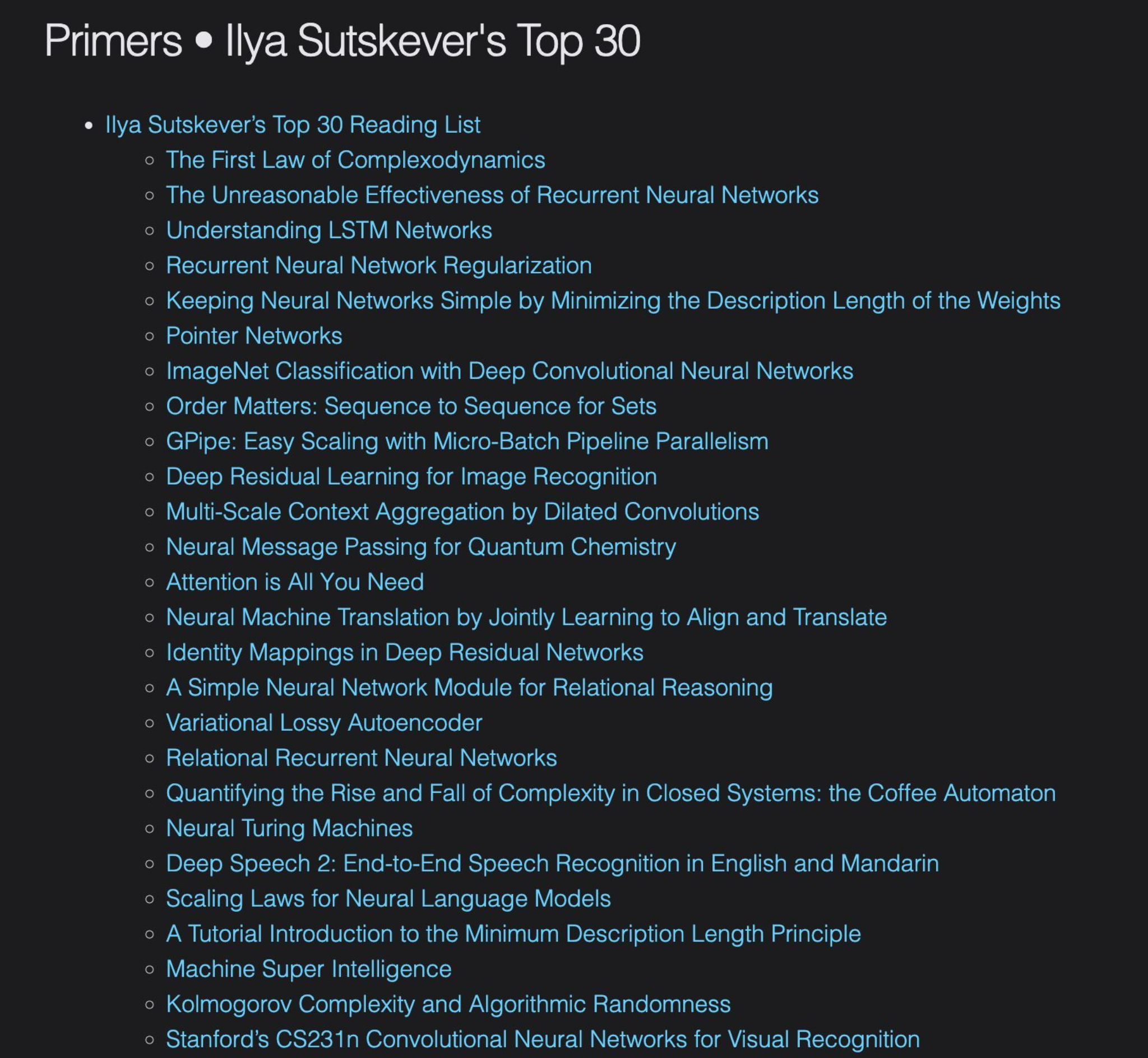
These papers and others are all available for free and are very useful for understand the math and science that goes into AI and how we got to this point.  Once you get through them you can tackle pretty much any new idea that comes out and have a good understanding of whether its meaningful or not.  I’ve kept at it, reading about what the open labs are doing and, where possible because unfortunately it is all behind closed doors now, what OpenAI, Anthropic, Google and Meta are doing as well.

This learning process was useful for conviction, just as I hoped it would be.  What has stuck with me the most is that this stuff is surprisingly simple.  It’s all based on math that I learned in undergrad engineering.  Today it involves matrices that are enormous, I mean they are hundreds of billions of parameters now, but the actual operations you are doing are not that different than what I learned in first and second year university.

I’m not the only one who has been blown away by the simplicity.  Sutskever said himself that one of the reasons he got into the field was because when he read a couple AI papers after his under-grad and couldn’t believe how simple the math was compared to what he was doing with his other math classes and projects.  It was a hint to him that this was onto something.

So that’s the first piece of my uneasiness.  AI is pretty simple.

Second bit of background.  One of the papers that Sutskever lists above is what is known as the Scaling Laws paper.

You hear a lot about scaling laws and what they mean for AI, from bulls and bears alike.  What they are usually talking about is this paper called Scaling Laws for Neural Language Models.  One of the writers of this paper is, interestingly enough, Dario Amodei, who is the guy in charge of Anthropic now.

This is one of the easier papers to read because it isn’t really exploring any new method or technique. It is just investigating what happens when you make models bigger.

It was written in 2020.  It is hardly ancient history.

It didn’t really set out with the expectation to find out what it found.  In fact, it was sort of assumed by everyone in AI at the time that eventually as models got bigger things would break down.  If you go through the previous 20 or 30 years of AI research, there is this sort of underlying assumption that you can’t just keep making things bigger.

Which sort of goes with the territory.  Science is all about simplifying things down through clever solutions.  Brute force is frowned upon.

With that expectation, the big discovery of the scaling laws paper was that no, that’s not right.  The expected wall doesn’t happen and, in fact, model performance seems to follow a remarkably consistent pattern, called a power law, whereby output gets better regardless of model size.

A power law is just a really simple equation that says that when you make some quantity, say x, bigger, the resulting y scales by a much larger (or, depending on the exponent, smaller) amount.  It looks like this:
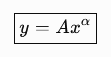
When they found that models followed a power law is was an aha moment.  It meant that A. you could basically extrapolate how well a model would perform as it got bigger.  And B. It followed a law where outputs got big much faster then the inputs, which tends to be profitable over time.

The paper identified three key inputs by which model performance scaled: the number of parameters (ie. How big the matrix is), the size of the training dataset, and the amount of compute you use.

They found that these relationships held across more than seven orders of magnitude.  Again, no sign of anything breaking down or even hinting that it would break down across a really wide range of sizes.

We are now six years past when that paper was written and so far the power law still hasn’t broken down.

Maybe we shouldn’t expect it to. Or at least, maybe we will be surprised with how big it can get before it does.

Power laws are everywhere in nature. Earthquakes, animal sizes, tree networks, blood vessels, river networks, there is just a lot of nature that follows a relationship of power laws.

Which is to say that when you start thinking about all this you start to wonder if we (being humanity that is) really stumbled onto something here.  We’ve tapped into something very simple but that scales.  Which certainly makes you go hmmm.

None of this is to say anything is for certain about any particular outcome for AI.  Nothing is.

But when you put together the simplicity and the scaling I think we are more likely to be surprised by how quickly AI improves, and as it improves creates more use cases, and with that creates more demand, then we are likely to be surprised that its been a big capital spending black hole that has no use.

The problem with the internet, which everyone likes to compare as the example of a bubble that popped, is that the technology didn’t move fast enough to keep up with the infrastructure being built.  If we could have had a Blackberry (the phone, not the pager) in 1998, an iPhone in 2001 and streaming Netflix by 2004, maybe the bubble wouldn’t have burst?  We just would have just kept laying fiber and building cell towers.

All of this is by way of background to understand where my uneasiness lies.  My uneasy feeling is about how quickly AI is getting better.  Which brings me to why I was reminded of that this week.

It started with this sort of cryptic (yes, pun) tweet:
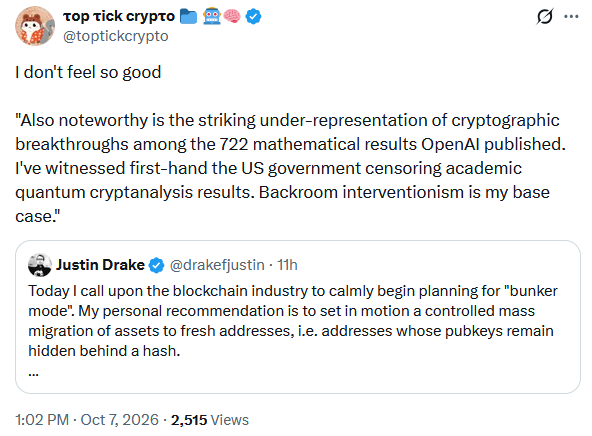
Who is toptickcrypto?  It has been a long time and I don’t remember who exactly toptickcrypto is the monikor for anymore but I do remember he was a fund manager, maybe he still is, that he got into crypto in like 2018 or something, and he knows a lot about stocks and crypto.

Him not feeling so good made me want to investigate what he was feeling not good about.  Which took me down the rabbit hole of AI models and math.   And it all was a little unnerving.

It all starts with this release by OpenAI.
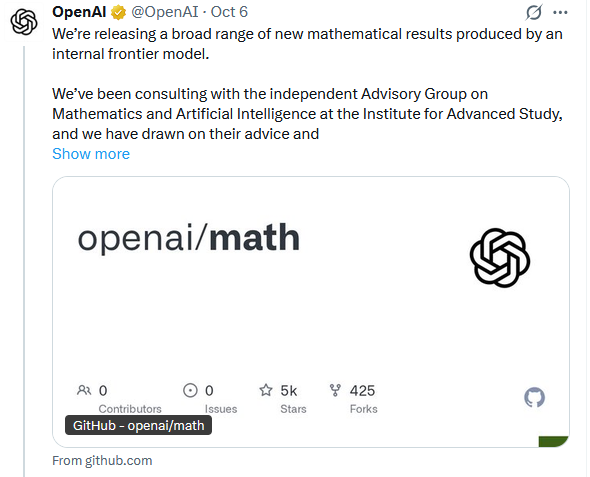
OpenAI published 722 math papers that together solved 372 math problems that had previously been unsolvable.  They did it with an unreleased version of their model.

So that’s pretty crazy.  And while I see an instance or two of people refuting the solutions, I see much more acceptance admitting what OpenAI did was real.

But beyond that, what Toptickcrypto is pointing out, and what makes him as a bitcoin/crypto guy not feel so good, is the rather ominous omission of those 722 problems: that 0 of them are cryptographic.

Cryptographic means solving a problem that deals with encryption techniques (you know, those things we depend on for literally EVERYTHING on the internet).

Which of course makes one wonder if A. they just happened to decide not to tackle cryptography or B. the cryptographic results are a little scary (ie. good at breaking encryption) and they don’t dare publish them or everyone would freak out.

This was not unnoticed in the crypto world, where there was some freaking out done.

Let me just preface this by saying that crypto, as the name implies, uses cryptography.  Also, because of the way crypto is structured, crypto is probably the #1 most vulnerable place to be hacked if cryptography techniques are hacked.

To point to just one of the posts from the community, from Vitalik Buterin, the guy who founded Ethereum and therefore should be taken seriously:
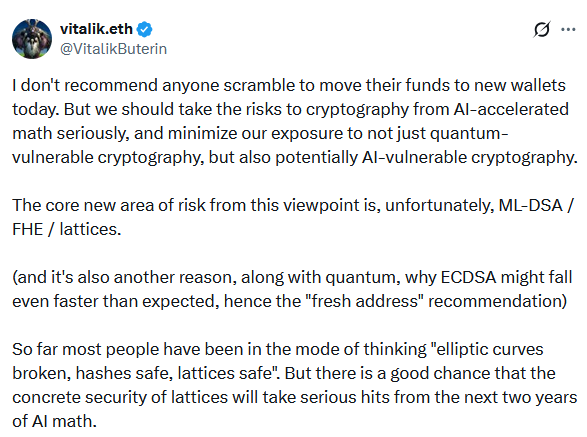
This isn’t the whole tweet.  The whole tweet is worth reading because Vitalik has put a lot of thought into this.  I have two thoughts on his thought.

First, saying “I don’t recommend anyone scramble to move their funds” is what every bank manager says before the bank run.  I’m not saying there is going to be bank run, I’m just saying this isn’t something you want to be saying.

Second, he is admitting that AI is making major steps in math, and that it is unlikely that those steps aren’t happening in the area of cryptography.  And based on that, his solution for you, for now at least, is to start moving your crypto to wallets that haven’t had their public key exposed (it turns out that if you have never sent money from a crypto wallet you have never shared your public key and thus it can’t be hacked).  Which again, is a bit like saying, take your money from the bank and put it under your floorboard and you’ll be okay.

I’m going to spend just a minute explaining how this all works and why this could eventually be a problem.

First, in crypto, pretty much all crypto, you have a public key and a private key.  Both of these are just very long strings of numbers.

The public key is what you send out to the world to transact.  The private key is what you would never tell anyone about, and ideally you would keep it locked in a bank vault somewhere.  If someone knows your private key, they essentially own all the crypto in your wallet.

The path between the two looks like this:

private key  ──(step 1: elliptic-curve math)──▶  public key  ──(step 2: hash)──▶  address

The worry is that first “elliptic-curve math” step.  The real problem with that step is the “math” part.

I haven’t really bothered to understand exactly what elliptic curve math is, but I can tell you a few things about it.

First, it’s a nifty technique whereby if you go in one direction (calculating the number that is your public key from the number that is your private key) it is relatively easy to do.  But if you go the other way, calculating your private key from your public key, it becomes very, very hard.  So hard that no one has ever figured out how to do it in a way that wouldn’t take many, many, many years.

However, it is not necessarily impossible.  No one has ever proved that going backwards in elliptic-curve math is theoretically impossible.  It just has been proven over decades of use that no one has been able to hack it, which means it’s practically impossible.

That is an important distinction, and suddenly quite a relevant one.  Because yes, we have something that no human being has figured out a shortcut around.  But AI is figuring out all kinds of whacky shortcuts.

Last detour, I promise.

When I was looking into all this I stumbled on this blog post, which talks about the mathocalypse.  Anyway, the author of the blog’s wife is a complexity theorist, which means she deals with really hard math.  His wife was reviewing one of the AI proofs from OpenAI.  And she had this to say about it:
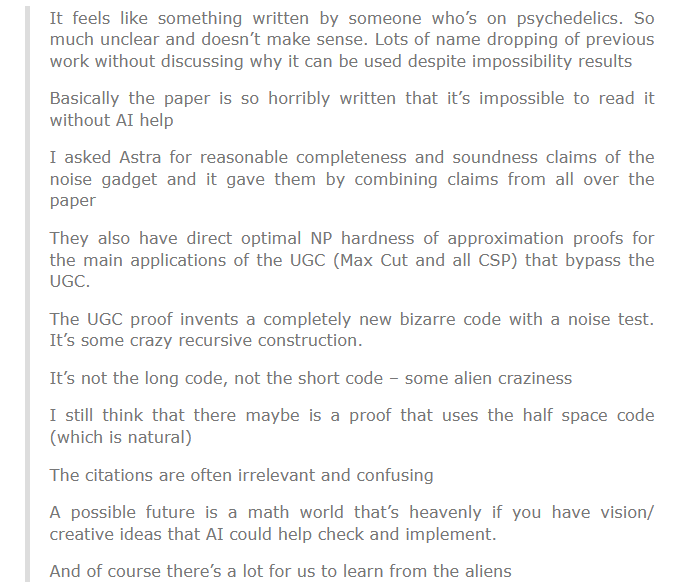
So there are a couple of ways you can take this.

First, you can take it in the mainstream “AI-isn’t-all-it’s-cracked-up-to-be-and-makes-things-up-all-the-time” sort of way. If you did, you would conclude AI is clearly spitting out gobbledygook and we have nothing to fear with this whole math proof stuff.

Or… the other way to take it is a little more seriously.  What if AI is simply making connections that are so far from being obvious to us that they sound like gobbledygook (to an expert in the field, keep in mind) but are really fundamental to  what you need to know to solve the problem?

Again, you sort of go hmmm.  Can’t know for sure but it is alarming.

Of course, all this strikes me as something that could be bad for crypto at some point.  And particularly bad for companies like Coinbase or Robinhood.  The idea that everyone in crypto is not going to be able to transact without exposing themselves is not a good scene.

But not just yet.  None of this matters just yet because fortunately OpenAI has tackled 700+ math problems but is leaving cryptography alone…. riiight.  But most of crypto was up on Friday so it is true to say that no one cares about this yet.  Citrini, the research substack, had this big piece on AI agents using stablecoins on Thursday, which helped crypto and actually makes a lot of sense and should send the crypto space much higher as long as (or until?) AI doesn’t cut it off at the knees.

The bigger thing for the plain vanilla common stocks I own is why this is a great example of where my uneasiness lies.

What I have been trying to lay out here is why things are progressing very quickly, why things are likely to continue to progress quickly, and from that, why the proper conclusion to draw is not the bear case that its all going to fall apart because of lack of demand, but instead that the real bear case is that at some point AI could break something in bad way.

There is no immediate action to take from that conclusion.  In fact, everything I am saying is actually very bullish on AI as long as and until something bad happens.  I think token usage will just keep rising, use cases that we haven’t even thought will keep materializing and Ed Zitron, Michael Burry and Paul Kedrosky will keep yelling at the sky.

But I think you also need to stay vigilant here, because we have quite possibly latched onto something that is lightening in a bottle.  And I don’t think any of us can say with certainly where it is going to take us.
WHY I THINK META MUSE COULD CREATE THE NEXT LEG FOR THE AI STOCKS

I am back posting. I have been gone for 2 and a half years but have not be gone from investing. Or from writing, I just haven’t been putting it up on a blog. I’ll maybe talk about that at some point, but maybe not. I mean who really cares right? Live in the present.

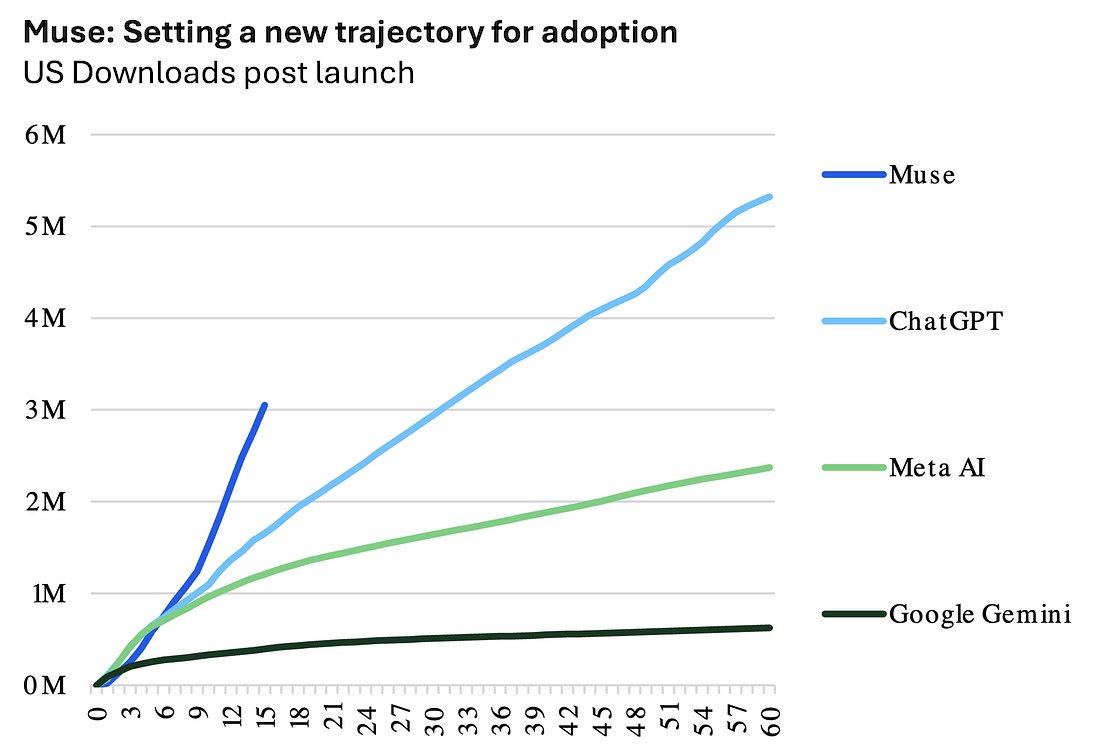
As for the present, I have been using Meta Muse for 5 days now and I think this is could be the next game changer for AI.

Which is good.  Because I have been a little nervous about what will come next with AI.  And that if nothing did come next, that the market may have been in for a fall.

Let’s step back in time and review.  In January, it became pretty clear that the whole AI-for-coding thing was going to take off.  AI was naturally good at coding because it is, after all, a language model, and coding is pretty much the easiest language to learn, at least in terms of definite structure.

And that happened.  It was a little delayed is all.

During the first days of the Iran war AI stocks sold off along with everything else.  But even then it felt like they were just biding their time, waiting for a pause in the war so that they could go on a run as coding took off.  Which is what happened in April.

I remember what I was thinking in March.  That period was a tug-a-war for me, trying to answer this question: why is the market not going down more with the Iran war a clear disaster?

I had two competing thoughts at the time.

One was the recognition of the old maxim (well, at least my old maxim) that goes something like this: “the market doesn’t care about bad things until it can’t ignore them any longer”.

This is something I have noticed over time.  It is basically saying that markets don’t actually like to go down.  So they don’t go down unless they have to.

However, there is a flip side to that maxim.  Just because nothing really bad has happened to the market yet, that doesn’t mean it won’t.  The market may still go off the cliff if things get just a little bit worse.

To that very worrisome possibility, I weighed the much more positive possibility that AI coding agents were just that big of a deal. 

It was possible that the market was strong in the face of war and high oil prices simply because it saw that coding agents were that big of a deal.  War wasn’t going to stop them.  Inflation wasn’t going to stop them.  And that you couldn’t push stocks down with them coming on the horizon.

As it turned out, it was this second possibility that was correct.  Coding agents were a big deal.  The market was right not to allow itself to be pushed down.

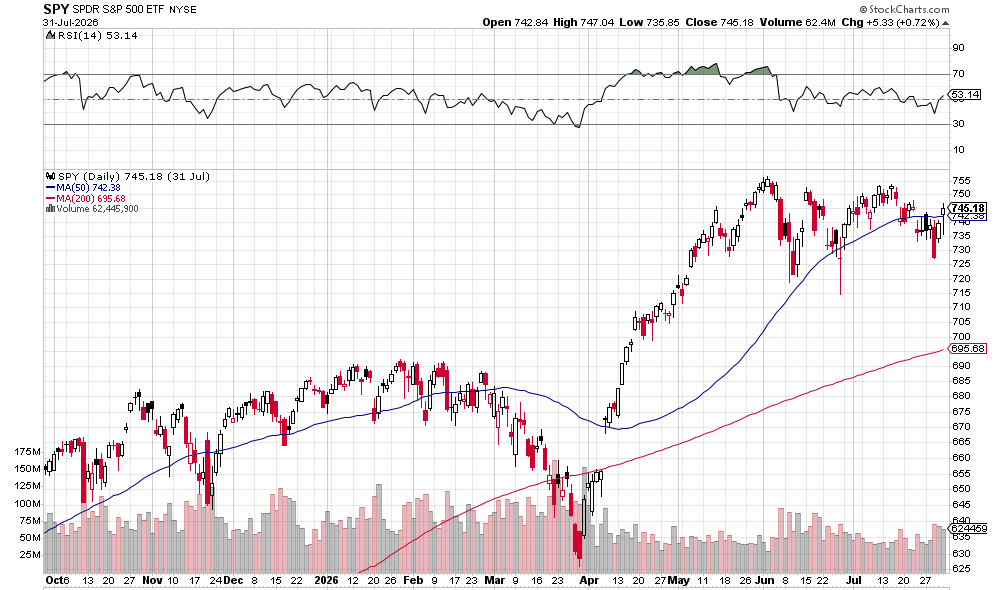
When the Iran war eased, even just at the margins, the result was a steep bull market that lasted through the spring and into the summer before it hit a wall.

 What happened at that point, and caused the pause that we are still in today, is a recognition that coding can only take AI so far.

You can replace programmers with AI.  You can generate more code faster.  And for a subset of the population (ie programmers and people that work with them) this can be very meaningful.

It is very meaningful to the programmers that lose their job.

It is meaningful to the companies that gain in productivity from being able to generate more code faster.

It is even meaningful to software companies, as we see now that the doomer-ism that software was about to be obsolete was wrong.  That, in fact, some software was growing faster then ever, and that most software companies were more profitable then ever, because they no longer had to couple growth with more programmers.

But AI-coding agents weren’t meaningful to most people.  AI had disrupted a segment.  But what would happen when that segment, which also just happened to be the fastest adopters of AI (programmers love technology!), became saturated?

That question is what got me thinking about what comes next?  It is something I have thought about all through the last month.

It is a big question, much bigger then it seems at a glance.  To understand why “something coming next” is really, really important, consider the AI build out that is upon us…

WHY WHAT COMES NEXT, MATTERS MOST

So… the thing about the AI buildout that makes it matter really amounts to this: It is TRULY MASSIVE.

AI capacity is usually measured in GW of power consumption.  Power is directly related to how many GPUs and CPUs you can run.  Measuring power is the same as measuring compute capacity.

There are different ways of defining what AI capacity is.  I am going to describe it as usable AI capacity, which would be what you call “frontier-grade”.  Frontier grade means you could use that capacity to train or serve a big frontier model on it, just so we can put a consistent set of numbers on it.

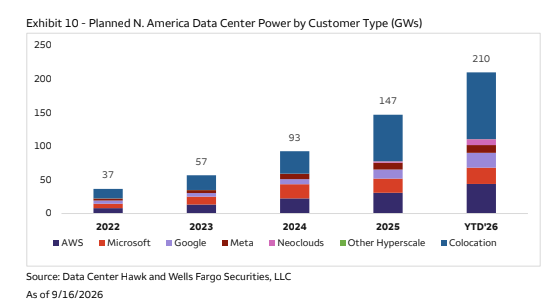
AI capacity is expected to be about 15 GW by the end of 2026.

It is expected to rise to 45 to 55 GW in 2027.

Planned datacenter capacity is even higher.  We are up to 210 GW (!!) of planned capacity that will come out in maybe the next 5 years or so.

So the thing is, these numbers are essentially insane. Consider that Alberta’s total electrical generation capacity is like 12 GW.

We are increasing AI datacenter capacity by two Albertas next year.  And the pipeline is for like 12-15 more Alberta’s.

Apart from the rather unreal size of what we are talking about, what made me even more uncomfortable in the summer was that it seemed like wealready had enough capacity for what we were doing with AI right now.

I use Claude regularly.  I code with it.  I use it in Excel.  I ask it a bazillion questions, mostly about stocks.

I’ve never had Claude say, “Woah, slow down there buddy, I can’t handle all this right now, I’m a little overloaded”.

I’m simplifying this a little too much of course.  There are lots of strings Anthropic can pull to manage usage without it becoming apparent to a user like me.  But still, if we were really, really short of compute, I would sort of expect Claude “brownouts” on occasion, just like when the electrical grid gets overwhelmed.

That isn’t happening.  Even at the margins.

Where I’m going with this is that if this isn’t happening now, and we are adding two Alberta’s of compute next year, well you start to wonder if we are going to tip over into a glut of AI capacity at some point.

Which wouldn’t be good for stocks.

AI IS THE MARKET?

There are two things that the casual observer of the stock market is not aware of right now:

  1. Just how many stocks have participated in the AI binge
  2. Just how badly stocks that are not participating in the AI binge are doing

On point #1, do you realize that companies like Enbridge, TC Pipelines and AltaGas trade at price to earnings multiples today that are about 50% higher then they were 4 years ago?

It’s true.  I spent a bunch of time on this a few weeks back.  These stocks used to trade at 4-6x EV/EBITDA.   Now its like 8-10x.

While it is always impossible to separate out what specific reason a stock is trading higher, and you can argue that with these pipeline stocks maybe it’s the Carney government and their pro-development stance, or maybe a decline in hatred of oil and gas, and yeah, okay I concede some of that might be it.

But if you look at the charts of these stocks, they all really started going up with the AI boom.

The reason, I think, was simply the recognition that more AI means more power (ie. That 10 Albertas in the next few years) and more power means growth in moving natural gas (and a lesser extent oil) and so these companies get higher valuations because they aren’t just stagnant dividend paying pipeline stocks, they are sort of growth stocks now.  If a pipeline stock is actually allowed to be called that?

That’s just one example.  But it holds broadly.  There are a lot of stocks and sectors that have been buoyed by AI, well beyond a bunch of chip stocks.

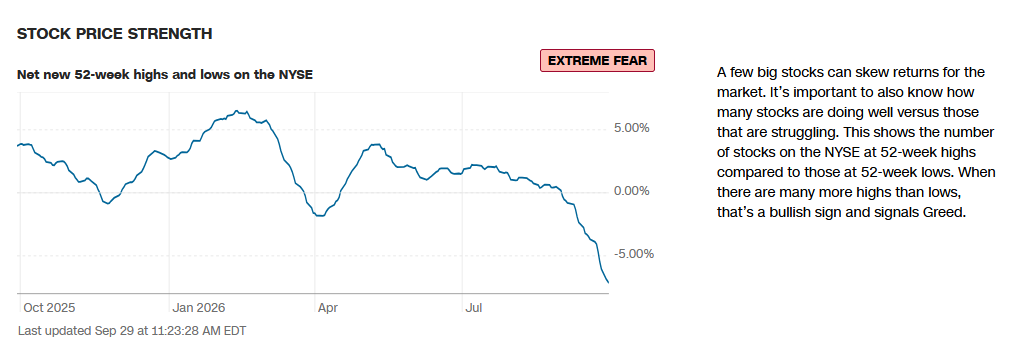
On to Point 2.  The market is pretty close to all-time highs.  But you’d never know it by looking at the average non-AI related stock.  In fact, 52-week lows on the NYSE are skyrocketing and 52-week highs plummeting.

There are a lot of stocks not doing very well at all.  Don’t get this wrong, I’m not making the argument that the market is a disaster.  I’m just saying that, if it weren’t for AI, it probably would be doing pretty blah.

The overarching point I am making here is that if it is true that AI is being overbuilt in the short term, the market could be in some trouble.

Which brings me to Meta Muse.

MUSE DOES EVERYTHING YOU COULD ALREADY DO WITH AI, BUT BETTER (MAYBE MUCH BETTER)

Look, I’m not going to pretend that I am an AI expert with my finger on the pulse.  But I do keep pretty close tabs on what’s out there, I use it every day, and so I think I have a (slightly) better than average grasp on the state of the industry.

And if I’m right, then Meta Muse is something new and different.

This isn’t immediately obvious.  Muse doesn’t necessarily do anything new.  I haven’t found something with Muse where I’m like wow, I couldn’t do that before.

But what Muse does, is it does things much, MUCH more easily then you could have done them before.

The product is billed as an assistant.  And that is truly what it is.  It is like having someone to do and keep track of all the things that are a hassle for you to do.  And to do the things you never did do because you didn’t have the time to do them.

You couldn’t really say that about Claude or ChatGPT.  Yes, you can get Claude to do anything, but half the time you are stuck with a python file or installing a C++ compiler.  And most people don’t want to go there.

Here are some of the things with Muse I have done in the past 48 hours:

  1. Had it build a process whereby every Friday it scans all the local flyers for certain groceries that we buy on a regular basis.  It then finds the best deals on each of them and sends an email with the list to my wife, mom and myself.
  2. Recreate (I already had something like this in Claude) a Daily brief newsletter in HTML format that comes out every day and summarizes all the AI content on my AI X.com list that I have curated
  3. Had it remind me of a bunch of tasks I keep forgetting about such as replacing a light, watching a particular video, doing a warranty call, replacing the car key battery
  4. Summarize a livestream on stocks that occurs every Friday afternoon.  I also had it schedule in summarizing future livestreams for me, which it will do every Friday and send me an HTML of the summary
  5. Helped me haggle with SiriusXM to reduce our subscription price by about 65%.  Also add a reminder of when this deal ends in a year so I don’t start paying full price.
  6. Build a Tetris game
  7. Create a short newsletter-style PDF of the Akamai/Anthropic deal based on my notes, model and discussion I had with Claude on the deal
  8. Add weekly reminders to take out recycling/green bins/waste at a particular time
  9. Check Calgary to Toronto flights every week for each airline to look for a deal and send an email to us with what they find each week and whether they think there is a deal worth acting on.

There are a dozen more I am mulling around in my head.  All of them could have been with Claude.  But Muse made them so easy to do that, unlike Claude, I actually did them. 

It was literally like a few sentence description for the grocery flyer check and it was done in a few minutes.  It built the Tetris game, which plays just like Tetris, in 3 minutes.   The AI Daily newsletter was something I did with Claude but I had to run .bat files every day to actually generate and so I only got around to it once or twice a week, whereas with Muse it just builds and creates the newsletter every day and I have it there every morning with my coffee and I don’t have to do anything to get it.

The things that Muse has that make it more useful are, I think, twofold.

One, with Muse you get your own virtual computer with memory and compute.  It doesn’t need to save things on your computer.  It isn’t always asking to access your computer or install something on it.  And it is set up to remember stuff for you.

That last point is really important I think.  Muse can be your memory, just like an assistant would be.  And it can be long-term memory.  Muse is going to remind me about the SiriusXM renewal in 12 months.

Two, Muse is a chat, so you have it up on your computer and phone and its just like you are talking to your assistant.

Now of course, the worry here, which is already all over the news, is privacy.

Do you want to give Muse your data?

The thing is, none of the tasks I listed above actually had me give Muse any of my data.   In fact, the only task where it would have been helpful was in haggling with SiriusXM, because if I was willing to give Muse my name, phone number, address, it would have just haggled with the online Sirius assistant, who I think it just a bot itself, for me.  Because I wasn’t, instead I just copied the prompts from Sirius into Muse and asked Muse how I should respond.  It worked.

But other then that, Muse doesn’t really have to access to anything.  In fact, because you get this little virtual computer in the cloud, it doesn’t even need to access your computer at all (whereas Claude or GPT did for some tasks).

Of course as I have it do more things, it will learn more about me.  It already knows some things about the groceries we buy or the flight we take most often.  Just like any assistant would.

But these stories I’m reading about it wanting your bank info or your email access, well… you can certainly do that, and maybe at some point everyone will do that, but it is far from necessary to get value out it.

WHY ANY OF THIS MATTERS

What all of this does is make me think that maybe we aren’t about to run into an AI glut.

I am starting to warm up to the idea that Muse ushers in the next leg of AI.

I am certainly not the only one that sees what Muse can do and, more importantly, how easy it can do it.  While AI was basically something that was super useful for programmers, researchers and people that liked to just ask lots and lots of questions, now its useful for, as Chris Camillo calls it, “the normies”.

Normies would define people who don’t really care about AI one way or another but if you can tell them where they buy coffee cheaply or alert them to a deal on flights and do it without them having to build and run a python script, and do it for free, they are happy to take advantage of it.

Muse isn’t perfect.  It fails in some tasks and there are certainly some people out there that are gleefully pointing out those failures.

But I think that misses the point.  Muse is just going to get better.  If AI’s trajectory so far is any indication, it is going to get better quickly.  And if I’m right about how this is going to open up a whole new,  and larger, addressable market of people, there are going to be other Muses that come around.  There will be an Anthropic Muse and an OpenAI Muse and a Google Muse in short order.

With coding agents, you had quick adoption of what is really a pretty small group of people – programmers.

With Muse, and whatever other coding agents are on the horizon, I am sure adoption will be slower.  Most people won’t use it.  But the pool of potential adopters is now essentially anyone that uses Facebook.  So its really, really big.

Muse is free.  Which gives you this massive pool of people that can afford it, even if only a small fraction of them are willing to be early adopters.

The other consideration, insofar as what this means for AI demand, is that about half the tasks I’m getting Muse to do are recurring.

With Claude or ChatGPT, it is all one-offs.  Ask this, ask that.  With Muse, much of what it is really useful doing is reminding, checking or doing something over and over again – every day or every week or every second Thursday.

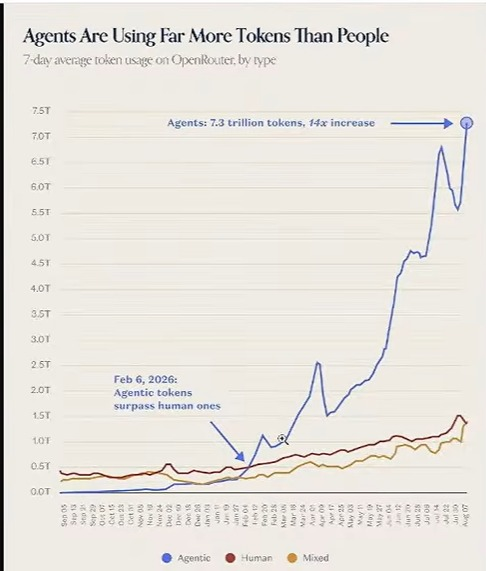
That is real recurring usage.  Which is additive.

And for now, the trend is your friend.

Finally, Meta announced just today that they have Muse for small businesses.  Which makes a lot of sense.  And given some of the things I am having it do for me, it will clearly be helpful to small businesses, especially if they can’t afford that assistant employee.

You add all this together and you start to see a picture of how this could play out.   If Muse and its soon-to-come descendants gain traction, usage is going to increase, maybe a lot.  Agents use A LOT more tokens then people.

And that, is where I was going with all this.

Maybe we aren’t about to hit an AI supply wall.  Maybe things are going to be okay.  And maybe the AI trade has yet another leg higher in the near future?