Skip to content

Posts from the ‘Aurizon Mines (ARZ)’ Category

Yesterday’s David Tepper Moment

David Tepper is a very successful hedge fund manager who, in the fall of 2010, went on CNBC and explained, with a simplicity that the market loves, why you had to own stocks.

“Either the economy is going to get better by itself in the next three months…What assets are going to do well? Stocks are going to do well, bonds won’t do so well, gold won’t do as well,” he said. “Or the economy is not going to pick up in the next three months and the Fed is going to come in with QE.

“Then what’s going to do well? Everything, in the near term (though) not bonds…So let’s see what I got—I got two different situations: One, the economy gets better by itself, stocks are better, bonds are worse, gold is probably worse. The other situation is the fed comes in with money.”

I am coining the phrase “David Tepper moment” to refer to a time when what appears to be the obvious thing to do is the right thing to do.  A moment when the correct action is “just that simple”.

I believe that yesterday was a David Tepper moment for gold stocks.

Read more

Week 43: Up and down

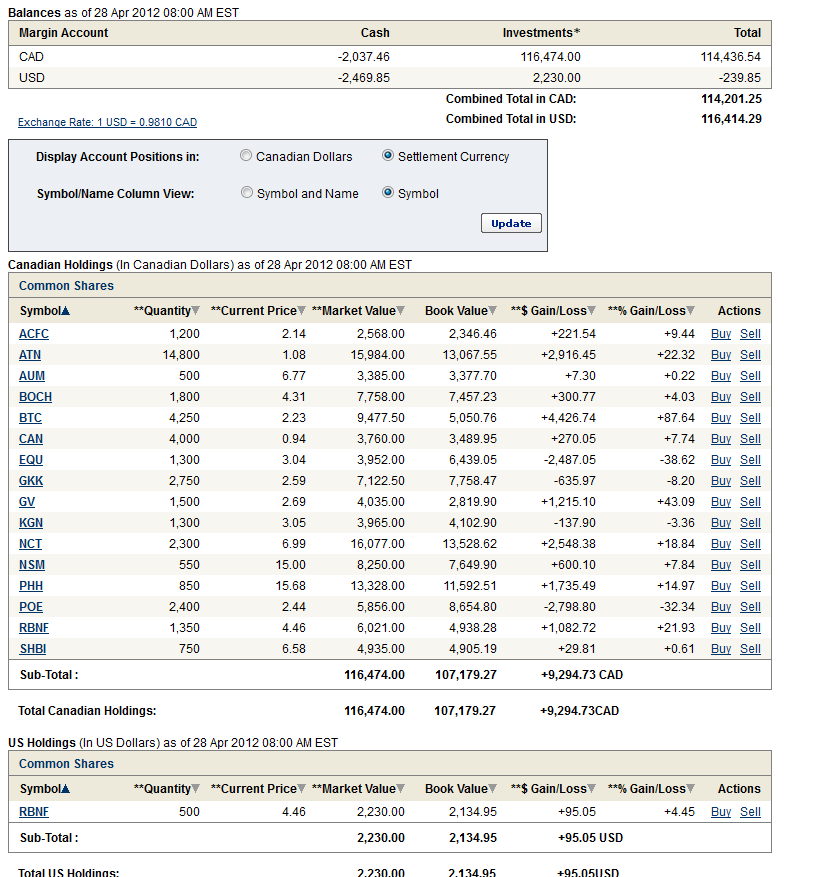
Portfolio Performance

Portfolio Composition

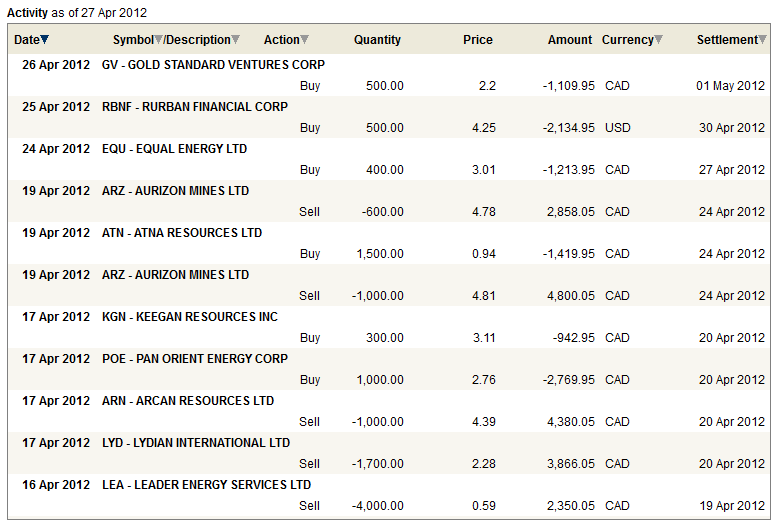
Week 42-43 Trades

Biweekly Portfolio Updates

Those who read this blog regularly may have noticed that I have begun to post my portfolio updates on a bi-weekly basis.  Every week was just too much.  First, not enough happens to my portfolio every week to devote an entire post to it.  Second, its a pain to copy and paste the pictures and update the chart every week.  That is time that would be better spent doing research.  Third, an perhaps most importantly, I have found that with weekly updates I was becoming a little too focused on my short term performance, and I think this was conflicting with my investment style.

When I think of how I have made money in the past, it has rarely been from making quick trades in and out of stocks.  I generally make my money by sitting.   Somewhat paradoxically my best investments have tended to go through a significant period of pain before eventually moving in the direction that I had originally expected them to.

I have to accept, and to some extent expect, that my portfolio is going to go through significant drawdowns at times.  Those drawdowns are challenging.  These drawdowns cause me to reevaluate, and either to strengthen my conviction in a particular position or to realize the folly.  A lot of the time I waffle back and forth on a stock, buying and selling it at the margins, before finally coming to a conclusion on whether to keep it or not.

In the course of the last year I have found that there is extra stress associated with keeping a public portfolio, where the performance is there for all to see, even though most of the people that read this blog are strangers.  I don’t want to make bad decisions.  I feel like showing my portfolio every week may be affecting my decision making ability, at least a bit.  So I am going to try showing my portfolio every two weeks from now on, as this will make the portfolio less of a focus of the blog, and will allow me to focus on the research topics that I really enjoy writing.

With that said…

Out of Aurizon Mines

Without of a doubt my most significant move over the last two weeks was to get out of Aurizon Mines.  On the downside, I got out of Aurizon before it jumped this week and became one of the TSX best performers for the week.  I’m not terribly upset with that because I bought Atna Resources, Keegan Resources, and Gold Standard Ventures with the proceeds.

The reason for swapping a producer for 2 development companies and an explorer was simply valuation.  The explorers and developers have been hit extremely hard.  I honestly never thought Atna would get back below $1.  I mentioned Keegan Resources in a previous post, pointing out that I learned of the company from this Mineweb article, where they were listed in the table below as having one of the highest cash to market capitalization ratios of any of the juniors.

Its worth noting that Canaco Resources is also on the list with a 0.65 ratio.  I bought Canaco back a few weeks ago at 85 cents and it has done reasonably well since then, trading back up to 95 cents.  I would say that companies like Keegan Resources and Canaco Resources represent fairly low risk opportunities to take advantage of the current gold price environment.  Both companies have 4x to5x more cash than their current yearly burn rate.  Both companies have large deposits and they are actively exploring so there is the possibility of these deposits getting bigger.

The downside to both is that the deposits are so-so, and they are in Africa. Those are my only hesitation with these two stocks. But I am optimistic that the takeover of Trelawney may portend to a bottom in the deposit holding juniors.  I was surprised that IAMGold chose Trelawney as a target.  It was my impression  that the deposit had disappointed and that it was going to be tougher to open pit than was at first suspected.  It goes to show there is a price for everything.  The price for Keegan Resources right now is hardly the cash in its bank accounts.  Canaco is only a little better.  I have to think that the mining intermediates must be looking at these possibilities with interest.

A future move that I could see myself doing in the next couple weeks would be to lighten up on these two companies a touch so that I can reinitiate a position in Lydian International.  I sold out of Lydian when it looked like the gold sector was about to go into tank mode.  I figured Lydian would go down (it did) but I also don’t believe that has anything to do with the validity of their project.  The work I did on Lydian 9 months ago remains true today.  The company could easily be a $7 stock if gold deposits began to be valued at $1500 gold.  It has a much better deposit than either Keegan or Canaco.

I also added to my position in Gold Standard Ventures when they announced news of a second drill hit on their Railroad property.  I listened to the conference call that was held that morning.  It is still too early to know what Gold Standard has hit upon.  What they know is that they have two large, long intervals about 300m apart, and they know from analogy that the mineralization and formation they are drilling into is consistent with some of the large Carlin gold deposits.  The stock has a market capitalization of $200M now, so its no longer a cheap speculation; there is a lot of resource built into the share price.  Still, I find it hard to lighten up at this point, when the evidence right now is pointing towards one of those large 5-10Moz Carlin deposits that would make a $1B market capitalization not out of the question.

Banks doing well… for now

The regional bank stocks that I have bought continue to perform well.  I am going to write a more lengthy post reviewing the earnings of the 4 stocks that reported this week (RBNF, BOCH, BTC, and SHBI) so I won’t go into that detail here.

What worries me about the regional banks is that there is some evidence that the US economy is softening.  In particular, the ECRI WLI, which I have been following for years, appears to have stalled out, and it fell for the 4th consecutive week this week.  This softening makes me feel much better about the gold stocks I hold, but it gives me pause on the regional bank stocks.

Spain

Also making me feel much better about gold stocks are my worries about Spain.  I now follow the Spanish 10 year and 5 year bond on a daily basis.  Both are getting ominously close to crisis levels.  It appears that my analysis from earlier this year (What is the LTRO going to do for Europe? And how does it affect my stocks?) is turning out to be correct.  In it I wrote:

Like the Fed operations in 2008, the liquidity injections led to short term spikes but no lasting impact on the market. I am willing to speculate that the LTRO response with follow suit.

The ECB needs to provide further liquidity injections as the markets in Europe are rolling over.  This time they are rolling over in response to Spain, which is somewhat more disconcerting than how they rolled over for Greece last year.  I have been hunting the net for some recent Kyle Bass commentary on the situation, but I have not been able to find any.

Losing dollars because of the dollar

I am taking a haircut on the strength of the Canadian dollar.  If you look at the difference between the Canadian and US dollar values of the account, you will notice that the Canadian dollar value is now a full 2% lower then the US dollar value.

More importantly, more than 50% of my investments are in US dollar stocks.  The regional banks and mortgage servicers that I own suffer every time the Canadian dollar goes up.  A move of the Canadian dollar to 1.10, which has been predicted by some, would hit the US stock portion of my portfolio to the tune of 10%, and my overall portfolio, in its current construction, by 5%.

I’m not ready to do anything about this at the moment.  With the problems in Spain creeping up, I can imagine a scenario where the Canadian dollar corrects rather severely, and my US dollar assets act as somewhat of a hedge.  But it is certainly something to keep an eye on.  I would hate to see myself turn out right on my US stock holdings only to see the gains wiped out by currency movements.

Aurizon Mines: Maybe growth is finally on the horizon of Aurizon

Sorry about the title.  That was a terrible rhyme.

I didn’t set off with the intent of writing a long post on Aurizon Mines this morning.  I have other research projects to spend my time on that hold more near term potential.  In particular, I have regional banks to evaluate, mortgage lenders to learn about, and mortgage lending podcasts to listen to and transcribe.

Nevertheless I must have a masochistic side because I am always more fascinated by the times I am wrong and the things that I don’t understand than with what is working and making sense.  And nothing has been wrong or made as little sense to me as the downward spiral of Aurizon Mines.

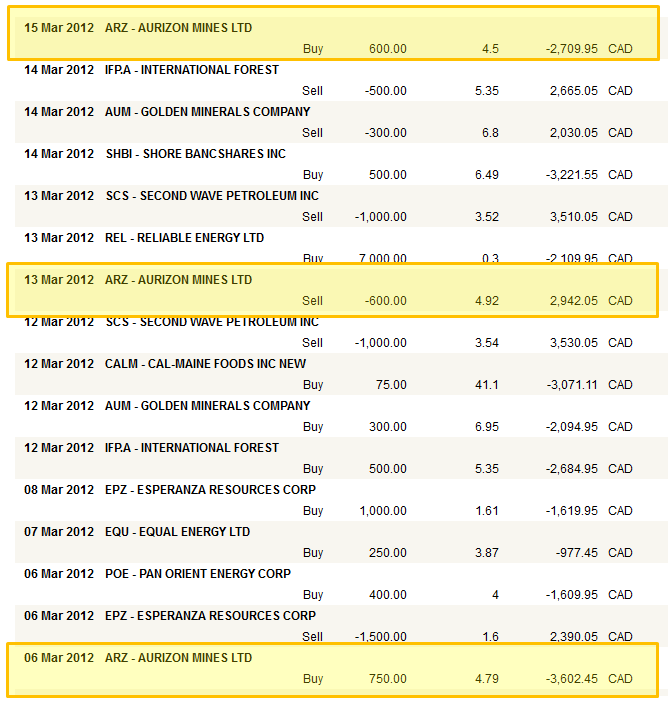
Over the past 6 months I have (somewhat unintentionally) been swing trading Aurizon Mines.  I hold a core position but around that position I buy more at or just under $5 and I sell what I buy at around $5.75 or $6.  It worked well a couple of times last year, however this year not so much.   The stock stalled out a few weeks ago at $5.50, it didn’t stay there long, and I ended up jumping out of some of my non-core position in the $5.30 range.  After that I sat as a bagholder with the rest, watching the stock tumble below $5.

In the last couple weeks I have been in and out some more, buying at $4.80, getting out at $4.9 before buying back on Thursday at $4.50.  The frequency of my indecision is telling. I clearly don’t know what to think about the stock.
To be honest, I didn’t think Aurizon would get this low.  The company holds $1.31 in cash and would be considered to be one of the lower cost gold producers. It has consistently met targets.  Its not a management disaster like so many gold miners.  These are solid operators.

The Alamos Gold Comparison

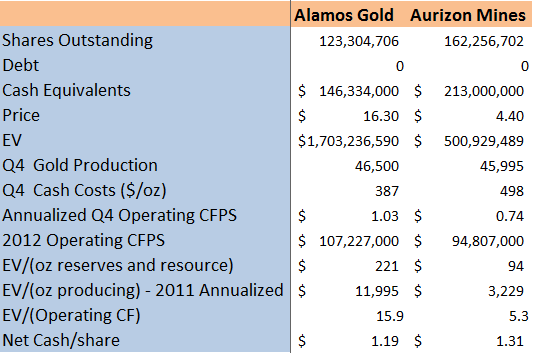
I did a comparison a few months ago between Alamos Gold and Aurizon Mines to demonstrate the disconnect.  I think it is instructive to dig up and refresh that analysis now that the Q4 numbers are out:
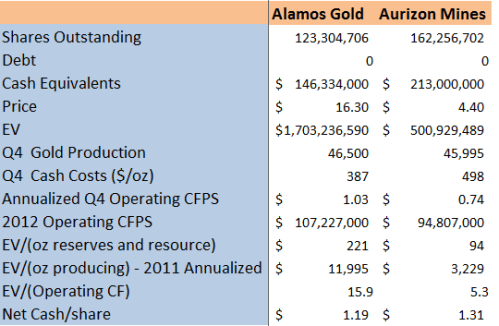
Instead of focusing on the valuation discrepancy and how the market has it wrong, I want to focus instead on why the market is willing to value Alamos at 2x to 3x the value they are willing to assign to Aurizon.

I think its all about growth and costs.

In the Alamos Q4 report, the company forecast that they would increase production from 153,000 ounces to over 200,000 ounces in 2012.  They also predicted that costs would come in about the same as they did in 2011.

In 2012, the Mulatos Mine is forecast to produce its one millionth ounce of gold. Ongoing exploration success has resulted in a track record of mined reserves being replaced. In 2012, the Company expects production to increase to between 200,000 and 220,000 ounces at a cash operating cost of $365 to $390 per ounce of gold sold ($450 to $475 per ounce of gold sold inclusive of the 5% royalty, assuming a $1,700 gold price). The Company expects that gold produced from the gravity mill, which will process high-grade ore from Escondida, will add a minimum of 67,000 ounces of production in 2012 at a grade of 13.4 g/t Au. Based on bulk sample testing conducted in 2007, the Company believes that there is the potential for higher production from the gravity mill as a result of realizing positive grade reconciliation to the reserve grade.

The high-grade gravity mill has been constructed and is currently undergoing commissioning and is expected to be operational with high-grade production by the end of the first quarter of 2012. The current life of the Escondida zone is approximately three years and exploration efforts in Mexico in 2012 will continue to focus on sourcing additional high-grade mill feed. Metallurgical testing completed in 2011 on higher grade ore from San Carlos demonstrated that it is amenable to gravity processing, potentially doubling the amount of available mill feed. Further optimization and metallurgical studies are underway in order to increase the amount of high grade ore that can be processed through the gravity plant.

On the other hand a look at Aurizon’s Q4 report shows the following outlook:

It is estimated that Casa Berardi will produce approximately 155,000 – 160,000 ounces of gold in 2012 at an average grade of 7.5 grams of gold per tonne. Average daily ore throughput is estimated at 2,000 tonnes per day, similar to 2011. Mine sequencing in 2012 will result in ore grades that are expected to be approximately 6% lower than those achieved in 2011. Approximately 42% of production will come from Zone 113, 41% from the Lower Inter Zone, and the residual 17% from smaller zones and development material.

Assuming a Canadian/U.S. dollar exchange rate at parity, total cash costs per ounce for the year are anticipated to approximate US$600 per ounce in 2012. Onsite mining, milling and administration costs are expected to average $134 per tonne, up approximately 6% from 2011 costs as a result of higher stope preparation costs and smaller stopes.

Flat production.  Higher costs.

$600 costs are not high by most gold mining standards.  With those sort of costs Aurizon would still sit in the top quartile of low cost producers.  I think that in this case Aurizon is guilty by association.  There have been SO MANY gold miners that have began to predict higher costs only to see those costs spiral much higher than was originally anticipated. The market is on guard.

The Sinking Growth Ship

As for the growth, the problem is that the company’s flagship growth project is not inspiring confidence.   I stepped through the news timeline at Joanna in a previous post.  Since Aurizon has made it a habit of updating the street with quarterly reminders of just how shitty the Joanna PEA is going to be, let’s do the same thing here.  Below is the time line of events:

May 12th 2008

Aurizon first commissioned a pre-feasibility study on Joanna.

November 11, 2009

Aurizon finally received that pre-feasibility study and proceed to a full feasibility study.

September 14th 2010

Aurizon notifies shareholders that the original recovery process assumed (called the Albion process) would show lower recoveries and higher costs than first anticipated. Additional metallurgical test work would be done and the study delayed until mid 2011.

August 11, 2011

Aurizon delays the feasibility study for Joanna again, saying: “the projected capital and operating costs appear to be significantly higher than previously anticipated. The increased scope of the project, as a result of the expanded mineral resource base, has increased capital costs, including those associated with an autoclave process. The costs of ore and waste stockpiles, tailings and of materials and equipment have also all been trending higher, along with the gold price.”

January 11, 2012

Another update giving an ETA: Feasibility study work on the Hosco deposit will continue in 2012 with completion of the study anticipated by mid-year. The feasibility study will incorporate a reserve update based on the increased mineral resource estimate announced on June 13, 2011, together with results of metallurgical pilot tests, a geotechnical study, updated capital and operating cost estimates, and other relevant studies.

As I wrote at the time:

Its been almost 4 years since the original pre-feasibility study on Joanna was complete! At this rate they should be mining by 2100.

The time line can now be updated with the latest installment from the Q4 report and the following comment:

While some studies are still in progress, based on its review of information currently available the Company believes that the feasibility study is sufficiently advanced to conclude that the projected capital and unit operating costs will be significantly higher than estimated in the December 2009 Pre-Feasibility Study, due in part to the change in the scope of the project, the expanded mineral resource base, the selection of an autoclave process and a decision to process the ore on site.

I think this is about the 3rd time the company has warned investors not to get their hopes up about Joanna.  Keep in mind that the original numbers for Joanna weren’t exactly thrifty (if I rememver right they were $200M + capital and $700 costs).

If I was going to translate this news-release-speak into plain english it would sound something like this:

It is surprising even us with how shitty this project is turning out to be

But that’s just my interpretation.  I could be wrong.

Takeover talk!

I have found 3 articles (here, here, and here) discussing a post-earnings release interview (or maybe it was on the conference call, I haven’t had a chance to listen yet) done by George Paspalas, the company’s CEO, where he said that the company has been approached by potential suitors and that the company is also looking for companyies they could takeover.

With respect to the potential for an acquisition, Paspalas said the following:

To receive the company’s interest, a target would have to be producing around 120 000 oz/y, and at similar profit margins to Aurizon’s flagship Casa Berardi mine in Quebec.  “We’ve looked hard, I can tell you that,” Paspalas said, speaking in a telephone interview from the firm’s Vancouver headquarters.   “There are a lot of companies out there…that are at a point where they have a pretty good project, but they don’t have any cash – and the shareholders are saying ‘enough’s enough’ in terms of dilution,” commented Paspalas.  “We have five or six opportunities in our grade one category,” he said, adding that one of these could close in the near-term if there weren’t any pitfalls in the technical due diligence or price negotiations process.

He went on to say that they are shifting their focus from looking at acquiring a producing mine to instead acquiring a near-term project.

The one report also said that Aurizon “has itself received informal approaches regarding potential mergers.”

Cautiously Optimistic

I think this is quite good news.  The problem with Aurizon, as I have tried to lay out above, is that the market wants growth and the market isn’t buying Joanna as the vehicle for that growth.  It’s too bad they will have to pay up a good chunk of their cash hoard to acquire a project but the argument could easily be made that the cash is being ignored by the market right now anyways.  If you remember Argonaut Gold, their adventure to double digit share prices began when the company took over Pediment Gold and with that acquisition bought themselves a stable of near term production projects.  A similar acquisition by Aurizon would be a positive.  It would allow the brokerages to start prjecting realistic growth  into the future, and from those higher production numbers they can begin to tag a higher multiple onto the stock.  Then everyone gets excited about the prospects and we all jump on the bandwagon and a couple of fund managers get on BNN and hype the stock and pretty soon you have Argonaut Gold all over again, going from $3 to $10 in a little over a year.

Its a plausible scenario.   If the takeover happens and it looks like its the right takeeover, I will no longer swing trade the stock and instead will begin to hold it for the longer term.  But without the takeover I am just not willing to put too many of my eggs in the Joanna feasibility basket, which is sounding more and more to me like it has a big hole in it.

Buying when you don’t want to

The hardest posts for me to write are the one’s where I have to write that I bought a bunch of stocks on a day where the market was down a lot.  Its tough because I am worried I will be proven wrong.  Its extra tough because I am notoriously early and so I have been wrong many times before.

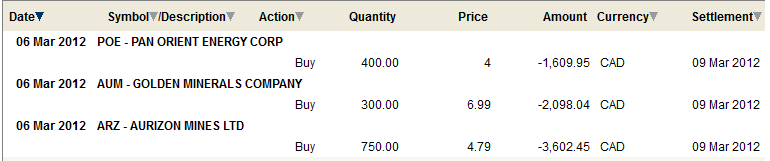
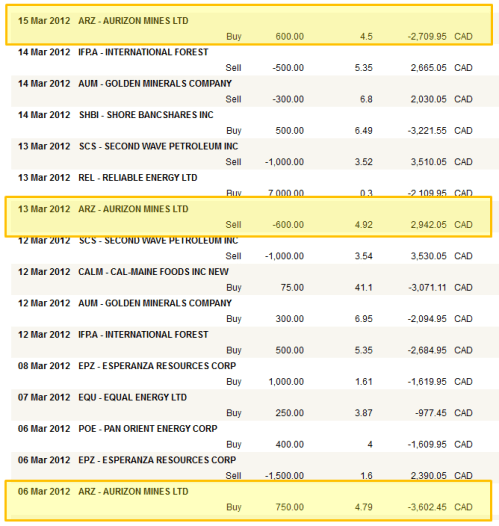
The market really tanked today and nothing tanked harder than the junior gold and oil stocks.  I had lightened up significantly on the gold stocks last week; I exited Canaco Resource, OceanaGold and a significant portion of Aurizon Mine. Unfortunately I used some of the proceeds to buy Pan Orient Energy, which took it on the chin today.

Nevertheless there is some truth to the old adage that the best time to buy stocks is often when you don’t want to.  Today I didn’t want to buy anything.  I even had half a mind to sell it all and stand away.

But having thought it through, I am having trouble making sense of the idea that this is the start of something big.  I have become a convert to the idea that the LTRO has taken out much of the systemic risk potential. The prices of periphery bonds suggest as much; even after today’s shellacking Italian and Spanish bonds sit near their lows.  The TED spread and Swap spread hardly moved at all and currently sits at 40 and 27 respectively, well of their highs of 60 and 55.  The bank stocks, while hit hard, did not lead the way down in the way they did in August.

It just doesn’t feel to me like it did in August, or in November for that matter, when the fear was palpable.  Yes, we are worried about Greece and what is going to happen.  But the evidence does not suggest that the big players are that worried.  If they were we would see more signals of the stress in the bond market.

Which makes sense.  By this point everyone knows about Greece.  Everyone who had money at risk with Greece should have been able to figure out how to take it off the table.  That yields aren’t rising in the periphery suggests that the real problem, that a Greece default would cause a domino effect, is not in the cards.

What I bought

I’ve had good luck buying Aurizon under $5 in the past and so I did so again today, restoring my full position in the stock.  I also bought more Golden Minerals.  Golden Minerals is a stock I had been tempted to sell when it got to $10, but I got a little greedy and decided against it, only to watch the stock fall back to $6.80 today, which is not too far away from my original purchase price.  The stock is reasonable at these levels; the company has $2 cash on hand per share and a 6Moz gold equivalent resource.

Interestingly, Rick Rule was on BNN yesterday and he had some positive comments on Golden Minerals in this clip (I’m not really sure how to embed video from BNN).

Since last Wednesday its been a swift fall for many gold stocks.  My bet here is that the latecomers have been fleshed out and that with stocks like Aurizon and Golden Minerals approaching their 52 week lows once again, we are close if not at the bottom.

I also added to Pan Orient.  This will be the last time that I add until I see the stock begin to rise again.  For the time being I will sit tight with what I own.