Skip to content

Posts from the ‘Empire Industries (EIL)’ Category

Week 372: Stealth Correction (also updates on Mission Ready, Blue Ridge and Empire Industries)

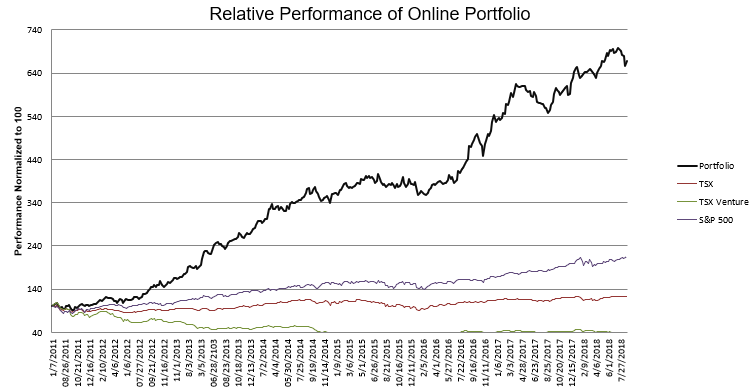
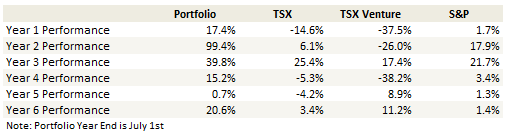
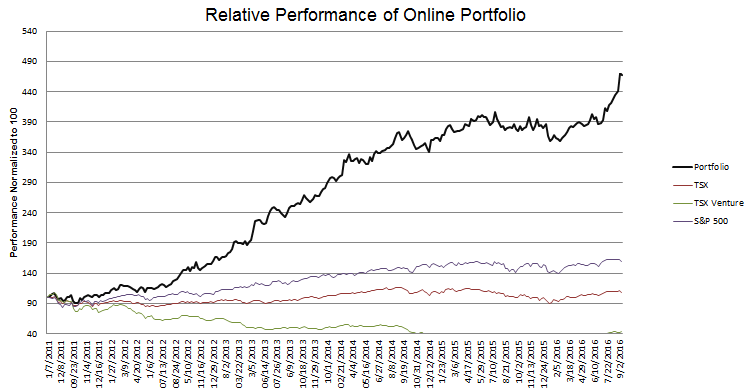
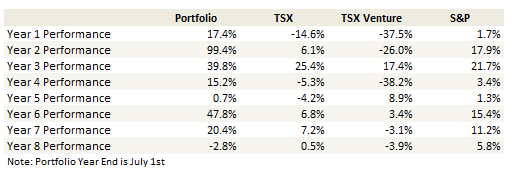
Portfolio Performance
Thoughts and Review

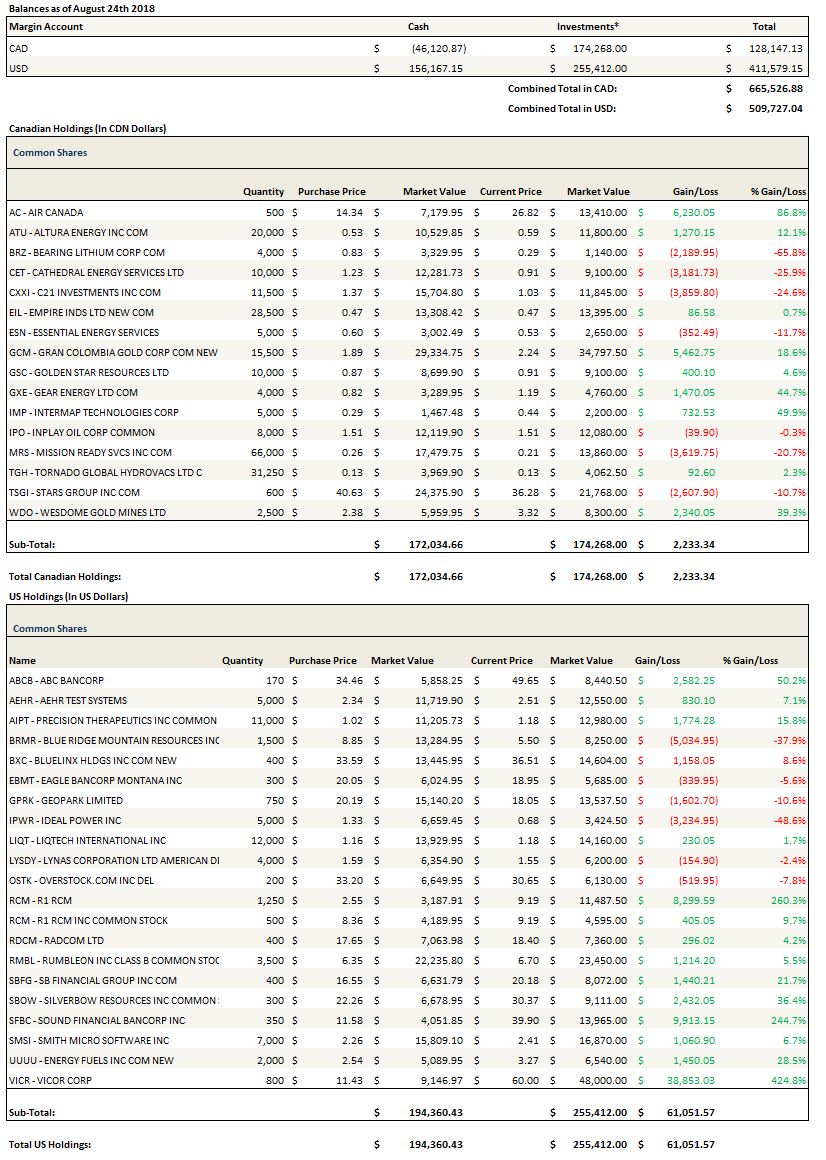
First off, the portfolio updates in this post are as of August 24th. I’m a little slow getting this out.  So the numbers don’t include what has happened in this last week.

I really got it handed to me in August.  The portfolio was cruising to new highs in July but those were short lived.  Top to bottom I saw a 6% pullback in a little over a month before finally bouncing a couple weeks ago.  Fortunately that bounce has continued this last week so things aren’t as dire any more.

What was funny about the move is that it didn’t feel like things were going that badly.  Usually when I lose 5-6% in a month (this seems to be an annual occurrence for me) I’m tearing my hair out, contemplating throwing the towel in, and generally in a state of disrepair.

Not so this time.  I have been surprisingly unconcerned by the move.

Why have I taken it in stride this time?  Here are a few reasons I can think of.

1. I lost on stocks that I still have conviction in.  Take for example Gran Colombia Gold (which is one of my larger positions).  I’m just not that worried about the move, as painful as it has been.  I’m still up on my position, and it remains cheap with no operating concerns.  I don’t feel like it warrants my worry.  RumbleOn was another (another large position), touching back into the $5’s at various points over that time.  We know what transpired there this last week.

2. I was getting beat up almost entirely by my Canadian stock positions.  Its probably irrational but I don’t worry as much when its my Canadian stocks that are going down.

3. Earnings for most of my positions were pretty good, even if those results weren’t reflected in the stock price.  Vicor was great.  Gran Colombia was stellar.  RumbleOn was fine.  R1 RCM was another stand-out, as was Air Canada.  No complaints.

Anyways it is what it is.  Things have gone better this week.  In the rest of the post I want to talk about 3 stocks in particular and these have turned into rather long excursions.  So I’ll leave any further portfolio comments for another time.

Mission Ready Solutions

Mission Ready has been halted since July 18th.  Nine times out of ten if a stock is on a 6 week halt it wouldn’t be a good thing.  Yet I’m pretty sanguine about the company’s prospects.  The news so far has been pretty good.

The big news happened on July 31st, when Mission Ready signed an LOI to acquire Unifire Inc.  They followed this up with an update on the foreign military agreement on August 2nd.  Then there was another news release August 7th that gave more detail on the foreign military agreement and more detail about the acquisition.  Finally they followed all of this up with a conference call to investors on August 15th.

Having spent some time reviewing Unifire and the deal, I am of the mind that it is a good one.   I am also cautiously optimistic that it will close.  On the conference call the CEO of Unifire was in attendance and spoke at it.  While that doesn’t mean it’s a done deal, his attendance and all the detail provided by Mission Ready points to it being well along.

Here’s the deal.  Mission Ready acquires Unifire for $9 million USD.  The purchase price is comprised of $4 million in cash and 26 million shares (priced at 25c CAD.  They are also taking on at least $6 million of debt (I say at least because Mission Ready didn’t specifically say what Unifire’s total debt was, only that they would be paying back $6 million USD of debt upon close).  With 129 million shares outstanding at $0.25c, $15 million works out to about 50% of the Mission Ready enterprise value.

Unifire is bringing a lot to the table.

As per the first press release Unifire’s “trailing revenue for the 6-month period ending June 30, 2018 was approximately USD$18.3 million”.  Their net income was $750,000 USD.  That’s a lot more than what Mission Ready has (as per the second quarter financials, Mission Ready is running at about $1 million of revenue a quarter).

More importantly, in the second press release (the one where they expanded on the details) Mission Ready pointed out that Unifire was the following:

  • A Department of Defense Prime Vendor.
  • A contract holder for the Defense Logistics Agency (“DLA”) Special Operational Equipment (“SOE”) Tailored Logistic Support (“TLS”) and Fire & Emergency Services Equipment (“FESE”) programs.
  • held “multiple General Services Administration (“GSA”) schedules, blanket purchase agreements and contracts with organizations such as the Department of Homeland Security, the U.S. Army Corps of Engineers, West Point United States Military Academy, Idaho National Laboratories, Hanford Nuclear Facilities, United States Air Force, United States Marines, United States National Guard, United States Navy, and many others”

I dug into this a little bit further.  Turns out that Unifire is actually 1 of only 6 participating vendors from the DLA Troop Support program (from this original Customer Guidelines document issued by the TLS).  Here’s a short list of the types of equipment offered by this program:
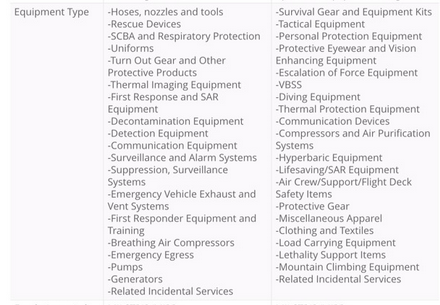
What does being a vendor of this program mean?  It means that if, as a government organization, you want to order one of the 9,000 items covered by the Troop Support Program, you can (I don’t believe the program has mandatory participation but I’m not sure about that) do it through one of these 6 vendors via this program and get subsidized product.

So who would order through the program?  According to ADS, “authorized Department of Defense, Federal Government and other approved Federally-funded agency customers”.

The overall amounts of product involved are significant.  According to this article:

With both being small-business set-asides, and continuations of prior contracts, the first contract will be used to procure special operations equipment (SOE) worth $1 billion per year, and the second will allow for the purchase of a total $985 million in fire & emergency services equipment (F&ESE).

These are big numbers.  So when Mission Ready stated the following in the August 7th news release with respect to Unifire’s justification for entering into the merger, they weren’t kidding:

Unifire has been limited in its ability to secure the initial capital required to facilitate many of the larger solicitations. Mission Ready has identified sources of capital that will enable Unifire to pursue TLS solicitation opportunities on a much larger scale than they have been able to at any point in their 30-year history, thereby creating immediate and significant growth potential.

Unifire has been getting maybe $30-$40 million a year in total revenue.  But its sitting in the enviable position of being 1 of 6 companies participating in a $2 billion program.  The lost opportunity is significant.

That said, Unifire is a significant vendor for the Department of Defense.  Here is Unifire’s revenue from contracts over the past few years (from Govtribe.com).  It seems to mesh up fairly well with Mission Ready’s stated revenue numbers for Unifire:
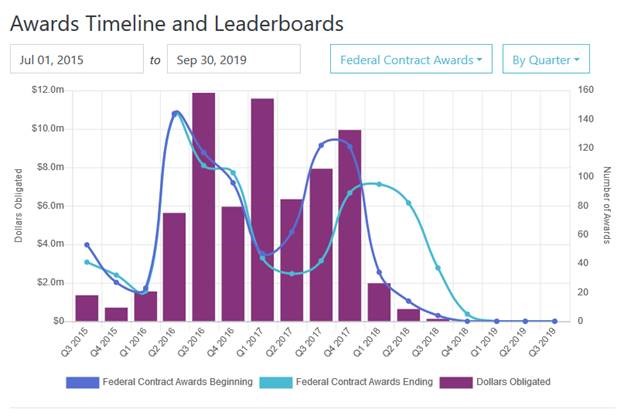
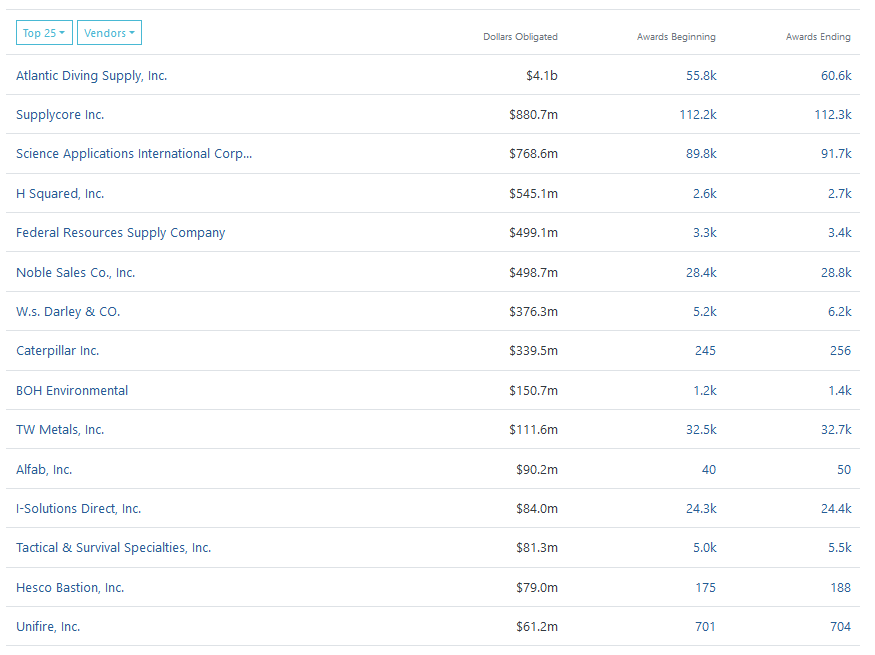
In fact Unifire appears to be the 15th biggest Construction and Equipment vendor with the DOD.
What Mission Ready is apparently bringing to the table is availability of capital.  They are going to raise $15 million USD at 25c [note: it was just pointed out to me that the 25c number wasn’t communicated and there was no pricing specified for the PP.  I could swear I read or heard that number somewhere but maybe I’m getting this mixed up with the Unifire shares.  I’ll have to dig into this].  They are also going to enter into a credit facility of a minimum $20 million USD amount.  The idea is that with the capital, Unifire will have a higher “solicitation readiness” and be able to bid on much more than the $2 million per month that they can right now.

Of course the other thing Mission Ready has is a suite of products that will fit nicely with what Unifire offers, and to which Unifire’s manufacturing capacity can be utilized.  And they also have this massive $400 million LOI with a foreign military that we continue to wait on.

On that matter of the foreign military distribution agreement, it appears the wait will continue.  In the August 2nd press release they explained what we already knew.   They had expected to receive orders by now but that this hasn’t happened and while they expect to still receive orders this year, they really don’t know what to expect any more.

They had more comments on the August 7th news release, which was more upbeat, if not cryptic.  With respect to the foreign military purchase order they said the following:

The Company is working diligently to finalize the Licensing Agreement in advance of the initial purchase order(s) (“Purchase Order” or “Purchase Orders”) and expect to complete the agreement for consideration by all parties no later than August 24, 2018.

You could read into it that they expect of some sort of purchase order soon that they need to get this new agreement in place for?  Maybe?  Bueller?  But who really knows.

Here’s what I do know.  I know that if the LOI for Unifire falls through and no PO comes from the foreign military then this thing is going to be a zero (or at least a “5 center, which is effectively the same thing).

But I also know that if the Unifire deal closes, if Mission Ready closes a $15 million financing and a credit facility of $20 million, if Unifire secures the $100 million of business in the next 18 months that is mentioned as a minimum requirement in the terms of the facility, and if the foreign military PO comes through, this stock is going to have a significantly higher capitalization then the current $25 million (CAD).

Honestly, when I review all the details above, I think the odds are on the latter scenario.

Blue Ridge Mountain

Oh Blue Ridge.  This stock has turned out to be a bit of a disaster.  I bought it at $9 and then at $7 thinking that it could be worth maybe $15 in a relatively short time as they sold the company at a premium.  With the news this week that they are merging with Eclipse Resources that value is likely to be realized over a much longer time period.

I still like the stock and plan to hold my new shares of Eclipse.  But I also recognize that this is a broken thesis.

I think what happened here is two-fold.  First, part of the value in Blue Ridge was in their stake in Eureka midstream, which seemed like it could be valued at $200 million or more itself.  In fact when the company announced the deal to divest their stake in Eureka (back last August), they said that the transaction was valued at between $238 million and $308 million (I’m not going to post the slide that breaks down that value because it has confidential written all over it for some reason).

Well presumably, given that the stock was trading at at $225 million enterprise value before the merger, the market didn’t agree.  The problem was that much of the “value” in the Eureka sale was in the form of fee reductions and the removal of minimum volume commitments (which I don’t believe are going to bring any cash in, though I’m still not sure on this).  So it was different than receiving tangible cash.

The second thing is something I missed originally.  As I wrote about in my original article on Blue Ridge last year, they have a lot of acreage prospective for the Marcellus and Utica.  What I didn’t understand well enough at the time was that much of the acreage in Southern Washington county and northern Pleasant county was outside of what is considered to be the “core” of these plays.  While the step-outs Blue Ridge has had so far have actually been pretty good, there is a lot more work to be done before the acreage gets the sort of value that acres in Monroe, Wetzel or Marshall county get.

I kinda figured this out earlier this year, but by then the stock was in the $6’s, which seemed to more than reflect my new understanding, and honestly even if I wanted to sell it at that level I couldn’t have given the illiquidity.

Well now with the Eclipse merger there is liquidity.  I think what you saw in the subsequent days was a lot of the bond funds that had picked up the stock in bankruptcy and who were now stuck with equity (which could very well be outside of their mandate) selling Eclipse in order to neutralize their Blue Ridge position and effectively get out of the stock.

That this seems to have waned on Friday, in particular given a pretty rough Stifel report on Eclipse, is likely a good sign.

My take is that the combined entity is not expensive.  Here is a little table I put together of what the individual parts and the new Eclipse looks like (my $6.64 for Blue Ridge is based on the conversion of Eclipse at $1.50 per share):
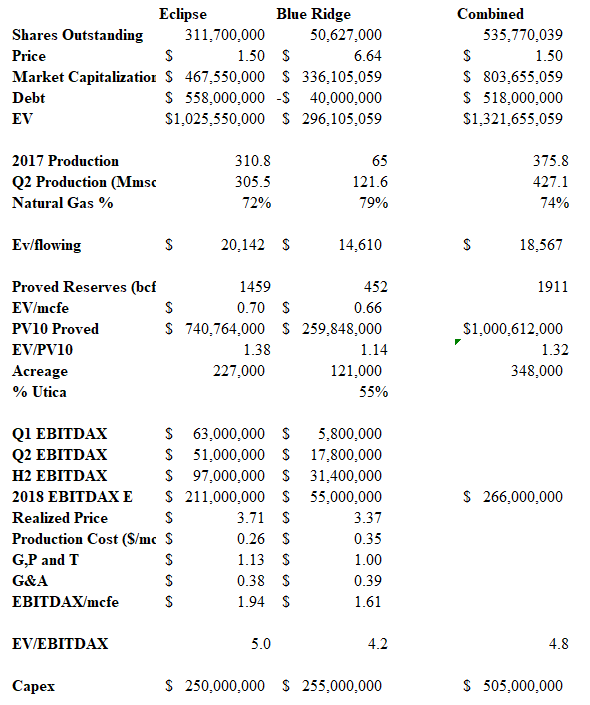
If you look at the comps, the combined Eclipse doesn’t stack up too badly.  5x EBITDA for a company anticipated to grow 20% in 2019 is probably a little cheap compared to peers.

Peer comparisons are hard though because there aren’t a lot of smaller, all natural gas, players in the Marcellus/Utica.  From what I can see its dominated by big companies like Range, Southwestern and EQT.  These companies are 10x the size or more.  They generally trade at higher multiples but that isn’t necessarily instructive.  The smaller “peers” are more oil weighted and in other basins.

So what do I conclude?  I’m going to stick with Blue Ridge/Eclipse because A. it’s not expensive, B. the Blue Ridge management team is leading the combined entity has done a good job operationally with Blue Ridge, C. There is a lot of undeveloped acres between the two companies and if they can prove up even a fraction of them the stock price should reflect that, and D. this is a nice way to play the upside option on natural gas.

But it didn’t turn out the way I expected.

Empire Industries

Empire announced second quarter results on August 27th.  It was another “meh” quarter.  But patiently I wait.

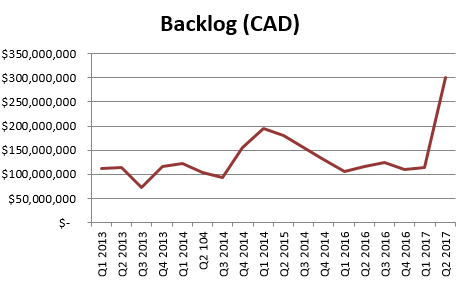
The reality is that Empire has been a perpetual “just wait till next quarter” story since last September when they announced the co-venture partnerships.  They have an incredible backlog of business.  Contract backlog as of June 30, 2018 was $280 million.  The co-ventures have a tonne of promise.  But neither the backlog or the co-ventures have translated into results yet.

They continue to struggle to turn the backlog into profits.  In the second quarter gross margins reversed (again) to 16.7% from 19.6% in the first quarter.  Remember that the magic number the company has said they should be able to achieve is 25%.

The problem has been the continued work through of three first generation rides that are being built at very little margin.  In fact the company said on the conference call that these contracts contributed no margin in the second quarter.  I had hoped that by the second quarter we would see the impact of these essentially unprofitable contracts abate.  But that wasn’t the case.

I talked with investor relations about this and it appears that in the third quarter we should see less of an impact.  But whether this means 22% margins or 18% margins is anyone’s guess.

Management also seem to recognize that their cost structure just isn’t low enough right now.  Part of the problem appears to be that they operate much of their manufacturing out of Vancouver.  They hinted that there are going to be changes in this regard in the next few months.

One of the key opportunities was how rapidly the growth — the market was growing, but with this growth came an increasingly apparent need to improve our cost competitiveness to capitalize on this growth. As a result, Empire has undertaken an aggressive action plan to reduce its cost structure, as described in detail on previous calls by Hao Wang, President and Chief Operating Officer of Dynamic Attractions, a wholly owned subsidiary and the primary business unit for Empire…The organization-wide cost-reduction initiative is well underway, reducing our headcount and fixed costs. Furthermore, we’ve identified and implemented design, procurement and production efficiencies that can improve our execution capabilities and our financial results.

They went on to say that “margin expansion is a top priority”.  This is a good thing because it’s crazy to be letting this backlog pass without making any money from it.

The other piece is expansion.  Again they touched on this (“we’re actively looking at innovative ways to increase our production capacity”) in the second quarter call.  It’s clear that right now they are capacity constrained. For instance, the backlog has essentially doubled over the last year and a half and yet the quarterly revenue is pretty much the same.  Its nice to have a backlog that extends out 3 years but it would be nicer if they could grow revenue a bit.

And then there is the co-ventures.  Nothing to announce but still on-track to be announced this year.

Just to recap the co-ventures, last August Empire announced the creation of two co-venture attractions companies.  The intent of these companies were to partner with “tourist-based locations” to co-own and operate Flying Theatre rides.  One of the companies, called Dynamic Entertainment Group (DEGL), would partner with US locations, while the other, called Dynamic Technology Shanghai (DTHK), would partner in Asia (China most likely).

It was a complicated structure with a rights offering (at 50c) and a private placement to their Shanghai partner Excellence Raise Overseas (EROL) also at 50c.

In total Empire invested $12 million in the ventures.  They own 62.5% of DEGL and (I think) 22% of DTHK.  The ownership in DTHK is via DEGL, which is makes things complicated.  The other 28% of DEGL and 78% of DTHK is owned by their partner EROL.  EROL and Empire invested at the same valuation.  Got that?

This somewhat ridiculously complicated ownership structure can be summed up with the following graphic (from the September 2017 presentation):
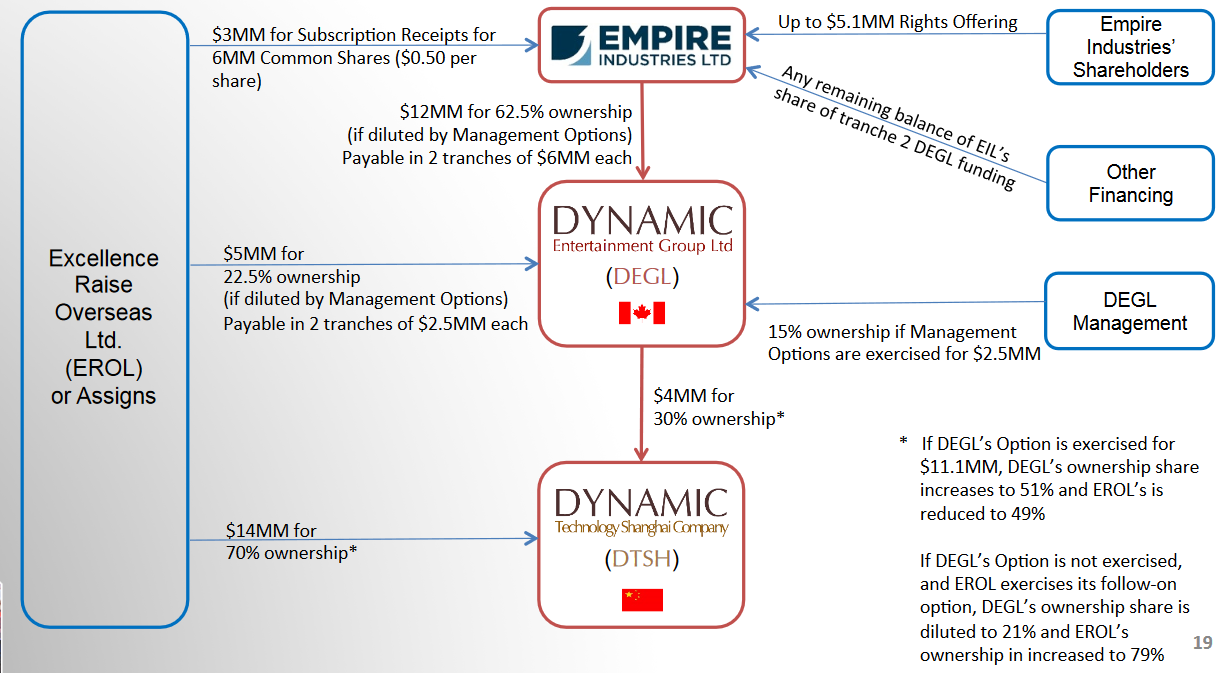
At the end of the day Empire gets to own 63% of a venture that will build and operate attractions in the United States and about 20% of a venture that will do the same in China.  Empire also gets to build the attractions that these ventures market.  Originally this was going to be at a low margin of 15% but given the recent results that margin is looking to be pretty much right in line <rolls eyes>.

Way back when the venture opportunity was finalized I was able to dig up more information on the economics of the attractions business.  First, I found information on the economics of what appears to be a fairly similar existing ride called FlyOver Canada.  The attraction is part of Canada place in Vancouver.  Flyover Canada is a virtual flight ride experience.  Its also owned by a public company named Viad, so unlike every other attraction I read about, there is actually publicly available information about its performance. Here is a quick summary from the 2016 Viad 10-K:

Flyover Canada showcases some of Canada’s most awe-inspiring scenery from coast to coast. The state-of-the-art, multi-sensory experience combines motion seating, spectacular media, and special effects including wind, scents, and mist, to provide a true flying experience for guests. FlyOver Canada is ideally located in downtown Vancouver, Canada. FlyOver Canada is rated by Trip Advisor as the #1 “Fun & Games in Vancouver” and has been awarded with the Trip Advisor Certificate of Excellence.

Flyover Canada is essentially a flying theater, which is the exact same attraction that Empire is looking to co-venture.  Empire has built numerous flying theaters in the past and references a number of them on their website’s Flying Theatre description.  It doesn’t appear that Empire built Flyover Canada (it was a competitor Brogent) but they did build Flyover Italy, Soaring over California, and Soaring, a Florida attraction.

Viad purchased Flyover Canada from Fort Capital at the end of 2016.   According to the Fort Capital press release at the time of the sale, the purchase prices was $69 million Canadian (remember if all goes well Empire and its ~$50 million market capitalization is going to own 63% of one of these in the US and 20% of another in China).  Flyover Canada had 600,000 guests and generated $11 million in 2016, so it’s a $20 a pop ride.  In their 2016 10-K Viad gave the following 2017 forecast for FlyOver Canada:

FlyOver Canada is expected to contribute incremental revenue of $9 million to $10 million with Adjusted Segment EBITDA of $5 million to $5.5 million.

The numbers are in US dollars.  Flyover Canada ended up doing $10 million of revenue in 2017, and though there was no EBITDA breakdown I have to assume it was close to expectations.  So it’s margins of 50%+

At the time I talked to IR about the opportunity.  The information I got was that depending on the size of the ride, revenue would be around $8-$14 million USD per year depending on the size.  Margins on the ride would be around 50%. A smaller ride would cost $10 million to $12 million to build, while a larger attraction would cost $18 million.  So these numbers are all pretty much inline with Flyover Canada.

The idea was (and is) that net to Empire’s 60% ownership, and assuming a split with a landowner, they should get somewhere between $3 million to $4 million of recurring EBITDA (CAD) out of the US deal.  I didn’t get any information on the Chinese opportunity.

Empire (via Dynamic Entertainment Group) would partner on the attraction with a landowner in a tourist destination.  The deal would be structured so that Empire got a preferential return until the cost of the ride is paid off.  Empire would make 10-15% margins on the design and construction of the attraction as per their contract with DEGL.  There is also a $3 million subsidy for developing creative content in Canada which would reduce the overall manufacturing cost to $7-$9 million.

The expectation was that the EBITDA should get a multiple of 10x.  Viad bought FlyOver Canada for about that multiple.  Again, if Empire got a 10x multiple on $3 million of EBITDA, that would eat up much of the current capitalization right there.

Overall, it’s always seemed like a decent venture for Empire once it gets off the ground.  The company invested $12.1 million via $8 million in equity and $4 million in debt.  In return they would eventually get the $2-$4 million of recurring EBITDA from the US venture, add two near-term attractions to their construction backlog (one for the US and one for China), and get some additional EBITDA (I don’t know how much) from the Chinese venture.

Of course like everything else with Empire this is a waiting game.  On the call they said “Before the end of the year, we expect to announce our first co-venture location. We expect to have an opening sometime in 2019”.  Hopefully we get an announcement soon.

Portfolio Composition

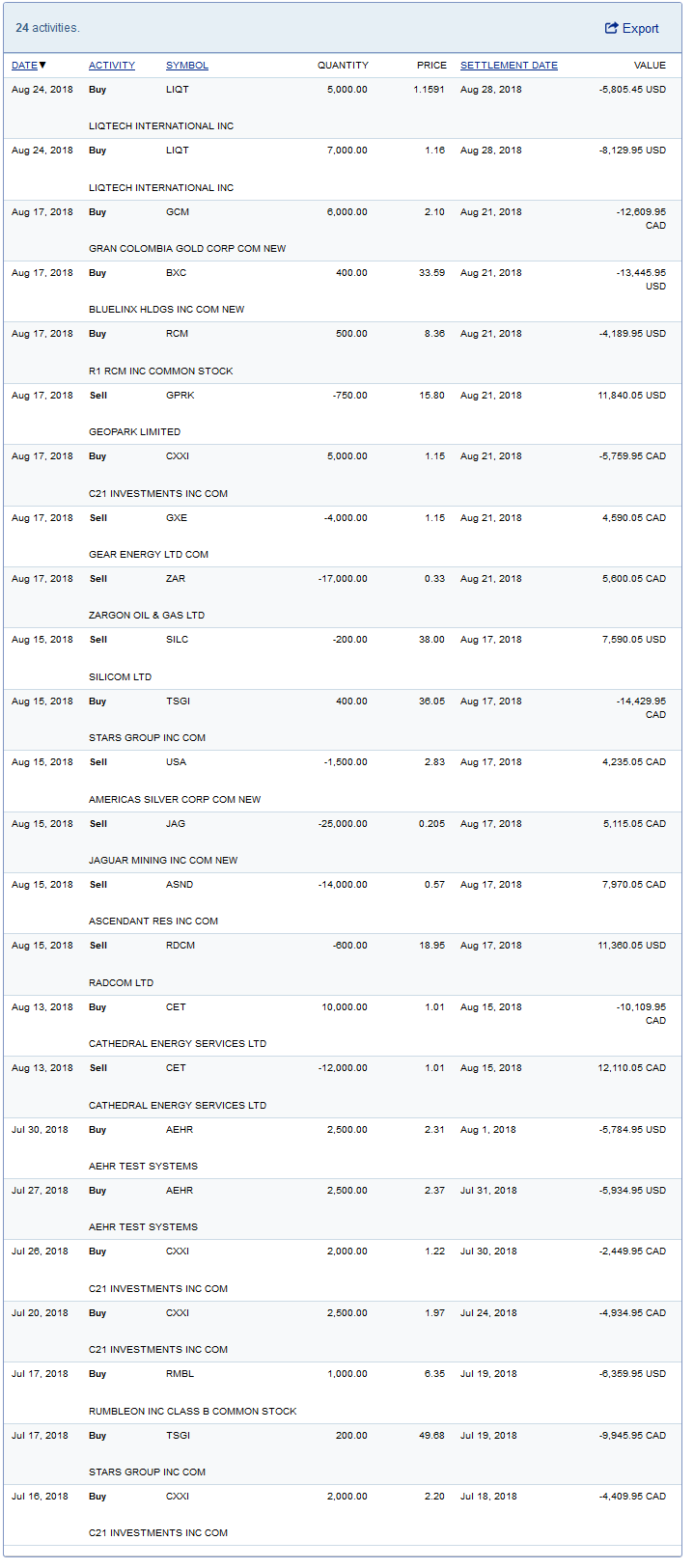
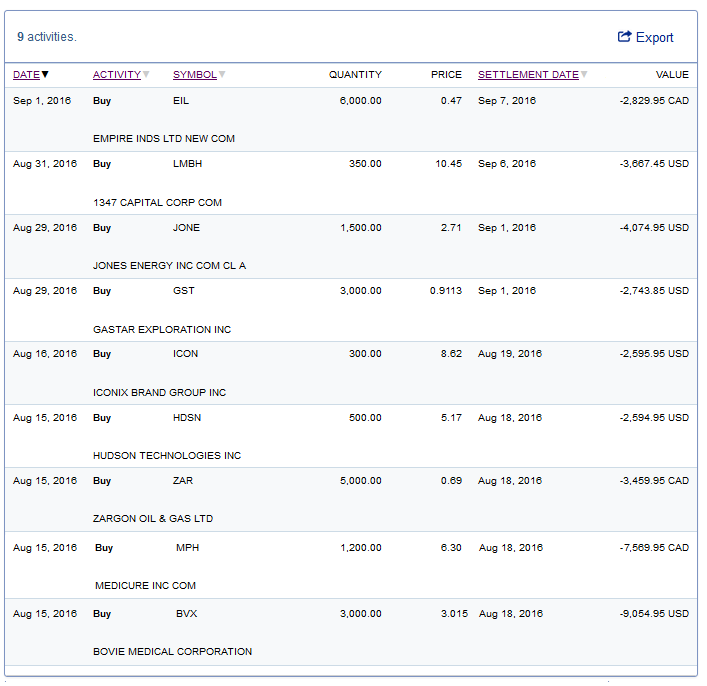
Click here for the last six weeks of trades.  Note that this is August 24th, so I’m a week behind here.
Adding to one of the few ideas that is working: Empire Industries

My portfolio has been behaving poorly over the last month and a half.  I’ve had very little confidence to add to positions in the face of these headwinds. That said, one of the few positions that has bucked the trend and that I have added to is Empire Industries.

Empire reported its first quarter results at the end of May.   The results were a step forward.  The company had $32 million in revenue, which was up significantly from the fourth quarter but fairly consistent with the level of the previous few quarters.  Gross margins of 22% were an improvement over the last few quarters, as was the EBITDA margin of a little over 9%.   The gross margin number has been improving of late (they had been in the high teens up until the last couple of quarters) as the company has shifted toward manufacturing the second generation of their attractions products and moved away from custom designs.  On the call management suggested that this level of margins, and maybe a little higher, would be sustainable going forward.

Along with the results the company announced the wind down of the steel fabrication business.  Some of that business will be moved towards providing support for Dynamic Attractions, while the rest has been shuttered.  Given that the business lost over $2 million last year and allows them to cut $1 million of overhead costs, I’m not sad to see it go.

I thought that Guy Nelson, Empire’s CEO, was particularly positive on the call.  He said that the “market for our immersive attractions is growing rapidly”, the Q1 results “prepare the company for strong results in the future”, and the backlog is “indicative of how we are the supplier of choice among the world’s top theme parks”.  They have “a record backlog of proposals in our pipeline” and its “safe to say that you can look forward to more contract announcements in the future”.

The big news that was announced just prior to earnings of was the $125 million four year contract announced earlier in May.  This is a huge contract, much bigger than previous contracts that have been in the $30-$50 million range.  They said they believed it was the biggest contract ever announced in their industry.  I honestly was surprised that the stock didn’t move higher on this news.

As I already mentioned, Nelson said on the call that it was “safe to say” there would be more contracts in the future.  True to his word, the company announced a $40 million USD contract with an Asian theme park operator last week.  Again, the stock popped on the news, but remains more subdued than I would have anticipated.

Including both of these new contracts, the companies backlog stands at roughly $300 million (CAD).

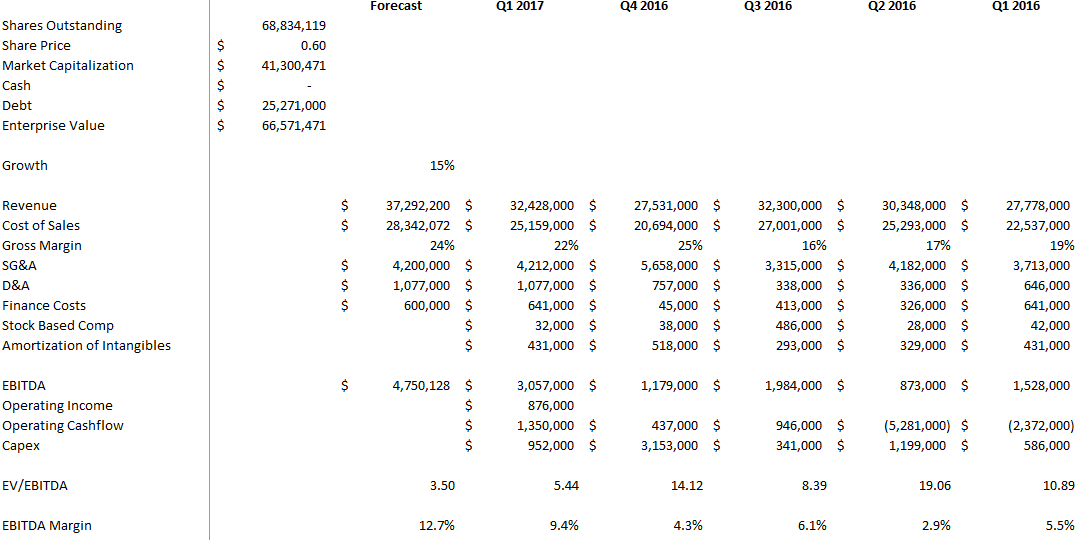
So what does that mean?  Well, at the current share price (~0.60c) Empire has a market capitalization of $40 million.  Add on $25 million of debt and the total enterprise value is $65 million.  For that price you get a company with trailing twelve month (TTM) revenues of $132 million, so the stock is trading at a little less than 0.5x TTM sales.

In the past you’d argue back that Empire’s businesses are low margin, so the multiple should be low.  But with the wind down of the steel fabrication business and the spin-off of the hydrovac business, and with the shift to higher margin second gen products for Dynamic Attractions, this is less the case now.  Gross margins for Dynamic Attractions are still low, but they are no longer mid-teens.  They are now over 20% and maybe can tick even a couple of points higher as they increase their second generation business and integrate the in-house manufacturing of their remaining steel fab assets.

Moreover, revenues are likely to grow over the next couple of years.  The $300 million in backlog is double its peak level over the last few years.  Over that time Empire has operated Dynamic Attractions at a revenue level that has been about ~80% of backlog (Dynamic Attractions revenue has been about $100 million annually while the backlog, while volatile, has fluctuated around the $120 million level).  Given that the backlog has now doubled, how much can we expect a commensurate move up in revenues?

It may have made sense for the company to trade at a low multiple when the steel business and hydrovac business were revenue drivers, when the media attraction business had lower margins and a smaller backlog and thus some uncertainty around its sustainability.  But now, with a backlog of over $300 million (or more than two years of revenue at the current rate) and when it’s “safe to say” there are more contracts coming, it just doesn’t make sense to me.

So what’s it going to take to move the stock? Well I think that one thing holding back the stock is its accounts receivable.  So far we haven’t seen revenue convert into cash.  The company has accounts receivable of $37 million.  This is actually an improvement over the 3rd quarter of 2016, when it was as high as $44 million.  That means days sales outstanding is 111, which seems very high to me.  It also means that the company has to maintain a lot of bank debt in order to balance their cash needs.

Also helpful would be one more contract to just put them over the top, and maybe a another quarter showing similar or hopefully even better gross margins and 10% conversion to EBITDA.

When I model out how the business could improve further, its not too difficult to see EBITDA getting to $5 million quarter.  As I show below, assuming the same operating costs as the first quarter, a 15% jump in revenue (which shouldn’t be out of line given the large increase in backlog) and a couple basis point improvement in gross margins (brought on by the continuing shift to second gen products and the wind-down of the steel fab business), and you are almost there.

But we’ll see.  So far there are sellers in the mid 60c range that have to be overcome before any move higher can take place.  The stock has languished for years.  The current price movement may simply be a function of a few legacy holders taking the opportunity to get out.   Whatever the reason, I’m willing to bet that there is a reasonable chance that the stock moves higher in the coming months.

Week 270: Change is in the air?

Portfolio Performance

week-270-yoyperformanceweek-270-performance

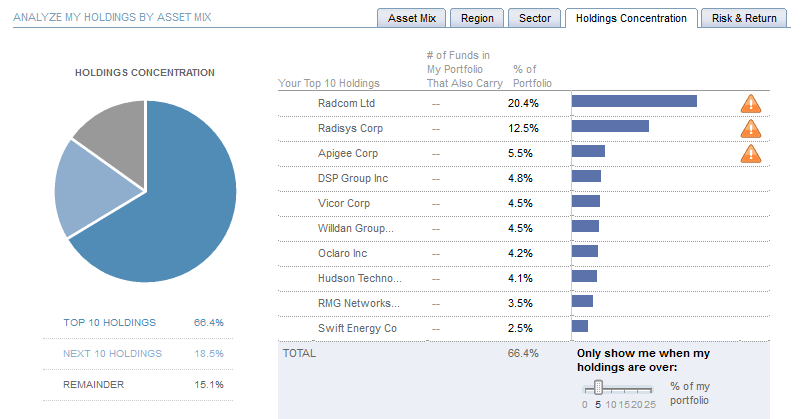
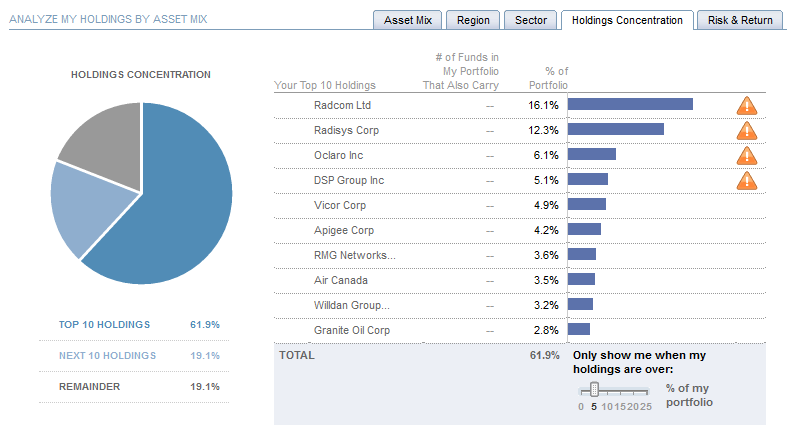
Top 10 Holdings

week-270-holding-concentration

See the end of the post for my full portfolio breakdown and the last four weeks of trades

Thoughts and Review

The second quarter results are finished and as I look back on August I can’t help wondering if something has changed.

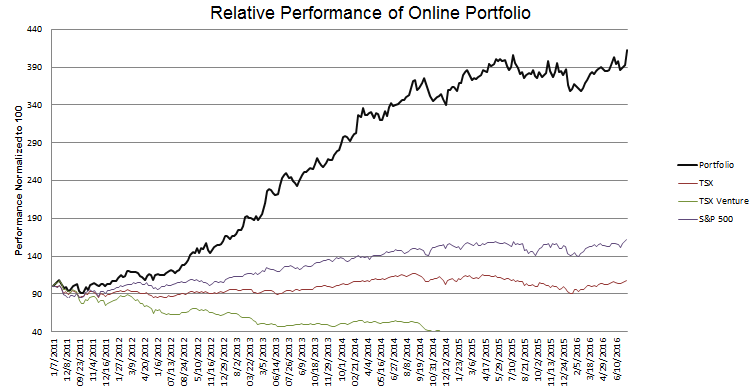
Since February the market has done well but for the first time in over a year I have done better.  I had a miserable first month of the year but after deciding things had gone too far in early February, its really turned around.

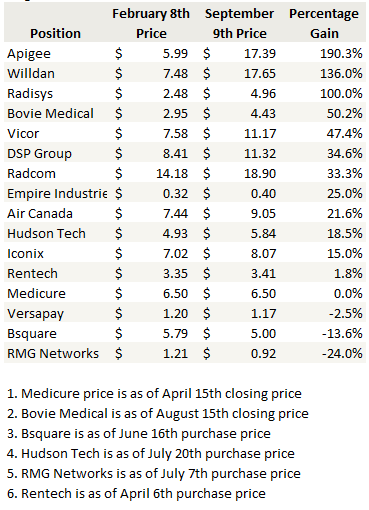
Here is the performance of my more significant individual non-oil related positions since that day.

gains_since_the_bottom

August was a particularly good month.  I was up over 10%. I’ve had a number of big movers over the past few months.

But its more than performance that makes me think that something has changed.

The way that the small and micro-cap stocks I own have been acting has been different than the past year and a half.  For reference, in August of last year I pondered whether you could have a bear market that was never actually defined as a bear market.  At the time I wrote:

When I raise the question of whether we are in a bear market, its simply because even though the US averages hover a couple of percent below recent highs, the movement of individual stocks seems to more closely resemble what I remember from the early stages of 2008 and the summer of 2011.

Through most of 2015 and into the first couple of month of 2016 the movements of small company stocks just didn’t feel right.  Every move up was pressured.  Every move down was too easy.  This of course climaxed with the selling stampede of January and February of this year.

But I have noticed a change in temperament in the subsequent months, and this seemed particularly evident through the second quarter earnings season.   I still had misses.  BSquare had miserable results.  CUI Global was lackluster.  Both stocks fell.  But even then, the moves down didn’t have quite the same conviction as similar such moves in the past year.

Its hard for me to put my finger on exactly what it was that was different, so maybe this is all just sophistry, but it was almost like these stocks were going down grudgingly, because they had to, not because they wanted to.

Even Friday, which was a brutal day for the indexes, didn’t seem as bad as all that through the lens of my positions.  Radcom ended up.  Radisys spent most of the day green before giving up the ghost in the last 30 minutes.  A number of other positions started the day poorly but didn’t really follow through, almost to be saying yeah, we have to be down because the averages are down but there is no reason to panic.  A couple  of the oil stocks I’ve recently added (more on that below), fell at the open only to grind their way back up.

To be sure, part of my perception may be that I’ve picked up my game and picked better stocks.   It took me a while to figure out what my theme was for 2016 but once I settled on growth stories it has served me well.  This replaced sectors like tankers and airlines and REITs where I tried to find gain in 2015 and for the most part failed at it.

So maybe that’s the source of the change.  I’m staying away from value, looking for growth, and that’s what is working.

I’m wary that we have had a big move up, that each of the prior moves up over the last couple years has been followed by a precipitous fall, and that the election in the United States isn’t really setting itself up to be market friendly.

Nevertheless I can’t lose the thought that while we never had an official bear market we did have an extremely ugly period for small and micro-cap stocks and maybe that bear market capitulated in the first couple of months of the year and we are on to something new.  Its worth keeping an eye on.

Oil and my oil stocks

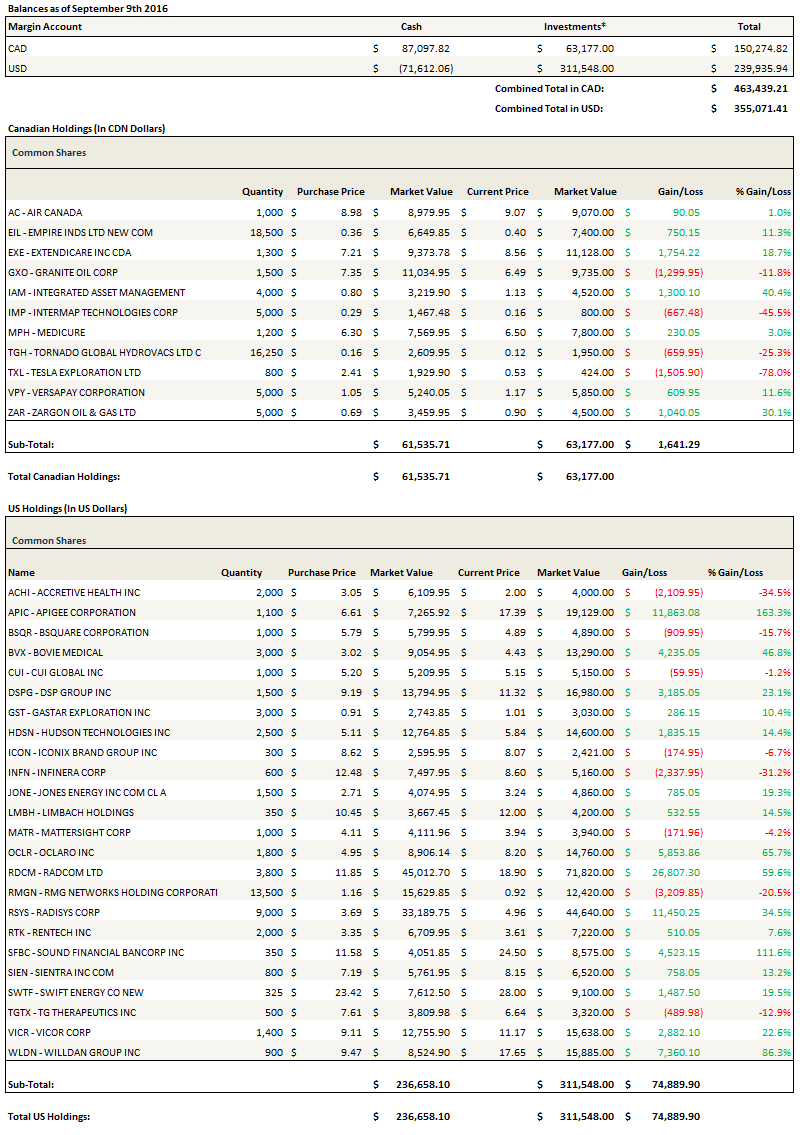
Inline with my tweets over the last few weeks I have been increasing my oil exposure.  I added a number of names and been adding to a couple of others.  Here are the tweets.  I’ll talk about each of these below.

I also took a position in Journey Energy (JOY) late this week but I’m not going to write about that one in this update.

Nevertheless they are all small bets.  Other than Granite Oil, which is about a 3.5% position for me, my oil bets are in the 1% range.

I don’t have a crystal ball on oil.   I am sympathetic that the builds we have seen (up until this week’s rather massive 14mmbbl draw) are due to the drainage of floating storage.  I’m hopeful that once this runs its course we could see some surprising draws in the shoulder season (this thesis has been expressed by a number of investors on InvestorVillage, not the least being Robry825, who describes his position here and  here).  I’m also cognizant that oil wells do decline and that we simply aren’t drilling like we were a few years ago.  Still, as I’ve said on many occasions before, I play the trend till it ends but when it ends I really don’t know.

Its also worth noting that while the US election could turn out to be a gong-show for stocks in general, it sets up as having very little downside and a fair bit of upside for the Canadian oil stocks.  Either Clinton wins and its status quo, which has been already heavily discounted in the disappointment of investors with Canadian oil stocks, or Trump wins and well, regardless of what chaos that entails, he did say he will approve Keystone, which would be a big tailwind for energy producers, particularly given the boondoggle that’s taking place with Energy East.

Nevertheless I don’t like not being in oil.  Part of this is simply hedging.  I am a Canadian investor who primarily invests in US stocks.  Therefore I am naturally short oil via the Canadian dollar.  If oil prices go up, so with the Canadian dollar and I will lose.  Owning some oil stocks helps to balance that out.  If I can hit the odd rocket ship like Clayton Williams or Resolute Energy have been recently, then all the better (note that while I have talked about Clayton Williams in prior posts I haven’t mentioned Resolute because I got the idea from a subscription service run by Keith Schaeffer.  He’s had a few winners for me since I took a subscription and would recommend it).

Empire Industries – China Theme Park Deal

On September 1st Empire Industries announced a “strategic cooperation agreement” with a Chinese company called Altair to build out a new space theme park in the Zhejiang province of China.  The announcement coincided with Justin Trudeau’s visit to China and apparently he was on hand at the signing.

The stock shot up on the announcement and to be honest I got a little too caught up in the hype and added to my position at 45 cents.  While I think those shares will ultimately deliver a positive return, there were some details left out of the news release that warrant caution.

In particular, this article from Business Vancouver fills in some of the details.

On the positive side, Empire will be delivering 6 attractions to the park for a price of $150 million.  This is significant dollar amount that will more than double the backlog.

Also, Empire will have an option to take a 20% stake in the amusement park.  Guy Nelson, president of Dynamic Attractions, the amusement park ride manufacturing subsidiary to which the work is directed, said they would likely exercise this option.  Given that the park has a price tag of $600 million, a 20% stake is a big investment for a company the size of Empire.  It would also makes you wonder about how Empire is going to get paid, as it seems a little too coincidental that their ownership opportunity is about the same dollar value as the cost of the attractions they are to deliver.

The other consideration that contributed to the stock pulling back from its highs was that construction of the park depends on getting the land.  Currently the land belongs to the Chinese government and the agreement that Altair struck was as the reserve bidder, meaning that they get the land if no one else places a bid.

I’m not selling any of the shares I own.  If the deal goes through it should still be a significant positive for the company.  But I should have been more wary of any Chinese dealings and I will wait for more news before acting further.

Granite Oil – Enercom

Granite presented again at the Enercom conference in September. They gave a presentation that an engineer would love and an investor would shrug at.  I don’t believe I heard the acronyms ROR or EBITDAX or even NAV a single time.

Last month I wrote that I had reduced my position in Granite.  After further consideration, a little more research and a more optimistic attitude towards the oil price, I decided to add back what I had sold.  The stock had also sold off into the low $6’s which has been good support in the past.

During the first six months of the year Granite focused on infrastructure.  They drilled one well in the first quarter and three more wells in the second quarter.  They converted a number of older wells into injection wells and added compression to facilitate the gas injection process (as I’ve written before their primary and only asset, Ferguson, is a large oil field where they are implementing an early enhanced oil recovery (EOR) strategy via gas injection.

In the second quarter the company achieved 100% voidage replacement in the heart of the Ferguson field.  The reservoir is now pressurized back to its original pressure.  Granite can move ahead with development drilling and expect the pressure support to limit well declines.

In the second half of the year the company expects to drill 5 wells.  On September 6th they announced results from the first of these wells.  Over a 96 hour test the well flowed at an average 815 boepd and ended the test at 995 boepd.   The company well costs are $1.2 million, down from $1.9 million in the first quarter of the year.

One number Granite did mention at Enercom was that the total contingent original oil in place (OOIP) at Ferguson is 457 million barrels. This is actually from a fairly old estimate by Sproule in 2012.

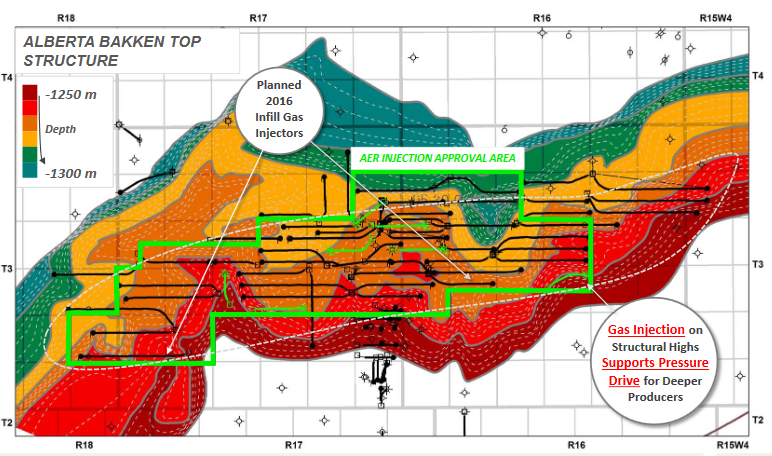
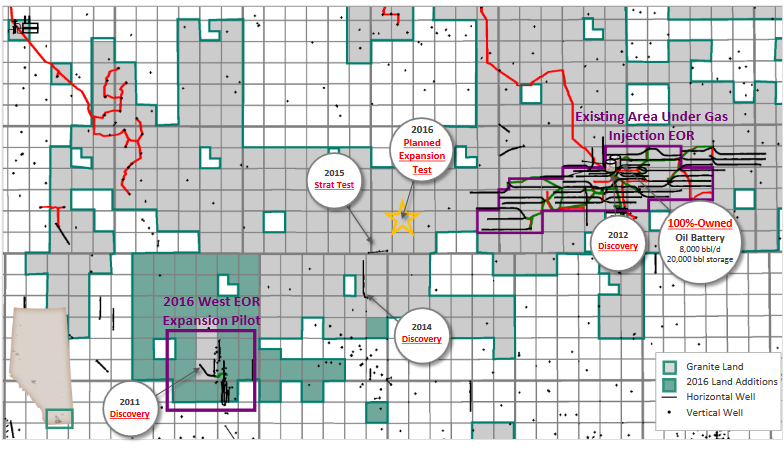
I contacted the company to clarify how much of their land package the estimate accounted for.  Their response was that the estimate encompassed an area a little larger than the current EOR approved area.  The EOR approved area is about 23 sections, shown below:

eor-approved

The entire land package held by Granite is over 550 sections.  This includes two other discovery wells to the south west:

entire-land-packageIts an extremely large package for a little company with a $200 million market capitalization and very little debt.  The wells aren’t as exciting as Permian wells, but they also come in at about 1/8th the cost.  The company doesn’t get much respect, but I hope that changes if they show some growth in the second half, which is possible as they finish out their drill program and see the full effect of the EOR.

There were a SeekingAlpha article written about Granite here.

Update/Summary of Accretive Health

I’ve owned a small position in Accretive Health since late last year.  And I owned the stock once before that, in 2014.  Yet I’ve never actually written about it.

Part of the reason I have stayed quiet on the position is because it has, until recently, been very small.  But I’ve also kept quiet because the thesis is hard to get behind.  This is the definition of a flyer.

Accretive Health has a few problems:

  1. They have been investigated for abusive billing practices.  There is a VIC article written around the time these issues arose that explains the claims in some detail here
  2. The abusive billing practices were followed up by an SEC investigation into revenue recognition.   The result of the investigation was that the company did not release its financial statements for the period of 2012-2014 until just last year. This article is a decent source for that episode.
  3. The conclusion of the SEC investigation led to a restatement of GAAP results and the subsequent GAAP accounting practices that were enforced make their financial statements pretty much useless.  Accretive can’t book revenue from a client until either the end of the contract term or when the agreement is terminated.  This means they go long periods with very little revenue and if they lose a client (generally a bad thing) they can show a big profit.
  4. Much of their business is dependent on Ascension Health.  Ascension is a large non-profit hospital operator.  They are also a large owner in Accretive.  They have shown their willingness to exploit their leverage as they did when they tried to take Accretive over with a a low-ball offer in mid-2015

Sounds exciting doesn’t it?   Nevertheless the potential upside holds my interest.  Here’s some details about how Accretives business works.

Accretive provides revenue cycle management for hospitals.  This means that they help streamline front- and back-office operations, including patient registration, insurance verification, coding compliance and collections.

Hospitals operate on extremely tight margins.  I have gathered margins can be as low as 1-2% if they are profitable at all.  Accretive’s model is to insert experts into the hospital, integrate their software into the hospital software, and work together with hospital employees to reduce costs, more effectively bill patients (for example finding insurance options, correctly classifying patient visits, etc), and improve revenue collection.

The contract with the hospital is performance based.  Accretive receives a percentage of the savings that they are able to achieve for the hospital, compared against a pre-contract run rate.  They also receive incentive fees that are based off of additional revenue the hospital generates due to their improved collection and billing processes.

This business model means that Accretive doesn’t get anything until later in the contract, after they have implemented their solutions, made changes to the processes, and the hospital has begun to reap the results.

It’s also a tricky business model for revenue recognition; billings are in part based on costs not yet invoiced by the customer and that have to be estimated, and the agreements typically include clawbacks if cost reductions aren’t maintained.  The consequence is that GAAP accounting insists that very little revenue be booked until the end of the contract.

Now lets talk about Ascension Health.  Ascension is Accretive’s biggest customer.  Accretive was actually born out of Ascension in 2004.  In 2015 Ascension accounted for 59% of gross cash generated (Gross cash generated is effectively the company’s internal metric of revenue equivalence it uses to get around GAAP accounting. I’m just going to refer to it as revenue from this point forward.  Likewise, I am going to refer to their net cash generated as EBITDA, which is basically what it is).

The relationship with Ascension is not always friendly.  Just around the time when the black cloud of lawsuits and SEC investigations was beginning to lift Ascension dropped a bomb on Accretive, writing a letter where they discussed taking the company private for about 50% of what was then the market capitalization (around $2.50 per share).  In a not so veiled threat Ascension said that if the takeover didn’t proceed they didn’t plan to enter into a new master services agreement with Accretive once the existing one expired in mid-2017.

In December of last year Accretive came to an agreement with Ascension whereby Ascension would drop the takeover offer, not walk away from their relationship, and enter into a new long term agreement for services.

The agreement is for 10 years.  Right now Accretive is responsible for about $6.5 billion of Ascensions net patient revenue.  The new agreement will add another $8 billion of net patient revenue from new Ascension hospitals and affiliates.

As part of the agreement Ascension gets an even larger piece of Accretive.  Accretive issued them $200 million of preferred stock paying 8% and convertible into shares at $2.50 (so 80 million shares).  Ascension also received 10 year warrants for 60 million shares at a price of $3.50.

Accretive has about 107 million shares outstanding not including any of the above conversion.  The market capitalization is about $200 million, cash is about $200 million and apart from the preferred there is no debt.

To put the size of the deal with Ascension in perspective, Accretive has provided guidance of $200-$220 million of revenue in 2016.  This would be “pre-Ascension new deal” revenue.  On the fourth quarter call management said that for every $1 billion of net patient revenue they on-board, they expect $40 million of revenue (they reiterated this statement on the second quarter call).

So basically Accretive stands to more than double revenue at the end of the on-boarding, which is expected to take 3 years (including this year).  The new business from Ascension will initially be at similar margins to the existing business, and those margins will improve as time passes and Accretive’s own systems and processes are implemented.

The tumult of investigations and Ascension related distractions has caused Accretive to lose some other business over the past year.  Ironically, the company had a blow-out first quarter on a GAAP basis, generating $167 million in net income.  But that’s because of customer attrition, which allowed them to recognize deferred revenue that had been accumulating for those customers.  The last thing you want to see with Accretive is strong GAAP results.  Hospital count dropped from 77 in the first quarter to 72 in the second quarter.

Nevertheless, the amount of new business coming from Ascension is substantial.  Accretive said that they expected EBITDA margins on the combined business  showed be in the mid to high teens.  At $400 million to $500 million of revenue Accretive stands to generate significant cash for a company with a $200 million enterprise value.

Still, there is enough uncertainty to warrant only a small position.  Will Accretive be able to turn around the business outside of Ascension, keep existing customers and win new customers?  Or have the last 4 years been too much.  And what is the state of the company itself?  Presumably after all the lawsuits, restatements, executive shuffles and unrest morale must be low so will they be able to execute?  Finally, the new agreement with Ascension is a departure from the legacy model; Ascension employees will be joining Accretive and Accretive will be taking over most aspects of the revenue cycle, as opposed to just advising and consulting.  Will this new model work and will it ultimately be as profitable as management predicts?

Lots of questions.  Nevertheless, if the questions are answered positively the upside is going to be significant.  While I did add to my position recently, I will keep it relatively small (its a little over 1%) until some of the answers become more clear.

Radcom Moves

Radcom has had no significant news since my last update.   Yet we still only have a single NFV deal.

I’m not too worried about how this plays out in the long term.  What I am bracing myself for is the scenario where Radcom presents third quarter results, gives a positive qualitative update on the pipeline but no quantitative progress.

Radcom has a $220 million market capitalization and a $170 million enterprise value.  It trades at 5.7x EV/sales.  I figure this means they need to grow revenues at 30-40% next year to justify that multiple.  That means another AT&T sized contract.

The market is going to want to see that happening by the third quarter report.  If it doesn’t the stock is likely going to sell back down to a multiple that reflects more skepticism.  Unfortunately these carriers aren’t known for their fast movements.  What’s another 3 months for a CSP looking to overhaul their network?

If such a sell-off occurs, it may be a great buying opportunity, but I’m not thrilled with the idea of getting from here to there.  Nevertheless the opportunity with Radcom seems to still outweigh this risk.  I sold a couple shares at $19 but less than 5% of my position.  So I’m just bracing myself for a potential pullback if carriers live up to their name.

New Position: CUI Global

I bought CUI Global because it has a new and better technology (for measuring gas composition) than the current standard, and they can sell that technology into a large addressable market (gas transmission companies and chemical plants).  But so far its been a struggle to gain a foothold into old-school industries that are not used to change and that are currently dealing with a protracted downturn.

Given this trajectory, it’s most likely that even if the story works out it will A. be delayed longer than anyone would have expected and B. have a number of false-starts and hiccups before finally showing consistent growth.

CUI Global operates two segments, Electronics and Natural Gas Integration.  The electronics business has been treading water and while it may have some medium term potential its not really the focus of my purchase.  There is a good discussion of the electronics division in the Q&A of the last quarter conference call.  For this write-up I am going to focus on Natural Gas Integration.

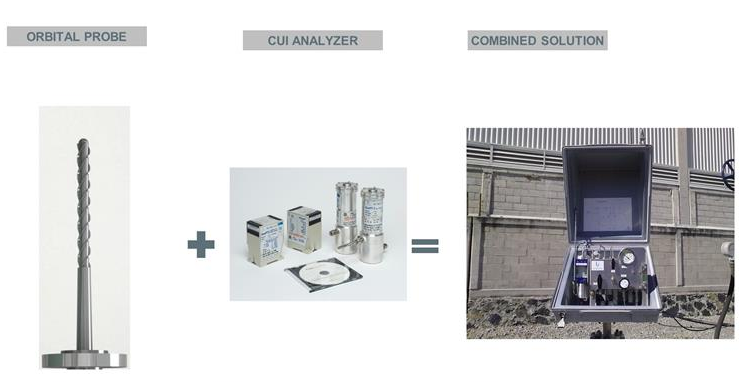
The natural gas integration segment sells a product for sampling and analyzing gas composition that is quicker and graceful than the existing technology.  Called the GasPT system, it consists of a probe and analyzer, both of which are unique in design and operation:

GasPTThe GasPT system is faster and cheaper than existing solutions.  These legacy techniques have been around for 60 years.  Their process works like this: gas is pulled out of the pipeline using a high pressure probe, transported to a gas conditioning unit which lowers the pressure to sea level, and transported through the low pressure pipeline to a gas chromatogram located in a shed where it takes 20 min to analyze the gas and report to operator the chemical content, from which energy content is inferred.

Installation of the incumbent technology costs a quarter of a million dollars, is a 6 week job, requires that a kiosk is built on site, that concrete, pipe, is laid and the carrier gas has to be replaced monthly.

In comparison, the GasPT system resides right on the pipeline, measures gas directly via the Orbital probe, there is no ancillary gas required, the cost of installation is $55,000 and it takes 90 minutes to install.   There is no operating overhead and the gas is analyzed in seconds.

Management has said on numerous occasions that during the bid process for the recently won Snam Rete business (more on that in a minute), they went up against Emerson, ABB and Elster and the head to head competition demonstrated that there is no comparable technology on the market.  They have also said that they are at least a couple years ahead of the competition in terms of development.

The company sells the GasPT system into two verticals:

  1. Natural Gas Transmission Operators
  2. Process Control for compressors and turbines.

The transmission operators they are trying to sell into are large national pipeline companies that aren’t easily receptive to change.  It took some time but early this year they began to make some inroads.  The company inked a contract with Snam Rete, an Italian gas transmission company, in February 2016.

The initial purchase order was for 400 units.  CUI Global has been delivering units at a rate of 50 per month.  The  total volumes of the contract is for 3,300 units with the opportunity for that to expand to 7,000 units.  They expect that next year volumes will ramp to 100 per month.

The thesis here is that

  1. The Snam Rete will ramp to 100 units next year and that will be enough volume to move the natural gas integration segment to profitability
  2. The Snam Rete contract will open the door to other national transmission operators.

CUI Global is engaged with transmission companies in France, Spain and Germany.  Listening to management I get the impression that they are furthest along in France, where in the second quarter they announced a distribution agreement with Autochim for sales of GasPT units in France and Africa.  They also talked on the second quarter call about their recent engagement with Transcanada Pipelines.

Worth noting is that Snam Rete is a low pressure pipeline delivery company, which is unusual.   Almost all gas transmission at a large scale is done at high pressure.  Because of the unique nature of their operations, Snam Rete did not have to purchase the whole solution from CUI Global, they took the analyzer but not the probe.  The other potential customers will be taking the full GasPT solution.

They are also gaining traction in its second market vertical, gas processing facilities.  On the last couple of calls they have talked about a contract with an ethylene plant operator in Texas.  In the first quarter they said:

Recently Orbital NA announced its receipt of a purchase order from a large scale ethylene plant operator in South Texas to design, build and deliver nine patented, ultra fast and accurate in depth, VE sample probes and sample systems and another purchase order for an additional six VE sample probes. That order totaling almost 1.8 million is a trial project which may result in a similar deployment of our technology across 54 other facilities operated by the same customer worldwide.

In the second quarter they qualified the potential of this operator as being a $100 million opportunity if they can expand the order to all the plants run by this operator.

Extending their reach into North America a bit further, a couple of weeks ago they signed a licensing agreement with Daily Thermetrics for the sale of the VE Technology, which is the probe portion of the GasPT unit.

I’m not sure what to make of management.  They tell a good story.  I came across the idea from a conference they participated in (the rebroadcast has expired but I can provide it if you email me).  What they described was compelling.  But going back through their old calls and financials, the execution hasn’t been great, though this may also be more of a function of the businesses they are trying to tap into.

CUI Global has a market capitalization of $110 million and cash and debt come close to cancelling one another out on the balance sheet.  When I model their business, it looks like they need to double the sales of the energy segment to get meaningful profitability for the company.

That may be a tall order.  But the contracts in the pipeline are big numbers.  The energy segment is operating at a run rate of $7.5 million per quarter.  The contract with Snam Rete for the 3,300 units was for $60 million Euro.  Presumably contracts with other transmission providers would be similar.  Likewise, the potential of this single ethylene plant operator is $100 million.

So the total addressable market (TAM) appears to be significant.  The company addresses its TAM on slide 11 of this recent presentation.

The question, which remains valid, is whether they can really gain traction and become the go-to solution.  The thing is, its binary.  Either they get more contracts or they don’t.  I don’t think you can sit on the sidelines and wait and see how it plays out.  Because the next contract, if it happens, will likely be the big move when it happens, and the stock will gap before you can react.

New Position: Jones Energy

I took a position in Jones Energy because of their recent acquisition of STACK/SCOOP acreage. Jones has long had a large acreage position in Oklahoma, but their target has been northwest and southeast of the STACK/SCOOP prospect, where they have targeted the Cleveland formation.  The new acreage should give better returns and more prolific well results.

The story you want to see play out is one where attention grows for the STACK/SCOOP and the play becomes recognized for its multi-zone potential that is close to, if not on par, with the Permian.   That should push up the price per acre and make the acquisition look even more attractive (it already looks like a good deal to me compared to other recent transactions.  Meanwhile an upcoming drill program should give some prolific IP30 results that will add excitement to the story.

At the moment the STACK/SCOOP does not have quite as good of returns as the Permian but they aren’t far off. Demonstrating the viability of the play even at these prices, Newfield points out (in their June presentation) that rig count is rising at a similar rate as the Permian:  

There are a number of large operators in the STACK. Devon has the biggest position, and Marathon, Cimerex and Newfield are also players. Newfield was the first mover in the play. Gastar (who I will talk about shortly) provides a good map of where the operators are.

Continental is a player in both the STACK and the SCOOP. They have acreage that is in the northwest for STACK (Blaine, Dewey and Custer county) and in Grady county for SCOOP.

Jones acreage (see the map below) is in the southern part of Canadian county, so around the Chaparral acreage, and south of that into Grady county. The northern border of Grady is roughly where the STACK ends and the SCOOP begins.  The STACK and SCOOP regions are considered distinct because the geology changes, as the Meramec formation dips down and is replaced by the upper and lower Sycamore.

Jones bought their acreage at $7,600/acre which is on the low side of other transactions I’ve seen. Marathon bought 61,000 acres at $11,800/acre (here they define their position). Newfield bought 42,000 acres from Chesapeake at $10,000/acre. Back in December Devon bought acreage at $17,000/acre. Continental recently sold SCOOP acreage that is in south Grady and further SW into Garvin county for about $9,000/acre adjusted for production. I don’t see too much evidence that Jones bought an inferior acreage position, other than that the STACK acreage is further to the southwest than the core STACK region at the intersection of Blaine/Kingfisher/Canadian.

As I said, STACK results look comparable but slightly less prolific than Permian. Most of the results are drilling into the Meramec formation, some drilling into Woodford. Well costs seem to be in the range of $4.5 million to $6.5 million for a 10,000ft lateral, which is a big range but I think that is because of changes in depth across the play. Continental is an outlier, they operate much further west than the rest of the operators and their wells cost $9-$10 million. The IP30 for the wells are around 1,500 boepd, with some wells delivering as high as 2,000 boepd.  Continental has seen its more expensive wells hitting 3,000 boepd. EUR per well is around 1 MMboe with again Continental being much higher at 1.7 MMboe. All operators report ROR that is consistently in the range of 70-80% at $50 oil.

The northern part of Jones acreage is prospective for the Meramec but transitions to the Sycamore as you go south (so where the STACK becomes SCOOP).   Though there isn’t a lot of information I’ve found on the Sycamore, what I have gathered appears to validate that well performance is similar to the Meramec.  Jones provides a few well results from Marathon and a company called Citizen Energy (who unfortunately is private and so there is no information on their website) in the map I showed above.

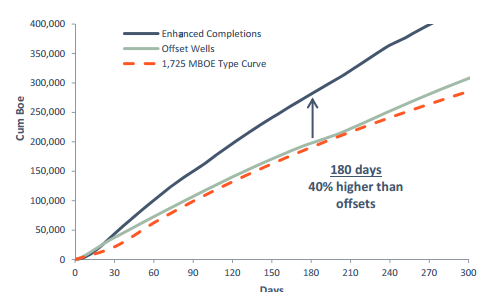
A second prospect in the STACK/SCOOP is the Woodford shale.  Their are a few Newfield well results in the Woodford referred to in the Jones map.   Continental seems have cracked the Woodford code recently.  Continental talks about how they are seeing a 40% increase in EUR on offset wells from recent wells where they have tweaked the completion techniques for $400K incremental cost.

clr-woodford

This is pretty interesting, especially because Jones acreage looks like it is in same area as Continental.  Below outlines where Continental has been drilling:

While the STACK/SCOOP lags the Permian in performance, the perception I get from listening to comments from Marathon, Cimerex and Newfield is that the area is earlier in the learning cycle, and we should expect further improvements (like we may have just seen with Continental in their Woodford SCOOP wells).
Cimerex in particular has acreage both in the Permian and in the STACK and they are allocating significant capital to both plays.  The gave a good presentation at Enercom, where they talk about both the Permian and the STACK/SCOOP making it easy to draw some comparisons.

Jones also has legacy acreage that is not too far away from the STACK/SCOOP.   They have 100s or maybe 1,000s of wells in this area targeting the Cleveland formation. In total they have 180,000 acres in Ellis, Roger Mills and Beckham county in OK and in Lipscomb, Ochil tree and Hemphill county in Texas. This acreage is to the northwest of the STACK but its not that far northwest. Much like the STACK/SCOOP, the acreage has multizone potential.  Jones has identified a number of potential zones in addition to the Cleveland. There is the Marmaton and Tonaka for example. Neither has been tested much. This article does a good job of delineating each of the STACK, SCOOP and the Cleveland/Tonkawa.

With respect to the multizone potential of the STACK/SCOOP and their legacy Cleveland land I thought the following comment was interesting from their second quarter call:

John Aschenbeck Got it, very helpful. One more if I could sneak it in on the Osage [ph], I’ve had a few operators say that Meramec EURs could potentially be possibly on the Osage as well leading you to believe Meramec-like returns in the Osage as well. Have any thoughts on that?

Jonny Jones We’ve got a 21-zone stack in the western Anadarko basin, of which these are just a couple of zones. We’ve been believers for a long, long time that there’s many pays out here, some of which are the ones you just mentioned, that really have not been exploited with modern technology. We have a lot of them in our section. People are just now starting to parse all the different trenches of the Mississippi and then that’s all they are. But there is a lot of other things out here besides those zones that are attractive. I think you’re going to see that come to fruition over the next six to nine months as folks actually start trying these different zones. The stack, the scoop, all these different zones right now are not one zone. There’s multiple pays here.

New Position: Gastar Exploration

Gastar is the other Oklahoma operator that I have taken a small position in.  By any traditional metric Gastar is a disaster.  They have about $575 million of debt versus a $125 million market capitalization.   Absent their hedges they aren’t generating enough cash flow to cover their interest payments.

But they own a lot of acreage (84,000 acres) right around the heart of the STACK:

The big question is whether the land in Kingfisher, which is a bit north of where Marathon, Newfield, Devon et al are drilling, is as prospective as the land further south?  I’m not sure, though from a number of presentations I’ve seen delineating the extents of the STACK it is clear the play extends well into Garfield county, so Gastar’s acreage is far from the edge of the formation.

While Gastar fails miserably on traditional valuation techniques, the stock looks pretty attractive if you apply acreage valuations that are comparable to recent land sales prices in the area.  By my calculation the current share price is reflecting about $6,000/acre for the STACK position and $4,000/acre for WEHLU (the WEHLU is on the eastern edge of the STACK and I don’t have as much information on how prospective it is but Gastar has been drilling decent Hunton wells there for a number of years).  The NAV is very levered to appreciation of this acreage.  At $8,000/acre for the STACK acres the NAV rises to $2.22.  If you use $11,000/acre the NAV is over $4/share.

I don’t know if Gastar gets revalued up to reflect the going rate of a STACK acre or whether the company sinks into bankruptcy.  I know they are going to do some drilling to prove out some of their STACK acreage and those results will be the key.  I also know from what happened to Resolute that when a company goes from reflecting bankruptcy to being valued based on current acreage prices the move can be pretty amazing.

New Position: Zargon Exploration

Unlike the first two positions oil and gas positions, Zargon isn’t a play on the STACK/SCOOP.  The company’s operations are primarily in Alberta with a small amount of production in North Dakota that is likely to be sold in the near future.

Up until July Zargon had too much debt and there was some thought that the company would eventually become a victim of bankruptcy.  At the end of the second quarter the company had $122 million of net debt to go against second quarter funds flow of $3.5 million.

But on July 22nd  Zargon announced the sale of is southeastern Sasksatchewan assets for net proceeds of $87.5 million.  The transaction significantly reduces debt and makes it much more likely that the company will make it through to the other side of this oil price downturn.

With the use of proceeds put towards the debt, the company’s net debt position is expected to be around $35 million.  I was buying the stock a bit lower than it is now, but even at 90 cents the market capitalization is only $27 million, meaning that the enterprise as a whole is going for $62 million.

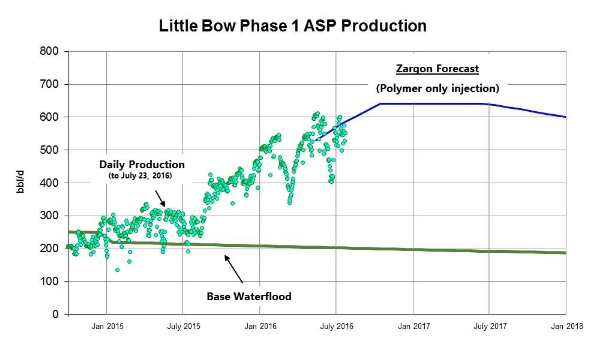
This doesn’t seem like a bad price to me considering what you get.  After the asset sale Zargon is left with about 2,800 boepd of production, 79% of which is liquids.  The production breaks down to 400 boepd from North Dakota, 2,000 boepd from various Alberta land packages, and 530 boepd from their Little Bow Alkali-Surfactant-Ploymer flood project.

All of these properties are low decline.  Little Bow production should actually increase through the end of the quarter before stabilizing at over 600 boepd.  This number could go higher if oil prices recover as the company has suspended alkali and surfactant injection because of the economics of the project at current oil prices.

littlebow

The other properties are very low decline, 14% according to the September presentation.

The properties as a whole have a proved PV10 of $108 million and and a proved plus probable PV10 of $176 million.  The enterprise value trades at a discount to the proved value of the reserves.  This is at forecasted prices though, and that forecast is assuming a slow oil price recovery through to 2030.

I think the current price is probably reflecting about $45 oil.  What I like about the stock, and why I took a position, is that at $55 oil the stock is probably a double at least.  Its probably not a great long-term hold, as I don’t see anything in particular about the properties that excites me, but as a vehicle for playing a price recovery in oil I think its worth a position.

One Last New Position: Limbach Holdings

I took a position in Limbach Holdings after one  of the funds I follow, Dane Capital, took a position.  Dane Capital is the same fund that I got the idea for RMG Networks from.  They have written up Limbach in two pieces on SeekingAlpha (here) and I’m not going to add more on the name right now because they describe the thesis quite well.

Portfolio Composition

Click here for the last four weeks of trades.

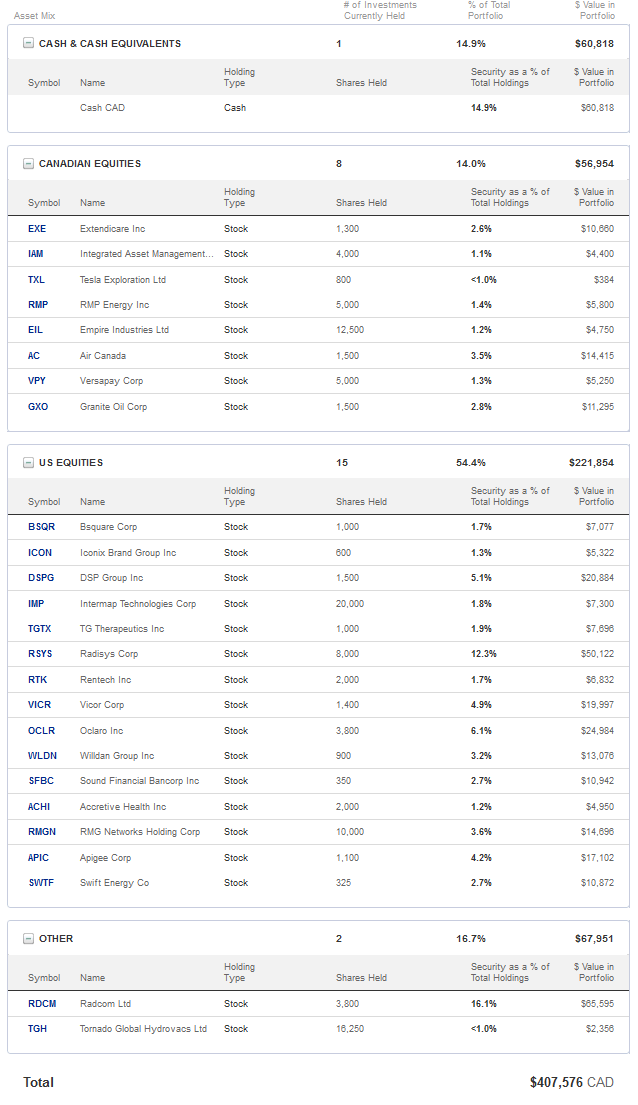
Below you will see that I’ve gone back to my old format for portfolio composition.  Those of you who have followed the blog for a while will know my love/hate relationship with RBC Practice Portfolios.  I used to be able to use the portfolio holdings page provided by RBC, but then they introduced a bug which basically screwed up the gain/loss on a position if you partially sold out or added to an existing position.  So I started tracking my portfolio via spreadsheet as well as with the RBC portfolio.  This is time consuming so when RBC introduced a new portfolio summary that wasn’t great but at least wasn’t totally out to lunch, I began to report it and have used it for the past few updates.  Well this week I realized that this summary has a bug as well, so I am back to reporting via spreadsheet.  I also took the time to add a function to my code that colors the gain and loss columns in green or red.

week-270

Week 262: Simplify

 Portfolio Performance

week-262-yoyperformanceweek-262-Performance


Top 10 Holdings

week-262-holding-concentration

See the end of the post for my full portfolio breakdown and the last four weeks of trades

Thoughts and Review

I made a grand total of two transactions this month.  I think that might be a record low for me.

The dearth of transactions is that it is not by design.  It’s the result of a shift I made back in February when the market was crumbling.  I decided I would get away from anything that looked like a swing trade.

In the past I’ve taken positions in stocks not because I see strong fundamentals or a particularly good event horizon or an industry development.  Instead I’ll take it as a trade because the stock has sunk down to what looks like the lower level of a range and I think I can catch a bounce as it traces back.

Its a strategy that I think, overall, has been profitable.  Over the years I’ve done it with success with companies like New Residential, Northstar Realty, Brookdale Senior, various oil stocks, and with the tanker stocks.

But its a strategy that expends a lot of brain power and it drains a lot of emotional capital without the opportunity for a big upside.  It also tends to put me into positions that I don’t have a lot of conviction in, and when a market event like what happened in January and February occurs, I end up selling stock at the wrong time.

So I’m not doing it any more.

For example, even though the tankers have traded down to what is really very cheap levels, I’m not playing a bounce.  I didn’t buy into any of the REITs that have recovered since earlier this year.

For what its worth, its probably saved a few grey hairs as I watch Teekay Tankers and DHT Holdings flounder with no appreciable momentum even as the market as a whole rises.  While some REITs have done well, others continue to flounder at lower levels.

It makes for a more boring and arguably slightly less profitable portfolio, but also for one that is easier to stand by through the market gyrations.  As Brexit hit and the market tanked for a couple days it didn’t even occur to me to sell any of my positions even as I lost a few percent.  The stocks I own I do so because I like them and I want to see them through to the events that I believe will result in their upside.

Without many trades this month I will talk about a stock I bought the previous month but haven’t discussed yet (BSquare), one event worth mentioning (Empire Industries spin-off) my investigation into cybersecurity stocks, and an update on what has been happening in the world of NFV/SDN.

BSquare

I’ve owned Bsquare once before but under a different auspice.  The first time around it was because of a good earnings report that made it look cheap.  But I didn’t have a lot of conviction in the business so I sold it soon after for a small gain.

This time I’m buying BSquare for the potential that they may be on the cusp of some growth.  This is another one of those stories like Radisys, like DSP Group, where you have a so-so legacy business and company that has traditionally floundered but there is a new product coming along that might be able to change that.

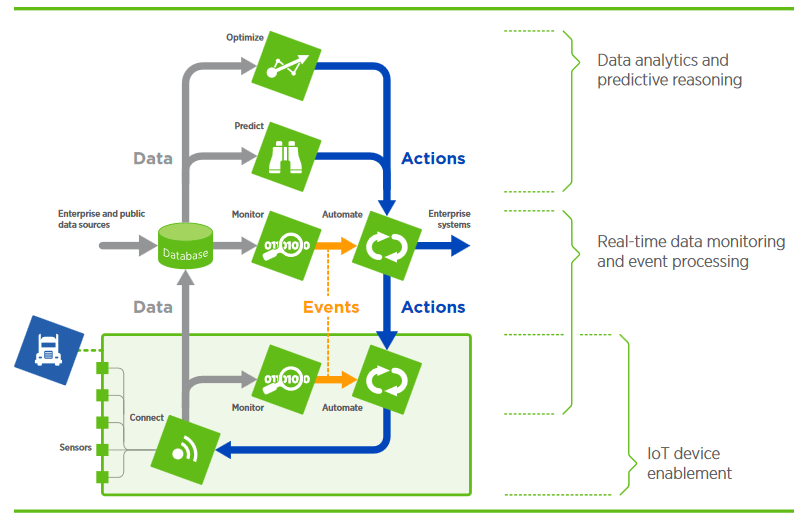
In BSquare’s case that product is DataV.  DataV is a software application that collects device data, performs monitoring and analytics on the data, and applies rules for predicting future conditions and failures and automating corrective processes within the device.

The product is an example of an Internet of Things application, where a companies assets are connected to the network, information obtained from the asset is used to quickly identify problems, and solutions and operational changes are pushed back to the asset through automated routines.

DataV operates both on the asset and in the cloud at the data center level.  The figure below illustrates the functionality at each.  The green boxes represents a feature set provided by DataV.  At the asset level monitoring and automation of simple rules are performed for time critical conditions.  At the data center level further monitoring and more complicated and less time sensitive automation rules are performed, as more complicated analytics like predictive rules and optimization routines are performed.

datav

Unlike some of the IoT solutions I researched, I feel like DataV is going down more of a solution specific path.  Rather than providing a platform to be implemented across an company’s asset base like some of the bigger IoT names, DataV is being targeted to customers to deliver specific solutions where there is an existing issue that it can solve. It seems like the right strategy, especially since their target market for DataV is the smaller end of the Fortune 500, who are less likely to invest large amounts of capital up front for a platform solution.

BSquare announced their first DataV contract with a major industrial company back in June.  The company described the use cases to be addressed as follows:

Predictive failure. The use of data analytics and real-time device information to accurately predict problems that could impair asset uptime, as well as prescribing remediation steps.

Data-driven diagnostics. Further use of data analytics and historical repair information in order to speed diagnostic and repair time, getting vital assets back in operation more quickly while reducing service and warranty costs.

I also found the following quote from the press release useful for understanding the product:

“This project is emblematic of what is truly possible with IoT: real-time data analytics applied to very large data sets in order to predict future conditions, prescribe corrective steps, and accelerate repair times. Collectively, these DataV capabilities can dramatically improve uptime while reducing cost. We look forward to a long-term relationship with this customer, working closely with them as they leverage IoT to achieve business objectives throughout their organization.

The contract is for $4 million over 3 years.

My hope here is that this is the first win of many.  While the company has only one win, they did make the following comment in one of their job postings, which gives me some optimism that there will be further wins:

Bsquare is investing significantly in marketing demand generation tied to its industry leading DataV IoT platform.  Market response has overwhelmed our current sales capacity, and we are looking for proven inside sales dynamos to join our team. 

I would say my conviction that this works out is medium at this point, so like many of my positions I will start small and build as positive data develops.  Given the size of BSquare, a $66 million maket capitalization with $27 million of cash on the balance sheet, there is plenty of room for upward appreciation if the product takes off.

I have also looked closely at the legacy business and while I don’t want to spend too much time on it here, I will say that it gives me pause.  The company is almost wholly dependent on Microsoft as a reseller and the contract terms with Microsoft have recently tightened.  It doesn’t feel like a very comfortable position to be in. Please contact me if you want more of my thoughts on the legacy business or if you have any insights into it yourself.

Empire Industries and their Hydrovac spin-off

In February Empire Industries announced that they were spinning off their Hydrovac business into a separate company. The transaction makes Empire more of a pure play on their amusement park ride business and creates a new hydrovac focused entity.

Both sides of the spin-out look pretty interesting.

Dynamic Attractions, which is the existing Empire business, is still very cheap, trading at around 3x EV/EBITDA with a market capitalization of about $25 million.  There is a healthy backlog of $107 million though that is down from year end of $130 million.

There is some talk that the next step will be the divestiture of the steel fab business, which would be another step towards making Empire a pure media attraction product company.  The company still has the telescope business and the 30m telescope contract, though recent setbacks make it unclear whether a new site will have to be found for the project before it can proceed.

Equally interesting is the hydrovac spin-off called Tornado.  As part of the spin Empire partnered with a Chinese company, Excellence Raise Overseas Limited, who injected a little under $10 million into Tornado.  $6.9 million of that is equity, $2.5 million is debt (it was supposed to be $7.5 million but the injection was done in USD and Reminbi and the Canadian dollar has gone up since the original agreement).  The equity portion gives the Chinese firm 45.5% of the new hydrovac entity.  If you do the math on that the Chinese entity paid about 25c per share.  The stock is trading below 15 cents.

Tornado is going to use the cash to set up an operating subsidiary in China and offer Hydrovac services there.  In Canada they just sell the trucks.  The business in China will be more akin to Badger Daylighting; contracting out the usage of the trucks and personnel.

Here is what the Tornado management said about their new business endeavor in their first ever MD&A:

news-money-transfer

What I find interesting about Tornado is that at the current price the market capitalization is $9.5 million you are only paying a little more than what the Chinese partner invested in the company.  Yet you are getting both the existing hydrovac manufacturing business in Canada, and the new Chinese expansion.  While the truck manufacturing business has been poor of late, basically delivering flat EBITDA for the last year, before the collapse in oil prices this business generated $2.5-$3 million of EBITDA.

So there is plenty of upside from the existing business that is arguably not priced in.  In addition you have a stake in what happens in the China segment, which is admittedly uncertain.

In addition to what I received with the spin-off, I bought a little bit of the stock because it seems cheap.  I would like to buy more but its hard to get a real sense of how substantial the opportunity in China is.

I have no idea if this is a huge market that they will win big with, or whether this is going to be an uphill battle.  It seems somewhat positive that the Chinese company wants to take a big slice, presumably they are doing so because they see the market opp, and the Empire management has been pretty astute, but who knows for sure.

So we’ll see.  Management is making some interesting moves, they may have some more up their sleeve.

I’m not smart enough to invest in security companies

I spent quite a bit of time over the last month trying to familiarize myself with the cyber security universe.   I went through transcripts, listened to conference calls, read presentations and 10-Ks.  I looked at Palo Alto, FireEye, Proofpoint, Rapid7, MobileIron and Qualys in some detail and more briefly at Tanium, Imperva and Splunk.  I come out of the whole thing still feeling like I only have a foggy understanding of the space.

Of all the firms I think I understand the biggest, Palo Alto and FireEye, the best.  Palo Alto is a firewall company and FireEye is an intruder detection and mitigation company.  I think on the most simplistic level, Palo Alto is trying to stop an intruder whereas FireEye is trying to detect and stop one once one gets in.

Both companies and for that matter most cyber security companies, provide an appliance (which is essentially a server blade that goes into the stack) supplemented by one or more subscriptions (along with maintenance and support which may or may not be bundled into the subscription price, depending on the company).  The appliances sit on premise and perform the basic protection services.  Some of the subscriptions are attached to the appliance, and some are not.

For example Palo Alto, to the best of my understanding, offers an appliance and 8 subscriptions.  These are shown in the diagram below.  The red boxes are subscriptions not attached to the appliance while the blue one’s are stand alone

subs

Just to give some color on what these do, Wildfire updates the firewall appliance with new emerging threats, Aperture provides the ability to monitor SAAS applications, Traps, is installed at the endpoint that prevents untrusted apps from operating. GlobalProtect extends firewall capabilities to mobile and offsite devices, Autofocus allows you to access a database of threat tags that help you identify the source and nature of a threat you’ve discovered, and Threat Prevention and URL Filtering provide some of the basic data required for performing the firewall functions.

So that’s Palo Alto.  If you go through the universe of companies you will find something similar in terms of an appliance with subscription services and/or stand-alone subscription services.

Where things begin to get fuzzy for me is once we get into the smaller players.  So Proofpoint software is primarily geared towards email protection.  Rapid7 and Qualys provide data hunting and analytics that try to aggregate and streamline the vast amount of data coming down to what is relevant.  Mobileiron’s platform manages security for mobile devices.  Imperva provides security to data centers and to a lessor degree to cloud applications and websites.

What I can’t figure out is how it all plays out between these niche companies and the larger one’s like Palo Alto and FireEye.  Is there room in IT budgets for all of these products?  Do the niche players get bought out by a consolidator?  Or does revenue growth start to slow for some of them?

 Another question that isn’t clear to me is how the move to the cloud impacts these businesses.  Some of these companies still generate a significant amount of revenue by selling the appliances.  As those appliances become virtualized and sales are software only, I wonder how margins and revenues will be affected?

In this regard, one of the most interesting things I listened to was this discussion at the Bank of America Global Technology Conference with former FireEye CEO, now Chairman David Dewalt.  Dewalt makes a number of very strong comments; that security is going to move to the cloud, that this will be disruptive, that this will change the landscape of what products and services are required, and that it will move dollars from a product or appliance bucket to a subscription bucket.

The final piece is whether spending has been artificially heightened by a few outsized threats.  There were some significant breaches in 2014 and even some of the company executives I listened to described the following period as being one where companies were throwing money at the problem without discretion.  That appears to be changing now.  We just saw Imperva issue pretty dismal guidance.  Qualys recently characterized the environment as “much more rational” and that we were seeing more caution on the part of customers, that they were looking to consolidate vendors, etc.

Finally, I don’t really understand the growth expectations behind all the names I looked at.  For example, the Stifel universe has 22 cybersecurity companies and the average revenue growth of those companies is 19% for 2016 and 2017.   Yet the cybersecurity market as a whole is expected to grow at 6.9%.   So who are all these low growth or market share losing companies?

It all sounds like one big bucket of uncertainty.  Which is hard to stomach when you are paying the multiples you are for these companies.  So the research has been interesting, but I’m not sure I will be adding any of these names soon.

Whats Happening in the NFV/SDN World

There are a whole lot of datapoints hitting the presses in the world of NFV/SDN.   Here’s a brief run down of what I have come across.

In the last week AT&T announced that they will offer the code to their SDN platform into open source, that they will be introducing virtual security functions for their virtualized network, and that they will be launching network functions on demand starting with 4 virtualized functions.  Of this news, the second may have relevance to Radcom, where there have been hints that their contract with AT&T could be expanded to some sort of security application.  The third piece (more details here) refers to a 3rd party server vendor for the white box back end, which certainly could be something Radisys provides.

Along the lines of the third news item, Radisys and AT&T held a joint presentation demonstrating their Mobile-CORD initiative and how you can monetize SDN and NFV.  Some more circumstantial evidence of the relationship developing between Radisys and AT&T.

This article (here) compares the move to NFV as being the equivalent to the datacenter move to cloud over past decade.  The key difference is that enterprises moved apps like Oracle, Exchange and SAP, CSPs are moving network functions that deliver wireless and wireline calls, text messages, and streaming media, along with services such as VPNs and firewalls.  This article specifically highlights service assurance as one of the two most important attributes of software defined infrastructure:

The second important characteristic of a software-defined infrastructure is service assurance. Customers expect seamless voice, video, and media quality and data protection. A truly carrier-grade infrastructure will deliver on these expectations by quickly analyzing the root causes of component failures, remediating those failures before they impact subscriber services, and ultimately, predicting and avoiding outages and performance issues before they occur. All of this can only be accomplished through automated software.

Another article I found interesting was this one, which exposes 10 myths about NFV.    Two important points made are that encumbents will have to rebuild from the ground up to make their app virtualized:

The best way to build a carrier-grade virtual network function (VNF) is to take a ground-up approach, starting with a purposefully designed modular architecture that addresses performance, scalability and other important requirements, Luxoft recommends.

And that Verizon is looking to share risk with vendors, also move might be to subscription type of relationship with vendors:

Verizon, for example, proposes a new business model in which its vendors share the risk in the introduction of new services.  If a service succeeds everyone will make money.  If it fails everyone shares the risk…Furthermore, virtualization lends itself to usage billing models, not only for consumer services but for business to business services.

I also found this article that talks about the need for both SDN and NFV being brought on by the amount of data that will be travelling the network as the Internet of Things grows:

As the Internet of Things (IoT) becomes more of a reality, and as these companies look to deploy 5G and reap all its promised benefits, most realize that they need to revamp their networks in order to deliver value and to compete (with you-know-who). These trends will result in significantly more data of widely different types traveling across their networks, and to retain service agility on a more-or-less static infrastructure, these operators need NFV and SDN, along with “cloudification” and advances in distributed computing.

This article gives the rather impressive 116% CAGR for NFV and SDN from now until 2021:

Spend on NFV and SDN ramped up in 2015, with analyst firm TBR forecasting the market reach nearly $158 billion by 2021, representing a 116% CAGR.

And finally Mark Gomes gave some interesting scuttle about Radcom in a conversation with an industry contact that he posted over the weekend.

Reluctantly exiting Photon Control

There is nothing more fun than getting this kind of press release about one of your companies while being on vacation with limited internet access.

news-money-transfer

I have absolutely no insights into how this plays out.  Maybe the loan gets repaid and the company puts itself up for sale at a premium.  Maybe the company rights itself and gets on with the business of delivering sensors.  No idea.

What I do know is that when I don’t know what is going to happen, I am more often than not better off selling first and asking questions later.  So I sold my shares.

I note two things since that time.  First, the shares have held up reasonably well, so there is clearly someone willing to buy into the panic.   Second, there hasn’t been any news that the money has been paid back.

I continue to watch the story because the company valuation is compelling.  The market capitalization is $73 million and the company holds $27 million in cash.  After subtracting cash, the stock trades at only about 3x free cash flow.

This is too cheap if the business is viable and there isn’t any overhang from executive malfeasance.

The sensor business hasn’t grown like I had hoped, but that still may come and even in its current state it remains nicely profitable.  I’d love to get back into the stock, but I need to remove the uncertainty before I do.

Portfolio Composition

Click here for the last four weeks of trades.  Note that the two transaction labeled Adj are me manually readding the Empire Industries and Tornado shares.  When Empire did the stock consolidation and spin-off my shares were lost in the practice account.

Also note that I bought RMG Networks stock, which I talked about already owning last month.  This was another unfortunate example of me forgetting to take a position in the practice account, and as a result having to buy the stock later at a higher price.  Oh well, if I am right about RMG Networks the upside will make 20 cents more I paid irrelevant.

week-262