Skip to content

Posts from the ‘Gold Stocks’ Category

Sigh…Gold Stocks

A couple of misses and a couple of really bad days for my gold stock holdings.  The fact that my portfolios are not down all that much is a testament to the power of cash (I am 55% cash at the moment), and shorts (while my banking short did not do well 2 days ago, they did quite well today, and I jumped on (off?) the Green Mountain Coffee bandwagon when I got a google alert yesterday morning about Einhorns presentation on the company (google alerts are invaluable tool in my opinion).  I am up a good chunk on that short right now.  Coastal has helped too.

But the gold stocks have been fairly distasterous.  First a miss by Argonaut Gold, followed by an even bigger miss by Jaguar Mining.   Aurizon Gold and Newmont didn’t miss anything but are respectively down 10% and 7%, presumably just for kicks.  And with gold down another $16 tonight so far, I am afraid the carnage isn’t over.

Let’s start with Argonaut.  I’m out!   Look, I like Argonauts prospects but I don’t like the cash flow they are going to generate this quarter from a little over 12,000oz of gold sales, which is 5,000oz less than last quarter.   With the stock being hardly down from its recent move up, I decided to break with the company for the moment.  I will look at the stock again when the dust clears.

Onto Jaguar.  I’ll admit that if Jaguar had been down 7-8% today I probably would have sold the whole thing and been done with it.  But at 20% down it just seemed to me to be a little overdone.

I sold half my position in Jaguar back in September but kept the other half because I trusted management too much and it did sound in August like they were having a good quarter.  So today was a bummer.  It was frustrating to see them fall so terribly flat.  The company has an “always something” complex.  Its always a one off problem but its always something.  However, I did buy back 1/3 of my original position today at the close.  The reasons I bought were:

  1. 21% is a lot to be down on a single day.  AEM shut a mine down today and it wasn’t down that much.
  2. They still are going to produce a lot of cash for the quarter.   They had 21.7M cashflow (0.25/share) from ops in Q2 on $60.6M of revenue.  In Q3 revenue was $70M and costs were roughly  $3.6M higher so cashflow from ops should be around $24-25M.  Of course its all the higher gold price but cash is still cash.
  3. While Paciencia sucked Caete looked like it finally turned around, and Turmalina looked fairly solid.
  4. The assets aren’t that bad (they haven’t had a grade type issue yet where the gold is actually not there) and with the right management I think someone might want to go in and buy the company at this price.  I mean you are getting total resource at less than $50/oz at this price.

Next is Aurizon, my as-it-turns-out-not-so-safe safe gold play.  I used some of the proceeds from Argonaut to increase my position in Aurizon.  Unfortunately it was a day or two too soon.  I bought most of my position in the $5.40-5.50 range.  Today the stock closed at $5.25.  Sigh…  I decided to go with Aurizon because they are really trading quite cheaply, they have around $1/share of cash on their balance sheet and no debt, and they should generate very strong cash flow in the 3rd quarter and going forward.  The theory is that this will somehow help the stock during these take downs.  Ha!  Not today, Aurizon was down 7%.

As for Newmont, its just another instance of trying to keep some exposure to gold stocks (which may be the essence of my mistake here) while not taking too much risk (which is beginning to look like an absurd statement in this market).  The stock has behaved pretty well, and low and behold it was down a mere 5% today.  Sheesh.

I guess the reality the market is telling us is that in a banking crisis, you are much better off owning banking stocks then gold stocks.  Clearly the losers of the collapse of fiat currency are the company’s who mine for the hard asset alternative.

Excuse the sarcasm.

Look, I am not going to get dogmatic here, and certainly not about gold.  The market is saying what its saying, as insane as it might seem.  I have raised more and more cash on every move back up (although never as much as I wished I would have raised in retrospect).  I’ve tried to take advantage of the moves down to make trades like I did today in Jaguar and earlier this week in Aurizon.  But its getting incredibly stressful to time these moves and deal with the volatility. Its wearing me down.

Probably the most frustrating part is how little time you have to get out when there is a move up.  I swear that on Friday afternoon the gold stocks peaked within the last 15 minutes of trading.  I pragmatically took money off the table.  Problem is, usually I do this in stage.  A little bit today, a little more tomorrow, gradually reducing the position down to a comfortable level.  No such thing in this market.  Friday afternoon the gold stocks peaked and on Monday morning most were down 5% within a few minutes of the open.  Same with Tuesday when Jaguar moved up.  I took a little off the table, but you have to do it all or nothing is this market, because as today is evidence, you just don’t get a second chance.
Argonaut Gold

Over the past couple months I have put together a fairly decent sized position in Argonaut Gold.  I’ve taken advantage of its dip below $5 (who’d a thunk it?) and the stock now makes up my largest gold stock position.  In preparation for the companies coming Q3 release (operating results will be released October 15th if history is any guide) this last weekend I sat down and listened to Argonaut Golds Denver Gold Show presentation and re-listened to their Q2 conference call.

Now I want to talk for a second about capex.   A lot of the simpler analysis that you will read on the web will provide a valuation of the company on a EV/oz basis.  In the case of most micro-cap evaluations (pumping?) this is usually followed by a comparison to the EV/oz value of a number of competitors, and then a conclusion that the stock in question is undervalued by some multiple of its current price.

So the unwitting gold mining investor jumps on this yet-to-be-discovered-by-the-market gem and proceeds to agonize over the fact that years later the value has yet to be realized and the stock, which has likely been diluted by multiple share offerings at this points, is still languishing at or below its current price.

Such is the agony that most of us gold stock investors have gone through when we first began investing in the sector.  Unfortunately, it seems that many continue this mistaken evaluation technique until they either give up or lose all their money.  I myself got tired of losing money and instead decided to try to understand why some gold stocks go up and others seem to do nothing for years.

One of the main differences between the winners and the losers of gold mining are the capital expenditures that it takes to bring the mine into production.  Mining is a process that takes place over many years, but the costs to build a mine are incurred mostly up front.  In any discounted cash flow model, those costs loom particularly large in determining whether a project is economic.

The cheapest type of mine development (as a general rule), is a heap leach mine, particularly if the ore does not have to be crushed before being taken to the pad.  All a heap leach mine requires are a bunch of yellow trucks and some cyanide solution to leach the gold out of the rock.   Lydian’s Amsular project is an example of a heap leach development.  Argonaut says that a typical heap leach project can usually be built for about $50/oz.  That means a 2Moz deposit can be built for $100M.  That’s about 1/4 of the costs it would take to build a mine of similar size that requires a mill and circuit.

During the Denver Gold Show presentation Argonaut put a lot of emphasis on the fairly minimal capital costs that it will take to bring on their two advanced stage projects.   Argonaut can bring on a lot of production for what amounts to a relative pittance of capital expenditures.  How can they do this?  The company was smart in acquiring a couple advanced stage projects when they bought out Pediment Gold.  The projects they bought were heap leach projects.

Management said during the presentation that an SRK estimate done by Pedimont (previous owners) suggested that La Colorada could be brought into production for around $25M.   I took a look at the PEA released for the San Antonio project and the CAPEX for that project is estimated at $70M.

There are not many companies that can boast near term production potential with so little up front costs.

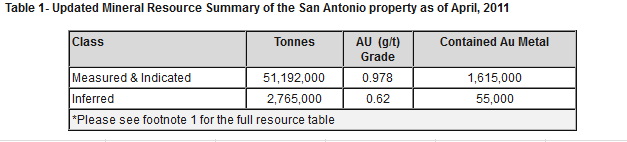
Both of these projects will have a material impact to Argonauts production profile, but the San Antonio is the bigger of the two.   Once built, San Antonio has the potential to produce 80,000-90,000 oz of gold a year at $500/oz.  The study (by AMEC) that developed that production profile was based on a resource of 1.2Moz.  Recent drilling at San Antonio has discovered an additional new zone with potential and the resource has grown to 1.6Moz.

I wrote an article the other day where I quoted from a recent Rick Rule interview.  One of the points he made was that pretty much all the PEA’s that are coming out these days are being done at $1100/oz gold.  Impressively, many of them are showing good economics at this price, but they would show much better economics if something approaching the forward strip price was used.  Most juniors are being evaluated and priced on this much lower gold price.

While Rule was referring to non-producing juniors, the same could be said for producing juniors with a pipeline of projects like Argonaut Gold.  And San Antonio  is a poster child for just that kind of valuation mismatch.

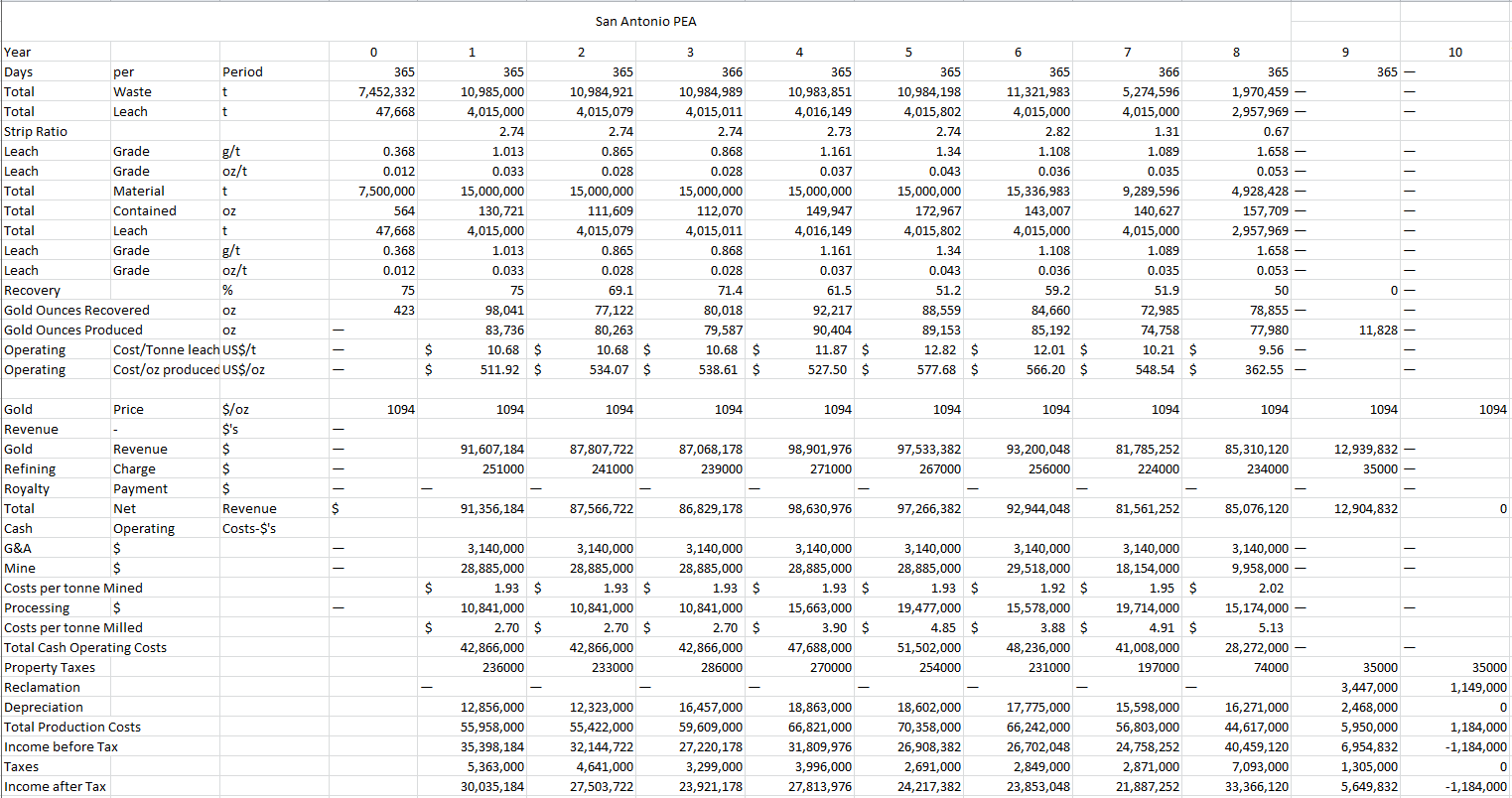
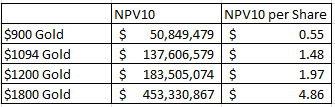
I spent a couple of hours working through the August 2010 PEA that Argonaut released on San  Antonio.  I looked at how the economics of the project would be affected by higher gold prices.  Below are the NPV10 results that I determined (the full analysis is available here).

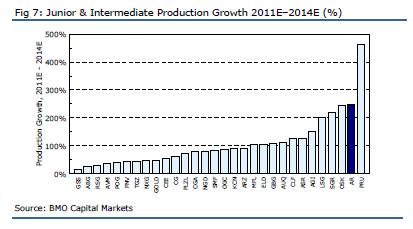
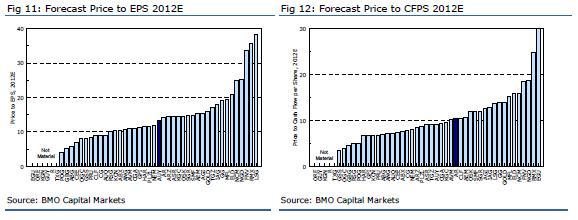
I  think you could make the argument that right now, Argonaut is getting minimal or any value attributed to San Antonio.  The stock is trading on par or at a discount to peers based on metrics of current production, when those peers have nowhere near the growth profile that Argonaut has.

This is particularly perplexing, I would say, given the relatively low capital cost associated with bringing the mine into production.  Below is where Argonaut sits on an earnings and cash flow basis in the BMO universe.

And San Antonio is not the only growth opportunity that Argonaut has.  La Colorada is smaller, and it seems like the company is still trying to get a firm understanding of the mineralization, but the project does boast over 600,000 oz of resource, and there was mention made that this probably exceeds 750,000 oz now with the recent drilling. As I mentioned already, a mine can be built at La Colorada for the paltry sum of $25M.

It looks like La Colorada has a bulk tonnage deposit at about 1g/t, but with a couple thin but very high grade veins fairly close to surface.  There should be a new resource estimate on La Colorada coming out shortly.  The advantage of La Colorada is that it is a past producing mine, so it is fully permitted and partially developed.

Together the two projects will cost about $90M to bring into production.  Argonaut should be able to generate in the neighbourhood of $70M cash flow from El Castillo if gold prices stay around these levels.  Thus, Argonaut should be able to substantially  grow its production with little, if any, share dilution.

The key to this though will be El Castillo. El Castillo is an extremely low grade (0.33g/t) heach leap mine, also in Mexico.  Argonaut has been very successful at producing fairly low cost ounces (~$550/oz) at El Castillo.

I have to admit that the low grade ore at Castillo scares me some.  Such low grade leaves little margin for error.

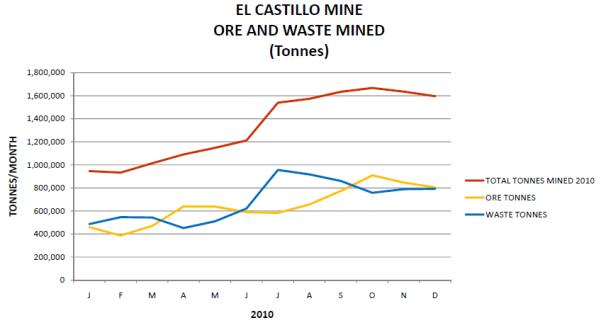
The reason Argonaut can mine cost effectively with such low grades is because the deposit has a very low strip of less than 1.  I grabbed the following screen capture from a presentation on El Castillo.

If you were to extend the graph into 2011, the strip would be even lower.  In Q1 the strip was 0.88 and in Q2 it was down to 0.78.

During the Denver Gold Show presentation management went on to point out that the mine plan should allow them to lower the strip further in the coming yeasr.  The strip ratio is expected to drop further as they progress deeper into the pit.  The company has also recently built a processing facility on the east side of the mine.  This should not only expand capacity, but it will help reduce costs.  One of the biggest expenses in a low grade mine is the transportation costs.  Having processing on either side of the pit should help reduce those costs.

When you put it all together you have a company with decent positive cash flow trading on reasonable metrics and with a tremendous growht profile that can be funded without dilution.  It seems like a reasonable investment to make as long as the fundamentals remain in place for gold to stay at these levels.

Rick Rule Agrees!

One Sunday I wrote a post describing why I am remaining bullish of gold mining shares.  Nervously, I have stuck by my premise that many factors are aligning in favor of the gold mining stocks, and I have added to my position in the last two days.  Tuesday was nerve wracking, and there were a few hours where I wasn’t sure if the market would ever stop falling, but I tried to look past the immediate carnage and capitalize on some of the opportunities I saw.

To that end I bought new positions in Brigus Gold, Aurizon Mines, and added to my position in Atna Resources.  I now own a basket of mid-tier producers.  I hold them nervously, but I still firmly believe that the factors I laid out on Sunday.

Today I found out I am not the only one.  Rick Rule did an excellent interview with James Pulplava on September 28th where he laid out the bullish case for gold mining shares.  He stated a lot of the same reasons that I outlined myself.  On top of these though, he added a few more catalysts that should contribute to a favorable revaluation of gold mining shares over the medium term.

  1. The project net asset values and existing project cash flows are being evaluated and valued off of much lower gold prices.  Most project pre-economic assessments are being done at $1100/oz gold, and many done over the past couple years were done at even lower prices.  As the brokerage community becomes comfortable with a higher gold price, these numbers should rise, as should the share price
  2. Senior gold producers are finally beginning to generate significant amounts of free cash flow.  Rule says that they expect the gold mining sector to generate more free cash flow this year than they have in the last 5 years combined.  Many of the small and mid-tier producers trade at discounts to the seniors, so it is reasonable to expect that senior producers will begin to take some of them over.

Rule elaborated on the first point.  He went on to say that at Sprott they had actually done the analysis on 5 non-producers  with pre-economic studies but not with feasibility studies out to see whether you could take the companies private and achieve an acceptable level of return from them.  They looked at the effects of hedging a portion of production up front with the takeover to help pay off the capital expenditures associated with building the mind.

I couldn’t help but think that one of the companies Rule likely evaluated was Lydian International.  Lydian fits the description of a company with a deposit that has a pre-economic assessment complete.  Rule has talked about Lydian before, calling them an excellent take-over candidate.   And my own analysis on Lydian showed an upside to the stock of $6/share at $1300/oz gold.  At $1600/oz gold the value of Lydian is literally multiples of the current stock price.

I also couldn’t help but think that if Sprott is performing this kind of analysis, it must be considering some sort of actions along these lines.

Rule said that of the 5 companies he evaluated there were 3 that passed the criteria.  Some other companies that I could see being include in that evaluation are Trelawney, Spanish Mountain Gold, and Geologix.

All companies I will have to keep an eye on.

Crisis-Weary and I Why I still own some Gold Stocks

I’ve gotten tired of reading about Europe and sovereign debt and under-capitalized banks.  I think I have read all I need to know to be able to make the decisions I have to make.  I’ve already gotten out of most everything but my very core positions, with those being a couple of oil companies, a special situation REIT, and a few gold stocks.

Its the gold stocks that I am most interested in understanding better.  While the gold stocks, particularly the junior and mid-tier one’s, performed terribly last week, I remain somewhat suspicious as to whether this under-performance can be maintained.

The gold stocks have a few tail winds in this environment that very few other stock groups have:

  1. The price of the commodity they sell has risen dramatically in price.  Keep in mind that at this time last year we didn’t even have $1400/ox gold.  Many of the stocks I am investing in are trading at valuations cheaper than they were at that time.
  2. The costs of production and the costs of construction have come down and, if this is going to turn into a recession, likely will continue to come down.  This goes not only for oil, rubber, steel, but for labor too, as in most mining districts gold companies are competing with the gambit of base metal producers that will be less able to bid up for workers
  3. For gold companies operating outside of the United States, in particular those in emerging economies like Brazil and Mexico, the currency headwinds that they have faced have subsided, and these companies should be able to enjoy falling cash costs in USD.
  4. As I have said ad nauseum, the likely endgame for the euro-crisis remains likely to be the end of the euro.  It is hard to imagine how the traditional store of value will not do well in an environment where the second largest currency ceases to exist in its present form.

So with those points in mind, and being somewhat euro-ed out from the past weeks of non-stop reading, I sat back this weekend and listened to conference calls and presentations from gold companies.  There were a few that piqued my interest, many that provided nothing new, and a few that stood out.  I’m going to spend the next few posts, which I will put out over the next few days hopefully, talking about 3 companies that stood out for me:

  1. Argonaut Gold
  2. Atna Resources
  3. Jaguar Mining